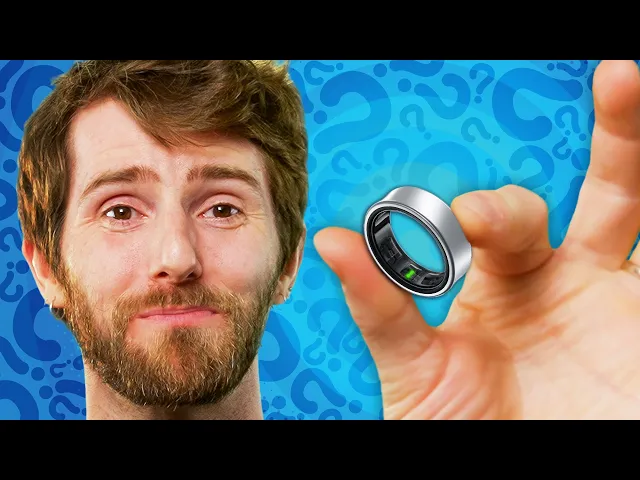
Why You Shouldn't Trust Your Smart Ring
Techquickie
0:00 Like the thirsty cast members of The Bachelorette,
0:03 Samsung Aura and, if rumors are correct,
0:06 [music] Apple all want to put a ring on it.
0:10 And why not?
0:11 The promise of a smart ring is undeniably sexy.
0:14 A screen-free titanium hoop that tracks your vitals 24/7.
0:18 Who wouldn't want it?
0:19 But, like a reality TV marriage,
0:22 buying a smart ring is sometimes followed by regret.
0:26 If you've ever wondered why your smart ring thinks you were napping
0:29 while you were working and yet misses your PR at the gym,
0:32 that's because, turns out,
0:33 shrinking an entire lab's worth of equipment down to the size
0:36 of a piece of jewelry requires some serious engineering compromises.
0:40 Compromises that could be fat-fingering your biometric data.
0:44 Let's break these devices down, starting with the main sensor.
0:47 [music] PPG, or photoplethysmography, is a fancy name for shining light
0:52 into your skin and measuring how much bounces back.
0:55 In a hospital, they'll clip a sensor onto your fingertip,
0:58 yield transmissive PPG.
1:00 It's incredibly accurate because the signal is unobstructed.
1:03 Smartwatches, on the other hand, use reflective PPG,
1:06 where the sensor and the photodiode are on the same side.
1:09 Fun fact, by the way,
1:10 they use green light because your blood absorbs it like a sponge,
1:14 providing a high-contrast signal.
1:16 Depending on, you know, how far apart your photodiode is,
1:20 if it's, say, on the curvature of a ring,
1:22 you may actually kind of be between these modalities,
1:24 where you're somewhat like in a transflective approach.
1:28 You may see behavior of both like a reflective and a transmissive PPG.
1:31 Smart rings can occupy a weird middle ground.
1:34 Because the sensors wrap around your finger,
1:37 light travels further through your skin than it would from a smart watch.
1:40 This gives the ring a slight signal advantage,
1:43 but it's one that unfortunately gets dragged down
1:46 by the constraints that arise from its size [music] and from its battery.
1:51 The amount of light you need in order
1:53 to measure an appreciable pulse is proportional
1:56 also to the active area of the photodiode that you're using to sense it with.
1:59 So, a bigger photodiode, a bigger sensor, means you can use less light,
2:03 less current, in order to perform the same relative measurement.
2:07 If you only just shrink the photodiode itself,
2:09 you're going to be decreasing your your signal-to-noise
2:12 ratio and have to, you know,
2:14 boost your LED light in order to accommodate for that.
2:17 You can think of it kind of like listening to a conversation in a crowded bar.
2:20 A smartwatch stands next to a person with a large, directional microphone.
2:24 A smart ring, on the other hand, is trying to hear them from across the room
2:27 using a tiny little spy mic taped to their collar,
2:31 which brings us to the battery.
2:32 The Samsung Galaxy Watch Ultra packs 590 mA hours.
2:38 [music] The Galaxy Ring, 17 to 22 and 1/2.
2:42 And yet, the ring claims it lasts for up to 7 days.
2:46 How?
2:47 Well, because it doesn't.
2:49 Both devices use duty cycling to extend their usable charge time,
2:53 but because the watch has a larger battery,
2:55 one intense session isn't going to drain it.
2:57 The ring, on the other hand, has about the battery of a Cheerio.
3:00 [music] They have also large dormant periods,
3:04 where the ring simply is not measuring at all.
3:07 And and so you can kind of think
3:08 of it as like interlacing on top of interlacing,
3:10 you know, in order to [music] make it so maybe you only measure the pulsations,
3:13 measure the heart rate, pulse ox, you know, for a minute, you know,
3:16 every 10, 15, 20 minutes, for example, in order to to keep conserving uh power.
3:21 [music] To put this in perspective,
3:22 when the Franklin Research Lab built their own DIY smart ring,
3:26 the battery gave out after about 4 to 6 hours of continuous use.
3:30 So, if we take that as a baseline for true continuous tracking,
3:34 to survive a full 168-hour week of nonstop data collection,
3:38 you'd need to wear 34 rings and swap them out like ammunition magazines.
3:43 By Wednesday, you'd look more like the Divination
3:46 instructor at Hogwarts than like a fitness enthusiast.
3:50 [music] The reason that smart ring bands can claim a week while Dr.
3:52 Franklin gets only 5 hours [music] is the sampling rate.
3:56 When a researcher says continuous, they usually mean high-frequency sampling.
4:01 When a consumer wearable says continuous, they often mean,
4:05 "Ah, we check in every now and then,
4:07 and then we interpolate a bit so the graph looks like
4:09 a solid line." And if you have a darker skin tone,
4:12 the LEDs actually have to work harder to get a readable signal,
4:15 which can cut that already slim battery life nearly in half.
4:18 [music] Now, that isn't to say that the form factor has no benefits.
4:22 There is a reason that hospitals clip sensors onto your fingers.
4:25 They are densely packed with arteries that are
4:28 right close to the surface of the skin.
4:30 But for smart rings, that's kind of a double-edged sword.
4:32 Besides being so darn cute and, [music] you know,
4:35 fingery, fingers are your body's temperature control meat sticks.
4:39 When you have vasoconstriction or dilation uh due to being
4:43 cold or due to, say, being in a sauna,
4:45 that will, again, change the distribution of blood
4:48 within the skin and impact your photoplethysmography signal.
4:51 Typically, vasoconstriction or having that blood
4:56 redistributed away from the surface
4:57 of the skin can have a detrimental effect on the PPG.
5:00 So, it'll decrease your pulses, it will decrease your signal-to-noise ratio,
5:04 and then the opposite is true when you have perfusion.
5:07 Cold hands equals a weaker signal,
5:10 which equals your ring struggling to find your pulse.
5:13 Lock outside in the winter or sit next to an aggressive air conditioner,
5:16 and your ring huh might think you're a spooky vampire with no pulse.
5:21 Or Sam Altman.
5:22 Unlike the finger, the wrist sits closer to the body's core,
5:26 [music] staying warmer and maintaining more consistent blood flow,
5:28 giving the watch a natural edge in colder environments.
5:31 But hey, I mean, if sitting still in a freezing room isn't your only hobby,
5:35 what about if you actually exercise?
5:37 Even a simple jog is going to slosh
5:39 your blood around enough to give the sensors a headache.
5:42 But for hand heavy lifting, the ring becomes basically decorative.
5:46 See, the problem isn't just motion, it's grip.
5:48 Odoo, your business doesn't need different apps for signing agreements,
5:53 running a POS, doing inventory management, or running email marketing.
5:57 All you need is Odoo.
5:59 It's a business management software with just about anything
6:02 you could imagine needing integrated into a single platform.
6:05 It's customizable and built to be easy to navigate since
6:08 you pick and choose only what you need, no extra fluff.
6:12 And if you only need one app, it's free.
6:15 Use our link for a free 15-day trial with no credit card required.
6:20 When someone tightly grips a steering wheel or a barbell,
6:23 we typically call this motion artifacts.
6:25 At the uppermost level of your skin, you have a capillary bed,
6:28 and when you apply pressure to this, that's
6:29 the first layer that actually gets compressed.
6:31 And so you end up with a a large spike in your photoplethysmography signal.
6:34 That's not attributed to your pulsations or your heart rate,
6:37 which is the thing we want to measure.
6:38 These motion artifacts and pressure-induced
6:40 [music] signal loss hit simultaneously, and they compound fast.
6:43 White-knuckling a barbell squeezes blood out of the very
6:46 capillaries the ring is trying to read.
6:48 So, by the time your heart rate has climbed to 160 beats per minute mid-set,
6:52 the ring might be reporting a breezy 80.
6:54 A quick TechQuickie safety tip, by the way,
6:56 wearing a metal ring during heavy lifts is not a good idea.
6:59 Beyond scratching the finish of your ring,
7:01 you're actually risking a degloving accident.
7:03 Seriously though, do not Google that.
7:04 The standard way to deal with motion
7:06 artifacts is to cross-reference the accelerometer data.
7:09 If motion exceeds a specific threshold,
7:11 then the PPG data just gets discarded entirely
7:14 because a gap is better than a wrong number.
7:17 A 2024 study even found that you might need to discard up
7:20 to 70% of heart rate variability readings due to poor signal quality.
7:25 To combat this data trashing, researchers are working on transformer-based AI
7:29 models to reconstruct corrupted PPG signals.
7:32 So, the sensor's tiny, the battery prevents continuous tracking,
7:36 cold hands kill the signal, gripping blinds it,
7:38 and most of these rings aren't even FDA-regulated medical devices,
7:42 making them pretty much high-end accessories with an asterisk.
7:46 So, are they an overpriced piece of e-waste?
7:49 Actually, no.
7:50 There is one time of day where almost all of these problems disappear, [music]
7:54 and that's during sleep.
7:55 Unless you're David Goggins,
7:57 you're probably aren't gripping a barbell in your sleep,
7:59 so your hands are relaxed and your arteries are right at the surface.
8:02 Smart rings can get incredibly accurate resting data while being
8:06 far more comfortable to sleep in than this darn thing.
8:10 Aura even boasts about their .999 correlation with medical-grade
8:15 ECGs for resting heart rate, which checks out.
8:17 Even with a few misbeats, basic average is easy.
8:20 Their .984 HRV correlation claim, however, has a massive catch.
8:24 Heart rate variability measures
8:25 millisecond differences between individual beats,
8:28 and it needs [music] beat-to-beat continuity.
8:30 So, a gap in the data doesn't just reduce accuracy,
8:33 it invalidates the entire measurement window,
8:35 which is why smart rings filter out low-confidence data before reporting.
8:39 To legally be able to claim this HRV accuracy,
8:42 many validation studies use sedentary participants.
8:45 In one, no subject's heart rate broke 90 beats [music] per minute,
8:49 so it's kind of easy to be accurate when your user's just vibing on the couch.
8:53 As for the high-level scores, like sleep score, readiness,
8:56 and stress, those are proprietary algorithms that arguably don't mean much.
9:01 It's kind of a way of gamifying your sleep
9:03 to see who [music] can have the most readiness,
9:06 I suppose, and to help you justify your $5.99
9:08 monthly subscription for the rest of your life.
9:10 If you want to see the testing facilities that smart wearables, like rings,
9:13 are designed in, check out this video where I visited one in China.
9:16 It's actually, for all of the dunking on these devices that we just did,
9:20 a lot more elaborate and way cooler than you might think.