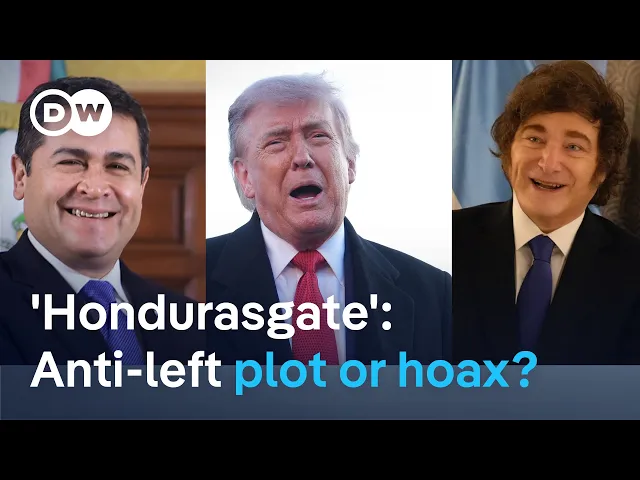
Plot against the left? Conspiracy claims shake Latin America | DW News
DW News
0:00 It's being called Honduras Skate,
0:02 an alleged right-wing plot to overthrow leftist leaders in Latin America.
0:06 The idea to set up a platform
0:08 to create and spread fake news against certain administrations,
0:11 in some cases using state funds.
0:15 Leaked audio recordings point to former
0:17 Honduran President Juan Orlando Hernandez,
0:19 Argentina's populist leader Javier Mille,
0:22 and US President Donald Trump as the main players involved in the plot.
0:26 And these are their alleged targets.
0:29 the administrations of Mexican leader Claudia Shinbal, the head of Brazil,
0:33 Luis Enasio Lula Dilva, and Gustavo Petro, Colombia's president.
0:39 For a bit of context, this is Hernandez being sworn in for his second
0:42 term as Honduran president in 2018.
0:45 He and members of his family were subjects
0:47 of a major drug trafficking investigation by US prosecutors.
0:51 Proceeds from drug sales were allegedly used to help elect him.
0:55 And then in 2022, Hernandez was arrested and extradited to the United
1:00 States where he was convicted and sentenced to 45 years in prison.
1:04 President Donald Trump pardoned Hernandez in 2025.
1:09 Hernandez was pardoned just days before an election
1:11 in Honduras that brought the country's current president to power.
1:15 Nasri Azura here is he is seen taking the oath of office in January.
1:20 During the campaign, Trump publicly backed Aswora,
1:23 saying US financial aid to Honduras could be
1:25 suspended if Asura did not win and become president.
1:29 Aswora was declared winner by a razor thin margin
1:32 after fraud allegations and a 3-week wait for official results.
1:38 So, let's listen to just one of the audio recordings
1:40 to give you a taste of what this is all about.
1:42 It's taken from an alleged conversation
1:44 earlier this year between Asura and Hernandez.
1:47 Let's have a listen to what Hernandez had to say.
1:53 We're going to set up a cell, Mr.
1:55 President.
1:56 From here, from the US, an information cell,
1:58 so they can't track us there in Honduras.
2:01 It's going to be like a Latin American news site.
2:04 I was on a call with President Harvey Malay,
2:07 and it was successful, very, very good.
2:11 And I think at this point, we can do great things for all of Latin America.
2:16 There are some cases coming up against Mexico,
2:19 Colombia, and most importantly, Honduras, Honduras.
2:29 Journalist Fritz Pino joins us from San Pedro Sula in Honduras.
2:33 So, there are a lot of moving parts here.
2:35 Help our viewers understand what exactly
2:37 are the allegations against Juan Orlando Hernandez.
2:42 So, Juan Orlando Hernandez is currently allegedly uh kind of master
2:49 planning and organizing a right-wing kind of um process of like
2:54 collusion and uh campaigns of disinformation and kind of rallying
3:00 supposedly rallying a lot of his right-wing uh allies into um
3:04 this coalition through which to also persecute and and attack
3:09 um leftwing political enemies through
3:13 this information and through different campaigns
3:15 even all the way to uh supposedly having conversations a conser
3:20 conversation with a former general about having political opponents disappeared.
3:26 So that's currently what's on the table in these alleged uh voicemails.
3:32 These allegations rose after a series
3:34 of tapes and audio recordings were leaked online.
3:37 How exactly did investigators gain access to these recordings?
3:40 Do we know?
3:43 And this is exactly Yeah,
3:45 this is exactly why it's really hard to currently to speak
3:50 about this because we there's no information of how these were obtained.
3:54 Um, allegedly they were obtained from WhatsApp, Signal and Telegrams.
4:00 Um, but there's no information on how that happened.
4:04 Um, so that there are about 37 audios that have been uh released,
4:11 but um between January and April of 2026 and on their page on Honduras Gate
4:18 on their the official page of Honduras
4:20 Gate um they were supposedly analyzed by Fonexia,
4:24 which is a Czech company um used by different
4:27 law enforcement um forensic teams in over 60 countries.
4:31 They say one of them is actually Germany.
4:34 Um, however, it is published in an outlet that is maybe two to three years old.
4:40 It's not very wellnown.
4:42 So, it's kind of the question there
4:44 is why why publish something so groundbreaking
4:49 with an outlet that's very not very known
4:51 and very new and very green in that sense.
4:55 And it does say it was supported
4:57 by a group of investigative journalists from Honduras.
5:00 Um, I'm here.
5:02 I've um I've asked my colleagues and everyone I basically know,
5:06 how have you worked on this?
5:08 And also some of the the best well-known or yeah,
5:12 best investigative journalists we have here in Honduras.
5:15 Nobody's worked on this.
5:16 Nobody knows who worked on this.
5:18 There's no information of how this was obtained or who obtained it.
5:22 Um, so and also on top of that, the text on the page there seems AI generated.
5:27 So, we don't really know a lot what's going
5:29 on or where or we can't really verify this.
5:32 So, everybody's also being very careful about speaking about
5:35 these allegations because we just don't know at this point.
5:39 All right.
5:40 Now, the president of Mexico, Claudia Shinbal,
5:42 was allegedly one of the main targets of the disinformation network.
5:46 This is how she responded.
5:47 It's striking that Juan Orlando Hernandez,
5:50 who was detained and taken to the United States for drug trafficking,
5:53 has been released, though his release was never fully understood.
5:56 And then these audio recordings surface.
6:00 So what exactly do you make of that statement from Sheen?
6:06 Well, first of all, it it's a bit ironic, right?
6:09 Um that someone who's that someone who's trying to make this really research
6:16 the war on drugs basically like
6:17 Trump releases someone like Juan Orlando Hernandez.
6:21 Um, so and also Shine Bomb is being put
6:24 under an enormous amount of pressure to persecute cartels
6:28 by the United States with always threatening to invade
6:32 Mexico and and basically do it do this themselves, right?
6:36 Um, so she she obviously asks why why why did this why did this happen?
6:44 And um basically when these audio recordings resurface it gives
6:49 kind of a piece of a puzzle that was unclear.
6:52 Why would why would Trump do this?
6:53 This is this is hurting his campaign.
6:55 So if these allegations are true,
6:57 what exactly does Trump hope to achieve with his support for Hernandez?
7:04 So Trump and Hernandez go way back.
7:06 uh especially because one has to really understand that um the right-wing
7:11 in Honduras and mostly Central America is not right-wing in a classical sense.
7:16 Uh they are more protecting or part of um a rightwing or more like
7:23 an opportunistic um oligarchical structure and they would
7:28 use basically any means to protect that structure.
7:32 Um so Hernandez has been extremely supportive of the US and has
7:38 also um included many and also um basically passed many different
7:44 policies that were in favor of the US rather than Honduras
7:48 in order to protect his power basically and his uh his base, right?
7:53 Um and this oligarchy alleged structure.
7:56 Um so basically by continuing to collaborate
8:01 what um basically Trump tries to achieve would
8:06 achieve in these cases um allegedly is that uh more policies in favor of the US
8:12 for example the satus which are special economic
8:15 zones um which were declared unconstitutional and um
8:20 and other policies that were in favor
8:21 of Trump and the rightwing the new rightwing basically.
8:25 So, if I understand you correctly,
8:26 we're seeing Trump attempting to expand his political influence in the region.
8:30 But according to the Honduras Gate reports,
8:32 Israeli Prime Minister Benjamin Netanyahu helped secure Hernandez's release.
8:37 What more do we know about Netanyahu's alleged involvement in the scheme?
8:44 So supposedly um Benjamin Netanyahu was involved and in the lobbying
8:49 that led to Juan Orlando's um Juan Orlando Hernandez's release from US prison.
8:57 Uh this is also a move that happened very very quickly,
9:01 very spontaneously and which has also sparked a lot of outrage here in Honduras.
9:07 This was right before the elections.
9:08 This happened 3 days around about before the elections.
9:12 um with Trump announcing a pardon
9:15 and these alleged voicemails con would basically they alleged
9:19 that Benjamin Netanyahu paid and kind of lobbyed
9:23 and coordinated the release of Juan Orlando Hernandez.
9:26 Juan Orlando Hernandez did have in his during
9:29 his presidency a very strong relationship
9:32 with uh the Israelis and also is you was using back then um basically
9:38 also system surveillance systems and intelligence systems
9:42 from Israel for example the Pegasus system um to listen to phone calls
9:47 and intercept phones of political rivals for example.
9:52 Um, so the relationship with Honolulando Hernandez and Israel is there.
9:58 Um, and these voicemails allege an even deeper connection
10:02 and a kind of lobbying for his release though he was
10:06 convicted of uh drug trafficking um over and trafficking over
10:10 about 100 500 thou 500 tons to the US basically.
10:17 All right.
10:17 Now let's take a look at the bigger picture here.
10:20 We have Trump and Netanyahu allegedly conspiring with right-wing
10:23 politicians in Latin America and targeting left-wing leaders.
10:26 Why exactly are these allegations such a big deal?
10:33 They are a big deal because on one hand
10:36 um we are entering this age of a disinformation war.
10:40 one could say um these voicemails could be
10:45 um disinformation um but also if they're true,
10:49 we're talking about a completely different type of war
10:52 that the new rightwing is waging using disinformation as a weapon.
10:57 Um so this is this is something completely new that we we're having right now.
11:02 But also looking at these voicemails,
11:06 it kind of seems we're slipping back into uh
11:09 the 80s and the '9s where people were
11:12 very scared basically uh where left-wing politicians or any
11:17 type of government opposition was were hunted down,
11:20 they were disappeared or they were targeted.
11:22 So this is kind of scooping back into that era and the worry that we're having
11:28 this resurgence of basically persecution of opposition.
11:32 Latin America has often been the target of disinformation campaigns.
11:36 Is this a case of nothing new here or is
11:38 this a different kind of interference to what we've seen before?
11:44 This would be definitely a level up.
11:46 Um we this has in this case not really happened in that specific form.
11:52 disinformation is not new to the region.
11:55 Um, also in Guatemala, for example,
11:57 there are a lot of these troll farms or information farms where they actually
12:03 have people pay to to basically be
12:06 online and basically troll their political opposition.
12:10 Um, and that's that is not new.
12:12 But what is new is either if these voicemails
12:16 are fake that this level of you know
12:19 sophistication in developing this type of uh this level
12:25 of disinformation or if there are true you
12:27 know the the type of collusion that is
12:29 happening on the right wing um the Latin American
12:32 rightwing backed you know by by the US
12:35 and Israel to create this coalition to develop this information.
12:39 So, we're at this new era of this information
12:42 and also people just have a hard time nowadays believing information.
12:47 This is why it's so these voicemails are
12:51 so controversial because in the time of AI, we just don't know if this is real.
12:55 We just can't tell.
12:56 And we're so at this at the brink of this that we just don't know.
13:01 Can can voices be developed like this in AI?
13:04 They sound kind of weird.
13:05 Well, it's also been tested with a system
13:07 that uses AI and that confirms that it's not AI.
13:10 So, it's just this uncertainty that's being currently developed and it's
13:14 going far beyond the classical disinformation
13:16 campaigns that for example were used, you know, like controlling television.
13:21 Juan Orlando was very was famous for actually
13:24 paying journalists back in his days to to basically
13:28 either not report on some corruption schemes
13:30 or to to hunt like to target his political opposition.
13:34 This was all known back then.
13:36 But using AI and using these type of tools and with these tools present,
13:40 this information has become a whole new monster that um has to be tackled
13:45 in this region and that is very not very known in this region yet.
13:49 And you've uh brought us right to my last question.
13:51 Do you expect there to be any real world consequences
13:54 from these allegations and from Honduras as we've seen so far?
13:59 So currently it's kind of dormant.
14:02 um not even well some of the political opposition
14:05 some of the leftist opposition have talked about this I'm
14:08 very sure um there everyone's on the left on the opposition
14:12 is on alert in the case that these are real right um if they are real and we're
14:18 talking about it in hypothetical terms we just you know
14:20 this would be a big issue that we're we're
14:23 not doing something about this but um I think it
14:27 is more of an alert but everybody is still
14:30 kind of waiting for a moment to when will there
14:33 be someone who can verify this right when will
14:36 we know and as soon as we know either it's
14:39 real or it's not real the reaction will be very
14:41 different so the journalists I've been talking to my colleagues
14:44 here in Honduras many have basically a pre-written text
14:48 that they answer to to whatever email we receive because
14:51 we receive a lot of emails you know also
14:53 from organizations from institutions um you know or or or experts
14:57 that say look man this is happening you know we have to talk about this and so
15:00 on and so on and um I think basically we
15:03 all have a pre-written text of like wait we have
15:06 to wait this we have to wait first until we
15:08 know more right so I think there's not really we
15:12 don't really know how what will happen we know
15:14 it did have an impact that people are moving
15:16 that people are responding and reacting to this but I
15:20 think the biggest wave of reaction of like the biggest
15:23 kind of impact it will have is as soon as we
15:25 have a way to actually verify this and that we
15:28 can confidently say especially us as journalists confidently say
15:32 this is real or this is not real, right?
15:34 And one way or the other,
15:35 we know that we have a problem of disinformation here in the region
15:38 and a new kind of that there's a new weapon out there,
15:42 you know, and that is AI that can be used for disinformation.
15:46 That was journalist Fritz Pino in Honduras.
15:48 Thank you very much for helping us
15:49 find our way through this very complicated issue.
15:53 Thank you.
15:55 So, what's your impression of Honduras Gate?
15:57 Leave your comments below.
15:59 If you like this video, please hit that like button.
16:01 And if you haven't already, don't forget to subscribe.
16:03 I'm Aaron Tilton.
16:04 Thanks a lot for watching.