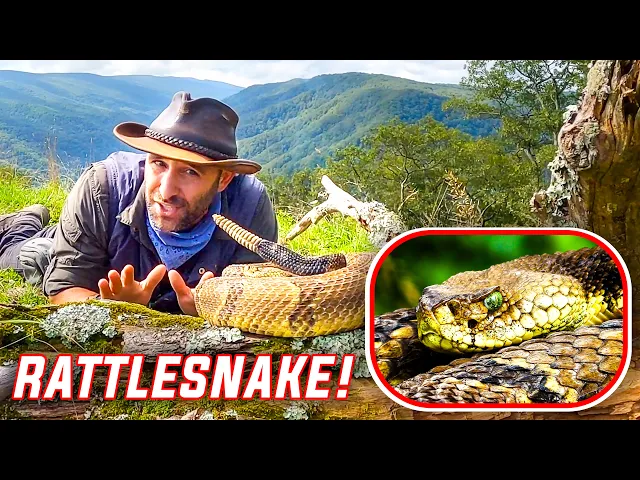
Craziest Cold-Blooded Catches of Coyote's Career!
Brave Wilderness Top Videos
0:00 I'm coming.
0:00 I'm coming.
0:01 I'm coming.
0:01 Whoa.
0:02 Holy mackerel.
0:02 That is
0:04 here.
0:04 Hold the paws here.
0:06 Drop.
0:06 Drop.
0:06 Drop.
0:06 Drop.
0:06 Drop.
0:07 Drop.
0:07 Now, I didn't want to let go of it.
0:09 Oh, I didn't know I let go.
0:11 There's an old saying, if at first you don't succeed, try, try, and try again.
0:18 When it comes to featuring the elusive timber rattlesnake,
0:22 this saying seems to be our team motto.
0:27 Oh my gosh.
0:29 The terrain that we traverse looking for rattlesnakes is
0:33 a challenge unlike anything we've really ever done before.
0:36 And this is our third venture out looking for timbers.
0:39 And it never gets any easier.
0:42 That sun is really beating down on us.
0:44 You can see all this distance down behind me.
0:47 These mountain sides are what we essentially scale looking for.
0:51 These perfect clusters of rocks where the snakes will be out and sunning.
0:57 It takes a toll on your body, that's for sure.
1:00 I'm going to catch up to Tim and Mario.
1:02 This hike is definitely testing our will to find these snakes.
1:09 Today, we have gained special permissions
1:11 to explore what is known as a rightaway
1:14 that was built several years ago during the insertion of a natural gas pipeline.
1:19 Upon initial installment, this type of construction would have had
1:22 an adverse impact on the local wildlife.
1:25 Yet beyond construction, it has become an ideal habitat for many species.
1:31 Insanely steep, brush covered, and strewn with a jumble of various rock sizes,
1:37 this is now the perfect safe haven for our sought-after target,
1:40 the timber rattlesnake.
1:46 Wow.
1:47 I mean, we're always talking about how beautiful West Virginia is,
1:51 but when you make it to the top of a bluff like this, check out the view.
1:58 That is something.
2:00 My goodness.
2:02 Wild and wonderful West Virginia right there.
2:06 Endless miles of possible snake territory.
2:10 But are we going to find one?
2:12 That's the real question.
2:14 Once again, we have teamed up with wildlife expert Tim Brust.
2:18 You likely recognize Tim from a variety
2:20 of episodes on the Brave Wilderness channel,
2:22 but it's truly the timber rattlesnake that we can define as his specialty.
2:27 Currently, Tim has been conserving
2:28 these snakes by mitigating human snake interactions.
2:32 Simply put, he explores areas that are about to go under construction,
2:37 finds and safely moves these reptiles from the path of bulldozers.
2:41 During this process,
2:43 he also educates field crews about these misunderstood animals,
2:46 which helps to keep the snakes alive
2:48 and the humans safe from having an unwanted venomous encounter.
2:54 We are going down at a pretty considerable
2:56 angle right now in our search for timber rattlesnakes.
3:00 Now, a lot of this environment has this crumbled flat rock, right?
3:05 All of this this almost like sheetro.
3:07 So, we're lifting up these giant pieces
3:10 of rock and looking beneath them for snakes.
3:14 You hear that?
3:15 It is completely hollow underneath this rock.
3:18 And it's very big, which means there's no chance of flipping it.
3:24 But I came down and I scouted this after walking over it.
3:28 And look at this.
3:30 That right there is an absolute perfect
3:35 spot for a timber rattlesnake to be hiding.
3:37 Now, you would never want to stick your hand up
3:39 and underneath a rock like that to sift through the leaves.
3:41 A bite from a temper rattlesnake could definitely kill you.
3:44 It's just a matter of covering ground and searching, searching, searching.
3:48 The more ground we cover, the better the chances we have of finding a snake.
3:54 The Western Hemisphere is home to 32 different rattlesnake species,
3:58 and in my opinion, the timber rattler is one of the most iconic.
4:02 We have been trying for years to share the species with you.
4:06 But today, things are about to change.
4:14 So, Tim and Mario are ahead of me.
4:15 They just call out.
4:16 They found a timber rattlesnake.
4:17 Making my way as fast I can down this rocky slope.
4:20 I'm coming.
4:21 I'm coming.
4:21 I'm coming.
4:24 Okay, this is it.
4:25 We've got a timber rattlesnake.
4:27 Yes.
4:28 Oh my gosh, that snake is beautiful.
4:30 Okay, sounds like we've got two snakes.
4:32 So, what we're doing is just bagging the snake
4:34 for the moment to see if we can get the bigger one.
4:37 Got a really big snake.
4:38 Really big snake.
4:40 All right.
4:40 What do you need me to do?
4:41 Whoa.
4:41 Holy mackerel.
4:42 That is a huge snake.
4:44 It's We can't We can't here.
4:47 Hold the tongs here.
4:49 You got him.
4:50 Yep.
4:53 Watch out.
4:54 Here's the red body here.
4:55 Be really careful.
4:56 There's other snakes in the area.
4:58 So, what's happening right now is we've
5:00 got a very big snake underneath this rock.
5:02 It's a very dangerous situation.
5:03 You can see how steep it is right here.
5:05 So, we've got to be very careful.
5:06 There are also other snakes within the rock.
5:08 So, we're going to slowly peel back pieces of these rocks
5:10 and see if we can safely get this snake.
5:13 Check it out.
5:14 There are sheds of snake skin all over the place.
5:17 We have found a hot spot.
5:19 It's been quite the hike to get to this spot,
5:21 but we have finally got a timber rattlesnake.
5:23 Several are going to happen.
5:25 the other one.
5:31 Oh my god, it's a big snake.
5:34 Oh my god.
5:35 Hold them.
5:35 Hold them.
5:36 Hold them.
5:37 Wow, that is a huge rattlesnake.
5:39 Okay, do we have another bag with us?
5:43 Okay, in total, we were able to secure three snakes,
5:46 one of which appeared to be a gravid female.
5:49 This is incredibly exciting for the future of this population.
5:53 Beautiful.
5:53 And to ensure she does not get stressed,
5:56 we immediately release her back into the rocks.
6:02 Don't want to get any closer than that.
6:04 How about that, Mario?
6:05 We finally got our timber.
6:06 We got multiple timbers.
6:08 Oh my gosh, that is a good size snake.
6:11 All right, so what we're going to do is actually put the snake in a snake bag.
6:15 At the moment, it is definitely a big snake, but we can't film right here.
6:18 We have to take it to a slightly more of a controlled setting.
6:21 So, we're going to safely bag it, move it,
6:23 and then bring it back down here for the release.
6:25 When you're bagging a snake,
6:26 you always want to secure it at the back side of the bag with the snake hook.
6:35 Snakes skin.
6:36 That means this is a healthy population
6:39 of rattlesnakes that hang out in this area here.
6:42 We've hit the rattlesnake motherload, that's for sure.
6:47 With the two other snakes contained,
6:49 we begin the arduous climb back up the steep sides of the rightway.
6:54 This is a very slow and very delicate process.
6:57 Mario, are you doing okay?
6:59 Actually, I tell you what, it's really hard on the forearm.
7:02 You got to keep the snake well away from your body so it doesn't swing on you.
7:07 Snakes can bite easily through the bags and most
7:10 people aren't animated when they're transporting snakes like this.
7:12 So, you have to be very careful.
7:16 There's the snakes.
7:18 That's where we came from.
7:20 And that is where we're still going.
7:25 A lot of effort, but totally worth it.
7:39 Wow.
7:41 There it is.
7:44 the timber rattlesnake.
7:46 This is our third attempt at finding one of these reptiles in the wild.
7:51 And my goodness is this one handsome.
7:54 Now, the name timber rattlesnake comes from the fact
7:56 that you find these snakes in forested areas.
7:59 And they are cryptic.
8:00 Unless you know exactly what it is that you're looking
8:03 for, your odds of seeing one are rather pretty slim.
8:06 Unless you stumble upon it and it gives you that warning of its rattle,
8:09 you may walk right past it.
8:11 Now, as compared to the other rattlesnake species here in the United States,
8:14 I'd actually consider this species rather docile.
8:17 Their defense is always going to be to rely on their camouflage first.
8:21 If you get too close, this is exactly what you're going to hear.
8:25 That rattle going into full action.
8:27 Basically, a security system that says, "You're too close.
8:30 Get any closer and you may take a bite." You
8:33 can see how close I am to the snake right now.
8:35 Just about a foot and a half from it.
8:38 I don't want to make any sudden movements and provoke it too striking,
8:41 but it definitely senses that I'm here.
8:43 The rattlesnake is the pinnacle of snake evolution.
8:46 What I want you guys to really take a look
8:48 at are the heat sensing pits right in front
8:51 of the eye and right below the nostril that allow
8:54 these snakes to pick up the heat signatures of their prey.
8:58 Basically, all they need to do is lay and wait
9:00 as an ambush predator for something to come close.
9:03 Their tongue will flick out.
9:04 They will sense the chemicals, the smell of that prey item,
9:07 and then with those heat sensing pits,
9:09 they can hone in almost like a heat-seeking
9:11 missile and then strike out with those hinged fangs.
9:14 Remember, the fangs are like hypodermic needles.
9:17 And the second they inject that venom,
9:19 that prey item has pretty much no chance of surviving.
9:22 Now, if it's something like a small rabbit or rat,
9:25 a chipmunk, a squirrel, and it runs off,
9:27 the snake will actually follow the scent
9:29 of that prey item until it succumbs to the venom,
9:31 and then it's capable of swallowing down its meal.
9:34 And those fangs work individually of one another and they will almost
9:37 use those like grappling hooks to drag their prey backwards into their mouths.
9:41 Now the fangs are modified teeth,
9:43 but all snakes have multiple rows of teeth within their mouth
9:46 that are constantly being replaced throughout the course of the snake's life.
9:49 So as the fangs draw the prey in, the other teeth
9:52 work it back down the throat and they swallow their prey whole.
9:56 Now, as compared to other rattlesnake species in the United States,
9:59 I would say the timber rattlesnake is more ambush than it is nomadic.
10:03 They will always lay in waiting for their prey to come to them.
10:06 Any small mammals or small amphibians that they
10:09 come across within the forested environment make perfect prey.
10:13 And a snake of this size, which measures,
10:15 I would guess just a little over 3 ft in length,
10:18 is considered a fullgrown adult.
10:22 You may be saying to yourselves, Coyote,
10:23 you guys are so good at being able to come across animals.
10:26 How come it's taken you so many attempts to find the timber rattlesnake?
10:29 This species specifically has been persecuted
10:32 beyond what other rattlesnakes have even faced.
10:35 A lot of times people will come across the den which is known as a hibernaculum.
10:39 Once they see this a huge collection of snakes,
10:41 what they will do is sometimes dump concrete
10:44 or gasoline and burn these snakes or bury them alive.
10:47 So you can wipe out an entire population of snakes by doing something like that.
10:51 So seeing one of these snakes, actually several of them like this in the wild
10:54 in a very difficult reach spot is a very positive thing.
10:58 It means that the population is thriving.
11:01 Nothing makes us more excited than
11:02 to see a thriving population of timber rattlesnakes.
11:07 This is just such a cool reptile.
11:10 Now, the next most important thing that we need
11:11 to do is actually collect the biometrics of this snake.
11:14 And to do that, what we're going to do is gently get it into a snake tube.
11:19 This will put the least amount of stress on the snake
11:21 and will be the safest scenario for both myself,
11:23 Tim, and the crew to be able to handle the snake.
11:26 What I also want to do is get a more
11:28 uplose look at that rattle because when it comes to rattlesnakes,
11:31 nothing is more impressive than that defense system.
11:37 All right, snake is on the move.
11:40 All right, Tim.
11:41 So, what would you like me to do to help with this part of the procedure?
11:46 And these guys, you want to gently direct their head into the tube.
11:51 Got it.
11:52 When he goes in, just set the tube at an angle if you can downward.
11:59 Okay?
11:59 Sometimes it takes 30 seconds, sometimes it takes 20 minutes.
12:03 Grab, grab, drop, drop, drop, drop down.
12:05 Quick, quick, quick.
12:08 I'm pushing them.
12:09 Push.
12:10 There you go.
12:12 Two on the tube.
12:13 Two on the snake.
12:14 Woo!
12:15 That was not easy.
12:17 Wow.
12:18 That is a powerful snake.
12:21 My goodness.
12:22 With the snake safely tubed,
12:24 Tim and I are able to quickly collect the biometrics,
12:27 which include the snake's total length,
12:30 scale count below the cloa to determine the reptile's sex,
12:34 and finally, a rattle button count.
12:37 This doesn't tell us anything specifically scientific.
12:40 It's just cool to compare rattle sizes.
12:43 That rattle is one of the most unique aspects of this snake.
12:47 And the rattle itself is actually made out of modified scales.
12:51 You can actually see the way that it's growing
12:52 out of the tip of the rattlesnake's tail itself.
12:55 Now, inside its tail are a bunch of very specialized muscles
12:58 that allow the tail to vibrate at a very high rate,
13:01 which causes the rattle to actually rattle.
13:03 So, I can rattle it myself like that.
13:06 Or if I let go of those muscles, the rattlesnake will rattle it on its own.
13:11 Now, the rattle is made out of something known as keratin.
13:14 the same material that the scales are made out of and the same
13:16 thing that your hair and your fingernails are made out of.
13:19 People always want to know, well, what's inside the rattle of a rattlesnake?
13:23 Truth be told, nothing at all.
13:25 They're actually interlocking segments that are hollow.
13:28 They're known as buttons, and when they vibrate against each other,
13:31 that is where you get the rattling sound.
13:35 Now, you cannot tell the age of a rattlesnake by the number of buttons.
13:39 People often think that like the rings of a tree,
13:41 if you count those buttons, you can tell how old the snake is.
13:43 That is not true because throughout the course of the snake's life,
13:46 it can lose segments of its rattle.
13:48 But a new button comes into place every single time this snake sheds its skin.
13:54 Now, this snake here has 1 2 3 4 5 6 7 8 9 10 11 12 13 buttons on that rattle.
14:03 Honestly, this is the largest rattle I've ever seen on any
14:06 of the rattlesnakes we have featured on the Brave Wilderness channel.
14:09 Truly a unique aspect of this snake's evolution that makes it
14:14 so incredibly distinct as compared to any other snake around the world.
14:19 Well, how cool was this?
14:21 Spending an unbelievable amount of time searching
14:24 for and finally finding the timber rattlesnake.
14:27 I'm Ky Peterson.
14:29 Be brave.
14:31 Stay wild.
14:32 We'll see you on the next adventure.
14:35 Together, Tim and I worked out of scene
14:37 to collect biometrics on the other big snake.
14:40 It was robust and as healthy as a rattlesnake could be,
14:43 which was a great sign for this thriving population.
14:47 No two snakes are ever the same.
14:49 And considering the timber rattler comes in such a wide variety of color faces,
14:53 it's pretty cool to see just how different individuals are,
14:56 especially when compared side by side.
15:00 Finally, we hiked back down to the point of discovery
15:03 and released both snakes into their corresponding rock crevices.
15:09 The future of rattlesnakes, and all snakes, for that matter,
15:13 is always tangled up in a series of uncertainties
15:16 that center around an unnecessary fear of these misunderstood reptiles.
15:21 Yet, it's conservationists like Tim Rust
15:24 and the tireless work he does to help people
15:26 understand the importance of these creatures that will
15:28 ensure they continue to slither across the planet.
15:32 If you're a large construction company and are
15:35 concerned for the safety of your team,
15:36 but are also cognizant of the important role native wildlife plays,
15:40 let's get these animals out of the bulldozers pathway.
15:44 Click on the link in the video
15:45 description below to contact Edge Engineering and Science.
15:50 Tim and the rest of their staff can provide
15:52 the necessary support to make sure your workers are safe.
15:55 The project's in compliance,
15:57 and the final result will be a happy balance between nature and humans.
16:09 Got him.
16:10 That might be your most epic catch of all time.
16:18 For anyone that dreams of adventure,
16:20 there's arguably no greater place on our planet than the Australian outback.
16:26 This vastly remote stretch of wilderness is the perfect place
16:29 to encounter some of the country's most recognizable animal species.
16:33 And if you are a fanatic of reptiles, this is your dream come true.
16:38 On this expedition, we are traveling nearly 300 miles from the sprawling
16:43 city of Brisbane and out toward the sparsely populated town of Neandara.
16:48 From there, we'll venture further into the bush with the hopes
16:52 of tracking down one of its largest reptilian inhabitants, the monitor lizard.
16:59 These ancient looking reptiles are rather common.
17:02 However, their elusive nature, coupled with perfectly designed camouflage,
17:06 can make them incredibly difficult to find.
17:10 To aid in this epic quest,
17:12 we have teamed up with two of the country's top reptilian enthusiasts.
17:17 Locky Gilding and Max Jackson,
17:19 who own and operate Australian wildlife encounters,
17:23 know these wild stretches of remote territory better than anyone.
17:26 And their expertise when it comes to locating monitor lizards is unprecedented.
17:31 working under their special permits.
17:33 We have one collective goal in mind.
17:36 Do whatever it takes to track down
17:38 and safely catch one of these phantom like lizards.
17:46 All right, guys.
17:47 Mondo road begins.
17:49 Keep your eyes out.
17:51 So, Max, when it comes to searching for monitors,
17:53 what is the telltale sign that we're in the right area?
17:55 I mean, what are we looking for right now?
17:57 For the sand monitors and the yellow spotted monitors.
18:00 looking for that type of soil that's not too rocky
18:02 and a bit sandy that they can dig their burrows in.
18:04 Basically, as long as they've got a place where
18:06 they can um shelter during winter and during nighttime,
18:10 only other ingredient is heat.
18:12 They really, really love heat.
18:13 So, they can be active in 35 40 plus degrees C.
18:17 So, this is perfect here.
18:21 The monitor lizard is an iconic reptile that has long been
18:24 on my wish list of animals to feature on the Brave Wilderness channel.
18:29 And this would be the first time in my life
18:31 where that wish stood a chance of coming true.
18:36 When I spring out of the car to catch a monitor, I'm going to need both hands.
18:40 So, we're going to try to get the initial
18:42 catch shot from my shoulder instead of the handheld camera.
18:46 I just know that if I'm fumbling around with a GoPro,
18:49 I stand a better chance of actually being bitten.
18:52 Let me tell you what you don't want to happen when working
18:54 with a monitor for those razor sharp teeth to slice into your arm.
18:58 It will send you to the hospital and you will be getting stitches.
19:02 So, we're going to the shoulder cam on this one, guys.
19:05 All right, man.
19:06 You ready?
19:06 Let's do it.
19:07 Monitor time.
19:13 Monitor right there.
19:14 Right there.
19:15 Turn the power on.
19:16 Yep.
19:16 Right back there up on that edge.
19:19 This is it, guys.
19:20 Okay.
19:21 Definitely monitor right up under the side of the road.
19:34 No way.
19:37 She thought he dove into here where he was going, man.
19:43 What happened, Coyote?
19:45 Well, we saw a small monitor, another one about that big.
19:49 I mean, lightning quick.
19:51 We drove past it.
19:52 Actually stayed on the road and as we got close, put its head up just like that.
19:57 Got down into a burrow.
19:59 Not a chance of catching that one.
20:02 Sprinted after that one.
20:05 Did I forget to mention that monitor lizards are incredibly speedy?
20:09 In fact, for their size,
20:11 these lizards are one of the fastest reptiles in Australia.
20:15 And after witnessing the speed of our first target,
20:17 I soon began to realize that catching a monitor lizard was
20:20 going to be a lot more difficult than I had previously imagined.
20:25 Late afternoon was creeping in as sharp beams
20:28 of sunlight cut through the trees with a blinding effect.
20:32 I could feel the window of lizard catching opportunity beginning to close.
20:36 Yet my hold on hope remains strong.
20:43 Among up ahead.
20:44 Yeah.
20:44 Right there.
20:45 Right there.
20:45 Slow down.
20:46 Slow down.
20:50 All right.
20:50 Let's go.
20:51 I'm ready to go.
20:51 Move slow.
20:52 Move slow.
20:57 Okay, guys.
20:58 We've got a monitor just in front of the vehicle here.
21:01 Going to approach slow.
21:03 Right now, it is just holding its ground.
21:14 In a flash, the lizard sprang into action.
21:17 Keeping up with a monitor lizard as it speeds
21:19 through tangles of branches and brier patches is virtually impossible.
21:23 And it was only a matter of time before one of two things happened.
21:27 Either the reptile would dive into a burrow and disappear out of reach,
21:31 or it would retreat high up into a tree, which is exactly what this one did.
21:36 See it?
21:37 Yeah, I saw that.
21:37 Oh, I see it.
21:38 It's right here up the tree.
21:40 Up the tree.
21:41 Right up the tree.
21:42 Right here.
21:45 As I peered up the trunk of the towering tree before me,
21:48 only one thought came to my mind.
21:51 Catch that lizard.
21:52 So, as I have done before, without a second of hesitation,
21:56 I began to scramble up the tree.
22:00 Careful.
22:12 might make a jump.
22:13 He's going to jump to this other section here.
22:16 He's at the end of that branch that your left hand's on.
22:18 He's at the end of that branch, man.
22:26 I've got him.
22:27 But he is locked under the end of this bridge.
22:33 Got him.
22:35 Nice catch.
22:46 That might be your most epic catch of all time.
22:49 Now the question is, how am I going to get back down?
22:53 Hold on.
22:53 I got to put it in my pocket.
22:57 Just kidding.
23:00 Hi, buddy.
23:01 All right, guys.
23:02 I've caught the monitor.
23:04 Now, it's just a matter of getting back down
23:06 out of this tree with it in my hands.
23:09 This is a bit of a precarious scenario right here.
23:16 Careful.
23:23 Bit of a scrape on my on my manberries there.
23:28 Not a problem.
23:30 I have got the lizard.
23:41 I got it.
23:49 Easy.
23:50 Go slow.
23:50 Go slow.
24:01 Woo!
24:05 Yeah.
24:04 And that is how you climb a tree to catch a monitor.
24:09 Woo!
24:10 That was epic.
24:11 That was epic.
24:12 A bit out of the range here.
24:15 Oh man, that was amazing.
24:19 I told you guys I was going all in to catch one of these lizards.
24:24 Wow, that's a sand monitor right there.
24:28 The Gul's sand monitor.
24:31 The quintessential goana.
24:34 Let me catch my breath, guys.
24:39 Wow, man.
24:43 One more high five.
24:44 That was awesome.
24:45 That may be the fastest I have ever climbed a tree without branches.
24:49 And the thing that really helped me with there was all of the grippy bark
24:54 on the side of that tree and the general arked angle and my arms are ripped up.
25:00 But it was absolutely worth it to catch this reptile.
25:04 This is a sand monitor commonly known
25:06 as a goana and it is an ancient looking creature.
25:11 I have dreamed about being able to get
25:14 one of these reptiles up close for the cameras.
25:17 Now, they do get significantly bigger than this, but you
25:21 can't really top a catch of that magnitude.
25:26 Wow.
25:27 I just have to take a second to absorb in the beauty of this reptile.
25:32 Look at that skin.
25:34 Little tiny scales in all that speckled patterning.
25:38 Now, I know in the past I've compared some lizard species to dinosaurs.
25:41 Now, as we know, dinosaurs evolved into birds,
25:43 and a lot of times you guys call it, but coyote lizards aren't really dinosaurs.
25:47 No, they are not.
25:48 But they are so similar in design.
25:50 Just look at the head of that creature.
25:53 I feel like I am looking at a velociraptor right now.
25:56 That long neck and those intelligent eyes.
25:58 And I'll tell you what, these creatures are intelligent.
26:02 Almost problem-solving intelligent.
26:04 Now, all monitor lizard species have a forked tongue.
26:07 That fork tongue helps them navigate their environment
26:10 and also to find and detect their prey.
26:13 And when it comes back into their mouth, similar to a heel monster,
26:17 they have what's called a Jacobson's organ in the roof of their skull.
26:20 And as the tongue runs over that organ,
26:22 it tells them almost like a little computer,
26:24 your food is this way or your food is that way
26:27 or something is getting close in your environment that you should flee from.
26:30 Typically, you won't find sand monitors climbing trees.
26:33 They're a terrestrial species.
26:34 But in an instance like that where it's evading a predator,
26:37 if a tree is the best way to escape, that's exactly where it is going to go.
26:42 Wow, look at those front forlims.
26:45 Can you guys see those claws?
26:47 Razor sharp.
26:48 Almost like the talons of a bird of prey.
26:51 And they have grappled onto my arms in several different places.
26:55 I'm actually really happy that I wasn't sliced up more than I have been.
27:00 These creatures are voracious predators.
27:03 They will eat pretty much anything.
27:05 They will eat small rodents.
27:06 They will eat insects, arachnids, other lizards,
27:09 eggs, and they will even eat dead animals.
27:11 So, a lot of times you will see
27:12 these lizards out on the roadsides feeding on dead carcasses.
27:16 Whether it be an emu or a kangaroo, that is fair game for a creature like
27:20 this to just dig into those guts and have a feast.
27:23 And this is one healthy lizard.
27:26 Let me turn it upright like this for you so you can see its back.
27:30 And it is just holding on to me about as tight as I am holding on to it.
27:35 Look at that.
27:35 Locked in place.
27:37 And there is so much muscle structure
27:39 in the tail and the center of this animal's body.
27:43 This is a male, a young one.
27:45 They can grow substantially longer than this.
27:48 I would say it's about 3 feet in length
27:50 from the tip of its nose to the tip of its tail.
27:52 Look at that coloration.
27:53 You see all the yellow speckling along the sides
27:56 of the legs and then that yellow tip of the tail.
27:58 That's one way that you can easily distinguish this monitor as compared
28:02 to some of the other species that are out here in the bush.
28:07 Excellent eyesight under the light of day.
28:09 Excellent hearing, incredible speed.
28:11 This is an apex predator when it comes
28:13 to the reptiles that can be found here in Australia.
28:17 So cool, guys.
28:18 Can you believe that we actually caught a monitor?
28:21 I am beside myself right now.
28:24 And we have been working long and hard today.
28:26 The sun is getting low in the sky.
28:27 It couldn't be the more perfect scenario
28:29 to get this reptile up close for the cameras.
28:32 Woo!
28:32 I can't believe it, guys.
28:33 I give you high fives right now,
28:34 but I need both hands on the lizard to make
28:36 sure that it doesn't spin around and give me a bite.
28:39 This truly is one of the reptiles we hope
28:41 to get in front of the cameras here in Australia.
28:43 And we finally did it.
28:45 I'm Coyote Peterson.
28:46 Be brave.
28:48 Stay wild.
28:49 We'll see you on the next adventure.
28:51 Man, what a catch.
28:54 We faced many challenges and several frustrating defeats in our quest
28:59 to bring this reptile up close for the cameras.
29:02 Yet, it was a combination of patience,
29:04 teamwork, and sheer determination that ultimately paid off.
29:14 And there it goes, man.
29:17 The sand go Anna.
29:18 Thank you, Australia.
29:20 Woo!
29:22 The sand monitor proudly stands as one
29:24 of the greatest animal encounters of my career.
29:27 And I consider myself fortunate to have had such an epic conclusion
29:32 to the tale of my time spent in the land of lizards.
29:39 Whoa.
29:40 Jeez.
29:41 Huge water snake.
29:42 Oh, they got a green over there.
29:44 They got a green.
29:45 What?
29:45 They got a green over there.
29:46 Oh man.
29:47 Ow.
29:48 Oh jeez.
29:49 at this one angry black racer.
29:53 Today we're headed out on a snake scavenger hunt.
29:56 I'll be working alongside my friend and wildlife biologist, Will Robertson.
30:00 Say hi, Will.
30:01 Hi, Will.
30:02 This region is known for its plethora of species.
30:05 We're going to be scouring the fields, searching the forests, flipping rocks,
30:08 and rolling logs, doing whatever it takes to find some of these cool reptiles.
30:13 Will, are you ready?
30:14 Let's find some snakes.
30:24 pollen.
30:28 Oh, snake.
30:28 I think it was a garter snake.
30:29 He went down into this little hole right here.
30:32 Oh, yeah.
30:33 There's his little face.
30:34 He's right there.
30:35 See if I can tickle him out.
30:37 There he is.
30:39 Gotcha.
30:41 Whoa.
30:42 There we go.
30:43 All right, let's take a look at this one.
30:45 So, that is the eastern garder snake.
30:48 One of the coolest things most people don't realize
30:49 about garder snakes is that they are mildly venomous.
30:53 Not a venom that could ever hurt a human,
30:56 but for the most part, these are super calm, super docile snakes.
31:01 You can see that little defense mechanism right there totally flattening out
31:04 the body and almost making the head look as if it's V-shaped,
31:08 which of course would be indicative of a venomous snake.
31:11 But, as we know, the garder snake is completely harmless.
31:17 This is cool.
31:17 It's like a river of moss.
31:20 Look at that.
31:22 Now, normally you probably have water flowing down through
31:25 this spillway and towards this lake that we're getting toward,
31:30 but it's just a really unique looking habitat.
31:33 Almost like Lord of the Rings.
31:36 And it seems as if the lake might pay off
31:39 because Will just said he's got a big water snake basking.
31:43 Oh yeah, that's a nice one.
31:46 These guys are nonvenenomous, but they do bite quite a bit.
31:49 So, we'll see what this guy does.
31:52 All right, Will's got the water snake.
31:55 Oh, yeah.
31:55 Beautiful one.
31:57 And definitely a species that people often times think is venomous,
32:01 but completely harmless.
32:03 The northern water snake.
32:06 That's another one for the list, Will.
32:08 Yeah, there we go.
32:09 Looking good.
32:11 Oh, coyote, sanitize real quick.
32:14 Don't want to spread those snake fungal diseases.
32:20 Oh, red belly snake.
32:21 Oh, red belly snake.
32:23 Pretty basic looking snake except for the fact
32:25 that it has a pretty vibrant red belly.
32:28 Let's flip it.
32:31 Oh, little V.
32:33 Look at his little tunnel.
32:34 Hi, buddy.
32:36 Got an interesting little precarious scenario here.
32:39 There is a rock ledge that a black racer is up on.
32:43 I think if I drop myself down into this little hole,
32:47 I might be able to come around the edge and get it.
32:50 I see it, but it does not see me.
32:55 It's right there.
32:58 Definitely right on the edge of this cliff.
33:03 Got it.
33:06 Getting under control is going to be a whole another story.
33:08 And these snakes are really biting.
33:11 Oh jeez, that is one angry black racer.
33:17 Will got a black racer for the snake scavenger hunt.
33:23 See if I can do this without taking a bite.
33:25 There we go.
33:26 Okay, focus is on the camera at the moment.
33:31 And there we have it.
33:32 Another species for the snake scavenger hunt.
33:35 All right, Mario, I'm going to bring it up for the tight shot.
33:38 That is the black racer.
33:39 Looks like it's getting ready to shed its skin.
33:41 You can tell that from the cloudiness in the eyes.
33:44 And the thing that I love most about this species is its agility and its speed.
33:48 Not to mention the coloration is very similar to the black mamba.
33:52 But of course, this is a nonvenenomous species.
33:54 So, a bite is going to be nothing more than a little soap and water to clean up.
33:58 All right.
33:59 Watch how fast the snake is when I let it back into the environment.
34:05 Or not.
34:06 That's kind of cool.
34:07 just to get it in that that display mode.
34:09 I thought you were just going to speed off,
34:11 but instead you're giving us some incredible B-roll.
34:14 Nothing wrong with that.
34:18 Oo, look at that big ringneck snake.
34:21 That's a nice orange belly.
34:22 So, these guys spend most of their time
34:24 underground looking for things like salamanders to eat.
34:27 They're very tame snakes.
34:29 They never bite.
34:30 You can see they have tiny tiny little heads
34:33 with a prominent yellow ring right around the neck.
34:36 Double flip.
34:38 No.
34:40 Put here.
34:40 Nope.
34:41 Guess who found a hog noose snake right here.
34:44 Whale.
34:45 Oh, it's on the move.
34:47 I got it.
34:47 I got it.
34:47 I got it.
34:48 I got it.
34:48 I'll grab him up here.
34:49 Okay.
34:52 Whoa.
34:52 Wow.
34:52 A hognosed snake for the scavenger hunt.
34:55 This is a difficult one to find.
34:56 And look at that pointed nose right there.
35:01 Uh-oh.
35:01 Uh-oh.
35:02 You know what happens when they poop, right?
35:04 Yeah.
35:04 These guys are known for playing dead.
35:06 Oh my gosh, the smell is unbearable.
35:09 Wow, dude.
35:10 You are covered in poop.
35:13 Let's wipe that off.
35:14 Oh my gosh, hands.
35:23 When lifting rocks.
35:28 Swallowed a bug.
35:35 I was going to try to tell you about rock etiquette.
35:39 Back to one.
35:47 When lifting rocks, it's important to have good rock etiquette,
35:51 which means you lift a rock gently and you
35:54 place it right back exactly where you found it.
36:00 Ants.
36:01 Whoa.
36:02 Do they bite or sting?
36:03 Let's find out.
36:08 They don't really do anything.
36:09 They run away.
36:11 Not the sting episode.
36:13 Will just called out to me that he found
36:15 an abandoned car that I need to check out.
36:18 I don't know what an abandoned car would be
36:19 doing out here on the side of this mountain.
36:22 Like, how did he even end up here?
36:24 Wow.
36:24 That is what I would not be surprised
36:28 if rattlesnakes were using this old rusted car.
36:31 That's really interesting.
36:33 I mean, how did this either?
36:35 They must have rolled it down the hill and crashed it.
36:38 It' be really creepy if we found a body in it.
36:40 Not that I can see.
36:41 Just some uh bush light.
36:44 Yeah.
36:44 Don't drink and drive.
36:45 That's a good message.
36:46 Let's see if we can lift this hood.
36:48 Give it a flipperoo.
36:54 I don't see any rattlesnakes.
36:56 No.
36:56 It's worth a check, though.
36:58 Holy.
36:59 Did it spin?
37:02 Yeah.
37:01 In place.
37:04 Creepy.
37:04 There's a rat snake on top.
37:05 Oh my gosh.
37:06 There is.
37:07 Oh my goodness.
37:08 In the abandoned car.
37:10 A new species.
37:11 New one.
37:12 New one.
37:13 All right.
37:13 What do you need me to do?
37:14 I might be able here.
37:15 Here.
37:15 Here.
37:16 Let me get tangled in the engine.
37:17 Yeah, guys.
37:20 There we go.
37:21 Wa.
37:21 New species.
37:22 Wa.
37:23 Careful.
37:23 Careful.
37:25 Slipping.
37:26 Yes.
37:26 How about that?
37:28 All right.
37:28 All right, Will.
37:28 What do we got?
37:29 We've got a black rat snake.
37:31 And this is actually a small one.
37:33 Despite being a pretty decent sized snake,
37:35 these guys are the largest snakes around here.
37:37 They can get almost 8 ft long.
37:40 They eat birds and they climb right up trees to nab squirrels.
37:44 This guy is in sheds, so his eyes are pretty blue.
37:47 Unbelievable.
37:48 Awesome.
37:48 What would you say is the holy grail of snake species in this area?
37:52 I would say the green snake.
37:53 They're bright, bright green.
37:56 They look like nothing else from around here.
37:58 They're super tropical looking.
38:00 You'd never believe that they're right here in the Appalachian.
38:04 When it comes to garter snakes, we found the mother load.
38:08 A whole pile of sunning snakeies right there.
38:12 These rocks are alive with snakes.
38:13 This is perfect conditions at the moment to find a number.
38:20 Whoa.
38:21 Jeez.
38:22 Huge water snake.
38:24 Really, really big northern water snake.
38:25 All right, here.
38:26 Let's uh let's Yeah,
38:27 I'm going to need uh at least you to hold the hold the camera.
38:32 Okay.
38:31 Wow, that's a big one.
38:33 Hopefully, it just not decides to give me a chomp cuz this is good size.
38:38 Wow.
38:40 Oh, they got a green over there.
38:41 They got a green.
38:43 What?
38:42 They got a green over there,
38:44 man.
38:44 Ow.
38:45 Oh, okay.
38:45 We're coming.
38:46 We're coming.
38:51 OH, BEAUTIFUL.
38:51 AMAZING.
38:52 And that's one of the rare ones for around here.
38:54 I was walking and sure enough just saw a little
38:57 movement and reached down and got the little green snake.
39:01 Amazing.
39:02 That is the holy grail.
39:04 Uh, wow.
39:05 Okay.
39:05 Well, all in one two-minute clip.
39:09 Huge northern water snake and a smooth green snake.
39:13 Here, let me give you this.
39:14 All right.
39:14 Let me see this guy.
39:16 Oh my goodness.
39:18 Wow.
39:19 The smooth green snake.
39:21 That is the ultimate right there.
39:23 Look at that.
39:25 Big snake, little snake, cute snake,
39:28 seemingly dangerous snake, but both completely harmless.
39:32 No way.
39:34 Mario just got another green snake.
39:36 How big is this one?
39:37 Oh my gosh, it's even tinier.
39:40 Oh my goodness.
39:41 Look at that little guy.
39:44 Wow.
39:45 Oh, that is gorgeous little green snake.
39:50 Well, we did it.
39:51 Two beautiful smooth green snakes.
39:53 Now, what's your favorite thing about this reptile?
39:55 It's got to be the vibrance, hands down.
39:57 I mean, it's a bright green snake.
39:58 It looks like it came from the jungle,
40:00 but here we are in the Appalachians, and we've got it.
40:04 So, this is one of my favorite snake species as a kid.
40:06 I used to always see them in my backyard,
40:08 but they're becoming more and more scarce.
40:10 And what is the reason for that?
40:11 Well, you know, along with habitat destruction,
40:13 when people spray pesticides on their lawn, these guys eat insects.
40:17 So, if they eat insects that have pesticides on them,
40:20 well, you know what happens?
40:21 It's going to wipe out the snakes.
40:22 So, less pesticides means more smooth green snakes.
40:26 Will, an enormous thanks to you for taking us
40:29 out today and some of your favorite herping spots.
40:31 This was the ultimate snake scavenger hunt.
40:34 Make sure to check out Will's YouTube channel.
40:36 Lots of awesome videos there.
40:37 And until we collaborate on the next one, I'm Coyote Peterson.
40:40 I'm Will Robertson.
40:42 Be brave.
40:42 Stay wild.
40:43 We'll see you on the next adventure.
40:45 All right.
40:45 Smooth green snakes back into the grass.
40:49 Fish on.
40:50 Should I be letting it taking mine like this?
40:53 Yeah.
40:55 He's running.
40:57 WOW.
40:58 THERE IT JUST JUMPED.
40:58 YOU SEE IT?
40:59 It's like the size of A KILLER WHALE.
41:01 WOW.
41:02 IT is massive.
41:04 This could be the world record size fish.
41:08 Well, it's the start of a very big adventure.
41:10 We are in the middle of nowhere right now.
41:12 British Columbia is a massive expanse of wilderness.
41:16 And this river that's flowing here is the Frasier River,
41:19 and it's surrounded in lore and mystery primarily around
41:24 the sightings of what may be a prehistoric creature.
41:28 We're going to be working with two experts today,
41:30 Kevin and Maro, conservationists and anglers,
41:34 and our goal is to see if we can catch one of these supposed river monsters.
41:40 Sunshine starting to peek out.
41:41 You've got clouds lining in between the crest of these mountains.
41:46 You got the frost line up top with the snow caps.
41:49 British Columbia is absolutely beautiful.
41:53 And we're going to catch a river monster.
41:54 Ho ho.
41:55 A big river monster.
41:57 All right, the boat's getting ready to pick me up.
41:58 It's go time.
42:02 In British Columbia,
42:03 we're pretty fortunate with what we have here for fishing, right?
42:06 It's a mecca in the world for fishing.
42:08 Once I was about 14 years old and and saw one for the first time last year.
42:13 We were fortunate enough to land a fish that's 11 foot 6 and 1/2 to the fork
42:18 and uh we were pretty excited to say
42:20 the least to see something that that spectacular.
42:23 It changed my life.
42:24 Well, hopefully we catch something between 7 and maybe 14 ft today.
42:28 Kevin has the world record at this point,
42:29 but as long as we get a big fish on the line, we will have an excellent episode.
42:36 Okay, so we officially have a couple
42:38 of lines in the water and like most fishing,
42:40 now we begin the waiting process.
42:43 There's heavy weight on the end of these baits,
42:45 so it essentially stays in one spot.
42:46 We want to let the fish come to it 28 ft deep in this spot right here.
42:51 So, we're going to catch big one today.
42:57 These two here are real close to this bait here.
43:02 They're just sitting beside each other.
43:04 Just see those two?
43:08 Yep.
43:08 Hold on.
43:08 Okay, here we go.
43:09 We're getting a bite.
43:10 Oh, we might have a bite now.
43:12 It could be a smaller fish.
43:15 Uh-huh.
43:14 Or it could be monstrous and he's just
43:16 going super slow with trying to get the bait.
43:18 Right.
43:22 Oh, yeah.
43:22 Definitely pulling a little bit.
43:24 Not a big fish.
43:26 Oh, okay.
43:26 Definitely a lot more pull now.
43:29 Oh, yeah.
43:30 There he is.
43:30 There he is.
43:31 Just keep them in the water.
43:33 Oh, yes.
43:37 Wow.
43:37 Just keep them in the water.
43:38 Yeah.
43:39 Yeah.
43:41 Whoa.
43:41 That is like perfect handle and hug size.
43:45 Look at that prehistoric creature.
43:47 A little mini river monster.
43:50 Even at this size, incredible power.
43:53 You going to walk them in?
43:55 Walk them in.
43:56 Yeah.
43:57 Okay, first one.
43:59 Fish is secure.
44:00 Good job.
44:02 Oh my goodness.
44:04 Look at you.
44:06 Unbelievable.
44:08 That is the white sturgeon.
44:10 A very miniaturized version of what we're
44:12 hoping to catch throughout the course of today.
44:15 But this gives us a chance to really examine the animal.
44:18 Look at that beautiful coloration.
44:20 It almost glistens white and blue.
44:23 Now, what's unique about the body structure
44:25 of this fish is that it's very muscular.
44:27 The skeleton is made of cartilage, but the head is made of solid bone.
44:32 The snout is very shovel-nosed in design.
44:35 You see those little things dangling off the front there?
44:38 Those are the barbles.
44:39 And it's those barbles that can sense chemicals within
44:41 the environment that help these creatures search for their food.
44:44 Now, the mouth of the fish,
44:46 I'm going to lift it up just very gently like that so you can see the underside.
44:50 They have no teeth.
44:51 These are environmental vacuums and that they use suction
44:55 to bring small crustaceations and other animal into their mouths.
44:58 So they use flat raspy plates to crush down on and then swallow their prey.
45:04 They've got these distinct pectoral fins on their side
45:06 which helps balance their body when they're underwater.
45:08 But it's this dorsal fin in the back
45:10 and the tail that really makes it look like a shark.
45:13 That codual fin will often be seen coming to the surface and those are
45:17 one of the indicators that people think
45:18 that they're seeing some sort of prehistoric monster.
45:22 This fish is truly ancient in design.
45:26 And its reptilian look,
45:27 especially if that back just comes to the surface like that, shows
45:31 you why people may misidentify this animal as a mythological creature.
45:36 At this point, we want to get the fish back off and into the environment.
45:40 But this is small, 2 and 1/2 ft in length.
45:43 We're hoping to find something that dwarfs this fish.
45:46 Something that could truly be considered a river monster.
45:49 All right, buddy.
45:50 Thanks for hanging out with us and happy hunting.
45:56 For us, it's it's very encouraging to see
45:58 these fish and when you get the small ones,
45:59 they're my favorite and so it's it's great seeing them.
46:02 Yeah.
46:02 The young ones mean the next generation is growing
46:05 to become someday these living dinosaurs in a sense.
46:08 Exactly.
46:09 Well, certainly the work that you're doing to instill conservation
46:12 and education aligns with everything that we're doing at Brave Wilderness.
46:15 And if we can catch a big fish,
46:16 we'll be able to show the world just why these creatures are so cool.
46:20 Yeah, for sure.
46:20 And it'll be uh it'll be good to see, you know,
46:22 what sizes we get cuz it's kind of like a lottery out here, right?
46:25 You get little guys, you get big guys.
46:27 We don't know.
46:28 Any tips for how to bring in one of these fish,
46:30 especially if it's 7 feet or more and weighing close to 300 lb.
46:33 Yeah.
46:33 So, one thing is never let your guard down ever.
46:36 And also, if you have a little bit of a pause,
46:39 straighten out your arms rather than keep them really tight in like this.
46:43 And that'll give your bicep and your forearm a little bit of a break.
46:46 And then you got to get right back into it.
46:49 So, you see that fish on there?
46:51 I'm going to try and cast right close to him.
46:54 Yeah, it's just trailing off the back of the boat.
46:55 The big question is whether or not it's actually hungry and wanting to feed.
47:00 If we get that monster on the line, hold on.
47:13 Now we got a fish.
47:15 Fish on.
47:18 Big one.
47:20 Bigger.
47:22 Bigger.
47:21 Okay.
47:21 You're going to grab this.
47:24 And you're going to you're going to stay square to him.
47:28 Okay.
47:27 So, face him.
47:28 Okay.
47:28 Yeah.
47:29 Like that.
47:30 Yeah.
47:30 This could be a legit river monster right here.
47:32 And hold on tight cuz when he's going, he's going to go.
47:35 Yep.
47:35 So, I'm just feeling him.
47:36 Hold on, dude.
47:37 Just hold on.
47:38 Yeah.
47:38 Yeah.
47:40 Okay.
47:40 Yeah.
47:40 Yeah.
47:40 Get ready.
47:41 Hold on tight.
47:42 Don't reel.
47:42 Don't reel.
47:43 Just hold.
47:44 Just hold.
47:46 That's a strong fish right there.
47:48 Holy cow.
47:48 We definitely have a river monster on the end of this line.
47:55 Wow.
47:55 This is going to require a lot of strength.
47:56 I could tell that.
47:58 Should I be letting it taking line like this?
47:59 Yeah.
48:00 Yeah.
48:00 Let him go.
48:00 Let him go.
48:00 Just stay square to him.
48:08 This is a very, very big fish.
48:12 I use all my body weight to hold on to this animal.
48:17 Come on, baby.
48:21 Oh, boy.
48:23 Farewell and ado, all ye fair Spanish ladies.
48:29 Farewell and ado, you ladies OF SPAIN.
48:32 WE GOT A BIG ONE HERE, CHIEF.
48:37 This could be your world record fast fish.
48:40 Kevin and I might break his record today.
48:43 My forearms are screaming right now.
48:48 That's why you don't skip arm day at the gym.
48:52 Wow.
48:53 Oh, look at him taking look at him taking slack.
48:57 Oh, he's running.
49:00 Every time I have the chance for slack, I got to take it.
49:07 Oh, there it just jumped.
49:08 Do you see it?
49:09 It's like the size of a killer whale.
49:12 Woo!
49:13 It is huge.
49:14 Did you see it?
49:15 It is really big.
49:18 We do not want to lose this fish.
49:20 We've got the fish up at the surface.
49:22 It's absolutely huge.
49:24 Mario's filming its heads right alongside the boat.
49:26 Wow, it is massive.
49:28 Holy cow.
49:29 What do you want me to do, Kevin?
49:30 This right there's good.
49:31 I'm going to grab the weight and then I'm going to grab the weight.
49:34 Reel a little bit.
49:35 Okay.
49:35 Reel a little bit in.
49:36 Just right there.
49:36 Yeah, that's good.
49:37 Right there.
49:39 Hold it there.
49:41 Hold it there.
49:46 Oh yeah, there.
49:49 That is a big fish.
49:51 Good job.
49:52 Wow.
49:53 Holy cow.
49:54 Yeah, that is a horse right there.
49:57 It's spilling out of the cradle.
50:02 Okay, let's see what his length is.
50:06 225.
50:07 Wow.
50:07 Yeah, he's pretty 86.
50:10 86 225 86 7 and 1/2 ft.
50:13 So that's over huge tail.
50:15 Over eight total length.
50:16 Over eight.
50:17 Total length.
50:18 Yeah, his head is huge.
50:20 Absolutely massive.
50:21 Look at the size of its head.
50:23 It's like a battering ram.
50:26 Woo!
50:28 We have done it.
50:29 We have caught a true dinosaur, the white sturgeon,
50:33 measuring 8 ft in length and capping in at probably close to 300 lb.
50:40 And when you look at the design of this animal,
50:41 it looks exactly like the smaller one we caught earlier.
50:45 The big bony head, the skuts that run down the length of the body,
50:49 but the difference is the girth and the weight.
50:52 This thing is absolutely massive.
50:54 Now, the lineage of this fish species dates back 200 million years.
50:58 And throughout our adventure, Kevin keeps calling these things dinosaurs.
51:02 They truly are living fossils.
51:04 What would you guess, Kevin?
51:05 This fish is probably close to 70 or 80 years of age.
51:07 Yeah, for sure.
51:08 At this size.
51:08 Yeah, that is ancient.
51:11 Something very cool about this fish is, see these scoots around here?
51:15 They're like blue.
51:16 Every fish has different unique markings.
51:18 You can always see it on the head and you can also see it on the scoots.
51:21 This fish is got really, really unique markings which is very cool to see.
51:26 Yeah, it almost looks like this diamond pattern and the head is
51:30 so smooth and then as soon as you get to those scoots,
51:33 they really are razor sharp, but they have this iridescent glow to them
51:38 and the pattern on each individual fish is completely unique.
51:41 Correct.
51:41 Yeah.
51:41 And and also the scoots, right, the further they go up river on the Fraser here,
51:46 they'll wear down like sandpaper.
51:47 So the closer to the ocean, they're sharper.
51:50 And if they're a transient fish,
51:51 you can get sharp fish in areas that you typically don't.
51:56 We spent hours traveling up river by boat.
51:58 But believe it or not, civilization is all around us.
52:01 The biggest threat a fish of this size faces is non- selective salmon nets.
52:07 These animals get tangled up,
52:08 the nets aren't checked for significant periods of time,
52:11 and they end up drowning.
52:12 80 years that it takes to get to this size,
52:15 and it can be lost in a single day simply because a net is not being checked.
52:19 It's really heartbreaking when you think about it,
52:21 but at the same time, people don't think about these animals.
52:25 The sturgeon is not exactly the prettiest fish on the face of the planet.
52:29 It lives in murky water, feeding at the bottom,
52:31 an environmental vacuum cleaner, but they're incredibly important.
52:35 And without them, the river system will completely fall out of balance.
52:40 You got to love something that's this big and this ancient.
52:42 When do you ever get to be hands on with a dinosaur?
52:46 I absolutely love this fish.
52:50 Sturgeon have been one of those misunderstood creatures
52:52 that I've loved since I was a little kid.
52:55 Oh, this was so cool.
52:57 Now, angling this fish was incredibly difficult.
53:00 Exhausting on the body, but the reward,
53:02 being able to get it up close and most importantly being able to share it
53:05 with the audience is what's going to help
53:07 change the face of conservation for these fish.
53:10 If you can't see it, if you can't appreciate it, you can't truly love it.
53:13 And if you can't love something, you don't have a real reason to protect it.
53:18 Kevin, thank you so much for bringing us out on this expedition.
53:21 For me, this is a new personal best.
53:24 8 ft in length, 300 lb.
53:27 Thank you, Sturgeon.
53:28 You have now topped the alligator gar.
53:30 I'm Cy Peterson.
53:32 Be brave.
53:34 Stay wild.
53:35 We'll see you on the next adventure.
53:37 All right, big fish.
53:38 Off you go.
53:41 Every day, another giant vanishes from our planet,
53:44 many of which go unseen and unrecognized.
53:48 But conservation warriors like Kevin and Maro
53:50 are working tirelessly to change this.
53:54 To glimpse a river monster at the surface is a sight one never
53:57 forgets and is a story of the unexplained that can last a lifetime.
54:03 But to physically angle,
54:05 get hands-on with, and spiritually connect with these ancient
54:08 creatures is a privilege one can only experience in person.
54:13 If you would like to raise awareness for white
54:15 sturgeon and become part of a research expedition,
54:19 make sure to visit and book your adventure today.
54:24 All right, guys.
54:25 We got a good turtle out in front of us.
54:27 Camera's rolling.
54:28 This could be it.
54:30 Deadp.
54:33 Oh.
54:33 Oh.
54:37 Australia is home to many reptilian species.
54:40 And while several of them are found
54:42 within the confines of the continent's interior,
54:45 beyond the tide, you will find one of the world's most cherished animals,
54:49 the green sea turtle.
54:52 In the past, I've had the chance
54:53 to swim alongside these elegant and timeless beings.
54:57 Yet strict regulations prohibit anyone
54:59 from making physical contact with these reptiles.
55:03 However, on this adventure, that is all about to change.
55:08 Today, the crew and I are heading off the coast of Bowen,
55:11 a small town situated at the top
55:13 of the Wit Sundays on the eastern side of Queensland.
55:17 Under the invitation of the World Wildlife Fund,
55:20 we will be given the chance to work alongside
55:22 the traditional owner rangers from Jaru and Bindle people.
55:26 These rangers take responsibility for the management
55:29 and protection of their sea country,
55:31 including iconic species like the green sea turtle.
55:34 Their work includes safely catching, collecting data,
55:38 and tagging these magnificent marine reptiles so
55:41 scientists can then determine what is happening
55:43 to the turtle population and ensure that the species
55:46 is continuing to thrive in these warm waters.
55:56 And as a buraba juru elder like I welcome
55:59 you to country and hope you have a good day.
56:06 Okay, what's going on?
56:07 Doing a smoke ceremony right now and the flames
56:10 are just welcoming us into this community.
56:12 Lost in the Bible.
56:14 I consider myself to be an expert when it comes to catching turtles,
56:19 and my method of leaping from kayaks to catch
56:21 snapping turtles has often proven to be incredibly successful.
56:25 Catching sea turtles, however, is a very different challenge.
56:31 As compared to snapping turtles,
56:33 these oceang dwelling reptiles are incredibly fast.
56:36 And instead of leaping feet first from a slow rowing kayak,
56:39 I will be jumping from a speeding boat.
56:43 The good news is that I will be apprenticing a man who I
56:46 now consider to be the greatest turtle catcher of all time, Aaron Taters.
56:51 He will be showing me the tricks of the trade that he
56:54 has spent several years mastering and which have resulted in the safe capture,
56:58 data collection, tagging, and release for hundreds of sea turtles.
57:08 So, what are you looking for, Aaron?
57:10 You're looking for shadows in the water.
57:12 Yeah, we're looking for a sort of a dark brown figure.
57:16 Okay.
57:15 We'll see the turtles.
57:16 They'll either sit still or they'll make a move for it.
57:19 The moment they move, we tell Eddie, "Yep,
57:21 he's off to the right." And that's what we'll chase him.
57:23 Then, Gotcha.
57:24 Yeah.
57:24 This is kind of the same way I search for snapping turtles.
57:27 I look for a dark shadow beneath the surface.
57:29 Wait for it to start moving.
57:30 I know it's not a rock and then you make him go.
57:33 Yep.
57:33 We sometimes you will get confused cuz there's a lot of stingray around here.
57:37 So just before you sing out, yeah, there's a turtle.
57:39 Just make sure you see his clippers first and start chasing.
57:45 Good to one.
57:45 Good to one.
57:46 This is Little Gangu.
57:47 Any turtles sighted yet?
57:52 Not yet, but we're working on it.
57:53 We'll keep you posted.
57:56 Roger that.
57:57 Over and out.
58:07 There is it to the right.
58:09 Got a turtle throw right here.
58:14 So really quick going left.
58:16 Upon spotting several smaller turtles and witnessing their impressive speed,
58:21 I quickly realized that catching a sea turtle was going
58:24 to be much more difficult than I had originally anticipated.
58:27 Big turtle here.
58:28 Big one.
58:28 Big one.
58:33 Y.
58:46 Yes.
58:52 Oh, that was a rough miss.
58:55 But the good news is that Aaron was right there
58:57 to follow up with an epic dive and successful catch.
59:01 Boy, does he make it look easy.
59:13 Dude, I had his front flipper in my hand.
59:16 I thought I had his flipper.
59:18 I said that.
59:18 I said he's got him and I cruising.
59:21 Well, great catch again, Aaron.
59:23 Dude, that was epic.
59:25 All right, I was so close.
59:28 That was the one.
59:30 I had the entire flipper in my hand and it went whoop right out.
59:34 I tried to grab the back of the shell.
59:35 Couldn't do it.
59:36 But at least we caught the turtle.
59:38 Let's get it onto the research boat.
59:39 Get the biometrics.
59:41 Keep at it.
59:43 As a team, our rate of success was fantastic.
59:45 Yet, my personal performance was lackluster at best.
59:49 I could feel that my confidence for catching sea turtles was beginning to sink.
59:54 Yet Aaron, being the incredible mentor that he was,
59:57 continued to encourage and critique my style.
1:00:00 anything that I see him too deep.
1:00:20 Is that a problem?
1:00:24 It's harder than it looks, folks.
1:00:26 Man, it was the same thing before.
1:00:28 I was not in front of the turtle.
1:00:31 Time was running out and my window to land
1:00:34 a giant was beginning to close when the boat
1:00:37 slowly motored into a clear stretch of water
1:00:40 that revealed a massive dark shadow beneath the surface.
1:00:44 All right, guys.
1:00:44 We got a good turtle out in front of us.
1:00:46 Camera's rolling.
1:00:47 This could be it.
1:00:49 This was it.
1:00:49 The pressure was on, and I would only have one dive,
1:00:53 one chance to catch this turtle.
1:00:56 Yep.
1:00:57 Yep.
1:00:57 Yep.
1:01:00 Aaron kept his sights locked on the speeding reptile,
1:01:02 waiting for an opportune moment when it would slow its forward
1:01:05 momentum and prepared to breach the surface for a breath of air.
1:01:09 This would be my window of opportunity.
1:01:12 And in that instance, he shouted the command.
1:01:23 Oh.
1:01:23 Oh, what the heck there?
1:01:38 Careful.
1:01:38 Careful.
1:01:40 Caught a turtle.
1:01:41 That did not feel good.
1:01:43 I I jumped down the back of the shell.
1:01:47 Woo!
1:01:48 Man, that is a good size turtle right there.
1:01:51 Without question.
1:01:52 The biggest turtle I have ever caught.
1:01:58 Man, I told you guys I'd do it.
1:02:07 Oh, man.
1:02:08 That's a male.
1:02:09 Good tail.
1:02:10 That's a male.
1:02:11 Woo.
1:02:12 Look at that tail.
1:02:13 Oh, man.
1:02:14 My goodness.
1:02:14 That's a dragon tail.
1:02:17 Yes.
1:02:18 Yes.
1:02:20 Woo.
1:02:22 That's the dragon right there, man.
1:02:26 Best turtle catch ever.
1:02:28 Of my life, at least.
1:02:30 Woo.
1:02:32 All right, guys.
1:02:32 We got to get the rest of our gear.
1:02:34 Get onto the research boat, get the biometrics,
1:02:37 and then release this dragon back into the wild.
1:02:39 Yes.
1:02:42 Yes.
1:02:41 I hope I caught all that on this camera.
1:02:51 All right, guys.
1:02:52 Well, there we have it.
1:02:53 There is the green sea turtle that I landed and he is an absolute giant.
1:02:59 This is the first male of the trip that we have caught.
1:03:03 An absolute beast.
1:03:04 Can you guys believe this?
1:03:05 I can't believe you caught it.
1:03:06 That was a catch.
1:03:07 Well, when I jumped into the water, I kind of went to the side.
1:03:10 I grabbed the side of it shell.
1:03:11 My hand slid down.
1:03:12 I held on to the back of the shell and actually climbed up
1:03:14 the side of it to get right behind the back of the carropus.
1:03:18 And you can see how healthy this turtle is.
1:03:20 Look it.
1:03:20 It is actually spilling out of it shell.
1:03:22 Ain't nobody buddy.
1:03:23 Now, let's take a look at the carropus of this reptile.
1:03:26 It is massive.
1:03:28 And I love this teardrop shape.
1:03:30 You see that?
1:03:30 This allows these turtles to stay completely
1:03:33 streamlined when they're swimming under the water.
1:03:35 If you take a look here, look at the size of this turtle's tatum.
1:03:40 Just like a snapping turtle, male green sea turtles have an extremely long tail.
1:03:46 Look at that.
1:03:47 As long and as big around as my arm is.
1:03:51 An absolute dragon tail right there.
1:03:54 Now, you hear the name green sea turtle.
1:03:56 You may be thinking to yourselves,
1:03:57 "Well, coyote, it's mostly brown in coloration.
1:04:01 Why do they call it a green sea turtle?"
1:04:03 That name comes from a thick layer of green fat
1:04:06 that exists just beneath the bone of the carropus that insulates
1:04:09 them between the bone and all of their main organs.
1:04:13 I know, buddy.
1:04:13 You just want to get back out there into the ocean, don't you?
1:04:16 Now, this guy's just fine.
1:04:17 Don't worry.
1:04:18 Sea turtles can stay out of the water for an extended period of time.
1:04:22 What a beautiful turtle.
1:04:24 Look at those eyes.
1:04:25 Such kind, intelligent eyes.
1:04:28 And you may notice that the turtle's eyes are very wet.
1:04:31 almost looks like it's crying.
1:04:33 It's not crying.
1:04:34 All turtles are capable of secretreting a mucus from their eye membrane
1:04:37 to help keep their eyes wet when they're out of the water.
1:04:40 This goes for all turtles.
1:04:41 Painted turtles, snapping turtles, spiny soft shells,
1:04:44 even sea turtles have the ability to secrete that mucus.
1:04:48 Now, you'll notice the beak of this reptile
1:04:50 is not hooked because unlike a snapping turtle,
1:04:53 they're not out there actually hunting for prey.
1:04:55 When they get to be this big,
1:04:56 they're are completely herbivores just kind of sifting along the bottom,
1:05:00 eating algae and seaggrass.
1:05:02 And the underside, oh, let me see.
1:05:05 Look at that.
1:05:05 You see how the lower part of the jaw is actually serrated?
1:05:09 They have bolt cutterlike power that would
1:05:12 easily snip off the edge of your finger.
1:05:14 So, when I jumped into the water, the first thing I was thinking was,
1:05:16 don't get my fingers near the mouth of the turtle.
1:05:20 All right, Coyote, I think.
1:05:20 Hey, Mario, why don't you uh jump in there and help Coyote quick?
1:05:23 Yeah, I'm going to need some help.
1:05:24 This turtle is so unbelievably strong and it just wants to spin.
1:05:28 We want to keep it as calm as we possibly can.
1:05:30 There you go, buddy.
1:05:31 Mario, you kind of got it locked in place there.
1:05:33 Yeah, sure.
1:05:34 Okay, first thing I'm going to do is get the length of the carropus.
1:05:37 Tracy, if you got that measuring tape, thank you.
1:05:39 I know, buddy.
1:05:40 I know.
1:05:42 Trying to calm down.
1:05:43 Sometimes what I do with snapping turtles is actually
1:05:46 just to place my hand on top of the head.
1:05:51 Okay.
1:05:52 and try to talk a little bit quieter.
1:05:54 Got him calmed down now.
1:05:56 Okay.
1:05:56 So, what we're going to do is go
1:05:57 right from the front edge of the carropus there.
1:06:00 Mario, if you want to just hold that in place.
1:06:02 You're good.
1:06:03 Right down the center line.
1:06:06 It is right at 94 cm.
1:06:09 Show me that real quick.
1:06:10 Check that out.
1:06:13 Without question, the largest turtle I have ever caught.
1:06:16 Thank you, Tracy.
1:06:18 All right.
1:06:18 Now, the next thing we want to do is get this turtle's weight.
1:06:27 Getting the turtle inside of this harness was one
1:06:29 of the most difficult aspects of this whole episode so far.
1:06:32 Do you guys have any guesses as to how much this turtle weighs?
1:06:35 Uh, 240 lb.
1:06:36 240 lb.
1:06:37 Mario, uh, 250.
1:06:39 250.
1:06:40 Oh, okay.
1:06:40 Ben, what do you think?
1:06:41 Hey, Ben, what do you think?
1:06:42 I'm going to go 275.
1:06:44 275.
1:06:44 Wow.
1:06:45 All right.
1:06:46 Uh, I'm going to go 230.
1:06:52 230.
1:06:51 Say it weighs 230.
1:06:53 And good.
1:06:54 Turtle is off the ground.
1:06:57 A little bit more.
1:06:57 A little bit more.
1:07:02 Turtle.
1:07:01 Okay.
1:07:02 Okay.
1:07:02 He's clear.
1:07:05 104.1 kilos.
1:07:08 Bring it down.
1:07:09 All right.
1:07:10 Five.
1:07:11 230 lb.
1:07:14 Wow.
1:07:14 Wow.
1:07:14 You're right on the right.
1:07:15 I guessed it.
1:07:15 230.
1:07:17 Amazing.
1:07:18 230 lbs is what this green sea turtle weighs.
1:07:23 What an absolute giant.
1:07:26 Amazing.
1:07:27 Okay.
1:07:27 Uh, the next thing we're going to do is tag this sea turtle.
1:07:30 This one has never been tagged before,
1:07:32 so that's really exciting for today's research.
1:07:34 Where I'm going to tag it is right up
1:07:36 here on its left fin between these two scales.
1:07:40 You see that right there?
1:07:41 Now, is that a fin or a flipper kind of?
1:07:43 Uh, I guess yeah, whether you call it a fin
1:07:45 or you call it a flipper or a foot, sea turtles,
1:07:47 and one of the things that really makes them different than other turtles,
1:07:50 you can see they do not have typical toes.
1:07:52 And like other turtles,
1:07:54 they are not actually able to tuck inside of their shells.
1:07:57 Even less so than a snapping turtle, this isn't going to hurt.
1:08:00 This is going to be like getting your ear pierced.
1:08:02 I'm going to do this as quickly and as smoothly as possible.
1:08:06 You got a good shot right there, Mark?
1:08:07 Sure do.
1:08:08 All right, big guy.
1:08:09 This is just Their skin is really tough.
1:08:10 This isn't hurting the turtle.
1:08:11 Now, this is this skin is like leather.
1:08:14 And I'm going to ratchet down real tight here.
1:08:16 Ready?
1:08:17 1 2 3.
1:08:21 There we go.
1:08:23 Perfect.
1:08:24 All right, the turtle is officially tagged.
1:08:26 And as you guys know, I name all the turtles that I catch.
1:08:29 And I think we're going to name this one Eddie after the man who so perfectly
1:08:34 captain the ship today and lined us up to be able to make this catch possible.
1:08:39 I did not expect to catch a turtle this size.
1:08:42 I was just hoping that I could catch a single sea turtle.
1:08:45 And after getting the chance to stand on the front
1:08:47 of that boat and watch Aaron dive in and catch several turtles,
1:08:50 I said to myself, you know what?
1:08:51 I think I can pull this off.
1:08:52 But to catch one of this size is
1:08:54 truly something that I never thought was possible.
1:08:56 Biggest turtle I have ever caught.
1:08:59 Wow, what an epic end to one amazing day here in Australia.
1:09:04 And I have to give an enormous thank you to the World
1:09:06 Wildlife Fund of Australia and the Guja Rangers for bringing this out,
1:09:11 showing us the conservation work that they're doing and all the efforts
1:09:14 they're making to not only preserve
1:09:15 but also protect these incredible marine reptiles.
1:09:19 I'm Coyote Peterson.
1:09:20 Be brave.
1:09:22 Stay wild.
1:09:23 We'll see you on the next adventure.
1:09:25 All right, guys.
1:09:26 It's time to get Eddie back off into the ocean.
1:09:30 The green sea turtle represents everything that is beautiful about our oceans,
1:09:35 and they are considered to be one of the most revered reptiles on our planet.
1:09:39 Their sentient nature has made them
1:09:40 an iconic figure in the world of conservation.
1:09:43 Yet, the future of this creature is unknown as their species
1:09:47 is either considered threatened or endangered throughout their worldwide range.
1:09:51 Still, hope glows brightly on the horizon
1:09:54 as organizations like WWF and traditional owner
1:09:58 rangers are constantly researching and promoting
1:10:00 the environmental preservation and conservation of this species,
1:10:05 ultimately ensuring a legacy for generations to come.
1:10:12 Costa Rica is home to one of the world's richest amphibian diversities,
1:10:16 and we figured this was the perfect opportunity to do a frog scavenger hunt on.
1:10:20 So, what we're going to do tonight is see
1:10:21 how many species we can find in a single adventure.
1:10:25 If you guys are ready, let the hunt begin.
1:10:30 Holy cow, look at this.
1:10:33 Holy mackerel.
1:10:35 Okay, so check this out.
1:10:36 We've got our first frog of the night.
1:10:38 Just a little one.
1:10:39 I believe it is a stream frog.
1:10:42 Let's see if I can catch it.
1:10:44 You see it right there in the leaves.
1:10:45 Look how well camouflaged that tiny hopper is.
1:10:50 Got it.
1:10:51 That is a stream frog.
1:10:55 A female stream frog.
1:10:57 And the females with this species get significantly bigger than the males.
1:11:02 Typically, it's the males that are found in the streams,
1:11:04 but females are more commonly found in forested areas.
1:11:07 And one of the coolest things about this frog
1:11:10 is the coloration on the underside of its belly.
1:11:14 Look at all of that yellow and orangish red speckling.
1:11:17 And then those bright red legs.
1:11:20 And if you look at the design of the frog's head,
1:11:23 it's almost matte in coloration.
1:11:26 Not so vibrant on top, but the underside is absolutely beautiful.
1:11:31 All right, let's let her go and carry on.
1:11:34 Here we go.
1:11:44 So, it's not technically a frog yet,
1:11:47 but right there is a little egg cluster of frog eggs.
1:11:51 And inside, every once in a while,
1:11:53 you can see the teeny tiny tadpoles moving within that gelatinous structure.
1:11:59 That is some variety of tree frogs, and they are beginning to take on life.
1:12:05 Very cool.
1:12:12 All right, guys.
1:12:12 We got another little frog here.
1:12:16 Got him.
1:12:18 Okay.
1:12:20 Wow.
1:12:21 That is a very strong, thick fingered dirt frog.
1:12:26 Now, the females do grow larger than the males.
1:12:28 So, I'm thinking this is definitely a female.
1:12:30 And what's unique about these frogs is
1:12:33 that they go through what's called direct development.
1:12:36 So, these frogs actually lay eggs that turn right into little froglets.
1:12:40 There are no tadpoles in the life cycle of this frog.
1:12:44 No, I got him again.
1:12:47 Wow.
1:12:47 It is unbelievably strong.
1:12:48 It's like on par in strength with the smoky jungle frog.
1:12:52 And they call them thick finger dirt frogs because
1:12:54 look how big and robust those front fingers are.
1:12:58 Very cool.
1:12:59 Well, that is another frog to check off
1:13:01 on our list in tonight's frog scavenger hunt.
1:13:03 Not the most brilliantly colored one,
1:13:05 but the life cycle certainly is interesting.
1:13:09 All right, let's keep searching.
1:13:14 I'm looking for frogs.
1:13:15 You're scanning down.
1:13:16 You're scanning up and then back up and then back down.
1:13:20 Back and forth.
1:13:20 Back and forth.
1:13:22 Oh, got a frog right here.
1:13:23 Look at this redeyed.
1:13:25 No, that is a splendid leaf frog right there.
1:13:28 Holy cow.
1:13:29 Look at this.
1:13:31 Yes, this is without question probably the most
1:13:35 beautiful frog we could have come across tonight.
1:13:39 Unbelievable.
1:13:40 Okay, let's see.
1:13:41 Don't want this guy to get away.
1:13:42 If he's going to go anywhere, he's going to jump right out onto my hat.
1:13:47 Got him.
1:13:49 All right, let me see if we can get you to just There we go.
1:13:54 climb right up onto my hand.
1:13:58 That is a frog that just jumped onto the light.
1:14:01 Hold on a second.
1:14:03 And I was just about to explain how, like all frogs,
1:14:07 they can hop if they need to, but they're much
1:14:10 more prone to actually walking up and over the branches.
1:14:15 You can see they have these really long spindly legs.
1:14:18 And each one of those toes is armed with a very sticky little suction cup pad.
1:14:24 And in fact, their fingers can spread out so
1:14:26 much that when they jump from leaf to leaf,
1:14:28 they practically glide and can move themselves through the rainforest.
1:14:32 When it comes to beauty, look at that orange coloration.
1:14:36 And you can't miss that tiger striping that runs down the sides of the body.
1:14:42 And look at those eyes.
1:14:43 They have a vertical pupil,
1:14:45 which gives them the ability to see incredibly well at night.
1:14:48 And that pupil expands and contracts to allow light to come into the eyes.
1:14:52 This frog is up in the treetops right now hunting for primarily insects.
1:14:58 This frog very rarely if ever comes down from the treetops.
1:15:01 So for us to see one at this level,
1:15:03 this height within the rainforest was practically being
1:15:06 in the right place at the right time.
1:15:10 I am just so blown away, so aruck at the beauty of this frog.
1:15:15 All right, we're going to place this frog back up
1:15:17 into its tree and see what other species we can find.
1:15:20 I don't know that we're going to find anything more beautiful
1:15:21 than this, but we certainly could find something a little bit bigger.
1:15:24 There it goes.
1:15:25 Right back onto the light.
1:15:32 So, we've got another frog.
1:15:34 I can't tell what species it is.
1:15:36 Very difficult to see.
1:15:38 I can just see its little butt hanging
1:15:39 down on the underside of a leaf right there.
1:15:42 And there's no telling whether or not this is solid ground or very sinky mud.
1:15:46 But, I'm going to go out there and see if we can get that guy.
1:15:52 What I'm going to actually do is just pick
1:15:53 the leaf and bring the leaf and the frog with me.
1:16:00 Gives you a really good look at just how camouflaged these frogs can be.
1:16:05 Legs all completely tucked in, eyes closed, just looks like a bump on a leaf.
1:16:12 That is the redeyed leaf frog.
1:16:16 Quintessential Costa Rica right there.
1:16:18 This is the most famous frog that you can come across here in Costa Rica.
1:16:22 And even despite the fact that I've got
1:16:24 him perched on the edge of my thumb there, the frog is still half asleep.
1:16:28 And look at that.
1:16:29 There's a little nictitating membrane that comes over
1:16:31 the eye that even has camouflage on it.
1:16:34 Looks like the veins of a leaf.
1:16:36 This frog is an absolute master when it comes to camouflage.
1:16:40 Now, one of the coolest things about these frogs is they are insecttovores,
1:16:43 which means they primarily feast on insects.
1:16:46 And they have teeny tiny little teeth in those jaws,
1:16:48 but they actually use their eyeballs to help
1:16:51 push their food down and into their throat.
1:16:53 So if they catch a fly or a beetle or a moth and begin to chomp on it,
1:16:57 those eyes will help force that insect down
1:16:59 their throat and eventually into the digestive tract.
1:17:03 I put in quite a bit of effort to go out there in the mud to get you,
1:17:05 but you're a little camera shy.
1:17:07 That's okay.
1:17:07 You still count as another frog in our frog scavenger hunt.
1:17:11 the most famous frog we could have come across tonight,
1:17:14 the one and only redeyed leaf frog.
1:17:16 All right, I'm going to go back out into the mud, find a new leaf for this frog.
1:17:18 We're going to continue searching.
1:17:21 All right, got some good water here.
1:17:23 Let's check this out.
1:17:25 Oh, careful.
1:17:25 Slippery.
1:17:27 Oh, here we go.
1:17:28 Look at this.
1:17:29 A glass frog.
1:17:31 Yes.
1:17:32 Okay, move very, very slowly.
1:17:36 Right on the edge of that leaf.
1:17:38 That right there is a dwarf glass frog.
1:17:41 Now, here in Costa Rica, there are 14 species of glass frog.
1:17:45 All of them are very unique.
1:17:47 Some of them actually have completely clear unders sides.
1:17:49 You can see the organs and the structure
1:17:52 of their underbelly right through their skin.
1:17:54 Now, I don't need to physically get hands-on with this frog,
1:17:57 but what I will do is bend the leaf just forward for you a little bit there.
1:18:00 Oh, now it's on to us.
1:18:02 And what's really unique about the glass frog is that this frog's head
1:18:06 structure is what actually gave inspiration for the design of Kermit the frog.
1:18:10 How cool is that?
1:18:11 Kermit is in fact a glass frog.
1:18:16 Well, of all the frog species we were going to come across tonight,
1:18:19 I was actually really hoping that we would see a glass frog.
1:18:21 This is cool.
1:18:22 The dwarf glass frog.
1:18:23 Smallest of the glass frog group.
1:18:47 I'm going to have to be really, really stealthy moving in on him.
1:18:52 His burrow is right behind him.
1:18:59 Got him.
1:19:01 Got him.
1:19:03 Holy mackerel.
1:19:06 Look at the size of that smoky jungle frog.
1:19:10 Those forearms are absolutely massive.
1:19:16 Without question, a male.
1:19:18 He is like Popeye.
1:19:20 Looks like this frog has been eating spinach.
1:19:23 Look at those forearms.
1:19:24 They are so muscular.
1:19:31 And that is the quintessential call of the smoky jungle frog.
1:19:36 Now, they will make that noise if they feel as if they're in danger.
1:19:41 Am I going to be right now if I make this screaming noise?
1:19:44 Perhaps whoever it is that's holding on to me
1:19:47 will let me go and I'll be able to escape.
1:19:50 Now, if the sound doesn't drive you off,
1:19:53 these frogs secrete a very potent toxin from their skin, it smells very pungent.
1:20:00 And if you have any scrapes or cuts on your fingers and it gets in there,
1:20:03 it is going to burn like crazy.
1:20:05 And actually, if that mucus is on your skin for too long,
1:20:07 it will just start to burn on its own.
1:20:10 It smells absolutely terrible.
1:20:12 Now, the way I can tell this is a male.
1:20:14 The males grow larger than the females and they have these very distinct
1:20:19 secondary thumbs which actually allows them
1:20:22 to grip onto the females during breeding season.
1:20:25 And the bigger and more dominant the forlims,
1:20:28 the more powerful this frog is when it comes
1:20:30 to battling for the rights to a breeding territory.
1:20:34 I know you've got so much to say.
1:20:35 We heard you the first time.
1:20:37 We really appreciate you hanging out with us tonight.
1:20:39 Now, just so it's clear,
1:20:40 me holding on to this frog right now is not causing it any pain.
1:20:44 I'm holding on to the big thick muscles in the hind legs.
1:20:47 This distress call is essentially a way
1:20:50 for this frog to escape any potential predator.
1:20:52 You can imagine if you were an ocelot and you came into the environment
1:20:55 and you bit onto this frog and it
1:20:56 started screaming like that, it would startle you,
1:20:58 giving this frog the chance to escape.
1:21:01 But when it comes to frog scavenger hunts here in Costa Rica,
1:21:04 I don't think we could have ended the night
1:21:06 better than with the enormous smoky jungle frog.
1:21:10 I'm Coyote Peterson.
1:21:11 Be brave.
1:21:13 Stay wild.
1:21:14 We'll see you on the next adventure.
1:21:16 All right, let's get Big Boy back down into his burrow.
1:21:20 Hey, Coyote Pack, if you enjoyed this frog scavenger hunt,
1:21:24 write in the comments section below and tell
1:21:26 us what your favorite species of the night was.
1:21:29 Here's a quick recap.
1:21:31 Streamside frog, thick fingered dirt frog,
1:21:35 splendid leaf frog, redeyed leaf frog,
1:21:38 dwarf glass frog, and last but not least, smoky jungle frog.
1:21:47 Got a crocodile right up on the embankment.
1:21:57 I got him PROPER STEVE IRWIN STYLE FOR SURE.
1:22:04 People often ask, "Yeah,
1:22:06 where does the inspiration for the work that you do come
1:22:08 from?" There are three very key people who have influenced my career.
1:22:12 Steven Spielberg, Bear Grills, and the one and only Steve Irwin.
1:22:17 Tonight, I'm getting the chance to fulfill a childhood dream.
1:22:20 We're headed out into a top secret location in Darwin
1:22:23 with the proper permits to catch saltwater crocodiles by hand.
1:22:28 For as far back as I can remember,
1:22:29 watching Steve hanging off the front of a boat, leaning into the water,
1:22:33 grabbing a salty, and pulling it up on deck is something
1:22:36 that I've always wanted to get the chance to try and do.
1:22:39 Will I be able to pull out the ultimate Steve Irwin catch tonight?
1:22:43 I guess we'll see.
1:22:44 I'm dedicating this episode to you, Steve.
1:22:46 Thank you for all the inspiration that you have
1:22:48 provided for myself and everybody out there who loves animals.
1:22:51 Rest in peace, my mate.
1:22:53 And we're going to do you proper.
1:22:54 Let's catch some crocs.
1:22:56 Criy, he said nothing's, you know, not a drop of rain.
1:23:02 Well, when you're when you're into Northern Territory, anything goes.
1:23:06 Rain or shine.
1:23:07 And we've been struggling with rain lately,
1:23:10 and we're about to launch out the boat to go look for salties.
1:23:13 Got a little bit of a storm coming in, but who cares?
1:23:15 Let's go out there and find some crocs.
1:23:23 We are officially out on the river.
1:23:25 The object tonight is to catch something under 2 meters in length.
1:23:29 And the challenge is to hang off the front of the boat.
1:23:32 To do this with my bare hands, classic Steve Irwin style.
1:23:36 At the moment, the focus is all about eye shine.
1:23:39 Getting the crocodile's eyes to reflect in flashlight beams is going to be
1:23:42 our first indicator that we'll have the opportunity to make a catch.
1:23:45 Now, if we spot a crocodile,
1:23:47 they're super susceptible to noise and the variations in light.
1:23:51 So, Max will have to keep the light spotted right
1:23:54 on the animal as we stay silent and slowly drift in.
1:23:58 With any luck, we'll find one that's the right
1:23:59 size and get it up close for the cameras.
1:24:04 See that just there?
1:24:08 Yeah.
1:24:07 Yeah.
1:24:08 See it?
1:24:09 Tiny little baby.
1:24:11 Oh, yeah.
1:24:11 Perfect.
1:24:11 That's perfect size.
1:24:14 So, we've got a really small crocodile.
1:24:15 It's right up against the embankment.
1:24:16 We're going to try to get it.
1:24:48 Dang We hit the roots and it went down.
1:24:56 I could see it just going.
1:24:57 I just nicked the edge of its tail.
1:24:59 I actually had a lot of trouble seeing it till we got right up on it.
1:25:02 Ah, that was so close.
1:25:03 It was a tiny one.
1:25:04 It was about this long.
1:25:05 Little hatchling.
1:25:28 Got a crocodile right up on the embankment.
1:25:33 We'll get close.
1:25:33 I don't think we're going to be able to catch that one,
1:25:35 but we'll see how long it stays there.
1:25:36 I'll jump right up on land if I have to.
1:26:06 Got it.
1:26:08 I got him.
1:26:11 I can't see behind me.
1:26:12 There's like a tunnel here.
1:26:13 Let me see if I can just get control for a second here.
1:26:15 PROPER STEVE IRWIN STYLE FOR SURE.
1:26:20 WOO!
1:26:21 Look at that, Salty.
1:26:22 Oh, BUDDY.
1:26:23 OH, MY ARMS are shaking.
1:26:25 I'm so excited.
1:26:29 The good news is I have control in exactly the right spot,
1:26:34 but it's just at that angle where it would be very,
1:26:37 very difficult for me to hold on to this animal with just one hand.
1:26:42 And isn't Yeah.
1:26:43 You see, it's requiring a lot of strength.
1:26:45 If he spins around the wrong way,
1:26:47 gets my arm or my hand in his mouth and spins around,
1:26:50 there goes my hand or my arm.
1:26:51 But that's it right there, ladies and gentlemen.
1:26:54 The saltwater crocodile.
1:26:55 The absolute perfect size we could have coped to come across and up on land.
1:27:03 Yeah, he's a very, very, very strong animal.
1:27:08 My arms are shaking.
1:27:10 This is the moment.
1:27:12 Childhood dream come true right here.
1:27:14 The chance to interact with a saltwater crocodile.
1:27:17 Growing up, countless times I watched
1:27:20 Steve Warwin catch crocodiles eight times this.
1:27:24 But for me, getting hands-on with a reptile
1:27:26 of this power and this ferocity is a life-changing experience.
1:27:31 Now, you see those teeth up front there,
1:27:33 perfect for catching fish really at this age.
1:27:36 Although, as an opportunistic predator,
1:27:38 if something comes close to the embankment,
1:27:40 the speed at which these reptiles can launch
1:27:42 up and out to grab their prey is staggering.
1:27:45 And this reptile is absolutely gorgeous.
1:27:48 See its eyes?
1:27:50 Oh, and that distress call right there,
1:27:52 even at this size, is basically saying, "I'm a big boy.
1:27:55 Do not get too close.
1:27:56 I will give you a bite that you'll never forget." And as a matter of fact,
1:27:59 I may take a piece of you with me.
1:28:01 Wow.
1:28:03 Absolutely beautiful.
1:28:04 And I'm going to hold on tight to just kind of lift his tail up a little bit.
1:28:07 Look at all the muscular structure.
1:28:10 That is the propeller that powers these animals forward.
1:28:14 so fast as I snuck up behind it,
1:28:17 I was immediately thinking it was going to launch off and be out of range.
1:28:22 And that moment when you're going to jump on the back of a crocodilian,
1:28:25 you just have to commit.
1:28:27 And in my mind, I had zero doubt when it came
1:28:29 to where I was going to grab a hold of the animal.
1:28:31 This area here is completely armorplated.
1:28:34 You see the osteoderms up on the back of its neck.
1:28:36 I have a firm grip, but I'm not choking the animal in any way whatsoever.
1:28:40 That distress call just basically says, "Hey,
1:28:43 something caught me." But it can tell at this point that I'm not biting it.
1:28:46 I'm not clawing it.
1:28:47 It's going to be released right back into the wild.
1:28:50 I just want you to be able to see the coloration in the body.
1:28:53 Look at that speckled patterning.
1:28:55 And when we're talking about the animals camouflage from up above,
1:28:59 this helps it keep hidden within sunlight and shadows.
1:29:03 But from the underside,
1:29:04 I'm just going to turn them like this ever so slightly for a second.
1:29:06 There you go, buddy.
1:29:07 I got you.
1:29:07 See how smooth and light colored the underbelly is?
1:29:10 That means that when it's up near the surface from underneath,
1:29:13 nothing's able to see it through the rays of sun.
1:29:16 Now, a crocodile like this, you would say,
1:29:18 "Well, it probably doesn't have any predators,
1:29:20 right?" Honestly, a bigger saltwater crocodile could
1:29:22 easily take out a reptile of this size.
1:29:25 But buddy, you are getting to the point where you are
1:29:27 going to become one of the most dominant predators in this river.
1:29:31 But I just have to take a moment to absorb getting
1:29:35 hands on with an animal that I think infatuated and inspired.
1:29:40 So many people out there watching.
1:29:42 Steve Irwin was the biggest influence, bar none, on anyone who loves animals.
1:29:47 It was an absolute tragedy when he passed away.
1:29:50 And I've always said to myself, man,
1:29:51 if there was ever the chance to get into Australia,
1:29:55 have the right permits, and catch one of these reptiles,
1:29:57 I would dedicate that moment to Steve.
1:29:59 To Steve, I say, "Thank you for inspiring all of us.
1:30:02 We would not be where we are today if it wasn't for the work
1:30:05 that you did and all of the drive that you put behind us who love animals.
1:30:09 So to you Steve Irwin criy mate, we caught ourselves a saltwater crocodile.
1:30:15 I'm Ky Peterson.
1:30:16 Be brave.
1:30:17 Stay wild.
1:30:19 We'll see you on the next adventure.
1:30:20 All right, Salty.
1:30:21 Time for you to get back out into the waters and do a night of hunting.
1:30:25 Okay, buddy.
1:30:26 I'm going to let you like this.
1:30:28 One, two, three.
1:30:34 Woo!
1:30:35 What a launch.
1:30:36 That was strategic.
1:30:37 I didn't want him to swing back around to give
1:30:38 me a little love bite before he took off.
1:30:40 Woo!
1:30:41 Criggy, Australia, we love you.
1:30:52 That way near the where that is.
1:30:56 You're going to go for a catch dog?
1:30:58 I got to catch a salty.
1:30:59 As as Coyote said, you know, we grew up watching Steve Owen and it was
1:31:04 a great influence to the career path I chose.
1:31:07 And if I'm in Australia, you got to got to catch Salty.
1:31:10 So that Salty that Coyote caught, perfect size.
1:31:13 It was it was gorgeous.
1:31:14 A little beauty as Steve Roin would say.
1:31:17 And what do we got up ahead of us?
1:31:19 I think we got another crab.
1:31:34 Go for it.
1:31:36 That's going to collapse.
1:31:37 Be careful.
1:31:37 Jump way up.
1:31:52 Very well.
1:31:57 You got him.
1:31:58 I got him.
1:31:59 Oh, you got him.
1:31:59 He's a lot bigger than we thought.
1:32:00 I got him.
1:32:01 Jeez.
1:32:01 And I fell into the mangros.
1:32:03 Hold on to him.
1:32:04 I'm stuck.
1:32:04 I got him.
1:32:05 How much my face?
1:32:06 Oh, shoot.
1:32:09 Woo.
1:32:12 Oh man.
1:32:13 I saw him underwater.
1:32:14 Oh jeez.
1:32:15 He was underwater.
1:32:16 He was coming right up.
1:32:18 Yeah.
1:32:17 And I was able just to sneak and grab him.
1:32:20 That was the most chaotic crocodile catch of all time, dude.
1:32:23 I slip.
1:32:26 Yeah.
1:32:26 As well.
1:32:26 We both We both slipped.
1:32:29 You went down.
1:32:30 I went down.
1:32:31 But we got another salty.
1:32:33 Yeah.
1:32:34 That was chaos.
1:32:35 That was just This croc was underneath the water and I was
1:32:40 scanning and then I saw it starting to pop its head up.
1:32:43 Right before it popped its head up and its eyes above the surface,
1:32:46 I just reached to grab it and then I kind of fell forward myself.
1:32:49 Lost my balance.
1:32:50 Oh man.
1:32:51 What a little beauty.
1:32:52 All right.
1:32:52 All right.
1:32:52 Well, let's uh let's switch spots here and we'll take a good look.
1:32:57 All right.
1:32:57 Second catch bonus edition.
1:33:00 Another salty.
1:33:01 Uh not as big as coyotes, but doesn't matter.
1:33:03 It's a salty nonetheless.
1:33:05 And it's a another little beauty.
1:33:06 Very dark in coloration.
1:33:08 Look at that.
1:33:09 Coyotes was a lot more yellow.
1:33:11 This is a about a three-footer juvenile making
1:33:15 that distress call just like coyotes was doing.
1:33:18 And uh I've loved crocodilians all my life.
1:33:21 I've worked with many species as well,
1:33:23 primarily the American crocodiles in South Florida.
1:33:26 So, getting my hands on a salty,
1:33:28 as Cody mentioned, they are like the ultimate of crocodilians,
1:33:32 the apex of crocodilians,
1:33:35 notorious worldwide for their reputation, but also their beauty.
1:33:40 They're one of my favorite croc species because
1:33:42 of just their iconic look and coloration and pattern.
1:33:47 And uh the fact that I had the opportunity to catch one tonight as well,
1:33:51 that means a lot to me, too.
1:33:52 So, there you go.
1:33:53 That's for you, Steve Owen.
1:34:15 There he is.
1:34:17 I'm Ty Peterson and on under my line I got the fastest fish in the ocean.
1:34:31 All right, WE'RE HEADED OUT TO SEA.
1:34:33 Time to catch some fish.
1:34:39 This is the trifecta fishing challenge.
1:34:41 Both myself, Mario, and Trent are all
1:34:45 taking attempts at catching different fish species.
1:34:48 Mario's going after the rooster fish,
1:34:49 Trent after the tuna, myself after a sailfish.
1:34:53 And with any luck, we're going to get
1:34:54 multiple fish species in front of the camera today.
1:35:05 What is that rooster?
1:35:07 It's a rooster.
1:35:08 I'm Mario Dakota and today I've hooked the ocean's rooster.
1:35:15 Oh, it's taking line.
1:35:16 All right.
1:35:16 Mario's got the rooster fish.
1:35:19 Hard, man.
1:35:20 That's strong fish.
1:35:22 He's not coming easy, man.
1:35:24 No, it's not.
1:35:28 Oh, I can see it.
1:35:29 I see it.
1:35:31 I'm going to get down there so we can grab him with a scoop.
1:35:33 Then we're going to put it on the floor and we're going to tag it.
1:35:40 Watch out.
1:35:40 Watch out.
1:35:41 Watch out.
1:35:41 He's not ready.
1:35:42 What do you want me to do?
1:35:42 It's okay.
1:35:43 That's perfect.
1:35:50 Ready.
1:35:56 Okay.
1:35:56 So, we got the rooster fish.
1:36:00 All we have to do is act quickly because we
1:36:01 can't have these fish out of the water for very long.
1:36:06 Yes.
1:36:09 Wow.
1:36:09 All right.
1:36:10 Look.
1:36:10 Look at those.
1:36:11 Look at those amazing dorsal fins.
1:36:12 That's why it gets the name rooster fish.
1:36:14 It's like it's like feathers.
1:36:18 Oh, man.
1:36:19 Ready.
1:36:19 Strong fish.
1:36:19 Yep.
1:36:20 Let's go for it.
1:36:20 Let's put it right here.
1:36:22 Okay.
1:36:22 Okay.
1:36:24 You ready?
1:36:24 Go.
1:36:24 Yep.
1:36:26 This a very important element right now is we're going to be tagging this fish.
1:36:30 These fish are part of a important catch and release program.
1:36:33 You do not keep these fish.
1:36:34 You need a measurement on it up here.
1:36:36 Close.
1:36:37 It is.
1:36:38 Okay.
1:36:39 Release them.
1:36:40 All right.
1:36:40 Here's your release.
1:36:41 Here's your fish.
1:36:45 Woo.
1:36:46 We did it.
1:36:48 Woo.
1:36:48 All right.
1:36:49 Fish on.
1:36:49 Keep going.
1:36:50 LET'S GO, MAN.
1:36:51 PARTY'S NOT OVER.
1:36:52 ANOTHER ROOSTER.
1:36:52 Another rooster.
1:36:54 All right.
1:36:55 Successful rooster fish catch.
1:36:56 Good bride on board.
1:36:57 Put a tag in it.
1:36:58 Thank you.
1:37:00 And uh next step, got to get you guys some fish.
1:37:04 And guess what?
1:37:04 If that fish was strong, the fish that you guys are catching are way bigger.
1:37:08 Way bigger.
1:37:08 So, good luck to both of you.
1:37:15 I'm Tren Underwood and I've got one of the biggest fishes in the ocean, a tuna.
1:37:21 We're going to hold this one.
1:37:22 Yeah.
1:37:22 Reel, reel, reel.
1:37:23 Keep reeling.
1:37:23 Keep reeling.
1:37:24 Okay.
1:37:25 Up, down, as high as you want to go.
1:37:28 Okay.
1:37:28 Up.
1:37:29 Remember.
1:37:30 Okay.
1:37:30 Reel.
1:37:31 Reel.
1:37:32 Going down.
1:37:33 Reel, reel, reel.
1:37:34 Okay, stop.
1:37:39 Up.
1:37:38 Reel down.
1:37:40 Reel down.
1:37:40 Reel down.
1:37:42 Okay, stop.
1:37:42 Okay, now we're going to move to the other side.
1:37:44 Okay, nice and slow.
1:37:45 Reel.
1:37:45 Keep reeling.
1:37:46 Keep the tension.
1:37:47 Okay, reel.
1:37:48 Reel.
1:37:48 Reel.
1:37:49 On the way down.
1:37:51 Remember, you only just do one turn.
1:37:54 You're not You're not putting any strength with your left hand.
1:37:56 Okay.
1:37:57 Now, down.
1:37:57 Now, reel.
1:37:58 There you go.
1:37:59 All your strength is on the right.
1:38:01 There you go.
1:38:02 Perfect.
1:38:03 at a job.
1:38:03 That's what you need.
1:38:05 You can take my glasses.
1:38:07 Reel down.
1:38:12 Good job.
1:38:12 Okay, reel down.
1:38:13 She's giving up.
1:38:14 She's giving up.
1:38:15 You're winning this fight.
1:38:17 Got bloody hands.
1:38:19 Reel.
1:38:19 Oh, I broke.
1:38:20 She broke.
1:38:24 Oh my god.
1:38:25 Take a breather, baby.
1:38:27 You did good.
1:38:29 Dang.
1:38:33 That is tough.
1:38:35 The hard part is my hand is just I kept
1:38:38 constantly slipping on this and just cut my whole hand up.
1:38:41 I mean, when when she pulled away and I felt that tension on the line,
1:38:44 I mean, it just felt like my bicep was going to explode.
1:38:46 The harness would have been ideal, but I don't think we can use it for this.
1:38:49 So, what I've learned is like I don't like this rod.
1:38:52 I want the rod over there that's got that nice hand grip.
1:38:55 Experience is the best part out of it, but you end up doing great.
1:39:00 I guess we'll keep trying.
1:39:02 Or maybe we took a loss.
1:39:03 I don't know.
1:39:11 Right here in the middle.
1:39:12 Ready?
1:39:18 I'm Kyrie Peterson and on end of my line, I got the fastest fish in the ocean.
1:39:25 Oh, this way.
1:39:33 THERE HE IS.
1:39:35 HOLY COW.
1:39:49 BACKWARDS.
1:39:51 BACKWARD.
1:39:52 Don't reel.
1:39:52 Leave it right there.
1:39:58 It's unique how they catch these fish.
1:39:59 They're using something called a C hook,
1:40:02 which is barbless and also biodegradable.
1:40:04 So, if any of those hooks broke off in the mouth of the fish,
1:40:07 eventually just biodegrades and the animal will be completely fine.
1:40:10 All right, my go bring the camera in closer.
1:40:14 And there we have it.
1:40:15 We caught a sailfish.
1:40:17 One of the fastest animals on our planet.
1:40:20 Unbelievable.
1:40:20 We got the tag into it very, very quickly.
1:40:22 I'll let go in just a second.
1:40:24 All the water is going through his gills right now,
1:40:26 so it's fine for me to hold the fish like this.
1:40:28 Unbelievably strong.
1:40:29 My arms are absolutely exhausted.
1:40:32 This was epic.
1:40:33 All right, we're going to let him go.
1:40:35 Ready?
1:40:40 There he goes.
1:40:41 Oh man, that was very, very hard.
1:40:44 That was way harder than I thought it was going to be.
1:40:47 Sailish has been one of those animals I've loved my entire life.
1:40:50 So to get to be out here today with the guys from Four Corners,
1:40:53 such a cool experience.
1:40:54 Thank you guys so much for this epic adventure.
1:40:58 Woo!
1:40:59 Let's get that drone backstage.
1:41:02 Got it.
1:41:02 I got it.
1:41:03 I got it.
1:41:07 Okay, so you guys have heard of big fish stories.
1:41:10 We've got a big fish story to tell.
1:41:13 Trent?
1:41:14 Yes.
1:41:14 So it was close to the end of the day.
1:41:17 We were concerned that maybe we wouldn't get anything.
1:41:19 We're all getting sleepy.
1:41:20 The hum of the motor, the slow trollling.
1:41:22 Actually, you fell asleep at one point and you kissed a fish.
1:41:25 Yes, I kissed a fish.
1:41:36 But anyways, as uh I was kind of about to go back to sleep and Arturo had said,
1:41:41 "Are you ready?" And I'm like, "Yeah, I mean,
1:41:42 I' i've been ready for the last couple hours.
1:41:44 Like, I don't believe it when I see it." And then all of a sudden,
1:41:47 boom, fish is on and everyone's pulling lines in.
1:41:50 They're like, "Come on, come on.
1:41:50 Come, come on." And this was the moment that it had to happen.
1:41:54 I'm tugging.
1:41:54 I'm tugging.
1:41:55 I already know what I'm, you know, going to deal with.
1:41:57 I was battling for 6 minutes on the first one.
1:41:59 And then very briefly into it, it snaps off the line.
1:42:02 Ah, he broke.
1:42:04 And before the rod could even get handed off, another rod came in.
1:42:08 It's the massive gold rod.
1:42:10 This is now my third battle.
1:42:11 I'm torched.
1:42:12 I mean, my bicep bug was going to explode out of my arm.
1:42:15 And I'm like, I got a reel.
1:42:16 But this rod felt really good.
1:42:19 I wasn't chopping up my hand anymore.
1:42:20 And then sure enough, in that moment, I got it all the way to the boat
1:42:25 and we raised the tuna up out of the water.
1:42:27 And they said it was close to about 100 lbs like Coyote's fish.
1:42:30 A little board.
1:42:30 There we go.
1:42:34 You did it.
1:42:35 You did it.
1:42:37 The experience was unlike any other.
1:42:39 our first deep sea fishing and I can't wait to go back and do it again.
1:42:43 Yeah, this was without question a complicated one to shoot,
1:42:46 but what I must say is that the guys from Four Corners,
1:42:48 Chuck, Arturo, Donald, Marvin, who you didn't see in this episode,
1:42:52 and Josh did a phenomenal job.
1:42:55 You don't realize how difficult it is to target three different
1:42:59 fish species and land all three of those in a single day.
1:43:02 So, if you guys are interested in coming
1:43:04 down here to Costa Rica doing some sustainable,
1:43:06 conservation ccentric fishing, definitely check out the guys at Four Corners.
1:43:10 We'll put all of their details in the about section below.
1:43:14 Big thanks to them for supporting us on this excursion.
1:43:17 And tell us, would you like to see another deep sea
1:43:20 conservation ccentric episode where the three of us have a new challenge?
1:43:23 Write the species in the comments section below and who knows,
1:43:26 maybe we'll be lucky enough to land those targets.
1:43:30 All right, guys.
1:43:30 Well, thanks for watching.
1:43:31 I'm Kyrie Peterson.
1:43:32 I'm Ariel Doa.
1:43:34 I'm Trent Underwood.
1:43:34 Be brave.
1:43:36 Stay wild.
1:43:36 We'll see you on the next adventure.