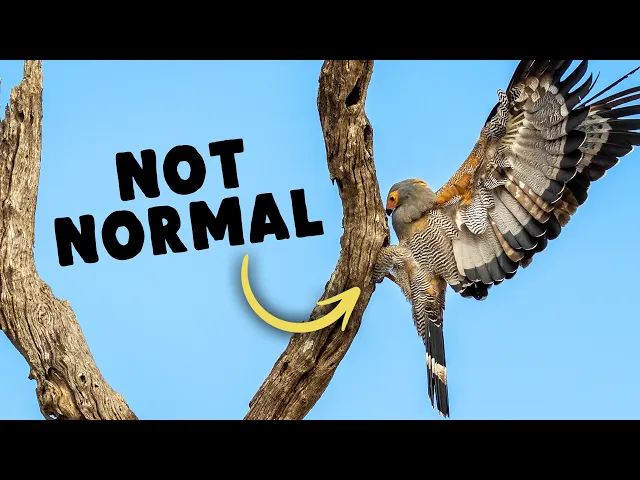
This Hawk Climbs Trees For Some Reason
Bizarre Beasts
0:00 What if I told you that today's beast flies, hangs upside down, and eats fruit?
0:06 What creature would you think it is?
0:08 A fruit bat seems like the obvious choice,
0:11 but there are a bunch of tropical birds that fit the bill, too.
0:14 Heck, even a sugar glider kind of makes sense
0:17 if you keep your definition of flying a little loose.
0:20 Now, what if I told you it's none of those things?
0:24 It's a bird of prey, a so-called raptor.
0:28 Not what you pictured, right?
0:29 But why not?
0:31 What even defines a raptor, anyway?
0:41 The Bizarre Beast Pin Club is open for subscriptions for the whole month.
0:44 Sign up by May 20th and your first pin will be one of these weird birds of prey.
0:50 The African Harrier Hawk, a member of the Accipitridae family,
0:54 can be found all over tropical Africa south of the Sahara,
0:58 from rainforests to deserts to human settlements.
1:01 They have about a 1.2 to 1.5 m wingspan,
1:05 making them the biggest hawk species in all of Africa,
1:08 and the females are typically larger than the males.
1:11 Their biggest standout features are their featherless face and long legs,
1:16 both of which help them with some of their unique foraging methods.
1:20 Their prey isn't that out of the ordinary, though.
1:23 They mainly eat small vertebrates like lizards, mammals,
1:26 and birds, as well as eggs and hatchlings.
1:28 But they also eat oil palm fruits, which is a little offbeat for a bird of prey.
1:34 Raptors are generally considered hypercarnivores,
1:37 meaning that their diet consists of at least 70% meat.
1:41 So sure, snacking on fruit here and there isn't out of the question,
1:45 but of the over 500 species of raptors in the world,
1:49 only a little over 30 have actually been observed doing this.
1:52 The African Harrier Hawk's diet has, in at least some cases,
1:56 been measured at about 13% plants on average,
2:00 which still puts them past the 70% meat cutoff for hypercarnivore status.
2:05 But they've also been observed eating a diet of up to 86% oil palm fruits,
2:11 and some folks might call you a straight-up frugivore at that point.
2:15 Raptor species that have been spotted eating fruits seem
2:17 to mostly opt for those with a high fat content,
2:20 which could just be a convenient substitute when prey is hard to come by.
2:25 Still, this doesn't totally explain why birds
2:27 like the Harrier Hawk or its neighbor, the Palm-nut Vulture,
2:31 have a more frequent affinity for this behavior than most raptors.
2:35 It may simply be that these species are
2:37 more visibly exploiting an available resource than their relatives,
2:41 who themselves might actually be eating fruit more than we realize.
2:44 When hunting its non-fruit food options,
2:47 African Harrier Hawks can soar about 30 to 100 m above
2:51 the ground to spot prey before zooming down on a target,
2:54 or they may hunt by scanning an area while perched at a high vantage point.
2:59 Fairly standard stuff.
3:01 But they will also fly around much closer
3:04 to the treetops and allow themselves to be mobbed.
3:07 Mobbing is when smaller birds squawk at or even
3:11 attack potential predators to drive them away.
3:14 Not usually a pleasant experience for any of the parties involved.
3:18 But the African Harrier Hawk actually uses the intensity
3:22 of mobbing as an indicator of where prey nests might be.
3:26 They seem to actively seek out the most aggressive mobbing
3:30 and even turn back around when things calm down again.
3:33 It's like warmer, colder, but with bird violence.
3:38 And what they do once they home
3:40 in on their target is probably their coolest characteristic.
3:43 Because, as strange and interesting as all
3:46 this fruit eating and songbird antagonizing may be,
3:50 it still doesn't explain that little bald face or those lanky legs.
3:54 Instead of diving and crabbing and other regular raptor behavior,
3:59 African Harrier Hawk's specialty is methodically
4:02 rooting out prey that hides in cavities.
4:05 Those featherless faces make it much easier to get all up
4:09 in a hollow tree to snatch whatever edible creature may be inside.
4:14 And if that proves too difficult, their extra-long legs,
4:17 or extra-long feet, really, can do the trick instead.
4:21 This is further aided by their extremely flexible ankles,
4:24 which let them easily rummage around inside of trees to grab birds,
4:29 eggs, bats, or what have you.
4:30 And yes, that prey list does unfortunately include
4:34 the offspring of our cavity-nesting friend, the hornbill.
4:37 African Harrier Hawks reach these types of hollows
4:40 by actually climbing up tree trunks and then hanging,
4:43 often upside down and at other wacky angles, while conducting their searches.
4:48 They also employ these inverted talents to plunder weaver nests,
4:52 which they search and even tear apart while
4:55 hanging in place and flapping their wings for balance.
4:58 Not exactly your textbook bird of prey attack style.
5:01 In fact, African Harrier Hawks are so specialized for this weird way of hunting
5:05 that their eyes don't even work the same way as all of their relatives.
5:10 Daytime hunting raptors have a wide binocular
5:12 field of vision that's great for attack accuracy, attack-curacy, if you will.
5:17 But they have a major blind spot directly above them.
5:20 This makes sense for two reasons.
5:22 They evolved ridges on the tops of their eyes to block out glare from the sun,
5:29 and they don't really need to look up
5:32 when the prey they're hunting is down below.
5:34 African Harrier Hawks, on the other hand,
5:36 totally lack that blind spot and can see above their heads with anywhere
5:41 from 20% to 100% more coverage than any other known Accipitridae species.
5:47 This means that they're better able to see
5:50 what they're doing while ransacking a tree,
5:53 regardless of whether they're right-side up or upside down.
5:56 It's a far cry from the aim for the prey
5:58 you're swooping down on method employed by raptors like we'd expect.
6:02 Looking for a doctor can feel a bit like
6:05 you're an African Harrier Hawk reaching into a tree hole.
6:08 You know what you're hoping to find,
6:09 but there is no guarantee that you'll get what you're looking for.
6:12 So sometimes we just put it off.
6:15 Not because we do not care about our health,
6:18 but more so because of how difficult it is to actually book and see a doctor.
6:22 But doctors that perfectly suit your needs are out there,
6:25 and you shouldn't have to reach into any tree holes to find them.
6:28 That's why today's video sponsor is Zocdoc.
6:31 Zocdoc is a free website where you can search,
6:33 compare, and instantly book high-quality in-network doctors.
6:36 So instead of trying to figure it all out on your own,
6:39 you can actually see real doctors, real reviews,
6:41 and real availability all in one place.
6:44 You just check their schedule, pick a time that fits your life, and book it.
6:47 Sometimes even same day or within 24 to 72 hours.
6:51 So if something's been on your mind or you've
6:53 been putting something off because it just feels like
6:56 too much to deal with, go to zocdoc.com/bizarrebeasts
6:58 to find an instantly book a top-rated in-network doctor today.
7:02 Thank you to Zocdoc for sponsoring today's video
7:04 and for helping us all take better care of our health.
7:10 So what exactly is it about this handful of traits that makes
7:13 the African Harrier Hawk seem so different from typical birds of prey?
7:18 The better question might be, what exactly is a raptor?
7:22 The truth is, there isn't a formally agreed-upon
7:24 biological definition of raptor or bird of prey,
7:28 and what qualifies is hardly taxonomically consistent.
7:32 The word raptor comes from the Latin word meaning to seize.
7:35 So having crabby talons seems to be the most common through-line,
7:39 and that tracks with the fact that all of the different raptor taxa
7:43 have their own highly adapted talon styles based on what they catch and have.
7:48 But that's the strange part.
7:50 The taxa in question aren't even that closely related.
7:53 The order Accipitriformes, which includes eagles,
7:56 ospreys, hawks, kites, vultures,
7:58 and more, is totally separate from the order Strigiformes, the owls.
8:03 And Falconiformes is closer to parrots and other
8:06 perching birds than to either of those.
8:09 The usually defining adaptations that make a so-called raptor,
8:13 great eyesight, a sharp beak, and those mean talons,
8:16 all basically amount to a set of convergently
8:19 evolved tools for finding and eating meat.
8:21 Simple as that.
8:22 Which is still plenty true for African Harrier Hawks,
8:25 but instead of eagle strength, owl stealth, or falcon speed,
8:29 they evolved dexterity for opportunistically hunting more stationary prey.
8:33 As with many of our favorite beasts, they simply evolved to exploit a niche.
8:38 Amazingly, the exact same can be said
8:40 for the Crane Hawk from Central and South America,
8:43 which has the same double-jointed tree cavity hunting style,
8:47 and it's not closely related to the Harrier Hawk at all.
8:51 Just more convergently evolved coolness.
8:53 So really, having specializations best suited
8:56 for its distinct predatory style actually make
8:59 the African Harrier Hawk a very suitable fit for the bird of prey club.
9:03 Eating fruit and climbing trees may
9:05 not follow our traditional raptor assumptions, but that's more of an us problem.
9:10 Ultimately, this is just another example of humans
9:13 creating boxes purely for our own convenience,
9:16 even when those boxes don't necessarily have much meaning in nature.
9:20 Very often, the labels we create are entirely vibe-based.
9:24 Just ask any botanist what counts as a pumpkin.
9:27 What makes the African Harrier Hawk unique from other birds of prey
9:30 doesn't actually mean it's not still a bird of prey itself.
9:34 Though to be fair, the sight of a hawk scaling a tree or flopping
9:37 around with one foot in a hole is a bit bizarre on its own merits.
9:42 But this beast is simply living its best raptorial life,
9:46 even if it has to stretch the definition of the term just as far as its legs.
9:50 Sign up for the pin club
9:52 at bizarrebeastshow.com and help keep this channel going.
9:55 If you want an African Harrier Hawk to be your first pin, sign up by May 20th.
10:00 Do you want stickers?
10:01 We have five different sticker sheets right
10:03 now featuring some of our favorite beasts.
10:05 Do you need a hyrax on your water bottle or a pumpkin toadlet on your computer?
10:09 Or maybe you need a cockapoo to watch everyone's driving.
10:12 Grab an individual sticker sheet or if you buy the whole bundle,
10:15 you're getting one of the sheets for free.
10:16 Get your bizarre beast stickers at bizarrebeastshow.com.
10:19 And now for some bonus facts.
10:24 Along with being great for sticking into tree holes,
10:27 the African Harrier Hawk's naked little face also lets us see them blush.
10:32 Their bare face is usually a pale yellow color,
10:35 but can flush bright red in a variety of circumstances.
10:39 Generally and unsurprisingly,
10:41 this seems to be something of an all-purpose excitement response,
10:44 including during courting and leading up to mating.
10:47 When nesting, African Harrier Hawk mates typically
10:50 take turns incubating the eggs and hunting.
10:52 They sometimes seemingly disagree when the time comes to swap roles,
10:57 resulting in shoving matches.
10:59 And curiously enough,
11:00 facial flushing seems to correlate with which parent is already at the nest
11:05 and which is returning from hunting and ready to take over.
11:08 While incubating the eggs,
11:09 the parent already sitting at the nest is more likely to turn red,
11:13 while the parent arriving stays pale.
11:16 But once the eggs hatch,
11:17 the parent at the nest stays pale while the arriving parent blushes.
11:21 Both individuals' faces go red during the shoving
11:24 instance until one of them backs down, at which point it goes yellow again.
11:28 These color-changing patterns seem to involve a system
11:31 of challenge and concession between nesting Harrier Hawks
11:35 and could be a form of communication between
11:37 them or just an incidental result of behavioral conditions.
11:41 It may sound like a pretty basic characteristic.
11:44 Skin has blood vessels in it and the amount
11:46 of blood pumped to the surface can change,
11:49 and that can certainly relate to experiences that crank up the heart rate.
11:53 But facial flushing has so far only ever been
11:55 observed in a couple dozen bird species around the world.
11:59 Chalk it up to yet another way that this beast defies bird norms.