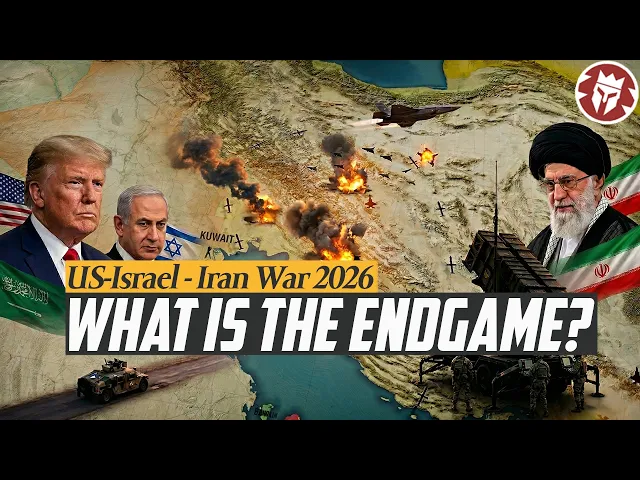
Can the USA and Israel Win?
Kings and Generals
0:11 Since October 7, 2023,
0:12 the Middle East has been in the midst of another cycle of violence.
0:16 But what is happening now in the region-
0:19 a major escalation as a result of the joint American
0:21 and Israeli attack on Iran- seems like something
0:24 that has the potential to have truly earth-shattering geopolitical consequences.
0:28 That is, if America and Israel do not win the war.
0:32 But what exactly would qualify as a victory for the sides?
0:35 And is it feasible to achieve this victory?
0:38 Watch this video to find our take on these matters.
1:04 BACKGROUND Turns out that the June 2025 war
1:27 between Israel and Iran was merely a prelude.
1:30 After practically destroying Iran’s air defense,
1:33 significantly damaging its military industrial complex and nuclear
1:36 infrastructure with the help of the United States,
1:39 Israel and America declared victory and opted not to prolong the war.
1:43 The feeling was that the damage inflicted on Iran
1:46 may be sufficient to bring down the regime, which appeared very vulnerable.
1:50 And when the people of Iran rose up once again in massive
1:53 numbers in early 2026 to protest
1:56 a horrible economic situation and political repression,
1:59 it felt like the writing was on the wall.
2:02 But the regime managed to defeat the protest
2:04 movement by cracking down with full force.
2:07 Thousands have been killed during the protests,
2:09 and even the Iranian government admitted to a death toll of more than 3k people,
2:14 while some estimate the casualties to have been higher than 30k people.
2:19 But while the crackdown was still going on, the US president Donald Trump made
2:23 a promise to the Iranian people fighting the regime- “Help is on the way”.
2:28 The American Carrier Strike Group 3,
2:30 with the aircraft carrier USS Abraham Lincoln
2:33 as the flagship and other US military assets, started moving to the Middle East.
2:38 Israel was also signalling its intention to renew hostilities against Iran.
2:42 Peace talks focused on the American demands for Iran
2:45 to give up its enriched uranium and nuclear program,
2:48 along with its ballistic missiles program and support
2:50 to its proxies in the Middle East,
2:53 were destined to fail, as the United States continued its military buildup.
2:57 Everything pointed to another round of war between the sides,
3:00 perhaps this time a decisive one.
3:02 THE START OF THE WAR On February 28,
3:04 the United States of America and Israel launched their air strike
3:08 campaigns with the respective codenames Operation
3:10 Epic Fury and Operation Roaring Lion.
3:12 A mass number of missiles and drones were fired on Iran,
3:17 the remaining air defense capacity of which, after the June 2025 war,
3:21 has been utterly incapable of dealing with this onslaught.
3:23 On the first day of the war, the attacking side made approximately 900
3:28 airstrikes targeting Iran’s nuclear and missile sites,
3:31 its remaining air defenses and its military and political leadership.
3:35 Particularly, the impact on the latter has been devastating.
3:39 On February 28, the airstrikes killed
3:41 the Supreme Leader of Iran, Ayatollah Khamenei,
3:44 the commander of the Islamic Revolutionary Guard Corps,
3:47 Mohammad Pakpour, the Defense Minister Aziz Nasirzadeh,
3:49 the Chief of the Military Office of the Supreme Leader,
3:52 Mohammad Shirazi and many other senior political and military leaders of Iran,
3:57 with Donald Trump claiming the number of 40 killed.
4:00 Iran was practically decapitated on the first day of the war.
4:04 One of the American strikes hit the Minab Girls’ School,
4:07 which killed more than 170 schoolgirls.
4:09 Local sources reported that the school was
4:12 previously the Islamic Revolutionary Guard Corps (IRGC) Facility,
4:16 which probably means that the Americans
4:18 made this strike based on outdated intelligence.
4:21 Still, this does not excuse the killing of so many children.
4:25 Within hours of the initial American and Israeli strikes,
4:28 Iran responded by launching Operation True Promise IV.
4:31 Iran fired rockets and drones at Israel, at American bases in the Middle East,
4:36 but also at the crucial infrastructure of the American Gulf allies.
4:40 Bahrain’s capital, Manama; the Saudi capital, Riyadh; the UAE capital,
4:44 Abu Dhabi; the Kuwait International Airport, and so on.
4:47 Iran's response indicated a couple of things.
4:50 Iran has been able to achieve at least some
4:53 degree of decentralization in decision-making, and as a result,
4:56 even the death of the Supreme Leader and most
4:59 military commanders did not prevent it from answering strongly.
5:02 Along with that, Iran chose the “if we burn,
5:05 then everyone around us burns too” strategy.
5:08 The logic behind this strategy is to increase the cost
5:11 of this war not only on the US and Israel
5:13 but also on the Gulf monarchies in order to force
5:16 them to persuade the United States to stop the war.
5:19 In early March, the United States and Israel
5:22 continued striking Iran with the Islamic Republic’s missile infrastructure,
5:25 from manufacturing plants to missile launchers, recognizing that at this point,
5:30 the most important weapons in the Iranian arsenal are its missiles,
5:33 along with its slow-moving, but cheap and disposable drones.
5:36 After firing missiles in three-digit numbers on the first 3 days of the war,
5:41 according to different independent reports,
5:43 since then their numbers have been decreasing,
5:46 with Iran firing around 20-30 ballistic and cruise missiles in the ensuing days.
5:51 The American and Israeli strikes on Iran’s missile
5:54 infrastructure have arguably played a key role here,
5:57 while Iran has also depleted its missile numbers to a certain extent
6:01 and is probably conserving its resources in preparation for a long war.
6:04 Along with responding with missile and drone strikes in the Middle East,
6:08 Iran also took steps to expand the geography of the conflict in early March.
6:13 Iran’s proxy, Hezbollah, started shelling the Israeli territory,
6:16 to which Israel responded by moving its
6:19 army into South Lebanon and conducting airstrikes.
6:21 Iran has also launched several ballistic missiles on Turkish territory,
6:25 presumably targeting the Incirlik base of the United States,
6:29 along with launching several drones on Nakhchivan, Azerbaijan.
6:33 HORMUZ BLOCKADE But Iran’s biggest escalatory response was
6:35 declaring the Strait of Hormuz closed to shipping.
6:38 Why is it so important?
6:40 Because roughly 20% of all seaborne oil trade,
6:43 the oil of the Gulf countries passes through this narrow chokehold.
6:46 Following Iran’s decision, several ships, mostly oil tankers,
6:50 had been hit in the first days of March.
6:53 Iran has used its coastal missile systems, drones, missiles,
6:57 fast attack boats and naval mines to disrupt shipments through the Hormuz.
7:02 Major shipping companies like Maersk,
7:04 CMA CGM and Hapag-Lloyd suspended transit through the Strait of Hormuz.
7:08 The price of oil jumped from around 65 dollars
7:11 per barrel to over 120 dollars at its peak.
7:14 The price of energy has increased significantly in many European countries,
7:18 the US, and elsewhere.
7:19 As a result of this blockade,
7:22 60% decrease in oil exports from this region was reported by mid-March.
7:28 To mitigate the situation,
7:29 the Trump administration temporarily suspended its embargo on Russian
7:33 oil and allowed countries like India to purchase Russian oil.
7:37 Trump has taken several steps, such as attacking Iran’s coastal batteries,
7:41 bombing the IRGC naval bases and attack boats,
7:44 its underground missile depots and drone launch sites.
7:47 They have also been considering the mine-clearing operations
7:52 to mitigate this crisis and providing protective convoys for tankers,
7:56 which can have only a limited impact
7:57 on shipments as long as the Iranian threat persists.
8:00 The mine-clearing operations will take weeks, if not months,
8:03 before the United States can truly secure
8:05 at least corridors for limited shipping through the Strait.
8:08 So far, the United States has been on its own in trying to de-blockade Hormuz,
8:13 as all its attempts to involve other countries,
8:16 including NATO allies, in these operations have received a similar response:
8:19 “This is not our war”.
8:21 Much like what Trump has been saying about Ukraine.
8:24 Thus, the United States appears on its own in this matter,
8:28 and there are no easy solutions here.
8:30 THE ESCALATION OF THE WAR So, while in the first days of the war,
8:32 while the shock and awe bombardment conducted by the US
8:35 and Israel decapitated Iran and greatly
8:37 damaged its military and civilian infrastructure,
8:39 created a perception that Iran was practically defeated,
8:42 its ensuing strategy of expanding the geography of its
8:45 operations and raising the cost of the war
8:47 for the United States indicates that the assessment
8:50 of the early days has been an overreaction.
8:52 Throughout March, the US-Israeli coalition continued destroying targets in Iran,
8:57 and at one point started flying at very low-altitudes,
8:59 confident that they could operate freely over the Iranian skies.
9:03 There has been an increased focus on Iran’s missile launchers
9:06 and drone launch sites to degrade Iran’s main deterrent in this war.
9:10 More strikes have also been reported on the IRGC infrastructure,
9:13 since this organization now appears in charge of Iran’s war effort.
9:18 So, in a conventional military sense, the United States and Israel continue
9:22 holding an overwhelming advantage in this war.
9:24 Whatever and whoever they can find and deem worthy of striking, they strike.
9:29 But Iran is still standing and wreaking havoc in the Middle East.
9:32 They continue targeting the Gulf states, Israel and American bases.
9:36 They have destroyed or heavily damaged some very expensive equipment,
9:39 like AN-TPY-2 radar systems,
9:41 which support the THAAD air defense system and an AN-FPS-132 Radar.
9:45 Most recently, on March 19,
9:48 Iran somehow managed to hit the American F35 fighter fighter jet.
9:52 The US command has confirmed damage to its F-35,
9:55 marking the first recorded instance of an F-35 being hit.
9:59 Cheap Iranian drones continue being a major nuisance for the Gulf countries.
10:03 The drone attacks sometimes occur in large packages of 50-100 drones,
10:08 and in the absence of other means, their air defenses have to use very
10:13 expensive missiles to down very cheap drones.
10:15 Even in the short term, this is financially infeasible.
10:18 This is where Ukraine enters the equation,
10:21 as arguably the best-equipped and most experienced
10:23 country in dealing with cheap drone swarms,
10:26 since it produces many cheap drone interceptors.
10:29 Ukraine has already sent its military specialists to the Gulf countries
10:33 and will most likely start selling its interceptors in the near future.
10:37 This will likely significantly mitigate the drone threat posed by Iran.
10:41 We also need to discuss the potential for further escalation of the war.
10:45 And here the oil and gas infrastructure
10:47 and water desalination capacity come to the forefront.
10:50 The conventional logic is that since the United States and Israel can destroy
10:55 Iran’s aforementioned facilities and since Iran can
10:58 respond in kind against the Gulf countries,
11:00 both sides would refrain from taking this escalatory step.
11:03 The US desperately wants to avoid an energy crisis in the Middle East,
11:07 since it would be very difficult to contain,
11:10 especially with the Strait of Hormuz remaining closed.
11:12 Since the start of the war,
11:14 Iran has been targeting the Gulf countries’ oil and gas storage and refineries.
11:18 But these strikes were limited,
11:19 as if trying to convey the message that we can do
11:23 more damage if we need to, don’t dare strike our energy facilities.
11:27 But on March 9-10, Iran started escalating
11:30 by striking the Shah gas field of the Emirates, which meant that the red line
11:35 of not targeting production facilities was now crossed.
11:38 Whatever remained of that red line was shattered when
11:40 Israel hit Iran’s South Pars gas field on March 18.
11:43 Even Donald Trump tweeted about this, claiming
11:46 that the United States had no prior knowledge of the attack and promised no
11:50 more attacks on oil and gas production facilities.
11:53 Even so, Iran responded by striking and damaging
11:56 Qatar’s major Ras Laffan liquefied natural gas facility.
12:00 WHAT IS THE ENDGAME AND WHERE WE ARE But where exactly does it leave us now?
12:02 In a nutshell, without a doubt, the United States and Israel have
12:06 significantly degraded Iran’s military and governance capacity.
12:08 But Iran still maintains the capacity to make sensitive strikes
12:12 in Israel and the Gulf despite the American help with air defense.
12:16 On top of that, Iran has so
12:18 far been successfully blockading the Strait of Hormuz.
12:21 Communication from the United States and Israel coming before
12:24 the war makes three goals of this campaign clear: 1.
12:27 Neutralizing Iran as a military threat.
12:30 2.
12:30 Eliminating Iran’s capacity to develop nuclear weapons, and 3.
12:35 Regime change.
12:36 Let’s start with the end goal,
12:37 since regime change would help achieve the first two objectives.
12:40 Khamenei is dead, and Ali Larijani,
12:42 a senior clerical-regime figure and possible de facto leader,
12:46 was killed in an Israeli strike.
12:48 But that does not mean the regime is collapsing.
12:51 President Pezeshkian appears marginal, many IRGC and Basij leaders are dead,
12:56 and it remains unclear how much control the new Supreme Leader,
13:00 Mojtaba Khamenei, actually has.
13:02 Many analysts argue that Iranian
13:04 military decision-making is now highly decentralized,
13:07 with regional IRGC commanders acting with broad autonomy.
13:10 That helps explain the gap between the more conciliatory tone of Foreign
13:15 Minister Aragchi and the IRGC’s continued threats and attacks across the region.
13:19 For now, the IRGC still appears to be the most powerful institution in Iran.
13:24 If the United States and Israel suddenly stopped the war,
13:27 the most likely outcome would be the IRGC
13:30 and the new Supreme Leader reasserting control.
13:32 Many leaders have been killed, but the ideology and governing system,
13:37 backed by millions of supporters, including armed ones, remain intact.
13:41 Many Iranians despise the regime,
13:43 but many others are tied to it ideologically and materially.
13:47 That makes spontaneous regime collapse unlikely without
13:50 either a true mass uprising or foreign intervention.
13:53 So far, there is little sign of such an uprising:
13:57 no major protests have emerged since the war began,
14:00 and the IRGC has already threatened a harsh
14:02 crackdown on anyone who takes to the streets.
14:05 Can we expect a foreign intervention then?
14:07 For all the degradation of Iran’s military,
14:10 its ground forces and the IRGC are still formidable.
14:14 Moreover, Iran’s geography makes it extremely difficult.
14:17 Zagros Mountains to the west,
14:19 and countries that are extremely unlikely to allow a foreign force to use
14:22 them as a base for a ground offensive to the North and East,
14:26 such as Azerbaijan, Turkmenistan, Afghanistan, and Pakistan.
14:29 To the South, Iran is on the shore of the Persian Gulf and the Gulf of Oman,
14:34 which will require an amphibious landing- not impossible,
14:37 but potentially very costly.
14:38 And even if you manage to enter the country,
14:41 the mountainous terrain of the country and several large deserts,
14:44 make Iran very challenging to operate in.
14:46 A limited operation, such as the occupation of the Kharg or Qeshm islands,
14:51 or even the mainland shore of the Strait of Hormuz to de-blockade it,
14:54 is a possibility, but it would also be extremely costly.
14:57 Even if a foreign force manages to land and capture these areas,
15:01 they would be constantly attacked by Iranian missiles and drones.
15:05 So far, the signals coming from America
15:07 indicate that a limited ground operation like
15:09 the one described above would be the furthest they would be prepared to go.
15:13 Such a limited operation would be another
15:16 major challenge for the embattled regime in Iran,
15:18 but it is unlikely that the capture of small islands
15:21 or even a small mainland territory would lead to its collapse.
15:25 Could an internal armed insurgency by one
15:27 of Iran’s ethnic minorities bring down the regime?
15:30 That seems unlikely.
15:32 Kurdish, Ahwazi Arab,
15:33 and Balochi groups have long fought low-level insurgencies,
15:37 but none has ever posed an existential threat to the state.
15:40 Since the war began, some opposition groups have signaled greater coordination,
15:45 yet Iraqi Kurdish authorities have already said their territory
15:48 will not be used as a base for attacks.
15:50 More importantly, no insurgent force is likely to launch a major
15:55 offensive unless the regime is already
15:57 crumbling through defections and internal collapse.
15:59 But, as discussed, it is hard to see
16:02 that happening without a major foreign ground campaign,
16:05 which also appears unlikely.
16:07 What is our verdict here?
16:08 The clerical regime has so far proven
16:10 itself to be more resilient than many expected.
16:13 Surely, it has been weakened, but it is still in power.
16:17 Barring a major ground offensive or some unforeseen internal collapse,
16:21 the likelihood of a regime change appears low.
16:24 Is a Venezuela-style behind the closed doors
16:27 deal with a high-ranking regime official a possibility?
16:30 Well, it is not completely impossible and Americans can
16:33 presumably find somebody to talk to find a middle ground,
16:36 but since it is completely within the realm
16:38 of speculation in absence of any relevant information,
16:41 we are not going to delve any further on this possibility.
16:45 What about the elimination of Iran’s nuclear potential?
16:47 Despite being one of the key talking points prior to the start of the war,
16:52 Iran’s nuclear facilities have not been the primary target in this war.
16:56 During the June 2025 war, Israel and the US did much more to weaken it
17:01 by severely damaging or destroying nuclear
17:03 facilities in Fordow, Natanz and Isfahan.
17:05 But this was not enough to completely dismantle Iran’s nuclear program,
17:10 as Iran still likely possesses about 440 kg of enriched uranium,
17:14 which is sufficient to produce 10 nuclear bombs.
17:17 At the same time, they still possess the industrial
17:21 and technological capacity to rebuild whatever has been destroyed.
17:24 In the currently ongoing war, the US and Israel have been targeting
17:28 the entrance points of Iran’s nuclear facilities.
17:31 This was the case in Natanz and Isfahan nuclear facilities.
17:35 The most likely goal here is to deny
17:37 the access of Iranians into these facilities,
17:39 perhaps to prevent them from recovering
17:41 the enriched uranium or other buried material.
17:44 Thus, the condition of Iran’s nuclear infrastructure is
17:47 more or less the same as before the war.
17:50 Significantly battered, but not completely dismantled.
17:52 And it is difficult to see how, without a ground invasion,
17:56 the US and Israel can verify the current
17:59 state of Iran’s nuclear infrastructure and destroy it.
18:02 What about Iran’s conventional military capacity?
18:04 This is where the United States and Israel have been the most successful.
18:09 Iran’s air defense is practically destroyed.
18:12 Israeli officials claim that 350 to 400
18:15 missile launchers have been either destroyed or disabled,
18:19 with only 150 still active.
18:21 Many Iranian aircraft and naval assets, and bases have been destroyed.
18:24 The same is true for command-and-control centers,
18:27 military bases, and missile and drone production facilities.
18:31 At this point in the war,
18:33 it is difficult to claim numbers because of the fog of war,
18:36 but all available data and analysis point
18:38 to a drastic damage to Iran’s conventional military capacity.
18:42 In a conventional military conflict,
18:44 this is the point when Iran is ripe for a ground invasion.
18:48 So, in a conventional sense,
18:49 the United States and Israel can claim that they have achieved this goal.
18:54 But since Iran is fighting an asymmetric war,
18:56 in the absence of any other options,
18:58 the current level of destruction does not constitute
19:00 a victory for the United States and Israel,
19:03 if we understand war as the continuation of politics by other means.
19:07 In itself, the degradation of Iran’s military capacity will likely constrain its
19:11 ability to project power in the Middle East to a certain extent,
19:15 but if Iran remains capable of producing and launching
19:18 drones and missiles at Israel and the Gulf countries,
19:21 it will continue to remain a threat.
19:23 CONCLUSION Here too, the conclusion remains the same.
19:25 Iran has been utterly devastated,
19:27 and it will take perhaps decades to recover from this war.
19:31 Its leaders are at the mercy of the American or Israeli decision-makers.
19:35 But without a ground operation or an unexpected
19:38 mass movement that will topple the regime,
19:40 the incumbent system will likely survive.
19:43 And with it, Iran’s remaining nuclear infrastructure,
19:46 military-industrial complex and armed forces, however battered, will too.
19:50 Trump can claim victory and exit the war whenever he pleases,
19:54 but as things stand, only a few will buy into it as a victory.
19:58 Because they have failed to bring the regime down.
20:01 They have failed to effectively protect their Gulf allies.
20:04 They have failed to prevent the blockade of the crucial Strait of Hormuz,
20:08 and failing to properly enforce the inviolability of trade
20:10 routes is less than ideal for a superpower.
20:13 They are also losing the aura of invincibility
20:15 at a time when the world order is crumbling.
20:18 At least, so far, as of March 21.
20:21 We will talk more about this war in the coming weeks,
20:24 so make sure you are subscribed and have pressed the bell button to see them.
20:28 Please consider liking, subscribing, commenting,
20:30 and sharing- it helps immensely.
20:32 Our patrons and YouTube members can watch more than
20:35 200+ exclusive videos- join their ranks via the link
20:37 in the description or by pressing the join
20:40 button under the video to watch these weekly videos,
20:42 learn about our schedule, get early access to our videos,
20:45 access our private Discord, and much more.
20:48 This is the Kings and Generals channel, and we will catch you on the next one.