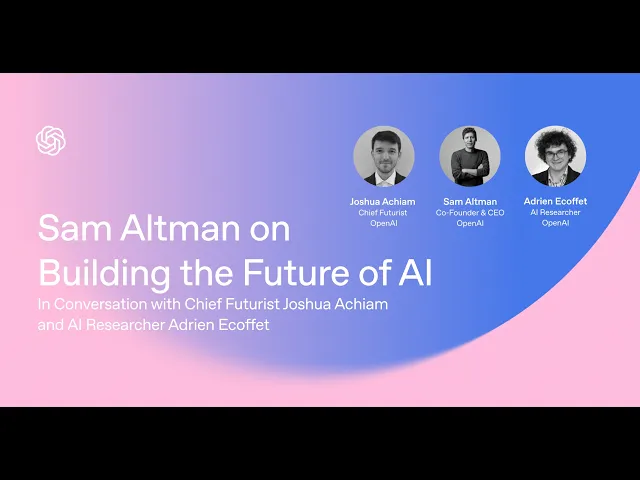
Sam Altman on Building the Future of AI
OpenAI
0:05 Good afternoon, everyone, and welcome to the OpenAI forum.
0:08 I'm Chris Nicholson, and I'm glad to be here with all of you today.
0:11 The forum is a place for serious conversation
0:14 about how AI is being used in the world, what we're learning from that, and how
0:18 more people can help shape its trajectory.
0:21 Today's conversation focuses on one of the biggest questions in technology,
0:26 what it will mean as AI systems grow dramatically more capable,
0:30 and how we should think about their implications for science,
0:33 work, our life together, and governance.
0:37 To discuss that, I'm joined by Sam Altman, co-founder and CEO of OpenAI,
0:41 Josh Achiam, OpenAI's chief futurist,
0:45 and Adrien Aoun, a long-time researcher here.
0:48 So, let's get started.
0:50 Sam, the blueprint we released this morning talks a lot about superintelligence.
0:55 Um a big question on my mind is, why are we doing that now,
0:59 and what are some things that you can
1:01 see from the inside that you wish everybody knew?
1:04 The The biggest reason is simply
1:06 that the rate of progress is continuing to accelerate,
1:09 and we believe we are very close now.
1:12 And this won't be a one-time thing.
1:13 This will be a you know, over the next few years to powerful models
1:18 that will impact the world in important ways.
1:20 The researchers that are working on these models that did
1:23 and I think an incredible job with this set of ideas,
1:27 and these are meant to be early ideas to start a discussion.
1:31 You know, I'm sure we'll get to much
1:32 better ideas as the world debates all of these.
1:34 Are staring down the models that are coming,
1:37 the pipeline in front of us, and you know, we may be wrong.
1:42 We may hit some wall.
1:43 We We are imperfect, but our But given what we see,
1:47 we expect to be in a world of extremely capable models quite soon,
1:52 and then for the the ramp of the capability to continue to increase.
1:57 I think this will have huge impact on the economy,
2:00 on the way we live, on what we can do.
2:02 And one thing I've observed from watching the world go through some
2:06 number of transitions is that the more time the the public, our leaders,
2:13 the political system has to debate ideas
2:15 before you really have to make a decision,
2:17 the more likely you are to make a good decision.
2:19 So, starting this now, given what we see coming,
2:21 so that as this becomes a very large issue of public debate,
2:25 I think it's important.
2:26 For sure.
2:27 Um and speaking of debate,
2:29 we brought in a lot of researchers in during very early in this process.
2:33 I think it was a maybe a unique exercise here in how many
2:36 researchers were working with the folks who also think about policy a lot.
2:42 It's closely tied.
2:43 What was that like for you and for the research group as a whole?
2:47 Yeah, you know, I think it was Well, it was a very interesting experience.
2:50 Like it was my first time working like actively on a on a policy doc.
2:55 I think it was a little bit like humbling in some cases,
2:58 you know, uh uh sometimes as researchers,
3:02 we can have these abstract ideas of oh,
3:05 we should really be thinking about the economic impact
3:07 of this or or about like policy for for safety,
3:10 but you know, it's it's one thing to think about
3:12 this and another thing to like actually put, you know,
3:14 pen to paper and um and think of concrete uh policy ideas that are
3:19 going to be debated by by your your peer uh your your peer researchers.
3:23 Um so, it was an interesting experience for me.
3:25 Um I I hope there was uh you know, very helpful for the final product uh
3:32 that we had the researchers involved so early
3:35 and so and so deeply like for for something
3:37 like this, uh especially since it's so forward-looking.
3:42 Uh you kind of need to to Sam's point,
3:44 like you need people who are um who are dealing with this technology every day,
3:49 who know how to build it, know how the safety stack works,
3:52 and also are seeing like the speed of progress.
3:56 Um and one thing that, you know,
3:59 that I remember as part of this process in the in the past
4:01 few months that we were were working on it,
4:04 like a lot of researchers went through a a transition uh from, you know,
4:10 writing most of their own code to having AI most write most of their code.
4:14 And I think that I think to some extent led them to bring
4:17 a lot of the urgency of like this technology is is real and important,
4:24 moving fast in a way that maybe um not everyone can can see.
4:29 Uh and and that's part of also kind of your your earlier question about why now,
4:34 like because we are seeing uh this urgency.
4:36 Can I tell a quick story that reminds me of?
4:38 Um There was a night in I guess it would've been late January,
4:48 early February of 2020 when uh the OpenAI researchers kind
4:52 of got obsessed with COVID before the rest of the world did.
4:56 And we were talking about it all the time,
4:57 and we were watching the numbers every day,
4:58 and we were like, "This is going to happen." Yeah.
5:00 And, you know, we were like making plans to go uh work from home,
5:04 and there was this like some article that came out
5:06 like mocking us because they're like these crazy people at OpenAI.
5:09 We had put like some copper or something on some
5:11 of the door handles because people I remember that.
5:14 You remember that?
5:15 And some journalist wrote about this, and there's all all these things going on.
5:18 And I And you know, we we kind of like made our plans,
5:25 and we assumed a shutdown was going to happen.
5:27 We were like, "There's this thing coming.
5:28 The world's not paying attention." And for whatever reason,
5:31 uh something about like working on exponential
5:33 makes you understand these things better.
5:34 So, I think we were like a group of people that were primed to do it.
5:37 Um And then there was this one night.
5:40 It was like a very cold night.
5:41 I lived in the Mission at the time.
5:42 And I was like, "I'm about to get locked in my house for a while,
5:45 and I'm going to go for a walk.
5:46 I want to one more time I want to like,
5:48 you know go for a walk cuz who knows what what's going to happen.
5:51 And I went through this long walk through the city, hours, cold cold night.
5:54 And I was like watching people, you know,
5:56 breathing in each other's faces in restaurants and bars through the windows.
5:58 And I was like wearing my mask looking all looking crazy.
6:01 And there was one other dude out wearing
6:02 a mask and kind of we nodded each other.
6:04 And that was But other than that it was just like life felt totally normal.
6:08 I have not felt that so acutely as I do again in this moment.
6:13 Yeah.
6:13 Um where it's like there is this crazy change.
6:17 The change has already happened.
6:18 Like the models have already hit some level.
6:20 Society has not digested them yet.
6:22 Yeah.
6:23 We feel like we see it clearly.
6:25 We are trying to tell the world that it's going to happen.
6:28 It is hard to get this across.
6:29 But it feels like that night in the very
6:31 beginning of COVID walking through the streets again.
6:33 That's really interesting.
6:34 And And you've talked a bit about the upsides to unlock
6:38 and a lot about science as a means to do that.
6:41 Um so So if we're going to like contrast this with COVID,
6:45 what are some of the hugely positive things in the pipeline for us?
6:51 I will answer that.
6:52 I think the positives are so positive we should talk
6:54 more about the other things that we're thinking about here.
6:57 But like it it you mentioned science.
6:59 If we can really go make a decades worth of scientific progress in a year,
7:03 if we can go cure a ton of diseases,
7:05 if we can come up with personalized medicine for people,
7:08 find new materials to sort of make cheap safe energy.
7:12 Uh there's if we can make it such that anybody who can come
7:16 up with an idea for a startup can have the AI implement it,
7:19 write the piece of software they want, uh you know,
7:21 have a custom video game that's like the most fun for you to play.
7:24 Uh this stuff is all wonderful.
7:26 Now, you know, part of the reason for putting this out with urgency is there
7:30 are going to there are a lot of things coming that we'll need to mitigate.
7:34 I assume we'll figure it out.
7:35 I I'm always an optimistic person by nature.
7:37 But also the benefits of this this has change the option space in front
7:43 of us and what we can do that one of my first reaction to reading
7:49 the blueprint after the researchers wrote it was like it is awesome but also
7:54 a little crazy that we can credibly be talking about these kinds of things.
7:57 Um so we do have like if the AI is as good as we think Yeah.
8:03 and all these wonderful things happen, we also have an incredible new tool
8:06 at our disposal to help us mitigate the potential downsides.
8:09 Yeah.
8:09 A tool for everyone.
8:11 Uh Josh, I'd like to ask you um so I I think we've talked about
8:15 this as social infrastructure that changes the way
8:17 people work and learn and participate in society.
8:22 Um what what responsibilities do we have and do institutions have to help
8:28 society get ready for that and how how do you think about it?
8:31 Yeah.
8:31 Um you know, one of the things that I think about here,
8:33 this does kind of come back to the broad benefits for everyone thing.
8:37 Uh for a long time in society,
8:39 we've had this great aspiration that everyone could have,
8:42 you know, food, shelter, electricity,
8:45 uh health care and we've we've always wanted to see there
8:51 be some kind of new step in the direction of providing
8:54 these sorts of things for everyone so that everyone can
8:56 focus on the things that are most important in their lives.
8:59 Um and we've often been told over and over again like,
9:02 you know, actually we can't have that, it's too expensive.
9:05 There's no way to pay for it.
9:06 Um like it's it's nice but it would be
9:09 too burdensome to society to do all of that.
9:12 And I think what AI and superintelligence will unlock is the freedom to do
9:17 all of it at a much lower cost than has ever been possible.
9:21 And correspondingly for the folks of us who
9:23 are sort of the stewards of the technology,
9:25 we have a special responsibility to make sure that we actually do fully realize
9:29 those benefits and be a part of building
9:33 policies and systems that help working people,
9:36 middle class people, people in low-income countries,
9:38 really make sure that it benefits everyone and not just the very wealthy.
9:42 So, I'm those are the things that I think of as key responsibilities here,
9:45 and I'm very excited about it.
9:47 Plus, the downside risks are also quite serious,
9:51 and there are systemic shocks that could happen.
9:53 We have to prepare.
9:54 We have to be thoughtful.
9:55 We have to be honest about them.
9:56 Yeah.
9:57 Yeah, so that sounds like a resilience question.
9:59 Um and and when I look at the document and and speak with you folks,
10:04 it sounds like you think of resilience in layers, right?
10:07 There's um kind of and and a lot of it is not before the AI goes out,
10:11 but it's also after the AI goes out in terms of um
10:14 our responses to AI and how people are are prepared for it.
10:18 I'd actually like to ask each of you how you think about resilience.
10:21 Um Adrian, why don't we start with you?
10:23 Yeah.
10:24 You know, I I think maybe you want one
10:26 distinction that I would draw with uh you know,
10:30 classically we've thought about about safety and about
10:33 making sure that we that we run,
10:35 you know, safety evals, that we red team our models,
10:38 um that we implement mitigations.
10:39 And I think like that's, you know, to your point of resilience is a layer.
10:43 This is like a very important layer that we should,
10:46 you know, still keep doing and keep expanding,
10:48 but um at the same time uh you want
10:54 society to uh be prepared for the possibility that well,
10:59 maybe there will be some actors who do less safety testing,
11:02 and like what what happens what happens then?
11:04 How society resilient to risks from AIs uh in these cases?
11:09 Um maybe there will be uh incidents in spite of our safety
11:13 testing or near misses uh in the in the uh blueprint, we talk, for instance,
11:18 about um incident reporting that's modeled a little
11:21 bit of after um how the uh aviation
11:25 industry uh does things when whenever there's kind
11:28 of like a near miss or any incidents,
11:30 like however minor, that kind of like gets reported
11:33 to um to a database so that, you know, all the companies can kind of know,
11:37 okay, well, this is a risk and perhaps uh you know,
11:40 here are uh mitigations that they could implement.
11:43 And so, there's a lot of things that could happen at a society-wide uh level.
11:48 Um another thing would be um you know, defending against uh against risks.
11:54 Uh we're talking about models that they can code um a lot better in now.
12:00 Uh that also implies uh cyber capabilities.
12:04 Like, could they help uh bad actors uh run cyber attacks?
12:08 Uh and I think part of resilience is ensuring that we uh that we
12:14 make our software systems uh more secure uh and use AI to do these things.
12:19 So, so again, there is as you said, all these layers.
12:21 So, that's kind of how I take the the resilience question.
12:25 Sam, before the show we were talking about how
12:27 prosperity can be emergent when everybody has access to AI.
12:30 Also strikes me that resilience can be emergent.
12:33 How How do you think about it?
12:34 Yeah, I I think our original AI safety thinking,
12:39 and the field in general, like I'll call it classical AI safety thinking,
12:42 was that there are going to be a very tiny number of AIs in the world.
12:47 The only thing that matters is making sure those AIs do the right thing,
12:51 and then as long as you align them and they don't do unsafe things,
12:54 the world will be okay.
12:56 I think the picture now is actually more stable, but more complex,
13:00 and there are going to be many AIs in the world.
13:03 Uh and the it will not be enough to just say like, you know,
13:09 this one company is going to make sure
13:10 the AI never does something it shouldn't do.
13:13 Um but there will need to be an emergent response across society.
13:17 Uh you know, Andrew talked a little bit about some of this, but if
13:21 we just take a few examples of threats that we expect to be coming.
13:25 Um cybersecurity is definitely going to become a huge issue.
13:28 AI will be incredibly good at finding vulnerabilities in software,
13:33 and I think the world will find that their software
13:35 is much more brittle and much less secure than we thought.
13:37 And you know, humans just have limited capacity to find the exploits.
13:41 Um, it is not enough to say that, you know,
13:45 one or two or three model providers are just going to make
13:47 sure that their systems won't do this because code is like,
13:50 you know, the same thing that code is very useful to be good
13:53 at, and being good at writing code can also help find security problems.
13:57 And even if all of us somehow could prevent
14:00 our models from ever being used for this, there
14:02 will be open-source models coming soon that are that are
14:04 good at code and thus good at security exploits.
14:06 So, what has to happen is the world has to use these models,
14:10 and there can be, you know, differential access.
14:12 You can give it to good known trusted defenders first.
14:14 We have a program for that.
14:15 Other companies will do similar things.
14:17 Um, and you have to empower
14:19 the companies that defend software because there will
14:22 be some power plant that no one has to the software for 20 years,
14:26 and no one can patch it, and there's a big problem with it,
14:27 and you have to do something about that.
14:29 Um, but a resilience approach here is,
14:32 okay, there's this new thing in the world.
14:35 There's AI that is really good at exploiting computer systems.
14:39 Um, let's use AI to defend it, and that is not a one-company thing.
14:42 That's going to require this huge effort.
14:44 Um, if we go a little bit further,
14:46 I I think there will be a uh bio version of this where,
14:51 you know, classically people have said, well,
14:53 we're just going to restrict our models from being able to develop pathogens.
14:56 Someone at some point is going to use some model to develop a pathogen.
15:00 And the world needs defense shields against that, detection systems,
15:04 rapid response treatments, a whole bunch of other things.
15:06 And this is not this doesn't get us off the hook
15:10 in any way of aligning our systems and building safe systems.
15:13 We still have to do that.
15:14 Like, we get a time advantage there as long as we stay at the frontier.
15:18 But, we do need the world to like do its thing,
15:22 society to have this emergent magic and build these layers of defensive shields.
15:26 Um there are many threats besides those two,
15:28 but that's enough given we have short time.
15:30 For sure.
15:31 Um Josh, you have shared some interesting thoughts with me about how
15:35 each huge technological shift has produced
15:38 new institutions and new democratic mechanisms.
15:41 Mhm.
15:42 And also you've uh been thinking a lot
15:43 about new institutions that might emerge now.
15:46 Um how are you What are What are your kind of What are your most exciting ideas
15:53 and what what do you really like to think
15:55 about in terms of the collective response to superintelligence?
15:59 Yeah, certainly.
16:00 Um so so one thing I'll say first
16:01 on the subject of resilience just as grounding,
16:04 a lot of the problems that we're concerned about
16:06 AI creating new externalities for are problems and vulnerabilities
16:10 that exist in the world regardless of whether AI
16:13 is present and AI just increases the urgency of action.
16:16 But coming back to COVID,
16:18 we found back then that everyone had a much deeper dependency
16:21 on the functioning of supply chains
16:23 than most people were previously conscious of.
16:26 Um supply chains are super important, supply chains for food,
16:29 for goods, for for everything that sustains civilization.
16:32 Um and also of course uh you know,
16:35 for for other types of vulnerabilities like democracy.
16:37 We've been debating for years how um there are
16:39 real risks when people are influencing society sort of inappropriately.
16:44 And we're we're worried that AI is going
16:46 to make these things potentially easier to attack
16:49 in the near term because there will be
16:51 tools at people's disposal that they haven't had before.
16:53 Um I'm excited about the possibility that we can build new institutions
16:58 and state capacities to use AI to rectify some of these vulnerabilities.
17:02 Um we can systematically identify them with AI in ways we couldn't in the past.
17:06 We can systematically close them in ways we couldn't in the past
17:09 and we can use AI to scale up efforts to combat
17:11 certain types of issues uh in in ways where we can
17:14 potentially make it too expensive for attackers to really do something.
17:18 So, uh you know, on on cyber and bio,
17:21 I am optimistic that maybe we can build an ecosystem of defenders that all
17:26 together can make it so expensive for attackers to try to, you know,
17:30 run a cyber attack that they there just won't
17:32 be that much of an incentive to do it.
17:34 And if we can fully implement the the bio resilient side of things,
17:38 um not just for pathogens that might impact humans,
17:40 but uh especially for the food supply chain.
17:42 This is one where I have like a hobby horse
17:44 on this and I'm going to talk about it every chance I get.
17:45 I think people under attend the food supply chain bio risks.
17:49 Um but we can use AI to make that resilient
17:51 at scale in a way that today is cost prohibitive.
17:53 Um so, I'm very excited about, you know, the things we can build there.
17:56 Yeah.
17:57 Neat.
17:57 Um one more question.
18:00 When we talk about kind of the individual transition for many people,
18:04 um what work looks like, where value shifts to.
18:07 I know you've been thinking about that a lot.
18:09 Um how how what do you see happening as folks kind
18:13 of transition to other ways of creating value in an AI economy?
18:18 Oh.
18:19 Oh, goodness.
18:19 That's very broad.
18:20 Um I think people will have a lot more uh opportunity to exercise agency.
18:28 Um you know, if you can uh start a new business and have a team of AIs
18:34 that handle all of the functions of putting
18:36 the business together that you have no expertise in yourself.
18:39 Um you can get something off the ground an awful lot easier.
18:41 And so, you know, there there are a lot
18:42 of ways that the economy just fundamentally changes
18:44 when you get people access and tools to help
18:47 them do more things than they could have before.
18:49 Yeah, for sure.
18:50 Um Sam, similar question.
18:52 You have so much experience with startups, running them,
18:55 managing Y Combinator, or just being in the ecosystem for so long.
18:59 What um how do you see startups changing and like
19:02 our potential to realize new ideas changing with AI?
19:05 I'm obsessed with trying to explore this space.
19:07 I don't know exactly what it's going to look like,
19:09 but I this idea of one person or a very small team being
19:13 able to create an entire startup as Josh was talking about pretty quickly.
19:18 Um all my instincts are there's something deep and important to figure out here.
19:25 Every time in our industry that the friction, cost,
19:32 whatever you want to call it of starting the startup has come down a lot.
19:35 Amazing new things have happened.
19:37 Um you know, I remember the transition The one of these transitions that I was
19:41 doing uh a startup during uh was when like basically AWS came out and all
19:48 of a sudden there was like an idea of a cloud and a small startup
19:51 didn't have to go do all the crazy things you used to have to do.
19:53 Manage his racks in the closet.
19:55 Yeah.
19:56 And that was like an amazing change to what you
20:00 could do as a small startup with a few people.
20:02 This one that's coming is much bigger and there have been several in between.
20:05 But uh I really want to find out what it looks like when a startup is you know,
20:11 two or three people and a ton of GPUs and you can just Yeah.
20:14 you can really democratize who can start a startup.
20:17 Yeah.
20:18 Yeah.
20:18 Yeah, it's that democratization aspect and it
20:21 gets down to the widespread availability of AI.
20:24 Um how do you What's What's the best frame
20:27 for thinking about bringing more people in, democratizing AI access?
20:35 I think when people talk about democratization of AI,
20:37 they they mean two different things.
20:38 One is share the access and making sure that everybody
20:42 gets to use sufficient AI to improve their own lives,
20:46 build things for other people, all that.
20:48 And the other is a sort of a voice in where it's all going to go.
20:51 Uh I think both are very important.
20:53 Um part of why we do things like this blueprint
20:56 are if we're not debating the issues as a society,
21:01 also part of the reason we actually released products in the first place.
21:03 People don't have a feel for this if we're not talking about this.
21:06 Um that is kind of a prerequisite to people being able to have input,
21:10 um, but it's not enough.
21:11 You also have to have a way that people's input that we
21:13 listen and the input is captured back into the into the system.
21:16 Um, so that's one that I think is really important
21:19 and the other is we need to put not just services like ChatGPT,
21:25 but the real deal high compute valuable
21:28 services where people can start a startup
21:30 or make a scientific discovery or whatever in broadly into many people's hands.
21:35 Yeah.
21:35 Yeah, and that's going to take new economic models or much cheaper uh,
21:40 inference to to get it wider spread, right?
21:43 And that's an infrastructure problem among many other problems to solve.
21:47 You know, we we used to talk for years in OpenAI
21:49 about when we were going to get through the compute crunch,
21:51 when we were going to build like enough compute that we wouldn't be so strapped.
21:54 I don't think we ever get out of it.
21:55 If we do our job, if we keep driving
21:57 the cost of intelligence down and the capabilities of intelligence up,
22:01 I think uh, you know, effectively if that happens, the demand is uncapped.
22:06 And the worlds where we don't build enough infrastructure,
22:15 I think you get a crazy concentration of power and concentration of compute
22:20 because people will just bid the price up and up and up.
22:22 So the only thing that I really believe
22:24 in as a long-term democratization strategy is to just
22:28 make so much AI infrastructure available and make
22:30 the models so good and so capable um,
22:33 that we hope to get to a world where people are like,
22:35 "I need help coming up with ideas for what to use
22:37 all this compute for." I don't think we will in practice.
22:40 Um, but I certainly think that if compute is very limited, you know,
22:45 the richest people and the richest companies in the world will just
22:47 sort of bid up the price to a kind of extreme degree.
22:50 It'll be another kind of scarcity that that is um, monopolized.
22:54 Where So this is a more data centers is actually a very egalitarian um,
23:00 initiative in the sense that they can make AI access more widespread.
23:04 I I would look at many examples throughout history.
23:07 You know, one of the best things that we ever did for really
23:10 increasing people's quality of life was
23:12 to drive the price of electricity way down.
23:15 Mhm.
23:15 Price of energy broadly way down.
23:17 Mhm.
23:17 Um energy correlates incredibly well with quality of life,
23:20 or at least it has for a long time.
23:21 Maybe now it'll be more about AI.
23:23 Um and by making energy abundant and shockingly
23:28 cheap relative to what it cost 50, 200 years ago, uh that has done like
23:34 quite a bit for lifting the entire world up.
23:36 I think we need to do the same thing with AI.
23:38 Mhm.
23:38 And I think that means you need a lot of it.
23:40 And just like with energy,
23:41 you need to innovate new ways to make it much more affordable.
23:44 Yeah.
23:45 Can I um give give a thought on on this whole issue as well?
23:49 I think we've talked a little bit about uh you know, the broad access to AI,
23:53 which I think is very important and and can create like you know,
23:57 potentially a lot of new products that will be um very helpful for the world,
24:01 very useful for people.
24:03 Um I think one thing that, you know,
24:05 we try to think about as well in in writing this blueprint is you know,
24:12 ensuring that, you know, ordinary people who maybe, you know,
24:15 aren't going to uh start start start up necessarily um
24:19 all of them like aren't left behind by this technology.
24:21 Um I think this is related to to uh something that that we might talk about,
24:26 which is kind of how does AI change the composition of the economy?
24:32 Does it uh move it more towards uh capital or towards like labor,
24:38 but labor that that is done by by AI really?
24:41 Um and and one of the things that we talk about in the blueprint is uh
24:46 how do you monitor modernize the the the tax
24:48 base for an economy that is like this?
24:50 Uh uh and how do you distribute kind of uh this prosperity that, you know,
24:56 will be created by this technology?
24:58 Uh how do you make sure that this is
24:59 prosperity for everyone and not like wealth for, you know,
25:03 a relatively few few people.
25:05 And so, this is something that we try to address in in the blueprint,
25:08 but I'm curious if we can talk about it here as well.
25:12 we totally should.
25:13 A couple of the big ideas that I saw were
25:16 have workers co-authoring how AI is deployed in their workspaces.
25:20 I'd like to to ask you about that, Josh, and I'd also ask I'd like to ask all
25:23 you about more broadly how society can capture the upside.
25:27 What are the institutional forms that'll that'll take,
25:30 but let's start with you, Josh.
25:32 Sure.
25:32 Just on the on this compute question for 1 second,
25:34 I want to say the compute allocation problem,
25:36 figuring out what things we use compute
25:40 to help people do with AI will probably one
25:42 of the most important society-wide questions to navigate over
25:44 the next few years while compute is relatively scarce,
25:48 and we should try to boost the amount of compute
25:49 in the world as much and as quickly as we
25:51 possibly can so we don't have to have painful trade-off
25:54 questions where there's some extraordinary good we could provide to everyone,
25:58 and we're stuck with a hard question where someone says, "Well,
26:00 how are you going to pay for that?" because the cost of compute is so high.
26:03 On getting workers involved in AI, I I actually I kind of want to back
26:08 up and just acknowledge an elephant in the room,
26:10 which is that a lot of workers are concerned about AI.
26:12 They're worried about what AI means for them.
26:14 They are not immediately excited at the prospect of of figuring out, "All right,
26:18 how are we going to use AI in our workplace?" And they're thinking, "Oh my gosh,
26:20 is the AI going to replace me?" And what I what I think
26:25 is sort of the important first step here is that those of us who
26:27 are working on AI and who are kind of the stewards for this have
26:30 to be putting out things like this this blueprint document where we say,
26:34 "Well, here's how we're going to advocate for policies to make
26:36 sure that the economy is fair and that you are supported,
26:39 no matter what." And then,
26:41 given that we've made this level of safety net, now we can talk about,
26:46 you know, something where where you have confidence in in us,
26:49 we can talk together, have a good conversation, Um,
26:51 we should figure out how do we empower unions
26:54 to make wise choices about where and how to use AI.
26:57 Um, how do we empower workers to participate in conversations
26:59 about the acceptable use of AI in the workplace.
27:01 I think a lot of folks are
27:03 rightly concerned about AI surveillance in the workplace,
27:05 making sure that workers are a part of the decisions
27:07 about those types of things feels very important.
27:09 And um, a big push on AI literacy to ensure that folks um,
27:15 you know, get the tools they need to use AI to make their lives better,
27:18 uh, to start small businesses, to to do all the kinds of things that, you know,
27:22 will help them realize their potential.
27:24 For sure.
27:25 Um, what are some institutions that you've considered
27:28 that allow everyone to capture some of the upside, Josh?
27:33 Um, so let's see.
27:36 For for new kinds of institutions,
27:38 I think state capacity to measure pieces of the economy in, you know,
27:42 greater granular depth so that there can be responses if there's,
27:45 you know, like an economic shift in the place or not.
27:47 yeah.
27:48 Um, I think AI's actually a very exciting tool for making that more
27:51 scalable and less expensive than it would have been in the past.
27:53 Yeah.
27:53 Uh, I I also think that there can be more
27:56 institutions that are kind of in between corporations and governments,
28:00 which have very very different levels of accountability governance-wise.
28:03 There maybe is like a need for something
28:05 with like more in between level of accountability.
28:08 Um, that can provide uh, you know,
28:13 like social safety net type services or Something
28:16 between a corporate board and the regulator.
28:18 Yeah, yeah, yeah.
28:19 Like there's um, like this can't all just
28:23 happen in private companies that have very minimal governance.
28:26 Uh, and we also don't expect that government, which moves fairly slowly,
28:30 is going to do all of it quite quickly.
28:31 And so we sort of maybe need some
28:32 in-between institutions that can help us prototype things.
28:35 Um, this is like a little bit spitballing.
28:38 Uh, and I I I don't think this is like quite covered in the blueprint,
28:40 but uh, you you know, you asked and so that's I think in the innovative
28:43 new institutions that I think we could do.
28:45 Cool.
28:45 Um, Sam, institutionally,
28:47 how are you envisioning that people might broadly participate in the upside?
28:56 I think we talked earlier about very broad access
29:00 and giving a lot of people a lot of compute.
29:02 Um, I you you hear these ideas like
29:05 universal basic compute or other things with nice branding,
29:08 but really what they mean is just like uh instead
29:14 of the traditional thinking of we're going to give people,
29:16 you know, a monthly stipend or money or whatever when AI does all the jobs,
29:19 I think it's way better to say, "Actually,
29:21 people are pretty good about knowing what
29:22 they need and pretty creative about figuring out
29:24 how to use things." But if people are boxed out of access to this resource,
29:28 uh that will be a a challenge.
29:31 I do suspect that we're going to have to make
29:33 changes to how we tax like in a world
29:36 where AI is doing most of the intellectual work
29:39 in the world or at least of the work of today.
29:41 Um, you know, we probably are going to need to explore some
29:43 way to tax that instead of taxing human income in the traditional sense.
29:48 Um, I suspect that we will need to provide new kinds of transition assistance,
29:52 unemployment insurance, things like that.
29:55 Um, and I suspect that eventually we will need to think about how people
29:59 get to be an owner in the upside of all of this in new ways.
30:03 Um you know, capitalism is dependent on a certain balance between
30:07 labor and capital and if that gets totally out of whack,
30:11 then the current system is not going to work
30:12 and there'll have to be some sort of evolution.
30:14 What that is I think is a very open question and again,
30:19 part of the goal here is to throw out some ideas, but there's many more.
30:22 Um and I will always leave some room and say maybe we're wrong and maybe
30:27 no change at all is required and somehow
30:28 this just works differently than we think.
30:30 But again, in a spirit of trying to use the time we have to think and debate,
30:37 it seems like a good time to start putting ideas here.
30:39 Can I say something on this maybe we're wrong aspect?
30:42 Like I I think one thing that you know,
30:44 in the in the blueprint we we have, you know,
30:47 proposals around like modernizing the the tax base and around like uh we
30:52 talk about maybe even a 32-hour work week and and these types of things.
30:56 I think there's there's something um important here about
31:01 uh trying to create counter-cyclical measures where you know,
31:07 conditional on disruption from uh from AI,
31:09 we have kind of uh additional like unemployment insurance,
31:13 uh we have these measures like the um 32-hour work week,
31:17 but then we um it's I think fairly important to me that, you know,
31:22 some of these measures uh maybe are maybe some
31:26 of these measures are good in the current world,
31:27 but I think many of them would be quite disruptive and we're
31:30 really talking about a world uh that uh that that changes a lot.
31:34 And so, like to me institutionally something that we need is kind of um
31:39 some thinking about what are potential disruptions
31:43 that could occur from AI and what are
31:46 things that we can implement as we as we see those coming uh to kind
31:50 of uh counter the disruptions and uh
31:54 distribute benefits uh broadly uh at that time.
31:58 Um Yeah, and I saw one of the ideas in the report was portable benefits,
32:01 since benefits are so linked to employers in America now.
32:04 It sounded like there were a lot of Correct.
32:06 Yeah, yeah.
32:06 And this was this one I think an example
32:08 of the one of the more kind of uh US-focused uh proposals,
32:11 of course, uh but um uh but yeah.
32:14 it's a great idea.
32:15 I think it's insane we don't already have that and that like
32:17 the way that the US benefits world has evolved is really bad,
32:21 but I think it's a great idea.
32:23 Mhm.
32:23 No one should lose their health care if they lose their job.
32:25 Like that just shouldn't happen.
32:27 Agreed.
32:28 Um so, Adrian, from inside the research organization,
32:32 you're seeing this acceleration, it's real for you,
32:34 you can see some some the um scientific um
32:38 kind of progress that's being made with these models.
32:42 Um what's what's our We want institutions.
32:45 We want society to keep pace with technology.
32:47 What What do you think the window is for adaptation?
32:50 So, you know, it's it's a Well, I was going to say it's hard to put a number.
32:55 I would say that there's a lot of uncertainty about these numbers.
32:59 Uh we've talked uh I think about uh having an an automated researcher
33:03 in 2028 or late 2028 uh and March of 2028 is the official goal.
33:08 What's that?
33:08 March of 2028 is the March, thank you.
33:10 Um uh and I I think one useful thing
33:14 to to think about here is once you have this automated researcher,
33:18 which is an automated like AI researcher capable of doing AI research,
33:22 you potentially have kind of like a double whammy of disruption, I would say.
33:25 Like, first of all, you have a model that is capable of advanced cognitive work,
33:31 clearly, which which AI research is.
33:33 And so, that in itself is a disruption.
33:35 It It may accelerate uh further AI progress.
33:38 And so, um you know, I I can't tell you, you know,
33:42 after that point exactly how much progress
33:45 we'll have made like a year from then, but it's probably, you know,
33:48 more than the the pace of progress that we've been making so far.
33:51 And so, uh this is kind of the the type
33:53 of window that uh that we're talking about in the video.
33:56 Yeah.
33:56 Thank you.
33:57 Okay, so we are at the point in the conversation where we open up questions.
34:01 It's not just me anymore.
34:02 It's uh members of the community.
34:04 So, I've got one here.
34:06 Um it's from Svetlana Romanova.
34:09 As AI becomes more capable,
34:11 what which human qualities do you think will matter most in the future?
34:15 I'd like to ask each of you one by one, Josh.
34:18 Um you know, I think there are human
34:20 qualities that are timeless and that will always matter.
34:23 Uh character, commitment, effort, um compassion.
34:27 I I think they're going to matter a lot.
34:30 Yeah.
34:30 Sam.
34:31 All of those, creativity, understanding what other people want,
34:34 but I will share a recent anecdote that really struck
34:36 home for me that things don't quite go the same way.
34:38 I went to my first robot cafe for the first like I was so excited to try.
34:42 I thought I was going to love it.
34:44 Mhm.
34:44 And it was the most underwhelming experience.
34:47 And I thought I was someone that did not need like the barista at Starbucks
34:50 to smile at me and say hi and ask how my day was going.
34:52 I really thought I was like didn't care about that.
34:55 It turns out that I really want that.
34:57 And walking into like push on the screen Mhm.
35:00 and have the robot do the thing and give you a delicious cup of coffee Yeah.
35:03 was like a deeply unfulfilling I don't want this experience.
35:07 Yeah.
35:08 And I thought I wouldn't have cared.
35:09 I totally just those small interactions throughout the day.
35:12 I I really appreciate them, too.
35:14 Okay.
35:15 Here Here's one.
35:16 Should those Oh, yeah.
35:17 That's fine.
35:18 That's fine.
35:19 No, go for it.
35:19 Well, I mean, I think what I was going to say is
35:21 a a little bit along the lines of of what Sam said.
35:23 And I believe it's in the blueprint like uh humans need each other.
35:28 Like I think we care about other humans.
35:31 Um in fact, you know, to some extent uh one of the most uh uh scary
35:37 things with the development of of technology and and social media,
35:41 video games, and stuff like that is like maybe uh that has gotten us
35:45 to lose a little bit of the connection that that we used to have.
35:47 But I I I still think that it's something that matters tremendously
35:51 to people and that they will recognize this more and more in fact
35:55 uh as as AI becomes uh becomes more advanced and can do
35:59 some of some of these other tasks that don't require human connection.
36:02 And so uh that's like one big thing that I believe will um will expand.
36:08 It seems like a good thing to me, right?
36:10 That like this is um this can be of course like a type of work, right?
36:16 You know, nursing and and uh and all
36:18 these these types of works in the care uh economy, teaching.
36:22 Yeah.
36:23 And but, you know, it's also just important to to our lives, right?
36:27 And I think that's to me like going to be the the big quality,
36:30 like how good you are as a person to other people.
36:33 Yes, I agree.
36:34 Um okay, so in America things like healthcare,
36:36 childcare, and elder care are very expensive.
36:39 Um here's a question.
36:41 How can AI expand access to those for everyday people?
36:46 Josh?
36:47 Um one thing I am so excited about is the way that AI
36:51 can help provide the best uh healthcare in the world to everybody.
36:56 Um I've heard a lot of stories from folks navigating
36:59 the healthcare system that they didn't know where to go,
37:02 um how to navigate the insurance, uh what specialist to talk to.
37:07 And you hear stories of people bouncing around
37:09 for a diagnosis for years and years and not getting anywhere.
37:12 You hear about folks who are who are stuck
37:14 in a healthcare system where even if you have the most caring,
37:16 compassionate nurses, and doctors,
37:18 there's not enough time to give everyone the best quality care.
37:22 And I think that AI is going to make
37:23 it possible to deliver the best quality care at scale.
37:27 I don't think it's going to replace doctors.
37:28 I think it's going to make their workloads manageable.
37:31 And I think it's going to make it
37:31 possible for patients to get the best experience possible.
37:34 Yeah, I agree with that.
37:35 A lot of patient empowerment out there.
37:37 So, yeah.
37:39 Uh we have all told stories many times of things we've seen
37:42 on uh social media about people having this like amazing healthcare experience.
37:46 Uh I don't have anything that amazing,
37:48 but I'll tell my own because at least it happened to me.
37:50 Uh I recently got a blood test.
37:52 Uh there were like nothing seriously wrong,
37:54 but a few markers were just like kind of out of their range,
37:57 and you know, you kind of scan down.
37:59 There's like 100 things,
38:00 and you just look at the list of things that are out of range,
38:01 and the ones that are like a little bit out of range.
38:03 I asked my doctor, he was like, uh you know,
38:05 probably those are all close enough, it's fine.
38:07 I put it in ChatGPT, it said, yeah, you're fine,
38:09 but like here's what's going on, take this one supplement,
38:11 get your blood test again in a month.
38:13 Mhm.
38:13 You should be okay.
38:14 And it did.
38:15 Again, I wasn't like that sick, I wasn't but like the fact that I could just
38:19 like upload my blood test and instantly get the right answer.
38:22 For like a kind of complex thing.
38:25 Yeah.
38:25 Was an amazing experience.
38:26 Uh and I think there will be many things like
38:27 that across healthcare education and all these other areas, elder care.
38:31 You know, that's one where I think we want people doing that.
38:34 Very much.
38:34 Yeah.
38:35 But there will be a lot of ways we can really drive down the cost of Yeah.
38:39 um healthcare and education and things like that.
38:40 For sure.
38:41 And even personalized learning like it can still be humans
38:43 but you can figure out how to teach individuals, right?
38:47 Um you know, how do you think about it?
38:48 Yeah, I mean, you know, I would say similar things of course.
38:51 I mean another basic thing in terms of healthcare, you know,
38:55 that I hope at least is is simply that, you know,
38:58 AI will be able to help medical research and that, you know,
39:01 that that's like a basic thing
39:03 that that would make uh healthcare better for people.
39:06 But also, you know, I just talked about
39:09 the care economy and and I think to some extent,
39:11 you know, to the extent that AI can um facilitate some of the of the more,
39:18 you know, bureaucratic, frankly,
39:20 aspects of of healthcare and and help us have more people actually,
39:26 you know, providing the the actual um
39:29 the actual healthcare uh to to individuals.
39:33 That that seems like like a a positive thing.
39:35 Like it's not AI would be providing um would be doing this.
39:39 We would be freeing up people to to actually uh do this work.
39:44 Yeah.
39:45 We can hope.
39:45 We we've talked a lot about the capability overhang this year,
39:48 how it AI has always capable of so many
39:51 things that most folks are not leaning into it for.
39:54 And I sometimes suspect that it's because they're
39:56 resigned to the world like it is, right?
39:59 I think PG calls it schlepp blindness, right?
40:01 So they're they're they have ceased
40:03 to consider that something better is possible.
40:06 Um so I think they're going to start leaning in more, right?
40:10 Um and and I think when they lean in that their behavior
40:14 is actually what will change society as much as any technological breakthrough.
40:18 Just that moment of adoption.
40:20 Um as you in your lives what are the moments where you've seen
40:25 somebody kind of light up and realize, oh I I can do this.
40:27 I don't have to live resigned anymore to the old ways?
40:33 Um wait, I've taken a lot of questions first.
40:35 Adrian, do you want to take a crack at this?
40:37 Now you get time to think about it.
40:39 Oh my god.
40:40 Wow.
40:41 Well, Yeah, putting you on the spot.
40:42 Yeah, maybe I maybe I maybe I do want time to think about this, but you know,
40:46 I mean to your point, I think it I think it's definitely the case that uh
40:53 that people take a while to adapt to new technologies.
40:55 I think to some extent, you know,
40:57 the the capability overhang might be large in terms of capabil-
41:02 uh capabilities versus how much people are actually using them.
41:05 Um I think there is an extent to which that's a function of how
41:11 fast the capabilities are improving versus how
41:15 fast people are used to, you know, things getting uh things getting better.
41:19 I have a favorite to mention.
41:22 Yeah.
41:21 My favorite of There are many options here,
41:24 but my favorite of all is watching parents who are coders
41:27 by training watch watching the parent watch their kids use Codex Mhm.
41:32 Ooh, for the first time.
41:35 Mhm.
41:34 And uh a kid who has a bunch of ideas and no idea
41:37 about like what the traditional limits are what would be hard or easy,
41:40 just start describing a video game and having Codex make it.
41:44 Uh and the the kind of like creative journey the kid goes through.
41:48 I mean, often you see the kid doing this mostly by voice.
41:51 Yeah.
41:51 And the parent is just like, that's not going to work,
41:53 and then it works, and then they're like, wow,
41:55 my kid is going to grow up in a world
41:57 where he or she just like expects this this happens.
42:00 Like, and I kind of still like I wouldn't even thought
42:02 to try that cuz I would've been so certain it didn't work.
42:04 Yeah.
42:05 So like, watching watching it through the parent's
42:07 eyes the kid do it for the first time,
42:08 especially if the parent is a software engineer by training, is awesome.
42:12 That's fascinating.
42:12 And this is a tale as old as time, right?
42:14 Like the this is a tale as old as time, right?
42:17 Like the kids always know how to use the the VCR in the '80s or whatever, right?
42:21 And yeah.
42:23 Um I just on the capability overhang and how
42:26 fast people notice when a capability has arrived,
42:29 there's an interesting time scale mismatch where
42:31 people have like a who who aren't super in the know on AI have
42:35 this like distant awareness that something is happening.
42:37 They know there's a product out there.
42:38 Once every few months they might check it out.
42:40 They don't immediately and instinctively probe it
42:43 to the maximal extent of its capabilities.
42:45 Uh and they often don't put it on the thinking setting.
42:48 Like they don't know that reasoning models have happened.
42:49 They stay on the default chat model that's that's right out there.
42:52 And so they wind up with this misperception
42:54 that things aren't moving as fast as they are.
42:56 And you hear people talk about, "Well, there's hallucinations.
42:59 It's slop.
42:59 It's making mistakes.
43:01 It's inaccurate.
43:01 Why would they ever tell us that it's going to do, you know,
43:03 these great things?" And uh this like visceral belief
43:07 gap is I think an issue that will get overcome
43:10 when they start to see other folks and institutions very
43:13 successfully use AI at sort of the maximal reasoning settings,
43:16 at the most capable settings, in ways that are shocking to them.
43:21 Um like this video game example,
43:22 but sort of like at scale for society as a whole.
43:25 Uh they're going to see a lot of people get diagnoses that, you know,
43:29 they wouldn't have expected that someone could get quickly.
43:32 And it's going to update them.
43:33 And I think I think that's just like an interesting phenomenon
43:35 that the the time scale for AI progress is weeks and months.
43:39 And the time scale for people to currently
43:40 checking back is like every half year or something.
43:43 And yeah, some big change will happen when
43:45 people um realize the maximal extent of capabilities today.
43:48 Yeah.
43:49 Um I agree.
43:50 The uh the point you brought up, Sam,
43:52 about the kids really illustrates for me what an advantage creative people have.
43:59 Like there are some folks that are just kind of a font of ideas.
44:02 Many of those ideas have never been realized.
44:03 Some are scientists, some are artists, many are children.
44:07 Um and it feels like the floodgates are opening for them to realize more things.
44:14 I think you mentioned that you would actually burn through your Codex list,
44:18 and you're not having it run all night anymore.
44:21 We just need to make a model that helps you come up with good new ideas.
44:24 I actually think this will be one of the most exciting things to do.
44:28 I don't think we're that far away from a model where you can say,
44:30 "Go look through all my text messages, all my email, look at my entire computer,
44:35 anything you can find about me,
44:36 and just suggest ideas that I've like gestured at as fragments
44:40 or that might be interesting to me." And I'll build those.
44:42 Yeah.
44:43 Yeah, agreed.
44:43 A thought partner, I see a lot of people using it like that.
44:46 Well, I think we're wrapping up here.
44:47 So, thank you all for joining us today, and thank you, Sam, Josh, Adrian.
44:53 This has been pretty cool.
44:55 It was a lot of fun.
44:56 Thank you.
44:56 Yeah.
44:57 Um so, the ideas discussed may sound ambitious to you, and they're meant to be.
45:04 Um but we know that they're also early and exploratory.
45:07 We're offering them not as a final plan,
45:10 but as a starting point in a very public conversation with policy
45:15 makers and everyone in society to encourage
45:18 more discussion and research and debate.
45:21 Um OpenAI wants this conversation to continue.
45:26 The company, we are inviting feedback through a new email address.
45:31 It's newindustrialpolicy.openai.com.
45:36 Please send us your best ideas.
45:38 We're launching a pilot program of fellowships
45:41 and focused research grants for up
45:44 to $100,000 in funding and up to a million in API credits.
45:48 And we're convening further discussions at the new
45:51 OpenAI workshop opening in Washington, D.C.
45:54 in May.
45:55 So, thank you again for being part of this forum.
45:57 We appreciate the time and thought
45:58 that everyone is bringing to this conversation,
46:01 and we look forward to continuing it.