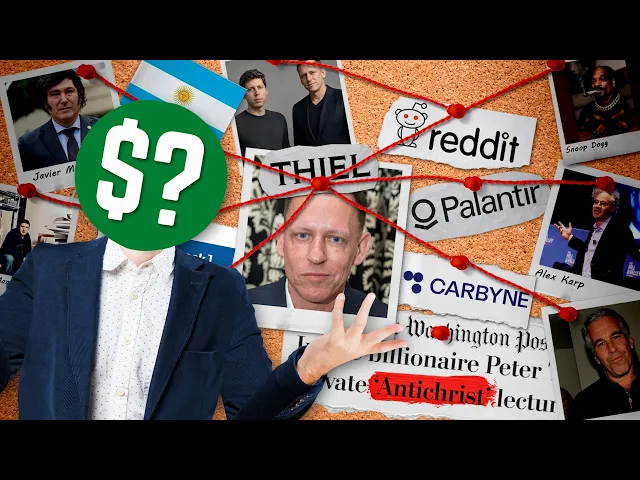
WTF Does Peter Thiel Actually Want?
How Money Works
0:00 Peter Teal is, to put it mildly, a bit of an unusual guy.
0:04 Within the last year alone, he has started a new life for himself in Argentina,
0:09 bankrolled the inaugural Enhanced Games that uh kind of flopped,
0:12 started talking other billionaires into abandoning the giving pledge,
0:16 published an essay about Watchmen and One Piece, doubled his net worth,
0:19 rifted the easiest softball interview question of all time.
0:22 You would prefer the human race to endure, right?
0:25 I don't know.
0:26 I I would I would um and to top everything off,
0:30 finished a speaking tour in San Francisco in Rome
0:33 about the Antichrist and how it is going to take
0:36 the form of tech regulation or Greta Thunberg with as far
0:39 as anybody could tell not a hint of irony.
0:43 Again, this was all just within the last year.
0:46 The time management alone would almost be
0:48 impressive if it wasn't all so strange.
0:51 Now obviously thanks to a string of successful
0:54 businesses and investments into companies like eBay,
0:57 Palanteer, Stripe, DeepMind, Facebook, SpaceX, Bitcoin,
0:59 and his own venture capital firms,
1:02 he has built an enormous private fortune alongside deep public connections,
1:06 which more than almost anybody else on Earth
1:09 has allowed him to indulge these unorthodox hobbies.
1:13 There is also a good chance that none of this is really news to you anymore.
1:17 And that's not by accident.
1:18 Just over the last decade,
1:19 Teal has gone from doing everything in his power to keep a low profile out
1:23 of the public eye to today where he
1:25 is almost seemingly trying to manufacture outlandish headlines.
1:28 And all of this all raises the obvious question of why.
1:32 Outside of just putting him in not a particularly flattering public spotlight,
1:36 these strange antics may genuinely
1:38 be impacting his underlying business interest.
1:40 So, what is it exactly that Peter Teal does?
1:44 And more importantly, what is it exactly that he wants?
1:48 A leak of private information purportedly related
1:51 to an ultra secret society called Dialogue,
1:53 founded by PayPal billionaire Peter Teal.
1:56 If you want to think about the the economy of California,
1:59 in some ways it's analogous to Saudi Arabia.
2:02 I um well I I I will I I'll get I will I will sort of get get to it by and by.
2:07 But the uh the first of the new experimental culture ideas
2:10 in Valley since the first uh the program to replace Western culture it's
2:14 framed as multicultural diversity is more than just hiring you know the extras
2:18 from the space cantina scene in Star Wars or something like that.
2:22 So you can imagine the attention and concern when Tilliel
2:27 decided to hold [music] a series of lectures on the antichrist.
2:33 All right, so like always with these videos,
2:35 it would be a lot easier and a lot more fun
2:37 to just rattle off examples of bizarre things this guy has said,
2:41 funded or supported over his career because honestly
2:43 there is a lot of material to cover there.
2:45 But for now, I want to as much as possible
2:48 leave the tinfoil hats to the side and just
2:50 break down what it is his businesses actually do
2:53 to get a clearer idea of what he actually wants.
2:56 So, from the beginning, Teal had a complicated childhood moving from Germany
3:00 to Ohio to South Africa to a uh
3:03 history city in modern-day Namibia before ultimately
3:06 settling in California when he was 10.
3:08 From there, by most accounts, he was a quiet,
3:10 studious kid that had the grades to get into Stanford,
3:13 where he founded the Stanford Review,
3:14 a student publication with a conservative focus.
3:17 After graduating from the prestigious school, he got a job as a law clerk,
3:21 then a securities lawyer at Sullivan and Cromwell,
3:23 then a derivatives trader at none other than Credit Swiss
3:26 with a side hustle of writing
3:27 speeches for Reagan's former secretary of education.
3:30 Outside of just being prestigious roles in their own right,
3:33 it's worth pointing out that he juggled all
3:35 these jobs over the course of just 3 years.
3:37 the only regular jobs that he really ever had.
3:40 Now, nobody should hold anybody's childhood or early career against them.
3:43 And the only reason it's really worth discussing
3:45 at all is to point out that despite the turbulence,
3:48 after his 3 years of holding down normal jobs came to an end,
3:51 he was still ultimately surrounded by family and friends who had the means
3:55 to invest a million dollars with him at the age of 29 in 1996.
3:59 That money was the seed capital to establish Teal Capital Management,
4:04 a small venture capital firm with the idea of using
4:06 his financial skills from his short stint on Wall Street,
4:08 mixed with his Stanford connections to invest in promising
4:11 startups before the larger VC firms got to them.
4:14 By most records, this fund didn't really do anything that noteworthy.
4:18 Its largest documented investment was a web-based calendar developed
4:21 by one of Teal Stanford friends that effectively went nowhere.
4:24 But the founder of that calendar project connected him with Max Levkin who had
4:29 another idea for a company that would
4:31 use cryptography to secure fully online payments.
4:33 So yeah, this part of the story you
4:36 have probably already seen 100 YouTube video essays on.
4:38 Although it tends to get told from the perspective of one of the other founders,
4:42 Teal Levkin and Nosk started a company called Field Link with an initial
4:46 investment of $100,000 from Teal of which
4:49 $35,000 reportedly came directly from Teal's parents.
4:52 Field Link eventually rebranded to Confinity, which launched PayPal,
4:56 which attracted further investment during the do-com hype,
4:59 merged with another online payments company co-founded by Elon Musk,
5:02 survived the crash, went public in 2002,
5:04 and by 2003 got bought outright by eBay,
5:07 giving all of the original co-founders a significant payday.
5:10 Those co-founders now colloally go by the name
5:12 of the PayPal mafia because it was
5:14 a surprisingly large group of people actually involved
5:17 in starting this business thanks to the mergings
5:19 and because almost all of these guys
5:21 double down into building more companies that love
5:23 them or hate them are just as if not more relevant than PayPal itself.
5:27 Now this whole business history is interesting and probably
5:30 worthy of its own how business worked video.
5:32 But the point is from here Tiel got a nice little
5:35 payday that he almost immediately started on his next project with.
5:38 Unlike a lot of the other PayPal mafia,
5:41 Teal didn't really have hard tech skills.
5:43 And yes, I know the raw engineering
5:45 skills of someone like Musk are hotly debated,
5:47 but he did go to school for science.
5:49 And he also at the very least saw himself as a techie engineer,
5:53 so pursued techy engineering businesses with his exit liquidity.
5:56 Teal knew what he was and what he wanted to be, a finance bro.
6:00 And less than 6 months after wrapping up the eBay sale,
6:03 he had positioned himself as the moneyman in two new ventures.
6:07 The first was Clarium,
6:08 a macro hedge fund loosely based on trading around the idea of peak oil.
6:12 This actually did pretty well in the run-up to 2008
6:15 and at its peak had around $8 billion in assets under management,
6:18 making him one of the largest hedge fund managers in the world at the time.
6:21 It didn't fare so well following the global financial crisis, though,
6:24 and a combination of bad bets plus investors pulling their money out
6:28 to shore up their own businesses meant that the fund shut down in 2011.
6:31 Although a standard management and performance fee structure still probably
6:34 made Teal a decent amount of money while it existed.
6:37 Now at almost exactly the same time he was setting up his hedge fund,
6:41 he also co-founded Palunteer Technologies.
6:42 The original thesis behind this business was
6:45 that PayPal actually had really good fraud detection.
6:47 And it did that by harvesting big
6:49 data and processing it with well-gineered algorithms.
6:51 So in the early 2000s, he thought the same kind of big data
6:55 processing could be expanded to combat well basically everything.
6:59 About 15 months after starting these two businesses,
7:02 he also made a half million dollar angel
7:04 investment into an upandcoming social network called the Facebook.
7:07 In addition to buying Zuckerberg a car and providing him personal mentorship.
7:11 As if he didn't have enough on his plate, less than a year later,
7:14 he launched Founders Fund alongside two
7:17 fellow PayPal co-founders and Sean Parker,
7:19 better known as Justin Timberlake from that movie.
7:21 This was a venture capital firm that invests in earlystage companies,
7:24 waits for them to grow, and then cashes out at a higher price.
7:28 So yeah, as far as the villain origin story goes,
7:31 this was, all things considered, pretty boring.
7:33 He had a wealthy family that funded a startup that got lucky and then
7:36 reinvested those early winnings into a venture
7:38 capital firm to recompound his wealth.
7:39 Throw a rock at a San Francisco TED talk
7:42 and you will hit 20 people with effectively the same backstory.
7:45 Also, for what it's worth, hot take alert here,
7:47 but a lot of his early investments were based on some pretty decent ideas.
7:51 Founders Fund in particular was launched with a manifesto which is not
7:55 a great sign but it did make a good point which is
7:58 that tech investment had become too focused on things that could be
8:01 flipped for a quick profit rather
8:03 than building genuinely innovative new technologies.
8:05 Teal concluded the reason for this was because worldchanging new technologies
8:09 were hard while making some new app or platform was easy.
8:12 They capped it off by saying that we
8:15 were promised flying cars instead we got 140 characters.
8:17 They also went on to point out that not everything with a plug is technology.
8:22 I mean, take the logo off it and maybe don't call it a manifesto, and honestly,
8:27 it wouldn't be that different from half the stuff
8:29 we talk about on this channel every other week,
8:31 which does make me feel some kind of way.
8:33 But it's time to learn how money works to find out
8:35 how an idealistic tech investor became one of the most powerful,
8:39 dangerous, and strange men in the world.
8:41 This video is sponsored by SY.
8:43 If you have ever been stuck abroad with no internet
8:45 and no way to call anyone, SY is the fix.
8:48 It is an e SIM app that gives
8:50 you affordable data plans in over 200 destinations worldwide.
8:53 No physical SIM card required.
8:54 You download an app, pick your plan, and you are connected the moment you land.
8:59 And Sy just added something I have been waiting for.
9:01 Instant phone numbers.
9:02 You can activate a real US number right in the app.
9:05 Use it for calls and text while
9:07 you travel and keep your personal number private.
9:10 One tap, no contract, no extra SIM.
9:12 Plans are flexible for every budget from a few
9:14 gigabytes to unlimited data and setup takes minutes.
9:17 You install the eim profile once through the app
9:20 and it activates automatically when you reach your destination.
9:22 SY also comes with built-in security that blocks malicious sites, trackers,
9:26 and ads as you browse,
9:28 which actually helps you use less data while you are abroad.
9:31 Whether it's a business trip or a vacation,
9:34 SY covers you in over 200 destinations
9:35 at a fraction of what roaming charges would cost.
9:38 They even have plans for cruise ships.
9:40 Now download the SE app or go to sely.com/howyworks and use
9:44 code howy works for an exclusive 15% discount on your data plan.
9:48 Scan the QR code on screen to get started.
9:50 Okay, so one thing to know about Teal
9:52 is that he never really stopped creating new funds.
9:55 There are serial entrepreneurs that normally have
9:58 some kind of early success and then
9:59 go on to spend their entire career founding new businesses over and over again.
10:03 And there are venture capitalists that fund those new businesses.
10:06 But Teal sort of became a serial venture capitalist,
10:09 creating a long list of funds to invest
10:11 into businesses based on different ideas he had.
10:13 Now, none of these are public because they don't need to be.
10:17 But of the ones we know about,
10:19 there are at least a dozen venture capital firms and other investment vehicles
10:22 that he has co-ounded with various
10:24 people specializing in different areas of tech.
10:26 After his hedge fund closed down in 2011,
10:28 he started Mithil Capital to invest in more mature companies,
10:31 relaunched Teal Capital as a family office to manage his other
10:35 investments and co-founded the America's Frontier Fund alongside Eric Schmidt,
10:38 the former Google CEO.
10:40 He has made co-investments into everything
10:42 from a hedge fund run by Joshua Kushner, Jared's little brother,
10:46 to a crypto investment fund alongside Mark Cuban,
10:49 a uh communications company alongside Jeffrey Epstein.
10:52 and he was also one of the early investors into Reddit alongside Sam Alman,
10:57 Jared Leto, and Snoop Dogg.
10:58 He also started Valor Ventures,
11:00 a VC firm focused on companies outside of Silicon Valley,
11:03 Crescendo Equity Partners, a private equity firm focused on Asian markets
11:06 that he started alongside his husband Matt Danzen,
11:10 and then so so many Rivendell companies.
11:13 Basically, if he needs a shell company, he just calls it Rivendell something.
11:17 That includes his personal Roth IRA fund,
11:19 which he used to make early investments into Palunteer and Facebook,
11:22 and which he grew from a $1,700 contribution in early 1999 to roughly $5
11:27 billion inside of a tax sheltered vehicle
11:29 that was designed for middle class retirement savings.
11:31 So, the lesson from all of this is
11:33 that his business ever since exiting PayPal has really
11:36 just been having money and having the right
11:38 connections to scale companies along to the next buyer.
11:41 Also to play devil's advocate a bit with that many fingers
11:44 in that many pies with that many other major public figures invariably
11:47 there are going to be some skeletons even before considering his own
11:51 personal agenda which um gets a little bit harder to defend.
11:55 Now these businesses have always had
11:57 a combination of philosophy mixed with commercial interest.
12:00 Founders fund thought that technology wasn't pushing us into the future.
12:04 His hedge fund was based on the thesis of peak oil.
12:06 All of the Lord of the Rings companies are
12:09 based on investing in some interpretation of the future.
12:11 And by itself, that's not unusual.
12:13 Most investment firms have some kind of thesis
12:15 about how they look at the market differently.
12:18 And most of the time, it's just branding to tell investors how
12:21 they're going to beat the boring index fund.
12:23 But over time, Teal's investments have
12:25 slowly shifted from being primarily motivated
12:27 by finding returns to arguably more motivated
12:30 by forwarding a very specific world view.
12:32 Founders Fund is really just a venture capital
12:34 firm that thinks it can beat the market
12:36 by investing in the hard stuff that nobody
12:39 else in Silicon Valley is brave enough to pursue.
12:41 Today, the firm manages roughly 17 billion in assets.
12:44 America's Frontier Fund is slightly more ideological and wants to bring
12:48 tech manufacturing back to America to stem the power of China.
12:52 But, you know, realistically, this could also make some money.
12:55 But then there are investments like Prenomus,
12:57 a venture capital firm founded by Patri Freriedman.
12:59 Fun fact, the grandson of Milton Friedman, the libertarian economist,
13:03 that is about pushing the idea of semi-aututonomous tech forward cities.
13:07 Even if these were successful,
13:08 it is unclear how they would provide a return to their investors.
13:12 So, this is arguably much more motivated by Teal's
13:15 ideology of libertarian cities and limiting government controls.
13:18 This has also extended to practice,
13:20 a smaller organization that Teal has heavily invested
13:22 in that wants to establish an independent internet
13:25 native nation with a future Ford city outside
13:27 of the direct influence of any existing nation state.
13:30 The company has reportedly raised over $525 million from investors.
13:34 Now, this is a wild enough idea by itself,
13:37 but some of the influences shaping the objectives of practis have uh generously
13:42 been described by outlets like the New York Times as a little bit fascist.
13:46 One of the co-founders of this particular project
13:48 talked of wanting to establish a non- US city as a place for tech leads to go
13:53 to if the US political environment became less tech friendly.
13:56 Now today, our tech leaders accompany the president on diplomatic missions,
13:59 stand in front of the cabinet at inauguration,
14:01 and pretty openly float the idea of government co-investment.
14:04 So with all of that in mind, you might reasonably think that the US
14:09 political environment has arguably never been more tech-friendly.
14:12 Teal would disagree.
14:13 Largely in response to proposed wealth tax measures in California, he has,
14:17 as of about 10 months ago, taken up primary residency in Argentina.
14:21 But the move also came with some other advantages.
14:24 The country's president, Javier Malay, shares his libertarian ideologies,
14:28 and the two are reportedly working
14:30 closely on business and technological partnerships.
14:32 So, it's not unreasonable to think that he wants
14:35 to develop one of his tech cities down in Argentina.
14:38 Another noted advantage of the move is
14:40 that Argentina is a geographically isolated and resourcerich country.
14:43 So in the event of the AI apocalypse,
14:46 it would make a great doomsday bunker location.
14:48 Now you might remember that Teal already fasttracked
14:50 New Zealand citizenship where he reportedly also has
14:53 a doomsday bunker that he and Sam Alman were going to share the end times in.
14:58 So Argentina is kind of the backup to the backup.
15:01 But to be fair, this move is not without precedent.
15:04 About 80 years ago, there was another group of Argentine immigrants that also
15:08 moved to the country to avoid political uh All right, moving on.
15:13 So, yeah, Teal has made more money and developed more contacts.
15:17 His objectives pretty clearly shifted from just making even more money
15:21 to advancing his own ideologies under the guise of investing in the future.
15:25 This also included very heavy spending on politics,
15:27 including $15 million on JD Vance when he was running for senator in Ohio.
15:31 The largest single donation to a Senate
15:34 candidate in American history at the time.
15:36 Now again, to be fair,
15:37 political spending from wealthy individuals is objectively extremely common,
15:40 and we did a whole video on it.
15:43 But Teal's super PAC, Protect Ohio Values,
15:45 went slightly further than just running ads.
15:48 They reportedly uploaded voter data to an obscure blog for Vance's
15:51 team to stumble upon rather than handing it over directly,
15:54 which would have broken the arms distance rule of super PACs.
15:58 This was challenged for being a pretty blatant flatting of the rules,
16:00 but the case was ultimately dismissed.
16:02 Beyond politics, he has also always had
16:05 a very complicated relationship with the media.
16:08 Before the 2020s, he actually tried to remain very private,
16:11 doing most of his business in ideological work behind the scenes.
16:14 This was kind of derailed by an article from the publication Gawker,
16:18 which outed him as gay back in 2008.
16:20 Now, to be fair, that was kind of a dick move,
16:23 especially since at the time Teal wasn't a particularly notable public figure.
16:27 He did not like this one little bit.
16:30 In response, he personally financed the lawsuits
16:32 of several people who were suing Gawker, most notably Hulk Hogan,
16:36 with the eventual end goal of bankrupting the outlet entirely.
16:39 A jury awarded Hogan $140 million in 2016,
16:42 and Gawker filed for bankruptcy shortly after.
16:45 Of course, by this point,
16:47 thanks to the media circus and his growing wealth tied to major companies,
16:50 he was in the media whether he liked it or not.
16:53 Now, the irony in all of this is that Teal also co-founded Palanteer,
16:56 which is a company built
16:58 on compiling privacy violating information about everybody.
17:01 The US government alone paid them $687 million in the first
17:04 quarter of this year for exactly that kind of work.
17:07 And then literally as we were putting this video together,
17:10 Teal and Enhanced Games founder Aaron Duza made another
17:13 move to shake up the journalism industry by launching Objection,
17:16 a company that uses AI to evaluate journalists claims and which
17:19 offers a service where for $2,000 anybody can dispute a story,
17:23 whereby the journalist's claims get scored by a panel of AI models,
17:27 which isn't at all dystopian.
17:28 Now, all of these battles kind of had a Barbara Stryzen effect where they put
17:33 him further into the public spotlight and now he is kind of just embracing it.
17:37 Today, he speaks very openly,
17:39 is very upfront with his politics and even is more outlandish ideologies.
17:42 He came up through Silicon Valley in the early
17:45 2000s in the 2010s where these kinds of ideas would have been very against
17:49 the grain and probably cost him major partnerships,
17:51 investments, and opportunities.
17:53 And well, it arguably still does.
17:55 Venture capitalists need promising founders with ideas just
17:58 as much as founders need venture capitalists with money.
18:01 There are a lot of potentially promising
18:03 entrepreneurs that just simply would not want to work with Peter Teal or any
18:07 of his several funds because of his controversial views.
18:09 What's more is that this is potentially
18:11 even having an impact on his existing businesses.
18:14 Palanteer does most of his work with governments and well
18:17 at least some of those governments are beholden to their people.
18:20 Teal is a German citizen and he is still having trouble
18:23 with his German drone company because
18:24 the government is uneasy about his political positions.
18:27 This is costing him real money and real opportunities.
18:30 So why not just shut the[ __] up?
18:33 His life would arguably be a lot easier and his business is a lot less
18:37 scrutinized if he didn't go out of his way to look like a super villain, right?
18:41 But the boring reality is that he has more money than he will ever spend.
18:46 and he seems to genuinely think he can convince
18:48 people that his ideas have their best interest at heart.
18:51 To that end and in anticipation of some push back,
18:54 he has also engineered his entire portfolio
18:56 and life for that matter to be extremely robust.
18:59 He has multiple citizenships in Germany, the United States, and New Zealand.
19:04 And he also applied for a passport in Malta in 2022.
19:07 He has structured companies specifically
19:09 incorporated and diversified across the planet.
19:11 and he has an extensive network and friends in very high places.
19:15 He is also not tied to a single
19:18 business like almost every other billionaire at his level.
19:20 Someone like Zuck, Bezos,
19:22 Ellison or even Musk are for better or worse poster boys for their companies.
19:26 Most people would have no clue what Teal is actually invested in.
19:29 And even with all of this background, his private holdings are private.
19:33 So we probably don't know the full extent of where his money is.
19:36 Yeah, sure.
19:37 He is associated with Palanteer, which is almost certainly by far his largest
19:41 asset at a roughly $9 billion stake.
19:43 But nobody thinks that is a nice company.
19:46 Its value isn't going to drop because of bad PR.
19:49 If anything, leaning hard into the school cap baddy bond villain thing
19:52 kind of cements what the company does to a lot of investors,
19:55 and average people aren't their customers anyway.
19:57 So, he can get away with saying whatever he wants
20:00 without the same vulnerabilities that other major business leaders have.
20:03 It just so happens that what he wants to say is kind of a bit out there.
20:08 Also, for what it's worth, he probably misses out on a lot of SoCal soy
20:12 boy founders that believe in nonsense
20:13 things like humanity's continued existence.
20:15 But for a lot of founders that want
20:18 to pursue less PC initiatives like nuclear tech,
20:20 weapons or big data harvesting, he is the first person they will go to.
20:24 Which means again to play devil's advocate,
20:26 saying wild things that makes headlines
20:28 is good marketing for his core businesses,
20:30 which is investing money into companies
20:32 that put returns over traditional ethics.
20:34 Now, it is almost impossible to cover this guy without simultaneously
20:37 him and going down a conspiracy rabbit hole at the same time.
20:41 Obviously, he is not advocating for a future
20:43 where regular people come out on top.
20:45 and he isn't really even trying to hide that.
20:48 But arguably the bigger problem is that people with this much
20:50 money can have so much influence to begin with.
20:52 Now, if you want to see all of these systems actually put to work,
20:55 go and watch this video next to find out
20:57 how money and politics made this a truly unsolvable problem.
20:59 And don't forget to like and subscribe to keep on learning how money works.