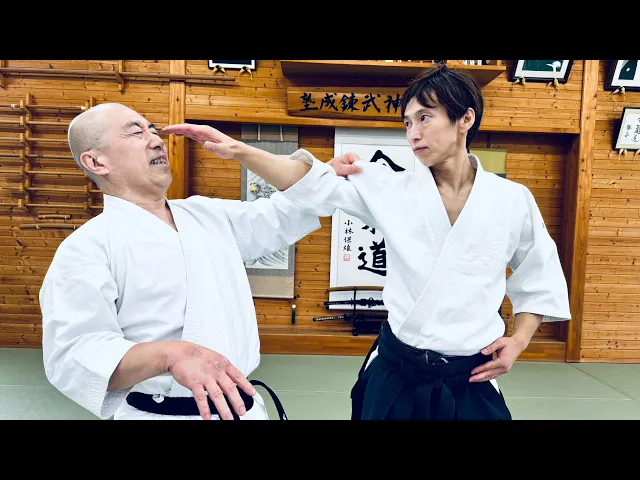
Terrifying Eye-Piercing in Kung-fu / Ultimate Relaxation in Aikido
kuro-obi world
0:00 What would you do if someone grabbed you here?
0:02 There are various ways to handle it.
0:07 This is a scene from the Blu-ray box set “Crossroad Evolution.”
0:10 Today, Aikido master Ryuji Shirakawa demonstrates and explains the Chinese martial arts techniques performed by Master Tamotsu Miyahira in this Youtube.
0:17 Today's theme is “Eye-Strikes and Relaxation.”
0:21 When grabbed, this is what you do in Aikido.
0:31 These are the techniques of Aikido.
0:34 Next, Miyahira sensei's technique.
0:39 Strike suddenly without any wasted motion.
0:50 Such completely waste-free movements.
0:54 He doesn't need to do things like this.
1:00 Truly without waste.
1:07 Truly characteristic of Miyahira sensei!
1:11 Ordinary people can't pull off such terrifying attacks.
1:13 Yeah. Aiming for the eyes is impossible.
1:16 Normally, you'd first try to pin the opponent down.
1:20 Miyahira sensei doesn't think about “subduing”—only “destruction.”
1:24 However, in Aikido, the goal is to subdue.
1:27 But Chinese martial arts aim to kill and destroy.
1:34 If a woman is grabbed, she won't be able to escape even if she tries.
1:43 But using this technique might allow children and women to escape danger.
1:48 This is truly useful self-defense, I think.
1:56 Regarding the eye strike, Miyahira sensei said, “Don't aim for the opponent's eyes; instead, draw the opponent's eyes toward your own fingers.”
2:08 It's hard to hit eyes that move freely with your finger.
2:12 So you pull the opponent's eyes toward your finger.
2:18 To make sure you hit the eyes, you do it like this.
2:29 That was interesting, wasn't it?
2:30 Yes, that way of thinking was interesting.
2:32 Usually, you follow the other person's eyes with your finger.
2:35 Instead, you draw their eyes toward your finger.
2:39 And you pierce the eye with your finger.
2:42 That's right.
2:44 That way of thinking was interesting.
2:46 I thought that was completely different from ordinary thinking.
2:52 Without actually experiencing that situation, that idea wouldn't have been conceived.
3:03 That kind of idea is hard to come by.
3:06 That's a completely waste-free motion.
3:09 If you evolve it further...
3:16 It's better to step on his foot first, then attack his eyes.
3:20 Once he steps on my foot, I can't pull this hand away from him.
3:23 Why is that?
3:25 It's strange.
3:26 I must be tensing up.
3:29 I should let go immediately, but I can't.
3:33 Because I try to support my body.
3:35 It's natural for your body to tense up the moment you're attacked.
3:44 But you're trained to relax your body precisely when attacked, right?
3:48 That's right.
3:49 When you lock his joints like this, his body stiffens.
3:54 This is normal.
4:03 But you can relax even at this very moment?
4:07 Yes, I can.
4:08 This will make your body stiffen.
4:16 But handle it as gently as possible to prevent stiffening.
4:24 Even if your arms are pinned, keep moving.
4:32 Train to keep moving even when your arms are pinned?
4:34 That's right.
4:37 For example, even if lifted by “aiki-age,” you should be able to move without freezing up.
4:55 To make it easier to understand, let's have Taka try it first.
5:02 I see, so this is the normal case.
5:06 And what about Shirakawa sensei's case?
5:14 When you become this tense, you can't do anything.
5:18 But if you can relax, your body won't freeze up.
5:22 In Aikido, we practice this relaxation on a daily basis.
5:30 In cases where one becomes physically stiff.
5:47 But if you can relax, this is what happens.
6:01 For example, if you can't relax, you'll be knocked down violently like this.
6:12 In a normal case, your entire body collapses.
6:16 If only you could relax...
6:28 Even though it's normal for the body to freeze in dangerous situations, you train yourselves to relax completely even in that moment?
6:45 Yes. It's ingrained through daily practice.
6:49 Normally, bodies freeze when they collide.
6:52 We're practicing absorbing that impact softly.
6:56 Taka, what did you think?
6:57 I can't help but wonder just how incredibly hard he must have trained for such an incredibly long period of time.
7:06 I've practiced it constantly, so I've mastered it completely.
7:09 I think it's very difficult to keep that constantly in mind while practicing.
7:22 Shirakawa sensei seems to be enjoying his activities on YouTube and such, but I think he's actually been putting in an incredible amount of practice.
7:33 Yes, I've been practicing for many years.
7:36 Especially in aikido, there are many exercises that focus on developing flexibility.
7:46 Miyahira sensei said that all martial artists should practice Aikido last, didn't he?
7:52 Yes, he did say that.
7:55 I think he meant to acquire soft movements.
7:58 Learning Aikido after mastering some other martial art allows you to use your body softly.
8:05 Yes, I think there's a very deep meaning in those words.
8:07 Not learning Aikido from the start, but learning various martial arts first and then learning it last.
8:22 This leads to a deep understanding of the true value of Aikido's gentle movements.
8:30 I believe this is something only Miyahira Sensei could say because of his deep understanding of Aikido.
8:36 You don't start with Aikido first.
8:39 What Aikido lacks can be found in other martial arts.
8:45 Therefore, if you learn other martial arts before studying Aikido, you will understand the meaning behind Aikido's body usage and its soft movements.
8:53 I think those words carry that meaning, which is why I was so happy.
9:01 I think he understood Aikido's weaknesses and said, “Aikido should be practiced last.”
9:11 It's precisely because he didn't just say “Aikido is the best” that I'm pleased.
9:18 He truly understands Aikido.
9:23 He also mentioned its position being like Tai Chi in Chinese martial arts.
9:28 In China too, after learning various martial arts, one studies Tai Chi last.
9:37 With age, one changes from rigidity to flexibility.
9:44 I believe softness and gentleness are what truly matter.
9:50 Taka, since you're 65, why not start Aikido?
9:53 Maybe my stiff wrists will loosen up...
9:56 Let's start Aikido after we turn 60!
9:59 Let's keep evolving together!
10:03 This is how I evolved.
10:08 If you want to see more, buy the Blu-ray Crossroad Evolution.