How Physicists Proved Everything is Quantum - Nobel Physics Prize 2025 Explained
Dr Ben Miles
0:00 The 2025 Nobel Prize in Physics was just awarded to John Clark, Michael H.
0:03 Devay, and John M.
0:05 Martinez for their experimental work,
0:06 revealing that the weird world of quantum mechanics can be
0:09 seen not just at the level of atoms and particles,
0:12 but even at sizes that human beings are more familiar with.
0:15 The heart of their discovery is one of the most
0:17 fundamental and frankly weirdest features of quantum mechanics,
0:20 something called quantum tunneling.
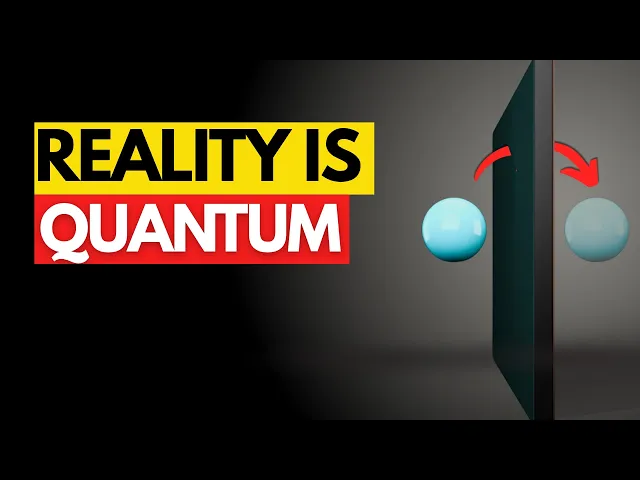
0:22 If I throw this ball or anything against a wall, it bounces back.
0:26 It's a lemon.
0:26 It doesn't bounce very well every single time.
0:29 But if we take this into the quantum
0:31 realm by shrinking this example down to the subatomic
0:33 level and instead of a ball imagine an electron
0:36 and make our wall very very thin with each
0:39 bounce against the wall there is some small
0:41 chance that the electron doesn't bounce back but instead
0:44 passes straight through the wall and appears on the other
0:47 side without ever being present inside the wall.
0:50 That other than my favorite explanation as to how Santa gets down small
0:53 chimneys is the idea that shows us how weird the quantum world can be.
0:57 And thinking about quantum objects as tiny billyard balls isn't accurate.
1:00 Instead, we need to think about them
1:02 as objects without any definite edges, as waves.
1:06 In quantum mechanics, a particle doesn't have one exact position.
1:10 Instead, it can be described by a wave function,
1:12 a mathematical shape that tells you where it's most likely to be found.
1:16 The taller the wave, the higher the chance that you'll detect it there.
1:19 The wave fades at its edges, but it never quite reaches zero.
1:22 Meaning that there is always a small
1:24 chance that that particle could be somewhere unexpected.
1:27 So when that probability wave meets a barrier,
1:29 part of it is reflected, but part of it can seep through,
1:32 carrying the tiny possibility that that particle can
1:35 appear on the other side as if by magic.
1:37 That means that for an electron traveling down a wire,
1:39 if there is a break in the wire,
1:41 there is a small chance that that electron could hop over the gap
1:44 and continue on its journey as if the wire wasn't broken at all.
1:48 In fact, we are engineering computer chips down
1:50 to the sizes where that is becoming a real problem.
1:52 Components are so close together,
1:54 electrons can jump from one circuit to another,
1:56 even when we don't really want them to.
1:58 Weird, but that is the quantum worldview.
2:00 And for most of the 20th century, quantum effects were believed to be limited
2:03 to this tiny regime exclusively to electrons,
2:06 photons, atoms, and things small since
2:08 larger objects always appear to behave classically.
2:10 But in the 1980s at the University of California,
2:13 Berkeley, John Clog, Michael Devay, and John Martinez,
2:16 Martineis set out to find if these sorts
2:18 of strange behaviors could also happen at the macro scale.
2:21 They turned to this idea of the electron jumping across a gap,
2:24 but in a specific form called a Josephson junction,
2:27 where two superconducting wires are sandwiched
2:29 either side of an insulating barrier, which acts as the gap,
2:33 creating an impenetrable wall that classical
2:35 electrons shouldn't be able to cross.
2:37 In a normal wire, as electrons are negatively charged,
2:39 they repel each other as well as scatter off of other atoms,
2:42 constantly losing momentum.
2:44 That scattering is what causes electrical resistance
2:46 and produces heat and light in our electronics.
2:48 But in a superconductor, when cooled down to some of the lowest
2:51 temperatures in the universe, everything changes.
2:54 As an electron moves, it slightly distorts the latis of metal ions around it,
2:59 leaving behind a small region of positive charge.
3:02 Another electron can feel that positive region
3:05 and is attracted to it following behind
3:07 the first electrons path and linking these two
3:09 electrons together into something we call Kooper pairs.
3:12 Inside the superconductor,
3:13 billions of these pairs move together without any resistance
3:16 at all described by a single collective wave function.
3:19 When that wave function reached the thin
3:21 insulating barrier of the Josephson junction,
3:23 it can extend into the barrier overlapping
3:25 with the wave function on the other side.
3:28 That overlap allows Cooper pairs to tunnel through,
3:30 creating a steady supercurren with zero voltage,
3:34 the hallmark of superc conductivity.
3:36 This effect won Brian Josephson the junction's
3:38 name the Nobel Prize back in 1973.
3:41 The Berkeley team though wanted to take this one step further.
3:44 They wanted to see if the whole wave function representing billions of Koopa
3:47 pairs within the wire could tunnel through
3:50 the barrier as a single quantum object.
3:52 That would be macroscopic quantum tunneling.
3:54 tunneling on a range that is relevant to human beings.
3:57 To run the experiment, they needed to measure the tiniest possible
4:00 changes in current and voltage across the junction.
4:03 They used a dilution refrigerator to cool
4:05 the junction to just a few tens of millichelvin,
4:07 temperatures colder than interstellar space,
4:10 and surrounded the setup with layers
4:11 of magnetic shielding and microwave filtering.
4:13 Then, as they passed a precisely controlled current through the junction,
4:17 at low currents, everything behaved as superconductivity predicts.
4:20 a steadystate supercurren flowed producing no voltage
4:24 at all as Koopa pairs tunnneled across the barrier.
4:27 But as the current continued to increase at a certain critical value,
4:31 counterintuitively to superconducting systems,
4:34 suddenly a voltage started to appear.
4:36 That spike meant that the collective quantum state had
4:39 escaped its confinement and was tunneling across the junction.
4:43 Now, it turns out the microscopic quantum tunneling of a wave
4:45 function representing billions of electrons is kind of hard to draw.
4:48 So, if that doesn't mean much to you, I'm kind of right there with you.
4:51 Without relying on just talking through the math,
4:53 let's talk about why that voltage is arising and why
4:55 that tells us this is a macroscopic quantum tunneling event.
4:58 As the wave function escapes, its relative overlap compared to the wave
5:02 function on the right hand side changes.
5:04 That continual variant is what's driving a voltage.
5:06 And that's what tells us it's
5:08 something about this macroscopic wave function that's
5:10 actually moving and is different from individual
5:12 cooper pairs just tunneling over the junction.
5:13 Maybe the more important question to ask here is how do
5:16 we actually know this is a quantum tunneling process that is happening?
5:19 Because there are situations where classical physics can explain this switch.
5:23 At higher temperatures,
5:24 random thermal energy can jolt the wave function over the barrier,
5:27 a process called thermal activation.
5:29 Actually, at higher temperatures,
5:30 we see a strong correlation between temperature
5:32 and the current required to see this phenomenon.
5:35 What tells us though that this is a quantum
5:36 process is that as these temperatures are decreased,
5:39 the escape rate stops showing any dependence on temperature at all,
5:44 moving it out of how classical systems behave at these temperatures.
5:47 This process can only be the quantum system
5:49 representing billions of Koopa pairs tunneling through the barrier,
5:53 proving to us for the very first time that quantum properties
5:56 of the universe happen even at scales above the individual particle.
6:01 Back in 1935, Shreddinger was talking about a cat in a box to make a point
6:04 about how absurd quantum theory sounds when
6:06 you take it out of the microscopic world.
6:09 But here we are.
6:10 Thanks to Clark Devet and Martinez, we've seen actually it is entirely possible.
6:15 It's not the zombie cap that we were promised,
6:16 but it laid the foundations for superconducting cubits that we use today where
6:20 the same principles of these early Joseph
6:22 and junctions are harnessed to control quantum states.
6:25 This discovery often gets so much visibility
6:27 and celebration because it is the underpinning part of so much of what quantum
6:31 mechanics and quantum computation now relies upon.
6:34 But keep in mind that this is all the output of that discovery.
6:38 This took decades to finally prove and was driven purely by curiosity
6:42 and a need to know without necessarily
6:45 understanding any of what might be potentially unlocked.
6:48 Just testing a theory out against the behavior of the universe
6:50 until we proved it one way or the other.
6:52 and it's why this work feels so worthy of a Nobel Prize to me.
6:55 If you made it this far without your wave function collapsing
6:57 and would like to support the channel and the content that we make,
7:00 hit the like button and join our Patreon if you'd like.
7:02 You'll see some updates about a quantum computing company that I just visited.
7:05 Congratulations to the rest of this year's Nobel laureates.
7:07 Thank you for watching.
7:08 I'll see you in the next one.