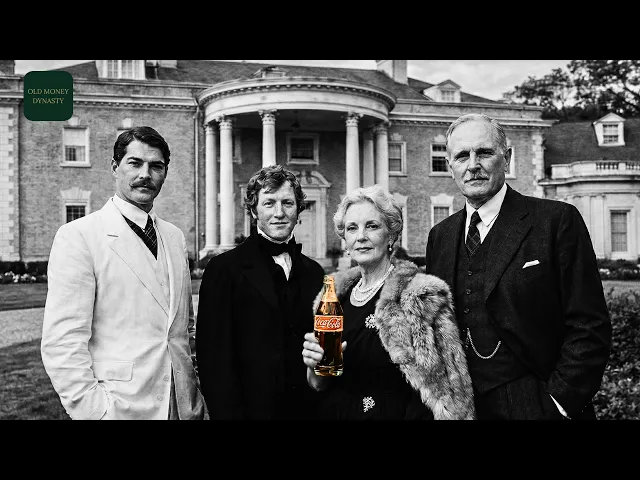
The Rise and Ruin of the Coca-Cola Family | Full Documentary
Old Money Dynasty
0:00 On the 16th of August, 1888,
0:02 every druggist in Atlanta locked the doors of their shop and walked
0:05 together through the summer heat to bury one of their own.
0:08 The man in the coffin had invented something,
0:10 a dark carbonated syrup that he sold
0:12 from a pharmacy counter for 5 cents a glass.
0:16 He died broke, still chasing the morphine
0:19 that had owned him since the Civil War.
0:21 His name was John Stith Pemberton.
0:24 The drink was Coca-Cola.
0:26 Within 3 years of his death, an ambitious pharmacist named Asa Griggs Candler
0:32 would claim full ownership of that formula.
0:35 He paid, across a series of murky deals, a total of around $2,300.
0:41 Candler turned those $2,300 into a corporation worth millions.
0:46 He built skyscrapers.
0:48 He bankrolled a university.
0:50 He became the mayor of Atlanta.
0:53 Then, in 1919, his children sold the entire
0:57 company to a group of investors for $25 million.
1:00 Today, the Coca-Cola company is valued at roughly $340 billion.
1:05 The Candler children used their money to build
1:07 enormous mansions across Atlanta's most fashionable neighborhood.
1:12 They filled those homes with pipe organs, exotic animals, and scandal.
1:17 One heir drank himself to ruin.
1:20 Another watched her husband die from gunshots in their own library.
1:24 The patriarch himself ended his days in tabloid disgrace,
1:28 married to a woman half his age.
1:31 The family that replaced them, the Woodruffs,
1:33 held on for 60 years and built a global
1:36 empire from the ashes of the Candler sale.
1:39 This is the story of Coca-Cola's two dynasties, what they built,
1:44 what they lost, and the price of selling too early.
1:48 Chapter 1, the wounded soldier's recipe.
1:53 On a warm Easter Sunday in April of 1865,
1:56 Union Cavalry under General James Wilson stormed the city of Columbus, Georgia.
2:01 It was among the last engagements of the Civil War,
2:04 fought days after Lee had already surrendered at Appomattox.
2:08 Most of the soldiers defending the city knew the war was over.
2:11 They fought anyway.
2:13 Among them was a 43-year-old pharmacist serving
2:16 as lieutenant colonel in the Third Georgia Cavalry Battalion.
2:21 His name was John Stith Pemberton.
2:23 During the assault, a Union saber caught him across the chest.
2:27 The wound nearly killed him.
2:29 The morphine they gave him to manage the pain
2:31 would finish the job slowly over the next 23 years.
2:36 Pemberton had been a respected figure long before the war.
2:40 Born in 1831 in Knoxville, Georgia, he earned his pharmacy license at 19
2:46 and built a successful practice in Columbus.
2:49 His laboratory was considered among the finest in the South,
2:53 stocked with $35,000 worth of specialized equipment.
2:57 He married Ann Eliza Clifford Lewis in 1853.
3:02 They had one son, Charles.
3:03 [music] After the war, Pemberton moved his operations to Atlanta,
3:08 a city pulling itself from the wreckage of Sherman's march.
3:12 He manufactured patent medicines and sold them across the region.
3:16 But private agony drove his professional ambition.
3:19 The morphine dependency that followed his injury
3:21 consumed both his health and his income.
3:23 [music] He experimented constantly,
3:26 searching for something that could replace the drug that was destroying him.
3:30 His first significant attempt was a concoction he called French Wine Coca.
3:34 It blended red wine with extracts of the coca leaf and the cola nut.
3:39 The coca provided cocaine.
3:41 The cola provided caffeine.
3:43 He marketed it as a cure for nervous disorders, headaches, and fatigue.
3:48 It sold well across the Southeast.
3:50 But in 1886, Atlanta and Fulton County passed
3:53 temperance legislation that banned the sale of alcohol.
3:57 Pemberton's profitable tonic was suddenly illegal.
4:00 He had to reformulate.
4:02 Working with drugstore owner Willis Venable,
4:04 he stripped out the wine and adjusted the recipe through trial and error.
4:08 What emerged was a thick, sweet syrup.
4:11 Mixed with carbonated water at a pharmacy counter,
4:14 it produced something altogether different from medicine.
4:17 Pemberton's bookkeeper, Frank Robinson, suggested the name.
4:20 He thought two capital C's would look striking in advertising.
4:24 Robinson also penned the flowing script logo by hand.
4:28 It remains virtually unchanged to this day.
4:32 On May 8th, 1886, the first glass of Coca-Cola
4:36 was poured at Jacob's Pharmacy in downtown Atlanta.
4:40 It sold for 5 cents.
4:42 About nine servings moved on an average day.
4:46 Pemberton ran his first newspaper advertisement 3 weeks later,
4:50 calling it delicious, refreshing, and invigorating.
4:54 He sensed the formula had potential.
4:57 [music] He told associates that it might someday become a national drink,
5:00 but his body was failing.
5:02 Stomach cancer joined the morphine addiction
5:04 in draining whatever remained of his strength.
5:07 Desperate for money, he began selling off pieces of his ownership
5:11 to various business partners around Atlanta.
5:14 His son, Charlie, wanted cash, not shares.
5:17 [music]
5:17 Through a tangle of deals that historians still struggle to fully untangle,
5:21 a fellow Atlanta pharmacist named Asa Griggs
5:23 Candler acquired the rights to the name,
5:26 the formula, and the business in stages between 1888 and 1891.
5:33 The total cost across all transactions [music] came to roughly $2,300.
5:38 Pemberton did not live to see Candler's first full year of ownership.
5:42 He died at his home in Atlanta on August 16th, 1888, 57 years old.
5:48 The cancer had spread through his stomach.
5:51 The morphine had long since spread through everything else.
5:55 His body was returned to Columbus and buried at Linwood Cemetery.
5:59 He left behind a widow with nothing
6:01 and a son who had inherited his father's worst affliction.
6:06 Charlie Pemberton tried to sell his own version of the formula.
6:09 It went nowhere.
6:11 He died roughly 6 years after his father consumed
6:15 by the same opiates that had started it all.
6:18 The drink they left behind had barely begun.
6:21 Chapter 2, the pharmacist who bought an empire.
6:27 The story goes that Asa Griggs Candler arrived in Atlanta
6:30 in 1873 with a dollar and 75 cents in his pocket.
6:34 He was 21 years old.
6:36 A druggist named George Jefferson Howard hired him on his first day.
6:40 And Candler reportedly stayed until midnight without
6:43 pay just to prove he was worth keeping.
6:46 Within 5 years he had married the boss's daughter,
6:49 Lucy Elizabeth Howard and bought into a competing pharmacy.
6:53 Within a decade, he owned it outright.
6:56 Candler was not a glamorous figure.
6:59 He was a Methodist who did not drink, did not approve of idleness,
7:02 and measured a man's character by how early he arrived at the office.
7:07 He built a profitable business manufacturing patent medicines,
7:10 but he understood that the real money was
7:12 in finding one product that could sell everywhere.
7:16 He first tasted Coca-Cola sometime in the late 1880s.
7:20 Candler suffered from chronic headaches.
7:23 Someone offered him a glass.
7:25 He liked it.
7:27 More importantly, he watched other people like it.
7:31 While Pemberton saw medicine, Candler saw a refreshment.
7:35 The acquisition of the formula cost
7:37 him roughly $2,300 across several transactions.
7:42 What came next cost him everything he had in a different sense.
7:46 His first strategic decision was critical.
7:48 He stopped advertising Coca-Cola as a cure for ailments
7:51 and began promoting it simply as a delicious drink.
7:55 In 1892, he incorporated the Coca-Cola
7:57 Company with an initial capitalization of $100,000.
8:01 Then came the coupons.
8:04 Thousands of handwritten tickets offering
8:05 a free glass at any participating drugstore.
8:09 He sent barrels of syrup to pharmacies that had never
8:11 heard of the product wagering that once people tasted it,
8:14 they would come back and pay.
8:17 By 1895, Coca-Cola was sold in every state and territory in the country.
8:23 Syrup sales had grown from roughly 9,000 gallons
8:26 in 1890 to more than 370,000 gallons by 1900.
8:31 He also sold the bottling rights.
8:33 In 1899, two lawyers from Chattanooga convinced Candler to let
8:37 them bottle and distribute Coca-Cola across most of the United States.
8:41 He charged them $1.
8:44 He did not believe bottles would amount to much.
8:47 Within 20 years, more than a thousand bottling plants were operating nationwide.
8:52 It was one of the most consequential misjudgments in American business.
8:56 As wealth accumulated, Candler remade Atlanta.
9:00 He completed the Candler Building on Peachtree Street in 1906,
9:04 a 17-story marble tower that became
9:07 the city's tallest structure and first steel skyscraper.
9:11 He developed the Druid Hills neighborhood,
9:13 personally financing roads and water lines.
9:16 In 1914, he pledged $1 million and 75 acres to relocate
9:22 Emory College from the small town of Oxford to Atlanta,
9:25 [music] where it became Emory University.
9:28 His lifetime gifts to the institution totaled roughly $8 million.
9:33 In 1916, he ran for mayor and won,
9:35 handing control of Coca-Cola to his five children.
9:39 The following May, a warehouse fire in the Fourth Ward
9:42 spread across 50 city blocks and destroyed more than 1,500 homes.
9:47 Candler ordered houses dynamited to starve the flames.
9:50 The city rebuilt.
9:52 But by 1919, his wife Lucy was dead of breast cancer after 41 years of marriage.
9:58 Within months, the children he had entrusted
10:01 with his empire did the one thing he never expected.
10:03 They sold it.
10:05 Chapter 3, The Bottle That Conquered America.
10:10 By 1915, Coca-Cola had a problem that had nothing to do with taste.
10:14 It had imitators, dozens of them.
10:16 Companies with names like Coconola, Coca-Cola,
10:19 and Mocola were filling identical straight-sided bottles
10:22 with similar-looking syrup and hoping nobody would notice.
10:25 Many customers did not.
10:27 Paper labels peeled off in the ice
10:29 buckets where shopkeepers stored their drinks.
10:32 And once the label was gone, every bottle looked the same.
10:36 [music] The Coca-Cola Bottling Association wanted a bottle so distinctive
10:38 that a person could recognize it by touch in the dark,
10:41 even broken on the ground.
10:43 The shape alone should give it away.
10:46 They sent the challenge to roughly 10 glass manufacturers across the country.
10:51 In Terre Haute, Indiana,
10:53 a team at the Root Glass Company went looking for inspiration.
10:57 The designer, a machinist named Earl Dean,
11:00 walked to the local library with a colleague and searched
11:03 for images of the coca leaf and cola nut.
11:05 They found neither.
11:08 What they did find in the Encyclopedia
11:10 Britannica was an illustration of a cocoa pod.
11:13 Coca-Cola had nothing to do with cocoa,
11:16 but the pod had an elongated shape with prominent ribs that caught Dean's eye.
11:20 He sketched a bottle based on its curves.
11:23 The original prototype was fatter than what eventually went into production.
11:27 The bulging center would not fit the existing bottling machinery,
11:30 so the design was slimmed and adjusted over the summer of 1915.
11:35 The patent was filed under the name of Root Glass Plant supervisor,
11:39 Alexander Samuelson.
11:41 Dean chose lifetime employment at the company over a $500 prize.
11:46 Coca-Cola's executives picked the Root design as the clear winner.
11:50 Bottlers across the country began using the new contour bottle in 1917.
11:55 Within a few years, it had become
11:57 the most recognizable commercial container in the world.
12:00 In 1950, it became the first consumer product
12:04 ever featured on the cover of Time magazine.
12:07 The bottle did more than sell drinks.
12:09 It made Coca-Cola impossible to counterfeit.
12:12 And it turned a liquid commodity into something closer to a branded object.
12:17 When Asa Candler's children decided to cash out 2 years later,
12:20 the contour bottle was part of what made the company worth
12:22 buying at a price that would have seemed absurd a generation earlier.
12:27 Chapter 4, the $25 million mistake.
12:32 The children did not agonize over the decision.
12:34 Their father had handed them control of the Coca-Cola
12:37 company in 1916 when he became mayor.
12:40 Their mother was dying.
12:41 The business, while enormously profitable,
12:44 faced an uncertain regulatory climate and growing
12:47 legal battles over caffeine and labeling.
12:50 When a syndicate led by Ernest Woodruff,
12:52 president of the Trust Company of Georgia,
12:54 offered $25 million, the Candler heirs took it.
12:59 The deal closed on September 5th, 1919.
13:02 It was the largest financial transaction in the history of the American South.
13:07 The new owners immediately restructured the company and took it public.
13:11 500,000 shares were offered at $40 each.
13:14 Investors across Atlanta lined up to buy.
13:18 A single share purchased that year would eventually be worth millions.
13:21 Asa Candler, still mourning his wife, accepted the sale with resignation.
13:27 He later remarked that when he gave the children the business,
13:30 it became theirs to do with as they wished.
13:33 He would not have sold, he said,
13:35 but from a business standpoint, they had driven a hard bargain.
13:39 Whether he believed that or merely needed to, the record does not say.
13:44 The children believed they had been shrewd.
13:46 $25 million in 1919 was an almost incomprehensible fortune.
13:52 They could not have known that the company they had just
13:54 released would grow into one of the most valuable corporations on Earth.
13:59 They could not have foreseen Robert Woodruff, Ernest's 33-year-old son,
14:04 who would take the presidency in 1923 and spend
14:07 the next six decades turning Coca-Cola into a global empire.
14:12 What the Candler children could see was the money in front of them.
14:15 And they spent it exactly the way you would expect
14:18 the heirs of a southern dynasty to spend a sudden fortune.
14:22 They built mansions.
14:24 Chapter 5, The Mansion Arms Race.
14:29 Along Briarcliff Road and the surrounding streets of Druid Hills,
14:32 the Candler children planted their fortunes into the ground.
14:36 One by one, between roughly 1916 and 1922,
14:41 each of the five heirs built an estate designed to outshine the others.
14:45 Their father had given them a neighborhood.
14:47 They turned it into a monument.
14:49 The eldest, Charles Howard, built Callanwolde.
14:53 Designed by Henry Hornbostel,
14:55 the same architect who laid out the Emory University campus,
14:59 the Gothic Tudor mansion stretched across
15:01 27,000 square feet on a 12-acre estate.
15:04 Its centerpiece was a custom Aeolian pipe
15:07 organ built into the walls with chambers
15:09 hidden behind carved tracery so music could
15:12 fill every room from a single console.
15:15 Walnut paneling, stained glass, and bronze balustrades ran through the house.
15:20 Charles served as chairman of Emory's Board of Trustees for nearly 30 years.
15:25 His home looked the part.
15:27 The second son, Asa Jr., known to everyone as Buddy, went bigger.
15:32 His estate, Briarcliff, sat on 42 acres just north of his brother's property.
15:38 The Georgian Revival mansion featured its own Aeolian organ,
15:42 larger than Charles's.
15:43 It also included two swimming pools, a golf course,
15:46 a working farm, and a private zoo.
15:50 Where Charles built for respectability, Buddy built for spectacle.
15:54 Their sister Lucy, the only daughter, married a banker named Henry Heinz.
15:59 They built Rainbow Terrace on Ponce de Leon Avenue,
16:01 an elegant home with formal gardens and a library that would
16:04 later become the most infamous room in the family's history.
16:08 Walter, the third son,
16:09 built Lullwater House on a wooded property with a creek and waterfall.
16:14 He was a businessman and horse sportsman, quieter than his brothers, [music]
16:18 and his estate reflected a preference for land over architecture.
16:21 The house and grounds were eventually purchased by Emory University.
16:25 Lullwater has served as the university president's residence ever since.
16:29 The youngest, William, built Rest Haven on Springdale Road.
16:33 Designed by the noted architect Neel Reid,
16:36 it was the most restrained of the five estates.
16:39 William had no interest in building a monument.
16:42 His home fit the neighborhood rather than towering above it.
16:46 He became president of the Atlanta Biltmore Hotel
16:49 and died in 1936 at just 46 years old, the first of the siblings to go.
16:55 Their father watched all of this from his own
16:57 mansion at 1500 Ponce de Leon Avenue,
17:00 a house he had built the same year he became mayor.
17:04 Asa Sr.
17:04 had built a fortune by spending as little as possible.
17:08 His children had learned a different lesson, [music]
17:10 but the money he had created was now scattered
17:12 across Druid Hills in the form of pipe organs,
17:14 [music] swimming pools, and private zoos.
17:18 The family had turned Coca-Cola money into a small kingdom.
17:22 Chapter 6, Buddy's Zoo and the fall of a fortune.
17:27 Of all the Candler children,
17:29 the one Atlanta could not stop talking about was the second son.
17:33 Asa Griggs Candler Jr.
17:35 known since boyhood as Buddy, had been trouble from the start.
17:39 At Emory College, he skipped classes, smuggled a goat into the bell tower,
17:44 and earned the yearbook title of class pugilist.
17:48 His father sent him to Los Angeles to open Coca-Cola's West Coast operations.
17:53 He spent most of his time in pool halls.
17:55 But Buddy had energy and money forgave a great deal.
17:59 He built the Briarcliff Hotel in Atlanta's Virginia Highland neighborhood.
18:04 He supervised construction of the airfield
18:06 that would eventually become Hartsfield-Jackson International [music] Airport.
18:11 He raised airplanes.
18:12 He collected magic tricks from China and India,
18:15 and later hired a Filipino magician named Jose Cruz
18:18 [music] to live on the estate and perform at parties.
18:21 He hosted soirees in a gold leaf ballroom
18:24 on the top floor of his [music] mansion,
18:25 where professional magicians mingled with Atlanta's society crowd.
18:30 Then, in the early 1930s, he bought a zoo.
18:34 The animals arrived by truck and were paraded through
18:36 the residential streets of Druid Hills to the Briarcliff grounds.
18:41 His brother Walter reportedly looked on and said it
18:44 was the biggest fool thing Buddy had done yet.
18:47 The collection included a Bengal tiger,
18:50 four lions, a black leopard, a gorilla, baboons,
18:53 and a group of elephants he named Coca,
18:55 Cola, Pauses, Refreshes, Refreshing, and Delicious.
18:59 He opened the grounds to the public and charged 25 cents admission.
19:03 The neighbors tolerated the noise and smell for a while.
19:07 Then a baboon escaped, attacked a woman,
19:09 and devoured $60 in cash from her purse.
19:13 She sued.
19:14 She won $10,000.
19:17 Buddy, facing mounting financial trouble, was forced to close the menagerie.
19:22 He donated the entire collection to the Grant Park Zoo,
19:25 which eventually became Zoo Atlanta.
19:28 The drinking, which had followed him since college, never stopped.
19:32 He sold the Briarcliff estate in 1948 and spent
19:36 his final years in the penthouse of his own hotel.
19:39 He died on January 11th, 1953.
19:43 The mansion he left behind was converted into an alcohol treatment facility,
19:47 the first in Georgia.
19:49 The irony required no explanation.
19:52 Chapter 7 The patriarch's disgrace.
19:58 Asa Candler had known only one woman his entire adult life.
20:02 Lucy Elizabeth kept the household steady while he built an empire.
20:06 When she died in early 1919,
20:08 something in him broke that no amount of money could fix.
20:12 He was 67.
20:13 Within months, his children sold the company
20:15 he had spent three decades building.
20:18 He did not fight them.
20:19 He let them go.
20:21 Then, unmoored for the first time in his adult life,
20:24 he began making decisions that would have been unthinkable a year earlier.
20:29 First came Onie Zima de Bushelle,
20:31 a socialite from New Orleans who was decades younger.
20:34 They became engaged.
20:35 The family intervened and pressured Asa to break it off.
20:39 He did.
20:40 She sued him for breach of promise.
20:43 The newspapers ran the story on front pages across the South.
20:46 The suit failed, but the damage to his reputation had already been done.
20:52 In June of 1923, he married May Little Reagan,
20:56 a widowed stenographer from his office building.
20:59 She was 35.
21:01 He was 71.
21:03 She had twin daughters.
21:05 Within months, May was arrested for drinking at a disreputable establishment.
21:09 Asa filed for divorce in the summer of 1924.
21:13 Then, for reasons no one has adequately explained,
21:16 he withdrew the suit that December.
21:18 She moved back in.
21:20 He began giving away what remained of his fortune.
21:23 His gifts to Emory University, already immense,
21:26 continued until he had set aside barely enough to live on.
21:30 In 1926, a stroke left him unable to care for himself.
21:34 He spent his final years in and out of Wesley Memorial Hospital.
21:38 Asa Griggs Candler died on March 12th, 1929.
21:42 He was 77.
21:44 He had arrived in Atlanta with a dollar and 75 cents.
21:48 He had turned a pharmacy drink into a national corporation,
21:50 built skyscrapers, funded a university, and run the city as its mayor.
21:56 He ended his days in a hospital bed.
21:59 His fortune was gone.
22:01 His family was scattered across Druid Hills
22:03 in mansions he would never visit again.
22:05 He was buried at Westview Cemetery,
22:07 not far from the mausoleum his son Buddy had spent 20 years building.
22:12 Chapter 8: Murder at Rainbow Terrace.
22:17 Someone had been breaking into the house for months.
22:19 Small amounts of cash kept disappearing from Lucy's
22:22 purse and from drawers left unlocked overnight.
22:25 Henry Heinz, her husband, was not a man accustomed to being stolen from.
22:30 He was vice president of Citizens and Southern Bank,
22:33 a founder of the Atlanta Boys Club,
22:35 the driving force behind Scottish Rite Hospital,
22:38 and serving his second term as president of the Atlanta Athletic Club.
22:42 He had offered the local patrol officers a $100 reward if they caught the thief.
22:47 Two officers, Marion Blackwell and Bill Miller,
22:49 had begun patrolling the grounds each night.
22:51 Heinz kept watch himself some evenings,
22:53 sitting up late in the rooms facing the garden.
22:57 On the evening of September 28th, 1943,
23:01 a railroad worker named Blaylock was at home recovering from a recent surgery.
23:06 Friends arrived and invited his wife on a country drive.
23:09 She took the children and left.
23:12 Alone and restless, Blaylock drove across town to Druid Hills.
23:17 He had broken into Rainbow Terrace twice before.
23:20 The second time, just weeks earlier,
23:22 he had taken $80 from Lucy's purse in the dressing room.
23:26 He knew the layout of the house.
23:29 That same evening, Heinz was inside.
23:32 He was 63 years old.
23:34 When the intruder entered, Heinz did not call the police.
23:38 He went after the man himself.
23:40 What happened next remains disputed.
23:43 Lucy called the hospital and the police around 10:00 that night.
23:47 The first report said Heinz and a companion had been wrestling with a burglar.
23:51 When officers Blackwell and Miller arrived,
23:54 the same two men who had been patrolling the property for weeks,
23:57 they encountered a figure crouching in the bushes
23:59 outside the house and opened fire.
24:02 It was not the intruder.
24:04 It was the couple's son-in-law, Dr.
24:06 Bryant King Vann, whose property connected to Rainbow Terrace by a dirt path.
24:11 Vann survived.
24:13 He insisted he had come to investigate the commotion.
24:16 He always disputed whether he had fired first.
24:19 Henry Heinz did not survive.
24:22 He was found shot in the library,
24:23 the same room where the family had entertained guests for two decades.
24:27 Blaylock later confessed.
24:29 He wrote his account on a yellow sheet of paper,
24:32 describing how he had entered the house,
24:34 how Heinz had confronted him, and how the encounter turned fatal.
24:38 The Candler family posted a $2,500 reward.
24:42 Lucy hired Raymond Ector,
24:44 a retired city detective known for blending into saloons and back alley bars,
24:49 to track down additional leads.
24:51 Ector told the press his investigation was progressing
24:54 satisfactorily and that he had located new witnesses.
24:58 He never came close to finding anything the official account had missed.
25:02 The case was closed, but Atlanta never fully accepted it.
25:06 Rumors persisted for years that a relative,
25:08 not a stranger, had pulled the trigger.
25:11 The son-in-law in the bushes, the officers who already knew the property,
25:15 the conflicting accounts of who fired when, none of it settled cleanly.
25:21 Lucy described the intruder as either a light-skinned black man or a white man.
25:26 Police found dark smudges near the window where the intruder had entered.
25:30 Some speculated that someone had wanted to appear to be something they were not.
25:35 Lucy could not bear to remain in the house.
25:37 She eventually married Enrico Leide, a cellist and conductor who had founded
25:41 a forerunner of the Atlanta Symphony Orchestra.
25:46 [music] She lived until 1962.
25:47 Rainbow Terrace passed through other hands
25:49 and was eventually divided into condominiums.
25:53 The library where Henry Heinz died is still there.
25:58 [music] Chapter 9 The man who made Coca-Cola global.
26:02 Robert Woodruff was nothing like the Candlers.
26:05 He had no interest in mansions, pipe organs, or private zoos.
26:10 He failed out of Georgia Tech.
26:12 He barely lasted a term at Emory, where faculty later noted he excelled
26:17 mainly at cutting classes and spending money.
26:20 He started his career at 19 shoveling sand at a foundry
26:23 in Atlanta for wages his father considered beneath the family name.
26:27 What Robert [music] Woodruff had was an instinct for selling things,
26:31 and once he found his way into sales at the White Motor Company in Cleveland,
26:34 he rose so fast that he was a vice president before he turned 30.
26:39 When his father, Ernest,
26:40 led the syndicate that purchased Coca-Cola from the Candler children,
26:43 Robert had bought shares of his own.
26:46 By 1923, those shares were in trouble.
26:50 Stock that had been offered at $40 had fallen to 18.
26:54 The company owed more than it could pay.
26:57 Three of Ernest's associates traveled to New
26:59 York to persuade Robert [music] to take over.
27:02 He agreed, despite a salary of $36,000 a year,
27:06 roughly [music] 50,000 less than he had been earning at White Motor.
27:10 He later explained the decision plainly.
27:12 He figured if he could bring the stock back to what he had paid for it,
27:15 he would sell, get even, and go back to selling cars and trucks.
27:21 [music] He never went back.
27:22 Instead, he rebuilt the company around a single obsession, quality.
27:27 He found that some fountain operators were cheating on the syrup,
27:31 that bottling plants were unclean,
27:33 that bottles were coming off the line half-washed.
27:37 He abolished the traditional sales department
27:39 and replaced it with a service department, whose job was not to push syrup,
27:43 but to help bottlers and distributors improve their operations.
27:48 He set up training schools for fountain salesmen.
27:51 He launched a massive advertising campaign built
27:53 around the slogan that would define an era, the pause that refreshes.
27:59 His deeper ambition went beyond America.
28:02 He wanted Coca-Cola to be, in his words,
28:04 within arms reach of desire everywhere in the world.
28:08 Not just in drugstores, not just in bottles,
28:11 anywhere a person might be thirsty, a Coca-Cola should be waiting.
28:16 Under his direction,
28:17 bottling operations opened across Latin America, Europe, and Asia.
28:22 By the late 1930s, the company was operating in 44 [music] countries.
28:27 The drink began to feel less like a product
28:29 and more like an extension of American identity.
28:33 Woodruff understood this.
28:35 He did not just sell syrup.
28:37 He sold an image of satisfaction that crossed borders and languages.
28:41 He had married Nell Hodgson in 1912.
28:44 They had no children.
28:45 The company became his only legacy, and he guarded it accordingly.
28:49 He officially stepped down as president in 1955,
28:52 but never released [music] his grip.
28:54 Through the board and the finance committee,
28:57 he guided Coca-Cola's direction for more than half a century.
29:01 He handpicked every successor.
29:03 He remained until his death in 1985 at the age of 95,
29:08 the most powerful figure in the company's history.
29:11 Where the Candlers had built a product, Woodruff built a brand.
29:15 And the moment that made both possible arrived not in a boardroom,
29:19 but on a battlefield.
29:21 Chapter 10: 5 billion bottles.
29:26 In 1941, the United States entered a war and sugar was rationed.
29:30 For most American companies that relied on it, this was a crisis.
29:34 For Robert Woodruff,
29:35 it became the greatest business opportunity of the 20th century.
29:40 [music] He issued a directive that year.
29:42 Every man in uniform would get a bottle of Coca-Cola for 5 cents,
29:45 wherever he was stationed, whatever the cost to the company.
29:51 [music] It was patriotic.
29:51 It was also brilliant.
29:52 Because the military classified Coca-Cola as essential to troop morale,
29:56 the company was exempted from sugar rationing entirely.
30:00 In June of 1943, General Dwight Eisenhower sent
30:03 an urgent cable from Allied Headquarters in North Africa.
30:07 He requested 10 portable bottling plants, 3 million filled bottles of Coca-Cola,
30:11 and enough equipment to produce the same quantity twice a month.
30:15 Within 6 months, a company engineer had
30:17 flown to Algiers and opened the first plant.
30:20 By the war's end, 64 bottling operations had been erected across Europe,
30:24 North Africa, and the Pacific, set up as close to combat zones as possible.
30:30 The company sent 148 employees overseas to build and maintain the plants.
30:36 They were issued army uniforms, given the rank of technical observer, [music]
30:40 and treated as commissioned officers.
30:42 The soldiers had their own name for them, the Coca-Cola Colonels.
30:46 More than 5 billion bottles were consumed
30:48 by American service personnel during the war.
30:51 The drink arrived by supply ship, by cargo plane, and sometimes by Jeep,
30:55 dispensed from small mobile units designed
30:57 to keep Coca-Cola cold without reliable electricity.
31:01 For soldiers in foxholes and field hospitals, it was not a beverage.
31:06 It was a piece of home.
31:08 But the lasting effect was not sentimental.
31:10 It was strategic.
31:12 In every country where those 64 plants operated,
31:15 local populations tasted Coca-Cola for the first time.
31:19 When the war ended, the infrastructure remained.
31:22 Plants that had been built to serve soldiers were converted to serve civilians.
31:26 Between the mid-1940s and 1960,
31:30 the number of countries with bottling operations nearly doubled.
31:34 What had begun as a wartime gesture became the foundation
31:37 for a global business that no competitor could replicate.
31:41 Even the Soviet military developed a taste for it.
31:45 Marshal Georgy Zhukov, who led the Red Army into Berlin,
31:48 was introduced to Coca-Cola by Eisenhower during post-war negotiations.
31:52 Zhukov liked it so much that he requested a special colorless
31:55 version so it would resemble vodka and draw less attention from Moscow.
32:00 The company quietly obliged.
32:03 By the time Robert Woodruff stepped back from daily management in the mid-1950s,
32:07 Coca-Cola was no longer an American product sold abroad.
32:11 It was a global presence.
32:13 The 5-cent promise he had made to the military
32:16 had returned more than any advertising campaign could have purchased.
32:20 The Candler children had sold an empire for $25 million.
32:24 The war alone had built one worth many times that.
32:28 Chapter 11, What remained.
32:33 The Coca-Cola Company is today worth more than $340 billion.
32:39 Its products are sold in more than 200 countries.
32:42 Nearly 2 billion servings are consumed every day.
32:46 The 5 cent fountain drink that John Pemberton mixed in an Atlanta
32:49 pharmacy has become one of the most recognized brands in human history.
32:54 The family that created it owns none of it.
32:57 The mansions outlasted the Candlers.
32:59 Not all of them and not gracefully,
33:02 but the houses that Coca-Cola money built along Briarcliff
33:05 Road and Ponce de Leon Avenue are still standing.
33:09 Each one repurposed for something the family never imagined.
33:13 Callanwold, the Gothic Tudor estate where Charles Howard
33:16 had installed an Aeolian organ in the walls,
33:18 was donated to Emory University after his death in 1957.
33:23 Emory sold it.
33:25 It passed through a church, then to DeKalb County,
33:28 and in 1972 it became the Callanwolde Fine Arts Center.
33:32 Today it hosts jazz concerts, poetry readings,
33:35 and painting classes in rooms that were built to impress Atlanta society.
33:39 The organ still works.
33:40 The audience has changed.
33:42 Briarcliff fared worse.
33:44 After Buddy went bankrupt and sold the estate in 1948,
33:47 the government planned a veterans hospital that never materialized.
33:51 In 1953, the year Buddy died, the mansion became the Georgian Clinic,
33:56 Georgia's first alcohol treatment center.
33:59 The man who could not stop drinking had
34:00 built the house where others would learn to.
34:03 Later it housed the Georgia Mental Health Institute.
34:07 When that closed in the late 1990s,
34:09 Emory University absorbed the campus but left the mansion itself vacant.
34:14 It remains empty today.
34:16 Its windows boarded behind a thick granite wall.
34:18 Its gardens swallowed by undergrowth.
34:21 Its gold leaf ballroom and organ chambers silent.
34:25 Preservationists have warned for years that it may be too late to save.
34:29 Walter's Lullwater House found the most dignified second life.
34:33 He sold it to Emory in 1958 and since
34:36 1963 it has served as the university president's residence.
34:41 [music] His creek, his waterfall,
34:42 and his wooded grounds are now enjoyed by someone who did not build them.
34:47 Rainbow Terrace, where Henry Heinz was shot in the library,
34:51 became a boarding house after Lucy left.
34:54 It was eventually divided into condominiums.
34:57 The library where a man died is now someone's living room.
35:01 The other homes scattered in different directions.
35:04 Asa senior's house at 1500 Ponce de Leon Avenue became a Greek Catholic Church.
35:10 William, the youngest and quietest of the five, had died first in 1936 at 46.
35:17 His house on Springdale Road passed out of the family's hands without ceremony.
35:21 None of the Candler heirs held onto their Coca-Cola stock.
35:25 They had sold the company in 1919 for $25
35:28 million and spent the next several decades spending it,
35:32 investing it badly, and watching it disappear.
35:35 Had any one of them kept a single share from the original offering,
35:39 it would have split 11 times over the following century,
35:42 becoming more than 9,000 shares.
35:45 One share purchased at $40 in 1919 would today be
35:49 worth more than $700,000 in stock value alone before dividends.
35:56 [music] The family that created Coca-Cola chose houses over shares,
35:58 spectacle over patience.
36:00 The houses crumbled.
36:02 The stock only climbed.
36:04 Robert Woodruff, who had no children and wanted no mansions,
36:07 understood something the Candlers never did.
36:11 He gave most of his fortune away,
36:12 but he did it while holding onto the stock that generated it.
36:16 His single gift to Emory University in 1979,
36:20 $105 million in the form of 3 million Coca-Cola shares,
36:24 was at that time the largest donation
36:26 ever made to a single educational institution.
36:30 He funded the art center that now bears his name,
36:33 the park in downtown Atlanta that bears his name,
36:36 and a health sciences center at Emory that bears his name.
36:41 He preferred to give anonymously.
36:44 He had a foundation called Trebor,
36:47 which was simply his first name spelled backward.
36:50 Much of Atlanta did not learn who had been
36:52 paying for their city until after he was gone.
36:55 Woodruff died in 1985 and was buried at Westview Cemetery,
36:59 [music] the same grounds where Asa Candler had been
37:02 laid to rest more than half a century earlier.
37:05 The founder of the company and the man who made it
37:07 immortal ended up in the same soil a few hundred yards apart.
37:11 But in Druid Hills, only the Candler name still clings to the walls.
37:15 You can walk through Callanwold on a Tuesday evening and hear
37:18 a piano student practicing in a room
37:20 where Charles Howard once entertained governors.
37:23 You can drive past Briarcliff and see nothing but boarded windows behind stone.
37:27 Pemberton died broke.
37:29 Candler died diminished.
37:31 The children died scattered.
37:33 Woodruff died at 95,
37:35 still holding shares he had bought more than 60 years earlier.
37:39 The drink outlived them all.
37:41 It outlived the mansions, the zoos, the pipe organs, and the fortunes.
37:47 Somewhere right now,
37:48 someone is opening a bottle of Coca-Cola who has never heard any of their names.
37:53 That was always the point.
37:55 The product was never about the people who made it.
37:58 It was about the people who drank it.