America's job market is collapsing
Max Fisher
0:00 There's something strange going on with the American economy I wanna show you.
0:03 On one hand, the stock market is soaring and not just stocks.
0:06 Gold, bonds, GDP, the economy is booming.
0:10 Stock market has been rising.
0:11 Americans have more money in stocks than ever before.
0:14 Another record high.
0:15 Not bad, huh?
0:16 The stock market has gained almost $3 trillion in value since the election.
0:21 You smell that?
0:22 What is that?
0:23 What?
0:23 What's that smell?
0:23 I smell money.
0:25 So the job market must be good too, right?
0:26 That's how that works, right?
0:28 And hiring has slowed.
0:30 Cut tens of thousands of jobs.
0:33 Job.
0:33 Job.
0:33 Job market.
0:34 Job market.
0:34 Nobody can find a job.
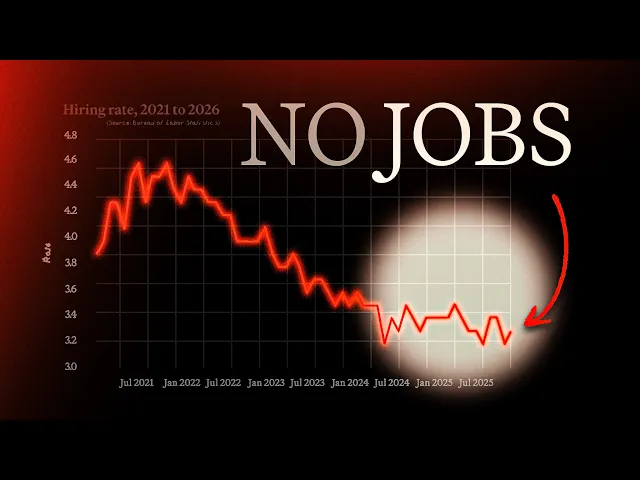
0:36 This is a thing called the hiring rate.
0:37 It's basically how many people as a share
0:39 of the total workforce get hired every month.
0:42 And you can see it's way down.
0:44 The last time it was this low was for a hot second in the early pandemic,
0:48 but the last time it was sustained at this level was at the low
0:51 point of the global financial crisis that melted down the entire world.
0:54 America is in the middle of a huge jobs crisis.
0:57 If you have a job, you're probably okay,
0:59 and you might not even know that anything is wrong.
1:02 But if you find yourself needing to get a job,
1:04 it is like the dust bowl out there.
1:06 But remember, judging by the stock market, the economy is good.
1:09 Like let's put that chart we just looked at, hiring rate,
1:12 on top of a chart of the stock market.
1:14 I just put this together on the Fed website.
1:16 It's nothing fancy.
1:17 That bottom line is the hiring rate and top is the stock market.
1:21 It's weird, right?
1:22 So what's going on here?
1:23 It makes more sense if you see what happens if
1:26 you actually go online and try to find a job.
1:28 Imagine I'm a new graduate, or I move cities, or I got laid off,
1:33 whatever it is, something came up, I need a job.
1:35 LinkedIn, what do you got for me?
1:37 All right, let's try searching writer job.
1:40 I'm a writer.
1:40 Search writer, and let's look.
1:42 New York City metropolitan area, what do we got?
1:44 Here we go.
1:45 Here we go, okay.
1:46 Conde Nast writer.
1:48 That's good.
1:49 95,000, that could be better, posted two weeks ago.
1:51 Wow.
1:52 Over a hundred people applied, Duolingo.
1:54 Okay, that's kind of fun, $153,000 a year.
1:57 That's a little low for a big tech company, posted two days ago.
2:00 Wow, over a hundred people applied.
2:02 LinkedIn stops counting applications after 100 people for whatever reason,
2:06 I guess to not discourage you.
2:07 So I apply for this job, I am up against at least a hundred other
2:11 people and maybe a lot more than a hundred people,
2:13 which means my odds of getting it statistically
2:15 are worse than my odds of getting into Harvard.
2:17 So, okay, let's look for a lower salary.
2:20 Maybe that will help cut down on this competitiveness a little bit.
2:22 Games associate writer at the New York Times.
2:25 Only a week ago, over a hundred people applied.
2:27 Okay, you know what?
2:28 We're gonna try a job that's a little bit more in demand.
2:31 We're gonna try marketing,
2:32 it's not what I went to school for, but times are tough.
2:35 All right, what do we got?
2:36 Okay, grocery store in New Jersey.
2:37 Associates category manager.
2:39 I don't know what that is.
2:41 It doesn't list a salary.
2:42 It was posted a week ago and over a hundred people have applied.
2:45 Okay, Google posted one day ago, over a hundred people applied.
2:49 This is a nightmare.
2:50 There's nothing out there.
2:52 I need to settle, I need a job.
2:53 I'm gonna search barista.
2:56 I'm not too proud.
2:58 The thing is, you know, I need healthcare.
2:59 If nothing else, I need healthcare.
3:02 I'm gonna filter by medical insurance benefits.
3:06 Whoa, look at that.
3:08 It cuts down from 440 results to only 18 with it.
3:12 Okay, sorry guys.
3:13 I didn't realize it was super greedy that I wanted healthcare.
3:16 What do we have barista at Joe and the Juice six days ago?
3:20 50 people.
3:21 So yeah, like I said, brutal out there.
3:25 This is the crisis.
3:27 There are no jobs, very few jobs and so many people looking for jobs,
3:33 which means every listing out there gets a zillion qualified applicants.
3:37 You could spend all day every day firing off applications
3:40 for jobs you're overqualified for and still never get an interview.
3:44 And that is exactly the trap that millions of people are stuck in right now.
3:48 And that number is growing every week,
3:50 even though the economy is supposedly good right now.
3:54 Well, we are gonna get to the bottom of why this is happening,
3:57 why you and so many others can't find a job
4:00 because this turns out to be much bigger than just jobs.
4:03 There is a deeper thing here that is affecting everyone,
4:06 whether you're looking for a job or not, and in ways you are probably not aware
4:10 of that reveal a lot about why our economy isn't working.
4:14 (bright music) Hey, everyone just wanted to cut in here with a quick
4:21 heads up that we actually recorded this before the Iran war,
4:24 like melted down the global energy economy.
4:27 So you're watching the intro thinking, hey, it's weird.
4:29 He's not mentioning the Iran war, that's why.
4:31 But everything that you're about to hear still applies, still true, actually,
4:36 even more so because these deeper trends that we are about to explore have
4:40 all been building for months or years
4:42 and the Iran stuff is just amplifying them.
4:45 Okay, that's it.
4:46 Now, the video.
4:47 This story is eventually going to tell us where
4:49 this strange quiet crisis is taking all of us, what our future looks like.
4:53 And that means understanding our present,
4:55 what it means to have an economy that is good and bad at the same time, right?
4:58 Good in the sense of the numbers going up
5:00 and bad in the sense of there being no jobs.
5:02 And we're gonna talk about why it has got
5:04 Trump facing a borderline existential dilemma where he has
5:07 to choose between jobs on the one hand or some
5:11 of his highest priorities as president on the other.
5:14 But first we've gotta answer a more pressing question.
5:17 Who took the jobs away?
5:20 (upbeat music) This is the US labor market.
5:27 Each one of these is a job.
5:29 And imagine there are like 160 million cards,
5:32 and this is a worker, in a healthy economy,
5:34 you've always got a few empty jobs and a few people who are looking look.
5:40 Look at that, another hire.
5:41 But we're not in a healthy economy, right?
5:43 So we're gonna use all this to show why.
5:46 What is it that's taking these jobs away?
5:48 And it's actually a few things that are all happening at once.
5:52 So let's start with an obvious one, AI.
5:55 Everyone is worried about AI displacing human jobs.
5:59 The truth is so far this might be more a worry than a reality though.
6:05 This is a study by the Federal Reserve looking
6:07 into this and it found that mostly companies aren't adjusting headcount for AI,
6:11 which is to say cutting jobs.
6:13 A small proportion of service firms do say they're reducing headcount for AI,
6:17 but others say they're actually increasing hiring for AI work.
6:20 So it seems like AI is so far not directly displacing a ton of jobs, just a few.
6:27 But let's come back to this because there is
6:28 much more going on here than meets the eye.
6:30 Okay, another big one, tariffs.
6:33 I'd like to see the chart if you have it.
6:35 That's tariffs charged to the USA,
6:38 including currency manipulation and trade barriers.
6:41 Tariffs were supposed to bring back jobs by forcing factories
6:45 to relocate to America from places like China and India.
6:48 Here's Howard Lunik, the Trump official in charge of tariffs.
6:51 Remember the army of millions and millions of human
6:54 beings screwing in little little screws to make iPhones,
6:57 that kind of thing is gonna come to America.
7:00 What tariffs actually did was force
7:02 manufacturers already in America like this TV
7:04 factory to shut down or to move their factories out of the US.
7:09 According to this industry report on manufacturers leaving the US,
7:12 one in five international firms has exited the country since
7:15 tariffs went up and they're taking those manufacturing jobs with them.
7:18 The reason that this is happening is because
7:20 any business needs to import parts and raw materials.
7:23 Factories import rivets and rubber and machinery.
7:26 Construction companies import lumber, tile, even restaurants import ingredients.
7:31 You know, tomatoes.
7:32 About half of US imports are just the stuff that goes
7:36 into American made products and tariffs make all of that more expensive.
7:39 So American businesses that might've spent money on hiring
7:42 now have to spend it on tariffs instead,
7:45 or they might even have to close as many have, which is how you get this, job
7:50 losses in every part of the manufacturing economy.
7:53 This is a big one, tariffs.
7:56 It's where we start to see how
7:58 these burdens on the labor market hold back everyone,
8:00 all of these people who would have
8:02 gotten that job in engineering or construction,
8:04 except that job no longer exists because of tariffs.
8:08 Now those people are competing for these remaining jobs,
8:11 which means everyone else who is already looking for a job now has a harder time
8:16 getting that job that might've been gettable a year
8:18 ago because there's all of that new competition,
8:21 which brings me to another big culprit.
8:24 Mass government layoffs,
8:28 mostly from Elon Musk's DOGE closing down or gutting agencies last spring.
8:35 This is the chainsaw for bureaucracy.
8:37 And then also from the government shutdown in the fall.
8:39 The federal government is the country's biggest employer.
8:44 But in just a few months last year, that one employer dropped 271,000 jobs.
8:50 That alone is equivalent to 1/10 of the losses
8:54 from the entire 2008 global financial crisis.
8:57 And these pushed out federal workers aren't just in DC,
9:00 they're in absolutely every state and they
9:03 work in basically every white collar field,
9:05 which means, again, if you're trying to get a job in accounting,
9:10 sales or marketing or really anything in an office,
9:13 you are suddenly competing with a few hundred thousand former federal workers
9:18 who just got displaced from the federal government for that same job.
9:21 So now it's a lot harder to get this one job because of all of that competition.
9:25 Just one more that we have to talk about.
9:27 Look, all you really need to know, I know this is a big boring white building.
9:30 All you really need to know is
9:31 that there's this thing called the Federal Reserve,
9:35 and they set this thing called interest rates.
9:38 And interest rates determines how much you pay
9:41 when you borrow money to buy a house, purchase a car, or start a business.
9:46 Interest rates have been high for a few years now, that's deliberate.
9:50 They made interest rates high so people would
9:52 borrow less money and would therefore spend less money,
9:55 which means there would be less inflation.
9:58 But the downside is that if someone wants to borrow
10:01 money now to start a business or to expand a business,
10:05 it's more expensive to do that.
10:07 And as a result, they cannot hire as many people.
10:14 This is where we need to zoom out because each
10:16 one of these on their own is bad enough, right?
10:18 You see them blocking out jobs.
10:20 So there's fewer jobs and more people competing for the existing jobs.
10:23 But the real story here is in how these things all
10:27 interact with one another to create a perfect storm of job suppression.
10:32 Remember this guy we just saw with Trump?
10:34 That's Jerome Powell, the big boss at the Federal Reserve,
10:38 which sets interest rates.
10:39 Here he is in December.
10:40 If you get away from tariffs, inflation is in the low twos, right?
10:45 So it's really tariffs that's causing most of the inflation overshoot.
10:50 Tariffs make everything more expensive.
10:52 That's the main thing that they do.
10:54 It is a 10 to 20% tax.
10:55 What he's saying is that if it weren't for tariffs, he could cut interest rates,
11:00 which would let businesses borrow money to hire more people.
11:03 But he can't because of tariffs
11:06 and all of that additional spending equals inflation.
11:12 So tariffs lock in inflation and inflation locks in high interest rates,
11:19 tariffs, inflation, interest rates, even if that hurts jobs.
11:23 I'll let Jerome explain.
11:24 The situation is, is that our two goals are a bit intention, right?
11:27 So interestingly, everyone around the table at the FOMC
11:34 agrees that inflation is too high and that we
11:36 want it to come down and agrees that the labor
11:38 market has softened and that there's further risk.
11:40 Everyone agrees on that.
11:42 Jerome is saying, tariffs force us into this impossible situation.
11:46 He can fight inflation by setting high interest rates,
11:49 but he can't push rates as high as he'd want because high
11:52 rates bring inflation down by slowing the economy and that hurts jobs.
11:57 But right now, you've got this difficult
11:59 balance and there are risks to both sides.
12:01 There's no risk-free path.
12:04 If it was just inflation and the labor market
12:06 was just really strong and then rates would be higher.
12:08 He chose sort of this middle path,
12:09 but he made clear jobs would have to suffer to keep down inflation from tariffs.
12:14 We're committed to 2% inflation and we will deliver 2% inflation.
12:17 So you see how having tariffs and high rates and inflation creates this perfect
12:22 storm where they all make each other worse and block out a ton of jobs.
12:26 Let's pause here so I can tell you about
12:27 something cool I learned from the folks at Henson Shaving.
12:31 What, don't gimme that look, I shave parts of my face.
12:33 My entire life, razor companies have been trying
12:35 to sell me on more and more blades,
12:37 but it turns out that more blades does not mean a better shave.
12:41 The plastic razor doesn't properly support them.
12:43 So the cutting edge fluctuates and the result
12:46 is irritated skin and more plastic waste.
12:48 Henson Shaving wanted to solve that problem
12:51 by using techniques borrowed from aerospace engineering
12:53 to build razors with a blade exposure less than the thickness of a human hair,
12:58 thereby removing any flex from the blade, which results in a gentler shave.
13:01 And they're offering our viewers a hundred free blades with the purchase
13:04 of a razor by going to hensonshaving.com/thebiggerpicture
13:08 using the code the bigger picture.
13:10 Link and offer code are also in the video description below.
13:13 Not bad right?
13:14 Now, let's get back to our video.
13:15 There's another big connection here.
13:17 Interest rates again and AI.
13:20 Remember I said we'd come back to this report
13:22 saying that companies aren't replacing people with AI.
13:25 And it seems like that's true, like the data backs that up.
13:28 But there is something that that data leaves out.
13:30 This is a story in The Atlantic last year by the writer Derek Thompson,
13:33 who argued that AI might be competing with new
13:36 college graduates or people trying to get their first job,
13:38 which is why it didn't show up in that report.
13:40 Like law firms using AI to pick up any extra
13:44 paralegal work instead of hiring a new paralegal to do it.
13:47 Because remember, high interest rates make it too expensive to hire.
13:52 Or maybe there's a consulting company that hires five new people,
13:55 where previously they'd have hired 20 because those five can
13:58 now use AI to do entry level work more efficiently,
14:01 which means instead of AI displacing existing jobs,
14:04 it might be taking the place of new jobs,
14:08 which would help explain why the job market for new graduates is
14:12 the worst it's been relative to what it's like for other workers in decades.
14:16 And so we're gonna call this relationship
14:18 here between interest rates and AI, chatbot workers.
14:23 (bright music) And what they may be blocking out here are entry-level jobs,
14:29 the kind of thing you would have gotten
14:31 just out of school if not for those chatbots.
14:33 And the reason that I'm attaching this to interest rates is because the slow
14:38 economy plus high rates means that companies
14:40 are unusually desperate to save money by using,
14:43 let's say one person with a chatbot in place
14:47 of what have would've otherwise been two jobs.
14:50 Okay, another AI related thing and one that you
14:52 might not think of as deleting jobs, data centers.
14:56 Meta continuing its massive investments in AI,
14:58 this time in the form of compute power,
15:00 announcing two new major AI data centers.
15:03 So here's the deal.
15:04 Investment in data centers is like the entire US economy right now.
15:08 $3 trillion so far.
15:10 And partly this is about people thinking that AI is gonna be huge,
15:14 but it's also about tariffs.
15:16 Tariffs make it harder to turn a profit in industries that import or export,
15:21 which is like basically every industry.
15:24 So what's happening is the entire economy is investing every extra dollar
15:27 it has that normally would've gone into those healthy industries into AI
15:31 and specifically to a part of the AI economy that is
15:34 resilient to tariffs because it doesn't
15:36 involve that much importing or exporting,
15:38 which is data centers and specifically to a part of the AI economy,
15:46 data centers that is resilient to tariffs.
15:49 So the capital that might have gone towards starting a factory or a call
15:52 center or a magazine is going towards
15:55 giant humanless rows of high price processors instead.
15:59 So I said before, this is posing a big dilemma for Trump.
16:01 One that is putting a lot of the top
16:03 priorities of his entire presidency at risk.
16:05 It has to do with what Trump says is the solution to the jobs prices.
16:10 At the same time, illegal aliens stole American jobs.
16:13 This is a speech President Trump gave in December about the economy.
16:16 Too many immigrants he said are crowding out the job market.
16:19 So we have to get those immigrants out.
16:21 For the first time in 50 years,
16:23 we are now seeing reverse migration as migrants go
16:26 back home leaving more housing and more jobs for Americans.
16:30 There's a certain intuitive,
16:32 if ruthless logic to this that if you remove enough foreign-born workers
16:36 from the labor pool like this, let's say this is a foreign-born worker,
16:40 then native-born workers, this guy, can take those jobs for themselves.
16:45 That's the idea.
16:46 But are they right about this?
16:48 Is that actually how this works?
16:50 And one way to find out is by looking at what
16:52 happened to the job market in prior rounds of mass deportations.
16:56 Even as we are a nation of immigrants, we're also a nation of laws.
17:00 This is President Obama in 2011 announcing
17:02 what would become a huge deportation campaign.
17:05 Deportations of criminals are up 80%.
17:09 Remember this was during the global financial crisis.
17:11 Job scarcity was a huge issue.
17:14 So did deportations help?
17:16 Did more native born Americans get jobs because of deportations?
17:20 Well, some economists looked into exactly that question.
17:23 They analyzed the nearly half a million deportations in the country,
17:27 which have been rolled out in stages county by county.
17:30 And they tried to identify patterns
17:32 in what happened after these deportations took place.
17:35 And what they found is that the employment rate among citizens,
17:38 among native born Americans, actually dropped.
17:41 The reason for this is something called complementarity,
17:44 which means that jobs mostly done by immigrants,
17:47 complement those mostly done by citizens.
17:50 Here we'll use the board to show this.
17:52 What I'm gonna do is I'm gonna mark off some
17:54 of these jobs that are just like manual labor jobs,
17:57 jobs that are done predominantly by immigrants like construction.
18:01 So, okay, bear with me one second.
18:06 Okay, so this over here, this is immigrant labor.
18:08 These are jobs that are predominantly done by immigrants.
18:11 Things like manual labor or construction is a really big one.
18:15 And what happens is that when you take these workers away,
18:18 let's say because you conduct mass deportations
18:21 that remove many of them from the country,
18:23 what you think is gonna happen is citizens are gonna take those jobs,
18:26 but actually they don't.
18:28 Citizens do not take those jobs.
18:30 It's because these jobs tend to be strenuous,
18:32 long hours, dangerous, they give you back and joint problems.
18:36 Look, I don't blame people for not wanting them,
18:38 but what it means is that number one,
18:40 you do not have more jobs going to citizens.
18:43 And number two, construction firms,
18:45 companies that predominantly employ immigrants face big labor shortages,
18:49 which means that those companies have to cut back.
18:53 And what that leads to is the loss of complimentary jobs.
18:57 Job over here held primarily by citizens like foreman,
19:02 architects, accountants, you know,
19:04 jobs that are held by native born workers who might have a college degree,
19:07 might have a high school degree because the firms that employ
19:11 them no longer exist because they've lost those construction workers.
19:14 Those economists that I mentioned earlier found that in all,
19:17 mass deportations in any particular area, regardless of where it was,
19:22 reduced employment among citizens by about 3/4 of 1%,
19:26 wherever those deportations took place, that's more than a million jobs actually
19:30 that got lost just because of the native
19:33 born workers whose employers could no longer
19:35 employ them because they lost that immigrant labor.
19:39 To put this in other way, the economists found that for every 100
19:43 undocumented immigrants kicked out of the labor market,
19:46 about 12 citizens lost their jobs too.
19:49 And economists say that the impact of Trump's deportations could be
19:53 even more severe by collapsing whole industries like childcare and construction,
19:58 potentially eliminating the jobs of two and a half million native-born workers,
20:03 including over 800,000 just in construction.
20:06 You work in a field related to construction,
20:08 anywhere from an architect to a site manager, you could be in big trouble.
20:12 So this is all to say that Trump's big solution for the jobs crisis,
20:17 deportations is actually not only making it worse,
20:20 but one of the biggest drivers of joblessness that we have in the country.
20:28 Same thing goes for tariffs.
20:29 Remember, tariffs are supposed to turn America into a nation
20:33 of—- Millions and millions of human beings screwing in little,
20:35 little screws to make iPhones.
20:37 But what it did instead was cause American businesses to cut back or close.
20:42 This is what I mean by Trump's dilemma on jobs.
20:45 Take a look here.
20:46 Trump's net approval rating on jobs.
20:47 They go from plus seven way, way, way down off the screen to minus 30 points.
20:53 He knows his poll numbers are dropping hard largely over the economy.
20:57 And look, maybe he really believes what he said in December
21:00 that the economy is actually good
21:02 and it's good because of tariffs and deportations.
21:06 But the truth is that the job market is
21:08 down in large part because of those two things, which means that Trump,
21:12 whether he knows it or not, is facing a choice between upholding what are
21:16 two of his highest priorities for his entire presidency,
21:20 deportations and tariffs or giving up on them in order to maybe salvage the job
21:24 market and therefore his odds of holding onto
21:27 Congress in the midterm elections later this year.
21:29 This is the dilemma that could very well decide
21:32 how the entire second half of his term goes.
21:34 So far, Trump is holding the course and as his poll
21:38 numbers get worse as a result, I don't know.
21:39 I expect that this question of which course they
21:42 wanna take will get raised within the White House.
21:43 This is actually a good moment to take a step
21:46 back and ask how all of this can represent,
21:50 like we said at the start of the video,
21:52 an economy that is both obviously in a lot of ways quite bad,
21:56 but in others like the stock market seemingly weirdly pretty good.
22:01 Let's actually take a look at that stock market.
22:05 This is the S&P 500, which is roughly synonymous with the stock market.
22:09 It's crushing it, right?
22:10 Okay, but look at it this way.
22:11 That top line is just the top seven tech stocks
22:15 which are going gangbusters versus that second line in the bottom.
22:18 The rest of the stock market, which is looking pretty flat.
22:21 This is the first hint of the larger thing that's going on here.
22:24 There is all of this economic activity happening right now and there's a lot
22:28 of people getting rich off of it and not just like tech billionaires,
22:31 but anybody with a 401k or who put a little money in the market
22:35 might actually be building quite a nest
22:36 egg right now off of this booming market.
22:38 But all of that economic activity is super
22:41 concentrated in one little sliver of the economy.
22:45 AI, and the AI economy is weird because
22:47 it's a boom that doesn't create any boom towns.
22:53 Like the auto industry built entire cities,
22:55 all of these workers and other businesses that sprang up around the car factory.
23:00 Before that, there were logging towns and mining towns.
23:03 And look, I'm not glorifying the past like today's San
23:05 Jose or Seattle exists because of prior rounds of tech companies,
23:08 but when it comes to AI, you don't get a Detroit, you don't get a San Jose.
23:13 What you get are this.
23:16 For something that is so huge in financial terms,
23:19 like bigger than every other industry I have mentioned so far,
23:22 there are very few jobs and very little effect therefore,
23:25 on the wider economy, and I'm not saying this to beat up on AI,
23:29 this thing that's happening is emblematic
23:31 of the bigger thing going on with the economy.
23:34 This idea of being two economies right now,
23:37 a little economy that is doing crazy well and then another much larger,
23:42 much weaker economy hiding behind it.
23:44 But those two not really touching each other.
23:46 And this two track economy thing, it's actually kind of everywhere right now,
23:51 like companies are expressing optimism about the economy,
23:55 but consumers are expressing really severe pessimism.
23:57 And if you break that number down with that top line showing
24:00 confidence among people making more than a hundred thousand dollars a year,
24:03 you see that the next line for people
24:05 making less than that used to run about parallel,
24:08 which makes sense, both exist in the same economy,
24:11 so they both respond about the same way in terms of optimism
24:14 and pessimism until a few months ago when those two lines split,
24:18 which is really unusual, actually, hold on a second.
24:21 That shape looks familiar.
24:23 Yeah, this, it looks like a letter K, we saw that shape before, it was here.
24:29 Remember?
24:30 Hiring rate on the bottom, stock market on the top.
24:33 There it is again, letter K.
24:35 And it turns out that's what this economy we're in is called, K shaped.
24:39 You may have heard this mentioned before,
24:40 it's a pretty new concept, but it's kind of everywhere right now.
24:43 An economist named Peter Atwater first used it a few
24:45 years ago to refer to pandemic lockdowns that caused the fortunes
24:48 of one group of people to go up and another
24:50 group of people to go down, like a K, right?
24:54 And this is different from just your classic inequality.
24:57 The rich doing better than the poor.
24:58 K shaped economy is when there's a change in the economy
25:01 that causes two things that were previously in sync to start to diverge,
25:06 which we see all over the place now.
25:08 So why is this happening now?
25:10 Why today?
25:13 Atwater says that among other things, it's from all of this inflation,
25:18 which is hurting some people and is actually helping others
25:21 because inflation is making stuff that those people already own,
25:24 like houses or investments in the stock market, more and more valuable.
25:28 But it's not just inflation, it's also all of this stuff like AI.
25:33 Remember we said basically the entire economy now is just investing in AI.
25:38 This, right?
25:39 Well, there's another K.
25:41 If you're unlucky enough to work or invest in an industry that is not AI,
25:45 the dry up in economic activity maybe already feels to you like a recession,
25:50 mass government layoffs.
25:51 Remember that's 250,000 people who lost their jobs.
25:54 The savings from which went to pay
25:56 for tax cuts that just benefited the richest 5%,
25:59 another K and all of this K shapedness is showing up in other ways too.
26:04 That AP story from earlier talked about how consumer brands like
26:07 Coca-Cola are increasingly treating us
26:09 as operating in just two separate economies,
26:11 fancier and fancier stuff for the increasingly well off like rich people water,
26:16 rich people milk, while the rest of us
26:18 get poverty marketing and low price mini cans.
26:23 Hey everyone, just one last thing I wanted
26:26 to tell you all about a new subscriber
26:28 only video series I'm really excited about that we're
26:31 launching at New Press called No Dumb Questions.
26:34 I have always thought that the best questions,
26:37 the one that leads you to the biggest
26:39 surprises and the most interesting stories,
26:42 aren't the like esoteric, brainy sounding ones.
26:45 It's the big broad, like almost childlike.
26:48 Why is this the way it is questions.
26:50 So every week or two, we are going to post a subscriber only video on New Press,
26:55 answering a few questions submitted by regular subscribers that do just this.
27:01 Usually those will be on the news and sometimes
27:02 they will be on the broader stories behind the news.
27:05 And in this week's, which is already up,
27:07 I'm answering a few big questions on the Iran war,
27:11 like one that we spend some time on is why has
27:13 America not been able to win despite all of its military might?
27:17 Another is why does Iran have the global reputation it has and is that deserved?
27:22 Another, why have they never followed through on building nuclear weapons?
27:25 And we get in even more than that.
27:26 To subscribe, follow the link in the description
27:28 or scan the QR code on your screen to get access to those answers and lots
27:34 more as part of this new recurring series,
27:36 plus other subscriber only features like ad free videos,
27:39 behind the scenes content and more, hope to see you there.
27:41 This, this widening division between one world
27:44 at the top of the K and in another world
27:48 at the bottom is what our future looks like
27:50 if these weights on the job market stay in place,
27:53 because this actually all ties back to the labor market, to jobs drying up.
27:57 The reason it doesn't feel like the economy is in free fall
28:00 to most people is because a lot of us are doing well.
28:04 The top half of that K is why even with all this turmoil,
28:07 we are not seeing the kind of business
28:09 closures or mass layoffs that we did in 2008.
28:12 There's enough activity to keep things basically afloat,
28:15 but this also means that if you are on the bottom half of that K,
28:19 as many people are, you might feel forgotten
28:22 precisely because the wider economy looks sort of okay.
28:25 So people often talk as if it is, you feel forgotten because nobody seems
28:29 to be acknowledging what you're experiencing.
28:31 Still, every week that passes with a stalled labor market,
28:35 more and more people move from the top part of that K down to the bottom part.
28:40 Companies are saying they're probably not adding jobs at all this year,
28:43 so this is going to keep getting slowly, steadily worse.
28:46 But this is really unhealthy.
28:48 People who are looking for a job already know
28:51 that there is a big part of the economy in crisis,
28:53 in a lot of ways, they see what's coming from more and more people every week.
28:57 Scarcity, tense competition,
29:00 declining wages and long periods of searching without work.
29:03 And here's the thing, sooner or later, this is everybody,
29:06 no matter what you do or how will you do it,
29:09 at some point, eventually, you will need to find a job.
29:12 Maybe that's because you were laid off or your company closes,
29:15 or just because you have to move cities or you have
29:18 the bad luck to be 22 and you're graduating college into this economy.
29:22 Whatever the reason, given enough time, this is a crisis for all of us.
29:28 (tense music)