What do MUST, SHOULD, and WOULD Really Mean in Writing?
Adam’s English Lessons · engVid
0:00 Hi, everybody.
0:00 Welcome to www.engvid.com.
0:02 I'm Adam.
0:03 In today's video, I want to talk to you
0:06 about a specific aspect of English writing, okay?
0:10 And this is something that I think gets people...
0:13 Gives people a lot of trouble
0:15 because it's very nuanced differences between words.
0:19 And more specifically, I'm talking about modal verbs;
0:23 "must", "have to", "need to", "should", "could", "would", "will".
0:27 All of these modal verbs have very specific uses, and especially in writing,
0:34 using the wrong word creates the wrong impression for the reader.
0:39 In spoken English, you can more or less get the idea you want across,
0:44 and people won't pay as much attention to the choice of modal words.
0:49 In writing, because there's no facial gestures, there's no body gestures,
0:53 a reader has only the words in front of him,
0:56 and so the choice of words can make a very big difference.
1:00 And I'm going to tell...
1:01 Show you specifically what I'm talking about.
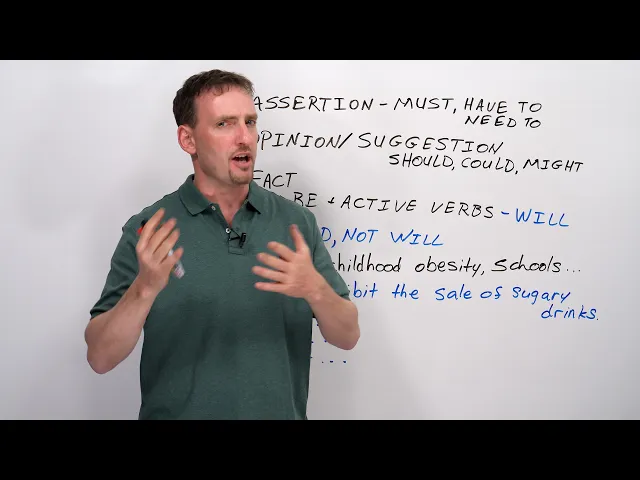
1:04 I'm talking about making an assertion,
1:07 providing an opinion or a suggestion, and stating a fact.
1:11 Each of these ways of writing aims to achieve a different goal.
1:17 So, when you make an assertion or an opinion,
1:20 what you're doing is you're giving something
1:23 that may or may not be true, especially opinion.
1:28 An opinion is just an opinion.
1:30 There's no such thing as an undoubted opinion, for example.
1:34 That's what makes an opinion an opinion.
1:36 You can have one, I can have one, they could be different.
1:40 One of us is right, one of us is wrong,
1:43 but there's not enough evidence to prove either one of us right,
1:46 which is why it's an opinion.
1:48 An assertion is a forceful expression of an idea.
1:52 Now, it could be true or it could not be true.
1:57 A lot of people try to express something as a fact simply by saying it strongly.
2:04 Saying it strongly does not make it a fact.
2:07 It might make you seem more confident,
2:09 it might make the reader more likely to believe you
2:13 or to at least engage in a conversation with you,
2:17 but it doesn't mean it's true, okay?
2:20 And that's the most important difference.
2:21 Anything that's a fact is a fact.
2:24 It can't be argued against.
2:26 That's what makes a fact a fact.
2:28 So, when we make assertions, we commonly use these modal verbs.
2:34 When we provide opinion,
2:36 we would say "should" or "ought to", and when we offer suggestions,
2:41 we could say "could", and when we talk about possibilities
2:44 or suggestions or advice, we can use "might".
2:47 Now, when you're talking about assertions and opinions,
2:50 this is where a lot of people get confused.
2:54 Make sure you're using the word "would", not the word "will".
2:58 "Will" is a fact.
3:01 "Would" is a hypothetical.
3:04 It's possible, but there's no reason to believe that it's 100% fact now.
3:09 Now, before I continue,
3:10 I just want to let you know that "will" and "would" are often mixed up,
3:16 and especially in writing.
3:18 So, I did create another video specifically talking about "will" versus "would",
3:22 and if you want a bit of review, you can go watch that video after.
3:25 There's a link here for you to do that.
3:29 Next, let's talk about facts.
3:31 So, facts, we use the "be" verb or an active verb.
3:35 And if we're going to use a modal verb, we're going to use the modal "will".
3:39 Now, obviously this is going to be much easier with an example,
3:41 so let's look at an example.
3:44 I'm going to start one sentence,
3:45 and then I'm going to finish the sentence four different ways.
3:49 "To combat childhood obesity",
3:51 so children are getting fatter these days, "schools"- now,
3:56 I'm going to continue- "schools must prohibit the sale of sugary drinks".
4:02 They must do this.
4:03 I'm making a very strong sentence.
4:06 They must do it.
4:07 Now, if I say that a school must do
4:10 this, does that mean that the schools are doing it now?
4:14 No.
4:16 "Must" automatically suggests- and as "must", "should", and "could",
4:21 all of these modals suggest a future, because right now, it is not a fact.
4:28 And if it's not a fact now, it can only be a fact in the future.
4:32 If you're talking about the past, then you're only talking about facts,
4:36 and then you're going to use a past tense verb of whatever the verb is.
4:41 So, "schools must prohibit the sale of sugary drinks".
4:44 I'm making a very strong statement.
4:47 Right now, they're not, but they must do this.
4:49 Or, "to combat childhood obesity,
4:52 schools should prohibit the sale of sugary drinks".
4:56 This is my suggestion.
4:58 I think that this is a very good idea that schools should do.
5:00 Obviously, now they're not doing it.
5:03 They should do it, because this will help fight obesity.
5:07 "To combat childhood obesity, schools could prohibit the sales of sugary
5:13 drinks." This is just one possibility, one suggestion of what they could do.
5:18 They could do other things, too.
5:20 So, I'm still stating an opinion, more of like a suggestion,
5:24 a possibility of what they could do.
5:28 Or, "schools might want to prohibit", again, another suggestion.
5:33 Okay, so now, "to combat childhood obesity,
5:36 schools prohibit the sale of sugary drinks in their cafeterias", for example.
5:42 So, right away, you should notice a very...
5:45 You should notice a noticeable difference, right?
5:48 Here I'm stating a fact.
5:50 Right now, schools do this, because they're trying to combat obesity.
5:55 I could also say, "schools have prohibited",
5:58 or "many schools are prohibiting as we speak", etc.
6:02 But basically, I'm stating a fact.
6:05 There's no suggestion, there's no potential of something to do,
6:09 there's no forceful thing that they should do in the future.
6:13 Right now, this is what is happening, okay?
6:16 And I can say the sentence in another way with using a "be" verb,
6:20 but it doesn't really matter.
6:21 It doesn't really matter, especially simple present gives an idea of...
6:26 Simple present generally gives the idea of fact,
6:29 but any present tense verb will work as well;
6:32 present perfect or continuous as well.
6:35 So, this is one example.
6:37 Let me give you a few more just to get the idea a little bit clearer.
6:40 Okay, so now, I've written here a short little paragraph,
6:43 and I want you to notice the underlined verbs and try to understand.
6:48 And is it making an assertion,
6:50 offering a suggestion or opinion, or is it stating a fact?
6:55 So, "Some employers prefer to give their staff
6:58 extra holidays instead of a raise." I forgot to...
7:03 Prefer to give their staff extra holidays instead of raises.
7:07 So, this is a fact.
7:09 I'm just stating somebody's preference, and I can clearly point it out.
7:13 I can go to other companies and show you that they give more raises.
7:16 So, nothing to argue here.
7:18 Simple present verb, no problem.
7:20 Action verb.
7:21 "This approach would not work in our company." Okay?
7:25 Now, the reason this is an unreal assertion is because "would not work",
7:30 well, I don't know, we haven't actually tried it.
7:33 It would not work if we tried it, but we haven't.
7:37 So, it's a hypothetical situation.
7:40 Again, that video between Would and Will will explain that.
7:43 So, it's not a fact.
7:45 "In our company, because most of our employees cannot afford to travel." So,
7:50 this is actually a fact.
7:52 Now, notice I'm using "cannot" and not "could".
7:55 "Cannot afford", I'm looking at the whole thing
7:58 as a present action verb with a modifier,
8:01 not as a modal verb of a hypothetical, imaginary situation.
8:06 "We should raise their monthly incomes." This is something we should do,
8:11 which means we haven't done yet, so it's an opinion.
8:14 "As this would be more practical." So, "would be", again, if we did it.
8:20 So, this is more of an assertion because it's not a fact.
8:24 "But we must also consider", "we must consider", now, again, is this a fact?
8:33 No, it's more of an opinion.
8:34 We must do this.
8:35 We obviously haven't yet, but if you ask the bosses of the company,
8:40 maybe, "I don't want to consider it." Right?
8:42 So, you have to be very careful with "must".
8:45 "Must" is always an assertion, but you have to ask, "Can I prove it,
8:49 or is it just a very strong opinion?" In this case,
8:52 it's a very strong opinion that sounds like a fact.
8:56 That's the thing about assertions.
8:58 If somebody says something strongly enough,
9:00 a listener or a reader might think it's a fact.
9:04 Be very, very careful about facts and assertions.
9:09 "Must also consider staff burnout." Now,
9:12 "burnout" is a condition where you overwork
9:16 somebody and their brain sort of, like, smoke comes out of their ear, right?
9:21 It's technically fatigue; very,
9:23 very tired from doing your work over and over and over again.
9:28 It could be from just too many hours and physically just too tired.
9:32 It could also be from extreme boredom.
9:35 If you're doing the same job day after day after day after day,
9:39 even if it's not a hard job,
9:41 the sheer repetition and boredom might make you a little bit crazy,
9:46 and we call this condition "burnout".
9:49 So, "staff burnout", which is a common issue in this industry.
9:54 Again, I'm stating a fact,
9:55 because there have been reports, there has been research,
9:59 and you can go to other companies and see
10:01 the high turnover of staff, so that's a fact.
10:04 So again, this is just a very small and minor example.
10:09 As you're doing your reading, especially those of you who are doing the IELTS
10:13 and TOEFL or preparing for the IELTS and TOEFL,
10:16 this is one of the things that you need
10:19 to understand for the writing section, for the essay.
10:23 It's also very important to understand how modals work for the reading section,
10:29 because sometimes what they will test is your ability
10:32 to understand the difference between an opinion and a fact.
10:35 And they'll give you an opinion,
10:37 or they'll give you a fact in the reading passage,
10:41 and then the question they will paraphrase,
10:44 but they'll write it as an assertion, but not a factual assertion.
10:50 So, you have to make sure you understand if things are working together.
10:54 Consider the "yes", "no", or "true", "false", "not given" questions.
10:59 It's all about paraphrasing and how a sentence is structured,
11:02 so it's very important to understand the intention of the writer.
11:07 Okay?
11:08 So, if you have any questions about any of this, please go to www.engvid.com.
11:12 You can ask me in the comments section.
11:15 I will also put up a quiz there.
11:16 There is actually a quiz there
11:18 that you can test your understanding of assertions, opinions, and facts.
11:23 If you want some more tips on writing, especially for the IELTS and TOEFL,
11:28 please visit my other YouTube channel, www.writetotop.com.
11:34 That's where I deal with a lot of this more advanced writing tips.
11:38 And that's it.
11:39 I hope you liked the video.
11:41 Please give me a like if you did.
11:43 Don't forget to subscribe to my channel,
11:45 and click the little bell there so you get notifications of future videos.
11:50 And come back soon.
11:51 I'll have more useful writing tips for you, and grammar tips, and all that.
11:55 See you again soon.
11:56 Bye-bye.