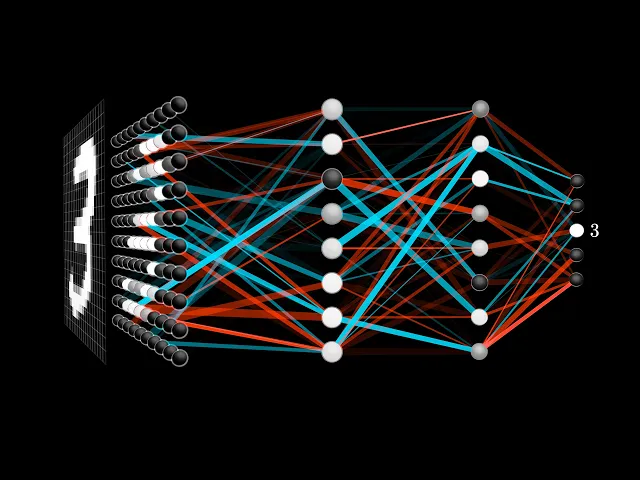
But what is a neural network? | Deep learning chapter 1
3Blue1Brown
0:04 This is a 3.
0:06 It's sloppily written and rendered
0:07 at an extremely low resolution of 28x28 pixels,
0:10 but your brain has no trouble recognizing it as a 3.
0:14 And I want you to take a moment to appreciate
0:16 how crazy it is that brains can do this so effortlessly.
0:19 I mean, this, this and this are also recognizable as 3s,
0:22 even though the specific values of each pixel
0:25 is very different from one image to the next.
0:28 The particular light-sensitive cells in your eye that are firing when you see
0:33 this 3 are very different from the ones firing when you see this 3.
0:37 But something in that crazy-smart visual cortex
0:40 of yours resolves these as representing the same idea,
0:43 while at the same time recognizing other images as their own distinct ideas.
0:49 But if I told you, hey, sit down and write for me a program that takes in a grid
0:54 of 28x28 pixels like this and outputs a single number between 0 and 10,
0:59 telling you what it thinks the digit is,
1:01 well the task goes from comically trivial to dauntingly difficult.
1:07 Unless you've been living under a rock,
1:08 I think I hardly need to motivate the relevance and importance
1:11 of machine learning and neural networks to the present and to the future.
1:15 But what I want to do here is show you what a neural network actually is,
1:18 assuming no background,
1:19 and to help visualize what it's doing, not as a buzzword but as a piece of math.
1:25 My hope is that you come away feeling like the structure itself is motivated,
1:28 and to feel like you know what it means when you read,
1:31 or you hear about a neural network quote-unquote learning.
1:35 This video is just going to be devoted to the structure
1:37 component of that, and the following one is going to tackle learning.
1:40 What we're going to do is put together
1:42 a neural network that can learn to recognize handwritten digits.
1:49 This is a somewhat classic example for introducing the topic,
1:52 and I'm happy to stick with the status quo here,
1:54 because at the end of the two videos I want to point
1:56 you to a couple good resources where you can learn more,
1:58 and where you can download the code that does
2:01 this and play with it on your own computer.
2:05 There are many many variants of neural networks,
2:07 and in recent years there's been sort
2:09 of a boom in research towards these variants,
2:12 but in these two introductory videos you and I are just going
2:15 to look at the simplest plain vanilla form with no added frills.
2:19 This is kind of a necessary prerequisite
2:21 for understanding any of the more powerful modern variants,
2:24 and trust me it still has plenty of complexity for us to wrap our minds around.
2:29 But even in this simplest form it can learn to recognize handwritten digits,
2:33 which is a pretty cool thing for a computer to be able to do.
2:37 And at the same time you'll see how it does fall
2:39 short of a couple hopes that we might have for it.
2:43 As the name suggests neural networks are inspired by the brain,
2:46 but let's break that down.
2:48 What are the neurons, and in what sense are they linked together?
2:52 Right now when I say neuron all I want you
2:55 to think about is a thing that holds a number,
2:58 specifically a number between 0 and 1.
3:00 It's really not more than that.
3:03 For example the network starts with a bunch of neurons
3:07 corresponding to each of the 28x28 pixels of the input image,
3:12 which is 784 neurons in total.
3:14 Each one of these holds a number
3:17 that represents the grayscale value of the corresponding pixel,
3:20 ranging from 0 for black pixels up to 1 for white pixels.
3:25 This number inside the neuron is called its activation,
3:28 and the image you might have in mind here is that each
3:31 neuron is lit up when its activation is a high number.
3:36 So all of these 784 neurons make up the first layer of our network.
3:46 Now jumping over to the last layer,
3:48 this has 10 neurons, each representing one of the digits.
3:52 The activation in these neurons, again some number that's between 0 and 1,
3:56 represents how much the system thinks
3:58 that a given image corresponds with a given digit.
4:03 There's also a couple layers in between called the hidden layers,
4:06 which for the time being should just be a giant question mark
4:09 for how on earth this process of recognizing digits is going to be handled.
4:14 In this network I chose two hidden layers,
4:16 each one with 16 neurons, and admittedly that's kind of an arbitrary choice.
4:21 To be honest I chose two layers based on how
4:23 I want to motivate the structure in just a moment,
4:25 and 16, well that was just a nice number to fit on the screen.
4:28 In practice there is a lot of room
4:30 for experiment with a specific structure here.
4:33 The way the network operates,
4:34 activations in one layer determine the activations of the next layer.
4:39 And of course the heart of the network
4:41 as an information processing mechanism comes down
4:43 to exactly how those activations from one
4:46 layer bring about activations in the next layer.
4:49 It's meant to be loosely analogous to how in biological networks of neurons,
4:53 some groups of neurons firing cause certain others to fire.
4:58 Now the network I'm showing here has already been trained to recognize digits,
5:01 and let me show you what I mean by that.
5:03 It means if you feed in an image, lighting up all 784 neurons of the input layer
5:08 according to the brightness of each pixel in the image,
5:11 that pattern of activations causes some very specific pattern in the next
5:15 layer which causes some pattern in the one after it,
5:18 which finally gives some pattern in the output layer.
5:22 And the brightest neuron of that output layer is the network's choice,
5:26 so to speak, for what digit this image represents.
5:32 And before jumping into the math for how one layer influences the next,
5:36 or how training works, let's just talk about why it's even reasonable
5:40 to expect a layered structure like this to behave intelligently.
5:44 What are we expecting here?
5:45 What is the best hope for what those middle layers might be doing?
5:48 Well, when you or I recognize digits, we piece together various components.
5:54 A 9 has a loop up top and a line on the right.
5:57 An 8 also has a loop up top, but it's paired with another loop down low.
6:01 A 4 basically breaks down into three specific lines, and things like that.
6:07 Now in a perfect world, we might hope that each neuron in the second
6:11 to last layer corresponds with one of these subcomponents,
6:14 that anytime you feed in an image with, say, a loop up top,
6:18 like a 9 or an 8, there's some specific
6:21 neuron whose activation is going to be close to 1.
6:24 And I don't mean this specific loop of pixels,
6:26 the hope would be that any generally loopy
6:29 pattern towards the top sets off this neuron.
6:32 That way, going from the third layer to the last one
6:35 just requires learning which combination
6:37 of subcomponents corresponds to which digits.
6:41 Of course, that just kicks the problem down the road,
6:43 because how would you recognize these subcomponents,
6:45 or even learn what the right subcomponents should be?
6:48 And I still haven't even talked about how one layer influences the next,
6:51 but run with me on this one for a moment.
6:53 Recognizing a loop can also break down into subproblems.
6:57 One reasonable way to do this would be to first
6:59 recognize the various little edges that make it up.
7:03 Similarly, a long line, like the kind you might see in the digits 1 or 4 or 7,
7:08 is really just a long edge,
7:10 or maybe you think of it as a certain pattern of several smaller edges.
7:15 So maybe our hope is that each neuron in the second
7:18 layer of the network corresponds with the various relevant little edges.
7:23 Maybe when an image like this one comes in, it lights up
7:26 all of the neurons associated with around 8 to 10 specific little edges,
7:31 which in turn lights up the neurons associated
7:33 with the upper loop and a long vertical line,
7:36 and those light up the neuron associated with a 9.
7:40 Whether or not this is what our final network actually does is another question,
7:44 one that I'll come back to once we see how to train the network,
7:47 but this is a hope that we might have,
7:50 a sort of goal with the layered structure like this.
7:53 Moreover, you can imagine how being able to detect edges and patterns
7:56 like this would be really useful for other image recognition tasks.
8:00 And even beyond image recognition,
8:02 there are all sorts of intelligent things you might
8:04 want to do that break down into layers of abstraction.
8:08 Parsing speech, for example,
8:09 involves taking raw audio and picking out distinct sounds,
8:12 which combine to make certain syllables, which combine to form words,
8:16 which combine to make up phrases and more abstract thoughts, etc.
8:21 But getting back to how any of this actually works,
8:23 picture yourself right now designing how exactly the activations
8:26 in one layer might determine the activations in the next.
8:30 The goal is to have some mechanism
8:33 that could conceivably combine pixels into edges,
8:35 or edges into patterns, or patterns into digits.
8:39 And to zoom in on one very specific example,
8:42 let's say the hope is for one particular neuron in the second layer to pick
8:46 up on whether or not the image has an edge in this region here.
8:51 The question at hand is what parameters should the network have?
8:55 What dials and knobs should you be able to tweak
8:58 so that it's expressive enough to potentially capture this pattern,
9:01 or any other pixel pattern,
9:03 or the pattern that several edges can make a loop, and other such things?
9:08 Well, what we'll do is assign a weight to each one
9:11 of the connections between our neuron and the neurons from the first layer.
9:16 These weights are just numbers.
9:18 Then take all of those activations from the first
9:21 layer and compute their weighted sum according to these weights.
9:27 I find it helpful to think of these weights
9:29 as being organized into a little grid of their own,
9:32 and I'm going to use green pixels to indicate positive weights,
9:35 and red pixels to indicate negative weights,
9:37 where the brightness of that pixel is
9:39 some loose depiction of the weight's value.
9:42 Now if we made the weights associated with almost all of the pixels
9:46 zero except for some positive weights in this region that we care about,
9:50 then taking the weighted sum of all
9:52 the pixel values really just amounts to adding
9:54 up the values of the pixel just in the region that we care about.
9:59 And if you really wanted to pick up on whether there's an edge here,
10:02 what you might do is have some
10:04 negative weights associated with the surrounding pixels.
10:07 Then the sum is largest when those middle
10:09 pixels are bright but the surrounding pixels are darker.
10:14 When you compute a weighted sum like this, you might come out with any number,
10:18 but for this network what we want is
10:20 for activations to be some value between 0 and 1.
10:24 So a common thing to do is to pump this weighted sum into some
10:27 function that squishes the real number line into the range between 0 and 1.
10:32 And a common function that does this is called the sigmoid function,
10:35 also known as a logistic curve.
10:38 Basically very negative inputs end up close to 0,
10:41 positive inputs end up close to 1,
10:43 and it just steadily increases around the input 0.
10:49 So the activation of the neuron here is basically
10:52 a measure of how positive the relevant weighted sum is.
10:57 But maybe it's not that you want the neuron
10:59 to light up when the weighted sum is bigger than 0.
11:02 Maybe you only want it to be active when the sum is bigger than say 10.
11:06 That is, you want some bias for it to be inactive.
11:11 What we'll do then is just add in some other number like negative
11:14 10 to this weighted sum before
11:16 plugging it through the sigmoid squishification function.
11:20 That additional number is called the bias.
11:23 So the weights tell you what pixel pattern
11:25 this neuron in the second layer is picking up
11:28 on, and the bias tells you how high the weighted
11:31 sum needs to be before the neuron starts getting meaningfully active.
11:36 And that is just one neuron.
11:38 Every other neuron in this layer is going to be
11:41 connected to all 784 pixel neurons from the first layer,
11:45 and each one of those 784 connections has its own weight associated with it.
11:51 Also, each one has some bias, some other number that you add on to the weighted
11:55 sum before squishing it with the sigmoid.
11:58 And that's a lot to think about!
11:59 With this hidden layer of 16 neurons,
12:02 that's a total of 784 times 16 weights, along with 16 biases.
12:08 And all of that is just the connections from the first layer to the second.
12:12 The connections between the other layers also have
12:14 a bunch of weights and biases associated with them.
12:18 All said and done, this network has
12:21 almost exactly 13,000 total weights and biases.
12:23 13,000 knobs and dials that can be tweaked
12:26 and turned to make this network behave in different ways.
12:31 So when we talk about learning,
12:32 what that's referring to is getting the computer to find a valid setting for all
12:37 of these many many numbers so that it'll actually solve the problem at hand.
12:42 One thought experiment that is at once fun and kind of horrifying is
12:46 to imagine sitting down and setting all of these weights and biases by hand,
12:50 purposefully tweaking the numbers so that the second layer picks up on edges,
12:54 the third layer picks up on patterns, etc.
12:56 I personally find this satisfying rather than just
12:59 treating the network as a total black box,
13:01 because when the network doesn't perform the way you anticipate,
13:04 if you've built up a little bit of a relationship
13:07 with what those weights and biases actually mean,
13:09 you have a starting place for experimenting
13:11 with how to change the structure to improve.
13:14 Or when the network does work but not for the reasons you might expect,
13:18 digging into what the weights and biases are doing is a good way
13:21 to challenge your assumptions and really
13:23 expose the full space of possible solutions.
13:26 By the way, the actual function here is
13:28 a little cumbersome to write down, don't you think?
13:32 So let me show you a more
13:34 notationally compact way that these connections are represented.
13:37 This is how you'd see it if you choose to read up more about neural networks.
13:40 Organize all of the activations from one layer into a column as a vector.
13:48 Then organize all of the weights as a matrix,
13:49 where each row of that matrix corresponds to the connections
13:51 between one layer and a particular neuron in the next layer.
13:58 What that means is that taking the weighted sum
14:01 of the activations in the first layer according to these weights
14:04 corresponds to one of the terms in the matrix
14:07 vector product of everything we have on the left here.
14:14 By the way, so much of machine learning just
14:16 comes down to having a good grasp of linear algebra,
14:18 so for any of you who want a nice
14:20 visual understanding for matrices and what matrix vector multiplication means,
14:24 take a look at the series I did on linear algebra, especially chapter 3.
14:29 Back to our expression, instead of talking about adding the bias
14:32 to each one of these values independently,
14:34 we represent it by organizing all those biases into a vector,
14:38 and adding the entire vector to the previous matrix vector product.
14:43 Then as a final step, I'll wrap a sigmoid around the outside here,
14:46 and what that's supposed to represent is that you're going to apply
14:50 the sigmoid function to each specific component of the resulting vector inside.
14:55 So once you write down this weight
14:58 matrix and these vectors as their own symbols,
15:00 you can communicate the full transition of activations from one layer
15:03 to the next in an extremely tight and neat little expression,
15:07 and this makes the relevant code both a lot simpler and a lot faster,
15:11 since many libraries optimize the heck out of matrix multiplication.
15:17 Remember how earlier I said these neurons are simply things that hold numbers?
15:22 Well of course the specific numbers that they hold depends on the image you
15:26 feed in, so it's actually more accurate to think of each neuron as a function,
15:31 one that takes in the outputs of all the neurons
15:34 in the previous layer and spits out a number between 0 and 1.
15:39 Really the entire network is just a function,
15:41 one that takes in 784 numbers as an input and spits out 10 numbers as an output.
15:47 It's an absurdly complicated function,
15:49 one that involves 13,000 parameters in the forms
15:52 of these weights and biases that pick up on certain patterns,
15:55 and which involves iterating many matrix
15:57 vector products and the sigmoid squishification function,
16:00 but it's just a function nonetheless.
16:03 And in a way it's kind of reassuring that it looks complicated.
16:07 I mean if it were any simpler, what hope would we have that it
16:10 could take on the challenge of recognizing digits?
16:13 And how does it take on that challenge?
16:15 How does this network learn the appropriate
16:17 weights and biases just by looking at data?
16:20 Well that's what I'll show in the next video,
16:21 and I'll also dig a little more into what
16:23 this particular network we're seeing is really doing.
16:27 Now is the point I suppose I should say subscribe to stay
16:30 notified about when that video or any new videos come out,
16:33 but realistically most of you don't
16:35 actually receive notifications from YouTube, do you?
16:38 Maybe more honestly I should say subscribe so
16:40 that the neural networks that underlie YouTube's recommendation algorithm
16:43 are primed to believe that you want to see
16:45 content from this channel get recommended to you.
16:48 Anyway, stay posted for more.
16:50 Thank you very much to everyone supporting these videos on Patreon.
16:54 I've been a little slow to progress in the probability series this summer,
16:57 but I'm jumping back into it after this project,
16:59 so patrons you can look out for updates there.
17:03 To close things off here I have with me Lisha Li
17:05 who did her PhD work on the theoretical side of deep
17:08 learning and who currently works at a venture capital firm called
17:11 Amplify Partners who kindly provided some of the funding for this video.
17:15 So Lisha one thing I think we should quickly bring up is this sigmoid function.
17:19 As I understand it early networks use this to squish
17:22 the relevant weighted sum into that interval between zero and one,
17:25 you know kind of motivated by this biological
17:27 analogy of neurons either being inactive or active.
17:30 Exactly.
17:30 But relatively few modern networks actually use sigmoid anymore.
17:34 Yeah.
17:34 It's kind of old school right?
17:35 Yeah or rather ReLU seems to be much easier to train.
17:39 And ReLU, ReLU stands for rectified linear unit?
17:42 Yes it's this kind of function where you're just taking a max of zero
17:47 and a where a is given by what you were explaining in the video
17:51 and what this was sort of motivated from I think was a partially
17:55 by a biological analogy with how neurons would either be activated or not.
18:01 And so if it passes a certain threshold it
18:03 would be the identity function but if it did
18:06 not then it would just not be activated so
18:08 it'd be zero so it's kind of a simplification.
18:11 Using sigmoids didn't help training or it was
18:14 very difficult to train at some point and people
18:17 just tried ReLU and it happened to work
18:21 very well for these incredibly deep neural networks.
18:25 All right thank you Lisha.