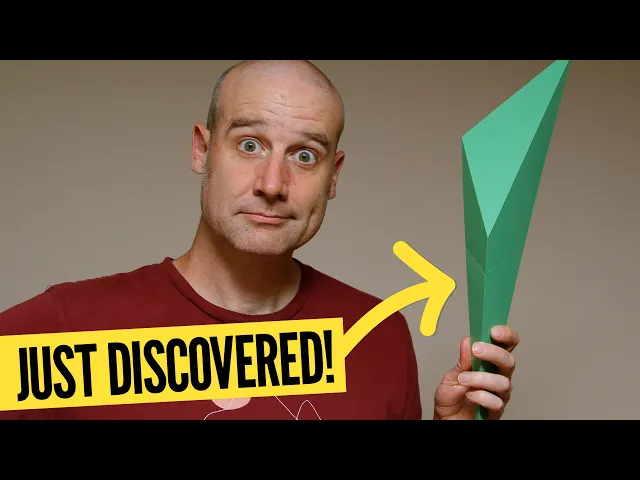
Maths has finally discovered a self-righting tetrahedron!
Stand-up Maths
0:00 [News jingle and music plays] Breaking math news.
0:02 Mathematicians have finally built a tetrahedron, just months ago,
0:05 that they've been theorising about for over 60 years.
0:08 To find out more about it, I tried to build my own (fairly unsuccessfully).
0:13 And of course, we spoke to an expert in the maths field.
0:18 I mean, an actual maths-field.
0:20 For some reason, Matt wanted to film outside
0:23 for this video despite being constantly blinded by the sun.
0:26 [News music stops] In 1966, mathematicians Conway and Guy theorised that both,
0:32 there is a tetrahedron out there which is only stable on two of its faces,
0:39 but there is no tetrahedron that's stable on one face.
0:43 And half of that was answered the very next year when Hungarian mathematician,
0:48 Heppes, came up with this tetrahedron.
0:51 Also, this video, brought to you by Bamboo Lab Printers.
0:54 Yes, all the models in this video were made on my Bamboo Lab X1C printer.
0:59 An incredibly versatile and reliable 3D printer.
1:02 So, if I get this convenient and, now, perfectly level surface, here.
1:08 There are two surfaces on the tetrahedron,
1:12 that one and that one, where it's completely stable.
1:17 However, if I try to balance it anywhere on the other two,
1:21 if I try this one here, and this is not the wind, ready?
1:25 Falls over.
1:26 And if I try this one here, falls over.
1:29 And, quite interestingly, that second one,
1:32 when I balance it on that face, it doesn't fall directly over.
1:35 It actually goes to the other unstable first and then over.
1:40 So, if I balance it there, fall.
1:43 So this is, I guess, a bi-stable tetrahedron and in their paper,
1:49 Heppes defined it with its coordinates of the corners plus or minus epsilon.
1:55 Here is the 1967 paper by Heppes and you
1:58 can see there's just the four coordinates right there.
2:02 with a minus epsilon to define where vertex "A" is.
2:05 Now the rest of the paper is Heppes showing where
2:08 the central mass moves based on the value of epsilon.
2:11 But I wanted to see this thing.
2:13 And so I actually just took these coordinates.
2:15 I assumed an epsylon of 0.1 and I made
2:18 this .stl file just defining the four faces of the tetrahedron.
2:22 That's what I 3D printed.
2:23 And that's okay.
2:24 But to get a better sense of it,
2:27 my friend Sam put the coordinates into a GeoGebra file.
2:29 So there's a tetrahedron.
2:30 There's the center of mass.
2:32 And there's where it projects down.
2:33 And if I turn on the vertex labels, they're the ones as defined by Heppes.
2:39 And the face labels,
2:40 we just give each one the letter of whatever vertex is opposite.
2:43 And you can see initially the center of mass is directly above that edge.
2:47 And that's why we have epsilon to move vertex "A" around.
2:50 So if we move it this way, look at that.
2:53 You can see now the center of mass has moved out.
2:55 It's off the base, which means this is now unstable.
2:58 It's going to tip over from this; face "D" is going
3:01 to lift up and face "A" is going to slam down.
3:03 But where's the center of mass now?
3:05 Oh, look at that.
3:06 still just a little bit out.
3:08 We can move it around more by adjusting epsilon,
3:11 but as long as it's not on the base,
3:13 we'll start to tip and face "A" will lift up and face "C" will slam down.
3:18 Boosh!
3:18 Now, this is a big face.
3:19 The center of mass is directly, look at it, it's just above the face.
3:24 That is not going anywhere.
3:25 So, to recap, face "D" was unstable,
3:28 it will always transition from there to face "A"; that's also unstable,
3:31 it would transition to face "C"- face "C" is stable.
3:35 Now face "B", if we start there, it's just stable.
3:38 So there are two stable faces.
3:40 It's a bi-stable tetrahedron.
3:43 So 1967 we know a two-stable arrangement tetrahedron is possible.
3:49 But what about the monostable tetrahedron [music sting:
3:52 "dun dun duuuun!"] with a single face it always ends up on?
3:55 Well, we can't talk about monostable shapes
3:57 that always end up in the same orientation,
4:00 no matter how you put them down, without talking about the "Gömböc".
4:04 I haven't got a gömböc or Steve Mold.
4:06 Steve Mold has a gömböc.
4:08 Oh, I could ask him to show it to me.
4:10 Ah, the one time I go somewhere nice to film
4:11 and now I got to go inside, phone Steve.
4:15 [Matt] "Steve, you own a gömböc." [Steve] "I do.
4:17 Funnily enough, I have it right here on my desk." [Matt] "Oh,
4:19 that's convenient." [Steve] "Yeah.
4:21 Yeah.
4:21 So, look, the thing about the gömböc is it's got two, well,
4:25 it's got two equilibria, but one is unstable,
4:28 and so it's only got one stable equilibrium,
4:32 which means it doesn't matter how you place it on the table,
4:36 it's always going to end up rolling back to this position.
4:39 So, that's the stable equilibrium position.
4:40 There's an unstable one, right?
4:42 If you put it like that on the edge, it'll balance there.
4:44 But, as soon as you give it any kind of knock,
4:47 it'll end up back in that position." [Matt] "So
4:49 how does this differ from just like a weighted
4:52 sphere that would always end up the same way?"
4:55 [Steve] "So the difference is this is homogeneous throughout.
4:58 So the density is the same all the way through.
5:01 So you could do it like a, a weeble.
5:04 A weeble wobbles but it won't fall down.
5:07 Just to give you that.
5:09 So whereas this it can achieve the same thing.
5:12 It's a weeble except that it's not weighted inside anywhere.
5:15 This is the only object that does that.
5:17 But I mean, I'm not a maths guy.
5:19 I like I don't know.
5:20 Like it's all it's interesting that it's curved.
5:22 Would you think it would be possible if,
5:25 to do it with a shape that's all flat sides?" [Matt] It's not,
5:29 It was proven in 1969.
5:31 You cannot have a monostable tetrahedron, question answered.
5:35 In fact, even in higher dimensions,
5:38 so a higher dimensional tetrahedron is called a simplex.
5:41 All the way up to 8D, there are no monostable simplexes.
5:46 It's all over for shapes that have
5:50 a delicious homogeneous filling like the gömböc.
5:54 But if, instead of a homogeneous filling,
5:57 if the weight was unevenly distributed, suddenly it is possible.
6:02 And, apparently, we believe in 1984 Conway, John Conway,
6:07 had a sketched out sort of proof that it
6:12 would be possible to make a non-homogeneous monostable tetrahedron.
6:17 [SUM sting] Richard Guy had a conversation about
6:21 this with another mathematician in the 80s at Cambridge University,
6:24 named Robert Dawson.
6:26 and Robert Dawson tried to build with some of his friends at Cambridge,
6:32 this non-homogeneous monostable tetrahedron.
6:34 It was built out of lead and bits of bamboo.
6:38 As far as we're aware, this is the first and only previous attempt
6:43 before this year to make one of these.
6:46 And if you read the recent paper that just came out a couple months ago,
6:50 that Robert Dawson is also involved with, it seems
6:52 that that model from the 80s is long lost.
6:55 That's the only other attempt and we no longer have it.
6:58 Or so we thought until a couple weeks ago,
7:01 where it turns out it does still exist.
7:04 It's been looked after by, unbelievably, a friend of mine named Colin Wright.
7:09 He still got it.
7:11 And oh, I could give him a call.
7:14 He can show it to me.
7:16 Uh back inside.
7:17 [Matt] "So Colin, you have the missing model." [Colin] "Well,
7:20 I have a missing model.
7:22 I've spoken Yeah, I've spoken with Bob Dawson.
7:25 Um, one of the authors on the paper,
7:28 and his memory is that there were actually two models.
7:31 Uh so I have one of them, which I have very cleverly put down somewhere.
7:35 Here we go.
7:35 And I have a milk bottle..." [Matt] "It's
7:37 in a milk bottle." [Colin] "with one of the models.
7:39 And if I tip it out, let me just, I'll hold it up to the camera here.
7:43 I don't know how well you can see that cuz
7:45 it's a it's a spindly little thing." [Matt] "It's
7:48 tiny." [Colin] "Yeah..." [Matt] "So it's a tetrahedron
7:50 in that it's got three edges and a vertex." [Colin] "Yeah.
7:55 So we, we created the vertex on the top and then
7:59 three arms which are made out of bamboo, splints of bamboo,
8:03 and then the other three edges on the bottom
8:06 and the, and the interior are entirely missing." [Matt] "Right." [Colin]
8:10 "So it's an implicit tetrahedron to, to reduce the weight
8:13 as much as we could and it doesn't quite work.
8:16 I mean, this is one of the reasons why, at the time,
8:19 we made the model, we thought this could be made to work,
8:23 but we need something that's got a greater density to be the weight at the top,
8:27 and we need to get the angles slightly better.
8:29 So, the angles weren't quite right.
8:31 Um, but if I put this down, uh,
8:34 on a surface here and I bend the camera down," [Matt] "Oh,
8:38 yes." [Colin] "then you may be able to see the little spider-like thing
8:42 that's sitting there.." [Matt] "Yep." [Colin] "And then if I let that go,
8:48 you'll see that apparently it rolls over" [Matt] "Oh!" [Colin] "like that.
8:53 And there..." [Matt] "Yeah." [Colin] "you go.
8:55 Now the thing is..." [Matt {simultaneously}]
8:56 "always end up face," [Colin] "Right.
8:58 So, so it's only stable, it's only, It.
9:00 Well, it, it should be only stable on that face." [Matt]
9:04 "Got it." [Colin] "But what happens is the model doesn't quite work.
9:07 So, uh, when I release it from here,
9:10 it rolls from, call this 'Face A", that it's resting on now.
9:14 It rolls from A to B to C to D.
9:17 Uh, so it rolls from A to B to C to D.
9:22 But the model doesn't quite work.
9:25 Uh, so what actually happens is, if I allow it to roll slowly,
9:31 it actually rests on face B as well.
9:34 So..." [Matt] "Right..." [Colin] "The angle here.
9:37 Oh, no.
9:37 It's very." [Matt] "There it goes" [laughs] [Colin] "Yeah.
9:41 The, the angle, the angle here, uh,
9:44 is almost exactly 90° and it needs to be more than that.
9:49 It needs to be an obtuse angle with the mass outside of it.
9:54 So if I just help that over there, which is a bit tricky to do,
9:58 but if I just help that over there, then it goes and it does the final one.
10:02 But what happens is, uh, if I release it from the initial position,
10:06 it's got enough speed as it comes over here.
10:09 To carry it over onto the next face
10:12 and then onto the next face." [Matt VO] "Interestingly,
10:15 what Colin just showed me from the 1980s bamboo model
10:18 is a system where it starts on face A, that's unstable.
10:23 So, it goes to face B, also unstable, tips to face C,
10:27 face C, unstable, all the way to face D.
10:30 That's stable.
10:31 We have a monostable tetrahedron and that is what we now call a "type two",
10:37 which as you may have noticed, implies the existence of a "type one",
10:41 because what they had in the 80s was not the only option.
10:44 Imagine a tetrahedron that starts on face A that's unstable
10:48 goes to B that's unstable onto D which is stable.
10:52 But what about face C?
10:53 Turns out face C unstable also goes to D.
10:56 So you don't have a chain going from one to the other to the other.
11:00 There's just two different ways to get to the one stable face.
11:04 And the big breakthrough, 40 years later, was when Gergő, Robert, Gábor,
11:09 and Krisztina realised you can actually build
11:13 both of those different types of monostable tetrahedron.
11:17 This fantastic paper, that came out a year ago.
11:20 So, this was a big breakthrough that did not hit the news.
11:23 It was only when someone made one that it did.
11:27 And spoiler alert, they made a type one in this fantastic GeoGebra file,
11:31 also made by my friend Sam.
11:33 She's really helped me out on this.
11:35 Now, here, oh, ignore these extra lines.
11:37 They're the supports that were eventually built in the physical one.
11:40 So, spoiler, but if this was a homogeneous tetrahedron,
11:43 that's where the central mass would be.
11:45 And you can see on face A, perfectly stable.
11:48 Look at that.
11:48 Right above the base.
11:49 But this dark region, that's a different density region.
11:52 And if that was sufficiently more dense compared to the rest of it,
11:56 you can see here there's its centrid,
11:59 the center of mass, and it's just above outside the base.
12:02 So in theory, this means by making
12:04 one region a different density to another region,
12:07 we can kind of pick any arbitrary location inside
12:10 the tetrahedron and move the center of mass there.
12:12 If it just happens to be right in there,
12:14 that moves it far enough off that we can tip from face A to face D.
12:19 Now in this case face D is the only stable face and actually
12:24 B and C both tip onto A and then A tips onto D.
12:28 So it is a type one and this is the one
12:31 that was most likely to be able to be made.
12:33 You just needed to have one region here that was
12:35 a different density compared to the rest of it.
12:37 The only problem now is the ratio between the less dense part
12:41 of the tetrahedron and the dense part has to be at least a thousand times.
12:47 It's like three orders of magnitude change
12:50 in density for this tetrahedron to work.
12:52 So I thought even though I won't succeed, I'm going to give it a go.
12:58 So I have 3D printed this tetrahedron.
13:00 I had to print it in two different sections and then I've glued them together.
13:05 To make this bit heavier, I paused the print where I'd left a cavity.
13:10 Put in some metal washes, like not a thousand to one,
13:13 but it's something, and then continued the print.
13:16 And so, while this won't properly right itself,
13:19 it's still a completely adequate teaching aid.
13:21 So, I can show you that if I put the heavy face down flat,
13:26 that is definitely stable.
13:27 Now...
13:27 [Business Matt] "Actually, while you're speaking about 3D printing,
13:30 it's me, Business Matt.
13:31 This video is sponsored by Bamboo Lab.
13:34 They make the 3D printer we used
13:36 to make that tetrahedron." [Matt] "Business Matt.
13:38 Are you allowed outside?" [Business Matt] "There's
13:40 a very good point and particularly when it's windy.
13:43 It turns out I can be outside.
13:46 But the longer we sit here,
13:48 the angrier camera-person Alex gets." [Matt] "Although if they're already angry,
13:52 would you like me to just pass this to you?" [Business Matt] "Yeah,
13:55 why not?" I'm I'm sure Alex will make it work.
13:59 Thanks!
14:01 I was able to take the coordinates from the maths paper,
14:04 recreate it in Bamboo Lab,
14:06 split it very easily into two parts that I could later glue together,
14:10 and I could design the print with a hollow void
14:13 and then set it to stop printing at that point.
14:16 So, I could put in the metal washes.
14:18 I could not have made this tetrahedron, which almost works,
14:21 or this video if it wasn't for my Bamboo Lab printer.
14:25 If you already have a 3D printer and you
14:27 want to find some fun maths things to print,
14:29 without getting coordinates from a maths paper and turning them into an .stl,
14:33 which I do recommend, you can head on over to Maker World
14:36 where there's a huge range of models available.
14:39 And I always like to print something someone has requested,
14:42 which this time was from video producer Alienne,
14:45 who wanted two of these phenomenal knot prints to use as fashion accessories.
14:50 Oh, good.
14:50 You you've got it back.
14:52 That simplifies things.
14:53 Anyway, link in the description below." [60's
14:55 Batman TV Series scene transition music] [Matt] Huh?
14:57 Okay.
14:57 So, you've got the heavy part here.
15:00 If I put that down first, that is definitely stable.
15:04 All three other faces should be unstable.
15:06 And you can tell if like that, you can see if I line it up,
15:10 this just sticks out.
15:11 If that was heavy enough, it would cause it to flip up like that.
15:16 And likewise here, if that was heavy enough,
15:19 whoop, it would cause it to tip that way.
15:22 So, while this doesn't actually work completely properly,
15:25 having it slightly weighted meant that I could have a play with it and kind
15:30 of get a sense of the overall geometry and why in theory it could work.
15:36 Although, it was only in theory until very recently.
15:41 Building this thing to actually work was an incredible feat,
15:44 and I really wanted to see it for myself.
15:48 And the lead mathematician, Gábor,
15:50 said that he'd be very happy to jump on a call with me and show me.
15:56 Oh, here we go again.
15:58 At last, I had a phone call with Gábor and his student,
16:02 Gergő, at the Budapest University of Technology and Economics,
16:06 who started off by explaining just how precise and difficult
16:11 the engineering behind this model was proving to be.
16:15 [Gábor] "And to design this thing you needed,
16:19 uh, kind of theoretical insight which we had.
16:24 We needed some geometric ideas which we added.
16:27 You needed engineering ideas how to design the objects and that we had.
16:33 We are both engineers and but you also needed technological insight.
16:38 There are several technological tricks which we could never have
16:45 designed and the result is certainly depending also on the technology.
16:50 It's not something we are happy to disclose any part of this publicly
16:56 but I still would not recommended to try." [Matt VO] "Along the way,
17:00 they showed me how their research could
17:02 be applied to future space mission landers.
17:04 And I took the opportunity to show them what I had made." [Matt] "Here's,
17:09 this is your tetrahedron.
17:11 [Gábor] "Okay." [Matt] "But I 3D printed it in two bits.
17:15 [Gábor] "Yeah." [Matt] "And then I paused the print
17:19 and I put a whole bunch of metal just in here.
17:23 So that's the bit that should be a lot heavier.
17:27 Obviously, the center of mass is still way-way in the middle.
17:30 It's..." [Gábor] "How does it behave?" [Matt] "Almost good enough.
17:34 So, if you give it a bump, a little nudge, it'll do it.
17:39 Or if it's got some momentum, but you can you can put it down
17:44 and it will just sit there in place." [Gábor] "Matt.
17:47 Can I can I say something?" [Matt]
17:50 [Laughs] "Yes." [Gábor] "So I think that building
17:54 the actual tetrahedron was a big step
17:57 towards making it accessible to many people.
18:00 But another huge step is what you have done." [Matt] "Yeah." [Gábor] "Yes.
18:06 Yes.
18:06 This is this is an enormous step towards many
18:10 people because now they will see what is the difficulty,
18:13 because this is not a bad attempt.
18:15 This is a kind of a professional homemade stuff.
18:18 Yes." [Matt] "Thank you." [Gergő] "Yeah, that's true" [Gábor] So this is,
18:22 this elevates the whole story to a different, yeah.
18:24 Yeah.
18:25 Yeah.
18:25 Communication wise it is, uh,
18:27 it is in a different league now." [Matt VO] "But then finally it was
18:30 time to see the actual model they
18:33 had built." [Matt] "Do you have the tetrahedron,
18:35 the engineered?..." [Gábor] "I have a piece of good news." [Matt] "Good,
18:41 good-good-good." [Gábor] "Of course." [Matt] "Look at this, it's got
18:46 a special box." [Gábor] "And, um..." [Matt] "Oh wow." [Gergő] "So,
18:51 would you like to see it tip?" [Matt] "Yes, please." [Gábor] "I think Okay.
18:57 So, we can do this uh tipping to the stable
19:03 side." [Matt] "Yep." [Gergő] "Uh, from this place.
19:09 Oh, so it does one tipping and it's
19:13 the most." [Matt] "One more to go." [Gergő] "Yeah.
19:17 Yeah.
19:17 Yeah.
19:18 The most interesting one from the biggest opposite from the biggest face.
19:25 Uh, how can I do it?
19:28 So you see when it does two tips subsequently." [Matt] "One-two,
19:33 very fast." [Gergő] "Yeah.
19:35 Yeah.
19:35 Yeah.
19:36 Yeah.
19:36 It works very fast.
19:38 Uh, which is a little bit deceiving.
19:41 So it suggest that that it's easy to do but that's not the case.
19:46 So, um." [Matt] "I thought this one..." [Gergő] "if
19:49 it's working then it is working fast but if it,
19:53 um, err." [Gábor] "If it doesn't work..." [Gergő]
19:55 "if it doesn't work it very hasn't very fast.
19:58 So yeah so it either works very fast or..." [Matt]
20:01 "Or not at all." [Gergő {simultaneously}] "in no way in this gravity.
20:06 Yes." [Matt] "Can you put it back on the big side and turn it
20:09 around so I can see where the center of mass is on that plate.
20:13 So is that just off the base?" [Gergő] "Well,
20:17 the center of gravity is somewhere around here, I guess." [Matt] "Yeah.
20:22 And that's just, just above, just off there..." [Gergő] "Yeah,
20:27 just off the the big face.
20:29 Yes." [Matt] "Oh, wow." [Gergő] "Some, yeah,
20:32 that's the trick.." [Matt] "That's the bit
20:36 mine doesn't do." [Gábor] Just one comment,
20:39 which is probably obvious to you that the more faces a polyhedron has the easier
20:46 it is to make it monostable and this is
20:50 the most difficult problem in this category.
20:52 If you can do it with four faces you can do
20:55 it with any number of faces and it was a mathematical challenge.
21:00 It was a historical challenge which we owe to Conway.
21:04 It was a good topic for his diploma.
21:07 I think it's a lot of fun for many people.
21:11 People are, people just love it and and it does
21:15 connect to the space industry but not in a trivial way.
21:20 So this this object for example doesn't look
21:24 monostable" [Matt] "No." [Gábor] "But it is monostable.
21:26 And whether it can be made monostable it's a delicate matter of these angles.
21:32 So we even think that if you can take a lunar lander and design it
21:39 so that it is not omnistable but it is stable only on two or three faces,
21:45 you already win because you can design it
21:48 the antennas you can design it for just three
21:52 cases and not for 10 cases." [Matt VO] "So
21:55 given the model that was eventually made was type-one,
21:57 I did also ask if a type-two would be technically possible." [Gábor] "Now
22:03 our intuition and computations show that if you want to build that version,
22:10 you need a core which is heavier than
22:13 the core of the sun." [Matt] "So there you are.
22:16 I guess doesn't matter how good the bamboo and lead was.
22:18 It seems the type 2 model made by Colin
22:21 and Robert back in the 80s never could have worked.
22:24 So that is the non-homogeneous, monostable tetrahedron made real.
22:30 Will that be the biggest maths news of 2025?
22:34 We'll find out.
22:35 If anything else happens, send me an email.
22:37 I'll look into it.
22:38 So, thank you for watching the video.
22:40 If you're wondering where I've been this entire time,
22:43 this is a landscape sculpture called "The Cells of Life".
22:47 It's at Jupiter Artland,
22:48 a wonderful site with loads of art, just outside Edinburgh.
22:52 I've always wanted to come here and I thought filming
22:55 this video would be a fantastic excuse to come and visit,
22:58 uh, in a tax-deductible manner.
23:00 I'll have a link to it below.
23:03 I'll also link to all the .stl files
23:05 I use for printing things out in this video.
23:08 Thanks for watching.
23:09 Bye.