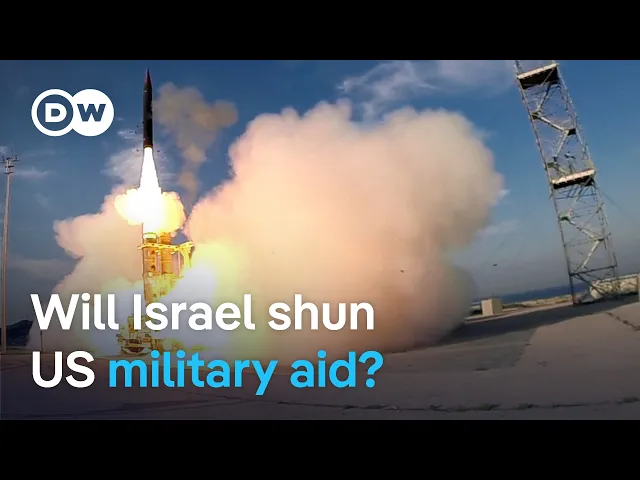
US military support for Israel in doubt | DW News
DW News
0:00 Why would America's key ally in the Middle East say thanks,
0:03 but no thanks, to billions of dollars in military aid?
0:07 Prime Minister Benjamin Netanyahu is proposing
0:09 weaning Israel's military off US tax dollars.
0:12 That despite years of insecurity and conflict in the Middle East.
0:16 So, what's driving this shift?
0:17 And can Israel really stand on its own?
0:20 Those are the questions we'll explore with Bradley Bowman.
0:23 He's senior director of the Center on Military
0:25 and Political Power at the Foundation for Defense of Democracies.
0:29 He joins us now from Washington D.C.
0:31 So, thanks for being with us, Bradley.
0:34 Thank you very much.
0:35 Appreciate the opportunity.
0:37 All right, before we get into it, let's take a look at what Netanyahu
0:39 said on US television news program 60 Minutes.
0:43 He was asked if Israel would possibly
0:44 reset its financial relationship to the United States.
0:48 This was his answer.
0:51 He said, "I want to draw down to zero
0:54 the American financial component of the military cooperation that we have,
0:58 because we receive $3.8 billion a year,
1:01 and I think that it's time that we weaned ourselves
1:04 from the remaining military support." Netanyahu also provided a timetable.
1:09 He said, "Let's start now and do it over the next decade,
1:12 over the next 10 years, but I want to start now.
1:15 I don't want to wait for the next Congress.
1:17 I want to start now." So, Bradley,
1:21 this is not the first time Netanyahu has said he
1:23 wants Israel to end its dependence on US military aid.
1:27 So, is this a genuine strategic shift?
1:31 You know, I think this is a significant strategic moment
1:34 in the bilateral relationship between the United States and Israel.
1:37 You know, I worked these issues as a senior staff in the Senate for many years,
1:41 and it's been a focus in my at the current research institute where I work.
1:45 And I think when you look at this, it's
1:46 important to make sure that viewers have a common vocabulary.
1:50 Uh he's talk- what he's talking about there is foreign military financing,
1:53 or as we say in the United States, FMF, foreign military financing.
1:57 And we're currently under a memorandum of understanding that was
2:00 signed in September 2016 that covers fiscal years 2019 to 2028.
2:06 So, we're approaching the end of that 10-year window, and as he said,
2:10 the United States has provided Israel $3.8 billion per
2:14 year divided between $3.3 billion in foreign military financing,
2:18 FMF, and $500 million for air cooperative air missile defense programs.
2:24 And so, as we've approached the end of that window,
2:26 there's been questions about what comes next and what should come next.
2:30 And all of these discussions are happening
2:32 within the context of evolving political conditions,
2:36 particularly here in the United States, but also in Israel.
2:39 And let's remember that Prime Minister Netanyahu
2:41 is in the midst of a re-election campaign.
2:45 And so, saying things like that, like he said there,
2:48 plays well with certain elements of his political base.
2:52 But when you actually look at some of the numbers, uh you see a different story.
2:57 So, symbolic uh statement by the Prime Minister up for re-election, absolutely.
3:02 Significant strategic consequences, potentially, absolutely.
3:08 So, question, how exactly dependent is Israel on this foreign military funding,
3:13 on this FMF funding, as you were calling it?
3:16 Yeah, so uh again, it's important for folks
3:19 to now that we have kind of some basic vocabulary
3:21 in the FMF to understand the difference between
3:24 that and the ability of Israel to buy American weapons.
3:27 But let's start with the FMF.
3:29 So, when you look at um foreign military
3:31 financing from the United States for Israel over time,
3:34 and this data is according to Jane's
3:36 as well as the Congressional Research Service,
3:39 uh FMS as a percentage of Israel's independent
3:42 defense budget reached as high as around 30%, 30%,
3:47 a third of their independent defense budget in 2006,
3:51 and then dropped and kind of hovered around
3:53 the 20% range from about 2010 to about 2019,
3:57 and then we saw a drop below 15% around 2023 and then spiked after
4:03 October 7th when we saw the supplemental
4:06 additional supplemental funding provided by the United States.
4:09 And now it's dropped again below around 10%.
4:12 So, what's explaining that?
4:13 What's explaining that is the growing Israeli economy.
4:16 I mean, that's great for Israelis, that's great for the United States.
4:19 You know, the more that they can pay for their own defense, that's great.
4:23 But, when you when you zoom out a little bit
4:25 more and you look at percentage of GDP spent on defense,
4:30 you start to get a picture a more
4:32 nuanced picture than a lot of people appreciate.
4:35 And let me just give you a few more numbers.
4:37 So, the United States spends about 3% of its GDP on defense,
4:41 its gross domestic product.
4:43 Most of your of our European allies are barely, you know,
4:46 they they struggle to meet the 2% and very few are higher than that.
4:50 So, Israel is actually kind of a model ally.
4:54 The Trump administration called them that in their national defense
4:56 strategy twice in terms of percentage of GDP on defense.
5:01 In they spent about 4% of GDP in 2022, 5% in 2023.
5:07 In 2024, after the October 7th terror attack, Israel spent roughly 8% of GDP.
5:14 That's a crazy high number.
5:16 I mean, that's more than double what the United
5:17 States spends and far more than any European country spends.
5:22 And they're come down in 2025 and then 2026 to about 7%.
5:26 So, why does all that matter?
5:27 Well, that number tells you a little bit about what they can afford.
5:30 And then when you add to that the wars that we saw with the between Iran
5:34 and Israel in April and October of 2024 and then the 12-day war in June of 2025,
5:41 and then what we've called the 40-day war more recently,
5:44 Israel, like the United States,
5:46 has expended an enormous quantity of munitions and both in in Lebanon
5:51 as well against others and so they've incurred a huge bill,
5:54 a growing bill that they're going to have to pay for and yet
5:58 they're already spending an extraordinary amount of their GDP on defense.
6:02 And so if you begin to phase out American foreign military financing,
6:06 even though it's about 7 to 10% of their budget and and you consider the fact
6:10 that a large portion of that future
6:12 foreign military financing for a future 10-year period,
6:16 potentially more than 20 billion of it is already
6:18 spoken for, then you start to see that if
6:21 you phase out American foreign military financing at time
6:24 when the Israeli defense needs are growing to replenish, modernize and expand,
6:29 then you then you start to have a problem if you're someone who believes
6:32 that Israel should exist and should be able
6:33 to defend itself and afford to do so.
6:36 So looking forward, is this type
6:38 of spending from Israel on its military sustainable?
6:40 I mean, will its GDP actually allow
6:43 them to continue this high level of spending?
6:45 I mean, their needs aren't going to decrease in the short term.
6:49 No, their needs are increasing significantly and if you you
6:53 complicate that with a phasing out of US foreign military financing,
6:57 then the gap between the budget that Israel needs
6:59 and they have will grow and that will be translated
7:02 in reduced security for Israel and reduced ability to fight
7:07 common adversaries and defend common interests with the United States.
7:10 And as the United States is looking is confronting
7:12 an axis of aggressors where we have China, Russia,
7:15 Iran and North Korea cooperating in what our chairman
7:17 of the Joint Chiefs of Staff said in unprecedented ways,
7:20 we need and want capable partners who can
7:23 help carry the burden in their respective regions.
7:25 And so from a selfish American perspective,
7:27 we want Israel to be militarily capable.
7:30 And so I I I am quite concerned about this and you know, to expect a democracy,
7:35 let's remember Israel is a democracy, to sustain 7 to 8% of gross domestic
7:42 percent of GDP on defense for 10 plus years.
7:46 You know, you talk about the guns and butter domestic debate and if
7:49 the the government that replaces Netanyahu is
7:51 a is a center or center-left government,
7:53 are they going to be able to maintain that?
7:55 I'd be surprised and that will will mean a reduced margin
7:58 of safety for Israelis and a partner uh in the Middle
8:02 East for the United States and our European allies that is
8:04 not as capable as we want them to be, I fear.
8:07 Yeah, it does seem that we're seeing kind of a phase
8:09 change both in the US and in Israel as well.
8:12 And I want to take a look at what seems
8:13 to be a uh a factor driving this change from Netanyahu.
8:17 Yeah, you mentioned the election due this year in Israel,
8:20 but Netanyahu also cited shifting political attitudes in the United States.
8:24 Uh in a survey carried out by the Pew Research Center in March this year,
8:29 60% of US adults said that they have an unfavorable view of Israel.
8:33 Opinions of Israel are also becoming more negative,
8:35 especially among younger Americans.
8:38 A majority of Democrats and Republicans under the age
8:40 of 50 now have a negative view of Israel.
8:44 So, with those numbers in mind,
8:46 do you think that Netanyahu's statements are a recognition
8:49 of a long-term shift in US support for Israel?
8:53 We have seen uh changes in public opinion in the United States regarding Israel.
8:58 Uh and you can you some of this uh goes back years
9:01 and some of this is a function of after October 7th uh Israel perceptions,
9:06 particularly on the left in this country regarding
9:08 Israeli military operations in Gaza and also uh
9:12 the way that the current war against Iran was
9:15 conducted has uh created additional anger among some Democrats.
9:19 And uh in addition to that poll you cited,
9:21 we see some of the similar reflections in a Reagan
9:24 Institute uh poll that they conduct once or twice a year.
9:27 And there's definitely a distinction between Republicans and Democrats,
9:30 and there's definitely a distinction by age.
9:33 And the more Democrat you are, the more negative the perception tends to be.
9:36 Uh and the younger you are, the more the negative the perception tends to be.
9:40 And so, if you're an Israeli looking at this, you
9:42 say there's a couple of views you can take.
9:44 One view is, "Hey, we Israel need this foreign
9:47 military financing because our defense needs are growing,
9:50 and this is really not a time to take a 7 to 10% decrease
9:54 in our defense budget when we're already at about 6 to 7% of GDP on defense.
9:59 So, let's let's work with America and keep
10:01 this foreign military financing going as long as we can
10:03 because we need it." Or you could look at it
10:06 the the politics in the United States and say,
10:08 "Hey, this money is going to get cut off sooner or later.
10:11 So, let's rip the band-aid off and do it now and force
10:13 the changes in Israel domestically that need to be made." And so,
10:17 that's essentially the debate.
10:18 And so, there are politics that Netanyahu's playing with, you know,
10:22 he's trying to curry favor with some elements of the far
10:25 right that views American foreign military financing as like handcuffs,
10:29 that that money somehow gives the United States the ability
10:32 to tell Israel what it can and can't do.
10:35 And that if you get rid of that foreign military financing,
10:38 then suddenly they'll have liberty or freedom they don't have.
10:41 But that view to me doesn't stand up to scrutiny
10:44 because Israel's still going to be flying American F-15s,
10:47 F-35s, F-16s, relying on American munitions for decades to come.
10:52 And they're going to still need parts for those systems.
10:54 So, Israel's not going to be building its own F-35s anytime soon,
10:57 and they're going to need parts for those aircraft.
10:59 So, if they're really worried about politics
11:01 in the United States going south that fast, that quickly, that badly,
11:04 then I worry those who are calling for an FMF phase-out
11:07 are simply jumping on a Bronco that they're not going to control,
11:10 that's going to end up in a barn they don't like.
11:13 That's a really interesting point,
11:14 and I want to circle back to that in just a second.
11:16 But if we're staying on the political side in the United States,
11:19 now foreign aid is an unpopular subject for many in Trump's base,
11:23 and an increasing number of Republicans
11:25 also hold a negative view towards Israel.
11:27 So, do you think Netanyahu's statements are an attempt to help
11:30 Trump ahead of the midterm elections this November in the US?
11:34 You know, I don't know.
11:35 I don't frankly like it when any
11:37 foreign national tries to impact American politics.
11:40 I don't think we should do that to other countries, including Germany.
11:42 I don't think other countries should do it to us.
11:44 If those are his motives, I don't like it.
11:46 Um you know, I'd say let Americans choose who
11:48 lead and let Israelis choose who they want to lead.
11:50 That's the That's the way it should work in a democracy, right?
11:53 But undoubtedly, there's maybe some shenanigans at play here.
11:56 But the bottom line is, you know,
11:57 I really you know, I worked for three Republican senators,
12:00 but I'm at a non-partisan think tank now and I
12:03 try to call balls and strikes regardless who's pitching.
12:05 And here's where I come down.
12:07 You know, the United States is confronting
12:08 this axis of aggressors that is a real thing.
12:11 They're cooperating across all domains of power, presenting dilemmas for us.
12:14 We are America's powerful.
12:16 We're the most powerful military in the world, but we need help.
12:19 You know, the bullies are coming around the corner in the playground
12:21 and it's good to have friends who know how to throw punches.
12:23 And Israelis have demonstrated they know how to throw punches.
12:26 But you know, when we make Israel powerful,
12:29 as I said, they can help carry the burden.
12:32 And there's a little anecdote I'd like to tell.
12:33 There's a There's a terrorist named Fuad Shuker who was involved
12:37 in the the killing of over 240 Marines in Lebanon in 1983.
12:41 The US put out a Rewards for Justice program for him calling for five million
12:46 saying there'd be five million dollars for anything
12:48 that led to his his you know, being brought into custody.
12:53 Well, that just sat there for years and years and years.
12:55 And then one day, Israelis flying in American-made jet,
12:58 probably an F-15, firing an American-made munition,
13:02 brought justice to Fuad Shuker,
13:04 this man responsible for killing over 241 Marines in Lebanon in 1983.
13:09 He's never going to going to kill US service members
13:11 and that's because of the Israelis flying American jets and American weapons.
13:15 And I could give you about three more hours
13:16 of examples of how we benefit from this cooperation.
13:20 So those who would suggest that this is just
13:22 a Christmas gift or a holiday gift for Israel and it's
13:26 pure charity really have not spent the time to understand
13:29 how we Americans selfishly benefit from this cooperation with Israel.
13:33 And so, I hope that folks put the politics aside,
13:37 um, but you know, with the Prime Minister of Israel saying,
13:40 "We don't need this." He's obviously undercut,
13:43 arguments of those of us in the United States
13:45 who say that it is a good thing for us.
13:47 And it's probably going to result in a phase
13:49 out happening more abruptly than it would have.
13:53 And that's going to create more defense budget crises,
13:55 if you will, for Israel than it would have otherwise.
13:59 And you were you said that, some in Israel
14:02 viewed this financial aid as a type of handcuffs.
14:05 How do you think that the broader military relationship between
14:07 the US and Israel could change if those handcuffs came off?
14:13 Well, you know, so, one, I I I argue that I think that argument is flawed.
14:17 That the United States will have a leverage over
14:20 Israel whether Israel's receiving foreign military financing or not.
14:25 Any Israel, any Israeli who looks
14:28 at this relationship objectively understands, you know,
14:30 this isn't the arrogant American saying this, it's just a geopolitical
14:33 reality that there's a senior partner and a junior partner here.
14:35 Yes, Israel is a sovereign autonomous nation and will make its decisions.
14:40 Um, but those on the far right in Israel think
14:43 an end to FMF is going to end US leverage over Israel,
14:47 I think we're going to have a rude awakening.
14:49 Because Israel's going to remain reliant to some degree
14:53 on American political debt debt block and economic power.
14:56 The whole move right now though,
14:58 among those who are supporting this FMF phase out,
15:02 which is gaining momentum frankly because of the comments of the Prime
15:05 Minister and some of the responses that's elicited in Congress,
15:08 including from people like Senator Lindsey Graham, um,
15:11 are are trying to shift to more a a strategic partnership.
15:15 I published in December arguing for FMF,
15:17 but also arguing for an increase in research and development cooperation.
15:21 Israel is not in industrial power, but they are a defense technology superpower.
15:26 Uh and they are quite impressive on AI and biotechnology and air defense.
15:31 So, there's lots of ways where we can work with them
15:33 in a win-win sort of way that will benefit Americans.
15:36 And so, those uh those steps are already uh underway
15:41 um and should happen regardless of what happens to FMF,
15:45 and that will be good for the United States and that'll be good for Israel
15:47 because um it will help American military members
15:51 be more capable in the first island chain, uh in Eastern Europe,
15:55 or uh on the Korean Peninsula because in many
15:58 cases Israelis are at the forefront of military R&D.
16:01 So, I'm I'm a big proponent of increasing that cooperation.
16:05 Uh of you making the most of things
16:07 like the US-Israel Operations Technology Working Group.
16:10 Um and that's definitely where all the focus is in both
16:13 Israel and the United States in trying to evolve the relationship.
16:16 All I'm simply trying to do is highlight uh
16:19 that the arithmetic really doesn't work for the Israeli defense budget
16:22 in the certainly in the short term and maybe even
16:24 the medium term if you phase out foreign military financing.
16:28 And it may catalyze a series of events that those of us who want Israel
16:32 to exist and be secure and have the means
16:34 to defend itself may not like uh because there are other ways that a US Congress
16:39 where you have 40 Democrat senators voting against
16:43 giving Israel bulldozers and 36 Democ- 36 senators
16:48 oh some of those were uh were Republican,
16:50 but 40 senators voting against bulldozers 36 voting against munitions.
16:55 Um you you can look at that vote two ways.
16:58 You could say uh that's a function of the Iran war,
17:00 that's a function of what perceptions regarding Gaza.
17:04 Um and you know, when those things fade into the rearview mirror,
17:06 those votes will change.
17:07 You can say that.
17:09 Or you can say we're in the midst of a generational
17:11 tectonic shift uh in perceptions of Israel in the United States.
17:15 Um and things could get much worse.
17:17 Um I think that's to answer that question,
17:19 it's more of a psychological, sociological, political science question.
17:22 And anyone says they know exactly what that's going to look like in 1, 5,
17:26 10 years, I don't think I I don't think you should trust that too much.
17:30 Yeah, none of us have crystal balls.
17:32 So, that was Bradley Bowman.
17:33 Exactly, that was Bradley Bowman, senior director of the Center on Military
17:37 and Political Power at the Foundation for Defending Democracies.
17:39 Thank you very much for your insights.
17:42 Thank you.
17:45 So, what do you think is behind the strategic shift?
17:47 Leave your comments below.
17:48 And if you like this video, please hit that like button.
17:51 And if you haven't already, don't forget to subscribe.
17:53 I'm Aaron Tilton.
17:54 Thanks for watching us.