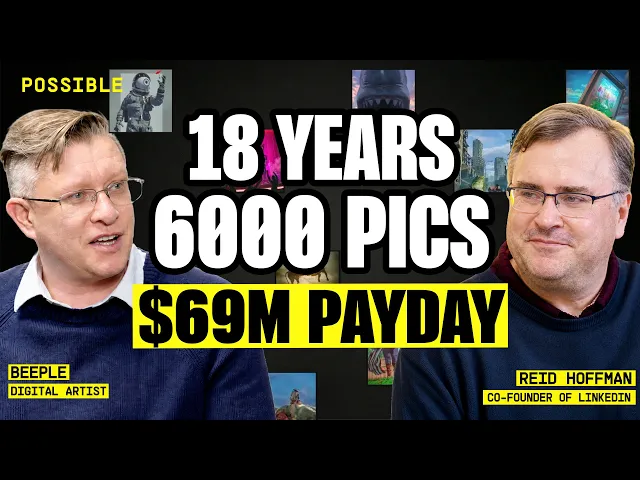
How Beeple's $69 MILLION sale was just the beginning.
Reid Hoffman
0:00 Do you hear people sometimes say things like AI doesn't have a soul?
0:04 Yeah.
0:03 And it's like, well, what the[ __] are you talking about?
0:06 Of course it doesn't have a soul.
0:07 It's a computer program.
0:09 People say, "Oh, this AI agent is my friend." It's like,
0:11 no, a friend is a two-directional relationship.
0:12 The AI agent can't be your friend yet.
0:14 If you look at AI as a way for humans to do less,
0:19 you will be very fearful of it.
0:22 Yes.
0:21 If you look at AI as a way for humans to do more, you will be inspired by it.
0:26 The future is going to be so weird.
0:29 These technologies, they're moving faster and faster,
0:32 and they're sort of like intertwining in ways
0:34 that we can't sort of like predict.
0:36 Digital culture used to live on the margins.
0:39 Now, it sets prices, shapes taste, and even redefines ownership.
0:44 Today, we speak with a digital artist
0:46 who didn't come up through galleries or institutions.
0:49 He built his reputation one day at a time,
0:52 publishing work online for free for years,
0:56 long before anyone ever thought it was valuable.
0:59 Almost overnight, that work collided with blockchain,
1:03 NFTs, and global speculation.
1:05 This conversation isn't about hype or quick flips.
1:08 It's about what happens when technology, authorship,
1:12 and attention converge in a single moment,
1:15 and how culture, value, and ownership are being rewritten in the process.
1:20 Welcome to Possible, people.
1:23 Uh so, Mike, I've been a fan of the art for a long time.
1:25 Thank you.
1:26 Thank you.
1:26 Um it's not just, obviously, the amazing artifacts,
1:29 the intersection of technology and like imagination and creativity,
1:34 but also the kinds of things you're willing to make
1:36 fun of, the kinds of ways of using satire, of of making this work.
1:40 We'll cover a bunch of this stuff.
1:42 Um but, you know, this podcast, Possible, technology optimists, you know,
1:46 kind of hoping for what do we make in the future?
1:48 Probably, and this is one of the reasons I've
1:50 been really looking forward to doing this with you,
1:52 little bit less familiar with art.
1:54 Right?
1:55 People.
1:57 What does like how does that name come about?
2:00 What does it brand stand for?
2:01 What is the for people who probably like
2:03 who's this Mike guy that reads talking to?
2:05 What what's the intro?
2:06 Sure.
2:07 So thank you very much for having me.
2:09 Very much appreciated.
2:10 I've been a digital artist for 25 years.
2:14 I'm 44.
2:15 And started making digital art when I got to college.
2:19 I went to school for computer science and then kind
2:22 of struggle through that and and sort of just graduated
2:25 and I was like I'm just going to like get
2:26 a job doing web design and like make art on the side.
2:29 And so you know that's what I did.
2:31 And technology has always been at the sort of like forefront of all
2:36 of the art that I've made since I got a computer in fourth grade.
2:39 It was like this is the thing.
2:41 which computer was it?
2:42 It was a IBM 386 SX.
2:47 I think I think it had 4 meg of RAM and a 20 20 or 40 meg hard drive.
2:55 Few people will know what that is but we do.
2:58 You know what it is.
2:58 Yeah.
2:58 It's like yeah you appreciate how insane you know everything is.
3:03 And so just kind of have been making digital art for the last
3:07 25 years and and sort of growing a following on social media
3:12 and a lot of people know me for the sort of like everyday
3:14 project where I've been doing a picture everyday for the last 18 years.
3:18 And done a bunch of sort of concert visuals and then
3:23 the NFT thing you know I obviously exploded and now here we are.
3:28 Here we are [laughter] in the in the in the node foundation
3:30 with the the launch of their you know the kind of museum and crypto punks.
3:35 But we'll get to that.
3:36 So I do think everyday is a good place to start because it's one of the things
3:40 where I think also you know kind of breaking
3:43 on the scene with Christie's and all this.
3:46 How did you start with the everyday project?
3:48 What what what made you decide to to it?
3:50 What made you decide to stick with it?
3:52 When did you start realizing this was a project that people were going to track?
3:56 So, I started in 2007.
3:57 I wanted to get better at drawing.
3:59 And so, I had seen an illustrator out of the UK
4:01 named Tom Judd who did a drawing every day, a like sketch every day.
4:05 And I thought, "Wow, that's a really cool way to like, you know,
4:08 he had the project had kind of completed it." He did it for 1 year.
4:11 And I thought, "Wow, I want to get better at drawing, too." So,
4:14 I was like, you know, "Why don't I try doing that?" And so, I did that.
4:18 And after the year, I realized I'd learned a huge amount.
4:21 And I was like, "Oh, I'd always wanted to learn a 3D program,
4:24 a 3D animation program." And so, I was like,
4:26 "Why don't I do a render a day in Cinema 4D and try
4:30 and teach myself this program which I knew nothing about that same way." And so,
4:34 then I started doing a render every day.
4:36 And then, very quickly, it was just like, I just kind of kept doing it.
4:40 But, it definitely was kind of like a slow progression of people sort of like,
4:44 you know, kind of like learning of this.
4:45 Like, definitely for the first year, and this was again in 2007,
4:50 so Facebook wasn't even open to the public at that time.
4:54 I was just posting on my website.
4:56 And it was just like, nobody saw it.
5:00 Um and so, you know,
5:02 it really kind of like slowly gained sort of like steam over that, um you know,
5:08 over the the sort of like full 18 years.
5:10 Was there a moment where it kind of hit an inflection
5:14 or was it just kind of like where suddenly it was like, "Wait,
5:17 there is this long kind of it's almost like
5:21 I'm thinking of the that film 7 Up, 14 Up,
5:23 21 Up, you know, kind of following people where where like where suddenly went,
5:27 "Aha, this is now evolved into something."
5:32 Um there I don't remember like a very specific anything happening.
5:36 It was really just like pretty quickly something that I
5:40 I knew I was not going to stop doing.
5:42 There was never really any time where I seriously considered stopping doing it.
5:46 But yeah, it really just was like a slow progression.
5:49 I mean, obviously, the everyday sale was a pretty like,
5:53 "Okay, this is like, you know,
5:54 a thing." But, that was, you know,
5:57 well into the sort of, you know, kind of like career of it.
6:00 But, yeah, I think it's I think in terms
6:02 of like continuing to sort of like do it,
6:04 it's I have an appropriate um expectation for each day.
6:10 Yes.
6:10 And that expectation is that I put a JPEG on the internet.
6:13 And so, if you kind of boil it down to like,
6:17 it's not like every day needs to be this like masterpiece.
6:19 It's like it's not going to.
6:20 Like, it's like things are going on.
6:22 Like, I don't have, you know, 365 masterpiece ideas per year.
6:27 Uh-huh.
6:28 And so, it it's going to be what it is.
6:31 But, the like momentum of the project kind
6:33 of like continues it going and sort of um yeah.
6:37 And I think just the act of sitting down,
6:40 I think you have more ideas in you than you think.
6:44 And I think that you don't have a lack of ideas.
6:47 I have this sort of like saying,
6:48 you don't have a lack of ideas, you have a lack of deadlines.
6:50 And if you had more deadlines, you would be like, "Huh, more things came out.
6:53 Look at that." And so, yeah,
6:55 that's that's a big sort of like ethos of the project.
6:58 Well, that's a great way to look at it.
6:59 And the day you're referring to, I think um was March 11th, 2021.
7:05 Christie's sold Everyday at something like $69 million.
7:08 Congratulations.
7:10 Thank you.
7:11 Now, most people kind of go, "I declare victory.
7:14 I get my sailboat.
7:16 You know, I'm I it's it's awesome." You go, "No, no, no.
7:20 I'm going to reinvest in the art community.
7:22 I'm going to reinvest in young artists." Say a little bit about
7:25 what that moment was for you and then how it is you said,
7:28 "Okay, this is how I'm going to help amplify young artists,
7:33 art culture, etc." And what that springboard has been since then.
7:37 Yeah, I think I got a lot of people being like,
7:40 "Oh, dude, you retired." And it's like, yeah,
7:42 I retired from like 60-hour weeks to like 90-hour weeks." [laughter] Like,
7:46 what the hell you're talking about retired?
7:47 But, part of that is like, I was doing this for free for many years.
7:52 And so, it's sort of like, well,
7:54 now I'm doing it and people are like paying me a[ __] ton of money to do it.
7:57 And so, it's sort of like, okay, I'm not going to stop now.
7:59 And it's like, it to me was never I didn't It
8:03 wasn't like I saw this big payday coming where it's like,
8:05 "Oh, one day, you know,
8:06 somebody's going to pay a[ __] load of money for all these." It was like,
8:10 you know, when the NFT thing prior to that, like,
8:12 it took a lot of convincing from my fans to be like,
8:15 "NFTs are a thing you should look at." Because I was like,
8:18 I wasn't super into crypto.
8:19 It was like, I don't This is I'm I'm a digital artist.
8:21 Like, what does this have to do with me?
8:23 And then when it clicked, it was like, "Oh, wow,
8:25 this could be that moment where people sort of like look at digital art
8:30 different." And other mediums have gone through
8:32 this where they were like not art,
8:34 and then they were art.
8:36 Yes.
8:35 And I was like, "This could be that moment." And so,
8:38 you know, it it's sort of like clicked.
8:40 But, I think the idea and the ability that this money has has sort
8:44 of like allowed me to open up a space and and sort of like hire,
8:49 you know, a team and and my brother quit his job and sort
8:53 of like was a huge huge piece of of building out that team.
8:56 Like, those are things that I feel just insanely blessed
8:59 to be in a position to do because I recognize how,
9:03 you know, insanely lucky and and sort of like rare that opportunity is.
9:07 And to me, it's also just like like the opposite
9:10 issue I have to like kind of like, "Okay,
9:12 just like pace yourself here because there's so many things."
9:15 And now with the AI and robotics and all these things,
9:17 there's just so many things that I'm so jacked up about.
9:20 Like, let's try that.
9:22 [laughter] And so, Awesome.
9:23 uh yeah.
9:24 So, we'll get to a lot of the future AI,
9:26 robotics, etc., including some quasi-ish dogs that I saw recently.
9:31 Um but, the thing you just mentioned I think is a good
9:33 moment here is what What that aha moment on uh NFTs?
9:38 Cuz we're sitting here in the Node Foundation.
9:40 You know, they're having this whole launch.
9:41 It's like what was this NFTs this could really be art?
9:46 Yeah.
9:46 Like I'm not like I'm naturally a technologist,
9:48 I'm naturally a software engineer, I'm naturally a creator,
9:51 but I'm not naturally like like I I I got convinced into being
9:54 a crypto person with NFTs and I saw the the artistic light moment.
9:59 What was that moment like?
10:00 What was the realization?
10:02 The realization was that like I considered what I was doing like art.
10:10 Like that this was capital A art.
10:12 I was sitting down, I was making a picture.
10:15 Like of course that's art.
10:17 What I didn't realize is that a lot of the traditional
10:22 art world kind of didn't really look at it as art.
10:25 It was just like that's just like digital stuff.
10:28 And like that that sort of like process,
10:32 photography in general and specifically really went
10:36 through that and it took a long time.
10:38 Photography was around since, you know, the mid-1800s,
10:41 but it wasn't until the mid-1900s that it was looked at as like actual art.
10:48 It was just like photography is just saying of like
10:50 a craft and you sort of like do it, but it's not like art.
10:54 And then it was like and it was like it kind of clicked that this NFT
10:59 thing was a way to own digital art in a way that was native to the medium.
11:05 And there was a growing consensus around that this is
11:08 how you sort of like collect art and people
11:11 were paying sums of money that I think were obviously
11:15 more significant than digital art had ever been valued before.
11:19 And so it was like, wait a second,
11:21 this is that kind of like moment where people are like,
11:23 oh wait, this thing that actually makes up
11:26 the visual language of almost everything you see.
11:29 Because if you think about it, a website, a commercial, a TV, a video game,
11:34 a billboard, all these things that you see, those are not made by painters,
11:38 those are not made by sculptors,
11:40 those are made by a person sitting in Photoshop,
11:42 a digital artist creating digital sort of like medium.
11:46 So, everything we see is already like made by digital artists.
11:49 Like, why would it not be an actually like respected medium
11:54 just like any other medium because it has all the same properties.
11:57 It has craft, it has intention, it has message,
12:00 it has nuance, it has all these things.
12:02 So, this medium is, you know, NFTs is allowing scarcity,
12:08 it's allowing people to sort of like collect it
12:10 and view it in a way that, in my opinion, the way I always viewed it.
12:15 You know what I mean?
12:16 So, 2009, uh you created a work called Subprime.
12:21 And you it was kind of like a way of, you know,
12:24 commentary on the collapse of the housing market.
12:27 What made you decide that an art piece was the right way to comment?
12:31 What was the, you know,
12:33 you're always a little hesitant about asking for intent
12:36 from artists cuz I know that part of the art is
12:38 like the art is you experience it and it causes
12:40 you to reflect and see the world in a certain way, and not as much to say, "Oh,
12:44 here's a sentence I wanted you to remember when you're looking at it."
12:47 Sure.
12:47 But say a little bit about the creation process and why
12:49 that was a How is that a mode of expression?
12:52 And then um how is that kind of a part
12:56 of the Beeple journey for this evolving stream of art?
13:01 Yeah, so Subprime is a short film that I did in 2009.
13:04 It was actually kind of the first short film that I did that used Cinema 4D,
13:09 and it was really actually the first piece that kind
13:12 of like blew up and sort of like went viral.
13:15 And prior to that, I had I had been putting a lot
13:18 of time and energy into entering film festivals and getting tons of rejections,
13:23 and it was just like, you know,
13:25 at first I thought like I would enter film festivals
13:29 just that had like big cash prizes cuz I was like,
13:31 oh well, this is for sure I like like I just give me the[ __] check right now.
13:37 And then I would get rejected not even get
13:39 into the film festival much less like win the top prize.
13:42 I was like, okay, yeah, let's like Not working out.
13:44 Yeah, this is not really the thing.
13:47 Um, and so I that was the first thing where I kind
13:50 of like put a lot more sort of like attention on posting,
13:53 you know, kind of like videos on the internet
13:56 and what that could sort of like bring.
13:58 Um, but I think the message behind it was really again,
14:02 this was at the height of the sort of like housing crisis
14:05 and you kind of like see the this house sort of like build more
14:08 and more and more and then at the end there's kind of like
14:11 a for sale sign on it and and it sort of you know,
14:14 was trying to be indicative of how we built up all
14:17 of this sort of like thing and then it was like,
14:18 oh[ __] there's no demand here and then it kind of, you know, collapsed.
14:22 But the things that I'm trying to do sort of like
14:25 more broadly with the the pieces that have any sort
14:28 of political sort of like commentary or things like that is
14:32 more so just like pose questions and and sort of, you know,
14:36 lately more in like a humorous way.
14:38 Sometimes some are not as more humorous.
14:41 Um, but just sort of like reflect back how things are.
14:46 Not trying to be like, here's how things should be.
14:48 It's just like, here's how it is.
14:50 What do you think about that?
14:53 Uh-huh.
14:52 Um, and so in that way I think the work is
14:56 a lot more different than you see a lot of work
15:00 in the traditional art world that is more pushing a specific
15:05 message or outcome that they would like to see happen.
15:08 And to me, again, there's no sort of like right answer,
15:11 but that is more like on the scale
15:14 of like propaganda at some point than sort of like,
15:17 you know, again, there's there's no right answer,
15:19 but like I'm more interested in just asking questions.
15:22 And what is the the way that, you know,
15:24 you and the persona of people are using art to ask the questions?
15:30 Because I, by the way,
15:31 I generally agree because part of the thing is how do we have a good dialogue,
15:34 how do we have a evolving culture and society?
15:36 It starts with questions.
15:37 You should always start with questions.
15:38 It's a much better, healthier thing and then
15:40 the dialogue is what eventually gets you to provisional answers.
15:44 But so, there's lots of ways to ask the questions.
15:46 You could simply go, "How[ __] up is this?" Yeah.
15:49 [laughter] Right?
15:50 But you also go, "No, no, here is here is a tangible way.
15:53 I've I've I've put invention and creativity
15:55 and a shaping of our perceptions of our experience."
15:59 What's some of the way of thinking about
16:01 kind of how art helps ask those questions,
16:04 helps us experience it as a fundamental human thing?
16:07 I think to me, I think there's many ways that that can
16:10 sort of like be accomplished and and art can ask questions.
16:13 I think the way I approach it is sort
16:15 of like taking a theme that I see happening today,
16:20 an idea or sort of like dialogue that I see occurring,
16:24 and sort of like extrapolating that out into the future
16:29 in a very extreme way of like sort of like,
16:33 "Okay, here's what that that might lead to 50 years from now in a crazy
16:41 techno sort of like future um in a in again an absurd sort of like way.
16:47 But yeah, it's it's trying to like take themes that I see and like, "Okay,
16:51 here's the ridiculous end point of that if we sort of like
16:56 go down this road or here's a very extreme kind of like
17:00 version of that to maybe get people to look at the conversation
17:05 that they're having in like a potentially different sort of like light."
17:09 Well, and obviously one of the things
17:10 about being in very challenging times today,
17:14 you have a very rich artistic landscape.
17:16 Yeah, there's no shortage of inspiration over, let's say, the last 10 years.
17:23 And I think what's interesting about that, too,
17:25 is like up until 2000 sort of like 19,
17:31 I would say, like most of the work, like there's been pockets, like you said,
17:35 like subprime, and there's been a few other sort of like
17:37 short films that were a bit more kind of like political,
17:40 but a lot of the work has just been like abstract.
17:43 And so, it's it's actually fairly new,
17:46 the sort of like very topical kind of like pieces
17:49 that the everydays sort of like uh touch on now,
17:53 but yeah, there's there's certainly And is it is it moments of resonance?
17:59 Like you go, oh, this is really important to extrapolate in the future,
18:02 or is it like a creative idea that comes to you?
18:05 Like like for example, you know,
18:08 uh you may have more recent pieces of this, but the one I'm
18:10 most familiar with is the kind of quasi little dogs with you know,
18:15 internet titans' faces going around taking
18:17 pictures and and pooping them out, right?
18:20 Which like what I found actually not
18:23 only interesting was the art exhibit itself,
18:25 but actually like seeing all the responses of the people around it.
18:29 Like did Was it an idea for that?
18:31 Was it like, oh, I've got robotics, what can I do with it?
18:33 Or was it, I want to comment on these kind of tech
18:36 titans and how they're interfacing with society and what the image looked like.
18:40 What's What's the kind of combination of ideas that come into that?
18:44 It's a little of both.
18:45 It's a little of sort of like looking at the things
18:48 that we're sort of like playing with and kind of like putting
18:51 together some pieces of sort of different things that we had
18:54 at the studio and different kind of like tangent- tangential sort of like,
18:59 you know, projects we had going.
19:00 I have a vague idea of what I'm trying to say with a piece,
19:05 and it sort of like crystallizes more after I make the piece.
19:09 Then it's sort of like I need to see the finish
19:11 finished thing and then I can kind of figure out like,
19:15 okay, what what is a message that this could sort of like impart?
19:20 But it's it usually doesn't it definitely doesn't
19:23 start as like a fully formed like, okay,
19:25 we're going to have the dog it's it's much more like gray
19:29 and I need to like experiment and see a bunch of things
19:32 and like that's not really the thing like I definitely it's not
19:35 just like I wake up and it's like boom fully formed idea.
19:38 Okay, let's get to work.
19:40 Boy it's like it's it's really like, okay, what about this?
19:43 No and like I'm constantly like trying things and be like,
19:46 no no no and like because at the end
19:49 of the day I'm trying to make something that I
19:51 have not seen before and like that I think is
19:54 the most important thing and it's really hard to do.
19:59 It's really hard to do on a deep level make something
20:04 that you've never seen before and I think that is actually
20:10 the only sort of like thing that an artist should do
20:14 and from there how people interpret it I think it it
20:17 will sort of like do that but if you look
20:19 at the like art that has stood the like test of time
20:22 all of it was stuff that people had not seen before
20:25 and then they were like and at first they were like,
20:27 that's not art and then they were sort of like, okay, yeah,
20:30 I guess I see how that could be art and it slowly like
20:34 inched forward the people's sort of like view of what art could be
20:38 and I think that's what I'm sort of like trying to kind
20:41 of like make and so the robot dogs hopefully were something that was like
20:46 Not seen that before.
20:48 Well, not only not seen it before and it had
20:51 a kind of a set of internet memes which also created
20:53 a bunch of different echoes but like when I was watching
20:56 it at the was really fascinating to watch people interacting with it.
21:01 It's almost like socialist theater.
21:02 Like the fact that it was designed
21:04 in this kind of interactive way of would you know,
21:07 would the Bezos dog go over and look at somebody and then, you know,
21:11 What was interesting about that is people,
21:14 and I think this this speaks to like a sort of like
21:16 broader conversation that is going to become
21:19 very very relevant very quickly here,
21:21 is the dogs weren't looking at people.
21:25 Uh-huh.
21:25 The dogs were literally just like walking around,
21:28 trying not to bump into each other,
21:30 [laughter] and people like looked at them and they were like,
21:33 "It's looking at me." And like blah blah blah, it's like
21:35 Oh, funny.
21:36 I promise you it is not [laughter] looking at you.
21:37 I The script does not have It's not looking at you at all.
21:41 Yes.
21:41 [laughter]
21:41 And but people like anthropomorphize all these things.
21:44 the art process.
21:45 This is also the art process,
21:46 but I think it's also like that's a bigger conversation about
21:50 sort of like AI that I want to want to have
21:53 and I think is very important and is going to lead us into some weird places is
21:57 we're anthropomorphizing technology and AI specifically.
22:01 And I think that is going to be lead us into very weird places.
22:06 You hear people sometimes say things like AI doesn't have a soul.
22:10 And it's like
22:11 what the[ __] are you talking about?
22:13 Of course it doesn't have a soul.
22:14 It's a computer program.
22:15 Like the fact that you're even saying that is like kind of insane.
22:20 Yes.
22:19 And it shows how crazy advanced it is that you're like,
22:22 "That's not human." It's again, no, it's not human.
22:25 Like have you ever said your refrigerator didn't have a soul?
22:27 Like what the[ __] are you talking about?
22:31 Yes.
22:30 And so, I think that's going to continue as AI
22:33 becomes more and more human-like and it is going to lead
22:36 to very weird things where people are trying to assign
22:41 human rights and human-like things to machines that I don't know.
22:48 I'm not I'm not sure we should do that, but like again,
22:51 I don't it's going to It's shit's going to get weird.
22:54 So, I agree we shouldn't.
22:56 One of the classic ones is people say, "Oh,
22:58 this AI agent is my friend." It's like,
22:59 "No, a friend is a two-directional relationship.
23:01 The AI agent can't be your friend yet.
23:03 But despite that, like one of the things I There's a There's a group
23:06 of CEOs that I have dinner with every so often here in the Silicon Valley,
23:10 and one of our discussion topics last
23:12 night was that some people have been marrying I just saw Yeah.
23:17 Yes.
23:17 [laughter] And you're like Uh Okay.
23:21 It's like I don't know.
23:24 Like it's kind of like [sighs] That just to me is so bizarre.
23:29 And it's just kind of like And I think that that's sort of like another
23:33 theme in my artwork is that I think the future is going to be so weird.
23:40 Yes.
23:42 these technologies are moving faster than They're moving faster and faster,
23:45 and they're sort of like intertwining in ways
23:48 that we can't sort of like predict.
23:50 And I think even the the NFT thing and sort of what happened
23:54 with me with this $69 million sale was a mixture of social media
23:58 suddenly allowing this kid from Wisconsin to amass a following of 2 million
24:04 people with no sort of like vetting from the outside traditional art world.
24:10 Yes.
24:09 And then this other crypto technology coming along and sort of like allowing,
24:14 you know, this sort of like sale to happen.
24:18 And And then something weird happens from it.
24:20 And so I think we're going to see a lot
24:23 more sort of like weird intertwining of like technologies.
24:26 So So what are some of the ways where AI, internet, etc.
24:30 has been capturing your attention for questions?
24:34 Right, so one of them are obviously the over-anthropomorphication.
24:37 Right, it's the Oh, it's my friend.
24:40 Oh, it's my spouse.
24:41 Like Like, okay, I think you need
24:44 to learn other human beings a little bit better.
24:46 It's not just the mistake of the AI,
24:47 it's the mistake of of human beings and so forth.
24:49 But what are the other ways where you go,
24:51 "Okay, this is changing our landscape into the weird,
24:57 and how do we ask the right questions to make the weird more good than bad?
25:02 Yeah, that's a good question.
25:04 Um I it's it's so pervasive in you know,
25:09 every sort of like aspect of of sort of like society.
25:13 And I think it's going to just continue to sort of like grow.
25:18 It's really to me very hard to kind of like wrap
25:21 my head around even where to begin with something like that.
25:24 Because it's very hard to like compartmentalize, you know, like oh,
25:28 it's just going to affect this thing or it's just going to affect that.
25:31 And I think I don't see enough people who are both
25:36 very excited by the possibilities of it and also a little like [laughter]
25:43 pretty quick here, guys.
25:44 Who are like, I think this is going to be very disruptive.
25:50 Yes.
25:48 Like the chances of it like, you know,
25:51 getting real bad are like definitely non-zero to me.
25:56 But at the same time, I'm like, I mean,
25:58 we're literally sitting behind an AI sculpture that I've got.
26:00 And it's like, oh man, look, I can do this thing now.
26:03 Like the ability of like, you know,
26:05 possibilities it's allowed me to make work that I can
26:08 express myself in different ways and and sort of like,
26:11 you know, make things like I said that I've never seen before is like immense.
26:15 So, I think it's really I just wish there was more
26:19 people who were approaching it on in a much more nuanced way.
26:23 Yeah, we're curious, hopefully optimistic,
26:26 but also very attuned to it's a very unusual and weird landscape.
26:33 What are some of the ways that you engage with AI in your creative process,
26:37 in your construction process?
26:39 What have you found to be interesting and useful?
26:41 What have you found to be eh, you know?
26:45 There's I mean, there's quite a lot of of sort of like different ways.
26:48 For the everydays, I use it, you know, very extensively on the everydays.
26:52 This is the first year actually this where I'm I'm using solely sort of like AI.
26:57 Before I'd I'd kind of like in been incorporating it more
26:59 and more over the last sort of like 2 3 years.
27:03 But this is the first year where I'm like, okay,
27:04 what if I just tried just doing sort of like AI as the like everydays.
27:09 And so that's one way.
27:10 Obviously these sort of like sculptures behind us in terms of, you know,
27:14 sort of like the programs we're able to write and sort
27:17 of like the the development or we're able to do with the studio,
27:20 it's been, you know, insane how much we're able to sort of, you know,
27:25 lean on this stuff to sort of like program stuff.
27:28 The robot dogs we're using AI to sort of like look to, you know,
27:32 they're taking pictures and then ranking the pictures
27:35 for how good they were and then,
27:36 you know, using sort of like a style transfer thing to do that.
27:39 And then the entire process of all the code that, you know,
27:42 underpinned that was all written by AI, too.
27:45 Um So it's really, I mean,
27:47 we've done speech things at the the studio to do that.
27:51 We just did a sort of AI kind of like performance with Danny McBride a few
27:57 months ago at the studio where we had
27:59 all kinds of different sort of like things.
28:01 We've used, you know, to make short films and and sort of like
28:06 all different types of like video as well.
28:08 And so honestly like I would say almost every sort of like, you know,
28:14 kind of aspect of of generative AI from coding
28:18 to video to image making to, you know,
28:22 sound, we've I I've touched on all of it.
28:25 I've got 60 bazillion subscriptions.
28:29 If you've made any sort of AI thing that is a subscription,
28:33 I promise you I have the like gold tier
28:36 [laughter] and I probably used it like three times.
28:40 Well, it's part of the art and expression.
28:41 So cuz part of what we do on Possible
28:44 and the Podcast is we're trying to help people grasp our agencies,
28:48 see how technology can help shape a more human future.
28:52 Um it's part of the reason why we love your art, uh the questions you're asking.
28:56 Like satire's a very important part of that.
28:59 It's not to say it's all like seeing the good,
29:02 the bad, and the weird is extremely important.
29:05 So, how would you kind of kind of help people
29:08 understand how AI can help you with more human expression?
29:13 Like what's the thing you would say, "Hey,
29:14 this is the way that you can take your agency,
29:16 grasp it, use it for creativity, use it for explaining,
29:20 for for exploring humanity." What would be the the kind
29:24 of like here's my here's been my path so far,
29:26 and here's some notes to all these younger artists that you help.
29:29 Yeah, I think it is something,
29:31 and I feel very It's something cuz there's no right answers with art.
29:35 And so, people are like, "I don't like this.
29:37 I don't like want to do it." They're not wrong, but it is going to be very hard,
29:41 especially if they want to work in a commercial world, to continue to work.
29:45 Because the speed at which it it can allow you
29:48 to sort of like make things is just absolutely unprecedented,
29:52 and you just can't keep up.
29:53 And so, to me, it really is purely a tool.
29:57 It does not have a soul.
29:59 It is a a tool which I can use to express
30:02 many different ideas that would otherwise take an insane amount of time,
30:07 and we just wouldn't do it.
30:08 Like we we actually had a CryptoPunks uh you know,
30:11 event yeah, a couple months ago at the studio or whatever,
30:14 and we made this little CryptoPunks game that you know,
30:17 you could match the traits or whatever.
30:19 We just wouldn't have done that without AI.
30:21 Like it wouldn't have been like, "Okay, let's spend,
30:23 you know, hire a bunch of developers and spend you know,
30:25 $50,000 to make this little like thing that's just a small
30:28 part of the We just wouldn't have done it." Yes.
30:30 Like And so, in that case, it allowed us to do a thing that you know,
30:34 is engaging and fun and like, you know,
30:36 an expressive thing that otherwise just wouldn't have happened.
30:40 And so, to me, that's what I'm sort of like interested in.
30:43 I'm I'm interested in not necessarily using it as a shortcut,
30:47 but unlocking things that you couldn't do.
30:49 This sculpture behind us uses AI,
30:51 and it uses it in a way where people upload pictures
30:55 and are able to sort of like influence future versions of the box.
30:59 That would not have been possible without AI.
31:01 AI is like deeply in the like material of how this artwork functions.
31:08 And so, I think coming up with those ways to look
31:13 at AI as allowing you to not just be lazy and do less, but how can you do more?
31:20 And I think that really is the sort of like crux of it.
31:24 If you look at AI as a way for humans to do less,
31:28 you will be very fearful of it.
31:30 If you look at AI as a way for humans to do more, you will be inspired by it.
31:36 And like that's the thing I I wish people
31:38 could sort of like take away with with this tool.
31:41 Well, and precisely that is a great way of putting it.
31:43 So, what we're trying to do is convert fear into curiosity.
31:47 Yeah.
31:47 Right?
31:47 So, it's like don't have fear, have curiosity about what you can do.
31:50 And um I actually listening to your comments, which I think are awesome.
31:53 Um it actually makes me think of AI as artistic intelligence, right?
31:57 As the AI as as like one of the things you It's part
31:59 of grasping that agency as something you can actually do in terms of it.
32:03 And I think it's it's it's you know,
32:05 your work is one of the the kind of the the the leading
32:08 lights even in the light sculpture for for doing that.
32:12 What are some of the lines of kind
32:16 of call it uh human experience that are currently
32:20 captivating your attention as as things to explore now
32:23 that we're in this this very beginning of AI?
32:27 Um I I think it really I don't know.
32:31 It's so good at visualizing different things that just
32:38 you couldn't do before and I and I hear people
32:40 talk about like one of the the criticisms of it
32:43 is just regurgitating things and it's not making anything new.
32:45 It's like that's not true.
32:47 Like there's many things that I've seen before
32:50 where it's like you could not do that before.
32:56 Yes.
32:55 Or minimally it would be so expensive to do nobody would do it.
33:01 Yes.
33:00 And so it's like like shots where it's like okay that shot is this weird thing.
33:06 The only people who prior to AI could do that would be like ILM.
33:09 And they're probably not going to spend, you know,
33:12 $2 million to make this 20-second clip of Donald
33:16 Trump blah blah blah whatever do do do do.
33:20 Yes.
33:19 You know, and so it's like that's a new thing.
33:22 And so I think you know, in terms of being able to be more
33:26 expressive about the sort of like human experience,
33:28 I think we're at the absolute sort of like beginnings of what
33:33 is possible and I think we will only continue to find more
33:37 and more things that that sort of like allow people to express themselves
33:43 because this brand new tool didn't take away any other tools before it.
33:48 It's like you can still do all of the things
33:50 you would could before but now you can also do this.
33:54 Yes.
33:53 And so I think looking at it is sort of like, you know,
33:56 instead of drawing a picture in an afternoon, you could write a whole book.
34:02 Mhm.
34:01 You could, you know, you or or or write a whole like kids book or whatever.
34:05 And so it's like instead of, you know, writing a kids book,
34:08 you could make a short film of that book.
34:11 Like make an animated series of that book, you know what I mean?
34:14 And so it's like all these things are just sort
34:16 of like it's it's just allowing you to do more.
34:20 And so yeah, Well, and part of it is you can now
34:23 create like a hundred different versions and you can go,
34:25 "Hey, 3, 17, and 26 all have interesting things.
34:29 Now I'm I'm to take those out and and the speed at which you're iterating
34:33 and the ability to do like micro things like
34:36 hey we're going to do a crypto punks thing.
34:38 I mean here we are at nodes launch for you know your art and for crypto punks.
34:43 It's like all of a sudden all kinds of crypto punk things become possible.
34:50 100% and and I think like it's I I get that it's
34:55 tough if your sort of like job and what you do was
34:59 involved in sort of like the craft of that and it does
35:02 that's the disruptive part that I have a lot of empathy for people
35:05 who are you know many times worked their entire life to build
35:10 up a skill that that skill is kind of like now
35:13 in the hands of many people who didn't put in all of that time
35:16 and so I get that but I think it's not going away.
35:20 Yes.
35:20 Like it this just not and so it's kind of like adapting
35:23 to this new reality and sort of like looking at it I
35:26 think a lot of times it's I I picture it as sort
35:28 of like looking at it as like now you're the boss of you.
35:33 Yes.
35:32 And so you just moved up one layer in the sort
35:34 of like the the kind of like hierarchy of sort of like abstract
35:38 thinking where it's like now picture you had like a million yous
35:42 under you and what would you do with a team of yous
35:46 to do different things and like that's that's you know what
35:50 to me makes it an inspiring sort of like thing that it's like
35:54 it's like now I feel like I have a team of artists
35:57 that I'm like able to sort of like direct like that and like Now what can we do?
36:01 That sounds exactly right.
36:02 What has worked and not worked so
36:03 far cuz I'm sure you've experimented with this.
36:06 Going to various of these you know all
36:08 the gold tier subscriptions and all the different AI services
36:10 and said make me an X like people would
36:13 and and and what has been inspiring so far
36:16 that that then creates self-re-reinforcing improvement on your quest
36:20 for questions and satire and and originality and what has
36:24 been I'm by the way I've done this as they
36:26 like how would Reid Hoffman make money investing in AI?
36:29 And most of it those answers suck.
36:32 Right?
36:32 But it's like, but where have you discovered things that you went, "Ooh,
36:34 this was an interesting part
36:36 for the the the the the as a as a team of people working on things?"
36:42 It makes things I would say it's it's roughly the same
36:45 thing that it's like almost of the time it's like,
36:47 "Oh, make something and be able to say it's like it it's pretty meh." Yeah.
36:53 Um but what I think is interesting
36:56 about that is had this technology not occurred,
37:00 I don't know that it would actually be that meh.
37:03 [laughter] And so what I think this that people are sort of like not
37:06 kind of like getting and and I think they they sort of like,
37:08 "Well, this is, you know,
37:10 killing creativity or whatever." I think it's completely the opposite.
37:14 I think everybody's like expectations went way up because
37:18 now I see things all the time where it's
37:20 just like a pretty picture that before if I
37:23 would have saw it I would have been like,
37:24 "Holy[ __] this is like amazing." Like, I know the like time and energy and like
37:28 work that would have like put put into it.
37:30 And now I see it and it's like, "Nah, it's fine." It's like, "Whatever."
37:33 Like it's like maybe if you would have saw those ideas of like,
37:37 "What would Reid Hoffman blah blah blah?" And you would
37:39 saw those like seven years ago it would have been like,
37:42 "These are pretty good ideas." Like it's like I don't know,
37:44 maybe we should look into some of this stuff.
37:46 Now you see it and you're like, "Nah,
37:47 that sucks." Like it's like everybody's expectations went
37:51 way higher and like the bar for creativity now
37:54 to cut through the noise of everything is
37:56 actually much higher than it was five years ago.
37:59 Yes, and that's called progress.
38:02 Which is great.
38:02 I think it is.
38:05 Yep.
38:04 How much do you sweat the which parts of it
38:07 are me and which parts of it are the AI?
38:09 Like, you know, in things like, you know, diffuse control,
38:13 which I think just recently, you know, did its run in in in LA.
38:17 Um, and I think now is here at in the node.
38:20 How much do you kind of think,
38:21 uh like does does the question matter which parts of it like the AI tools
38:27 bringing it and which parts people's bringing or does it is it like no no
38:31 the thing that we're that matters is
38:33 that high water mark of originality and asking
38:36 the question and being satirical and and and drawing
38:39 that line to that possible very weird future?
38:42 I think that's a good question.
38:44 Um I don't sweat it that much um because
38:50 I think it's it's more like is this interesting?
38:54 And it's sort of like if you leaned too much
38:58 on AI then there's a high chance it won't be that interesting.
39:06 Versus if you actually came up with something very novel
39:12 to ask AI to do then that's the interesting thing.
39:17 You gave it a very interesting prompt to be like do this and then when
39:22 it did the thing maybe you did rely hugely on AI for the actual production
39:28 of it but what's actually interesting is
39:31 the prompt because again anybody can type any[
39:35 __] into AI and you're going to get something and be like man it's fine.
39:39 Whatever.
39:40 Yeah.
39:39 Like it's not that interesting.
39:41 Just like everybody has cameras.
39:45 Everybody takes pictures.
39:46 Are you a photographer?
39:48 I'm not and I take a lot of pictures but I would never consider
39:51 myself a photographer and I think with art it's going to be the same thing.
39:55 Everybody's going to be prompting[ __] and like making all kinds of digital art.
39:59 That doesn't mean they're digital artists and nobody's
40:01 going to be interested in it almost definitely.
40:04 And so I think it it really comes down to what is the intent?
40:09 What have you brought to it to not just have it be something that is
40:15 some very average thing that anybody sort of like could have come up with.
40:19 So since we're sitting here at the kind of the opening
40:22 of the Node Foundation and and in addition to your work at Scripta Punks,
40:26 are you working on anything currently in the CryptoPunks universe?
40:30 Um I am not working on anything in the CryptoPunks universe.
40:34 I do we we did just do a a sort of like bigger meetup
40:38 um just a few months ago and and at the the studio in in Charleston.
40:43 Um and it is something where um I view
40:47 CryptoPunks as just this absolute sort of like masterpiece
40:51 that is one of those artworks that completely checks
40:56 the box of expanding your view of what art could be.
41:00 Um and I think people it's it's to me so far ahead of its
41:05 sort of like time that I think it's going to take uh you know,
41:09 a huge amount of time for people to kind
41:11 of like fully sort of like grasp how crazy it was.
41:14 And even because I came so relatively late to NFTs,
41:20 like so many of the things that I
41:21 take for granted in terms of the infrastructure.
41:24 I mean just the fact that there was no marketplace.
41:26 Like this is like I mean the the a fact that it has had
41:30 on my artwork and sort of digital art
41:33 in general just cannot be you know, overstated.
41:37 And so to to have a work, you know,
41:41 with the CryptoPunks show here is such a like huge huge honor.
41:44 Yep.
41:44 And and I myself by the way I'm relative
41:47 I I I vaguely tracked that there were CryptoPunks.
41:52 Um but it was only recently in a trip to uh Bhutan with you know,
41:57 Shawn our mutual friend and some others that it was like cuz I was like,
42:01 "Oh no, this NFT thing is going to come
42:02 back in various interesting ways." It you know,
42:04 it kind of had a commercial spike and then drop.
42:06 But I think, "No, no, actually in fact there's an enduring nature
42:09 to the art part of it." And obviously you, Shawn, are not me, are expert on it.
42:14 And so, I recently got in a CryptoPunk.
42:16 There it is.
42:17 There it is.
42:17 Right.
42:17 So, it's like, you know, you know, hey,
42:19 no no no shame, late joining of the community,
42:22 but but it's still like like this is
42:24 the cuz the inner place of where is identity playing, where is art playing,
42:29 um where does community play in, how is it
42:32 a uh a collective expression of I am the we,
42:36 and we're all playing into it, all fascinate me.
42:39 And that's part of the reason why I was like,
42:41 "Hey, you're you're going to be down here.
42:42 Let's do a podcast.
42:44 Let's let's start doing this." because that exploration of what's possible
42:49 in human creation and human expression
42:52 and human community and human connection is,
42:55 I think, like one of the things where we grasp our agency and do.
42:58 And I think that's one of the things that art does so critically,
43:02 which is the reason.
43:03 So, when you're um helping kind of then, you know,
43:08 and uh I'm much older than you, so you you know, the younger artists,
43:12 but you're still young in my in my in in in my age ca- clock,
43:16 what's the kind of things you're trying to hope that the way
43:20 that they will also help bring art into culture and society.
43:25 And what's the ways of that kind of asking the question about the weird,
43:29 about being, you know, kind of grasping technology as being human.
43:34 What's some of the stuff you're doing to try to encourage the next generation?
43:38 I think it's really just encourage the next generation to you know,
43:43 embrace this technology and sort of like be look at it
43:48 as a tool to express yourselves and and sort of like,
43:52 you know, unlock a amount of work that you just
43:57 would not have been able to sort of like do otherwise.
43:59 And and sort of I've talked to to sort of like,
44:02 you know, college students a few times,
44:04 and it's not there's There is unfortunately still a percentage
44:11 of of people who think this is like an opt-out thing.
44:14 And it's sort of like It's like it's I I I disagree that this is going
44:20 to be an opt-out thing if you would like to work in the sort of like
44:24 to never get in a car.
44:25 Yeah, but it's very hard.
44:27 You can definitely do that.
44:28 You can decide I don't do email.
44:30 You can do that.
44:31 Like but it Going to be hard to operate.
44:35 There's a certain, you know, amount of sort of like possibilities that will
44:40 be closed off to you from that choice.
44:42 And so just that is is kind of like one
44:45 of the things that I've really sort of like tried.
44:47 But I I think that's where the like kind of like
44:49 worry comes in because it's sort of like it's moving so fast.
44:54 I'm very thankful and feel very sort of like blessed to be, you know,
45:00 kind of like in this position and not a 20-year-old starting out and being like,
45:05 "What am I going to do for a career?" And it's sort of like,
45:09 "I don't know what you are going to do
45:12 for a career if I'm being totally honest."
45:16 And I think that's a conversation too that I
45:20 feel like we should be having more that it's like,
45:23 "What are we going to do here?" But yeah, I don't know.
45:26 Well, what I think is it's it's more open cuz of the time disruption.
45:29 My very first book was a Startup of You,
45:31 which is how everyone needs to think of their career even if they're
45:34 going to get go get jobs and never start a company as an entrepreneur.
45:37 It's entrepreneurial, it's creative.
45:39 And that's actually part of the reason why I think your particular look,
45:42 artist pads are always super hard, long in the desert, you know,
45:48 and almost always if they're any good, trailblazing.
45:51 And so you can like go through the desert
45:52 for a long time before you suddenly find an NFT's Christie's oasis.
45:58 Right?
45:58 And then that kind of starts compounding.
46:00 But that's more of what everyone's careers look like.
46:03 So, you've got to approach it like an entrepreneur and also take agency in it.
46:06 Don't go "Oh my god, I thought I could just apply for a job
46:10 at the local company and then just do that." It's like, yeah, that's less of the
46:16 Yeah.
46:15 future universe.
46:17 But don't go, "Oh my god, life sucks cuz of that." Go, "There's opportunity."
46:21 Yeah, yeah.
46:21 "I can be creative.
46:22 I can do something." And grab the agency in terms
46:25 of in terms of what you're trying to do.
46:27 And I think among the the things that I
46:29 think great artistic expressions do is to show,
46:33 "Well, this is something This is an example of it." 100%.
46:36 of conversation.
46:37 100% and that's the thing I also sort of That's a great point and something
46:41 that I really try and impress on kids too is like just go do the thing.
46:45 Like don't wait for somebody to pay you to do the thing.
46:48 Like just go do the thing.
46:50 And like I did so many projects for free and so
46:54 many projects that it was just like I love doing this thing.
46:58 Like you know, and and it was really the art in general like I
47:03 didn't honestly think it was ever going to sort of like be a job.
47:06 It was just like I'm going to do web design.
47:09 I'm going to put all my sort of like
47:10 real energy and passion into sort of like creating art,
47:13 but sort of like that's just a side
47:14 thing and like if it never makes money, whatever.
47:18 I like I love doing it.
47:20 And so like finding that thing that you love doing
47:23 that you don't need somebody to pay you to do.
47:27 And sort of like really sort of like putting your sort of like
47:30 all into that I think is is a huge huge thing you know,
47:35 for for sort of like young people to sort of like take away.
47:38 So, one of the things I've also noticed as you've
47:40 gotten smart about like like learned over time and gotten
47:46 smart about like oh social distribution is part of what
47:51 uh encounters and makes the question be heard, right?
47:56 Gets the interest raised and paid attention to.
48:00 So, how much does the dynamic of that kind
48:04 of social distribution play into your creation process, to your launch process?
48:10 I mean, this is like very parallel to something
48:12 I do with companies where you just say,
48:14 "Look, figure out your go-to-market equally with figure out
48:17 your product." That's what I tell consumer internet entrepreneurs.
48:19 So, where does that fit in your creative process and your launch process?
48:23 How How How much of it's deliberate?
48:25 How much of it's accidental?
48:26 How much is like you just have a platform now and it works?
48:29 No, it's very deliberate and it's always been sort of like deliberate.
48:32 It's been a sort of like conscious choice to make um
48:37 design choices that would make my work sort of like more seen.
48:42 And again, sort of like coming up with you know,
48:45 coming up through sort of like web design,
48:47 I was very, you know, aware of sort of search engine optimization.
48:51 And so, when I started posting, you know, work on social media,
48:54 I realized very quickly that it's like, "Okay, if I follow some of these rules,
48:59 then I can sort of like, you know,
49:01 get more sort of like reach and get more people to see this." And so,
49:05 it really, you know,
49:06 is something I kind of like think a lot about in terms of, you know,
49:11 trying to break through the sort of like attention economy and and kind
49:14 of being able to sort of like get this stuff seen.
49:17 Um and again, there's no right or wrong answers, but to me,
49:21 I am trying to kind of like have a dialogue with these things
49:24 and and want them to be part of sort of like a a conversation.
49:28 And so, if people don't see it, then that's very hard to have that conversation.
49:33 And so, it really does play a lot into many design considerations because I'm
49:38 trying to work make things that are
49:40 very visceral and can cut through that noise, which is very, very hard to do.
49:47 Um and so, yeah, it it really is something that I'm kind of like, okay,
49:54 is this artwork something that is going to be, you know,
49:58 similar to the dog, something that you're immediately like, whoa, what the hell?
50:02 And I think if you're trying to do something that people have not seen before,
50:08 that naturally kind of like goes in hand-in-hand because the things
50:13 that most often go viral are things that people have not seen before.
50:18 It's like, oh, did you see the blah blah blah?
50:22 That blah blah blah is never something that everybody's seen before.
50:25 Yes.
50:25 Yes.
50:26 It is by pure virtue virtue of the fact that it went sort of like viral.
50:29 It is something novel.
50:31 And so, um yeah, it's something that I'm sort of like acutely aware of.
50:35 And I think is actually weirdly not that much
50:41 of a concern in much of the traditional art world.
50:44 I feel like that's not like they're just like whatever.
50:46 I don't give a[ __] if people see this.
50:48 And like it seems kind of like pretentious
50:55 in a way that it's like this is so brilliant.
50:58 Like either you'll[ __] like see it and get it or like you just won't.
51:02 And it's just kind of like, Okay, well, good luck with that.
51:07 [laughter]
51:06 Well, I think it answers the Zen koan of like a tree falls in a forest,
51:09 no one there to hear it.
51:10 It's like, fine, you can ask these philosophical questions about sound,
51:13 but if there's a piece of art that is never seen,
51:16 never engaged with, you know, that's nice.
51:19 What's the point?
51:19 Like the point is to ask the question.
51:21 The point is to have the experience.
51:22 The point is to to to be to be
51:25 on that journey of what is the journey of human experience.
51:29 100% and I don't you don't always need to love it, Yes.
51:32 but I would rather it evoke some sort of like emotion in you.
51:35 I would rather you either love it or hate it than just be like,
51:39 meh, that's whatever.
51:40 Like that you can like easily ignore it.
51:42 And so, yeah, it's definitely a consideration when I'm making art.
51:46 100%.
51:47 And then so this, you know,
51:48 given we're in the Node Foundation, it's a new new organization entity.
51:54 So, one thing is, okay, art should evolve.
51:56 If we're thinking about how does
51:57 that question get asked through the various media?
51:59 How does the dialogue, the the the discussion happen?
52:02 How does the encountering of the question,
52:04 how does the encountering of the satire,
52:06 how does the encountering of the perspective happen?
52:08 How do you think museums should evolve?
52:11 Like, cuz cuz like art should evolve in all these ways,
52:14 but how should museums evolve as well?
52:16 I think museums have a massive opportunity to be more through digital art
52:25 more inclusive in a way that's um What's the word I'm looking for?
52:33 Sort of like objectively like more inclusive.
52:38 In that they could because it is by virtue of of how the medium works,
52:45 it allows for a lot more sort of like voices to be sort of like shown.
52:50 And so, I think you will see museums sort of like doing that.
52:53 Very easy sort of like concrete example is if
52:55 you hang a very nice screen in a museum,
52:59 you can show thousands of artists from the local community versus if you
53:05 wanted to have a group show with thousands of sort of like things,
53:11 physical things that needed to be sort of like
53:13 shipped in from all over the world or whatever,
53:15 that's really hard, it's really expensive,
53:17 it's sort of like logistically a massive undertaking.
53:21 And so, in that way,
53:22 I think digital technologies will really allow a lot more sort of like,
53:26 you know, kind of like voices to be at the sort of like table.
53:30 And I think what I would love to see museums do is again
53:34 sort of like focus on that attention economy maybe a little bit more.
53:40 And and not to the point where they just become,
53:42 you know, a sort of like physical Instagram,
53:47 but I think there's a maybe a little bit
53:50 more of a sort of like happy medium of kind
53:52 of like meeting people where they are and trying
53:54 to sort of like make sure we're kind of like programming.
53:58 And I think um using digital technologies that I think are more visceral
54:05 and and maybe accepting and understanding that like I mean I hate to say it,
54:10 my kids grow up with like iPads and and sort of like[ __] like that.
54:14 And so it's like they take it takes a little bit more to like, you know,
54:19 to for them to have a sort of like
54:22 an emotional kind of like connection with a piece.
54:24 And so I'd really love to see museums kind of like be more,
54:31 you know, part of of more current conversations, too.
54:34 Because the the sort of like speed that a lot of museums work at is that's
54:40 been another challenge coming from the sort of like
54:42 digital world where it's like I make something,
54:44 I put it out immediately when I want to.
54:46 And then it's like we talk to museums and it's like,
54:48 "Okay, so 2028." And it's like, "2028?
54:50 It's like, are you[ __][ __] me?
54:53 Am I even going to give a[ __] about this artwork
54:54 in 2028?" I'm going to be four other things that I made, whatever.
54:58 And so it's just like Probably 30 other things it is.
55:00 Yeah.
55:00 And so it's like I would love to see a bit more sort of like, you know,
55:06 recognizing how fast culture and how fast things
55:09 are moving and trying to kind of like be able to be part of those conversations
55:14 in a closer to real time than they are now.
55:18 Modern time.
55:18 Yeah, modern.
55:19 Yeah.
55:19 So, rapid-fire questions we ask um all of our guests.
55:24 You can answer at any length.
55:27 Okay.
55:26 Uh first one, is there a movie, song,
55:28 or book that fills you with optimism for the future?
55:33 Um no.
55:39 [laughter] Not one?
55:40 Uh I mean maybe not I don't know about optimism, but like I don't know.
55:45 Like I guess for the future.
55:50 For where we're going, for the path.
55:52 I don't know.
55:52 Not really, to be honest.
55:54 me as a very optimistic person.
55:56 This is surprising to me.
55:57 like I wouldn't say optimistic.
55:59 Like I What is one you have?
56:02 Uh okay, so Give me a Give me a I'll give you a couple of examples.
56:06 So, um so one Give me a movie.
56:08 I don't read any books.
56:09 I'm not that much of a book reader, sorry.
56:11 No, no, no.
56:12 I actually think there's elements of the Murderbot
56:16 Apple television series that does it.
56:19 Highly recommended.
56:20 Okay, I'll watch that.
56:21 Murderbot.
56:22 Um how about uh well, actually in fact,
56:26 like this is a little bit this is this is 10 15 years old,
56:29 but like some of the best television I think
56:31 I've ever seen was the Benedict Cumberbatch uh Sherlock Holmes.
56:36 Okay.
56:36 one.
56:36 Right, because that kind of question of how you can
56:38 take this old thing and make it very present future.
56:42 It's like a through line of humanism.
56:46 Sure.
56:45 Right, would be an example.
56:47 Um most technology films are, you know,
56:50 like oh look, the AI's coming to get you.
56:53 Yeah, that's what I was That's what I was saying.
56:56 Um but like for example, even in some of the written science fiction,
56:58 like uh Iain Banks has a culture series, which is, you know,
57:02 how does AI and human beings help create the future together, which, you know,
57:07 even with dramatic tension and so forth, I'd like to see more of.
57:10 I would like to see something I feel like it's
57:12 hard to do something optimistic that doesn't come off like too Pollyannaish.
57:18 Yeah, too like weird it because I don't think I don't
57:21 necessarily think the future is going to be good or bad.
57:27 I think the future is going to be much like it is now.
57:35 Mhm.
57:34 is is or is is today worse or better than 50 years ago?
57:39 I mean, it depends on how you look.
57:41 I could find many ways to be like
57:43 it's much better in mortality rates and and sort
57:47 of all kinds of of metrics to to show that the world is like much better,
57:52 but many people don't view it like that.
57:54 They see, you know, things that are not as good and like I could also find,
57:58 you know, metrics where it's like, you know,
58:00 suicide rates and blah blah blah that are like,
58:02 "Well, that's not great." And so,
58:04 I think it's going to be like that in the future.
58:07 And so, I don't know.
58:08 Maybe that's just how I like view things that it's not necessarily optimistic.
58:12 So so for me, so I actually think it will be better.
58:15 I think 50 years is better.
58:17 It doesn't mean it's better in everything.
58:18 It doesn't mean that there are some things that haven't gotten worse,
58:20 which we either have to improve or not.
58:22 And by the way, I think precisely the reason why, you know,
58:26 uh your work and work like yours of asking the question
58:28 is part of that how how do we have a better path?
58:32 Sure.
58:32 Right?
58:32 It's never perfectly better.
58:35 Sure.
58:35 That's cool.
58:35 Um so, where do you see This may be another challenging question.
58:39 That [laughter] was the I'm sorry.
58:40 That was the worst rapid-fire answer in the history of this podcast.
58:45 Shut her down, [laughter] boys.
58:47 Or promoter, right?
58:48 It's it's you know, it's it's it's it's exactly right.
58:51 Um where do you see real progress happening outside your industry?
58:56 Um I mean, I think there's real progress
58:58 in in sort of like many different things, you know,
59:03 like we had talked about with with sort of like medicine
59:06 and and kind of like people like human rights and things like that.
59:09 I think, you know, much of that is actually getting better.
59:12 Again, if you're looking at like sort of like longer time scale.
59:15 Um so, I think I am very, you know, I don't know.
59:21 I guess optimistic is like a maybe it's it's still like realistic.
59:26 I I feel like you're like praying pragmatic or whatever.
59:29 But I I think there are many different ways you can look at it about things,
59:33 you know, progressing.
59:36 So, here's a here's one of our favorite questions,
59:38 which is what's a question that you wish people would ask you more often?
59:43 That is a good question.
59:46 Wow, I do [laughter] Um what is a question?
59:55 Um I think sometimes there's questions there's a lot
1:00:03 of focus on sort of like the NFT technology stuff.
1:00:08 Like the the questions you asked were really
1:00:10 good because they were a lot so much more
1:00:12 about the like art than the like technology
1:00:16 and probably because you come from the technology like, okay,
1:00:19 I understand how that it's like but like a lot of times in the like
1:00:23 art world they're so focused on the technology and it's kind of like,
1:00:26 why are you really going to ask me that much about the actual sort art.
1:00:30 And it's like that's weird.
1:00:31 It's like most of the time like, so this is how my blockchain and so yeah,
1:00:36 I guess I wish the art world would talk more about art.
1:00:40 Art with the technology, not the technology.
1:00:42 Yes.
1:00:45 Yeah.
1:00:44 So, um and our final very optimistic question.
1:00:48 Um if everything breaks humanity's way over the next 15 years,
1:00:53 what's the first step to get there?
1:00:56 What is the first step to get there?
1:00:59 That is a good question.
1:01:01 I think it is I don't know.
1:01:05 It's just I think the first step to get
1:01:07 there is recognizing that we might not get there.
1:01:12 I think the the good things will come almost sort of like automatically
1:01:16 if we build this crazy thing that can like answer all of our questions.
1:01:21 The good things it will just be like,
1:01:22 well, you just answer how do we solve cancer?
1:01:24 Well, there you go, cancer's solved.
1:01:27 The bad things will also come automatically
1:01:31 unless we like try and mitigate for those.
1:01:34 So, I almost think we need like a kind
1:01:36 of like more pessimistic view in like weirdly, ironically in some sense,
1:01:44 to like mitigate those bad things from kind of like,
1:01:48 you know, overpowering the good things that will automatically just solve.
1:01:51 Some pessimism to power our optimism.
1:01:54 Yeah.
1:01:54 Mike, it's been a great pleasure.
1:01:55 I look forward to our next conversation.
1:01:57 Thank you, sir.
1:01:57 Thank you.
1:01:58 Possible is produced by Pallet Media.
1:02:00 It's hosted by Ari Finger and me, Reid Hoffman.
1:02:03 Our showrunner is Sean Young.
1:02:05 Possible is produced by Tanasi Dilos, Katie Sanders,
1:02:08 Spencer Strassmore, Emo Zu, Trent Barbosa, and Tafadzwa Nyamurundwe.
1:02:14 Special thanks to Surya Yalamanchili, Saida Sabiyeva,
1:02:17 Ian Ellis, Greg Biotto, Parth Patel, and Ben Rallis.
1:02:21 A big thanks to Scott Wickelman, Sean Bonner, Natalie Stone,
1:02:25 Becky Kliner, and the rest of the team at the Node Foundation.