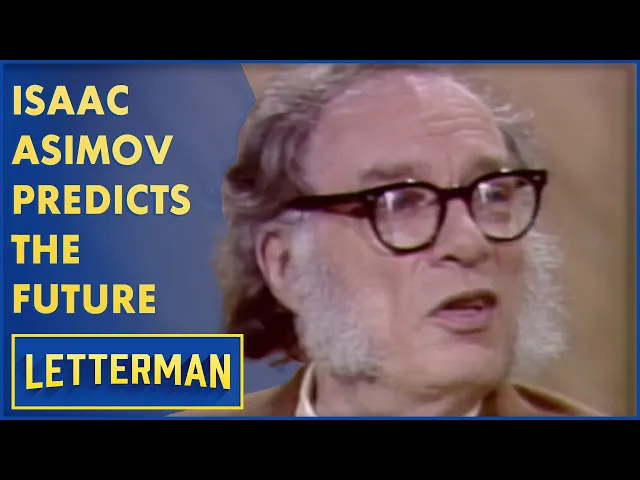
Isaac Asimov's Vision Of The Future | Letterman
Letterman
0:00 my next guest most recent published work is his 221st book I haven't written
0:06 that many postcards uh the book is
0:09 entitled enjoy still felt an autobiography welcome
0:12 please Dr Isaac Asimov okay let's spend a minute here talking about the fact
0:26 that you've written 220 21 books so far so far is that a compulsive Behavior
0:34 do you think I enjoy it you know why not sure but I say
0:41 to myself here I am a handsome writer I should know right yeah what kind
0:48 of schedule do you put in to write that many books I get up
0:51 in the morning sit down and write when I finish writing go back to bed
0:57 is uh is there one particular work that's a favorite for you out of all
1:01 of those Publications well yes the one you've got right there is the second
1:05 volume of my autobiography that in the first volume if you put them together
1:10 is my favorite book because it's my favorite subject tell me a little bit about
1:16 yourself what uh what uh what would we need to know about you well
1:22 once you've said 221 books that's it what else is there I mean if you
1:26 sit down and write that you haven't got time for anything else uh what
1:30 are you working on now several things right now I'm working on my monthly essay
1:36 for the magazine of fantasy and science fiction and when I get done
1:40 with that I will go back to one of the books some in the middle
1:44 of is that your favorite topic area science and science fiction I suppose so
1:49 though I also like to write Mysteries and I like to write limericks I like
1:55 to write history books like to annotate
1:58 like the Bible Shakespeare various other things
2:00 what exactly does that mean when you annotate the Bible oh well you simply you
2:05 simply copy down all the all the verses in the Bible and you make little
2:11 footnotes and and say whatever you please about each one and if you're if you
2:16 do it right the annotations are longer than the thing you're annotating I've got
2:20 a book coming out called in the beginning in which I annotate the first 11
2:24 chapters of Genesis you can get the first 11 chapters on Genesis and maybe
2:29 15 pages or so but the book is about 200 pages long counting my annotations
2:34 um why do you think there is now uh a real interest in in science
2:40 and uh like these space movies Star
2:42 Wars The Empire Strikes Back Close Encounters
2:45 oh well because the technology of the movie industry has reached the point where
2:50 they can put in spectacular special effects
2:53 and people enjoy watching those special effects did
2:56 you enjoy those two movies I enjoyed Star Wars The Empire Strikes Back In fact
3:02 I enjoyed the Empire Strikes Back so much that when they finished it I
3:06 jumped up my seat and yelled start the third part they have done that haven't
3:12 they they're projected like nine and I figure that at the rate they're going
3:17 they'll do the last few after I'm dead which doesn't strike me as Fair
3:22 um you know what I feel uh is unfair at the height of the manned
3:27 space projects you know that was great because
3:29 everyone's attention was focused on that and I
3:32 wish we had something else like that to shoot for now do you
3:36 think we uh backed away from the manned space program at the wrong time
3:40 no yes absolutely the reason for that was that we had gone into space primarily
3:44 to beat the Russians so when we got to the Moon we had and so
3:49 it was true football fashion having scored the the touchdown we went home yeah
3:54 but the Russians are keeping right on going
3:56 and sooner or later they'll do something
3:57 spectacular and we'll get back in the race what do you think that that would
4:00 be what spectacular thing could we look for well I suppose if they build
4:05 a really large space station or they put up their version of the shuttle
4:10 and make it work while we're still fussing around with ours then all
4:13 of a sudden Congress will will pour a lot of money into it and we'll get
4:18 going again yeah um what would be the next logical step after we put
4:23 a man on the moon and say we wanted to continue putting men places where
4:27 would we put our next man ah well we ought to stay here
4:31 in the Earth Moon system for a while and get it really developed we have
4:36 to ought to build space stations we
4:38 have to build space settlements get some power
4:42 stations in orbit build some factories get a mining station on the moon and once
4:48 we've got a real space civilization going
4:50 then we can explore further from a good
4:53 strong space space if that's speaking as a science fiction writer or a man
4:58 who has studied the needs and what space can provide us no I think
5:02 that's speaking as a real human being
5:04 have you ever written about things and then
5:08 seen them come true occasionally yes I described a spacewalk in 1952 and when
5:14 they did it some years later it turned out to be exactly the way
5:19 I described it wasn't very difficult I
5:22 described pocket computers in 1950 got the appearance
5:25 exactly right I talked about space stations
5:29 getting energy Down to Earth in 1940.
5:32 and got that almost right I put the put it
5:35 in Mercury's orbit instead of moon's orbit to get it
5:38 closer to the Sun maybe someday we'll do that I
5:42 predicted that the opposition to the space race and there
5:46 was yeah so uh but these are little things
5:48 I never tried to predict I just tried to write
5:51 stories I would sell so I could pay my way
5:54 through college that whole Phenomenon with the Phenomenon with computers
5:58 and digital stuff it used to be I could
6:01 pretty well figure out any clock radio not so anymore
6:04 it's all advanced to the point where you really have
6:08 to sit down and read the lousy book to figure
6:10 these things out now and it seems like things are
6:12 getting more and more complex for just getting by day
6:15 to day well it always happens that way things get
6:19 more complex to do more than as the technology advances
6:22 further it gets simpler again until the next Quantum jump
6:26 and then it becomes complex again yeah I remember when
6:30 radios first came out so you're too young for that when
6:33 radios first came out it was next to impossible
6:36 to tune them uh now you just turn them
6:39 on I remember when television first came out you had
6:42 to have a live-in television repairman now you just turn
6:46 it on if anything goes wrong with it it means
6:49 you buy a new set yeah when when the uh
6:51 the radios did come out they were like the size
6:54 of a of a Buick in some cases and now
6:57 I'm you can get them just about that big it's
7:00 uh unless you want to walk down the street
7:02 playing at the top of the range then it's back
7:05 to the Buick yeah that's right that's a whole different
7:07 situation here in New York City talking about among other things
7:12 is prolific work as a writer this represents 221
7:15 books published what uh what kind of Hardware do you
7:18 have in your home to keep this thing uh moving
7:21 various typewriters yeah that's about all you just get up
7:24 and Wander from room to room type a little
7:26 and then type a little and type a little no there's
7:28 just one typewriter and the other three just sit there
7:31 in case something happens to the one I can grab
7:33 one or the other three is it possible to write
7:35 more than one book at a time well not simultaneously
7:38 but I've got three different books in various stages that's
7:42 what I mean do you ever how do you keep
7:44 everything straight well as long as it's non-fiction there's no
7:46 trouble you just or at least for me there's no
7:49 trouble if it were fiction I'd have to work
7:52 on one book I I don't think I could manage two
7:55 fiction books I'd get confused in the plots yeah uh
7:58 I want to get back to talking about your feelings
8:01 about new developments in certain areas for example uh
8:04 in the next five to ten to fifteen years in medicine
8:07 why it seems to me that the important discoveries
8:10 will be how to fiddle around with genes so
8:14 as to perhaps correct some of the diseases we that are
8:18 congenital maybe instead of treating diabetes with insulin we can
8:23 fix up a gene so that you make your own
8:26 maybe perhaps we can get rid of some other conditions
8:30 like that how would that be administered do you do
8:32 you get like an inoculation at Birth or the parents
8:35 get it or how would that happen well I suppose
8:39 that eventually we'll reach the stage where children as born
8:44 will have a genetic analysis and that you could then
8:48 try to do something like that graft the necessary genes
8:52 into the pancreas for instance and hope that they'll do
8:57 sufficient work to prevent the eventual development of the diabetes
9:01 that's a very risky area to be uh experimenting
9:05 with isn't it yes and presumably they'll do their best
9:08 with animals before they try anything on human beings
9:11 you could you could alter or add to or detract
9:14 from any characteristic of a human that way couldn't you
9:18 well in theory yes but you know you have to work
9:21 up the technology to a high pitch of excellence
9:23 and we're just at the beginning of that now yeah
9:27 uh and what what signals the beginning what have we
9:31 done so far well we've been working mostly with bacteria
9:34 that's how far we are and we've managed to engineer
9:39 bacteria so to speak so that uh particular bacteria can
9:43 form chemicals that they themselves naturally wouldn't make but we
9:47 insert the genes for it so that we can now
9:50 have bacteria making human insulin diabetics now take insulin obtained
9:55 from domestic as slaughtered domestic animals which is not exactly
9:59 like human insulin it does the work but you could
10:03 you could get allergic to it and now we have
10:07 human ensure which we can get from bacteria and have
10:11 I heard correctly about a synthetic insulin or is
10:13 that what you're speaking of or well in a sense
10:16 it's synthetic in that it's manufactured as a result of human
10:20 agency but it's exactly like human insulin and the body
10:25 can't tell the difference uh what about cancer research any
10:29 breakthroughs there well Heaven Only Knows we've been waiting
10:32 for one for 30 years at least maybe 50 and we
10:36 can never we can never tell when it'll come
10:39 but it isn't here yet um what about the weapons
10:43 race well now they keep talking about space weapons about
10:47 using about using laser beams or ion beams things like
10:51 that against satellites and you'll have either killer satellites doing
10:56 the job or stations on Earth and uh as long
10:59 as the satellites are unmanned I suppose it doesn't
11:03 do any harm to shoot them down but I figure
11:07 that the best weapons researchers no weapons research yeah you
11:12 don't foresee that happening though I guess huh oh well
11:15 I imagine that uh I imagine that in 30 years
11:19 we'll have a situation in which there won't be any
11:21 wars either that or there won't be any us let's
11:24 get to the matter of communications developments uh we were
11:30 unable to place a call here to Missouri on a fairly
11:34 sophisticated piece of equipment um you see any Monumental
11:39 breakthroughs in the area of communications well there are Monumental
11:43 breakthroughs that are underway now in terms of communication satellites
11:47 and Optical fibers and I imagine that more and more
11:51 we'll be using laser beams for communicating rather than either
11:55 electrical currents or radio waves and it will then be
11:59 possible to have millions literary minions of times as many
12:02 messages carried on a on a wire or on a beam
12:07 as we now can so that everyone can possibly
12:11 have their own television channel the way we all now
12:14 have our own telephone numbers and uh closed circuit television
12:19 will become the great thing and everything from education
12:23 to research will be done by by way of communication communication
12:30 devices the book is called enjoy still felt which is
12:35 part two of your autobiography correct right part one was
12:38 in memory at Green it had a autobiography of Isaac
12:41 asthma of 1920 to 1954 with a black border made
12:45 my wife very nervous you hadn't even met me
12:49 in 1954 she kept saying who's this imposter right Dr Isaac
12:52 Asimov thank you very much doctor for being with us
12:56 we're going to pause for an NBC news update [Applause]