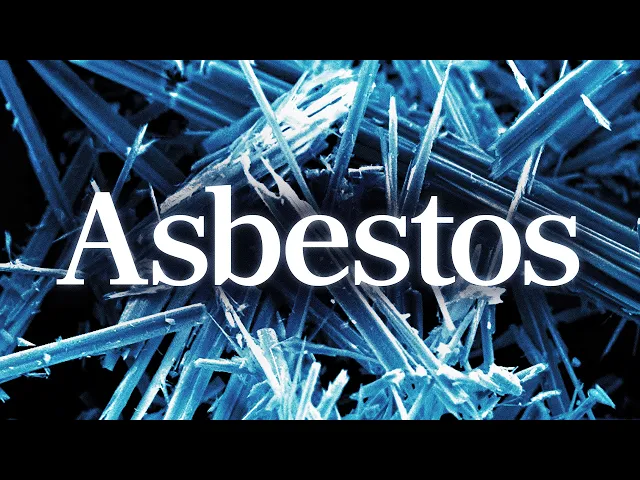
The asbestos problem is worse than we thought
Veritasium
0:00 (text softly clacking) (suspenseful music) (suspenseful music drowns out
0:10 speaker) (bushes rustling) (videographer
0:14 breathing)- [Gregor] They're just everywhere.
0:19 Whoa, this is really blue.
0:22 You should come look, this is so blue.
0:24 [Researcher] Look at how many you're finding.
0:27 [Gregor] I feel like Gollum, my precious!
0:30 if it weren't so dangerous, it'd be a fun activity to do.
0:33 [Researcher] These are the big chunks,
0:35 so what about all the particles you can't see?
0:38 This same kind of material was used
0:40 in the construction of the World Trade Center buildings.
0:42 And when the towers fell,
0:44 it was pulverized to microscopic size and released into the air.
0:48 The particles remained airborne for days
0:50 and thousands of people unknowingly breathed them in.
0:54 They buried themselves deep within people's lungs,
0:56 wreaking havoc and causing all sorts of diseases.
1:01 We've known for decades that these particles are extremely dangerous,
1:04 but when the towers fell, no one was warned.
1:09 The concentrations are such that they don't pose a health hazard.
1:14 [Gregor] And yet today the diseases linked to that dust have
1:17 killed more than twice as many people as the attacks themselves.
1:21 Once we started looking,
1:24 we kept finding this material in places we never expected.
1:28 He was telling the newspapers, "People aren't just eating it and breathing it,
1:31 they're mainlining it."- [Gregor] In popular off-roading spots,
1:34 in makeup, and even kids toys.
1:37 [Sean] Say It Ain't So Mickey Mouse crayons.
1:40 No!
1:40 It's been detected in the dust around schools and homes.
1:44 Five generations of people died up there.
1:46 [Gregor] And instead of banning it outright, we let it spread.
1:50 (camera shutter clicking) Some countries are still
1:54 importing hundreds of thousands of tons each year,
1:56 and it's estimated that by 2035,
1:58 nearly 2.8 million people might die because of it.
2:01 (dramatic music) This is a video about
2:07 a deadly miracle material we can't stop using.
2:11 This investigation is based on publicly available documents,
2:15 recordings, and third party sources.
2:16 All of our links are in the description.
2:18 Thank you to Ground News for sponsoring this video.
2:21 More about them later.
2:24 There is this story about the ancient Greeks from around the second century AD.
2:29 They had this golden lantern that would burn for a whole year without going out,
2:34 all because of a very special wick that just wouldn't burn down.
2:37 So how did they develop this technology?
2:40 Well, the truth is they didn't, they found it.
2:46 Imagine you're walking around 2,000 years ago and you
2:49 see this fluffy looking stuff poking out the ground.
2:51 It's got all of these fibers that you can pull apart and twist into shapes.
3:00 [Sean] First off, let's get a nice bundle.
3:03 So it looks like cotton.
3:04 [Gregor] It looks like it would burn really well,
3:06 like it would just-- Yeah, you can start a fire with it, right, alright.
3:10 [Gregor] Okay, let's see what happens.
3:13 [Sean] It's not burning.
3:14 That's because this is actually a rock.
3:17 It's a naturally occurring mineral.
3:19 The core building block is simple.
3:21 It's a silicon atom surrounded by four oxygen atoms.
3:25 Now silicon has four electrons in its outer shell, but it really wants eight.
3:29 So each of the oxygens shares one electron with it,
3:33 but oxygen doesn't share evenly since it's more electronegative than silicon,
3:37 it pulls those shared electrons closer to itself.
3:41 This leaves the oxygen side slightly
3:43 negative and the silicon side slightly positive.
3:46 Now there's an electrostatic attraction between these atoms,
3:49 which pulls the atoms closer together and strengthens this bond.
3:53 The result is an incredibly stable
3:55 pyramid shaped unit called as silica tetrahedron.
3:58 But if you look at the oxygens in these corner spots,
4:01 they've only shared one electron,
4:03 but they actually want two to complete their outer shells.
4:07 So the corners link up with other silicon atoms to form more tetrahedra.
4:11 And in this way, the structure just keeps growing.
4:15 The bonds inside here are incredibly strong and stable,
4:18 and because the atoms are already tightly
4:20 bound to the oxygens inside the silicate structure,
4:23 the oxygen in the air has nothing to react with, so the material doesn't burn.
4:29 But overall, there's nothing special about these building blocks.
4:32 More than 90% of the Earth's minerals are made from this stuff,
4:35 everything from quartz to clay.
4:38 What makes this material special is how those units link up.
4:43 Here, the tetrahedra have formed a sheet,
4:45 and bonded to it there is actually a second
4:47 sheet made of magnesium atoms and hydroxyl groups,
4:50 which are just an oxygen and a hydrogen stuck together.
4:53 Now, the atomic spacings of these two layers are slightly different.
4:57 So there's a tiny mismatch,
4:59 which causes tension between these layers causing them to curl up,
5:03 and you end up with these tiny scroll-like tubes.
5:06 These tubes don't break down easily under heat.
5:08 The structure stays stable up to around 600 degrees Celsius.
5:12 So like all these individual fibers that you see running through here,
5:15 those are all like these curls?
5:17 Yes.
5:17 What is that, what was that there?
5:18 [Sean] That's just a place where I twisted the fiber with my tweezers.
5:23 Oh, okay.
5:24 And when you twist these fibers, they actually don't break.
5:27 So it's literally a rock you can weave.
5:33 And when you do, the fibers form a tangled, layered structure.
5:36 So if heat is introduced, it has to pass from fiber to fiber across
5:40 many contact points with air filling the spaces between them.
5:43 This reduces how quickly heat can spread through the material.
5:47 Because of that, people started weaving it into things
5:49 like theater curtains and insulation blankets for steam engines,
5:53 even fireproof clothing,
5:55 essentially anywhere they didn't want something to catch fire.
5:57 But by far the most important use came around in the 1800s.
6:02 Between 1790 and 1870, the number of people living in urban areas in America
6:07 jumped from 1 in 20 to around 1 in 4.
6:11 So to accommodate this, people had to tack on extra floors
6:14 onto existing buildings and courtyards would
6:16 then be filled with makeshift extensions,
6:18 effectively tightly packing all of these buildings together.
6:22 Pretty much all these buildings were made out of wood,
6:25 but the people inside still cooked with open flames.
6:28 They used gas lamps, they lit candles.
6:31 So one accident and an entire neighborhood could go up in flames.
6:35 That reality hit New York City in December, 1835,
6:39 when within a span of just two days, three separate fires erupted in Manhattan.
6:45 One bystander described what followed as "An ocean of fire with roaring,
6:50 rolling, burning waves." By the end,
6:54 a third of a mile of Manhattan was engulfed,
6:57 destroying nearly 700 buildings at a cost of $20 million.
7:01 That's over $730 million of today's money.
7:05 Similar catastrophes were happening in cities all over the world,
7:09 Chicago, London, Hamburg, Tokyo.
7:12 [Reporter] When will this appalling rate of destruction come to an end?
7:18 [Gregor] The problem was that when a building burned,
7:20 it spewed up embers into the air.
7:22 These then got carried by the wind and landed onto other roofs,
7:26 setting them alight.
7:30 So 23 years after the Great Fire of New York,
7:32 a 21-year-old named Henry Ward Johns set out
7:36 to break that chain reaction by making roofs fireproof.
7:40 But that's trickier than it sounds.
7:41 Whatever his solution was, it had to be usable across an entire city.
7:45 So cheap and easy enough to mass produce,
7:48 durable enough to sit exposed on rooftops baking in the summer sun,
7:52 freezing in the winter, and most importantly,
7:54 it was not allowed to ignite even when exposed to burning embers.
7:59 Now, Johns knew of a mineral that was already being spun into fireproof fabric,
8:04 but only the long fibers were useful for thread.
8:07 The shorter ones were actually swept aside as waste.
8:10 Johns realized those scraps were exactly what he needed,
8:13 fireproof, tough and most importantly, cheap.
8:17 So he set up a makeshift lab
8:18 in his basement apartment and started experimenting.
8:21 He heated up tar in his tea kettle,
8:24 smeared that onto cloth, and then pressed in these tiny fibers.
8:27 Then he ringed the whole thing through his wife's brand new clothes ringer,
8:31 and when he tested it, it worked, it didn't burn.
8:36 In 1868, Henry Ward Johns patented his invention, and by 1927,
8:41 the company he built was generating $45 million in annual sales,
8:46 more than 800 million in today's money.
8:49 Soon people were using this fire-resistant stuff
8:51 in all kinds of building materials, across America,
8:54 consumption grew from around 20,400 tons in 1900
8:58 to a peak of 803,000 tons in 1973.
9:03 (upbeat music) Because of that, pretty much every building in the US,
9:08 public or private, commercial or residential, used some form of this material.
9:12 During that same period, stronger building codes,
9:15 safer heating systems and other fire-resistant materials were also introduced,
9:19 and it showed, during that time, fire-related deaths dropped around 80%.
9:24 So this material likely helped save millions of lives worldwide.
9:28 (lively music) Because it couldn't be destroyed by fire,
9:35 the name the ancient Greeks gave it, it stuck around.
9:39 They called it inextinguishable, or asbestos.
9:45 (bright music)- [Presenter] Asbestos, the remarkable mineral.
9:51 [Gregor] By the mid 20th century, asbestos was everywhere,
9:53 inside brake pads, toasters, ironing boards,
9:56 hair dryers, surgical dressings, and blankets.
10:00 You know, brewers filtered beer through it.
10:03 One brand of toothpaste even used it for extra polish,
10:07 the fake snow in department store windows and in movies
10:10 like "The Wizard of Oz," all of that's asbestos too.
10:14 Unusual weather we're having, eh?
10:17 [Gregor] Sorry, Dorothy.
10:18 It was such a big deal, Marvel even had a villain called Asbestos Lady.
10:23 She'd set a fire to escape the police,
10:25 and she'd easily walk through it, safe inside her asbestos bodysuit.
10:30 To feed this demand, asbestos was pulled out of the ground on an enormous scale.
10:35 Major mining operations spread across Canada, Russia,
10:38 and South Africa with global production peaking
10:41 at approximately 4.8 million tons per year in 1977.
10:49 But the reason asbestos ended up in so many different products
10:52 is because it's actually a group of different minerals, that white,
10:58 fluffy stuff we tried to burn earlier, it's called chrysotile,
11:01 and it belongs to a mineral family known as the serpentines.
11:04 But other types of asbestos looked completely different.
11:08 For instance, there is also brown asbestos known as amosite.
11:12 It forms thick fibers that almost look like wood splinters,
11:16 strong, stable, and highly heat resistant.
11:19 So it was perfect for putting into building materials like cement panels.
11:24 This type belongs to a different mineral family, the amphiboles,
11:28 here, instead of forming sheets, the silica tetrahedra lock into rigid,
11:34 ladder-like chains, and amosite, iron and magnesium ions,
11:38 along with hydroxyl groups embedded in the structure,
11:40 bind those chains together, forming these long, needle-like fibers,
11:46 but tweak that chemistry just slightly so
11:48 that now iron and sodium ions bind the chains,
11:51 and you get this, blue asbestos or crocidolite.
11:56 These crystals split easily along their length
11:58 and they create these fine flexible fibers
12:01 that are still extraordinarily strong with tensile
12:03 strengths comparable to high grade steel wire.
12:08 This type went into chemical-resistant insulation, shipyards,
12:11 and even filters inside early gas masks.
12:14 Oh, and there was another use, one that's hard to believe now.
12:18 In this magic box I have right here is
12:21 something that was manufactured right here in North Carolina.
12:26 They're cigarettes, produced in the 1950s, and if you look at the filter,
12:33 you see the filters are blue, asbestos.
12:39 This is Kent with a Micronite filter that was
12:43 manufactured with crocidolite asbestos in the filter itself.
12:46 So you're not only smoking, you were smoking it through a blue asbestos filter.
12:50 Yes, what a deal.
12:52 Only Kent has the revolutionary new Micronite filter you've heard so much about.
12:57 Kent and only Kent filters best, filters best, filters best.
13:02 (tobacco crackling) (suspenseful music)- [Gregor] In the early 1900s,
13:12 a young woman named Nelly Kershaw worked
13:15 in a factory that spun asbestos fibers into threads.
13:19 Every day she breathed in the dust that those machines threw into the air.
13:23 So by her early thirties, she was so sick she could barely breathe.
13:29 And when she finally decided to ask the factory for help,
13:33 they refused, they said helping out workers would set a dangerous precedent.
13:38 Nelly died shortly after at the age of just 33.
13:43 Nelly's case caught the attention of pathologist Dr.
13:46 William Cook.
13:47 When he opened up her chest, her lungs were gray and scarred,
13:51 almost blue-black, like they had a huge internal bruise.
13:54 And when his scalpel passed through them, they rasped.
13:58 It was like scraping against sandpaper.
14:02 The tissue was full of mineral grit,
14:03 and under the microscope the cause was unmistakable,
14:06 asbestos fibers lodged into the lung tissue.
14:11 If we were to inhale some type of an asbestos fiber,
14:14 I kind of won't think of them as like little microscopic straight arrows,
14:17 they kind of just shoot down through the nose
14:20 or the mouth and move down through the trachea.
14:23 If we continue on going down here,
14:25 we get smaller and smaller as we penetrate deeper into the lung tissue.
14:29 And then you get into these alveolar sacs,
14:31 these asbestos fibers, they lodge in the tissue there,
14:34 and lung secretions, enzymes, even white blood cells,
14:37 they have a really hard time breaking those down.
14:40 You end up with scarring deep inside the lungs.
14:44 In 1924, Dr.
14:45 Cook published the first medical description of this condition,
14:48 which became known as asbestosis.
14:52 When these asbestos fibers lodge into the lungs,
14:55 the body treats them like invaders,
14:57 specialized cells called macrophages move in, cells whose job
15:00 it is to engulf and digest bacteria, dust or debris.
15:04 But asbestos fibers are too long and stiff to swallow.
15:08 It's kind of like trying to eat a toothpick sideways.
15:11 The macrophages keep trying and failing, and in the process,
15:15 they release inflammatory chemicals that damage the surrounding lung tissue.
15:19 So workers breathing in asbestos dust day after day,
15:22 accumulated more and more damage.
15:24 When doctors sent by the British
15:27 government examined hundreds of asbestos workers,
15:29 they found that more than 25% already showed signs of lung disease.
15:34 And for workers with over 20 years of exposure, that number was closer to 80%.
15:40 So in 1931, the government officially classified asbestos as a workplace hazard,
15:45 making it one of the first industrial
15:47 materials to be regulated for health risks.
15:49 But the new rules only covered factories where asbestos was manufactured.
15:53 They didn't extend to other workers like ship builders,
15:57 miners or construction workers who were regularly exposed to asbestos dust.
16:04 Across the Atlantic, things weren't much better.
16:06 There was no binding federal asbestos rules in the States,
16:10 only a recommendation.
16:11 The US Public Health Service suggested a temporary exposure limit
16:15 of 5 million asbestos particles for a single cubic foot of air,
16:19 which meant that a worker breathing normally could inhale over 300
16:22 million asbestos particles an hour and still be considered within guidelines.
16:27 This became especially problematic for shipyard
16:30 workers when World War II broke out, ships were packed with asbestos insulation.
16:34 So workers spent their days cutting
16:36 and fitting asbestos in thick clouds of fibers.
16:40 And according to the guidelines of the day,
16:42 these levels met the official definition of safe working conditions.
16:46 In fact, asbestos was still marketed as a magic material.
16:50 A few years earlier,
16:51 "Time" magazine actually put Johns-Manville's president, Lewis H.
16:54 Brown on its April 3rd, 1939 cover.
16:57 But in the early 1960s,
16:59 finally one doctor started connecting the dots on asbestos.
17:04 Dr.
17:05 Irving Selikoff was running a small clinic in Patterson, New Jersey,
17:08 when the local asbestos workers Union asked
17:10 if their members could come and see him.
17:13 Before long, he'd seen multiple workers
17:15 with either severe lung scarring or more concerningly,
17:19 an extremely rare cancer called mesothelioma.
17:23 A mesothelioma is strongly associated with asbestos exposure and is
17:28 cancer of those cells lining the inside of the chest cavity.
17:32 And most commonly, it's this pleural cavity.
17:34 These pleural membranes are aligned with mesothelial cells.
17:39 Sometimes what happens is the fibers will work their way out
17:43 of the lung tissue and directly get into this cavity here,
17:46 and they can literally pierce out the lungs.
17:50 They cause constant irritation.
17:52 And over time, that can trigger cancerous changes
17:55 in the cells that make up those linings.
18:00 Selikoff needed more data to understand the scale of the problem,
18:03 but factory owners refused to share medical records from their workers with him.
18:08 So Selikoff had to get creative.
18:11 See, during World War II,
18:12 many shipyard workers employed by the Navy underwent federal background checks.
18:17 Thousands of these men had been working with asbestos to insulate ships.
18:21 So using surviving FBI wartime personnel records,
18:25 Selikoff began tracking them down and one
18:29 by one painstakingly pieced together their medical histories.
18:33 What emerged wasn't a handful of isolated tragedies,
18:37 it was a pattern, that exposure proved deadlier than combat itself.
18:43 8.6 out of every 1,000 servicemen were killed in action,
18:47 whereas 14 out of every 1,000
18:50 shipyard workers later died from asbestos-related cancers.
18:55 Selikoff launched a formal investigation
18:57 into hundreds of asbestos insulation workers,
19:00 and what he found confirmed his fears, widespread disabling asbestosis,
19:05 dozens of cases of mesothelioma,
19:07 lung cancer rates roughly seven times higher than
19:10 expected and a threefold increase in gastrointestinal cancers.
19:14 In 1964, he organized a conference at the New
19:16 York Academy of Sciences where for the first time,
19:19 all this evidence was presented publicly in one place,
19:22 and on the record, it marked the moment when asbestos stopped being seen
19:26 as a modern miracle material and instead
19:29 started being recognized as a public health crisis.
19:35 But the asbestos industry fought back trying to discredit Selikoff.
19:39 Industry-funded research groups came out with papers minimizing
19:42 the risk of exposure and framing Selikoff's findings as overblown.
19:46 They started a coordinated PR effort to discredit him,
19:50 trying to call him alarmist, and starting a rumor that he wasn't even a real
19:54 doctor just because he got his medical degree out in Scotland.
19:58 But Selikoff kept going.
20:00 He kept publishing data on the devastating health effects of asbestos exposure,
20:05 he worked 18 hour days documenting every patient who wrote to him.
20:09 He contacted policymakers, even world leaders,
20:13 urging them to take action against asbestos.
20:18 Now Selikoff, the legendary doctor who organized this conference in the 1970s
20:24 found that intravenous drugs were being contaminated by asbestos filtration.
20:29 People aren't just eating it and breathing it, they're mainlining it.
20:34 By the 1970s, no one could deny it any longer,
20:37 miners, factory workers, shipyard insulators,
20:40 people who'd been exposed decades earlier during the asbestos boom,
20:43 were now turning up with multiple cancers in huge numbers.
20:48 Asbestos exposure is linked to all sorts of different cancers.
20:51 The lung tissue has lymphatic vessels in it,
20:54 but you have 'em throughout your whole body.
20:56 The asbestos fibers sometimes on their own
20:58 can migrate into the lymphatic vessels.
21:01 Sometimes the white blood cells will take it into the lymphatic system.
21:05 Once you hit the lymphatic system,
21:07 you have the potential to go anywhere in the human body.
21:12 [Gregor] Autopsies have found fibers in nearly every organ in the body,
21:15 the brain, bone marrow, spleen, intestines,
21:18 pancreas, prostate, ovaries, thyroid, and liver.
21:22 And in every tissue those fibers reach, they set off the same chain reaction.
21:27 I'm imagining these white blood cells with personalities,
21:30 and they get all mad and frustrated
21:31 because they can't engulf this asbestos fiber.
21:34 They've coined this term called essentially, frustrated phagocytosis.
21:38 They start releasing these things like reactive oxygen species.
21:42 They can cause damage to surrounding cells,
21:44 and really important is damage to DNA.
21:48 Those cells can start dividing out of control when they start to clump together,
21:52 and we start to call those clumps of cells cancer.
21:56 US courts were flooded with lawsuits against companies like Johns-Manville.
21:59 The harm asbestos caused was well documented.
22:02 The information was out there.
22:03 Companies should have known their products were dangerous.
22:07 They should know what's reasonably available
22:09 in the public domain about the dangers of asbestos.
22:12 If they can read asbestos patents, they can read asbestos pathology papers.
22:18 But the companies denied it.
22:19 What was needed was definitive evidence that the companies
22:22 knew their products were killing their workers.
22:27 Then an attorney, Carl Ash, noticed something strange in the 1974 report
22:32 by this huge asbestos company called Raybestos Manhattan.
22:35 See, in this report, the company suggested that they had actually been
22:39 investigating health hazards of asbestos since the 1930s.
22:42 So Ash started digging.
22:44 He filed a request for internal documents,
22:47 and at first, the company claimed it couldn't find much.
22:51 Then unexpectedly, Ash was handed a banker's box stuffed full of documents,
22:56 meticulously kept by Raybestos Manhattan's, former president, Sumner Simpson.
23:03 Back in 1935, a journal contacted Simpson because
23:07 they wanted to write an article about asbestosis.
23:09 Shortly after, Simpson himself reached out to Johns-Manville's lawyer,
23:13 Vandiver Brown, saying, "I think the less said about asbestos,
23:17 the better off we are." To which Brown replied,
23:19 "I quite agree with you that our interests are best served by having asbestosis
23:24 receive the minimum of publicity." The same
23:27 papers also revealed that in the 1930s,
23:29 Raybestos and Johns-Manville hired an external company,
23:32 Saranac Laboratories, to do studies of asbestos on animals.
23:36 But the companies insisted on controlling what
23:38 from those studies will be made public.
23:41 As a letter from Vandiver points out,
23:43 "It is our further understanding that the results will be
23:45 considered the property of those who are advancing the required funds,
23:49 who will determine whether, to what extent and in what manner they shall
23:52 be made public." A clause to which Saranac Laboratories said,
23:56 "Yes." But after their lead researcher who
23:58 was compiling all this evidence died in 1946,
24:01 the companies agreed that nothing should
24:03 be published that contained any objectionable material.
24:06 Objectionable meaning any sort of indication that asbestos causes cancer.
24:11 So when Saranac Laboratories finished their research,
24:13 the companies took the report, edited it, and just buried the evidence.
24:17 Here's an original copy of that manuscript,
24:19 and you can find whole sections just crossed out.
24:23 Other documents were even more damaging.
24:24 A Johns-Manville medical official later testified that up until 1971,
24:29 the company had a policy of not telling their workers
24:32 if their physicals showed signs of asbestosis or asbestos-related lung cancers.
24:37 And in sworn testimony, a witness recalled a meeting they had
24:41 in the early 1940s with the president of Johns-Manville,
24:44 asking why they weren't warning workers about asbestos.
24:48 As the witness recalls it, they asked,
24:50 "Do you mean to tell me you would let them
24:52 work until they dropped dead?" To which the president replied,
24:55 "Yes, we save a lot of money that way." Once the Sumner Simpson papers got out,
25:02 they unlocked a new industrial Watergate.
25:04 The industry's standard, "Oh, we didn't know," defense, it simply fell apart.
25:09 Comparisons were made to big tobacco's concealment of smoking risks.
25:13 And the lawsuits surged,
25:15 each case brought new discovery and each round of discovery exposed a wider,
25:19 more coordinated coverup.
25:21 (files thunking) (suspenseful music) Ever since the word asbestosis
25:25 started showing up in medical journals in the 1920s,
25:28 Johns-Manville went out to secure the market around itself.
25:31 First, they acquired the biggest rock wall company,
25:34 then they acquired a firm holding
25:36 the key patents to calcium silicate insulation,
25:39 insulation that could be made without asbestos.
25:41 Now, at the same time, companies that had non asbestos insulation
25:45 were incentivized into creating asbestos product lines.
25:49 With each acquisition or inducement,
25:51 another potential competitor lost the ability to denounce asbestos and say, "Oh,
25:56 we have an asbestos-free product." So each in turn
25:59 became a member of this conspiracy of silence.
26:02 That is how the asbestos industry guaranteed its survival,
26:05 by ensuring no one could speak out against it.
26:09 [Narrator] We suggest you consider asbestos for the walls of your home.
26:14 Their business decisions and the people who make them are businessmen.
26:18 I mean, the word morality or moral
26:20 obligation is almost non-existent in the corporate documents.
26:25 In 1982, Johns-Manville filed for bankruptcy protection.
26:29 Manville Corporation's board of directors has determined that the corporation
26:32 should file for reorganization under chapter 11 of the Bankruptcy Act.
26:38 Not because they were broke, but in a move widely seen as a way
26:41 to shield the company from a flood of asbestos lawsuits.
26:45 Despite all the evidence against them, Johns-Manville survived.
26:48 They continue operating to this day, although they no longer produce asbestos.
26:54 Between 1940 and 1980, the asbestos industry, led by Johns-Manville,
27:00 exposed roughly 21 million Americans to these fibers.
27:04 Asbestos related deaths amounted to at least 8 to 10,000 people every year,
27:09 with many more suffering lifelong disease.
27:14 In 1989, the EPA issued a rule to phase
27:17 out almost all asbestos use in the United States.
27:20 And that should have been the end of the story.
27:24 But the industry sued immediately,
27:26 not because anyone disputed asbestos causes cancer,
27:30 that was undeniable by this point, but because of a legal technicality,
27:34 see, under the law, the EPA had to prove
27:37 that an outright ban of asbestos was the only solution.
27:40 And that anything less than that just wouldn't cut it.
27:43 This was an almost impossible feat.
27:45 Now, the industry argued that they hadn't
27:47 done that, and unfortunately the US courts agreed.
27:50 So in 1991, they ruled that the EPA just hadn't met this narrow legal standard.
27:55 And with that, the asbestos ban was dead in the water.
27:59 But by then, asbestos had become so financially and legally
28:03 risky for the companies that manufactured it or used it,
28:06 that its overall use did actually decline.
28:09 Yet in the end, after years of trying to define and regulate asbestos,
28:13 the only thing that truly stuck around was a definition and a narrow one.
28:18 Chrysotile and five amphiboles, because these were the only ones being mined,
28:22 sold, and used in factories.
28:24 But those six became the official asbestos minerals and anything else,
28:28 no matter how fiber-like or potentially dangerous, well, that doesn't count.
28:33 (suspenseful music)- [Reporter] The FDA for the first time in 50 years,
28:42 considering testing for asbestos in cosmetics and talc powder.
28:46 [Reporter] Traces of it have now been detected in children's play sand.
28:50 Thousands of people are claiming that they developed various forms
28:54 of cancer after years of using Johnson and Johnson's baby powder.
28:58 Is this all the stuff that you've collected over the years?
29:01 No, it's not all of it, but this box is full of all
29:05 the Claire's-labeled products that I found asbestos in.
29:09 Everything little girls could possibly want to have their makeup in.
29:14 Like, oh, I don't know, how about sparkly boxes, right?
29:18 Yeah.
29:19 And there's a cell phone.
29:20 Yes.
29:21 With eye shadows on it.
29:23 Yeah.
29:23 There's asbestos in there.
29:25 There's asbestos in the unicorn.
29:27 It's in all of that?
29:28 Yes.
29:28 All of these have asbestos in them.
29:33 I started seeing asbestos fibers everywhere.
29:35 Everywhere, okay.
29:37 The eyeshadows, the blush, they all had asbestos fibers.
29:40 Alright, wow.
29:42 okay.
29:46 What year was this?
29:48 2017.
29:48 [Gregor] What?
29:49 2017.
29:50 [Gregor] I thought it was gonna be like 1980 or something.
29:53 What, 2017?
29:55 Yes.
29:55 Whoa.
29:56 And the manufacturer came back and said,
29:58 "There's no way." And they sponsored another
30:01 laboratory to look at the same samples.
30:04 And they said, "No, none of this counts
30:06 as asbestos." It's all cleavage fragments, or CPLA, clay or something like that.
30:12 And it was balderdash, right?
30:14 I called friends all across the States and said, "Hey,
30:16 do you have a Claire's store near you?" Can you find the sparkly box?
30:21 Right.
30:22 And send it to me, pronto.
30:24 There's Claire's in all, in all of the malls, all across America.
30:28 And then I look further and it's all over the world.
30:30 I mean, every mall, everywhere.
30:33 And I end up testing Claire's from Brazil to Japan to London,
30:37 I found asbestos,- No way.
30:41 Right.
30:41 So that turned into a huge story, right?
30:44 And now I don't think you can
30:47 buy very much talc-based cosmetics at Claire's now,
30:51 but it was a several-years-long battle.
30:55 (suspenseful music) These are different products that were sold at toy stores.
31:12 Like here's the secret spy kit.
31:15 And you see there's a fingerprint kit there, right?
31:17 And in that fingerprint kit was a powder in which I found asbestos fibers.
31:24 Say It Ain't So Mickey Mouse crayons.
31:26 No!
31:27 I found asbestos in those.
31:31 And this keeps happening.
31:32 Just a couple of months ago,
31:33 around 70 schools in Australia and New Zealand had to close
31:36 down because of the asbestos found in children's play sand.
31:40 Out of the 60 outlets that reported on this story,
31:43 only 24% were from right-leaning sources.
31:46 Depending on where you get your news, this might have never crossed your radar,
31:49 which is a problem because public health
31:51 information like this shouldn't fall through the cracks.
31:54 And this is why we've asked Ground News to sponsor this video.
31:57 They compile news from outlets all over the world into one place so
32:01 that you can easily see the partisan split and with their color-coded layout,
32:05 it's also easy to sort your news by factuality,
32:08 ownership and source so that you can see how a story like
32:11 this is getting covered side by side with all the context you need.
32:14 Take these two headlines for example,
32:16 this article from the "Herald Sun" only talks about the fear of asbestos,
32:20 while this very high factuality source firmly
32:23 states that asbestos was found in decorative sand, that difference matters,
32:27 I would like to know whether the concern
32:29 is over a mere suspicion or actual asbestos contamination,
32:33 and that's why I find Ground News so useful.
32:35 You get the full picture, not just one headline sensationalizing for clicks.
32:40 And they also have a dedicated blind spot
32:42 feed for stories like these that are, you know,
32:44 disproportionately covered by either side of the political spectrum,
32:47 all to help people avoid their echo chambers.
32:50 Now, we partnered up with Ground News because we share the same mission,
32:54 getting to the truth,
32:55 and that's why we're offering 40% off their vantage plan at ground.news/ve.
33:01 So if you wanna support the channel,
33:02 but also want a clearer understanding of the world,
33:05 check out that link in the description, or you can also scan this QR code.
33:09 So I wanna thank Ground News for sponsoring this part of the video,
33:12 and now let's go figure out why asbestos
33:15 is even getting into all these consumer products.
33:18 Now, no one is intentionally putting asbestos in makeup or kids' toys,
33:22 so how did something we know is deadly just end up everywhere?
33:27 Well, it's an unfortunate consequence of where asbestos forms
33:31 and nowhere makes that more clear than Libby, Montana.
33:36 It kind of breaks my heart to talk about it.
33:40 The mine up there is vermiculite mine.
33:42 It's about five six miles north.
33:44 Vermiculite is a mineral that is used
33:46 in everything from insulation to fireproofing to potting soil.
33:50 On its own, it's harmless.
33:52 The problem was, Libby's vermiculite formed
33:54 mixed in with affable asbestos fibers.
33:58 And the same thing happens with other minerals we mine,
34:01 including stuff like talc.
34:03 That's how asbestos ends up in products like the ones we saw at Sean's lab.
34:09 And the worst part, the company that owned and operated the mine, W.R.
34:13 Grace, they knew, they knew the ore contained asbestos.
34:16 They knew people were getting sick and they didn't warn the town.
34:20 In fact, they tried to cover it up for almost 30 years.
34:25 They had hundreds of workers in there.
34:27 And of course, when the miners would go home,
34:29 they had dust all over their clothes,
34:31 and their kids and their wives got it and died as well.
34:34 But the doctors up around Libby, they knew, boy did they know.
34:39 Besides the lung disease and cancer's long associated with asbestos exposure,
34:43 researchers were also finding rates of some autoimmune diseases
34:46 were nearly six times higher than the national average.
34:49 And by the time the Libby situation hit the headlines in 1999,
34:53 reporters documented nearly 200 deaths in a town of fewer than 3,000.
34:58 And it could take 20 years for it to go,
35:00 but pretty soon you have no breath at all and you die of asphyxiation.
35:05 I could tell I'm talking on the phone by somebody's voice,
35:08 how far along they were toward death, because none of 'em survived.
35:13 Finally, in 2009, the EPA declared a public health emergency in Libby,
35:17 calling it "The worst case of industrial poisoning of a community in US
35:22 history."- But Libby's just the tip of the iceberg,- Because for decades, W.R.
35:28 Grace shipped Libby vermiculite around the country, and with it,
35:32 deadly affable asbestos,
35:33 which ended up in millions of homes as attic insulation.
35:38 And Grace also made a fireproof spray that was
35:41 used on the steel frames of high-rise buildings.
35:43 By 1970, over half of the multi-story buildings
35:46 erected in the United States used this fireproof spray,
35:50 including the World Trade Center.
35:53 But this spray was actually marketed as asbestos-free.
35:57 According to a later investigation by the "New
35:59 York Times," Grace lobbied regulators to adopt
36:02 a threshold under which products containing less
36:05 than 1% of asbestos would not be regulated.
36:08 Grace argued that the danger of such small amounts had not been proved.
36:12 This became known as the 1% rule or the Grace Rule.
36:16 That decision didn't just affect the products from Libby's mine,
36:20 it reshaped how asbestos was detected, regulated, and ignored everywhere.
36:26 (building roaring) (sirens wailing)- [Speaker] Oh my God!
36:31 (people chattering)- [Speaker] Look at the shadow of death!
36:34 [Speaker] Oh my God!
36:35 Okay, when that went down, I knew it.
36:37 I knew they had asbestos, and so I started calling.
36:40 I said, "What do you, how are you gonna protect people from that 'cause
36:44 now that stuff's all over the place.
36:45 You saw the dust clouds,
36:47 right?"- [Gregor] September 11th became the largest real world
36:50 test of asbestos detection following a single catastrophic event.
36:54 The dust is so thick you can't see.
36:57 When the EPA began sampling the dust and analyzing it,
36:59 they chose a method we use back
37:01 at the lab called polarized light microscopy or PLM.
37:04 But the PLM has two major limitations.
37:07 First, it's struggles to detect asbestos if it's less
37:10 than 1% by weight in the sample, and second,
37:13 it can only see the fibers that are roughly longer than
37:17 about five micrometers or wider than about a quarter of a micrometer.
37:21 As a result, the smallest and oftentimes the most dangerous fibers,
37:25 like the ones pulverized during the collapse of the towers,
37:28 are difficult to detect using just the PLM.
37:32 To reliably find these, you need transmission electron microscopy or TEM.
37:37 [Sean] Where we top out of about a thousand times with electro,
37:39 with light microscopy, this tops out at about a million times.
37:44 But what we need to see is just what are
37:47 the finest fibers that potentially can go into your lung.
37:51 [Gregor] Without having used a TEM, the EPA declared New York's air safe.
37:56 Everything we've tested for, which includes asbestos, lead,
37:59 and VOCs have been below any level of concern for the general public health.
38:06 [Gregor] But some researchers after 911 actually did do studies with TEM.
38:10 They found asbestos levels far above the EPA's
38:13 own safety thresholds in most of their samples.
38:16 And the report also warned that because many
38:18 of these fibers were actually smaller than normal,
38:21 they were especially dangerous.
38:23 They posted the results on the American Industrial Hygiene Association website,
38:28 but within hours, their post disappeared.
38:31 Less than 24 hours later, the researchers were notified they been taken off
38:35 the job and were no longer required at Ground Zero.
38:39 One former EPA chief investigator later went on CBS saying they believe
38:43 the agency had deliberately used the wrong
38:46 testing methods and downplayed the danger.
38:50 New York City directly lied about the test results for asbestos in air.
38:55 When they finally released them, they doctored the result.
39:00 We don't know if that's true, but to be clear,
39:02 PLM is still widely used to detect asbestos because it's faster,
39:06 it's cheaper, it's easier to deploy.
39:08 But what we do know is two things.
39:10 First, the PLM method was not sensitive enough to detect
39:14 whether there were asbestos fibers in the dust at Ground Zero.
39:17 And second, the EPA did have other, more sensitive methods available to them.
39:22 Whatever the motives, the result was the same.
39:25 New Yorkers were told that the air was safe when it really wasn't.
39:29 And as of December, 2023, 6,781 of those who have been registered
39:34 with the World Trade Center Health Program have died
39:37 either of an illness or a cancer linked
39:40 just to their time being around Ground Zero.
39:43 (suspenseful music) (sirens wailing) But even if the EPA had used the TEM,
39:50 the answer would still not be simple because
39:52 even then researchers run into a more basic problem.
39:56 What actually counts as asbestos?
39:59 Is there asbestos in the air?
40:00 Is there asbestos in the soil?
40:01 Is there asbestos in the water?
40:03 Is there asbestos in the body?
40:05 All of those counting rules are based on fibers that are not super-long,
40:10 but they're way longer than the vast majority of say,
40:14 Libby amphibole fibers and the vast majority of fibers that are inhaled.
40:20 So they're not even counting those, they're not even looking for them.
40:25 The ways that we are right now telling people
40:28 whether they're being exposed or not is a lie!
40:32 [Gregor] And when longer fibers
40:34 break forming these so-called cleavage fragments, they don't count either.
40:37 Yeah, there's a whole effort to say, "Oh yeah, if it's been broken,
40:42 it's not dangerous." But there are so many papers out there
40:45 that show that if you put pure cleavage fragments into mice,
40:48 they get very, very sick.
40:50 [Gregor] This really matters when you're in a place like
40:52 this and you realize the dust
40:54 could be considered asbestos-contaminated under one definition,
40:57 and perfectly safe under another.
41:00 [Researcher] Nobody would've expected to find asbestos here.
41:03 [Gregor] To be clear, there were no asbestos mines in Nevada,
41:07 no industrial sites, no history of asbestos commercial use at all.
41:11 But geologists, Brenda Buck and Rod Metcalf found asbestos
41:15 spread across approximately 1 million acres outside Las Vegas.
41:22 [Rod] Geologic processes transport these materials.
41:24 And you know, before the erosion started,
41:27 they were just in the bedrocks along the mountain front.
41:30 Now they're in sediments down they're, in the stream here.
41:35 [Brenda] And the problem with the naturally
41:36 occurring stuff like this is it may be
41:38 only a small percentage in the rock and even a smaller percentage in the soil,
41:43 but this stuff gets in the air.
41:45 [Gregor] Entire communities might be breathing
41:47 it in and getting sick without knowing.
41:50 So Brenda and Rod tried to warn people.
41:52 Back in late 2012, they compiled all of their findings
41:55 for a presentation at the Conference of the Geological Society of America.
41:59 But before the conference even began,
42:01 the abstract caught the attention of a journalist who reported on the story,
42:06 and that's when the pushback started.
42:09 Soon the state of Nevada sent a cease and desist letter,
42:12 and officials questioned Brenda and Rod's methods.
42:16 So if you go to Las Vegas,
42:17 you're gonna get exposed to asbestos that they didn't want that out there.
42:20 Every time I drove into Boulder City,
42:22 there was an official tailing me within a minute.
42:27 The message was clear, don't look any further.
42:30 Well, we did decide to look further.
42:32 So we drove out into the desert to a popular off-roading spot
42:36 to test whether there really is asbestos in the dust around Las Vegas.
42:41 Okay, I'm strapped into a dune buggy here.
42:43 I'm going to go down in that basin, and Sean's strapped up some dust collectors
42:48 with receivers in my breathing zone so we can
42:51 actually figure out how much asbestos I would
42:52 be inhaling through the dust that I kick up.
42:55 (dune buggy engine spluttering) (tires roaring)
43:01 (soft rock music) (Gregor laughing) Woo!
43:14 You see those donuts, huh?
43:15 [Sean] Yeah, yeah, you were ripping it up down there.
43:17 [Gregor] Yeah, from a geological point of view, any notes?
43:20 It rained today.
43:21 I thought about that while I was watching, I was like,
43:23 "There might not be much dust," but these are
43:25 the air samples that were hanging in your breathing room, right?
43:27 Yes, yeah, yeah.
43:28 And I looked at them and the filters have some tanning on them.
43:30 Oh, that's good.
43:31 Which means we actually did get some dust.
43:33 We don't know what's in it yet, but there's something in there.
43:37 But the original plan was for us to actually do
43:39 this at the dry lake bed just outside Boulder City,
43:42 because this is where people do the majority of their off-roading,
43:45 you know, they camp, they do photo shoots, even take their wedding photos,
43:49 except not on the day that we were there.
43:51 Okay, we're out here on the dry lake bed, supposedly in Las Vegas,
43:56 where on the one day that we're here,
43:59 the lake has decided not to be dry in any sort of definition.
44:03 Oh my God.
44:04 And so what we're gonna go do is suit up, get some samples,
44:07 and figure out how much asbestos there really is in this stuff.
44:12 (suspenseful music) (people softly chattering)- [Sean] Okay.
44:23 We're gonna do a third.
44:24 Let's go out to that island.
44:26 (suspenseful music continues) Okay.
44:30 Okay, got the samples.
44:32 Next step, take 'em to the lab.
44:35 (car door thunks) (suspenseful music)- Great to see you guys again.
44:42 Yeah, good to see you too.
44:42 Well, we are here for one thing I suppose, like what kind of results did we get?
44:48 Now the big reveal, drum roll please.
44:53 I did the dune buggy air samples first.
44:55 Those samples that you had on your left and right shoulders,
44:58 I didn't find any asbestos fibers.
45:01 Okay, well, I guess that's a bit of a relief.
45:02 I'm glad we did the demonstration and I'm kind of glad we didn't find
45:06 anything because I'm pretty sure I took my mask off at a few points.
45:09 I've been in those shoes, like, we didn't find anything.
45:12 Oh, but wait a minute, I was breathing that (beep).
45:16 (laughing)- Exactly.
45:18 (chuckling) So what about the samples in the dry lake bed?
45:22 Ah, another drum roll.
45:26 Okay.
45:27 I found amphibole asbestos.
45:29 Wow, okay.
45:30 It's there.
45:31 It is there.
45:32 I counted up a number of fibers, the area of the filter they analyzed,
45:37 and I figured out that we had between 30 and 50
45:42 million asbestos structures per gram of mud that we were walking through.
45:51 Whoa.
45:53 Just to think that we pulled off to the side of the road,
45:56 walked what, 30 meters, took three samples, and all of them had these incredibly
46:01 high concentrations of asbestos right there,
46:03 it's not like we had to go out and find.
46:04 Right.
46:05 Very wet soil was lucky for us because we know there's asbestos in that soil.
46:13 Now think about the guys that go taking
46:15 their jeep across there when it is a dry lake.
46:18 I mean, that was our initial plan to do the dune bugging there.
46:22 And I can't like help but think about people drive down that road all the time.
46:26 They must pull over, they must go down there,
46:28 like just kick dust and rocks and-- [Sean] We know they do.
46:31 We know they do.
46:33 And there's no sign to tell you that there's anything wrong with the dry lake.
46:39 It's not like we, you know,
46:41 discovered this, this has been available data since-- [Sean] October
46:46 of 2013 is the actual publication date of naturally occurring asbestos,
46:50 potential for human exposure in Southern Nevada by Brenda Buck et al.
46:57 So 13 years we've had this data.
46:58 It's not like we'd rediscovered anything.
47:01 And that's the other thing that's really hard about this science.
47:03 You need the public to be aware, but you don't want to terrify them.
47:07 And so how do you find the right way?
47:11 [Gregor] This will potentially be seen by tens of millions of people.
47:13 So is there a message you want to get out?
47:16 This is a natural hazard, just like a lot of things in your life,
47:21 it's really good for people to know whether
47:24 or not their house is in a flooding zone, right?
47:26 It's really good to know about earthquake risks.
47:29 It's really good to know about hurricanes and tornadoes.
47:32 Well, this is just another natural hazard, and if you have the information,
47:37 then you can make better decisions to live a healthier life.
47:41 (gentle music)- [Gregor] One big problem is that asbestos
47:57 in the real world doesn't line up with how it's regulated.
48:00 Take this fiber, it comes from a sample of the same blue asbestos
48:04 from the site outside Las Vegas we visited at the start of the video.
48:08 [Sean] I think we have two different phases,
48:11 at least of amphibole here because if it's yellow in this orientation,
48:16 but also blue in this orientation in the same fiber bundle,
48:20 then we have a change in the phase from here to here.
48:26 [Gregor] So this one fiber is actually two minerals.
48:29 And that complexity shows up in its structure too,
48:32 under the electron microscope, one side could meet the definition of asbestos,
48:37 the other may not simply because of its shape.
48:39 So one single fiber could fall within one of the six
48:43 named and regulated asbestos minerals if you look at one side,
48:47 but the other would be completely unregulated.
48:50 Your lungs don't care about these categories, though.
48:54 [Narrator] The asbestos fiber, you'll find it everywhere.
48:57 No ordinary rock, no single rock indeed,
49:01 but a group of related minerals with characteristics in common,
49:04 but in varying degrees,- Most experts will say,
49:07 "Asbestos isn't a mineral or a geologic term,
49:11 it's a commercial one," but that's symbolics.
49:16 Why do I say that?
49:18 Because it's not just a commercial term.
49:21 We now know that asbestos can kill you.
49:23 So if we're gonna say that, we have
49:25 to define it based on health effect, and we don't.
49:29 [Gregor] So what are we actually doing about it?
49:30 The system was so complex, it was so burdensome that our country hasn't
49:34 even been able to uphold a ban on asbestos,
49:38 a known carcinogen that kills as many as 10,000 Americans every year.
49:44 [Gregor] Well, in 2016, Congress did try to fix this broken system.
49:47 They passed an amendment giving the EPA new
49:50 power to evaluate and restrict dangerous chemicals, including asbestos.
49:55 I think it's time to sign the Frank R.
49:58 Ladenburg Chemical Safety for the 21st Century Act into law.
50:02 [Gregor] But then progress stalled, again.
50:06 Under the Trump administration,
50:07 efforts to strengthen asbestos rules slowed dramatically.
50:11 Trump had publicly praised asbestos for years.
50:14 A lot of people in my industry think
50:16 asbestos is the greatest fireproofing material ever, ever made!
50:20 It wasn't until 2024 that the US finally banned chrysotile asbestos.
50:25 But this ban doesn't cover the other five types of asbestos,
50:29 and it still allows some manufacturers up to 12 years to phase it out.
50:33 It doesn't address what to do with asbestos
50:35 already in schools and homes and other buildings,
50:38 nor does it fix any of the numerous classification, identification,
50:42 and detection loopholes, and it doesn't address the asbestos in the environment.
50:47 On top of that, the EPA is already getting sued, again.
50:53 There have been tremendous forces from commercial industries to make
50:58 it sound like it's not as bad as it is,
51:01 and to find ways to allow them to continue to use the material.
51:08 This is a sad, sad fact
51:11 of our decision-making in our country and other countries,
51:14 is that it's driven by money.
51:16 But at least the United States are going for some level of moderation.
51:19 Other countries are not that lucky.
51:21 In 2019, India imported more than 350,000 tons of asbestos,
51:26 and it's predicted that in the upcoming decades,
51:29 6 million people there might develop asbestos-related diseases.
51:32 And similar things are happening in many of the other countries in Asia.
51:36 We've actually found this website where it looks like you
51:39 can just buy asbestos cloth made in China, but please don't.
51:44 And all of the asbestos that we've already mined,
51:47 even after we stop using it, it's still out there.
51:50 Asbestos doesn't naturally decay in the environment.
51:54 So should you be worried?
51:56 Well, having asbestos in your house
51:59 doesn't automatically mean that it's dangerous.
52:01 If you have asbestos in your ceiling and you don't drill into it,
52:04 you're probably gonna be fine.
52:06 Asbestos is an issue if the particles go airborne,
52:10 but who knows which house has asbestos,
52:13 where all of that asbestos is, who's gonna take care of it and how?
52:17 So a lot of the answers to these questions just don't exist yet.
52:21 But if you're worried about asbestos exposure for yourself,
52:24 check out the links that we've put in the description.
52:28 I think a big part of the problem
52:30 is that people assume asbestos is a solved issue.
52:33 And I'll be the first to admit, I fell for that line of thinking.
52:36 Here's the ending I wrote for our PFAS video.
52:39 We've been here before with lead gasoline, Freon and asbestos,
52:42 and each time we did the research and made
52:45 the right decision to phase these chemicals out.
52:48 Yeah, I was completely oblivious.
52:53 We will look back at our history and what do we do with tobacco?
52:57 Everybody was smoking, right?
52:58 It would be improper for me to not offer an ashtray
53:02 even if I wasn't a smoker back in the day.
53:04 And all the scientists working for the big cigarette companies said, "Why,
53:09 tobacco never hurt anybody." But because of the outcry
53:14 and the recognition that smoking causes disease,
53:18 everybody knows someone who died because of cigarettes, right?
53:23 Now, you might find out that asbestos-related
53:26 diseases has touched you in some way, you don't even know yet.
53:30 I didn't know my grandfather died because of asbestos,
53:34 that my father is dying more likely than not because of asbestos.
53:39 Did I know that when I started looking at asbestos under a microscope, no.
53:44 Did I know that when I changed the brakes on the Jeeps that I ran around in, no.
53:48 Did I know that when I ran around through asbestos-containing dust, no.
53:53 Now I do.
53:56 Pretty much every scientist and journalist we spoke
53:58 to for this video said the same thing.
54:00 This is a hard story to get out there.
54:02 They've faced economic pressure, political pressure, the research got buried,
54:07 and some people even received death threats for reporting on the story.
54:10 It is an uncomfortable topic,
54:13 but I think it's these uncomfortable topics that matter the most,
54:16 that have the potential to do the most good,
54:18 yet they are also the ones that are the most uncomfortable to watch.
54:22 So I really appreciate you for sticking around to the end and facing the truth,
54:27 making yourself aware and becoming part of the solution.
54:30 So perhaps now more than ever, thank you for watching.
54:34 (screen chiming) (suspenseful music)