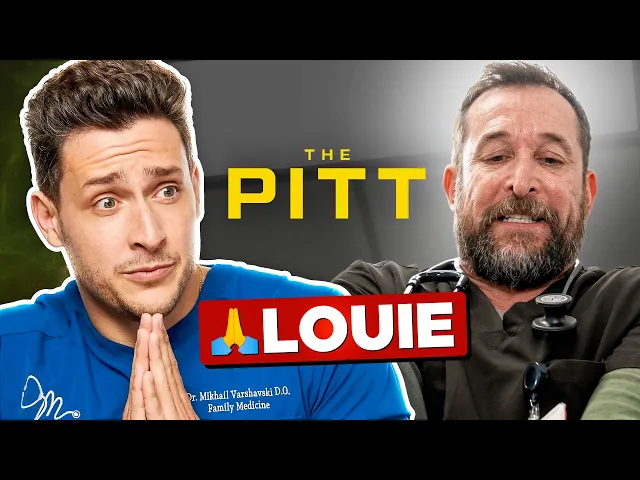
Doctor Reacts To The Pitt S2 Ep 6 w/ Sepideh Moafi
Doctor Mike
0:00 We're about to watch and react to episode six of "The Pitt",
0:03 but for this episode, I need to call a consult from the one and only, Dr.
0:07 Al-Hashimi, Sepideh Moafi.
0:09 Are you ready to take on episode six of "The Pitt"?
0:12 Let's do it!
0:12 Yeah?
0:13 Born ready, baby.
0:13 Okay, let's do it.
0:14 (Sepideh chuckles) And huge thanks to Zocdoc for sponsoring this video.
0:20 [Dr.
0:20 Langdon] I'm in.
0:21 Bag him.
0:22 (chest compressions thumping)- I am
0:26 notorious for pointing out chest compressions
0:30 not being done (Sepideh laughs) or being done perhaps not perfectly.
0:34 Okay.
0:34 How's Robby doing?
0:35 So, I'm a bit of a stickler for form.
0:37 Okay.
0:38 [Doctor Mike] Only because, what I've come to realize in my years
0:41 of practicing medicine and making YouTube content, people learn from television.
0:47 Yes.
0:47 [Doctor Mike] On what they should do, what they shouldn't do.
0:49 Yes.
0:49 What they think is correct.
0:50 So I would love to see the chest compressions be a little bit deeper.
0:53 But otherwise, it looks great.
0:54 Yeah, yeah, yeah.
0:54 It's hard because-- It's a real person.
0:56 When they teach, it's a real person,
0:57 so you're having to keep your arms straight and sort of push your chest forward.
1:03 Right.
1:04 And kind of act with your shoulders.
1:06 And so it's a very sort of artificial movement.
1:08 But yeah, it's, it's actually harder than it looks.
1:12 I think it's really smart in the way that they manipulate the camera angles.
1:16 Yeah.
1:16 Yeah yeah yeah.
1:17 Because honestly, it doesn't let me give critique.
1:19 Yes.
1:19 'Cause it's like, "Oh, we're just seeing the shoulders bounce."- Yes.
1:22 And that looks good already, because most people are doing stuff like this.
1:25 Yes.
1:25 You should text Noah though,
1:26 and let him know that he needs to brush up his game.
1:28 No, he's doing a good job.
1:28 I'm just kidding.
1:29 'Cause then poor Louie over there is gonna start...
1:31 I know.
1:31 Really feeling it on his ribcage the next morning.
1:33 That's right.
1:35 Okay.
1:35 Holding compressions.
1:36 (machine beeps)- [Nurse] Good square line on the end-tidal CO2.
1:39 V-fib.
1:39 Charge to 200!
1:42 Charged!
1:43 Clear!
1:45 (paddles thud)- Stand by with epi.
1:51 So that's very concerning.
1:52 We're starting to see blood enter the ET tube,
1:55 signaling that there's some kind of bleeding process going on, and, I
1:59 believe this patient is one who's come in multiple times for alcoholism,
2:03 and already has fluid building up in his abdomen.
2:06 They had to do a paracentesis.
2:08 In those patients, they have scarring of their liver.
2:11 That increases blood pressure in the portal venous system.
2:15 And what happens there is the body tries
2:18 to decrease this pressure by shunting blood in different directions.
2:22 But the problem is, the venous system is not meant to be a high-pressure system.
2:25 They're thin-walled, and they don't respond well to pressure.
2:29 So when that blood flow starts getting redirected to areas like the stomach,
2:32 the esophagus, those blood vessels that are thin start becoming wider.
2:37 They are more susceptible to rupturing.
2:39 Any amount of slight friction, pressure, ET tube going in.
2:43 All of that can risk bleeding.
2:46 And in general, patients who are end-stage
2:50 liver disease also have issues with platelets,
2:53 clotting factors, 'cause a lot of that happens from the liver.
2:57 A lot of problems with bleeding in these patients.
3:00 So, very tough to see a situation like this, where it's already terrible,
3:04 'cause we're in cardiac arrest, and now there's problem on problem on problem.
3:08 And this is a character that we,
3:11 as an audience, have grown so attached to, Louie.
3:14 This is, yeah.
3:15 Yeah.
3:16 Suction that tube.
3:17 (devices beep) You're not in the esophagus, are you?
3:21 Definitely not.
3:21 I passed right through the cords.
3:23 Good breath sounds.
3:24 End-tidal CO2 confirmed.
3:26 [Nurse] His lungs are filling up with blood.
3:27 [Dr.
3:28 Robby] I know.
3:28 This never gets easy, by the way.
3:29 Watching this amount of blood and-- Are you squeamish of blood, in general?
3:33 I didn't think I was squeamish, but yeah,
3:35 my first day, we did the clamshell procedure from episode one.
3:40 And so I, yeah, I felt like I was getting a bit lightheaded,
3:45 'cause the full-body prosthetics, they look so real!
3:47 So real!
3:47 Yeah, exactly.
3:49 Every detail, every (indistinct), is accounted for, so, I do,
3:52 I still, and watching the show, like during the clamshell,
3:55 even though I was in the room for however many days that took,
3:57 it was hard for me to watch.
3:59 Are you filming a scene like this straight through?
4:02 Or are there stops for angle swaps, camera changes, et cetera?
4:07 No, we actually have less downtime than most film and television.
4:10 Oh, really?
4:11 Okay.
4:11 Yeah.
4:12 Shows and films, because the light is already prefixed
4:15 into the, so it's basically hospital lighting that we're using,
4:19 and there's a switchboard where they, yeah.
4:20 There's very little downtime between setups.
4:23 But we do take a good amount of time to rehearse the trauma procedure.
4:27 So we have a med tech advisor for every episode.
4:30 Yeah.
4:31 Usually I call them and bother them for as long as they'll talk to me,
4:35 and let me pick their brain.
4:37 So on the day of the procedure, we'll go through,
4:39 they'll talk to each one of us individually,
4:41 sort of give us the lay of the land,
4:43 and then put it all together, run it at 25% speed,
4:47 50%, 75, and then bring it up to speed.
4:49 And once, you know, they feel it's ready, then we roll.
4:52 And yeah, like I said, there's very little downtime between shots.
4:56 Yeah.
4:56 This 25, 50, 75, 100 approach, is very similar to the "see one,
5:00 do one, teach one" that has been discussed on the show.
5:03 [Sepideh] Yeah.
5:03 It allows you to get more and more comfortable.
5:05 [Sepideh] Yes.
5:05 Without feeling like you're gonna make a mistake,
5:06 and it comes off perhaps less genuine.
5:09 Yes, yes, yes.
5:10 Absolutely.
5:11 But I mean, once you get in that flow state,
5:13 once you're in the pocket, it's thrilling.
5:16 I mean, I'm glad there are no lives actually at stake here for us,
5:19 but, but it really is, because it's,
5:22 it's the sort of co-dependence or interdependence of your colleagues,
5:25 of your scene partners, and everything, we just rely on each other so heavily.
5:30 [Dr.
5:31 Robby] Hold compressions.
5:32 (machine beeps)- [Dr.
5:34 Langdon] Asystole.
5:34 Resume CPR.
5:35 Another amp of epi.
5:37 [Nurse] Needs more suction.
5:38 (machines beep) (body squelches)- Pulmonary hemorrhage from liver failure.
5:43 Is he going to make it?
5:46 See, it's hard to know if, at least for me, watching,
5:49 if this is a pulmonary hemorrhage or, as Noah mentioned in the scene,
5:54 was this a situation where the ET tube was inserted incorrectly?
5:58 [Sepideh] Mm.
5:59 [Doctor Mike] Because of those fragile blood vessels
6:01 that can occur from advanced liver failure in the esophagus,
6:05 if you insert there, and you injure one of those blood vessels, you can't tell,
6:09 is this bleeding from the mouth coming from the esophagus or from the airways?
6:13 [Sepideh] Mm.
6:14 There are obviously situations from this pressure buildup,
6:16 the coagulopathy that happens as a result of liver
6:18 failure that could lead this to be alveolar bleeding.
6:23 So like the smallest little pockets, air sacs,
6:26 within the lungs that can cause bleeding, but very difficult to know.
6:29 And in an ER setting, it almost doesn't matter,
6:31 'cause you're trying to do your best to bring this person back.
6:34 But in a scenario like this, there's just, it feels very far gone.
6:39 Should we give PCC?
6:41 Too late for that.
6:43 And he's not an ECMO candidate.
6:45 Nothing else we can do?
6:46 (machines beep)- No, I think we're done.
6:54 (sighs) (machine flatlines) Oh, Louie.
7:00 (machine flatlines)- 12:07.
7:08 Why do I need to see a psychiatrist?
7:10 Jada, why do I need to see a psychiatrist?
7:13 It's gonna be okay, Jackson.
7:14 Dr.
7:15 Jefferson says he can help.
7:17 [Javadi] Do you know how you got here?
7:20 The medics brought me.
7:22 I don't really remember.
7:23 I was in the library.
7:25 [Dr.
7:26 Jefferson] What were you doing there?
7:28 I was studying.
7:31 I was trying to study.
7:34 But then they wouldn't stop talking.
7:36 [Dr.
7:36 Jefferson] Who wouldn't stop talking?
7:38 They don't want me to pass the bar.
7:39 Who doesn't want you to pass the bar?
7:41 That's what they told me.
7:42 This is a situation where paranoia is entering the equation,
7:45 because there may have been no other people actually interrupting his studies.
7:50 Schizophrenia is a possible diagnosis,
7:52 especially in this age demographic, is when it can start.
7:55 And the interesting part about schizophrenia is,
7:58 sometimes it's brought on by some acute stress state where
8:01 we cannot even predict why it started at this moment,
8:06 but something happens in someone's life,
8:07 something very stressful, a critical illness,
8:09 and then full-on schizophrenia begins,
8:11 where before that, there were no signs of the schizophrenia.
8:14 Very interesting.
8:15 I was fascinated by that, in talking to our tech advisors, our medical advisors,
8:20 that this is apparently very common for young males in their early twenties,
8:26 in college, high-stress environments,
8:28 and especially with marijuana, when they're smoking marijuana.
8:31 [Doctor Mike] Yes.
8:32 [Princess] Everything okay, Roxy?
8:33 (curtain pulls)- I can't get off the bedpan.
8:37 Oh, that's what I'm here for!
8:44 Your husband seems like a saint.
8:47 How long have you been married?
8:51 Too long.
8:53 (chuckles) Almost 20 years.
8:57 I always find it tough in scenarios like this, where
8:59 a patient is obviously in a lot of pain,
9:02 is going through final stages of their life,
9:05 it's a hospice situation, so, you wanna approach this situation with reverence.
9:08 You wanna be serious, you wanna be compassionate.
9:12 At the same time, it's so important to also interject some happiness,
9:17 some humor, some joy.
9:20 But then it's very easy to cross that line.
9:22 [Sepideh] Yeah.
9:23 [Doctor Mike] And finding that line with each patient is,
9:25 I think, the most valuable part of being a clinician.
9:28 I was just admiring Kristin's work,
9:30 because she's so beautiful and alive and real
9:34 and just present in everything that she does.
9:36 I think she's just such a beautiful, brilliant actor.
9:39 But it's a cast of people like her who are
9:42 just making really smart choices with the script that we have,
9:45 which is so well-written and loaded and really kind of like a treasure chest,
9:50 or a minefield, and you just continue to mine as an actor and you
9:54 get more and more and, these moments of levity that you're talking about,
9:58 yeah, I was, I was thinking as we were watching it,
10:01 the way that the camera is panning down to the bed and then up to them,
10:04 it makes you feel like you're inside of the room with them,
10:07 like you're experiencing it, and it creates this other dimension of humanity
10:12 and authenticity for the show that makes you then,
10:16 in these quiet moments, relate even deeper to these characters,
10:20 whether it's the patient or the nurse.
10:22 This feels like I'm shadowing a nurse for the day to see what they do.
10:26 Yeah yeah yeah, yeah.
10:27 There is no difference between this and what I experienced in the hospital.
10:30 Mhmm, mhmm.
10:31 So, I think that's a testament.
10:32 I believe this one's directed, if I'm not mistaken, by Noah.
10:35 [Doctor Mike] Oh, really?
10:36 Okay.
10:36 Yeah.
10:36 So it's always interesting, you'll see this season,
10:38 Shawn directs an episode too, episode nine.
10:40 This kind of, like, this level of detail
10:43 is so important for them because they're actors.
10:46 They come at this from the inside out.
10:48 Whereas a director that comes from maybe
10:50 a photography background or a filmmaking background,
10:53 it's more of an outside in approach.
10:54 And both are right.
10:55 Both are equally as effective.
10:57 Yeah!
10:57 But I think as an actor, it's really satisfying working with somebody
11:01 who understands it from the inside out,
11:03 and cares, like, pays attention to these details,
11:06 because they know that the audience will feel them.
11:10 Sure.
11:10 Let's discuss our incarcerated patient, Gus.
11:13 Prison infirmaries tend to be short-staffed, so we need to be thorough.
11:17 What's in a differential diagnosis for malnutrition?
11:20 Inadequate intake.
11:22 Methamphetamine use.
11:24 Severe alcoholism.
11:25 ADHD medication.
11:27 [Dr.
11:27 Al-Hashimi] What else?
11:28 Cancer of the oral pharynx, esophageal strictures, prior strokes, malabsorption,
11:32 inflammatory bowel disease, none of which were in his medical record.
11:35 I don't think it was noted, also past bariatric surgeries.
11:39 Mm.
11:40 So patients who have a bariatric surgery sometimes have
11:42 a malabsorption syndrome where they don't get their nutrients as well.
11:44 And this type of questioning happens very often.
11:47 In the "House MD" days, they would be in front of a whiteboard.
11:50 And that's so not realistic, with the exception of if you're doing like
11:54 a, we have these rounds called M&M rounds,
11:56 morbidity and mortality rounds, where,
11:58 if someone dies, or someone's very sick, at the end of the month,
12:01 we collect these cases, we present them and then write on a board.
12:03 But when we're actually taking care of a patient,
12:05 this is the exact way that they're done.
12:07 And we sneak in little, you know, drink or food breaks to kind of, you know?
12:12 Make sure the audience knows that we're not-- People eat.
12:14 [Sepideh] Yes, that doctors need to eat too.
12:16 Let's start with a nutrition history once he's back from CT.
12:19 What is the story with your incarcerated patient?
12:22 Gus Varney, three rib fractures, with normal O2 sats currently.
12:25 Waiting on CT results.
12:26 Okay.
12:26 If he's stable at the two hour mark, I'd say he's good to go.
12:28 Let's get the ball rolling on discharge.
12:29 Let's wait on the CT results.
12:31 We can move him outta trauma one, at least.
12:33 Yes, we can.
12:33 What's open?
12:34 13 and 14 will be discharged soon.
12:35 15, once we can move Louie to the viewing room and get it cleaned up.
12:39 Our paracentesis patient, Mr.
12:40 Cloverfield?
12:41 V-fib arrest.
12:42 We'll do a debrief when we know how many patients we gained from Westbridge.
12:45 So Gus goes to 13, 14, or 15.
12:48 I kinda wanna keep him in plain sight.
12:50 What about BH2?
12:51 [Nurse Dana] Sold.
12:52 Why not give him some privacy?
12:53 Everyone can see him in BH2, like he's a monkey at the zoo.
12:57 Because he came in with an orange jumpsuit
12:58 and we need to think about patient and staff safety.
13:01 Safety first.
13:02 BH2 beats a prison cell.
13:03 [Dr.
13:04 Al-Hashimi] Not by much.
13:05 You guys have a lot of tension going on there.
13:07 There is some tension.
13:08 There is push and pull.
13:09 I think friction can be generative, though.
13:11 And I think that's what's interesting about the dynamic that Dr.
13:15 Al-Hashimi has introduced into "The Pitt".
13:18 It's a different tune.
13:19 It's a different melody.
13:21 It's clearly a well-established culture, ensemble, ecosystem,
13:25 and she sort of steps in, and brings something kind of radically different,
13:32 and tries to harmonize as best she can,
13:35 but there are some clashes sometimes between her and Robbie.
13:39 And I think, just as an audience member, at this point, in episode six,
13:44 if they can find a way to work together,
13:47 I think they could be an unstoppable team.
13:49 And I think what they represent is, you know,
13:52 more of this old-school, hands-on, intuitive approach Dr.
13:55 Robby, and Baran Al-Hashimi, who represents this newer, more progressive,
14:03 you know, the modernization of medicine, what could be.
14:06 (door opens) (curtain pulls)- [Dr.
14:10 Langdon] I'm sorry, man.
14:11 We didn't have time to find you.
14:14 What happened?
14:16 He was apneic and pulseless.
14:19 We started CPR and intubated him.
14:22 He had a massive pulmonary hemorrhage.
14:23 Robby called it.
14:24 Could have been as simple as, because he has this liver failure,
14:28 and he has the high capacity for bleeding or high risk for bleeding,
14:31 and doing chest compressions, you break a rib, punctures the lung.
14:35 That alone could have caused this.
14:37 Never cleaned a dead body?
14:39 (curtain pulls) Probably never seen one, either.
14:43 No one tells you what it looks, feels,
14:45 or smells like, but you get used to it over time.
14:49 This is mostly for dignity purposes,
14:51 to have the patient be available for someone
14:55 to view before sending them to the morgue.
14:57 But you're not doing like, an embalming process here, so.
15:00 We pull off the gown, wipe 'em down with towels, and we'll roll him on his side.
15:06 Clean his back, stuff the sheet under him.
15:08 Pads for mucus and other bodily fluids that might come out after the fact.
15:13 Usually, we leave the ET tube in for the coroner,
15:16 but Louie was a chronic alcoholic with end-stage liver disease.
15:20 Not a coroner's case.
15:22 Yeah so, usually, we would call the coroner, as residents, present the case,
15:27 and they would decide whether or not this was
15:29 necessary to be a coroner's case or not.
15:31 The most difficult part is, this doesn't happen as much in the ER,
15:34 but when someone's admitted to the hospital and someone dies,
15:37 you go in, as the resident,
15:40 and you have to formally diagnose the patient as dead, deceased.
15:44 You're looking for certain reflexes, pupillary, corneal,
15:48 listening for extended periods of time for lung and breath sounds.
15:52 And the whole family's there.
15:54 So you're trying to be respectful.
15:56 You're talking to them about the process of what will happen in the coming days.
16:01 And there's times where you're talking, but you just know none of it's landing.
16:04 [Sepideh] Yeah.
16:05 So you just have to be there.
16:06 Ask, a lot of times, if they have questions, and suspend talking,
16:10 and listen more, even though your job is to talk.
16:13 Mhmm.
16:14 Because, in that moment, the information's not landing.
16:17 It's not valuable.
16:18 So.
16:18 And it's a way, I mean this is,
16:20 reminds me of, you know, how we approach our work as actors.
16:25 Sometimes you have the language on the page, or what you're saying,
16:29 you're taking this family through this process,
16:31 but you're really communicating something else.
16:33 You're communicating love and care and presence with this language.
16:37 And so often, as actors,
16:38 we have the language in the script that we're communicating so much more.
16:43 [Doctor Mike] Right.
16:44 With, so.
16:45 [Nurse Dana] So what's up with Evel Knievel?
16:46 Brandon Lee, 52.
16:47 Fell off a motorcycle pyramid at 25 miles per hour.
16:49 Motorcycle pyramid?
16:50 You recruiting?
16:51 Got a fellow rider in your midst.
16:52 [Mr.
16:53 Lee] No kidding.
16:53 How high up were you?
16:54 On top of a three-two-one.
16:55 But the bottom guys are sitting down, driving the choppers.
16:58 I'm fine.
16:58 I don't need all this.
17:00 Were you wearing a helmet?
17:01 [Mr.
17:01 Lee] Of course!
17:02 Oh, what do you know?
17:02 They're still in style!
17:04 Good vitals, tender right wrist, and big left knee lac.
17:07 Hey Joy, Perlah?
17:07 Trauma two.
17:09 Who else can I have?
17:10 Santos and Whitaker are in with Louie.
17:12 Yeah, gimme Whitaker.
17:13 He could use a distraction, and Santos has been ducking traumas all day.
17:15 She's behind on her charting!
17:17 Who isn't?
17:17 (record scratches)- If I'm being honest...
17:20 Yes.
17:20 I'm currently very behind on my charting.
17:21 Are you?
17:22 (Sepideh laughs)- Yeah.
17:23 I'm getting messages right now about it.
17:25 I can feel my phone getting the vibration alerts.
17:28 But interestingly, my hospital is beta testing an AI system.
17:33 Okay!
17:33 Okay.
17:33 To try and figure out how to make this more clean,
17:38 quicker, more effective, with the concern from every doctor that, "Oh,
17:42 will we now be seeing double the amount of patients
17:46 because we have this AI system?"- That's a slippery slope.
17:49 But it feels like, yeah, most people that I've talked to, most
17:53 doctors that I've talked to, welcome this change,
17:55 because especially people who are of a sort of like,
18:00 in maybe, I'm assuming we're kind of in a similar age bracket,
18:02 and older, because you've trained with hands-on, you know-- For sure.
18:08 Medicine and, and you know how to use this as a tool, not as a replacement.
18:13 My biggest thing when I was in residency training,
18:15 I would get in trouble because I refused to do,
18:17 the rule was do your note in the room with the patient.
18:20 Mhmm, mhmm.
18:21 And I would just refuse to type when I wanted to interact with a person.
18:25 Yes!
18:26 I just, I couldn't be that keyboard warrior, and that meant, after hours,
18:30 I would be sitting and doing notes and trying to catch up.
18:33 But now, with these AI tools, perhaps we can just have something on the desk
18:37 that is no longer creating a barrier to communication.
18:40 [Sepideh] Yes!
18:41 [Doctor Mike] And it kind of stays out of the way.
18:42 Well, and it strengthens the bond between physician and patient, right?
18:45 Because there's that psychological emotional attunement, and they feel,
18:50 and you earn their trust that way,
18:52 and people who are coming, whether it's a checkup or for some sort of illness,
18:57 there is this power dynamic of, you know, you guys are,
19:01 we're coming to you for your expertise and you have the answers.
19:04 And so when you do see your provider locked
19:07 in and sort of at the same place with you emotionally,
19:11 mentally, it makes a world of difference, and then you feel like,
19:15 okay, anything you say, I'm happy to do.
19:18 Yeah.
19:18 I'm happy.
19:19 You know?
19:19 Rather than having to fight to earn the trust.
19:21 I don't even like getting to the point where a patient feels that they
19:25 need to make the decision to do what I'm telling them to do.
19:28 Mm, mhmm.
19:28 I want for it to be an educational experience,
19:32 where I'm explaining what the options are.
19:35 Perhaps giving recommendations.
19:36 [Sepideh] Yeah.
19:37 But ultimately, it should be their choice.
19:39 [Sepideh] Yes.
19:40 To want to or not want to do something.
19:42 Good lung sliding bilaterally.
19:43 Pupils equal and reactive.
19:45 [Dr.
19:45 Robby] What do you ride?
19:46 [Mr.
19:46 Lee] The bullet.
19:47 Oh, royal infield, ankle breaker, Thumper!
19:49 BP 138 over 80.
19:51 Pulse 94, pulse ox 98.
19:53 So far everything's very reassuring, and he's all mentally there,
19:56 being able to memorize or call back the name of his motorcycle.
20:02 So, reassuring.
20:03 Does anyone have any trauma scissors?
20:05 I'll check the knee.
20:06 Not yet.
20:07 Why not?
20:08 [Dr.
20:08 Robby] Dr.
20:09 Santos?
20:09 Primary survey means rule out the life threats.
20:11 Don't get distracted by lacerations or fractures.
20:14 No free fluid in the belly.
20:15 Airway, breathing, circulation are fine.
20:18 Okay.
20:18 That's ABC.
20:18 That just leaves two letters.
20:20 DE.
20:21 (both laugh)- Disability.
20:23 Wiggle your toes, sir?
20:25 Any pain in your arms or legs?
20:27 [Mr.
20:27 Lee] Not really.
20:28 [Dr.
20:28 Whitaker] Does it hurt when I push here?
20:29 No.
20:30 Okay.
20:30 No midline tenderness.
20:31 Nexus negative.
20:33 No obvious brain injury or spinal cord injury.
20:35 That just leaves E.
20:37 Joy?
20:38 Can I buy another vowel?
20:40 [Dr.
20:40 Robby] Dr.
20:41 Whitaker?
20:41 [Dr.
20:42 Whitaker] Exposure.
20:43 AKA, strip and flip.
20:44 Cut off his clothes, and we'll log roll him.
20:46 A lot of times in the hospital,
20:47 that is one of the most anger moments from the patient.
20:50 'Cause they're like, "This is my favorite shirt!
20:52 This is, don't cut it!
20:53 I'm fine!"- Oh really?
20:54 (laughs)- Yeah, but they've experienced a serious trauma.
20:56 You don't wanna miss something,
20:57 'cause there have been instances where someone comes
21:00 in, adrenaline rush because they got into a fight, they got shot as a bystander,
21:06 and they don't realize they have a bullet
21:08 hole in their leg that went through their tissue,
21:10 and had we not exposed their full body, we would've never seen it, so.
21:13 Oh my gosh.
21:14 Very important to check the entire body.
21:16 Would you, have you, do you ride a motorcycle?
21:18 No.
21:19 Would you ever?
21:20 I've crashed a motorcycle.
21:20 (laughs)- No!
21:22 Interestingly enough, when I was really young.
21:23 And I haven't rode since.
21:24 And ever since you, yeah.
21:25 But I do race cars.
21:26 [Sepideh] And you wouldn't.
21:27 So.
21:27 Oh, you do race cars.
21:28 But that's different, right?
21:29 I mean, you still crash.
21:30 I guess it's just safer.
21:32 Sure, sure.
21:33 Helmeted motorcycle acrobat.
21:34 Eight foot fall standing on top of five riders.
21:37 Primary survey normal, eFAST negative.
21:40 So in a scenario like this where the exam seems fine,
21:43 it's tempting to not do imaging.
21:45 [Sepideh] Mm.
21:46 However, one of the criteria that we use to decide whether
21:49 or not someone should get imaging stems from also the mechanism of injury.
21:53 [Sepideh] Mm.
21:54 [Doctor Mike] And an eight foot fall at speed is
21:56 a pretty serious mechanism of injury that would usually warrant imaging.
22:00 Another motorcycle accident.
22:02 [Dr.
22:02 Garcia] Hello, sir.
22:02 I'm Dr.
22:03 Garcia from surgery.
22:04 Hello.
22:05 Okay, we will roll him in, three, two, one.
22:12 They closed the drape!
22:13 (both laugh) I'm always talking about the drapes not being closed,
22:17 but I assume it's for filming purposes, right?
22:20 Yeah.
22:21 Okay.
22:21 Most of the time.
22:22 Yeah, yeah, yeah.
22:22 Because a big part of what I do and what I train residents is,
22:25 they'll walk into the exam room, they'll do everything perfectly correct,
22:28 like, before, let's say a pap smear.
22:30 And they'll introduce to the patient what they're about to do.
22:33 They're very calm, very kind.
22:35 And they're about to start the procedure, and I'm like, "Hold on a second.
22:37 If someone opens this door right now."- Yeah.
22:40 The patient is fully exposed.
22:41 Yes.
22:41 You have to close the secondary drapes.
22:43 I'm always yelling that at them.
22:44 Do they ever tell you, "Well they don't on 'The Pitt',
22:46 and everything on 'The Pitt' is-"- Yeah, yeah.
22:48 (both laugh) No, they don't do that yet.
22:49 Back to the show in just a second,
22:50 but first I wanna tell you about my sponsor, Zocdoc,
22:53 a free website where you can easily search and compare high quality,
22:58 in-network doctors, so you can find the right one for you.
23:01 Dr.
23:01 Robby seems like a great doctor to me,
23:03 and he delivers exactly the quality of care I'd expect to find on Zocdoc,
23:07 who can help you book in-network appointments
23:09 with more than 150,000 providers in all 50 states.
23:15 Look, I get it.
23:15 Finding a doctor is not just hard for patients, but for me, too!
23:19 That's right.
23:20 Just because I'm a physician doesn't mean I
23:22 get how insurance and all this stuff works.
23:24 My dad and I have actually struggled with this together.
23:27 He's a family medicine doctor, too,
23:29 and ran into a health problem of his own and needed to find a new doctor.
23:33 We tried to find someone, but we ran into all those same roadblocks you do.
23:37 Confusing websites, endless voicemails.
23:40 So we tried Zocdoc and found the right person.
23:43 They specialized in exactly what my dad needed,
23:45 were close to his home, and actually had openings for new patients.
23:49 My favorite part?
23:50 You can see the doctor's actual appointment openings,
23:53 choose a time that works for you, and click to instantly book a visit.
23:57 So stop putting off those doctor's appointments and go to zocdoc.com/doctormike,
24:02 also linked in the description,
24:04 to find and instantly book a top-rated doctor today.
24:06 All right, let's get back to "The Pitt".
24:09 [Nurse Jesse] Gus here is wondering if he's clear to eat.
24:12 As long as it's a liquid diet.
24:14 We have the results of your CT scan.
24:17 Your jaw should heal without surgery, which is good news,
24:20 but it will be a few weeks.
24:22 Before I can eat?
24:24 [Dr.
24:24 Mohan] Solid foods, yes.
24:26 We have a calorie-rich supplement drink called Ensure.
24:29 Comes in chocolate, vanilla, or strawberry.
24:33 Chocolate, please.
24:34 [Dr.
24:35 King] Good choice.
24:35 How many can I have?
24:36 Two a day is recommended.
24:38 I'll get it for you.
24:40 You have an appetite.
24:41 That's good.
24:42 (door buzzes)- Mr.
24:44 Varney, your blood tests indicate low levels of protein and vitamins.
24:48 This actor, John Lee Ames, I think is his name.
24:51 He was so detail-oriented and so specific about his pain.
24:59 I mean, you, he broke your heart.
25:02 I couldn't watch him on my coverage because I'm supposed to be tough,
25:06 and I would just crumble.
25:07 I'd start crying.
25:09 I love that they've sort of folded
25:11 this case into the conversation that, you know,
25:15 because it really makes us reflect on who gets care,
25:19 who deserves care, who's afforded care, what kind of care do they deserve?
25:23 'Cause he looks, initially,
25:25 they made him look like kind of a serial killer or something.
25:28 [Doctor Mike] Right, yeah.
25:29 You know?
25:30 He looks the part.
25:31 But there was a softness, this childlike quality about him, that even though,
25:36 when she says chocolate, he says chocolate, his eyes light up.
25:39 It just broke your heart.
25:40 So again, going back to what the show does
25:43 beautifully is it reveals the humanity in all of us.
25:47 Yeah.
25:47 At the surface, we might judge somebody like that.
25:49 But then you see he's just a kid who wants to eat.
25:53 Yeah.
25:53 Who wants to be taken care of.
25:54 Which, there should be no barriers for anyone to get care.
25:57 Criminal, not criminal, person who wants care, who can't afford care.
26:02 Like the idea is we should be giving care,
26:04 especially in an ER setting, to everyone at the highest level.
26:08 CT's ready for Brandon.
26:09 As soon as we take a look at this knee.
26:13 Ooh.
26:14 Whoa!
26:14 Through the deep fascia.
26:15 How's it look?
26:16 Definitely gonna need stitches.
26:18 [Mr.
26:18 Lee] How many?
26:19 A lot.
26:19 It could be an open joint.
26:20 We'll do a saline load after CT.
26:24 Lever sign negative.
26:25 ACL intact.
26:26 Okay, ready to roll.
26:27 I'm not gonna lie.
26:28 It's really tough to know if the ACL's intact from doing
26:31 that sign test (laughs) when the knee is in that shape.
26:36 When there's that much damage.
26:37 During global swelling like that, it's very
26:40 difficult to have clear tests, with the exception, if there's a full, full tear,
26:44 and there's just full laxity when you're doing certain special tests.
26:47 But in general, it's tough to point that out.
26:50 We need to admit our incarcerated patient, Gus.
26:52 What did the CT show?
26:54 Moderate pulmonary contusion, three rib fractures, no intraabdominal bleeding,
26:58 an oblique fracture in the body of the mandible, anterior to the angle.
27:02 All favorable for healing.
27:03 What's the treatment plan?
27:04 A pain-- Security!
27:05 (people clamor)- Pain medication, antibiotics, liquid diet,
27:11 a pulse ox a few times a day, and then also dressing changes for the laceration.
27:16 Which he can get at his correctional facility.
27:18 Or, he stays here for a few days and we get him on the right track to healing.
27:23 Why don't you two go check on your patients?
27:25 Got it!
27:26 Sure thing.
27:29 What am I missing?
27:30 That's a great question!
27:31 I was expecting conflict, but he's admitting that he might be missing something.
27:35 That's very disarming.
27:37 Do you think that's enough information for him to have to admit the patient, or?
27:41 In a situation where, in "The Pitt",
27:44 they're already overloaded, beds are premium.
27:47 Scarce, yeah.
27:48 You have to be aware that you need space.
27:52 Yes.
27:53 So you try and decrease the need for people to spend time at the hospital,
27:57 in addition to thinking about the fact that every
27:59 time you bring a patient into the hospital,
28:01 you're risking them getting a hospital-associated infection.
28:06 And in a hospital, traditionally, you're not resting well,
28:09 the lights are always on, people moving around.
28:11 Maybe correctional facility isn't comparable to home,
28:14 but if you've spent years there and you're comfortable there,
28:17 maybe you're resting there as well.
28:19 But, if he's not aware of something, some risk,
28:23 some healing factor, perhaps this will change his guidance.
28:27 He's not getting enough to eat at his correctional facility.
28:30 The portions are tiny.
28:31 Too many carbs, not enough fruits or vegetables.
28:33 He's lucky he hasn't developed a chronic illness.
28:37 We don't have any inpatient beds.
28:38 He would board down here for three days.
28:39 We're still getting runs from Westbridge,
28:41 and we cannot tie up behavioral for that long.
28:44 Also, based on his presentation, it would be very unique to understand why he's
28:49 so advanced in his malnutrition as a single individual.
28:53 Like are they not feeding him specifically?
28:55 Are inmates stealing his food?
28:58 Some further questioning would be helpful here, because if that's the case,
29:02 you can have social work actually begin the process
29:04 of investigating the correctional facility and asking them questions.
29:08 Why don't I call the prison doctor
29:09 and find out what they're working with over there?
29:11 Thank you.
29:12 My pleasure.
29:12 But see, in a scenario like this, it would
29:14 be great to pawn this off to a med student,
29:16 or perhaps a social worker, not the director of the ED, so.
29:21 What do you say, kid?
29:23 Ready to go home?
29:27 How's your pain Mrs.
29:29 Hamler?
29:30 It's the same.
29:32 We're gonna write you a script for Keppra.
29:34 You'll take that to prevent seizures once a day starting tomorrow.
29:37 Between your broken leg and the bruises from your seizure,
29:39 the pain will probably get a little worse.
29:41 Yeah.
29:42 The most important thing is to let others help you.
29:43 You'll need assistance showering and getting to the bathroom.
29:46 [Mr.
29:46 Hamler] Yeah, no problem.
29:47 I won't leave her side.
29:48 In a scenario like this, giving the plan is smart, but then asking the patient,
29:52 "Does she have any concerns about going home?" 'Cause it seems like...
29:56 [Sepideh] There's a, yeah.
29:57 There's some kind of hesitation there.
29:58 [Sepideh] Tense dynamic, yeah.
29:59 All right, fill me in.
30:01 This is Harlow Graham.
30:02 She was seen in triage.
30:03 CBC and CMP came back normal.
30:05 IT was supposed to bring the VRI down, but they're slammed.
30:08 I know a bit of sign language.
30:10 Harlow, this is Dr.
30:12 Santos.
30:15 Hi Harlow.
30:16 How are you feeling?
30:20 [Princess] She has a headache.
30:22 Okay, what else?
30:28 What is she saying?
30:30 I think she had a stomach ache, and she might have passed out?
30:34 This is getting into not great territory,
30:37 because when you're trying to understand someone who
30:40 speaks in sign language or communicates in sign language,
30:43 or perhaps even just a different language,
30:45 there's this temptation to take a shortcut
30:47 of, have someone who kind of knows the language.
30:50 [Sepideh] Yes.
30:51 To interpret.
30:52 But there is a fine line between
30:54 presenting accurate information and dangerously inaccurate information.
30:58 Mm.
30:58 Mhmm.
30:58 So in a scenario where someone's not sure,
31:00 it's better to communicate by writing in a scenario like this.
31:03 It's actually why a lot of channels on YouTube
31:06 will have their content dubbed in a different language.
31:09 We have not yet done that in many languages.
31:12 We've done professional transcriptions in Spanish, but not dubbing.
31:16 Why?
31:17 Because if someone is to dub my voice in a different language,
31:21 and slightly change the inference of what I'm saying,
31:25 that can lead someone to making a bad
31:27 healthcare choice for themselves or their family members,
31:30 in a different country,
31:32 and it's very expensive to have a medical professional actually do that dubbing.
31:36 So we have held off on that.
31:38 Wow.
31:39 But interesting to show how nuance really matters in healthcare communication.
31:42 Absolutely.
31:43 Yeah.
31:46 I'm not a hundred percent sure.
31:47 Okay.
31:48 We're just gonna need to wait for an interpreter,
31:50 'cause I need to ask a million questions and I can't do it this way.
31:53 So just call me when IT comes down.
31:54 Talk to the patient though.
31:55 (Sepideh chuckles) Like?
31:58 Yeah.
31:58 Ortho assessment.
31:59 Palpate all long bones, starting with the clavicle.
32:03 Got it.
32:04 We'll take the lower extremities.
32:09 (Mr.
32:10 Lee winces) Distal radius tender.
32:12 No deformities.
32:12 Needs an X-ray.
32:13 No bony tenderness down here.
32:14 No laxity of the knee.
32:16 Any concern about that knee leg?
32:19 It's an open joint.
32:20 He'll need a washout in the OR.
32:22 We could try a fluorescein injection?
32:23 Okay.
32:23 We'll need a Wood's-- Wood's lamp, 1% lido with epi,
32:26 sterile saline, sterile basin, sterile fluoro strip.
32:28 18 and 27 gauge needles, five and 60 CC syringes.
32:32 Interesting what they're doing.
32:33 I guess they're trying to figure out if
32:35 the potential opening has gone into the joint itself,
32:40 because the skin and the superficial tissues there,
32:44 the fascia, they can experience some infection, some bacteria,
32:48 but if it starts entering the joint, that requires IV antibiotic treatment.
32:52 [Sepideh] Mm.
32:52 So what they do typically is insert this dye that actually has
32:57 been used in a previous episode to check for a corneal abrasion.
33:00 Similar premise, just with saline,
33:02 to see if it actually starts entering the knee joint.
33:05 If it does, high risk for infection, so you wanna be prepared for that.
33:10 [Sepideh] Mm.
33:11 Lights out, Wood's lamp on.
33:12 (devices beep) Okay...
33:18 Might wanna use some of that on Halloween.
33:20 That is 250 CCs of sterile saline
33:22 with one small touch of a sterile fluoro strip.
33:27 We are going to inject this fluid into your knee, Brandon,
33:30 and if there's anything glowing in your wound, we know we have a leak.
33:35 This could also be done to check for fistulas.
33:37 If there's an abnormal connection somewhere in the body,
33:39 you can inject into one part of the body and see
33:42 if it transports there because of this new path that's created.
33:45 And sometimes fistulas and these abnormal
33:47 connections form just from friction within organs.
33:50 So, this is pretty wild,
33:51 but you can actually develop your colon rubbing against your bladder,
33:57 to the point where you can create a fistula where feces end up in the bladder.
34:04 And you end up urinating feces, fecal material.
34:06 No!
34:07 Yeah.
34:07 So imagine how scary that is to a patient-- I don't want to imagine.
34:10 When they start experiencing that.
34:12 Yeah.
34:12 And they present that way and they go,
34:13 "What is going on?" Recurrent UTIs, foul smell, et cetera.
34:17 That's why you need to always think
34:18 about potential fistulas as part of your diagnosis.
34:21 You'd have to surgically operate.
34:23 Correct.
34:24 Like you'd have to...
34:27 That looks good.
34:28 Laceration did not enter into the joint space.
34:31 Surgery not needed.
34:33 Excellent.
34:33 I can get back to the prix.
34:34 No, we'll still need to stitch you up and splint your wrist.
34:37 Hanging a gram of ancef.
34:38 Wait, he has a penicillin allergy.
34:40 [Kim] No, PEN-FAST was negative.
34:41 We're okay.
34:43 My mom said I got a rash with amoxicillin when I was two.
34:46 90 plus percent grow out of their penicillin allergies from childhood.
34:49 So a lot of people come in saying they have a penicillin allergy
34:52 and sometimes we do some testing to rule out if they still do.
34:56 Because if they don't, it's better to use a medication like penicillin,
35:00 which has lower rate of side effects,
35:01 and is more targeted to the type of bacteria that we expect to find,
35:05 therefore creating less bacterial resistance to antibiotics.
35:08 Yeah.
35:09 Probably not a true allergy.
35:10 Go ahead and give it, Kim.
35:12 But have epi and Benadryl standing by, right?
35:13 [Dr.
35:13 Robby] Yes, to be on the safe side.
35:14 (record scratches)- Well, it's the ER.
35:16 I'm hoping that there is epinephrine and Benadryl.
35:19 Most people who think they have a penicillin
35:20 allergy actually don't- Always listen to the nurses.
35:24 They run the ER.
35:25 We just try and stay outta their way.
35:27 Facts.
35:27 (Sepideh chuckles) And in general,
35:29 when people tell me they have a drug allergy, many times it's something like,
35:33 "Oh, my stomach gets upset when I
35:34 take this medicine." It's not exactly an allergy.
35:37 And it's important to differentiate between the two because look,
35:40 having an upset stomach but decreasing the risk
35:43 of a complication might be worth it,
35:45 versus someone has anaphylactic shock as a result of a medication.
35:50 Way different proposition, so.
35:52 Hey, I just got word that the at-home morphine pump is gonna be delayed.
35:55 Hospital pharmacy has to mix it, and then deliver it later today.
35:59 Well, should we keep her here until it's ready?
36:01 No, you can give her a 200 milligram tablet of MS Contin.
36:04 200 milligrams?
36:05 Biggest pill they make.
36:06 Releases over 12 hours for patients with opiate tolerance.
36:09 Got it.
36:10 I'm surprised they're not doing fentanyl patches
36:12 for her, because that is a much more potent medication,
36:15 but it's a patch, so it doesn't have to be taken by mouth,
36:17 and you can get really high doses.
36:20 Which is why fentanyl could be so dangerous, but for someone who's, as he said,
36:24 opioid tolerant, meaning they've taken huge doses,
36:26 their body has become accustomed to those doses.
36:29 Hmm.
36:30 You gave us a clozapine ileus about an hour ago.
36:32 Your resident reported no surgical history,
36:34 but the chart says they've had an appendectomy.
36:36 We're not admitting the patient without a surgery consult.
36:38 Who called it in?
36:39 [Dr.
36:39 Campbell] Dr.
36:40 Trinity Santos.
36:41 Dr.
36:42 Santos!
36:42 You had an ileus patient.
36:44 You neglected to mention a history of appendectomy.
36:47 There was no history of appendectomy.
36:49 It was in your note.
36:50 I may have forgotten to proof check it.
36:53 I was using the app that Dr.
36:54 Al-Hashimi suggested to catch up on my charting.
36:57 Wonderful.
36:57 Ah!
36:57 Dr.
36:58 Al-Hashimi.
36:59 Yes.
37:00 [Dr.
37:00 Robby] Dr.
37:00 Santos was just using your AI tool.
37:02 Oh, that's!
37:03 That can't be blamed on you!
37:04 You have to proofread the notes!
37:05 I said it!
37:06 (Doctor Mike laughs)- It hallucinated a history of appendicitis.
37:11 As I mentioned to Dr.
37:12 Santos, generative AI is not perfect.
37:14 We still need to proofread every chart it creates.
37:17 The patient also has a history of headache, followed by Dr.
37:20 Park from urology.
37:21 That should probably be neurology.
37:24 Unless urologists are now treating migraines.
37:26 Another example that should have been caught by proofreading.
37:29 AI's 2% error rate is still better than dictation-- Yeah,
37:31 I don't really give a shit whether or not you wanna use robots down here.
37:35 I need accurate information in the medical record.
37:37 Understood.
37:38 You know what I will say?
37:40 We're having all these wars about this 2% accuracy.
37:43 When I was on wards, you should have seen the handwriting of the specialists.
37:51 Yeah.
37:51 Yeah, yeah, yeah.
37:52 Completely illegible!
37:53 Completely!
37:54 In fact, there were some, it wasn't even worth looking at the note.
37:58 You would just know that they were there,
38:00 because their note was semi-present, and you have to page them every time.
38:04 And you know what's weird?
38:05 They were so sweet!
38:06 And they would explain everything that happened.
38:08 But why do you want the call?
38:10 Since you're already writing it, make it legible!
38:14 Yes.
38:14 [Doctor Mike] If they knew how we practiced medicine 20 years ago, when-- Yeah.
38:17 [Doctor Mike] There were no computers involved.
38:19 [Sepideh] Yeah, yeah.
38:20 This is a miracle!
38:21 [Sepideh] Yes.
38:22 Compared to that.
38:22 And, I mean, a friend of mine who is a doctor,
38:25 specializes in end-of-life care, he says that, I mean,
38:28 he's the most hypervigilant, obsessive perfectionist.
38:33 And he's terrified of making a mistake!
38:35 Yeah.
38:36 'Cause you're human!
38:37 Of course.
38:38 You know?
38:38 You deserve to have a bad day.
38:39 You deserve to be sleep-deprived.
38:40 The fact that that could affect someone's care
38:42 or someone's diagnosis or, so he is team AI,
38:46 because it can reduce human blind spot at the end of the day.
38:50 But needs strict supervision.
38:53 [Doctor Mike] Right.
38:54 I just got off the phone with the physician assistant at the prison.
38:57 They've got a 16-hour-day infirmary with NP and PA coverage,
39:00 giving everything that we need, and they've got an RN for overnights.
39:03 Even so, he's here because they're ignoring his basic needs.
39:08 He's here because somebody kicked the shit out of him.
39:10 I think you're missing the point.
39:11 We have more to offer.
39:13 Robby.
39:14 Got four more coming our way.
39:15 Okay.
39:16 Got it.
39:16 What you're trying to do is very noble.
39:18 We don't have the resources to spare.
39:19 Okay, then why admit the unhoused man, Digby?
39:22 Why not send him back to the street with antibiotics and a roll of gauze?
39:25 Because Digby lives on the street, and your incarcerated patient has a mid-level
39:28 provider and a nurse looking after him.
39:30 We both know the quality of care is not the same.
39:33 Sorry, are you waiting for me?
39:34 No.
39:35 Dr.
39:35 Al-Hashimi?
39:35 For the patient in seven.
39:37 A few days here could make a world of difference for Gus' health.
39:40 We are a safety net, but nets have holes.
39:42 We are not admitting him because this is not about social justice.
39:44 (Dr.
39:45 Al-Hashimi stammers)- Everything I've done in my career
39:49 is an effort to improve the system.
39:51 Just because you know it's broken doesn't mean you stop trying.
39:55 I think in a scenario like that, fixing
39:57 the system could mean a lot of different things.
40:00 Maybe it's not about admitting this patient to fix the system,
40:03 but using that as an opportunity to create a line of communication and dialogue
40:07 with the prison system to find out why these holes in the safety net exist.
40:11 Because, in an ER setting,
40:14 I would have to agree with Noah here, in that, in an ER,
40:17 you're trying to stabilize a patient and either make
40:20 the choice that they need to be admitted for medical reasons,
40:22 or they need to go somewhere,
40:25 we call it "disposition", where they'll be looked after.
40:28 And if it's not a high complexity of illness,
40:31 we can send them to a different facility to get care.
40:33 But now if we feel like that facility's not doing a great job,
40:36 we can start an investigation, we could start a line of dialogue.
40:39 If you make the decision to universally bring people in, you'll
40:43 get to the point where you can't deliver care to almost anyone.
40:46 Just from a story perspective, and what this moment represents,
40:50 these two characters is,
40:52 they're both coming in with their, their experiences, their biases.
40:59 We'll learn a little bit later why Dr.
41:02 Al-Hashimi might favor the incarcerated patient in this instance,
41:06 but I think she's had experience where these kinds
41:09 of things are sort of pushed under the rug.
41:12 Yeah.
41:13 And that that's more the norm than anything else.
41:15 And it also just shows their position and their philosophies as doctors.
41:20 For sure.
41:21 That he's somebody, the hardship that she's experienced
41:23 that we'll learn more about has made her lean
41:26 in more and become more empathetic and want
41:29 to sort of refine and find creative solutions.
41:32 And for him, it's made him, in ways, more callous and more detached.
41:39 [Doctor Mike] Yeah.
41:40 And so, I think what this moment represents more is that the (indistinct)
41:45 or how they are coming at this from, in a diametrically opposed way.
41:50 They're just polar opposites.
41:52 I think it shows how, while healthcare is a science,
41:54 it's also an art, and two good doctors-- Yes.
41:57 Can have reasonably different plans for a patient.
41:59 Based on their experiences.
42:00 Yeah, exactly.
42:01 Yes, yes.
42:01 (knocks on glass)- Robby!
42:04 Pulse ox just dropped.
42:06 What happened?
42:07 [Nurse Jesse] I don't know.
42:07 I stepped out for a minute.
42:08 It's down to 85%.
42:10 [Dr.
42:10 Robby] You having some trouble breathing?
42:12 A little.
42:13 Start him on two liters oxygen nasal cannula.
42:15 Titrate to five.
42:16 Keep the pulse ox at 92 or higher.
42:18 Does he have a pneumothorax?
42:21 He's gonna have to stay.
42:23 For how long?
42:24 [Dr.
42:25 Robby] I'm not sure.
42:27 [Nurse Jesse] Sorry, boss.
42:28 I only stepped out for a second.
42:29 Lemme know if anything changes.
42:30 You were in the room when his pulse ox dropped?
42:32 I was.
42:33 What were you doing?
42:34 D, still can't get ahold of ortho.
42:35 Leave 'em to me.
42:38 What did, she put tape on it?
42:40 So it didn't catch a signal?
42:43 Can I assume that you've already called upstairs to get Gus Varney a bed?
42:46 Do you wanna tell me what you did?
42:49 I don't know what you're talking about.
42:51 His pulse-ox was steady.
42:52 We were about to discharge him.
42:54 Did Dr.
42:55 Al-Hashimi put you up to that?
42:56 Al-Hashimi?
42:57 No!
42:58 You know he's gonna go back to prison after they discharge him upstairs.
43:04 I thought you didn't go the extra distance for your patients anymore.
43:07 This is, this is a little bit disingenuous.
43:10 Okay.
43:10 (laughs)- Saying that she's going the extra distance faking
43:14 something for him is not necessarily going the extra distance.
43:17 Now he might be exposed to extra testing that he doesn't need.
43:21 [Sepideh] Mm.
43:22 Can also create side effects of that, and more problems for him.
43:25 Also, as an ER doc, you can call upstairs
43:28 for an admission from us in internal medicine or family medicine ward.
43:31 We'll come down, examine the patient.
43:33 If we don't feel like it's a good admission, it might get rejected.
43:36 Yeah.
43:37 Yeah, so.
43:37 You're creating some interpersonal conflict as well.
43:41 Sure.
43:41 [Sam] Could this, is this illegal, what she did?
43:43 I mean-- Allegedly?
43:44 No one will know.
43:45 [Sam] Okay.
43:46 That's the real answer.
43:47 In reality, all she needed to do was say, "Hey, his blood pressure was low,
43:52 his pulse ox was low." She didn't even need to create that scene.
43:54 And something to point out there is,
43:56 the pulse ox is such an imperfect device to capture someone's pulse.
44:01 So if they have their nails painted,
44:02 if their fingers are cold, it doesn't catch a good signal.
44:06 So often someone's pulse ox drops and we re-adjust it and it's fine.
44:10 The fact that his pulse ox dropped
44:11 for 30 seconds and readjusted and it was good,
44:14 and that's the reason why he's staying, is also a little bit-- Yes.
44:18 Overblown, perhaps.
44:19 Okay.
44:20 Found this with his stuff.
44:23 Who knew he was married?
44:28 That's Rhonda, Louie's wife.
44:30 High school sweetheart.
44:32 He never really wanted kids.
44:35 But Rhonda wore him down,
44:37 and when she finally got pregnant, he changed his tune.
44:40 He got excited.
44:45 And then about a month before the baby was due,
44:47 Rhonda and the baby were killed in a car crash.
44:54 Louie never really came back from that.
45:00 May his memory be a blessing.
45:03 [Woman] His memory be a blessing.
45:07 It's so important to have those moments
45:08 to not lose humanity for, not just the patients, but also for the providers.
45:13 It's so easy to get cold to death.
45:16 Yes.
45:17 And destruction and mayhem-- Yes.
45:18 When you're seeing it all day long.
45:20 Yes.
45:21 But at the end of the day,
45:22 there's always reasons for why things happen and, sometimes
45:25 we're not aware of them and we're quick to judge.
45:27 So moments of reflection like that are so powerful.
45:28 Yeah, and it's almost like a ritual, right?
45:31 It's a practice that becomes part of the humanity in care.
45:36 Interesting that, again,
45:37 in an episode that highlights the humanity of patients and providers,
45:42 we're also on one hand talking about how important it is to talk about humans,
45:47 but also AIs in this episode.
45:49 Yes!
45:49 Yes.
45:50 There are so many topics covered in this one episode.
45:52 It's really impressive!
45:54 It's what's so compelling about the show,
45:56 because on the surface, it's about a hospital.
45:59 It's about these healthcare workers.
46:00 But it really, in essence, it's about everything and everyone,
46:04 all of these societal issues that walk through the door,
46:08 from immigration, we'll see, in later episodes with ICE.
46:12 Episode with ICE.
46:13 And last season, gun violence.
46:17 You know, sex trafficking.
46:20 Grief, poverty, houseless community.
46:22 I mean, there's so many different things explored, and to, for example,
46:28 with the mass shooting last season, we see, unfortunately, in this country,
46:33 too often, these cases, we'll read about it,
46:36 or it'll be in the news cycle for a day or even a week, but then it's gone.
46:42 And what "The Pitt" has done, I think for the first time in history,
46:46 beyond documentaries, really showed not just the cost on patients,
46:52 but also on the healthcare workers, and how Robby, last season,
46:56 was housing this PTSD and grief from his mentor's passing.
47:00 But now, this season, they all have a shared collective traumatic experience
47:05 that they're holding and, like I said before,
47:07 this scar tissue that forms that just gets, you know,
47:11 harder and harder to get rid of, and-- Yeah,
47:13 there's some kind of metaphor to be had where scar tissue in the human body,
47:17 whether it's on the skin or inside the body, it helps you stay functional.
47:23 Mm.
47:23 Because that's what its goal is.
47:24 Yes.
47:25 But at the same time, it doesn't replace the tissue that was there one to one.
47:29 Yes, yes.
47:30 And it does make you, from tensile skin strength, a little bit weaker.
47:34 Yes.
47:35 A little bit less effective.
47:36 So, it leaves its lasting mark on you.
47:39 Yes.
47:40 And unless you address it and know that it's there,
47:42 it's easy to think that, "Oh, you're fine." But in reality, it's not quite fine.
47:48 No, no.
47:49 You're functional, but that chronic stress can wear you down.
47:52 And, and the practice of post-surgery,
47:54 at least I know this from a dance injury that I had,
47:56 you know, you have to massage the point.
48:00 [Doctor Mike] Right.
48:00 You have to care for and take care of yourself.
48:03 [Doctor Mike] Right.
48:04 Consistently, or else that scar tissue forms, right?
48:08 And so I think all of these can be,
48:10 can be viewed as metaphors for, you know, our inner experience, too.
48:13 Our emotional lives.
48:15 And I can't let you go without pointing out that, speaking of societal issues,
48:20 you've been very vocal about what's going on in Iran.
48:23 First with protests, now with the war.
48:26 Any statement you wanna leave with the audience about what's important to you?
48:30 Correct me if I'm wrong, you were an Iranian refugee.
48:33 Yes.
48:34 Okay.
48:34 Yes.
48:35 So this must mean even more to you then.
48:36 It does, and I mean,
48:37 a big population of Iranians migrated before the revolution in '79,
48:44 and even more, I believe, if I'm not mistaken, after the revolution.
48:50 My family stayed and fought for democracy,
48:53 essentially, for as long as they could,
48:55 and were there during the Iran-Iraq war as well until they were forced to flee,
48:58 like most refugees, and lived in camps for a while.
49:03 I was born in a refugee camp, and so,
49:06 that experience and this medieval despotic regime has really
49:12 forged my worldview and my existence, like many Iranians.
49:18 And seeing this right now,
49:19 not only this uprising that's been repressed, brutally, as always,
49:25 we've seen this throughout the past 47 years,
49:27 where there's mass uprising met with violent repression.
49:31 [Doctor Mike] Yeah.
49:31 And so we saw, late December, early January,
49:34 there was a wave of protests that were
49:36 the biggest in Iran's modern history about,
49:39 you know, economic decline and inflation.
49:44 And so, bazaar owners, shop owners closed their shops and stormed the streets.
49:48 And then, as per usual, it's a similar pattern,
49:50 where the regime will cut out the internet.
49:55 So there's an internet blackout, still,
49:57 a few months in, and just, you know, ruthless execution.
50:04 There are over 7,500 confirmed dead from the regime, from those protests,
50:10 and another 15 or 17,000 bodies that haven't been
50:14 accounted for, but if history has told us anything,
50:16 it's, the number is often, it's so,
50:19 so much more, it's far higher than what we know.
50:22 They don't want reform.
50:23 They've tried reform.
50:25 They want a regime change.
50:27 And they want to have a voice in change.
50:29 There needs to be a regime that, that accounts
50:33 for the plurality that exists in Iran,
50:36 of ethnic backgrounds, political backgrounds, religious backgrounds.
50:41 And so, it's been a 47 year struggle.
50:44 It's been a century-long struggle in Iran.
50:46 It didn't start with this regime,
50:48 but it's certainly worse than anyone could have ever imagined,
50:52 and now with the war, obviously, things have intensified,
50:55 and I don't know of an example in modern history where,
51:00 where we've been able to bomb our way into democracy,
51:04 you know, from an airstrikes campaign.
51:06 [Doctor Mike] Yeah.
51:07 It's very complicated, but what's not complicated is the humanitarian cost,
51:11 and that people in Iran need our attention.
51:14 They need our voices to know that the world has not turned their back,
51:19 that they're not being killed and repressed in silence.
51:23 I think they arrested something like 50,000 protestors in a few days.
51:27 And all of these people, they don't get proper trials.
51:30 They're kangaroo trials, and they're given sentences like,
51:35 "you've created acts that disservice God",
51:38 or "an enemy of God" or some, bullshit, excuse me.
51:42 And then they're publicly hanged.
51:45 They're publicly executed, so.
51:47 Even some doctors are being held liable for giving care to the protesters.
51:50 That's right!
51:50 That's right.
51:51 That's right.
51:51 [Doctor Mike] I've heard stories about being pulled out
51:52 of their beds in the middle of the night.
51:53 It's just incredible.
51:55 That's right, and this new precedent of healthcare workers being targeted,
51:59 it's really horrific.
52:02 And so, you know, as best we can, we have to amplify and use our voices,
52:06 and there are international laws against this that are obviously ignored.
52:11 And you work with the IRC, right?
52:13 I do, yes.
52:14 The IRC.
52:14 International Rescue Committee, which is a refugee resettlement agency.
52:19 They provide services in 40 different countries
52:21 and all over the United States as well.
52:23 Do they accept donations?
52:25 Yes!
52:25 Yes!
52:26 Okay.
52:27 Yes, we'd love to-- Great opportunity.
52:28 Absolutely.
52:29 And, I'd love to donate $10,000 on your behalf.
52:32 Oh!
52:32 Doctor Mike!
52:33 For being such a great advocate.
52:34 Thank you so much.
52:35 For an important cause, so yeah.
52:36 That means so much, thank you.
52:37 Well, I think it's a small part where we can play a role.
52:40 There's people all around the world that are struggling in these terrible
52:44 circumstances where you wish you could be there to help everyone,
52:47 but perhaps a small token of just our attention.
52:50 [Sepideh] Yes.
52:51 [Doctor Mike] Can start...
52:52 And something, one last thing that I wanna layer in here that you'll see,
52:54 starting in the next episode with my character, it's not a spoiler.
52:58 [Doctor Mike] Okay.
52:59 But she worked with Médecins Sans Frontières, Doctors Without Borders,
53:02 as a humanitarian aid worker, as a doctor.
53:05 And right now, when we're living through, or we're witnessing,
53:10 unprecedented humanitarian crises, from global disasters,
53:14 I mean, climate disaster,
53:15 to war and displacement, to rising authoritarianism and, you know,
53:20 the shutting down of medical facilities, clinics around the world.
53:25 I think having a character like this adds
53:29 a certain gravity to the world of "The Pitt",
53:31 and an important representation or visibility that so many of, you know,
53:37 your brave colleagues go and fly across
53:39 the world to help in these war-devastated places,
53:44 and leave forever affected and forever scarred,
53:49 and forever indebted to be the voice of the people, their colleagues abroad.
53:54 Because medicine, as you know, it's a language,
53:56 and once you're a doctor in one place, you're needed everywhere.
53:59 And so, it's the same medicine, different dialects.
54:03 But I think that the practice, as we were talking earlier,
54:06 about the edge effect of, you know, diversity actually creates, is generative,
54:11 and can help us all improve and help our healthcare workers,
54:15 as we've heard from testimonies that people who are humanitarian
54:18 aid workers who serve as doctors in different crisis zones,
54:23 that it does only make us better to keep our eyes
54:26 open and use our platforms and our areas of expertise,
54:32 specialties, or anything we can do to help.
54:35 Yeah.
54:36 Yeah.
54:36 Well, I thank you for using your platform in that way, and-- Thank you!
54:39 We're gonna leave some sources in the description of this video-- Thank you.
54:42 To push people in that direction, so.
54:43 Thank you, Mike.
54:44 Thank you.
54:45 Thank you.
54:45 And if you'd like to see the interview with Dr.
54:48 Al-Hashimi's adversary, click here and check that out,
54:51 and as always, stay happy and healthy.
54:52 (chill beats music)