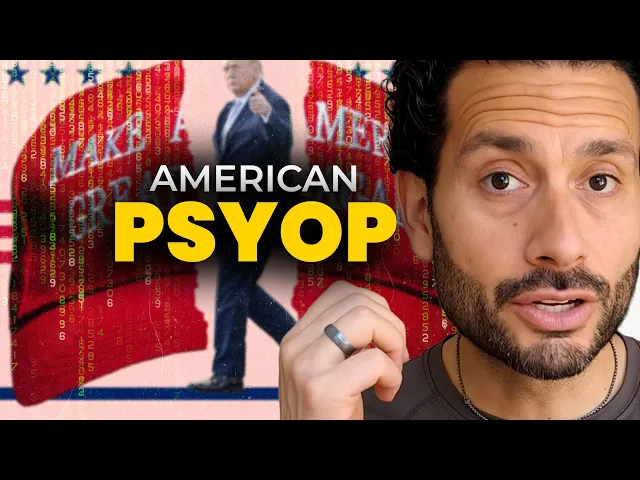
LEAKED: The Algorithm Trump is Using to PSYOP the World
Andrew Bustamante
0:00 If you're feeling overwhelmed by the news right now,
0:02 I want you to know that that is not an accident.
0:05 In intelligence operations, we have a term that we call information warfare.
0:09 And in the information warfare battlefield,
0:11 what you're seeing right now is not chaos.
0:14 It's something that we call media conditioning.
0:17 Contrary to what many people believe, most countries in the world can't actually
0:21 control what their media says about the government.
0:24 Only in governments with state sponsored media is that possible.
0:28 So your democracies across Europe, the United States, most of Latin America,
0:32 most of Asia actually don't control or have state sponsored media.
0:36 So they rely on this process that is called media conditioning.
0:40 Media conditioning is when the government selectively releases bits
0:44 of information to the media knowing that the media
0:47 will carry that information forward to the public
0:49 and spin it in whatever way they choose.
0:52 but it will create a complimentary information warfare landscape
0:56 for what national security ambitions the government is trying to execute.
1:00 Here's how media conditioning works.
1:02 It's based on the premise that human
1:03 beings are fundamentally biologically inclined to actually
1:08 ask the wrong question first and overlook the correct question most of the time.
1:14 And that's because human beings are generally focused on asking
1:17 the question that is most important to us as individuals,
1:21 forgetting the fact that we are individually part of a larger organism,
1:27 whether that's a family, a tribe, or even a nation.
1:30 Right now, many people are asking the question whether
1:32 or not Donald Trump is telling the truth about Iran,
1:36 saying that regime change is done, that the conflict is nearly over,
1:40 and that we have successfully prevented Iran from developing a nuclear weapon.
1:44 Even while the president is making these claims,
1:47 we see headlines coming out every day that have a very different message.
1:50 stories about thousands of new US troops being deployed into the Middle East,
1:54 demands from the Iranian government that they
1:57 maintain control of the Straits of Hormuz,
1:59 and the president himself saying that there
2:01 are still thousands of targets in Iran left for Pete Hegsath and the Department
2:05 of War to strike alongside Israeli partners.
2:07 Add to that the fact that Attorney General Pam Bondi just got fired,
2:12 the Army Chief of Staff got sacked,
2:14 DNI Tulsi Gabbard may be next on the chopping block,
2:18 and the IRS has no senior leadership, no IRS commissioner,
2:22 as we get ready to go into one of the largest tax seasons in American history,
2:27 thanks to the big, beautiful bill.
2:28 For you and me and millions like us,
2:31 this creates an environment where people's emotions spike.
2:34 Their attention locks in, but they don't actually
2:38 take any action because they're too busy waiting, watching, and worrying.
2:44 Inside that cycle of inaction,
2:46 people are waiting for answers to their questions,
2:48 but those answers never arrive because
2:50 a whole new round of new information breaks.
2:54 Charlie Kirk's bullet may not match the rifle that the suspect was using.
2:58 New information about the Epstein case hits the airwaves.
3:02 New names, new documents, new speculation, and it all hits us at once.
3:06 Too much information for any individual to be able to process
3:09 in order to make a choice and take an action.
3:12 So, we get stuck in this continual cycle of inaction.
3:16 That is the value of media conditioning.
3:18 Conditioning you to watch, to listen, to read, and not to act.
3:24 And then totally unplanned but somehow perfectly on schedule,
3:28 you have to layer in all of the organic
3:31 information that goes viral across our modern-day information systems.
3:36 A funny meme, a viral video, a racist statement, someone's public embarrassment.
3:41 Something natural, something organic,
3:43 something completely separate from the government
3:46 takes over and once again spikes your emotional highs and keeps you distracted
3:50 from doing anything meaningful with your time.
3:52 This is classic psychological operations 101.
3:56 Misdirection upon misdirection,
3:58 keeping people stuck in a cycle of listening and learning and watching,
4:02 but never acting or asking the right questions.
4:05 The goal isn't to convince you to do any one thing.
4:08 It's to simply exhaust you to keep you from choosing to do anything else.
4:13 And that's because exhausted people don't take action.
4:17 and they especially don't take actions that could contradict or undermine
4:21 the national security objectives of the country that's trying to protect them.
4:25 That's the benefit of media conditioning.
4:27 It not only works for your enemy's population,
4:29 but it actually works for your own population as well.
4:33 It keeps both sides of the public
4:34 from taking any kind of unexpected or unpredictable
4:38 action that could compromise all of the attention
4:40 and focus of the government above them.
4:42 That's media conditioning, and it's worked even before World War I.
4:46 When you flood the airwaves, whether it's through flyers or radio transmissions,
4:50 TV shows or social media apps,
4:52 you are creating an environment where people want to complain,
4:56 they want to worry, they want to criticize,
4:58 they want to argue, but they don't want to take action.
5:02 Instead, they want to continue to watch and continue to wonder
5:05 and continue to wait rather than take an action now because they feel
5:09 like the environment is so unpredictable and so dynamic that whatever they
5:13 do today might end up being a waste of their time tomorrow.
5:16 So, they simply sit and wait.
5:18 Like many other effective psychological operational tactics,
5:21 the goal behind media conditioning is to make the public feel emotionally numb.
5:27 Yes, they may feel very angry or very scared,
5:30 but their actual dynamic difference,
5:32 the volatility, the delta between their emotional high
5:36 and their emotional low becomes much, much less.
5:40 This is very similar to your own physical sense of numbness where your ability
5:44 to feel something and your ability to feel nothing become closer and closer.
5:48 So essentially, whether you're touching something or not touching something,
5:52 you really don't know because you feel numb.
5:54 The same thing can happen to you emotionally.
5:57 When my instructors at CIA taught me this concept,
5:59 they told me to imagine a half filled water bottle.
6:03 Consider this water bottle half filled with water.
6:06 The average person of an average life on an average day.
6:09 And the water inside is their emotions.
6:12 If you shake that water bottle up, you end up getting tons of splashing,
6:15 tons of bubbles, water all over the sides of the inside of the bottle.
6:20 It's a very dynamic and explosive change.
6:23 If you take that same water bottle and you
6:25 fill it all the way to the top with water,
6:28 taking an average person on an average day
6:30 in an average life and filling them full of emotion,
6:34 then when you shake that water bottle up, there's much less splashing.
6:38 There may not be any bubbles and there's
6:40 certainly no extra water running down the inside
6:42 of the water bottle because the person has already
6:45 been filled with emotions before you shook them up.
6:48 That's the type of emotional numbness that we're
6:51 talking about when we discuss media conditioning.
6:53 For an average person who's not emotionally overwhelmed,
6:57 small changes can make a big splash.
6:59 But if you take that same person and you overwhelm them with emotions,
7:03 the same small changes barely make any splash at all.
7:06 And when governments are successful at making the public emotionally numb.
7:10 Using this media conditioning process,
7:12 it makes it easier for them to change policies related to the public.
7:16 and it makes an environment where accountability virtually disappears.
7:20 This is not only true in the United States.
7:22 This is true all across Europe,
7:24 all across the Middle East, Latin America, and Asia.
7:27 Also, it's why you can look at the news anywhere
7:30 and see headlines that mimic what we have in the United States.
7:33 I'm in Europe right now celebrating my birthday and the Holy Week of Easter,
7:37 and I'm seeing the same thing in multiple
7:39 different languages across headlines in multiple different countries.
7:42 Every government in the world is in a similar place right now.
7:46 A place where they need to make massive
7:47 changes and they need to make those changes quickly.
7:50 And they all understand that if their public was fully informed,
7:54 the public would slow them down.
7:56 Governments are building newer, more modern,
7:58 larger militaries than they've built in the past.
8:01 They're trying to deploy AI into governance.
8:04 They're dissolving parliaments.
8:06 They're inventing new technologies.
8:08 And they need real public issues.
8:10 the issues that actually affect your future and your wealth
8:13 and your happiness to be something that you overlook.
8:17 And that's where media conditioning is helpful.
8:20 This is how psychological operations work,
8:22 how they've always worked and how they will always work.
8:26 They hijack attention.
8:28 They derail focus.
8:29 They keep you looking in a direction
8:31 that's contrary to where you should be looking,
8:33 but is exactly where the government wants you to look.
8:36 This is exactly how psychological operations work.
8:39 How they've always worked and how they will always work.
8:43 Because the truth is that your focus, your attention is power.
8:47 Not just for you, but also for the governments trying to lead you.
8:51 And governments worldwide understand that major change is on the horizon.
8:55 Here in the United States,
8:57 we have one of the most important midterms of our existence coming up.
9:01 All across the European Union,
9:02 democracy is struggling and new policies are being written every week.
9:06 There are literal bombs going off in the Middle East
9:09 and Asia is in an all-out economic war against the West.
9:13 This is the perfect time for countries to be
9:15 leaning into media conditioning because what they don't want is
9:19 for individuals to take actions now that could undermine
9:23 the goals and objectives of the governments that manage them.
9:26 This is not the time that they need someone writing a contentious book.
9:29 This is not the time that they want
9:30 somebody creating a new nonprofit that benefits their enemy.
9:34 This is not the time that people want
9:35 someone to start a movement that becomes a revolution.
9:38 In a strange way, we find ourselves in a coordinated but not
9:42 cooperative effort to keep individuals worldwide
9:46 from taking specific actions that benefit them.
9:49 But even as the government may be taking
9:50 advantage of the media to use it against you,
9:52 there are still certain areas where you can
9:55 take action and take control that benefits you tomorrow.
9:59 And one of those areas is in your wealth,
10:01 specifically in your plans for personal retirement.
10:04 And one of the best tools that I have found
10:06 to build your retirement wealth is something called Block Trust IRA.
10:10 Block Trust IRA is a government approved
10:12 retirement vehicle that allows you to move
10:14 your retirement account out of the falling
10:16 US dollar and into fast rising cryptocurrency markets.
10:20 Block Trust IRA uses award-winning
10:23 AI technology that consistently outperforms buy
10:26 and hold advice that's most likely driving your current retirement account.
10:30 It's a dedicated 247 intelligence asset
10:33 that's constantly working to maximize your return, minimize your risks,
10:37 and keep you away from any of the traditional volatility
10:39 that you see when you hear about cryptocurrency in the headlines.
10:42 And that's exactly why Block Trust IRA has been voted the number
10:45 one crypto technology platform among a group of 1,500 of its peers.
10:50 and how it has not only outperformed the S&P 500,
10:54 but actually outperformed Bitcoin itself by more than 250% since 2020.
10:59 My favorite thing about Block Trust IRA is
11:01 that it's backed by $200 million in institutional insurance,
11:05 and it uses militarygrade information protocols
11:08 to protect not only your personal information,
11:10 but also your investment information.
11:12 I've already arranged for you to get $2,500 in bonus Bitcoin funding
11:17 added to your new Block Trust IRA account if you sign up today.
11:21 All you have to do is click on the top
11:23 link in the description below or visit edscrypto.com to get started.
11:27 You may be living through one of the biggest information warfare operations
11:30 in history with misinformation and disinformation flying at you all the time.
11:35 But the fact is that cryptocurrency made 80,000 new millionaires last year.
11:40 And you could be one of those newly minted millionaires
11:43 this year if you sign up with Block Trust IRA today.
11:47 That's not luck.
11:48 That's a better intelligence asset.
11:50 And that's an asset that you could have if you click
11:52 on the top link in the description below or sign up today at edscrypto.com.
11:57 I'll see you on the other