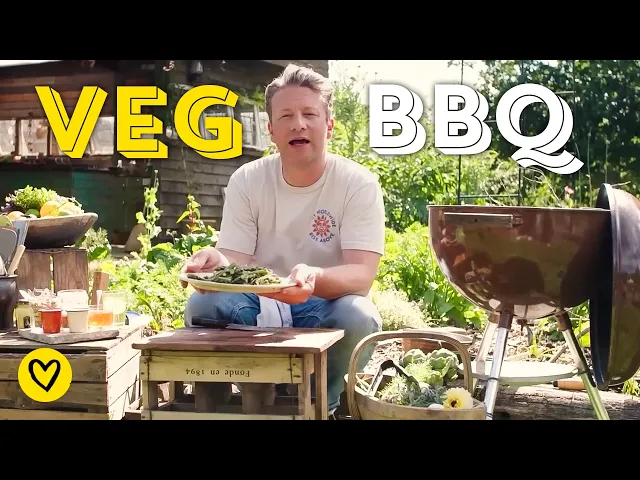
Cooking Veggies On The Barbecue | Jamie Oliver
Jamie Oliver
0:00 So, what I want to do for you guys is just get you thinking about veggies.
0:07 Often like the afterthought, often the little kicker,
0:11 but can we actually make veggie dishes that are as genuinely
0:16 scrumptious as other cool things happening on the barbecue like oberines,
0:21 asparagus, potatoes, carrots, all of that, you know,
0:24 can we make them utterly delicious?
0:26 So look in the world of barbecuing like you know when you light
0:30 a barbecue so I got that going like half an hour ago like
0:34 the kind of graph of heat kind of goes up like that then
0:38 it starts to subside and if you're lucky a nice hit of charcoal will
0:42 last about an hour and a half you know and you'll get
0:44 a good innings out of it and of course you can have more going
0:47 on the side and you can add to it but there's this natural
0:50 sort of half an hour before it's really a good temperature to grill meat.
0:54 It's too hot.
0:55 Unless it's tiny bits of thin meat that cook quickly.
0:59 Like the first half an hour, it's too angrily hot.
1:02 But that's really good for veg.
1:04 So, I've had a nice little wash up on this asparagus.
1:07 Have a look at the asparagus here.
1:10 Just beautiful.
1:10 So, let's do asparagus first.
1:12 I'm just going to grab a watch.
1:14 Uh, I'll do nothing to it.
1:16 We're going to go in dry.
1:18 Okay.
1:18 A lot of people I've seen it a lot.
1:20 People put oil over veggies and then they start barbecuing.
1:23 you start getting flames, the oils that you use start to degrade.
1:27 I don't want it.
1:28 If you go in dry, right,
1:30 what's going to happen is you're going to char the veg and you're going
1:34 to bring out a nutty quality that you are not going to see by frying,
1:39 steaming, boiling, roasting, right?
1:40 It's going to be a different flavor.
1:43 That's really exciting to me.
1:45 So, just literally throw the asparagus on the grill
1:48 and you're going to be good to go.
1:51 Look at that.
1:52 So, this is going to be mega.
1:54 All I want to do is make like a simple little French dressing.
1:59 Let's do it in here.
2:00 You can actually use like a bowl or a pestle mortar.
2:04 Um, let's just do basic like vinegarette style.
2:07 So, I'll take a little bit of Dijon mustard.
2:11 I'll take a fork.
2:13 Take a heat teaspoon of the Dijon.
2:17 Um the conversation to be had around the genius of a vinegarette is like quality
2:24 oil we'll take that and quality vinegar
2:28 like often I find that people don't understand
2:31 the importance of vinegar right so white
2:33 wine vinegar red wine vinegar that's good cider
2:36 vinegar cherry vinegar that's good and this is
2:38 a really kind of shallow thing to say
2:40 but I'm pretty much right all the time if you see in the supermarket or Delhi
2:44 an expensive vinegar if you can buy it because it will transform what you do
2:49 with veggies and salads and in the long run it will pay for itself because
2:52 it will make things that are very cheap
2:53 and good value like veggies really really delicious.
2:56 Right?
2:56 So normally when you pay for an expensive
2:59 vinegar it's going to be something extraordinary.
3:03 Right?
3:03 So they do things with barrels, herbs, all kinds.
3:08 So, and I collect vinegars.
3:10 And I know I sound boring right now, but you can either think I've gone mad,
3:14 which is highly possible, or maybe I'm right.
3:17 So, I'm using about four parts olive oil to one part vinegar.
3:25 Now, just as a little kind of thoughtfulness
3:28 that might help you in your world of cooking,
3:31 whenever I'm doing different veggie dishes or salads,
3:33 I'm not just looking at the different veggies.
3:36 I'm looking at the different oils and the different
3:39 vinegars or form of acid like lime, like orange, like lemon juice.
3:43 So, what I try and do is take a veggie and take
3:48 a specific vinegar and then if I go to another veggie,
3:51 I'll use another vinegar or citrus, right?
3:53 So, I'm just amplifying how different this veggie is from the next.
3:57 And the theory is if you do that with things like herbs as well,
4:02 then as you're eating at a dinner table,
4:05 right, everything tastes perfectly unique and wonderful and sort
4:07 of levitates in its own sort of beautiful flavors.
4:10 I don't know if that makes sense, but that's what I do all the time.
4:15 So that's why I collect vinegars, red wine vinegars,
4:18 cherry vinegars, champagne vinegars, um flavored vinegars, herb vinegars.
4:23 So look, I'm just turning these asparagus.
4:26 You can see they're getting charred.
4:28 and just let them crackle and char.
4:32 So have a taste.
4:34 Salt and pepper.
4:37 If your vinegarette is a little sort of on the sour side,
4:43 just a little honey is a beautiful thing just to balance.
4:47 And there you go.
4:49 That's beautiful.
4:50 there.
4:50 So now what I'm going to do is take
4:54 the asparagus and just pop it on the board like this.
5:02 It's interesting.
5:03 Asparagus is very, very delicate and rightfully so.
5:07 It should be treated with respect and love.
5:10 It's so special.
5:11 But often it's steamed or boiled,
5:14 which is very gentle and brings out the natural sweetness.
5:17 But by charring it, what you get is something [music]
5:21 that is kind of blistered and charred and it feels aggressive, right?
5:26 But because it hasn't been diluted by water,
5:30 you've got this incredible nutty expression of asparagus
5:33 that is unusually elegant through brutal heat.
5:36 Right?
5:36 So, what I'm going to do is just take the asparagus, line them up a little bit.
5:43 I might just slice up some of the stalks just
5:48 at an angle for no reason just to kind of break it down.
5:54 And then I've got this lovely vinegarette.
5:56 Experiment with different mustards.
5:58 Experiment with different vinegars.
6:01 Experiment with, you know, uh,
6:04 honey or, you know, maple syrup or different herbs.
6:09 And then I would just dress it like a normal salad.
6:15 So as soon as you dress it, then you're kind of rehydrating the asparagus.
6:20 So it goes from something that's kind of quite dehydrated
6:24 and charred to something that's starting to shine and look beautiful.
6:28 [music] Now if you try it.
6:37 Oh, it's just so sweet, so natural.
6:39 The smoke and char is subtle.
6:42 Actually, it's [music] really subtle.
6:43 So, this on a plate is truly a thing of joy.
6:48 So, pick it up.
6:49 Look at the colors.
6:50 Look at the colors.
6:52 I'm hemmed in a little corner here.
6:55 But literally, I couldn't be happier.
6:58 This for me is my happy place.
7:01 And I think that's like just being outside cooking, having a little base camp.
7:08 Such a beautiful thing.
7:09 [music] This is honestly what cooking is all about.
7:13 Just take some of that lovely vinegarette.
7:17 Finally, slice [music] some chives.
7:19 Subtle oniony vibes, but really subtle.
7:22 [music] And then just a scattering of those chives is going to be joyful.
7:28 And actually, what I've got, let's have a little look here.
7:31 Got some chive little chive flowers.
7:33 Where did they go?
7:34 Oh, here they are.
7:38 Look at these.
7:39 These are really nice.
7:41 So, these are small ones, but you get massive ones.
7:45 And you just literally pinch [music] it at the top like that.
7:48 And then you just sprinkle them on top.
7:50 And just look at that in the sunlight.
7:53 It's just so beautiful.
7:56 And why would I do it?
7:57 It's not just to look pretty, by the way.
7:59 Like, chai flowers are really mild and really sweet.
8:02 Like a wicked little expression.
8:04 But that is amazing.
8:07 So that in its own right, I think is a beautiful thing.
8:10 So first up, grilled asparagus
8:13 with a beautiful vinegarette dressing and flouring chives.
8:18 Right, one down.
8:21 So here we got broad beans, which are a fantastic bean.
8:26 And if you look here, if I just open up, it's the most wonderful place to live.
8:34 I wish that my bed was like this.
8:36 It is so soft and gorgeous.
8:39 And those broad beans are so sweet and fresh and delicious.
8:43 So, [music] funny enough, when they're small like this, actually,
8:46 you can eat the whole thing.
8:48 No one really knows that.
8:50 And if you slice them up with lemon juice,
8:53 olive oil, salt, maybe a bit of chili,
8:55 definitely some salty cheese, like pecorino,
8:57 parmesan, that sort of vibe, it's heaven.
9:00 The beans are heaven.
9:02 As they get bigger, obviously they get bigger,
9:05 but the outer skin gets [music] a bit more leathery,
9:08 so sometimes people peel them.
9:10 But of course, this is the excitement about growing your own stuff, right?
9:15 [music] Really easy to grow, um, super nutritious, but when you grow things,
9:18 [music] you get them in all of their forms.
9:21 Normally, when you go to a farmers market or a supermarket,
9:24 why would they want to sell you something small and [music] genius?
9:27 Because they can sell it to you three times the size, right?
9:30 and then they've got more weight and then
9:31 they can charge you for more weight, right?
9:33 So, when you grow your own things, you get to learn things like,
9:36 you know, [music] being able to eat the whole thing when you think you can't.
9:40 You get them really small, medium, large.
9:42 Even when they're over large and they're kind of getting woolly,
9:45 they have a different quality.
9:47 So, look, we're doing ever so well in no time at all.
9:51 Look at this.
9:52 Just look at that.
9:55 It's just exciting.
9:56 And when I had my first tiny flat in London, [music] I had the tiniest garden.
10:04 And guess what?
10:05 I grew in it.
10:06 Salads, simple veggies.
10:07 When I didn't have a back garden,
10:10 I still grew in my flat on the windows in window boxes.
10:13 I think it doesn't matter how old or young you are.
10:16 It doesn't matter where you are.
10:17 But look at that.
10:18 Gorgeous.
10:22 Next.
10:23 Let's be brutal again.
10:25 Yeah, let's get brutal.
10:27 So, what we have here is broad beans.
10:32 Often, maybe dare I say it, nearly always, um,
10:38 these are potted and steamed or boiled or brazed or stewed.
10:42 Um, not often are you going to see it flung with disrespect onto a barbecue.
10:48 Burnt, dare I say it, within an inch of its life on a barbecue.
10:54 So, uh, this is cool.
10:56 Think edamami beans uh in a Japanese restaurant.
10:59 Um think um sort of smoky scoldiness.
11:03 Think inside.
11:04 Remember where those broad beans were, which is such a kind of cuddly
11:09 little sleeping bag protecting those precious broad beans.
11:12 Like in there's moisture.
11:13 So you don't need any water to steam.
11:16 We're going to steam on a barbecue when that heat
11:19 is so aggressive and it's going to burn chicken, right?
11:22 like this is going to be amazing for burning the broad beans.
11:26 So, this is a wicked little idea.
11:29 So, as that is joyfully burning,
11:31 um I want to show you another little vibe that I
11:36 think might arm you with deliciousness and and cunning little tricks.
11:40 So, in my little pestle here,
11:42 I'm just going to give it a little wash out in my little camp setup.
11:49 So, pestle and mortar.
11:50 If you haven't got one, uh,
11:53 if you seriously believe that you're going to be cooking any time in your life,
11:58 um, get yourself pestle and mortar.
12:00 This old school rock on rock.
12:04 This is about flavor, marinades, flavored sugars, and today flavored salts.
12:08 Right.
12:09 So, over there, what have we got?
12:11 Just so we got logic and like, not that I'm right,
12:14 but like just so you can see how I'm
12:16 thinking so you can do your version of the same.
12:18 So inside these little things, we are steaming sweet, precious broad beans.
12:24 Gorgeous.
12:25 So let's contrast that.
12:27 So um let's be, you know, in the spirit of Japanese and wasabi and heat, maybe.
12:33 Let's let's use some chili.
12:35 I like that.
12:36 I'm down.
12:37 So let's make a flavored salt.
12:39 Flavored salts often don't get done or talked about, right?
12:42 So what can we do?
12:43 You can take a herb, say mint, bash it up just a little bit,
12:47 make a little sludge, then put salt through it.
12:49 D, put it on a tray, dry it out, crack it up.
12:52 Then you got mint flavored salt.
12:54 Same with thyme, same with rosemary, same with bay, right?
12:56 You could do lemon zest and rosemary, right?
12:59 Bash it up, salt goes in G on a tray, dry it out, crack it up in a jar.
13:05 You know, it'll last for months.
13:07 The flavor of citrus and rosemary, like make up your own combos.
13:12 There's no right, there's no wrong.
13:14 Let's think.
13:15 Okay.
13:16 Chili.
13:16 Um, I'm going to just pop that in here like that.
13:21 Pick a herb.
13:24 I'm going to go rosemary.
13:25 Think it'll be nice.
13:27 Chili and rosemary.
13:28 It could be basil.
13:29 It could be something else.
13:31 Take a little bit of my garlic.
13:35 Just a little bit.
13:37 So, garlicky rosemary salt.
13:39 That's what we're going to make.
13:45 So, rock on rock.
13:46 We're just bruising and bashing.
13:49 This is This is going to be great.
13:52 We'll take a little lemon zest as well.
13:55 Citrus works really well with flavored salt.
13:58 We're going to take some salt, put a wedge in first,
14:03 and that creates a little bit of abrasion so
14:06 that we can really start pumping out this flavor.
14:11 So you can see that little bit of salt has kind of been absorbed now.
14:14 Now I'm going to put like a couple of handfuls in.
14:17 So this is a nice little job.
14:18 Uh you're going to see now as I muddle.
14:20 So I'm going from bashing to muddling.
14:22 Right.
14:23 This is going to make a big batch of salt.
14:26 Right.
14:26 So it's a job that takes How long did that take?
14:28 Like a minute and a half.
14:30 Right.
14:30 So look, once you've bashed it up,
14:31 [music] what I do is put it into a little tray like this.
14:35 Right.
14:36 And I'll keep some of it back.
14:38 But this here, shake it into one layer and that will dry in a couple of hours.
14:45 So look, that is a batch of beautiful flavored salt, chili, lemon, and rosemary.
14:50 It's going to be delicious.
14:51 I've got a nice little wge of salt here, ready for Where did they go?
14:58 Here you go.
15:00 These grilled broad beans.
15:02 Look at these gnarly and burnt.
15:05 You're not going to eat the outside, right?
15:08 those protected beans are on the inside.
15:10 But just like those little edomami beans, right,
15:14 when you give them just a little drizzle of some nice oil, right?
15:21 Uh we're going to put the salt on there.
15:24 Obviously, it's chili, so if you're sensitive,
15:27 you can put gloves on, but that ain't me cuz I'm tough.
15:31 Um toss it up.
15:34 You could do a whole board of these, right?
15:37 and just have on there couple of cold beers
15:39 and it's a whole kind of it's a whole thing.
15:42 I I I just love it.
15:44 And of course, you grab one and you just open up that little beautiful beam.
15:50 Look in here.
15:51 Look, look.
15:53 Just And inside you've got this perfectly steamed, beautiful bean,
15:57 but just by touching it, you've got salt in your hand.
16:03 So then when you eat it, it's perfectly seasoned.
16:08 Absolutely flipping delicious.
16:12 Again, brutal heat and pure elegance here.
16:20 Salt, lemon, wah, chili.
16:24 So, second little [music] recipe done, tossed up.
16:32 So, there you go.
16:35 Beautiful broad beans.
16:39 I can hear my kids.
16:41 It's one of my little ones birthday today,
16:46 so there's going to be exciting kids running around for sure.
16:50 How beautiful is that?
16:55 And there is my beautiful chili, rosemary, and lemon salt braw beans.
17:02 different but utterly delicious.
17:12 These are potatoes.
17:13 I got quite a lot of potatoes this year.
17:15 Um [music] um when they start to flower like this, this is
17:17 a good sign that they're going to be good to pull up.
17:21 Um I'm normally very impatient.
17:22 Come over here.
17:24 Um this is very very exciting.
17:26 So I've already been getting into this.
17:28 Um these are a purple variety.
17:31 And let's just pull them up.
17:37 Look at these.
17:39 So, you can kind of see what's going on here.
17:44 You got big ones, small ones.
17:47 Um, I mean, if you were super sort of geeky and you had the time,
17:51 you you'd kind of go borrowing and you
17:53 just click off the big ones and you'd leave
17:55 the little ones still attached and then you come
17:57 back a week later and you take these ones.
17:59 [music] But, I think life's a bit short.
18:01 Um, so I won't be doing that.
18:02 But basically, that is our potatoes.
18:04 Look at the color of that.
18:06 And they're so fresh.
18:07 If I just push the skin, can you see how that skin just comes off?
18:11 That, my friend, is heaven.
18:13 Look at the color.
18:14 And this color should be telling you that it's,
18:18 you know, nutritious, full of vitamin C.
18:20 Look at that.
18:22 Right.
18:22 Beautiful potatoes.
18:23 Where are we going next?
18:25 Okay, so let's just talk about potatoes.
18:31 Um, so many things to love about spuds.
18:35 Um, roasted, amazing.
18:36 French fries, amazing.
18:38 Um, boiled, I love it.
18:43 But grilled, not really talked about very often.
18:46 And actually, you can kind of get some vibes
18:50 around the same area as a French fry without question.
18:53 um when you're leaving skin on and you're using
18:56 dry heat like this that's aggressive uh you get
18:59 a nuttiness or a true flavor of potato that maybe
19:02 like we haven't had very often like it's really interesting.
19:06 So if it's small potentially we'll just cut it in half like that.
19:12 If it's big we'll go lengthwise and we'll do like a centimeter slice like that.
19:19 You can go thinner, but I think you want a nice bite.
19:25 I'm going to go on dry again.
19:27 And then we dress with flavors and oils and citrus and herbs that's alive.
19:32 Right, we do that after, not on there.
19:35 You don't need any oil.
19:37 That the starchiness kind of creates a lovely crust which is quite satisfying.
19:40 Now, we've only started grilling, but let's have a little check.
19:44 Can you see how lovely and blistery and gorgeous and dry that is?
19:48 So this is a really good thing if you do get
19:51 the odd potato like this one here is a bit overcharred, right?
19:56 So I would say that's that's overcharred.
19:58 Okay, but a little bit like when you burn your toast in the morning,
20:02 what you can do is scrape it off and save the day.
20:07 But it happens.
20:08 So it's good to to know that we're looking good.
20:15 Okay.
20:15 So, how are we going to bring this story together?
20:18 So, I'm thinking lemon.
20:20 Um, I think with lemon, what we've got for free is, well,
20:24 not for free, but what we often miss is the [music] zest.
20:27 So, a fine grater.
20:28 You can use the side of a normal standard square box grater.
20:31 And just take that lemony part off.
20:33 So, we know lemon, you know, salt and vinegar, right, with chips works.
20:37 So, instead of vinegar, we're going to go lemon.
20:41 So, we're going to have it in two forms.
20:43 We'll have it in the juice form and we'll have it in the zest form.
20:48 Good olive oil, extra virgin olive oil.
20:50 So obviously extravirgin olive oil, heart healthy, super delicious.
20:54 You know, it's great.
20:55 Like respect that.
20:56 But if you think about it as a kind of just as a sort of thoughtfulness,
20:59 um you know, we love French fries, all of us do.
21:03 But often like the association with un you know,
21:06 saturated [music] fats and unhealthy and deep frying
21:08 like that's that you can't ignore that, right?
21:11 So, we're going from a situation where an enjoyable
21:14 potato or spud is deep fried and we love it.
21:17 But this is now grilled.
21:19 So, we're doing a hyper potato flavor.
21:21 It's kind of interesting.
21:23 But what we're going to do is drizzle it in a good oil that's heart healthy,
21:28 uh, that's good for you, right?
21:30 And you wouldn't cook like a chicken leg on here.
21:32 It's too hot.
21:33 It would flame up and it would just be out of control
21:35 and it'll be looking good on the outside and raw on the inside, right?
21:38 So, we're still using that kind of golden
21:40 half an hour of super high temperature,
21:42 which is often unrealistic for lots of cuts of meat,
21:45 but we're kind of able to sort of I'm not going to say dry fry,
21:52 but dry toast these spuds.
21:54 And they're looking amazing.
21:57 Like, I think that was like 12 minutes of cooking, but it could be 15,
22:00 it could be 10 depending on how thin your potato is and how hot your coals are.
22:05 Have a look.
22:07 See?
22:07 So fluffy on the inside, crispy on the outside.
22:11 It ain't no joke.
22:13 Right.
22:13 So at this stage now on the board, so that's when I would just give it a nice
22:18 little drizzle of good quality extra virgin olive oil.
22:21 Right.
22:22 So we're going from the realms of deep fat frying,
22:24 which is considered unhealthy saturated fats,
22:26 to healthy oils and fats with olive oil.
22:29 Um that's really good for you.
22:32 Hit it with the lemon zest, with some lemon juice and some salt and some pepper.
22:45 And if you have a fine eye for the cute guy,
22:51 I have picked some borage flowers for absolutely
22:55 no logical reason other than to look fancy.
23:00 It will actually add a flower, not flour.
23:02 It will add a flavor,
23:04 but it's more like having fun with it and saying, "Hello, I'm a bit different.
23:10 I'm not your normal potato salad." And edible flowers like violas,
23:17 you know, marry golds.
23:21 You know, you might think there's no point in this.
23:23 There is.
23:24 There's always a point.
23:25 There's a point in everything.
23:26 Look, we got little little time flowers here.
23:29 We'll have that.
23:31 Um, we got some sage flowers.
23:32 Like at this time of year when herb flowers are around, like use them.
23:37 Um, they're fantastic.
23:38 But what you're going to get is something a bit surprising.
23:43 So, let's have a little try.
23:47 So, this one here has got my name [music] on it.
23:52 Olive oily salty lemony.
24:03 So good.
24:04 Honestly, if you've never done it, try it.
24:09 Utterly, utterly delicious.
24:11 This is my grilled and dressed up potatoes with lemon,
24:17 olive oil, salt, and pepper, and fancy flowers.
24:22 Come on.
24:24 Tell me that's not [music] a beautiful plate.
24:27 That will get people talking.
24:29 I love it.
24:34 So, this is one of my favorite worlds,
24:38 possibly one of the most misunderstood veggies.
24:43 This is an artich choke patch, mate.
24:46 It's epic.
24:47 Okay, first of all, regardless of what size garden you got, it don't matter.
24:52 If you go and buy artichokes in a shop,
24:55 if you can find them, they're expensive, right?
24:58 To grow them, cheap as chips.
25:00 Effort low.
25:01 They look incredible.
25:02 They come back year after year, right?
25:04 So, they're a perennial uh plant.
25:06 So, look at this.
25:08 Um when they're this size, which is just under the size of a tennis ball,
25:13 um there's a whole world of recipes you can do.
25:16 Um if they're small like this, you can [music] do all kinds of different ones.
25:22 You can grow them that big.
25:24 And they all kind of give you different
25:25 things to [music] like would you slice them?
25:27 Would you have them raw?
25:28 Like when they're this size, they haven't got a choke, artich choke.
25:31 So the choke is the flowery part.
25:33 [music] It's not poisonous or anything, but it's not that edible.
25:36 But when they're this small, they don't have one.
25:38 So that's cool.
25:38 When they get big, they do.
25:40 So then you pull the choke out and you stuff it with beautiful things.
25:44 So there's a whole world of recipes to do with this.
25:47 Most people, certainly in the UK, don't know what to do [music] with them
25:51 because they need to learn how to prep them.
25:53 I'm going to teach you how to prep them.
25:56 This is so cool.
25:57 And you can see they're just like cut and come again.
26:00 There's going to be loads more of these.
26:03 So, definitely have a go at growing those.
26:06 You won't regret it.
26:13 Last but not least, it's time for the underdog.
26:17 the artich choke.
26:18 Now, this is a nice one.
26:21 So, a lot of people don't know what to do with these.
26:23 There's many things you can do with it.
26:25 Let me just kind of let's just get on with it.
26:28 So, to prep an artich choke, it's obviously a flower.
26:31 We have a stalk that's often edible.
26:33 And we got the flower here that could have a choke.
26:36 These are so small that it probably won't have one.
26:38 What I'm going to do is just brutally grab like
26:41 two or three layers in the little leaves here like that.
26:45 pull it off and let's prep this up.
26:49 So, pull it off.
26:50 These are not edible, right?
26:51 We're going to pull it to the leaves that haven't seen as much sunlight.
26:55 Therefore, they're not as fibrous.
26:56 Therefore, they're more edible and therefore they're more delicate.
26:59 So, can you see how [music] I've pulled back the leaves?
27:02 So, when it goes from deep green to the light kind of yellowy color,
27:07 the yellowy color means tender.
27:08 So, now about one inch from the base of the flower here,
27:11 I'm going to cut that off.
27:13 Right?
27:13 And what we're going to end up with is the top of this artich choke.
27:16 I will rub it with lemon juice.
27:17 If you don't, it will discolor and go black.
27:20 Okay.
27:21 Then I'll go to the stalk and cut about 2 in from the base.
27:25 Then I'll grab a little speed peeler or a knife
27:29 and I'll just peel that edge of the artich choke like this.
27:36 Now, as soon as you've done that, we're going to rub
27:38 that with lemon juice again to stop it going black.
27:40 Right.
27:40 So, that's the first one done.
27:42 Right.
27:43 So that was peeling, cutting, [music] and speed peeling.
27:45 Now if I cut in to this artich choke like that, let's look inside.
27:51 Let's rub it with lemon again.
27:54 You can see actually there is uh a big enough choke for me to remove it.
27:58 So you can see the line of the choke is here.
28:00 So I just take a little knife and I run that at the base like that.
28:04 You don't want to cut into the choke,
28:06 but you do want to [music] remove the little furry bits.
28:08 They're not poisonous.
28:09 They're not bad for you.
28:10 They're just not particularly edible.
28:12 So with a little cut out and a drizzle of lemon juice,
28:16 this again is ready and raring to go.
28:18 So what we can do now is keep [music] this as a whole or put it into quarters.
28:23 Every time you cut the artichoke, we're going to rub it with lemon juice.
28:29 We're going to grill them today cuz this is all about
28:32 that dry heat that helps you amplify the natural flavors of veggies.
28:36 I think hopefully this is something that you might
28:38 be picking up on like the natural flavors Obviously,
28:41 when you're boiling [music] things,
28:43 you can smell it and also if you taste the water, it's quite tasty, right?
28:48 That's because you're losing flavor and potentially nutrition as well.
28:51 So, by cooking in this manner, [music] you're retaining flavor and nutrition.
28:54 So, it's a kind of clever way to cook.
28:58 So, this one I'll prep up, prep up, peel it back.
29:04 I'm keeping an eye on that as I'm grilling.
29:10 If you ever go to the markets in Rome where they're very good at artich chokes,
29:15 there's incredible ladies normally that just use a knife to do all of this.
29:19 And they do it so effortlessly and beautifully.
29:22 So, I'm going to cut this into quarters.
29:29 Cut the choke out.
29:30 Of course, the easiest way to prep them is
29:33 just to boil them and kind of deconstruct them.
29:37 do an autopsy on a plate and have it with salt and butter.
29:42 Beautiful.
29:43 But you know, today is all about fire and the barbecue.
29:47 Look at these tiny ones.
29:49 I love it.
29:51 Okay, so let's do something beautiful.
29:54 Let's go in with a little salt here.
29:59 I'm going to take a herb.
30:02 And this herb will be thyme.
30:04 I'm going to big up thyme.
30:06 a woody herb, but actually one that's often underloved and under respected.
30:11 So you can get lemon thyme, orange thyme,
30:15 variegated thymes, all kinds of beautiful thymes.
30:18 So I'm going to go in with some thyme.
30:20 Get it off the stalk if you can.
30:24 Bash it up like like a teaspoon of time.
30:27 This is the genius of cooking.
30:28 A little goes a long way.
30:32 So, you kind of like bash up the thyme to almost back to cellulose, right?
30:36 And then we're going to go in with good oil.
30:40 Um, I'm going to go in with citrus.
30:42 What I was going to do, but I forgot was actually cut a lemon in half and burn
30:49 it cut side down to start caramelizing the sugars in the lemon.
30:55 I forgot to do it, but it's a good vibe.
30:57 So, you get sweet and sour then.
30:59 So, we're going to go in with the thyme,
31:02 lemon juice, and we've got salt already.
31:05 We're going to really be a bit more generous with honey.
31:10 So, we're in the south of Italy, possibly Arabic influences, right?
31:16 So, honey, herb, olive oil, almonds, right?
31:22 We've cooked these beautiful artichokes.
31:26 They'll be soft on the inside.
31:30 Have a taste.
31:32 Balance.
31:32 Bit more lemon.
31:34 And that's now going to be a sublime dressing, right, for these artich chokes.
31:43 Now, you could use this for any lovely veggies.
31:47 So, we'll take these kind of gnarly artichokes.
31:50 Look at them.
31:52 And this method of cooking is is dehydrating them.
31:55 And of course, this dressing is rehydrating them.
31:57 So that's the logic and it's sizzling now.
32:00 So just have a little look at this first.
32:06 Very, very nice.
32:07 And then we're going to just toss it in that honey lemony dressing.
32:12 And like an old loofah in the bath
32:15 is going to rehydrate and just become like incredible.
32:17 Look at the shine now.
32:19 Right.
32:19 That's just delicious flavors happening there.
32:20 Just let it kind of percolate, marinate, do whatever you want.
32:25 Just diculate.
32:26 uh served with buffalo mozzarella, some lovely goats cheese,
32:29 um like squash it and sort of chop it and put it
32:33 on a little crustini or throw it through like a little kichi frittata mix.
32:38 Like that is the kind of like incredible
32:41 representation of of artich choke in my opinion.
32:44 So let's have another little taste.
32:48 Um, in that spirit of kind of south of Italy,
32:54 Sicily, Arabic vibes, pistachio is a thing.
32:57 So, I might go pistachio today instead of almonds.
33:00 And, uh, they're not roasted.
33:02 So, I'll just crack these.
33:05 Get that lovely green color.
33:08 The pistachios, some as a powder, some as a kind of crack, some as a whole.
33:14 Um, look, look at that.
33:17 It's looking good.
33:18 Let's Let's plate something up.
33:19 With so many plate choices, I just don't know what to do.
33:23 So, look.
33:24 Let's plate this up.
33:25 I'm going to put half on the plate like this.
33:29 Just some lovely little lovely fresh milky mozzarellas.
33:33 Bust those open.
33:34 Look at that.
33:36 And just pull those around the plate.
33:39 Look how gorgeous that nestle them in.
33:42 The fresh, the milky, the refreshing.
33:45 And it's nicer when they're cold and the artich chokes are warm.
33:49 This could be a share plate.
33:51 It could be a lovely starter.
33:52 And then I'm going to take the rest of these artich
33:55 chokes and just lay them in and [clears throat] around on top.
34:00 Just beautiful.
34:01 Right.
34:02 What I wanted to do in this little beautiful cookup, I've loved this.
34:07 Just sitting here cooking for me, cooking for you.
34:11 It's been such a joy.
34:12 Honestly, it's been a total pleasure.
34:14 Um, I mean, if anything, it's just like get outside and cook like a barbecue.
34:20 But really, what I wanted to give you was like,
34:22 it's not saying my way is the only way, cuz that's definitely not true.
34:26 But it's like the thoughtfulness of extracting
34:29 flavor and also the kind of challenge
34:31 for all the right reasons of like making veggies truly extraordinary like that.
34:35 You know, making a steak great is pretty easy.
34:37 Good chicken, great, good pork, you know, you can still mess it up,
34:41 but like it's kind of like it's all there.
34:42 [music] But with the veggies, you want to work with it and vibe with it.
34:46 And these little marinades, these little salts that I've made.
34:49 Look, look at this.
34:51 Over the top.
34:52 Come on.
34:53 Like people are going to go mad for this.
34:57 What is it?
34:57 What's the flavor?
34:58 Time.
34:58 What do you mean time?
35:00 Yeah.
35:00 You mean frumpy old time?
35:01 No.
35:02 No.
35:02 Elegant time.
35:02 Like we made this dressing like this.
35:04 [music] We got, you know, this time of year you got the flowers.
35:07 So like celebrate that.
35:08 I mean this for me is joyful.
35:10 And like if you take the mozzarella out of this equation,
35:13 [music] like if you cooked an amazing pork chop or battered out
35:17 like like a va scolop or a chicken breast and cooked it,
35:21 you know, on the grill and then put those marinated artich chokes
35:25 over it and finished it with some shaves of pecarino like like this.
35:31 This preparation is just the principle.
35:33 It's just the tip of the iceberg.
35:37 Look at that.
35:39 Finish with a little honey.
35:42 That's a dish, man.
35:44 Pistachios, thyme, honey, lemon, fragrant,
35:55 textural, soft, tender, surprising, exciting.
35:59 That with some milky mozzarella.
36:06 I love it.
36:07 Enjoy.
36:10 I'm going to give you the most beautiful recipe for skewered prawns.
36:13 I'm going to wrap them on skewers with smoky bacon.
36:15 And then in contrast to that, we're going to do a beautiful salad.
36:18 Refreshing with watermelon, feta, cucumber, herbs.
36:20 It's a really nice combo, guys.
36:23 So, let's do it.
36:24 First up, prawns.
36:25 So, what we can do is just take the heads off first.
36:28 So, I'll take all the heads off like that.
36:31 Really easy.
36:31 And you can just rattle through it super fast.
36:34 Then take all the shell off until the very end bit.
36:36 Lovely.
36:37 Now I want to show you how to butterfly them.
36:39 Get a knife and just run that carefully down the back.
36:42 Don't put pressure in.
36:44 And then once you've done that, you can get
36:45 the knife in and take that little vein out.
36:47 You have to be a little bit patient, but it's really easy to do.
36:50 And it allows the marinade to get inside
36:53 the prawns and make them even more delicious.
36:55 Now it's time for the marinade.
36:57 Really simple.
36:57 Get a little dish.
36:59 And then I'm going to get a lemon and some garlic.
37:02 Um, I want to use one of these little fine
37:04 grers just to get that lovely yellow lemony zest off.
37:08 I'll cut this in half.
37:11 So, the lemon juice will really flavor the prawns.
37:13 And then I've got the garlic here.
37:15 Now, what I like to do, just get like three or four cloves of garlic.
37:18 Skin on, no problem at all.
37:20 A nice little pinch of salt and a nice little pinch of pepper.
37:24 And then just give it a nice little bash.
37:28 And the skins will come off like that.
37:30 You just get rid of that.
37:31 Just smash up that garlic to a paste.
37:33 And then choose a herb.
37:35 It could be parsley, could be fennel, could be mint, whatever you want.
37:39 Basil.
37:39 Um, just tear that in there.
37:41 And we'll smash that in, too.
37:45 So, once you've bashed it all up, take it out,
37:47 put it into the little dish, pour over just a little bit of olive oil.
37:50 That is a lovely marinade sort of ready to kiss those prawns.
37:54 And because we've prepared them with such a lot of love,
37:56 that's going to get right in to all those little cuts you made.
38:00 And you can let those marinade for about half an hour,
38:02 but really just move it around so all that garlic and parsley gets everywhere.
38:06 Then what I want to do is get myself a nice skewer.
38:10 And I've got some smoky bacon.
38:12 Take a little bit of smoked bacon or panetta.
38:14 Put that on the end of our skewer.
38:17 Then get your prawn.
38:18 And you can almost put like two little bits like that.
38:21 And then you can put the panetta back and then you put the prawn.
38:24 So like you can just whack it on.
38:25 That's the truth of it.
38:27 But I quite like weaving on.
38:28 The bacon's going to protect the prawns from the brutal heat of the barbecue.
38:32 Kind of looks cool as well.
38:34 Look at that, man.
38:35 Just make sure it's not too compacted.
38:37 You want to let everything breathe,
38:39 not be too squashed in, cuz that will stop the heat.
38:41 Let me just have a little wipe down.
38:45 So, look, let me get ahead of the game with the salad.
38:48 We're going to do a watermelon and feta salad.
38:51 Let's cut these up.
38:52 Look at the color.
38:54 And then once I've done that, I'm just going to cut the outside off.
38:59 And then we'll do the next one.
39:01 Like that.
39:05 So once you've got your peeled watermelon,
39:07 we're just going to do lovely little sort of 1 cm slightly over slices,
39:12 1 and a half centimeters.
39:14 I want to simply slice these slices across 1 cm and then turn it the other way.
39:19 Kind of want to make it quite graphic and sort of like little mouthsized chunks.
39:24 So, we're going to use lemon again.
39:29 And then into that, some nice coldressed extra virgin olive oil.
39:33 To the party, just before we get going, I'll add some finely sliced red chili.
39:38 So, add as much as you like.
39:40 And then pick a herb.
39:41 Anything that you can chew and eat nicely goes in.
39:44 Just that fresh, fragrant, kind of irony hit is going to be good.
39:48 I'm just going to take half a red onion and we'll
39:53 just now mix it in to the rest of the herb leaves.
39:57 That lovely watermelon goes in.
39:59 So, let's put the skewers on.
40:00 Now, these will take about five or six minutes depending on the the heat here.
40:05 Now, let's get on to the next bit of our salad.
40:08 I've got these beautiful slices of feta.
40:10 I'll cut it into little slices.
40:12 In we go.
40:13 Look at the colors.
40:15 And then cucumber.
40:16 So, again, a centimeter slice.
40:18 So now just take a little time and pride in tossing this around.
40:23 Right, let's go and have a look at these little skewers.
40:28 Oh, come on.
40:29 Look at that.
40:30 You know, you want it to be golden and crisp.
40:33 When the bacon's crisp, the prawns are done.
40:35 And we've had 3 minutes on each side.
40:38 Come on, man.
40:39 Absolutely beautiful.
40:40 And I just serve it pretty much like that on the top.
40:44 Gorgeous.
40:44 And look at this point in the story.
40:46 You just have to grab that and just pull it straight off.
40:50 So look at that.
40:52 Let's have a try.