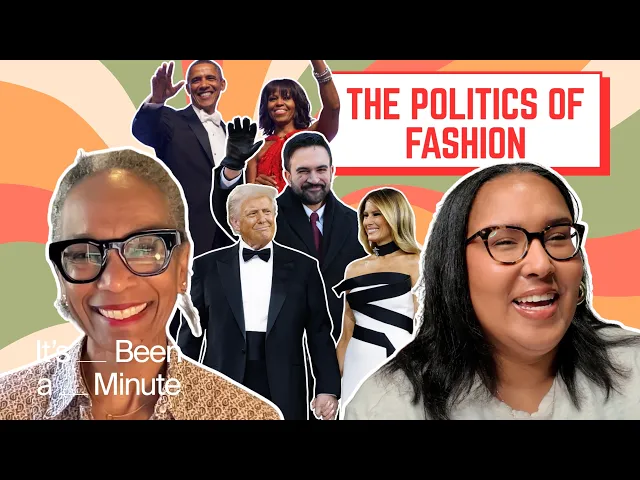
American fashion isn't as liberal as you think | It's Been A Minute
NPR Podcasts
0:00 Someone like the president like Donald Trump himself is
0:03 in some ways very particular about what he wears.
0:06 I mean it really feels like it is reminiscent of circa mid80s early
0:13 90s when he probably felt at his sort of best as a businessman.
0:21 And it's been written about a lot.
0:23 This idea that he not only hires people for his administration,
0:28 but he casts people for his administration.
0:31 He loves people who he thinks sort of look the part.
0:35 It's kind of communicating something about power.
0:40 Hello.
0:40 Hello.
0:41 I'm Britney Loose and you're listening to It's Been a Minute from NPR,
0:45 [music] a show about what's going on in culture
0:47 and why it doesn't happen by accident.
0:50 The relationship between politics and high fashion isn't new,
0:54 but something is definitely changing.
0:56 That's why it's been so curious to see the likes
0:58 of Lauren Sanchez and Jeff Bezos at [music] Paris Fashion Week,
1:02 or Brian Johnson and Clavicular walking the runway.
1:05 To unpack all this, I invited Pulitzer
1:07 Prizewinning critic Robin Gavon to the [music] show.
1:10 Robin has been an instrumental voice in fashion criticism for years.
1:15 Robin joins me to set the record straight about fashion's [music]
1:17 flirtation with politics and how we want our politicians to look.
1:22 Robin, welcome to It's Been a Minute.
1:24 Thank you very much for having me.
1:26 My pleasure.
1:27 My absolute pleasure.
1:28 Um, I'm a longtime reader, longtime fan.
1:32 I've been reading [laughter] you for like decades.
1:35 thinking broadly and kind of pulling out
1:37 to sort of the everyday person such as myself.
1:41 Um it seems like we all have this it seems like
1:45 that we're all sort of chasing this idea um both you
1:49 know myself as really a constituent and politicians and uh political
1:53 figures in terms of like how they want to present themselves.
1:57 like a lot of people are trying to sort of define or chase
2:00 what their idea of what power looks like um in fashion or in style.
2:06 Um it's funny like when on the campaign trail we
2:09 kind of hope that politicians kind of look like us.
2:11 Like I think about um uh you know when you see a figure who's
2:15 typically almost always in a suit like Zoran Miy the New York City mayor
2:19 or former President Barack Obama especially when
2:21 he was on the campaign trail you
2:22 want to see them with their sleeves rolled up and with the jacket off.
2:25 you want to see them pushing their tie over their shoulder so they
2:28 can eat some fried food at the Iowa State Fair or what have you.
2:31 Um, or you want to see them kind of dressed like Tim Walls,
2:34 whether he's in his camo or some, you know, a dad in plaid.
2:39 Like I think there's an expectation that we want
2:42 our politicians to look uh like us to a certain degree.
2:47 Um, I think about like how George W.
2:50 Bush would often be wearing his sort of like western wear.
2:53 uh that that image feels very associated with the idea that a lot of people
2:56 thought about him as like a guy you'd want to have a beer with.
2:59 Like we kind of on some level, at least when they're campaigning,
3:02 we want politicians to seem or look or dress like we do.
3:07 But then when they kind of like ascend to their elected role,
3:10 we also expect them to look like polished and professional.
3:13 And then of course still like even if you elect someone and you're you know
3:17 a reason why you they're in the public
3:19 eye um or have ascended to whatever post they're
3:22 ascending to we do endlessly kind of pick
3:25 them apart for their saratoral style choices in some
3:29 in some ways there are many ways they're fair and some ways they may be unfair.
3:31 I wonder what do we actually want our politicians to look like?
3:35 I mean, I think we want them to look like the best version of ourselves,
3:41 and that obviously means something different probably to to each person,
3:48 but I I think there's this element in which
3:51 you want them to be recognizable to you as someone that you feel that you
4:05 that as someone who sort of makes sense to you,
4:08 but I think at the same time we want them to be a bit better.
4:14 You want them to be more polished.
4:16 You want them to be to look a bit more professional.
4:20 You want them to look a bit more um you know sort of ready
4:25 to step into any environment and wanting
4:31 them to look comfortable in any environment.
4:35 And a lot of that is certainly the attire but it's also the way
4:40 that they move in the attire because there are people um you know you take you
4:46 know someone in a suit right I mean yes Zora Mandani wears a suit
4:52 but he also can wear that suit
4:55 and walk into a classroom of elementary school children
5:04 and be able to move in that suit
5:06 like get down on the floor and have
5:08 them climb all over him which we saw recently.
5:11 Yeah.
5:11 in in a way that shows you that, you know,
5:15 he is he's more than a suit that he is com
5:20 that he is able to sort of bring his entire self
5:25 um you know into that um into that space and I think that's sort
5:31 of the tricky part that you want someone who carries them in a way
5:36 themselves in a way that is a little bit um that that allows
5:43 him to stand out in the crowd but is also comfortable in the crowd.
5:51 You have long written about the intersection
5:53 of politics and style or politics and fashion.
5:56 I wonder what's a moment in fashion where a political figure wore
6:00 something or was styled in a way
6:03 that completely changed their public perception.
6:07 Honestly, I I would say two two things immediately popped in my mind.
6:13 The first one actually was I believe it
6:17 was Michelle Obama at the very last state dinner
6:21 uh that the uh Obama administration hosted and she
6:26 was wearing a Versace rose gold chain mail gown.
6:32 I remember it.
6:33 It was an incredibly glamorous gown,
6:38 but what was really striking was that it was chain mail,
6:41 which was sort of the Versace um uh the iconic
6:46 sort of material that the Versace brand was known for using.
6:51 And it was this moment when, at least for me,
6:54 it seemed to be that she had sort of fully leapt into the fashion universe
7:01 and no longer had even one foot in the universe of sort of first lady fashion.
7:09 The second one was Melania Trump and her um I don't really care.
7:16 Do you coach?
7:18 Oh, that jacket.
7:20 Yes.
7:20 Yes, that caused a lot of conversation.
7:25 It did.
7:26 And you know, she was on her way to, I believe, visit um children at the border.
7:34 And what was striking about it is
7:36 that she has always maintained that the message
7:39 was meant for the media and her sort of critics in um in the public space.
7:48 And even if I think you accept that at face value,
7:52 I think that someone who is in that position who decides that that is the way
7:57 that they want to respond to their critics
7:59 says a lot about uh their ability to be
8:04 be uh specific in who it is that they want to respond to versus just kind
8:12 of spraying anyone within in like eye distance
8:20 uh with their sort of anger and frustration.
8:26 Those are both two very very memorable moments in very different ways.
8:31 Um and they kind of represent I think some of the u I guess like two poles
8:38 of sort of political thought or even approach
8:42 to political dressing that we're going to get into today.
8:45 I mean, I have to say like more recently,
8:48 it feels like some key figures in American fashion have become more interested
8:52 in those on the right or at least
8:55 those who seem to be leaning more politically conservative.
8:59 Um, but specifically, I I'm thinking about Anna Winur.
9:03 Um, you know, photos from Lauren Sanchez and Jeff Bezos's wedding.
9:07 Um, you know, graced one of Winter's
9:09 last covers as editor-inchief of Vogue magazine.
9:13 And you know I I should still mention that she
9:16 is still um the global editorial director of American Vogue.
9:20 Um but to my memory you know at least in like
9:24 the last 15 to 20 years since I have been
9:26 paying a lot of attention to fashion um and how
9:30 it uh kind of mingles with politics at least in America.
9:34 Um much of the American fashion industry seems to have kind
9:38 of uh flocked toward or aligned themselves with um Democratic politicians.
9:45 Does that I'm wondering if that rings true
9:47 for you as somebody who's followed that really closely?
9:49 And and I wonder traditionally what has that relationship kind of look like?
9:53 You know, I mean it's it's funny.
9:55 I I think there is this perception that they've
9:59 always leaned towards Democratic politicians and but but in some
10:05 ways I would say that they have leaned more
10:08 towards um liberal ideas and [clears throat] progressive ideas.
10:15 But when it came to really sort of dressing and responding
10:19 to um sort of the players on both sides of the aisle,
10:23 I mean I would say that they were
10:26 relatively um sort of balanced in that approach.
10:29 There was little judgment.
10:31 I mean the first thing that comes to mind
10:33 for me is um the late Oscar Dearenta, right?
10:37 I mean he was that is who popped in my mind because he all
10:40 he he dressed Hillary Clinton and Laura Bush to my memory.
10:43 Exactly.
10:43 I mean he was someone who was really kind of known
10:46 for dressing first ladies and he happily dressed first ladies of both parties.
10:53 Um when I think about the some
10:55 of the politicians who have appeared in you know you
10:58 were talking about Anna Winter um in American Vogue
11:02 um you know they have included uh Cindy McCain and Condise Rice
11:09 and obviously you know Hillary Clinton and Michelle Obama.
11:12 So it hasn't really been this kind of party divide.
11:18 Um it has I think the ideals and sort
11:22 of the policies that the individuals in the industry
11:26 lean towards tend to be those that are more
11:30 um accepted by and promoted by the Democratic party.
11:34 But when it comes to sort of celebrating the politicians
11:37 or at least being interested in the politicians um that are out there,
11:42 they've been interested in in both of them.
11:44 I think it's only recently that we've seen that kind of tension.
11:51 Yeah.
11:51 I I mean I I mean you're absolutely right.
11:53 Like I I do want to say though, it is notable that like while Melania Trump
12:00 has been on the cover of American Vogue,
12:02 this was before she was a sitting first lady.
12:04 Since she's been a sitting first lady,
12:05 she has not been on the cover of Vogue magazine.
12:07 Before she was on the cover,
12:08 I believe with Donald Trump back in the 2000s when they got married.
12:12 Um this is
12:13 He wasn't on the cover.
12:14 She was on He wasn't on the cover, but she was on the cover.
12:16 Yes.
12:16 Yes.
12:16 Yes.
12:16 But the feature was about like them getting married.
12:18 Um, even though I think pretty much every sitting first lady,
12:23 at least to my memory, since at least Hillary Clinton has been
12:28 on the cover of Vogue magazine during her husband's tenure.
12:32 Um, it does feel notable that Melania Trump has not been
12:35 on the cover at any point in either of the two Trump administrations.
12:39 Um, and I suspect that part of that at least has to do with um,
12:44 and I think this is something important to mention that like
12:46 I don't want to tour is a long time and prominent um,
12:51 like uh, supporter and fundraiser for Democratic politicians at least.
12:56 Um, and she's maintained longtime relationships with, you know,
13:00 the Clintons and the Bidens and the Obamas.
13:04 Um, I think that that also kind of is at play here, too.
13:08 this kind of like absence of millennia during like it does feel like
13:11 to me at least maybe that could be an indicator that something has changed.
13:15 Well, you know, the sort of the the history of Vogue with first
13:19 ladies has always been that they have
13:22 always typically been photographed for the magazine,
13:25 but they've not always been on the cover.
13:26 You're right.
13:27 Hillary Clinton was the first one who was on the cover.
13:31 She was on the cover um I believe sort
13:34 of in the aftermath of the Monica Lewinsky Bill Clinton um kurfuffle.
13:43 Uh and uh and then after that Michelle Obama was
13:49 on the cover as you know this historical first lady.
13:53 I think because of that and because of the the real
13:57 sort of resonance that both of those covers
13:59 had um it sort of seemed like okay now we're we're kind of in this this um
14:05 tradition that first ladies are on the cover
14:08 but I remember Laura Bush being photographed for Vogue
14:12 and she was wearing um Oscar de Loretta and and she wasn't on the cover but she
14:19 she wasn't on the cover but she was in the magazine.
14:22 It was a big spread.
14:23 I remember I think she had like a navy gown or something like that.
14:26 It was a big deal.
14:27 Yes, that yes, that sounds right to me.
14:30 Um, you know, the first Trump administration
14:32 was so divisive going into that inauguration.
14:37 And you'll recall that there was a huge debate among
14:41 designers about whether or not they would quote unquote dress dress.
14:46 Yeah.
14:47 The first lady, I remember.
14:48 And you know, it was a real sticking
14:50 point because what this idea of dress dressing
14:54 the first lady really is about are you
14:57 going to make specific garments for the first lady?
15:01 Are you going to do one-offs?
15:03 Are you going to um you know alter things
15:06 that already exist in your collection for the first lady?
15:10 And as a result of a lot of that tension, uh, one,
15:14 Melania Trump sort of bought a lot of things just sort of off the rack.
15:20 And she also turned her attention to a lot of European designers,
15:24 which I think also sort of spoke to her sensibility um, sort of stylistically.
15:30 And that was a huge shift because typically we think of part of the role
15:35 of the first lady as is sort of the role
15:38 of any administration is to celebrate American brands,
15:44 American manufacturing, American artistry.
15:48 Yes.
15:48 I still remember from the first Obama inauguration what a big deal it
15:52 was that Michelle Obama wore this like white uh Jason Woo gown which does
15:59 to your point it feels like a big contrast to like this very slinky
16:03 almost like liquidy rose gold Versace number
16:06 that she wore for the last state dinner.
16:07 They send almost completely different messages to a certain degree.
16:10 But that first gown that she wore um
16:13 in in the two at the 2009 like I think inaugural ball
16:17 um it definitely sent this message that felt like young
16:20 optimistic um and specifically optimistic
16:24 about um America and its possibilities.
16:28 And I think that that to me signaled to the fashion
16:31 industry who had already done I think like I remember fashion designers
16:34 make like designing um sort of exclusive like Obama campaign merchandise
16:39 and selling that on the website um as like a way of fundraising.
16:42 But like it to me it signaled that she wanted to have a relationship
16:44 or that there was going to be relationship between her and American designers.
16:48 And that lasted I mean that lasted for like eight years straight.
16:53 Um and in some ways you know it could be said continues to this day.
16:57 It was also a really interesting moment in choosing someone like Jason
17:01 Woo because he was really in many ways kind of an untested designer.
17:06 I mean he was a very young designer.
17:08 His company was not that old.
17:11 Um he was um you know an immigrant.
17:14 I mean, yeah, a lot of the things at play there really kind of spoke to um
17:20 the kind of administration that um we were that was that that was being set up.
17:27 And the same was true about um the suit that she wore
17:31 at the swearing in which had been designed by um Isabelle Toledo.
17:36 Yeah, most of those designers were really like small independent brands.
17:42 And we talk a lot uh in the in the world of politics,
17:45 I mean, people talk a lot about um small business owners, right?
17:50 Everything is always about like what do small business owners have to say?
17:54 And I think a lot of people forget
17:57 that most American fashion brands are small businesses.
18:02 I mean, there's a few that are sort of these monolith, you know,
18:06 like um you know, like a Ralph Lauren, a billion dollar company,
18:10 but most of them were talking, you know, mediumsiz and sometimes, you know,
18:16 bubble gum and a prayer kinds of kinds [clears throat] of businesses.
18:21 And so that was a real reflection I think
18:23 of not just sort of aesthetics but also sort
18:27 of the way that about entrepreneurship and capitalism and sort
18:33 of the way that businesses are born in the US.
18:36 Oh certainly.
18:36 Did you see the Melania film?
18:38 I did.
18:39 Okay.
18:39 I did as well.
18:40 I did as well.
18:41 Fashion was such a big part.
18:42 It was such a big part of that film.
18:45 It was.
18:45 I mean, you absolutely get a sense of the care and the precision
18:50 that she applies to her wardrobe and to her um her public presentation.
18:58 What I thought was interesting though about the film
19:02 and about her approach to fashion is that, you know,
19:06 I I completely respect um [clears throat] you know,
19:09 someone's approach to fashion that is very much about the aesthetics of it.
19:14 And I think that is, at least for me, where her eye is focused.
19:20 I mean, there is a part of the film where you
19:23 see her really zeroing in on the collar of, you know,
19:28 this shirt that she's wearing underneath a coat.
19:32 And, you know, she's looking at it
19:34 and and she's concerned about sort of centimeters, millimeters really.
19:39 And, you know, and that is one point of view.
19:43 What I found interesting is that she was
19:46 seemed to be less interested in the narrative
19:49 and the stories that fashion can tell about um
19:54 the things that we think are important or the ways
19:58 in which we want to direct someone's attention um
20:02 sort of the the narratives that we want to tell
20:05 and you know I think she is very concerned
20:08 about the the images that will last in history
20:15 versus the the narratives that will last in history.
20:21 I want to kind of stick for a second with sort of how like Republican figures
20:26 on the right um kind of are communicating
20:30 or exploring their specific relationship to style right now.
20:33 Um I think about someone like the president like Donald Trump himself.
20:37 Um he is in some ways very particular about what he wears.
20:41 there's a certain type of shoe that he really likes to buy that he
20:44 prefers for from what I've heard um
20:47 through various reports um about his, you know,
20:50 about his cabinet and his and his colleagues that he's working with.
20:53 Um there's a certain type of shoe that he likes
20:54 to wear that he would prefer if his uh staff wore.
20:58 There are, you know,
21:00 he he kind of wears these um these suits that remind me of kind
21:05 of the fit of the suits that like my dad and his co-workers wore in the '9s.
21:09 Not to say that it's like necessarily an outdated fit.
21:11 It just feels very reminiscent of that time.
21:14 Um a time I think when a lot of people associated him Donald Trump with like
21:19 a power and opulence and possibly being kind
21:21 of at his height or approaching his height.
21:24 Um of like wealth, fame [snorts] in a pre-politic sense
21:29 u and relevance in a pre-politics in a pre-politic sense.
21:33 Um, and you know, he styles his hair a very specific way
21:37 and he his complexion looks a very specific way a lot of the time.
21:41 Um there even I think about someone like I don't know like Pete has said
21:45 a specific way Britney it's kind of like a there's volume there's
21:51 height um it has real structure it has [laughter]
21:55 real structure but there is a there's this kind
21:59 of I don't know I don't know if it's a brand of masculinity or a way of styling
22:04 um but even not even thinking not just about the men but about the women I mean
22:08 there was a whole like trend on social media,
22:12 the sort of conservative girl trend where, you know,
22:14 women were styling their hair and makeup
22:16 in a specific way that they felt mimicked how many
22:20 conservative women um whether they are public figures
22:23 or private figures that post online u on social media.
22:26 Like they were there's like a sort of teased kind of blown out hair um
22:32 and that might have a little bit of volume but perhaps not a ton of shine.
22:36 um a kind of chalky makeup appearance regardless of complexion tone.
22:41 Um and and very pronounced eye makeup.
22:45 Um but there does seem to be a kind of sensibility.
22:50 Um I wonder or or at least like there is an approach like a very
22:54 palpable approach to how to use style
22:57 and fashion as a means of communicating one's values.
23:00 Um I wonder what does that look like in the Trump era?
23:03 I I mean I I think there's there's there's a lot to unpack there.
23:08 Um you know I I I think first you know the disclaimer, right?
23:13 I mean there's no sort of Republican
23:17 style of dress versus Democratic style dress.
23:20 I mean, um, but I think that within sort
23:25 of the Republican world of sort of Trump supporters,
23:30 there are certain things that some of them tend to emphasize.
23:36 And I think one of those things um is the idea of the emphasis on gender
23:42 and very traditional classic stereotypical ideas of what
23:50 um femininity looks like and what masculinity looks like.
23:55 And I think you see that in the way as you were describing this, you know,
24:01 some of the the makeup and the hair and the eye the eye makeup in particular.
24:05 and
24:07 you know the big blown out hair and the um the brightly colored dresses that are
24:13 they kind of go against conventionally I
24:15 think what many people think of as beautiful
24:17 or pretty now even though they're kind of doing
24:20 the makeup and the hair to the max.
24:22 Well, I mean, I think it's leaning into a very sort of stereotypical um
24:28 you could say conservative oldfashioned a little
24:32 bit um notion of what femininity looks like.
24:38 And it's and it's very different from um the way
24:41 that sort of fashion has been presenting gender um in recent years,
24:47 which which is this idea that it's a it's much more malleable.
24:52 you're really borrowing and there's this sort of continuum um
24:55 as opposed to these two separate poles and I think you see
24:59 it in the way that masculinity is presented as well um
25:04 you know in with people like Hegath and uh RFK Jr.
25:09 and their like strange pull-up competitions and things like that.
25:13 All right.
25:14 or how Junior is working out in jeans which is
25:18 like are famously not comfortable to work out in but
25:20 also I have never met an anyone
25:22 on the planet who works out in jeans or [laughter]
25:26 their own um and then you know I think you also have a a president in Trump
25:31 who um it's been written about a lot this idea that he you know not only
25:37 um you know sort of hires people
25:40 for his administration but he casts people for his administration.
25:44 He loves people who he thinks sort of look the part
25:48 of whatever sort of role it is that, you know, he's filling.
25:54 And so he, you know, he wants his he um, you know,
25:58 people related to like the military to look like these sort of beefy,
26:05 muscular, superhero kinds of figures.
26:08 He wants them to look tough.
26:10 He likes guys, you know,
26:12 who have like full heads of silvery hair because, you know,
26:16 like all of these things where he
26:17 talks about like straight out of central casting.
26:21 And so I think that really comes into play when you have when when you
26:27 think about the people who have um
26:30 you know been very prominent in his administration.
26:34 someone like, you know, the dearly departed Christy Gnome um and the way
26:39 that she presented herself um with, you know,
26:44 sort of these like playing a character, you know,
26:47 putting on like the ice vests and putting on like the cowboy hats and
26:53 like all of these things that were very much
26:56 sort of playing uh using fashion as kind of costumeuming.
27:02 And then I would also just add, yeah,
27:05 Nick, you mentioned uh Trump's hair and like the makeup and all that.
27:10 And you know, there is sort of this old adage that people tend to sort of stick
27:16 with a look um as they get older that is
27:22 that reminds them of when they felt at their best, at their most prime.
27:28 And so I think when you look at the way that Trump comports himself,
27:33 dresses himself, it is this it is you you're correct.
27:39 I mean it really feels like it is reminiscent of circa mid80s early 90s
27:48 when he probably felt at his sort of uh best as a businessman
27:56 as a man about town in New York as the king
27:59 of New York and he has continued to use to to to style
28:07 himself in that same way uh regardless of changing times,
28:12 regardless of his own sort of changing like his his body changing,
28:16 his hair changing, all of that.
28:18 I mean, it is still that look.
28:21 That is such a good point.
28:22 I mean, that's kind of it's kind of communicating something about power really.
28:29 um what maybe he thinks power looks like when he felt perhaps at his most
28:34 powerful um and how he recognizes power in other people which I mean
28:39 well I think of sort of recognizing power recognizing um having
28:45 a particular view of what uh importance looks like having a particular view
28:52 of what beauty looks like um having a particular view of um
29:01 you know how he wants the people around him to reflect his sensibility.
29:09 Even though you know the hardest person for anyone
29:15 to really have a clear view of often is themselves.
29:20 And so I think when you kind of look at him and then you look
29:26 at the people that he surrounds himself
29:30 with, sometimes there's this disconnect that you see visually,
29:36 but I don't think that there's necessarily a disconnect in the way
29:40 that he sees himself fitting into that fitting into that lineup of people.
29:48 Hm.
29:49 Really?
29:50 Oh, sure.
29:51 I think he sees himself as, you know, this sort of vigorous ma macho guy.
29:58 I mean, I think that's how he um sees himself presenting.
30:04 You know, as we discussed, it's not necessarily there's it's not monolithic.
30:08 Um there's so many other ways,
30:11 even ways that might seem a little bit more sort of like youth forward.
30:17 um and very online, very digital.
30:22 Um I'm thinking about uh like Braden Peters, also known as Clavicular,
30:29 the controversial to say the least uh looks maxing influencer.
30:33 We've discussed him on this show before
30:35 and at this point I think a lot of people are aware of him um at least because
30:41 of a very interesting interview he did uh with CBS.
30:45 um he was kind of like bubbling.
30:47 He was beginning to crest with the mainstream I think when we discussed him
30:50 on the show a couple months ago and now he's definitely somebody but part
30:54 of like a major step or leap forward kind of like in his rise
30:58 was him walking the runway for a New York based designer named Elena.
31:04 And um you know she has a marketkedly
31:07 different aesthetic let's say than I think what
31:09 you might see if you're kind of scrolling
31:11 through the conservative girl makeup trend on social media.
31:14 Um but she has been deliberate embracing
31:18 a variety of controversial white right-wing figures.
31:22 Um you know whether it is you know having clvicular walk the runway
31:27 to having George Santos uh sit front row at that same fashion show.
31:32 Um there she has a very different look.
31:35 She's kind of associated with what people
31:37 refer to as like the dime square crowd.
31:39 She's taking a totally different tack.
31:41 Yeah.
31:41 I mean, I think, you know,
31:42 fashion is very good at um reflecting back at us what's going
31:48 on culturally and magnifying it to some
31:52 degree or magnifying different aspects of it.
31:57 Mhm.
31:56 There definitely are some sort of, you know,
31:59 conservative strands that are moving through um, you know, the fashion universe.
32:06 Um I mean there are the elements of um you know
32:10 as we were talking about sort of the hyper femininity and
32:14 the the machismo and the idea of um I mean I I mean I hate to use
32:21 the term looks maxing because it's oh it just seems like
32:27 you give something sad a term it's not supposed to be sad and I
32:34 don't know um But this idea of trying to um chisel your way and
32:44 or hammer your way hammer your way and um you know vitamin your way into some
32:53 kind of perceived idea of perfection I think is is is very sad.
33:00 And I don't know that that is to me that's not necessarily sort
33:04 of a conservative thing as much as it is a um terminally online kind of thing.
33:14 Um I I don't want to call it conservative
33:17 because there are definitely people who are conservative who
33:20 would look at some of that kind of let's
33:22 hear that kind of language and be appalled by it.
33:24 I mean that's sure beyond conservative that's into like some
33:31 kind of any anyway it's beyond conservative
33:34 and yeah I mean there definitely is this element of um having this idea
33:43 you know to go back to um the visual aspect of it having
33:47 this idea of what perfection is you know the Looks the looks maxers,
33:56 right, are quite specific about what they're aiming for.
34:02 And um what they're aiming for is a particular it is it is white.
34:10 It is chisel jaw.
34:13 It is um you know a very western white western European look.
34:23 That's interesting that you pull on that thread of like
34:25 at the end of the day there is this kind
34:27 of vein of perfectionism or like sort of what perfect beauty
34:32 or perfect masculinity um or perfect expression of femininity or whatever.
34:37 Um what that looks like.
34:40 Um and in some ways that does kind of line
34:42 up with how some people formulate their conservative politics.
34:47 um a narrow sort of a narrow so what someone may describe
34:52 as a narrow or um very specific set of what constitutes acceptable behavior,
34:58 how one should look, what constitutes what's acceptable in society.
35:03 Um, even thinking outside necessarily a Republican,
35:07 Democrat, just thinking about a conservative
35:11 uh conservatism more broadly does feel like it's kind of concerned
35:14 with um specificity and narrowing and kind of meeting a certain standard.
35:20 Yeah.
35:20 Well, I mean, as soon as you decide that there is um a singular ideal,
35:29 then you've automatically suggested that anyone who doesn't
35:35 the farther away from that ideal you are,
35:38 the less val that less perceived value you have.
35:44 When you start talking about sort of, you know,
35:47 the ideal physicality of someone,
35:51 well, then you're you're getting into very disturbing eugenics,
35:57 white supremacist kinds of categories.
36:01 That then of course opens up the all the questions of well, what is this ideal?
36:07 Who says it's it is the ideal?
36:10 Why is it the ideal?
36:12 What are we trying to say by declaring this the ideal?
36:16 And what are we trying to say about all of those people who don't meet it?
36:20 And you know, I think that's that's like the part
36:24 of the conversation that um sets people's teeth on edge
36:29 and says a lot of very distressing things about where we
36:36 are right now because it doesn't because that's not moving forward.
36:41 That's turning the clock backwards.
36:45 H [sighs and gasps] you know thinking about this current moment um in fashion
36:52 and kind of circling back to sort of where the fashion industry is at um
36:58 Anawanour's relationship to um the Bezos Sanchez couple has kind of taken
37:06 an interesting turn um not just from covering their wedding and putting
37:11 it on the cover of Vogue magazine um but you Honour has
37:15 been seen like you know at various fashion week events with the couple.
37:19 Um Law Roach has begun styling um Lauren Sanchez which has been kind
37:24 of an interesting turn of events and kind of different from I think how
37:29 um how do I put it like there the Bezos Sanchez couple's alignment
37:34 with or at least relationship to um
37:38 like the Trumps and the Trump administration.
37:40 I wouldn't I don't know that Jeff Bezos would say that they were best friends,
37:43 but the couple was um you know, they attended a lot of the couple's
37:47 like most important and key inauguration events.
37:51 Um if there isn't a strong relationship there, uh there is at least maybe
37:56 an attempt at a mutually beneficial relationship there.
37:59 And at least it seems like on perhaps
38:01 the Trump administration's end of things a desired relationship there.
38:04 you know, even though Bezos himself has
38:07 donated to both Democratic and Republican causes,
38:10 um Amazon's pack, like their political action committee
38:13 has donated primarily to Republican politicians and causes.
38:18 Um I wonder like, you know, and now too, you know,
38:21 Lawrence Sanchez and Jeff Bezos,
38:24 they are the primary donors for the 2026 Met Gala.
38:29 um which feels a little I don't know like sort of their prominent
38:34 featuring in um at least what's been communicated about the mechala thus far.
38:38 It does feel kind of notable to me um because this is also a year that like
38:42 you know Beyonce is going to be uh
38:45 I think like co-chairing or co-hosting the event.
38:48 It feels like a big step forward in kind of how at least Vogue,
38:53 the Vogue brand or Kanye Nask, if not the fashion industry more generally,
38:57 might be thinking about um their relationship to the kind
39:00 of power um and influence that a couple like that might wield.
39:05 And I guess I'm wondering like what is this kind
39:07 of like um growing alliance between Anow and the Bezos Sanchezes?
39:15 What might it tell us about fashion's
39:17 current or even desired relationship to power from a distance?
39:21 I think um the the biggest aspect of it is money, right?
39:29 I mean, the Met Gala is the
39:33 uh the key fundraiser for the costume institute and um
39:40 the the great moneyed crowd of the next generation of this generation,
39:49 you know, it's the tech people.
39:52 they are the the rising Rockefellers and Fords
39:57 and Carnegies and so forth and so on.
40:01 So I think some of it is just as simple as that like
40:05 that if you need to raise money you go to the people who have money.
40:10 I mean billionaires don't take this the wrong way
40:15 but I do think that there is an element of vulgarity.
40:20 Yeah.
40:20 And I think that some of this is sort of trying to cleanse it
40:26 a little bit to make it a little
40:27 less vulgar by attaching it to cultural institutions.
40:33 Um I think like a Robert Baron's library or something like that.
40:38 Yeah.
40:38 A a little bit.
40:39 I mean and and and I think some of it is also
40:43 just um it's it's a bright shiny high impact event and if you
40:51 have an interest in if fashion delights you then I completely see
40:57 why you would be enamored in wanting to be involved in that event.
41:02 And I think fashion delights at least Mrs.
41:06 Sanchez Bezos.
41:08 I see.
41:08 I don't know that it delights him all that much.
41:11 I cannot tell from the way that he dresses whether
41:13 he cares about [laughter] this sort of thing at all,
41:16 but definitely it does seem like she at least
41:18 is trying to communicate something about her image through fashion,
41:21 especially over the past year or so.
41:23 I tend to think that what she's communicating is just
41:26 I have a lot of money and I really like clothes.
41:30 I I'm getting that message loud and clear.
41:32 [laughter] Well, Robin, um I really appreciate this conversation and helping me
41:40 to unpack this moment that we're in right now,
41:43 uh at the intersection of style and politics, and I I honestly could not think
41:47 of a better person to have this conversation with.
41:49 So, thank you so much.
41:51 Oh, well, thank you.
41:52 I feel like we still have a trunkload of things that are like densely packed.
41:57 Well, that's why you have to come back.
41:58 You have to come back.
42:03 That was Pulitzer Prizewinning critic Robin Gavan.