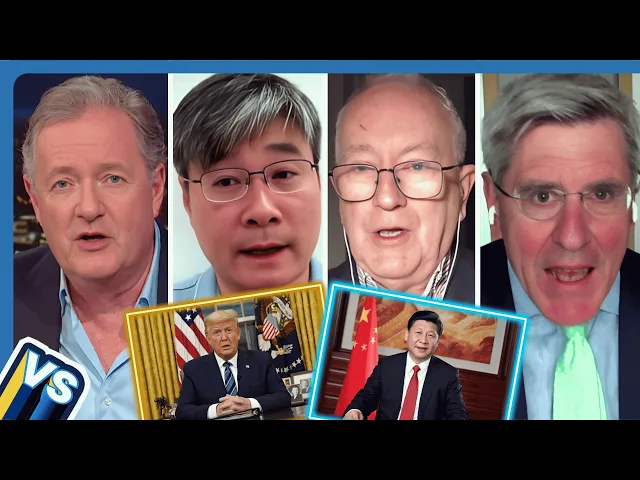
"Heading For A Global DEPRESSION!" Professor Jiang Debates Iran War, Trump And China Ties
Piers Morgan Uncensored
0:00 Are we heading for a global recession, do you think?
0:03 I think that we are heading towards a global depression.
0:05 I'm terrified.
0:06 People are not going to starve to death.
0:08 They're going to die of thirst.
0:09 Where is Russia?
0:10 Where are the Brits?
0:11 Where are the Chinese?
0:12 Where are the Europeans?
0:13 I think that's been a big problem for Trump is nobody seems to be helping.
0:17 If you want to get people to help you,
0:18 probably don't call them a bunch of morons
0:20 all the time would be my starting point.
0:22 It seems like you all can't determine who's
0:24 the good guy here and here who's the evil.
0:26 You're the bad guy for God's sake.
0:28 Yeah, exactly.
0:29 I mean, that's my point.
0:30 Okay.
0:30 If you can't realize that America is the evil empire here,
0:34 we're saying the the United States is the evil empire.
0:37 Yes.
0:37 Stop reading Hollywood scripts and realize which planet you're on.
0:40 Okay.
0:40 But if we're the evil empire,
0:41 why is it every immigrant in the world wants to come to the United States?
0:45 Nobody wants to go there now, mate.
0:49 This is a serious warning, announced the IRGC after firing at a US warship.
0:53 Australia Hormuse remains closed.
0:56 to the 100mile choke point along Iran's southern
0:58 border has become the regime's most powerful weapon.
1:01 Clearly, the United States has no military solution for opening it.
1:04 And while President Trump may boast that the US
1:06 doesn't need the straight rocketing gas prices,
1:09 the spiking inflation say otherwise.
1:11 Recent polls show that voters now trust Democrats more than
1:14 Republicans on the economy for the first time in 16 years.
1:17 The fact is that oil trades in a global market.
1:20 That means Americans will pay the price just like the rest of us.
1:23 And while the White House has promised
1:25 immediate relief as soon as the straight reopens,
1:28 most experts say the economic chaos will reign for months or worse.
1:32 So, how bad could it all get?
1:34 Well, one of my guests today is warning of everything from recession to famine.
1:38 Joining me to debate is the economics professor and commentator Steve Keem,
1:42 former economics adviser to President Trump, Steven Moore,
1:45 and returning to Uncensored, the game theorist, Professor Jiang.
1:48 Well, welcome to all three of you.
1:50 Uh, Steve King, welcome to Uncensored.
1:53 Um, thank you.
1:55 What is going on here economically?
1:56 We we keep being told this is the worst stress
2:00 on the global economy through energy that we've ever seen.
2:05 Is that right?
2:06 And how much worse could it get?
2:09 Well, it's it's right.
2:11 And every measure I've seen said it's larger than 1973 with the Omipa war,
2:16 larger than the price rise in uh the 1979
2:20 when prices increased by a factor of four.
2:22 uh and it's basically destruction of a large part of the planet's infrastructure
2:27 for dragging oil out of the ground and everything else we get along with oil.
2:31 So it's not just oil that's being destroyed.
2:33 It's something like about 30% of the world's helium supply.
2:36 It's something of the 30 to 50% of fertilizer.
2:39 Sulfuric acid is half of the sulfuric
2:42 acid we use for industrial processes is gone.
2:45 This is going to cause a monumental shock
2:47 to the production system of the entire planet.
2:50 the the markets so far have been remarkably
2:54 resilient given how stressed this has all been.
2:57 Why is that?
2:58 And are we going to wake up as some predict?
3:00 I think you've been one of them.
3:01 Is there going to be a massive backlash to all
3:04 this in terms of a potential recession, do you think?
3:08 Yes, I do.
3:08 And like I'm just smiling because I remember listening to George Soros
3:11 once explain his approach to how he made money out of the markets.
3:15 And he says, "Forget the efficient markets hypothesis.
3:18 That's a load of nonsense.
3:19 What actually the markets actually do is they
3:21 underreact in the first place and then overreact later.
3:24 So he'd pick something where there was going to be
3:26 an underreaction like for example what's going to happen
3:28 to the British pound where back in the days
3:30 of fixed exchange rates and he'd say he'd buy
3:33 them at that stage and know that they you know up or down you know take a put
3:37 or a call position know that the market's going
3:39 to come up to his position later and make a killing.
3:43 Now that's what's happening right now.
3:44 I spoke with five people who are financial
3:47 markets experts in a Twitter uh forum some couple
3:50 of weeks back and I finally got bored and left
3:52 the damn thing because not one of them talked
3:54 anything about the physical manufacturing processes behind what's happening
4:00 in the straight and when you destroy helium production
4:04 when you destroy fertilizer throughput when you lock all
4:07 those resources up the production system has to fall over.
4:10 So, this is going to be a financial
4:12 crisis caused by a damage to the production system,
4:14 which is the opposite of the usual situation.
4:16 The financial system screws the manufacturing system.
4:20 Steven Moore, welcome to Uncensored to You.
4:23 Um, you've been very supportive of Trump economics,
4:27 Trump uh, Trumponomics as some people call it.
4:31 It it struck me that this was always a massive gamble by President
4:35 Trump and that the potential downside was was big and it's turned out
4:41 to be very big so far with very little at the moment I
4:45 would say very little tangible upside in terms of concessions from the Iranians
4:50 because they've realized that by strangling
4:53 and controlling the straight of Hormuse coupled with their strategy of attacking
4:57 their their neighbors the Gulf state neighbors
4:59 that that twoprong wronged strategy can be
5:02 very effective in in damaging the economy
5:06 both for the Gulf States and for the global economy with the strait.
5:09 You know, how bullish are you about what is going
5:11 on here if this carries on for a few weeks or months?
5:16 Well, I certainly agree that uh look, energy is the master resource.
5:21 Everything that we have is derivative of energy.
5:24 And so when you see the price of oil go up
5:28 to as high as $110 a barrel from it was at, you know,
5:33 almost half that level uh at the beginning of the year.
5:36 Remember at the beginning of the year,
5:38 thanks in part to Trump's drill baby drill strategy,
5:40 we had the lowest gas prices in 50 years adjusted for inflation.
5:45 So everything was going swimmingly with respect to energy.
5:49 And then all of a sudden you have the straits closed down.
5:52 You have the bombing.
5:53 Uh and that has certainly disrupted things in a very negative way.
5:56 And look a higher higher price of oil
5:59 is just a basically attacks on the world economy.
6:02 It affects everyone.
6:03 I agree that uh you know so many
6:06 industries from our technology industry to our transportation
6:09 industry uh to our manufacturing is all very
6:13 uh dramatically affected by a higher price of oil.
6:16 And the real question is how long will this last?
6:19 Now none of us know that answer.
6:21 Uh I would say that the best way of gauging how
6:24 long this will last is to look at the futures market.
6:27 In other words, you can buy a barrel of oil 3
6:29 months from now and you can pay a price for that.
6:32 And so the futures markets are telling us that the price of oil
6:36 will migrate back down to, you know, 70 or $80 a barrel.
6:41 And let's hope that they're right.
6:43 uh because if it doesn't happen,
6:44 it's going to be really bad news for the Republicans
6:47 come midterm elections because the one thing one
6:50 thing that we all know is uh that that Americans
6:53 hate paying high gas prices at the pump.
6:56 Yeah.
6:56 But the person that knew that better than anybody was President Trump.
6:59 You know, I've known him a long time.
7:00 You have.
7:01 Um you know, yes, it was a massive gamble.
7:03 I understand he wants to stop Iran developing a nuclear weapon.
7:07 I understand the the arguments.
7:09 I just felt like going going to war with Iran
7:12 in the way that's happened had so many potential negatives
7:15 to it that it was an enormous political risk never mind
7:18 anything else and a huge as it's turned out economic risk.
7:22 Um and the the truth is about the future markets for example with this I
7:26 don't think anybody knows July Steven I
7:28 mean the truth is I don't think President
7:30 Trump knows what we do know is that the IRGC the Iranian regime remains pretty
7:36 well in charge that seems clear because the people are not rising up at all we
7:41 know that the straight of remains pretty well
7:43 closed they have control of that and you
7:46 know it if they think they can hold America to economic ransom it is
7:52 highly likely given the history of this 47-year
7:55 regime that that's exactly what they'll do
7:57 that they will affect maximum leverage economically knowing
8:01 that that is actually their most effective weapon.
8:07 So I would simply say to that that uh
8:09 you know Trump has has said short-term pain
8:11 for long-term gain and the big question of course
8:14 is how long is that short-term pain going to last?
8:17 Uh and so I don't have an answer to that.
8:18 I am not a foreign policy expert.
8:20 I'm an economist.
8:21 I'm here to tell you if the if the price remains high it will have
8:25 a very negative effect on the economy especially
8:27 given the fact that we are now moving into this incredible new age of uh AI
8:32 robotics where the data centers where our energy
8:35 demands are going to double over the next 10 years so we're going to use
8:39 a lot more energy and I'll just say one other final point the world is
8:43 not running out of oil and gas the world is you know wash in oil
8:46 and gas this is this is a uh supply chain main problem because the straight
8:52 is being shut down and the world has to come together to get those straits open.
8:57 Where is Russia?
8:58 Where are the Brits?
8:58 Where are the Chinese?
8:59 Where where are the uh uh you know
9:02 where are the Europeans and helping get that done.
9:05 I think that's been a big problem for Trump is nobody seems to be helping.
9:09 Well, one of the problems is he keeps trashing them all publicly,
9:11 which is if you want to get people to help you,
9:14 probably don't call them a bunch of morons
9:15 all the time would be my starting point.
9:17 Uh, let me bring Yeah, but we've helped Well, look,
9:19 we've helped them for 40 We spent
9:21 hundred billion dollars on the defense of Europe.
9:23 So, I mean, for them to sit on their hands,
9:26 I think Trump is right to say maybe we're going
9:27 to have to reinvestigate this uh this relationship with Europe.
9:31 Well, it could just be that that a lot of European countries
9:34 were not persuaded that Iran was about to imminently have a nuclear weapon.
9:39 And the reason [clears throat] for that, I can speak for my country, the UK.
9:42 Although if I'd been prime minister,
9:44 I would have absolutely allowed America to use
9:47 our bases for any military action they wanted.
9:50 Um, I do think that we have quite long memories here of what happened with Iraq
9:55 where we were assured that Saddam Hussein had
9:57 weapons of mass destruction and we went to war.
10:00 It cost enormous amount of money,
10:02 enormous amount of lives lost, led to the rise of ISIS.
10:05 It was pretty well a catastrophe.
10:07 So, I think people in Britain and others in Europe that went
10:10 to war in Iraq over the issue of WMD are like,
10:14 you know what, we're not persuaded.
10:15 And they should be allowed to be not
10:17 persuaded in my opinion without the president, you know,
10:20 going completely berserk as he's done because I don't think
10:22 that helps persuade anybody to to help in the way
10:26 that I think you you reasonably [snorts] put put
10:30 out a a sort of narrative here that yes,
10:32 of course, all the countries have a vested interest in the street
10:35 being reopened ought to be working together to do it.
10:38 But it is quite hard when the guy that started the war that led
10:42 to it being struck uh shut is just trashing you all the time.
10:46 Um, Professor Jen, let me bring you back into uh the debate here.
10:50 Welcome back to Uncensored.
10:51 We always get a great reaction when you come on.
10:53 So, um, so thank you for sparing me some of your valuable time.
10:57 Um, you know, Stephen mentioned there China
11:00 and why China isn't doing more to help.
11:02 It is interesting because China really gets more energy through the straight
11:07 than anybody else in the world and therefore has a bigger vested interest,
11:11 you would think, in getting it reopened as soon as possible.
11:15 Why is China kind of sitting this out?
11:19 Well, China is not sitting this out.
11:21 Um, we have the ceasefire in place because China did a lot
11:25 of backdoor negot diplomacy in order
11:28 to pressure the Iranians to attempt a ceasefire.
11:32 Um, this is out of character for China.
11:35 China does not like to involve itself in um other nations affairs and so I think
11:42 without Chinese pressure we would not have the RGC
11:44 agreeing to the CSR in the first place.
11:46 Um the issue is that the United States
11:49 continues to be unreasonable in negotiations with the Iranians.
11:54 The Iranians have done a lot in order to try to accommodate the Americans.
11:59 But you know when JD Vance went to Pakistan for for the first
12:02 time to negotiate with the Iranians basically uh it was a very heavy-handed
12:07 um ultimatum to the Iranians and after that I think that the uh
12:12 Iranians recognize that there really is
12:14 no hope in negotiating with the Americans.
12:16 The Americans want to escalate.
12:18 Why the Americans want to escalate um we don't know but we
12:22 can expect that um over the next few weeks the escalation will increase.
12:26 You know, Trump has talked about using uh US naval
12:31 ships to escort oil tankers through the ship of Homus.
12:34 This is clearly a provocation and we might have a golf and to gulf
12:38 of token incident uh which will allow Trump to justify a ground invasion, right?
12:45 And and a ground invasion, Steve Keane, would be to me [clears throat]
12:49 just pouring fuel onto what is already a burning fire of mayhem over there,
12:56 which I think could be horrendous for the United States.
13:00 Absolutely.
13:00 Absolutely.
13:01 And I think this the soldiers on the ships are having much the same reactions.
13:04 We don't know whether the new nuclear aircraft
13:08 carriers taken out by Iranian attacks or by sailors
13:12 stuffing their own clothing into the sewage system
13:14 to block it and force it out of the conflict.
13:16 Those are our two choices.
13:18 You have probably the least willing
13:19 American military in the history of America's
13:22 military incursions supposed to go up against a country of, you know,
13:26 90 million people who know they f face an existential risk.
13:31 It's absolutely ludicrous to be talking about ground
13:33 troops going into that part of the world.
13:36 And I've had, you know, I'm not an expert in military matters either.
13:38 We've all acknowledged that.
13:40 But but from what I've got from reports
13:42 of people who I know are experts in that area,
13:44 unless the Americans have Star Wars style weapons to use against the Iranians,
13:50 and this is going to be a slaughter of those American troops.
13:53 And then again, I completely agree.
13:55 This has probably been set up as another false flag,
13:57 which America should be famous for.
13:59 The Gulf of Tonkin, which dragged them
14:01 into the Vietnam conflict in the first place,
14:04 was put across as an attacker by American ships in international waters,
14:09 was actually an American attack within Vietnamese waters.
14:12 Uh, all this stuff, America sets up these wars and then loses them.
14:17 You've described Donald Trump as an anarchist who behaves
14:20 like a mafia boss uh with no idea of consequences.
14:24 And you've sent this message to world leaders, get rid of Trump, stop this.
14:28 America has to concede defeat and step back to give us
14:31 a chance to rebuild the world's
14:33 physical infrastructure before global famine sets in.
14:37 You added it's a cluster coming out of America.
14:40 If you're going to see regime change to stop this war,
14:42 forget about seeing it in Iran.
14:44 You need to see it in America.
14:45 I mean, that's that's strong rhetorical stuff there.
14:49 Um, just just explain what you what you're getting at.
14:54 Well, look, first of all, I mean,
14:55 my perspective on Trump comes from having a personal
14:58 relationship with somebody with narcissistic
15:00 personality disorder and everything.
15:03 I think the one advantage of that relationship
15:04 on the long term was I understood Donald Trump,
15:07 I think, and that is that he simply
15:09 wants to make himself the center of attention.
15:11 And it doesn't matter how you do it.
15:13 you make a center of attention by giving
15:14 a nice dance or by invading another country.
15:17 He just wants to be the center of attention.
15:19 I think that's why he fell for Netanyahu's provocation which
15:23 40 years of previous American uh presidents have resisted and went
15:27 in in the belief that over in a in you
15:29 know a couple of days I mean the all the talk
15:32 about you know we've got to get Iran to be
15:34 reasonable Iran Iranian regime yada yada yada the very first
15:37 thing the Americans did was assassinate the top leadership
15:40 of the country including the father and and I believe the wife
15:44 of the new leader uh [laughter] you want to be
15:47 taken seriously as somebody to negot negotiate with that just tells
15:50 you don't negotiate defeat them on the ground and just
15:53 like Vietnam was a war where they brought in enormous firepower
15:56 and lost to a guerilla or army this is bringing
15:58 in enormous power power and taking against a a a political
16:04 system which has devote broken itself into 31 like heads
16:08 of a hydra so that you can't take it out collectively.
16:11 So all America's tactics have backfired so far.
16:14 They'll continue backfiring.
16:15 The only way out is for Donald Trump to declare victory while conceding defeat.
16:21 Steven Moore, I mean,
16:22 I can't imagine a scenario where Donald Trump uh tries to get
16:27 out of this without at least presenting a case for for total victory.
16:31 That's his nature.
16:32 Um, but in terms of this war and the impact it's had on his legacy,
16:39 how was the tariff war doing before all this?
16:42 In other words, the the the the Trumponomics
16:46 which he launched with a huge gusto, you know,
16:48 a kind of year ago, how is how was that playing out,
16:52 do you think, globally before this?
16:54 In other words, you know, was was his economic strategy, do you think, working?
16:59 And is has this put everything back or was it not really working?
17:03 And this has added to the general sense of of chaos.
17:08 Well, first of all, I just have to say, I mean, come on.
17:11 Yeah.
17:11 It seems like you all can't determine who's
17:14 the good guy here and here who's the evil.
17:15 And by the way, I'm not even a big fan.
17:18 For God's sake.
17:19 Yeah.
17:19 Exactly.
17:20 I mean, that's my point.
17:20 If you actually think that we're the bad guys and the arenas,
17:23 the good guys, you have a personal personality disorder, my friend.
17:27 Sorry.
17:28 And and it really is amazing that you think that we're
17:31 the villains here and that the this is a regime.
17:34 And by the way, again, I'm not even I wasn't even necessarily in favor
17:37 of this incursion in the first place, but come on.
17:40 This is a regime that was killing thousands thousands,
17:43 murdering their own people.
17:44 This was a regime that was holding a nuclear weapon.
17:47 So, how are we the bad guys by trying to save lives?
17:50 And I do think, look, I think to Trump's credit,
17:52 he really did he did view this as a humanitarian
17:55 mission to save lives that were being slaughtered.
17:58 Now, in terms of our economy, look, you know,
18:01 we've had now five and a half years
18:02 of Trump's presidency with an incredibly strong economy.
18:06 Trump economics has worked.
18:07 If it hadn't been for COVID,
18:08 Trump would have been reelected with a 40 state re-election landslide.
18:12 The the economy was very strong going into 2026.
18:16 And it's true that the Iran
18:18 situation has really changed that picture dramatically,
18:21 which is why Trump really needs to bring
18:23 this to an end uh as quickly as possible.
18:25 But by the way, I'm not I'm not just attacking Steve.
18:27 I think there are a lot of foreign leaders, too,
18:30 who can't seem to figure out who's the good guy and who's the bad guy here.
18:35 That's American.
18:37 I I was facing being conscripted to fight for freedom in Vietnam.
18:41 And the one thing that threw me is
18:42 why am I being conscripted to fight for freedom?
18:44 Okay.
18:45 You go into Vietnam, you attack it.
18:46 Your whole thing is about going
18:47 to stop the communist invasion of Southeast Asia.
18:50 Who was the first country?
18:51 Vietnam has a war with China.
18:53 The first and last war that Turk are
18:56 completely against what you thought was going to happen.
18:58 Afghanistan, Iraq.
19:02 You should well you should be against this one as well.
19:04 Grow up.
19:05 Okay.
19:05 If you can't realize that Americ is the empire.
19:14 Yes.
19:14 The United States began this what what country has invaded America?
19:20 How many countries has America invaded?
19:22 Please stop reading Hollywood scripts and realize planet.
19:26 I I I I seem to think that 9/11 was an attack on America.
19:30 Maybe you don't agree with that, but yes.
19:33 Okay, that's one.
19:34 Which country?
19:35 I said before.
19:36 You forgot about that one, right?
19:38 No, I did.
19:38 I didn't forget.
19:39 I said country.
19:40 And no country did that.
19:42 That was a rogue.
19:43 And the the rogues came from Saudi Arabia,
19:45 not from the bloody country you raided in the results of it.
19:48 You guys have got a Hollywood version of your own history.
19:50 It's a joke from the outside.
19:52 Nobody takes you seriously anymore.
19:55 Before the evil empire,
19:56 why is it every immigrant in the world wants to come to the United States?
19:59 [laughter] Nobody wants to go there now, mate.
20:02 You right.
20:03 You should be at the border.
20:04 You can see
20:06 we have we have millions of people who are signing
20:08 up to get visas to come to the United States.
20:10 They don't want to go to any other country.
20:11 They want to come to the US.
20:13 I mean, look, from my from my point of view, I I let me be crystal clear.
20:17 I do [clears throat] think Iran is an evil regime.
20:20 Uh for 47 years, it's been oppressive to its own people in a despicable way.
20:25 And also it's been the the key sponsor of terrorism through the Houthis,
20:29 Tesba and Hamas uh through the la the last few decades and we've all
20:32 seen where that has led and that's been part of of the big picture problem.
20:36 President Jang, let me bring you you back in here.
20:39 People are looking at manufacturing resilience as one of the reasons why China
20:44 ultimately will prevail here in the economic aspect of of what is going on.
20:50 that China's moved beyond cheap labor to advanced automation.
20:54 Um Steve Keane has note has noted uh that if global trade stops,
21:00 China has the internal infrastructure to survive
21:03 whereas the west has outsourced its survival.
21:06 Is that do do you agree with that?
21:09 Yeah, I mean if you just look at the past couple months,
21:12 China has been much more resilient and much more able to adapt
21:15 to the new economic circumstance than other uh countries in Southeast Asia,
21:20 especially the Philippines and Thailand.
21:22 And Japan's also a lot of stress stress as well.
21:24 So it seems like the Chinese government has been
21:27 preparing for this eventuality for a long long time.
21:30 They've been very strategic.
21:31 They've been very uh um very long-term in their thinking.
21:35 The issue is that the long-term strategic scenario does not favor
21:39 China because China is still an economy that depends on exports.
21:45 And if there are these wars raging around the world,
21:47 then it's going to be very hard for China
21:49 to export its manufactured goods to the rest of the world.
21:52 The second issue is that China consumes a lot of resources.
21:55 Yes, I do understand that China has renew renewables and I
21:58 do know that China has a lot of inventory and stockpiles,
22:01 but eventually all this is going to run out.
22:03 So from a long-term strategic perspective, China is not as um as well adapted
22:11 to a change as say maybe Russia or the United States.
22:15 Will what's happened here with Iran and actually
22:18 to a lesser degree the Russian invasion of Ukraine,
22:21 which has also been now, you know,
22:23 we're four years in now and it's it's becoming a real quagmire.
22:28 Um, will what's happened deter China from uh invading Taiwan, for example?
22:36 I I think that given the current geopolitical
22:39 outlook and given the fact that this situation in Iran is only going to escalate
22:44 and this may have ripple effects throughout the world,
22:47 um I think that China is going to be much more cautious in its um approach.
22:54 In fact, we may see that China begins
22:57 to u become much more isolationist over over the years.
23:01 Yeah, I mean that's what I would certainly be tempted to if I were them.
23:04 Um Steve King, what is your prediction?
23:08 We've talked about what is happening and what we feel about it,
23:10 but what is your prediction for how this plays out?
23:15 I'm terrified about what the consequences could be here.
23:19 uh because the Iranians have done
23:20 a very clever tactic of basically guerrilla warfare
23:24 on at a national level far beyond what
23:27 the Vietnamese were ready for in the very first instance.
23:30 Uh and they are doing tit for tat anybody who's been
23:33 a supporter of America of course that includes the Arab principalities
23:37 and kingdoms and the Israelis as well will be retaliated
23:41 for any attack done on specific similar uh resources inside Iran itself.
23:47 Now Trump's there's already been one attack on a desolination plant in Iran
23:51 and I think I've seen figures to say that 96% of Iran's water is natural.
23:56 Uh you look at the other side the Arabian
23:58 state some of them have 96% dependence upon desalination.
24:02 If it goes that far then we will and you have
24:06 no idea how this stupid attack is going to turn out.
24:10 Then that could mean that those areas have to be
24:11 evacuated because people are not going to starve to death.
24:14 They're going to die of thirst.
24:15 Now this this is the horrific possibilities here are just ludicrous and it's
24:20 absolutely monumental failure of judgment to begin
24:24 this conflict in the first place.
24:26 Yeah.
24:26 I mean Stephen Moore that is the problem it seems to me
24:30 is that no one can say with any real confidence what
24:33 is going to happen and the one thing that global economy
24:36 needs is confidence and no one I don't think can say that.
24:40 We've also got this kind of geopolitical turmoil now
24:43 with the Gulf States where they've all been attacked.
24:47 They're seeing their business model to replace oil,
24:50 which was going to be tourism and come here, it's safe, it's sunny.
24:54 Uh we're going to have entertainment and sport and so on.
24:56 You know, we're seeing a dramatic dialing
24:58 down of investment in things like golf.
25:01 The live golf um investment is ending and so on.
25:04 you're seeing lots of immediate reactive signs that this has been very damaging
25:09 to the to the ongoing future business model of countries like Saudi Arabia,
25:15 states like Saudi Arabia and the UAE and Qatar and so on.
25:19 So there's a lot going on here, isn't there?
25:23 There is.
25:24 I mean, I I don't know kind of where to start.
25:26 I would simply say that I mean one really really positive thing that's
25:30 happened the last couple of weeks is the UAE dropping out of OPEC.
25:34 I mean as long as I've been alive since I was a teenager
25:37 I go back to the 1970s you know we've had OPEC with a blade
25:40 at our neck where they could just by turning on and off the spigotss
25:44 they could really uh throw the American
25:47 economy into recession and glo causing global recession.
25:50 And the fact that OPEC is falling apart
25:52 or at least appears so is a very good thing.
25:54 And and by the way, the reason OPEC the real reason OPEC is falling apart is
25:58 that the the country that has the most oil
26:01 and gas in the world is the United States.
26:03 We're the number one producer now, which is amazing.
26:06 And how do you have a cartel when
26:07 the number one producer isn't isn't part of your cow.
26:10 So what you whether you like Donald Trump or not,
26:13 you everybody has to agree that his drill baby
26:15 drill strategy has been amazing for the US economy.
26:18 that it's made us less reliant,
26:20 although we're still relying on Middle East oil, made us much less so.
26:24 So, I think the approach going forward for the US should
26:26 be produce as much energy as we possibly can at home,
26:30 our oil, our gas, our coal, our nuclear power,
26:32 and when when uh when it's appropriate,
26:35 we could maybe get some uh oil energy from wind and solar,
26:39 use it all so that we don't have to be captive to the Middle East any longer.
26:43 But is it naive?
26:44 Is it naive, Stephen, for President Trump to take a view of, you know,
26:48 this is not our problem, right?
26:49 The energy part of this.
26:51 We produce our own energy almost pretending there [clears throat] isn't
26:54 a global energy economy that's true
26:56 that America inevitably will be dependent on.
27:00 Of course, and and there's a global oil
27:02 supply and a global oil uh, you know, demand.
27:05 And what I'm saying is that we
27:07 can somewhat inoculate ourselves from that by because
27:10 the more and more we produce the more valuable the oil is.
27:15 Professor Jang, um the inevitable consequence of all
27:21 this I guess is that many countries as Steven Moore just indicated will become
27:27 as you said earlier about China more isolationist.
27:31 What impact will that have do you think on geopolitics globally?
27:36 I think that um we are reaching we are coming
27:39 to a point where the world's going to be very similar to 1930s
27:42 when the world became much more isolationist when the global economy
27:46 collapsed and when wars start to flare up around the world.
27:50 I mean uh even though America is the wealthiest country in the world even
27:54 even though it is energy uh independent
27:57 its economy is still um globally reliant.
28:00 So if the GCC collapses then it loses its petro
28:03 dollar and loses like trillions of dollars in investment and we
28:07 could see a financial crisis in America over the next
28:09 few months which would lead to a catastrophic global depression.
28:14 Um so the outlook for the world is is very very grim.
28:18 Uh Steve Keane, you've been very apocalyptic about the future of Bitcoin.
28:24 Explain why.
28:26 Oh, mainly because I people have talked
28:27 about Bitcoin as being an alternative to money.
28:30 And this is to me just naive about the nature of money itself.
28:34 And this is common across
28:35 the entire economics profession economists, weirdly enough,
28:38 in their mathematical models do not include banks or debt or money.
28:43 and they they try to treat money as if it's a commodity when money is
28:46 fundamentally a promise of a bank to you to to honor your liabilities to them.
28:51 Uh that's the actual nature of it.
28:53 So when Bitcoin was formed,
28:55 it was based on the same idea as a a similar similarum to gold.
29:00 The trouble is that gold actually does have
29:02 a value outside its use in the monetary system.
29:05 The production cost of gold is about $500 an ounce, I believe, at the moment.
29:10 And that's pretty it's pretty much its floor.
29:12 If you don't use it for money,
29:13 then this price will or or a a hedge against economic danger.
29:18 Then its value will fall back to its cost of production plus a margin.
29:22 It's used in, you know, all sorts of from jewelry to uh to to computer devices.
29:27 Bitcoin can only be used as either a store of value or a means of payment.
29:31 Now, we've had almost 20 years of Bitcoin now,
29:34 and it's still not used by any scale as a means of of of payment.
29:38 And the main thing is it's been treated as a store of value.
29:41 That's where the term hodddle comes from.
29:43 Hold on for dear life.
29:44 So the idea is you got a a a uh a a device which is supposed to be
29:50 replacing money but it's focusing upon the store of value
29:53 side of money rather than the use for exchanges.
29:56 Now if you focus upon the store of value you don't spend.
29:59 So on my feeling it's actually wrongly set up in the first place.
30:03 So it's only got value why people think it price is going to rise.
30:07 Now we're reaching the point where maybe you've got
30:09 as as much as its penetration will ever go.
30:12 And when it stops rising, then the only way to go is down.
30:16 Where I see the bottom isn't zero quite,
30:18 but it's at the stage where there are transactions you don't
30:20 want to put through the swift system or through the monetary system.
30:24 You know, illegal drug sales come to mind
30:26 and weapon sales and that sort of thing.
30:28 That's its flaw.
30:29 Way way below its currently what $60,000 price roughly.
30:33 And is the particular issue with Bitcoin
30:35 also that it it uses up enormous amounts
30:39 of energy and therefore there becomes a global
30:43 energy shortage that puts even more pressure on Bitcoin.
30:48 Yeah, absolutely.
30:49 Like I'm I'm I'm totally in the other side of the fence
30:51 on glo on global warming by the way to Stephen.
30:54 He probably knows that.
30:55 Um, but in that case,
30:56 if we are forced to say we've got to cut back on energy consumption,
31:00 then the two easiest things to end are international tourism and Bitcoin.
31:05 Stephen, oddly, I found I saw you nodding
31:09 pretty much throughout everything Steve Keane just said.
31:11 So, [laughter] have we reached a point of agreement here?
31:15 Well, maybe I'm not a Look,
31:17 I'm I'm glad that we have alternative private currencies out there,
31:21 which is exactly what Bitcoin is.
31:24 I I gotta tell you, I'm not an investor in I don't own bitcoins because I
31:27 don't understand it and I and it makes me nervous and I think it could crash.
31:32 But who knows?
31:32 I know people who invested in early who for now uh you know set a millionaire.
31:36 So uh what I would say though the reason I
31:39 favor these kind of alternative private currencies is for for too
31:44 long we've let central bankers control our money supply and they
31:47 haven't done a very good job of it with herkyjerky inflation.
31:51 And so I think this is a good way to keep By the way,
31:54 the central bankers hate cryptocurrencies
31:56 because they don't want the competition.
31:57 I'm kind of a libertarian,
31:58 so I like the idea that there that cryptos are out there,
32:01 but I'm not investing them myself.
32:04 Professor Jang, just finally, are we heading for a global recession?
32:08 Do you think?
32:10 I think that we are heading towards a global
32:11 depression and this is a process that could take decades.
32:15 We are in a new normal.
32:16 Uh we are un we are in the undiscovered country.
32:19 We are we are the level of destruction the level
32:23 of pain and suffering that we are moving towards is unimaginable.
32:28 So buckle up.
32:30 Can I can I answer that question?
32:34 Yes.
32:34 Look, we are entering the greatest period of um
32:38 productiv the greatest productivity revolution in the history of civilization.
32:42 nothing we'll over the next 10 years we'll never see anything like
32:46 what is coming with respect to um the this incredible robotics revolution.
32:52 So that's going to raise living standards.
32:55 This is like the the
32:57 Stephen because the big surely the big question with that is if the future
33:01 is robotic then aren't humans just going to get screwed in the process?
33:06 No, it's like saying, well, gee, isn't isn't, you know,
33:09 a uh a machine gonna gonna, you know, make people poor.
33:14 No, economic progress and productivity makes people richer, not poor.
33:18 And so, we're going to see um amazing and by the way,
33:22 not just in the area of production because,
33:24 you know, literally in the next 10 years,
33:25 we'll have technology uh through the blind people will be able to see,
33:29 people in wheelchairs,
33:30 we'll be able to rise up and walk, we'll be able to cure cancer.
33:33 I mean, this is an incredible future we're facing.
33:36 Uh, and it's going to not just be good for our health, but our wealth as well.
33:39 Okay.
33:40 So, we have two options.
33:41 Steve Keane, finally,
33:42 one is a global a global depression over the next few decades.
33:46 The other one is a global explosion of euphoric joy and success and
33:53 so where do you [laughter] remember the old movies?
33:57 Remember the old moving sliding doors?
33:58 Okay.
33:59 You make it through the train, you don't make it through the train.
34:01 I think we're at the sliding doors.
34:03 moment.
34:03 Uh I'm completely disagree with Stephen and we haven't talked
34:07 global warming and I think he's completely wrong on that front.
34:10 Global warming will end.
34:11 You don't think that?
34:13 Let me just say you not think
34:15 that the technology will requires energy requires energy.
34:20 One of my little short hands label that energy is a corpse.
34:23 Capital of that energy is a sculpture.
34:25 If you don't have the energy, the economy collapses.
34:28 We're seeing that right now with what the Iran war is doing.
34:31 we're going to see a 10 or 20% fall in energy levels.
34:34 Quite literally, when you look at the data,
34:35 a 10% fall in energy means a 10% fall in GDP.
34:39 That's as big a downturn as the Great Depression.
34:42 So, that alone is coming our way right now out
34:44 of this stupid war that should never have been commenced.
34:47 Then the long term, I would love us to get to that future.
34:49 I'm a technology designer myself.
34:51 I understand this area.
34:53 I would love to see it happen,
34:54 but it means we have to avoid catastrophe from global warming.
34:58 I know you believe that is it's a myth.
34:59 your side is onely into the public debate over that.
35:02 We're going to find out the hard way
35:04 in the next five years whether you're right or not.
35:06 That's the sliding door.
35:07 We could make it to the other side.
35:09 We have the future of plenty.
35:10 If we don't make the other side, we go back to cave.
35:13 Yeah.
35:14 Technology is the solution to climate change.
35:17 In other words, the only if it's really happening, the only way to divert it is
35:21 the only country that's getting there is China.
35:23 China is the one country that seems
35:25 to be pushing itself heavily in towards alternative energy,
35:28 both renewables and nuclear,
35:30 and it's even got the world's first relatively successful thorium reactor.
35:35 So, America's wasted its time invading other countries,
35:38 blowing up the rest of the planet,
35:39 trying to control the oil system rather than building its own infrastructure.
35:43 China is the winner.
35:44 You're saying China's going to use energy that's twice as expensive as oil,
35:48 gas, and coal, and somehow they're going to get rich on that.
35:51 I I would bet against that.
35:52 Yeah.
35:52 You know, people used to say the sun
35:54 doesn't always shine and the wind doesn't always blow.
35:56 Now we're saying the straight up hormones
35:58 doesn't always flow and that's far more significant.
36:01 We're going to see a huge desire desire by people
36:04 the rest of the world to liberate themselves from reliance upon oil.
36:07 Whether you think that's economic or not is no point about being economic.
36:10 You know who you know who tried to do that?
36:12 Germany tried it.
36:13 Look at Germany today.
36:15 They're Germany also turned off it nuclear power.
36:18 Germany turned off its own nuclear power stations.
36:20 That was monumentally stupid.
36:21 Okay.
36:22 China is the one that's been developing the nuclear technology.
36:25 I think China remembers good.
36:27 Okay.
36:27 China remembers the opium wars far better than the rest of the world does.
36:30 They know they can't trust the West.
36:32 They're building self-sufficiency and technological leadership.
36:35 If you want to see technological leadership
36:37 and where robotics might lead to people benefiting,
36:40 it's going to be China and not America.
36:42 Okay, we got to leave it there.
36:43 Fascinating debate, gentlemen.
36:44 Thank you all very much.
36:45 I really enjoyed that.
36:48 Thank you.
36:50 Piers Morgan Uncensored is proudly independent.
36:52 The only boss around here is me.
36:53 If you enjoy our show, we ask for only one simple thing.
36:57 Hit subscribe on YouTube and follow Piers
36:59 Morgan Uncensored on Spotify and Apple Podcast.
37:03 And in return, we will continue our mission to inform, irritate, and entertain.
37:07 And we'll do it all for free.
37:09 Independent uncensored media has never been more critical,
37:12 and we couldn't do it without you.