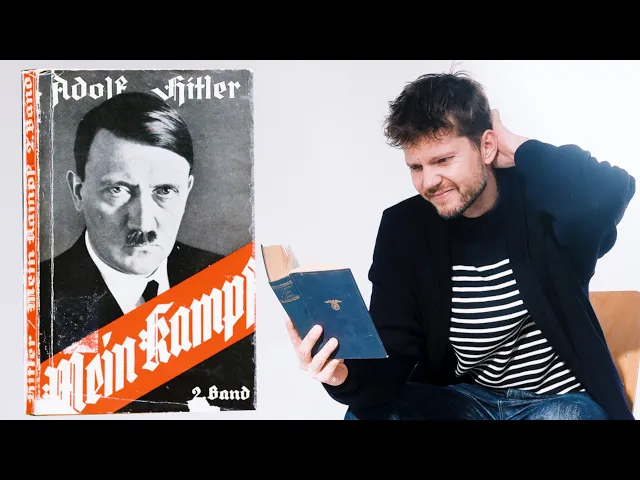
I Read Hitler's Book in 2025. It scared me for us.
The Present Past
0:00 This is my comf by Adolf of Hitler.
0:06 It's seen as the most evil book in history.
0:10 In it, he describes his life story, his plan to start a new world war,
0:14 and his conviction that Germany needs to get rid of the Jews.
0:19 [music] He was not taken seriously, but when he came to power,
0:24 he put all that he wrote down into practice.
0:29 The blueprint for world conquest.
0:32 A book which every good Nazi knows by heart.
0:36 It's titled Mank.
0:38 In this video, I will show you what's inside mine.
0:40 But to understand this book,
0:42 we have to understand what's happening in Hitler's time.
0:44 So I will show you the context of his ideas and what it means for the present.
0:52 Because history never repeats itself, but it does rhyme.
0:59 It's the 1st of April 1924.
1:01 Adid of Hitler is shown to his cell in Lansburg prison.
1:05 He has been convicted for trying to overthrow the government, but he's lucky.
1:09 The conservative judges went easy on this nationalistic troublemaker.
1:13 They didn't exile him to his home country, Austria, or worse.
1:18 He isn't even behind bars on a diet of bread and water.
1:21 Hitler is allowed to receive visitors.
1:23 He gets so many food parcels from admirers that he gains weight.
1:27 But Hitler has a problem.
1:29 As a leader of the National Socialist Party,
1:32 he has gotten famous for his speeches.
1:34 In prison, he has no podium.
1:37 He needs to show his followers the way forward.
1:40 He will write a book that shows his wealth and Shaolong, his ideology.
1:45 Where to start better than the beginning?
1:48 I consider it most fortunate today
1:50 that destiny selected Bonoin to be my birthplace.
1:54 This little town lies on the border between two German states.
1:58 Hitler is born on the 20th of April 1889
2:01 in the Austrohungarian Empire in a town on the border with Germany.
2:05 Already in the first paragraph,
2:06 Hitler used his life story to promote his politics.
2:10 Let's look at how that first sentence ends.
2:13 This little town lies on the border between two German states,
2:16 the union of which seems a task to which we
2:19 should dedicate our lives and pursue with every possible means.
2:23 Hitler is talking about the political idea to unite Germany and Austria,
2:27 both Germanspeaking countries.
2:30 13 years later, when Hitler's party comes to power,
2:33 he will make this dream a reality.
2:36 Nazi Germany annexes Austria.
2:41 What the first passage already shows is that Hitler's book is special.
2:46 It's special in that he very clearly shows what he's aiming to do.
2:49 From invading the Soviet Union to his idea
2:52 the Jews are parasites corrupting German blood.
2:55 It's all in there.
2:56 So what's inside?
2:57 My comf means my struggle.
2:59 These are the chapter markings.
3:01 The first part leans heavily on his life.
3:04 It's like a coming of age novel.
3:06 He describes growing up, living in Vienna, moving to Munich,
3:10 the First World War, and his move into politics like a true hero's journey.
3:14 It's filled with setbacks and moments of inspiration that led
3:17 him to his vision for Germany and the world.
3:19 He often lies or embellishes facts to fit his story.
3:23 He never tells us, for instance, that just before the First World War,
3:27 he fled to Munich because he didn't
3:29 want to be drafted in the Austrohungarian army.
3:31 [music] For someone that is so obsessed with war, it's not a good look.
3:35 The second book is more thematic.
3:37 In it, he describes different ideas for his party,
3:40 the role of his ethnic state, finding communism,
3:44 and what Germany's foreign politics should be.
3:47 Hitler doesn't stick to his chapters, though.
3:49 He will often go on tangents that last pages.
3:52 So, I will show you the main themes that make up Hitler's worldview.
3:59 For Hitler, struggle is a driving force of history.
4:03 He who would live must fight and he who doesn't wish
4:06 to fight in this world of permanent struggle has no right to live.
4:10 He believes his worldview is based on science.
4:15 On the 15th of September 1835,
4:18 a survey ship arrives at an island group close to Central America.
4:22 The next day, a young biologist leaves the ship.
4:24 Over a month of research,
4:26 the biologist makes a discovery that will change the world.
4:29 He finds the same species of bird on the islands of the archipelago.
4:33 But on each island, the birds have different beaks.
4:37 This discovery leads a young biologist to a theory.
4:40 What if animals are not made by God, but they evolve over time?
4:44 The young biologist is Charles Darwin.
4:48 His theory of evolution describes how
4:50 species must adapt to changing circumstance,
4:52 that nature is a place of struggle for survival,
4:55 and only the fittest organisms survive.
4:57 This theory makes headlines around the world and it quickly
5:00 gets turned and twisted if nature is about constant struggle.
5:04 Why would human affairs be different?
5:07 [music] According to Hitler,
5:11 humanity consisted of different races that were competing.
5:14 The Aryan race was the most noble.
5:17 Slavs and Jews the lowest.
5:20 Keeping these races from mixing was the only path to survival.
5:24 A people does not perish from lost wars, he said,
5:27 but from the loss of the power of resistance that only pure blood possesses.
5:31 To survive, Germany needed to be a vulkish estat,
5:35 an ethnic state based on the German race.
5:38 But how do you keep this nation and its blood pure?
5:40 You could try and promote desirable traits.
5:43 The goal was for the most beautiful bodies to find each other,
5:47 to bestow new beauty upon the nation.
5:50 Hitler wasn't alone in this.
5:52 Many people were thinking, you know,
5:54 if evolution is a thing, why can't we help nature?
5:58 Why can't we select humans with these desirable traits?
6:02 In the UK, the progressive Fabian Society wanted to breed humans like animals.
6:06 If a 20th part of the cost and pains were spent in measures for the improvement
6:11 of the human race that is spent
6:13 on the improvement of the breed of horses and cattle,
6:16 what a galaxy of genius we might not create.
6:22 You might be tempted to say, "What's so bad about that?
6:25 Making sure that the most healthy people that make babies,
6:29 maybe we can eradicate disease." The issue is it never stops there.
6:34 Because Hitler saw a nation that was infected by racial mixing,
6:38 and this needed fixing.
6:40 In our present state of law and order,
6:42 this brave bourgeoisan national world looks upon it as a crime
6:46 to make procreation impossible for those who suffer with syphilis,
6:50 tuberculosis, hereditary diseases and also cripples creatins.
6:55 And it can go even further.
6:58 If in Germany in a year a million children would
7:01 be born and we would take 700,000 to 800,000 away,
7:06 the people [music] might be stronger in the end.
7:08 Again, he was not alone.
7:11 Churchill wanted to sterilize risk groups, and some believed humanity should not
7:15 waste time [music] caring for the defective.
7:18 They would instead have great use for lethal chambers.
7:21 When the Nazis came to power,
7:23 they take the idea of these lethal chambers seriously.
7:26 After 1933, they sterilized 400,000 people.
7:30 They killed 70,000 invalid and mental patients and murder 5,000 children.
7:41 [music] Hitler spends a lot of time thinking about the First World War.
7:43 He has many positive memories.
7:46 For me, as for every German, the most memorable period of my life now began.
7:50 Like so many others, I had one worry during these days,
7:54 that we might not reach the front in time.
7:57 For the first time in his life, Hitler felt a kind of belonging, a purpose.
8:01 He got injured twice, received the Iron Cross for bravery,
8:04 and it forever defined his worldview.
8:07 But the war also helped him in ways he could have never imagined.
8:10 There's a quote by Karl Marx, and paraphrased, it goes something like this.
8:15 Men make their own history, but under circumstances that they don't choose.
8:20 Hitler found himself in circumstances that have
8:22 been described as a perfect storm.
8:24 At the end of the war,
8:25 a revolution overthrew the German emperor and established democratic republic.
8:30 When Hitler decides to go into politics, Germany is in a bad place.
8:34 The First World War was war on a scale the world hadn't seen before.
8:38 1.8 million Germans died.
8:40 2.7 million were permanently disfigured.
8:44 Millions of men that had gotten used
8:46 to daily violence were discharged from the army.
8:49 They return as soldiers that lost the war.
8:51 [music] They return as losers.
8:54 In search for meaning, many men turn to extremes to the Communist Party.
8:59 and to right-wing nationalistic fly cops.
9:02 These are paramilitary organizations [music] where these men
9:05 can cosplay still being in the army.
9:08 Many of them believe in conspiracy theories.
9:10 They think the German army was not defeated on the battlefield.
9:13 They think treacherous socialists and Jews had
9:15 organized strikes and sabotaged the home front.
9:18 This became known as the Dorsto legend or stab in the back myth.
9:22 It doesn't matter that reality is so different
9:25 that after 4 years Germany was on it
9:27 knees that the generals knew that with America
9:29 in the war they were never going to win.
9:32 When Hitler starts giving speeches he often talks to veterans like
9:35 this and like any good influencer [music]
9:37 he knows extremism is good for engagement.
9:40 So he leans into this kind of conspiracy.
9:43 He denounces the socialist leaders of Germany.
9:46 This kind of talk leads to political violence.
9:49 Between 1919 and 1923,
9:51 a wave of political assassinations ripped through the country.
9:54 In four [music] years, Germany sees 376 political murders,
9:59 and of which 354 were committed by right-wing nationalist persons.
10:05 They even assassinate government ministers.
10:08 [music] Next to the stab in the back myth,
10:10 there's another theme he can always rely on to really get his audience going.
10:13 In his book, he doesn't stop talking about
10:15 the treaty that ended the First World War,
10:18 the Treaty of Versailles.
10:18 [music] A precondition for future success of our movement was that it
10:25 should import knowledge of the peace treaty to the broadest masses.
10:29 Germany lost a lot of territory.
10:30 They had to pay huge war reparations and reduce their army to 100,000 soldiers.
10:36 But the worst part of it was article 231.
10:38 [music] This stated that Germany was the only one responsible for the war.
10:44 A perfect example of victor's justice.
10:47 In the book, Hitler presents himself in the Nazi
10:49 party as the only people opposing a settlement.
10:52 It's not true, but it's also a careful strategy.
10:56 They have to engrave ourselves into men's minds as an enemy of the treaty.
11:00 A recollection of our earlier position would earn us their confidence.
11:04 And when the government can't pay the reparations bill,
11:07 France and Belgium occupy the Rugerit, the industrial heartland of Germany.
11:15 Hitler knows he has rhetoric gold in his hands.
11:18 He gets ready for a speech.
11:20 It's the first time the New York Times will
11:22 cover a performance of this new man on the scenes.
11:24 The correspondent sits between an aristocratic general
11:27 from the First World War and a communist.
11:30 Suddenly, everyone jumps up and a roar of applause sweeps through the big hall.
11:35 Upon the speaker's platform steps a simple, modestl looking,
11:38 slender man of a medium height who seems underfed and overworked.
11:43 In astonishment, I note that the condescending
11:45 look of the old general on my left,
11:47 is gradually making way for an expression of wrapped attention.
11:51 My neighbor on the right, the communist,
11:53 no longer merely claps his hands in applause.
11:56 In his eyes, I think I see tears.
11:58 And at every slight pause in the speaker's address,
12:02 he roars approval with all his might.
12:05 In fact, in spite of the speaker's moderate tone,
12:08 a very hurricane of elemental passion seems
12:11 to be sweeping down upon the audience.
12:14 [cheering] This was at the start of 1923.
12:21 The situation with the killings, the coups,
12:23 the violence on the street is already bad.
12:26 But it's about to get a lot worse.
12:28 On the 1st of January, you would need 70,000 German mark to get $1.
12:33 But this quickly changes.
12:34 By December the 1st, you need 4 trillion200 billion marks to get $1.
12:40 The money presses couldn't keep up.
12:42 People ran around with wheelbarrows full of cash
12:44 to spend it as quickly as possible.
12:47 Stores were constantly updating their prices.
12:50 Bread could be twice as expensive in 1 hour.
12:53 So now all your savings are gone.
12:55 Your salary is practically worthless.
12:58 Looting, chaos, the shame that you have to send
13:00 your kids to school in clothes that are made from curtains.
13:03 Historian Sebastian Huffner said that the year
13:05 1923 prepared Germany not specifically for national socialism,
13:09 but for every fantastic adventure.
13:12 At the start of 1923, Hitler's party, the NSDe had 80,000 members.
13:18 By the end of the year, they had 55,000.
13:21 This wouldn't have been possible without Hitler's grasp of mass psychology.
13:29 Hitler had a big talent for propaganda.
13:31 He doesn't think too much of the general mass of people.
13:35 The receptive powers of the masses are
13:37 very restricted and their understanding is feeble.
13:40 Such being the case, all effective propaganda must be confined to a few
13:44 bare essentials and those must be expressed in stereotype formulas.
13:49 These slogans should be persistently repeated until the very last individual
13:53 has come to grasp the idea that has been put forth.
13:57 Hitler also understands that every great story needed an opponent,
14:00 a mirror image of the hero, a villain.
14:03 The thing is there were many things he didn't like.
14:06 Socialists, communists, the Jews,
14:08 modern consumer culture, the sexualization of society.
14:11 But having too many opponents, well, that will be too difficult for the masses.
14:16 Their sense of objectivity will be aroused.
14:18 They will ask how it is possible that all the others can
14:21 be wrong and that they themselves in their movement alone are right.
14:25 Hence, it will always be necessary to group
14:28 all opponents together as forming one solid front so
14:32 that the mass of followers will see only
14:34 one common enemy against whom they have to fight.
14:37 So the enemy Hitler gives to the audience is like
14:39 a recipe with all the ingredients he loves to hate.
14:42 It's like pizza with ice cream.
14:43 a combination of socialist, communist,
14:46 [music] and Jew that's responsible for everything that goes wrong in society.
14:50 So when he says during his trial
14:51 that the future of Germany is called destruction of Marxism,
14:56 either this racial poison, this mass tuberculosis will spread over our people.
15:02 Then Germany will die from its sick lung
15:05 or this will be removed and then Germany can flourish again.
15:10 But not before.
15:13 The message is clear.
15:15 For all his hatred, Hitler does admire the organization of the socialists.
15:19 He consciously copies them.
15:20 He steals their mass gatherings, their use of banners.
15:23 He used their color.
15:25 And from the communists, he understands he needs a good logo.
15:28 The new flag had to be equally a symbol of our own struggle.
15:32 It was expected also to be highly effective as a poster.
15:35 An effective insignia can in hundreds of thousands of cases
15:38 give the first impetus towards interest in a movement.
15:43 [music] Talking about topics like these can be quite difficult on this platform.
15:48 There's always risks of demonetization and sponsors don't really
15:52 want to be associated with the toothbrush mustache man.
15:56 But without sponsors, this channel and this video wouldn't exist.
16:00 So this is why I'm truly grateful to ODU for sponsoring this video.
16:04 What is ODO?
16:06 Well, I'm glad you asked.
16:08 The best business management software on the planet.
16:11 If you run a business, you must get tired of all these different
16:14 disconnected apps that each come with an individual subscription.
16:17 ODU solves that.
16:19 There are over 45 apps to run your business all on one platform.
16:23 Everything is centralized and each app communicates seamlessly with the others.
16:27 ODU automates your processes and helps you avoid costly mistakes.
16:31 No more duplicate data or manual errors.
16:33 It also goes with you.
16:34 Want to start with just one app?
16:36 Great.
16:37 It's completely free for life, including unlimited hosting and support.
16:41 Ready to scale?
16:42 Gain access to all apps starting at just 1990 per month.
16:46 Try Odo now by going to odo.com/r/present past 2.
16:57 A spectre is hard in Europe.
16:59 The spectre of communism.
17:01 When Karl Mars and Felic Engles wrote their communist manifesto in 1848,
17:05 the rise of a communist state was just theory.
17:08 But in 1917, Cyrus Russia fell to a communist revolution.
17:16 This sent shock waves through Europe.
17:18 Many people in Germany feared that the revolution would soon reach their doors.
17:23 Hitler hates anything that has to do with socialism, communism, Marxism.
17:27 All of them believe in solidarity among the working class.
17:30 a solidarity that crosses borders of countries.
17:33 And for Hitler, who is an extreme nationalist, that is a problem.
17:36 International solidarity will not work with his national socialist ethnic state.
17:41 He even believes this international solidarity
17:43 is a conspiracy to destroy Germany, a conspiracy led by the Jews.
17:49 Marxism represents the pure attempts by the Jew
17:52 to eliminate the overwhelming importance of the personality
17:55 in all areas of human life and replace it with the number of the mass.
18:00 But they were not only behind Marxism, they're also behind global capitalism.
18:05 This might seem a bit weird,
18:07 equating Jews with communism and then also capitalism.
18:11 That conspiracy seems just a bit too far-fetched,
18:14 but it aligns with Hitler's idea of propaganda.
18:16 It's not a good idea to have all these different enemies.
18:19 All enemies must be merged into one.
18:21 And it helps that anti-semitism was not unique in Germany.
18:28 You've always heard about his hatred for the Jews, but where does it come from?
18:33 And how much did he show in his book what he was going to do?
18:37 In European history, Jews were a minority that were singled out persistently.
18:41 Some stereotypes about Jews are directly the result of discrimination.
18:45 In medieval Europe, trades were organized in guilds.
18:48 There were guilds for brewers, for smithies,
18:51 but Jews were not allowed to be part of guilds.
18:53 In many places, they were not even allowed to farm.
18:56 So, they were forced into trades that were not protected
18:58 by guilds or that Christians were not allowed to do.
19:01 Christians were not allowed to change interest on a loan.
19:05 So, Jews took up the money lending trade.
19:07 In Germany, they are also over
19:09 represented in other non-traditional jobs like newspapers.
19:12 With the rise of nationalism,
19:14 Jews become singled out more and more as a group that doesn't seem to fit in.
19:18 Anti-semitism starts rising all over Europe.
19:21 In the late 1800s, there's a military scandal in France.
19:24 A Jewish officer is convicted for spying, a crime he didn't commit.
19:30 In the survey, it's seen that half
19:31 of the French population doesn't trust Jewish citizens.
19:35 In 1905, Russia loses a war.
19:38 And to divert anger, the SAR turned to anti-semitism.
19:41 There were 700 pilgrims in two weeks.
19:45 So Hitler's book stands in the long tradition of anti-semitism.
19:48 In 1919 he writes the first time that Jews are not a religion
19:52 but they are a race and they must be forced out of Germany.
19:57 Now in my he never writes he wants to kill
19:59 the Jews but the language he does use makes his intentions clear.
20:03 The Jews are parasites symbols of degeneration
20:06 of the empire or pathogens disease to be cured.
20:10 Talking about people like this dehumanizes them.
20:13 When they're not seen as human, it makes it easier to get rid of them.
20:18 And the first speech he gives when he gets out of prison is clear.
20:21 He's ready for a struggle against both Marxism and the Jew
20:25 as a spiritual carrier of this world plague and epidemic.
20:28 But in my comf, we can find a more chilling quote.
20:31 If at the beginning of the war 12
20:34 or 15,000 of these Hebraic corruptors of the people
20:37 were held under poison then the sacrifice of millions
20:41 of the front would not have been in vain.
20:45 Reading this knowing what will happen millions of Jews greets in other places.
20:50 It seems like Hitler is already here talking
20:52 about his final solution for the Jews of Europe.
20:55 After this, no one can doubt Hitler's intentions.
20:58 But the line from mine come to the cling of Jews is not straight.
21:02 It is twisted.
21:03 Jewish Germans were slowly excluded from society.
21:06 They had to wear identifying markers because they
21:09 did not resemble the propaganda the Nazis put out.
21:12 Like this picture of two perfect Aryan children that turned out to be Jewish.
21:19 For a long time, Hitka and the Nazis
21:20 had different ideas what to do with the Jews.
21:23 One of the options was to deport them to Siberia.
21:26 Before that could happen, they had to conquer the biggest country in the world.
21:35 On the 22nd of June 1941, Hitler invades the Soviet Union.
21:41 Hitler's whole ideology led to this.
21:43 A fight on epic scale, on life or death.
21:47 Aryan Germans would crush the inferior Slav opponent.
21:50 The army penetrates deep into Soviet soil, but the advance grinds to a halt.
21:55 The obsession with the Soviet Union will end Hitler.
21:59 Like so many of his actions, Hitler had described the attack in his book.
22:03 He also described how [music] that attack could fail.
22:07 If one wanted land in Europe,
22:09 this could by and large only be achieved at Russia's expense.
22:13 For such a policy, however, there was only one ally in Europe, England.
22:18 Why was Hitler so obsessed with land?
22:20 Hitler thinks a great nation needs a lot of land to be able to feed its people.
22:24 In history, this was generally true.
22:26 But the 1800s saw many technical developments in farming.
22:29 Artificial fertilizer improved yields.
22:31 Cooling kept food fresh.
22:33 Steamers make shipping go faster.
22:35 It doesn't matter.
22:37 He wants land and he will get it.
22:39 But how should they pursue colonies?
22:42 No.
22:42 too expensive to maintain, too hard to defend,
22:45 and he doesn't want to compete with the English.
22:47 He needs the lands of the Soviet Union.
22:50 The best thing is that he will hit two birds with one stone.
22:53 As we've seen, according to Hitler,
22:55 the Soviet Union is ruled by a Jewish conspiracy.
22:58 Destroying the Soviet Union means destroying this conspiracy.
23:02 He knows Germany would lose this battle,
23:03 and he keeps dreaming of an alliance with the United Kingdom.
23:07 But when he invades in 1941, this hasn't happened.
23:10 But the ability of Hitler to even wage
23:12 a world war was almost stopped by the economic circumstance.
23:17 Hitler is released on the 20th December 1924,
23:20 just 8 and 1/2 months after he went to prison.
23:23 He quickly compiles all the pages he has to release his book.
23:27 But is he too late?
23:29 Germany is not the chaotic country from the times of the coup anymore.
23:32 The economy is stable.
23:34 When a respected front-footed Sait reviews Hitler's book,
23:37 they see the end of the Nazi movement.
23:39 Constructive politicians have conquered the ghost of chaos.
23:43 They have rebuilt Germany and are about to restore safety in Europe.
23:47 The Times have moved on.
23:49 Hitler is based on this personal testimony.
23:52 Done.
23:54 The voters seem to agree.
23:57 In 1928, the Nazis got just 2.63% of the popular vote.
24:02 But the words of the Frankfooted Titan would not hold.
24:04 A year later, the global financial crisis hits Germany, the second in six years.
24:10 Germany is plunged into a deep depression.
24:13 The appeal of the Nazis rises again.
24:16 This is also reflected in the sales of the book.
24:18 It becomes a bestseller when Hitler comes to power in 1933.
24:21 The sales of his book have made him so rich he can refuse his salary.
24:26 He quickly gets to work on the promises he has made.
24:29 In mine cometh, Hitler said that when the NSDA would come to power,
24:33 6 years would not have passed before a courageous rash foreign policy
24:38 would find an equally bold will among a people thirsting for freedom.
24:43 Within 6 years, Hitler invades Poland.
24:46 It's the start of the Second World War.
25:08 So what does this mean for us?
25:10 In 2025, it is 100 years ago that Hitler released the first part of Minecom.
25:15 But we are still obsessed as ever with the Nazis.
25:18 This graph shows how often Hitler is mentioned in a book.
25:22 Godwin's law states that every discussion on the internet ends with the Nazis.
25:28 In politics, comparing someone to Hitler is the ultimate insult.
25:32 If we look at outcomes, exterminating the Jews,
25:35 starting a world war, no one is as bad as Hitler.
25:38 So, we shouldn't be too quick to compare other people with him.
25:41 But we can compare his political approach in a democratic arena.
25:45 Hitler was a populist.
25:47 He knew that in times of uncertainty and economic hardship,
25:50 the call for a strong leader becomes louder.
25:53 There are others who understand that message.
25:55 In Europe, extreme right-wing nationalism is out in the open.
26:06 In America, economic uncertainty has led to big promises.
26:10 Under my plan, incomes will skyrocket.
26:12 Inflation will vanish completely.
26:14 Jobs will come roaring back.
26:16 and the middle class will prosper like never ever before.
26:21 And we're going to do it very rapidly.
26:24 All effective propaganda must be confined to a few bare essentials.
26:27 And those must be expressed in stereotype formulas.
26:31 But no hope or dream we have for America
26:34 can succeed unless we stop the illegal immigrant invasion,
26:39 the worst that's ever been seen anywhere in the world.
26:42 These slogans should be persistently repeated until the very last individual
26:46 has come to grasp the idea that has been put forth.
26:49 And we know they come from prisons.
26:50 We know they come from mental institutions, insane asylums.
26:54 We know they're terrorists.
26:56 Nobody has ever seen anything like we're witnessing right now.
26:59 It is a very sad thing for our country.
27:01 It's poisoning the blood of our country.
27:03 People does not perish from lost wars, he said,
27:06 but from the loss of the power of resistance that only pure blood possesses.
27:11 It's poisoning the blood of our country.
27:14 He is trying to restrict free press.
27:16 He has asked generals to get ready for a war against the enemy within.
27:21 We should use some of these dangerous
27:22 cities as training grounds for our military.
27:26 National Guard, but military ones that are run by the radical left Democrats.
27:31 what they've done to San Francisco, Chicago,
27:34 they're very unsafe places and we're going to straighten them out one by one
27:38 and this is going to be a major part for some of the people in this room.
27:41 That's a war too.
27:42 It's a war from within.
27:44 He sees the left as an enemy of stability in America.
27:47 It's the enemy from within.
27:49 Even though the extreme right is responsible for threearters
27:52 of all political violence over the last two decades,
27:55 [music] it's not hard to see parallels of a people that see difficult times,
28:00 rising inequality, a changing society.
28:03 And just as I was ready to finish this video,
28:05 I saw something that really scared me.
28:08 He's going to get a third term.
28:09 So Trump 28, Trump is going to be president 28.
28:12 And people just thought I'd get accommodated with that.
28:14 But he's an instrument of divine will.
28:17 We need [music] him for at least one more term, right?
28:20 And uh he'll get that in 28.
28:22 And we have to seize the institutions, seize them, and then purge them.
28:26 We as a populist nationalist movement, as a MAGA movement,
28:29 we need [music] to get the house in a situation
28:32 that is permanently defendable by the MAGA movement.
28:36 You should beware politicians that offer easy solutions and lay
28:39 all the problems at the feet of one group,
28:41 that disregard dematic institutions, a free press, and the rule of law.
28:46 Because we know what can happen.