Vibration Plates, PRP & More: What REALLY Helps Your Joints? Ft. Leading Orthopedic Surgeon
Rena Malik, M.D.
0:00 What can people do to prevent joint degeneration?
0:03 Yeah, so let's define a joint.
0:04 A joint is just where two bones come together.
0:07 The The ones we think about most are our shoulder joint,
0:11 our knee, our hip, especially in midlife women and men.
0:15 So, when two bones come together, bones are actually pretty fragile.
0:19 And so, every bone is coated on the end with a layer of cartilage.
0:23 Cartilage is is white.
0:26 It's glistening.
0:27 It's smoother than ice.
0:29 It has a coefficient of friction that's less than ice.
0:33 So, it's so smooth, you don't even perceive it
0:35 moving in your joints until it starts to break down.
0:39 Cartilage itself is a matrix with some few scattered cartilage cells in it.
0:44 So, it's mostly scaffolding.
0:46 And the thing that makes it healthy is joint fluid.
0:50 Joint fluid that is not filled with inflammatory cytokines.
0:55 Joints are healthy when the cartilage do not
0:57 hasn't been worn down like a food grader.
1:00 Why would the cartilage matrix be worn down?
1:03 Well, there's so many reasons.
1:04 It could be due to high steroid use.
1:07 Maybe you had asthma.
1:08 Maybe you had cancer and have to have high steroids.
1:11 That's really bad for cartilage.
1:12 Maybe Or you abuse steroids.
1:15 Or you abuse steroids.
1:16 How about that?
1:17 Anabolic steroids.
1:18 Or maybe you were pre-Ozempic and carrying
1:22 around a couple of hundred extra pounds.
1:25 Joints bear 7 to 10 times body weight.
1:29 So, imagine 100 extra pounds,
1:32 it's like 1,000 extra pounds of pressure across a very delicate structure.
1:37 [snorts] And in the laboratory, when you want to damage cartilage,
1:39 you drop a marble on it.
1:41 It's very sensitive.
1:43 And so, maybe it was due to wear and tear of weight.
1:48 Maybe it's due to trauma.
1:50 Athletes twist and bend and bang.
1:53 And we get one sheet of cartilage on every bone for our entire life.
1:57 Once it's gone, it it can repair with a patch,
2:02 but it will never be the healthy cartilage we have again.
2:05 So, these are all reasons why people
2:07 end up with joint degradation, aka arthritis.
2:12 Before 50, men have more arthritis than women, a higher incidence of arthritis.
2:19 After 50, women will have can have a rapid progression in their arthritis.
2:25 In fact, get this.
2:27 There was a paper published in 1925, 100 years ago,
2:33 by a a researcher named Noble, documenting the arthritis of menopause.
2:39 100 years ago, That's insane.
2:42 someone started asking,
2:43 "Why do all these women in menopause have so much more arthritis?" Well,
2:47 it's because every musculoskeletal tissue, tendon, ligament, muscle, bone, fat,
2:55 muscle-derived stem cells, they all are cousins,
2:59 and they all have estrogen alpha and beta receptors.
3:02 So, if estrogen is not sitting in the receptor on the cartilage matrix,
3:07 it cannot maintain its integrity as well.
3:10 And therefore, lo and behold,
3:12 we have a rapid progression of arthritis in women in midlife,
3:17 of course, during a time when they're putting
3:18 on weight that they never wanted to have.
3:21 And so, we have that added pressure.
3:23 Maybe they're still not eating because they're
3:25 trying to diet their way to feeling better.
3:27 Maybe they hurt so much because
3:29 of arthralgia that they're not exercising because becoming
3:33 strong and moving your joints is one of the cures for my joint pain,
3:37 but it's counterintuitive.
3:39 If it hurts, don't move it.
3:40 Not true.
3:41 All the reasons that all of a sudden
3:43 women in midlife have this rapid progression in arthritis.
3:47 And then it slows them down.
3:49 And it's just one thing leads to the next.
3:51 Is it inevitable?
3:53 I mean, because we're living longer.
3:54 Is it inevitable that you will have joint pain and joint issues as you age?
4:01 [snorts] I think it's common, but not inevitable.
4:03 And I think it goes in degrees.
4:05 I mean, I I think having an ache and pain once in a while,
4:10 maybe that's inevitable.
4:12 Having pain that's so debilitating they have to sit in a chair,
4:15 I don't think that's inevitable.
4:17 But it cannot start when we're 60 or 70.
4:20 We have to be mindful from a very younger age and do
4:25 all the things that we've talked about in terms of keeping,
4:29 for instance, let's talk about the knees.
4:30 When people come to me with knee pain, I never just address their knee.
4:35 We always, one of the steps in my plan
4:38 for them is always to become strong as a bull.
4:42 The The The muscle support above and below the knee
4:47 has a critical effect on the impact that the knee sees.
4:50 So, they're always very surprised when I'm like,
4:52 "We're sending you to physical therapy,
4:54 and then we're getting you in a gym." Because
4:56 we are going to get you strong as a bull, and your knees will benefit.
5:00 So, to answer your question,
5:02 I don't think debilitating joint pain is inevitable,
5:07 but we have to start early on all the things we talked about.
5:11 Will we have aches and pain as we age?
5:13 Yeah, but not so much that they make us sit in a chair usually.
5:18 Right.
5:19 Well, also, I mean, you're you can damage your joints from overuse, too, right?
5:24 So, where is the balance then of Obviously,
5:26 you want to strengthen your muscles to maintain joint
5:29 health and do all the other things we've talked about,
5:31 but also avoid sort of, you know,
5:34 really minimizing that that joint fluid and and space
5:38 that kind of that cushion there in the joints.
5:40 You know, what's interesting is there there is
5:43 clear literature that even the impact of running,
5:47 long-term chronic running, does not speed up arthritis progression.
5:51 Running does not cause arthritis.
5:54 Yes.
5:54 That's good to know.
5:55 Yes, because that is a very common fallacy.
5:58 "Oh, you got to stop running." Well,
6:00 if you have trauma and your cartilage is damaged,
6:04 then the repetitive nature of a thousand steps a mile can make you feel worse.
6:08 But, long-term runners, running itself doesn't cause arthritis.
6:13 Probably for a lot of reasons,
6:15 one of which is is they're tend to be lighter people.
6:18 Mhm.
6:18 Right?
6:19 Mhm.
6:19 So, generally speaking, we don't need to worry about that.
6:22 If you're doing all the right things, If we're doing all the right things,
6:26 you don't need to worry that you're actually like wearing out your joints.
6:28 I would not know.
6:29 I would not stop being mobile because
6:31 of being afraid of wearing out your joints,
6:33 because what am I sentencing you to then?
6:36 If I say, "Why don't you sit still and don't wear
6:40 out your joints?" I am sentencing you to sedentary death syndrome.
6:44 We know that it's kind of like a societal mantra,
6:47 "Sitting will kill you." It's like smoking.
6:49 It's like smoking.
6:51 Yeah.
6:51 Yeah.
6:52 I want to talk about a couple things that are
6:53 sort of novel and interesting and people are talking about them.
6:58 What about vibration plates?
7:00 So, power plates, vibration plates, there is some small study data that it
7:06 can stimulate impact and build bone density.
7:10 Not as much as lifting, not as much as jumping.
7:14 Vibratory plates are great for engaging the lymphatic system.
7:19 They're great for involving your core strength in big compound lifts, right?
7:25 If your feet are firm on the ground and you're doing compound lifts,
7:30 even though it's hard, it's not as hard as doing those squats,
7:34 for instance, on a power plate,
7:37 because then you must engage all your small muscles to stay upright.
7:40 So, there's there's great value to it.
7:43 Value alone in building bone is not as strong from a research perspective.
7:48 Okay.
7:49 And what about PRP?
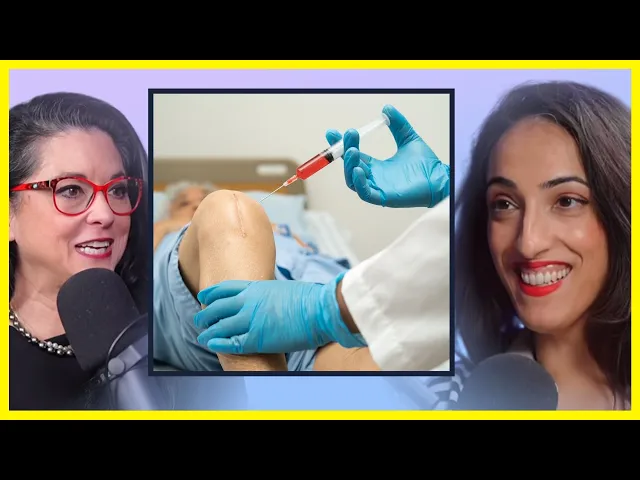
7:51 So, PRP is platelet-rich plasma.
7:55 We know that platelets, when you cut your leg shaving,
7:58 platelets rush to the s- scene of the crime in your bloodstream,
8:02 and they plug the hole.
8:03 But they're not just bricks in a wall.
8:05 They're sacks full of a variety of growth factors
8:08 that your body use to initiate the healing cascade.
8:12 So, what we've learned,
8:13 I started doing research on on platelet-rich plasma in 2000 in 2000,
8:18 when I was in the lab.
8:19 I know.
8:20 And I would just draw my own blood, spin off my platelets, cuz I had blood.
8:25 Why not, right?
8:26 Since that time, researchers have found that platelet-rich plasma
8:31 in a musculoskeletal system can be very effective for chronic tendon problems,
8:37 for rotator cuff tears, for moderate arthritis, for tendon and ligaments,
8:44 as I've said, like patellar tendonitis, tennis elbow, Achilles tendonitis.
8:50 But it is dose-dependent, and you have to know how many platelets you're giving.
8:55 So, the current literature points to needing 10 billion
9:00 platelets to to mount an effective anti-inflammatory and healing response.
9:05 10 billion.
9:06 So, that means wherever you're getting it
9:07 done needs to have the ability to count.
9:10 Otherwise, you don't know what you're getting,
9:11 and you don't know why it's not working, right?
9:14 And the science is evolving.
9:17 And but we do have enough papers to have meta-analysis,
9:20 with meaning a lot of randomized controlled trials,
9:22 then you compare them all in a meta-analysis.
9:26 [snorts] When I first started using platelets clinically,
9:27 we were doing 5 billion in three injections.
9:31 Well, the data evolved.
9:33 Now we know one injection of 10 billion is as effective.
9:38 My patients get about 80% relief for more than a year,
9:42 sometimes up to two years.
9:44 So, when we put the platelets into the knee joint, for for instance,
9:48 they burst, they release their growth factors,
9:51 start initiating an anti-inflammatory cascade.
9:55 And we believe that they call the stem cells from the synovium
10:00 into the milieu to start working because to heal a tissue you need cells,
10:06 you need scaffold, and you need growth factors.
10:09 So, the platelets are providing growth factors.
10:12 They're calling in the cells, and the knee has its own structure, right?
10:18 Yeah.
10:17 Are we to the end of the road
10:19 with research knowing how everything works precisely?
10:23 No, actually not.
10:25 But does it offer an amazing option if we don't want to go do surgery,
10:30 which most of my patients aren't looking for surgery?
10:33 Yeah.
10:34 And I've had great success with it.
10:35 So, I offer it.
10:37 right?
10:37 Like instead of an injection for pain,
10:39 which is just relieving the pain or inflammatory markers potentially,
10:43 it's actually creating more response.
10:46 Well, let's compare that, right?
10:47 So, I just told you that a dose of 10 billion platelets in my patients
10:52 and in the literature has an 80% efficacy
10:56 in relief of pain and can last durably.
11:01 A steroid injection, which is the go-to knee-jerk reaction,
11:05 which I rarely give, in the literature lasts 3 weeks.
11:10 And we don't really know what's 3 weeks.
11:12 Now, some people get a 6 months out of it,
11:15 but that is the exception, not the rule.
11:17 Yeah.
11:18 And so, the only time I use steroid injections is when people
11:22 do not want platelets or their joint is so damaged it's bone-on-bone.
11:28 We're just trying to buy some time getting them out of excruciating pain.
11:32 And then I'll do it cuz I'm not inhumane.
11:34 Right.
11:36 [laughter] Yeah, and I think the interesting thing about PRP is one,
11:39 there's definitely this lack of counting of platelets, you know?
11:43 And two is it's a blood product, and so there's no right you don't have to go
11:47 through the same regulation as like a pharmaceutical injection.
11:50 And so, anybody can really give it.
11:52 Anybody can I'm glad you brought that up, right?
11:55 And so, I I do worry and I tell my patients this too.
11:58 I think for for so people do this PRP for erectile dysfunction, however,
12:02 the data is mixed and because I think
12:04 we don't know the right amount of platelets, we don't know that you know,
12:07 there's still some some things that need to be figured out.
12:09 And so, yeah, could it work for the same reasons, right?
12:12 It's bringing growth factors and things like that.
12:14 Yes, it could.
12:15 I'm not convinced yet that I know exactly what to do, right?
12:18 And so, I'm not offering it.
12:19 But I think the issue is that yeah, anybody can do it.
12:21 At like anyone can give you PRP
12:24 without really even necessarily being trained on it.
12:27 Well, that's true.
12:29 And so, patients need to know who's treating them.
12:32 Are they board-certified doctors or licensed
12:35 clinicians at the very least board-certified?
12:38 There's a You know, there's all kinds of letters after names out there.
12:43 Lots of letters.
12:43 Lots of letters, and there are legitimate letters and there
12:47 are letters that I don't really know where they came from.
12:50 And I think if I don't know where
12:51 they came from that the public definitely doesn't know.
12:54 So, I just think people need to be careful.
12:57 Yeah.
12:57 Ask for the data.
12:59 Don't be sold.
13:01 People are very good sales people.
13:02 We were just talking about this at lunch before we
13:05 before we started that we're not good at selling things.
13:09 We're not taught in school.
13:10 There are so there are so many schools [laughter]
13:14 Well, that's not our vision that's not our mission.
13:16 Doctors are not um Not all doctors,
13:19 but we are not certainly looking to sell anything.
13:22 But yeah, I would say look, if I was getting something injected in my joint,
13:25 I would want it from an orthopedic surgeon or a PM&R physician.
13:30 Primary care sports medicine.
13:31 Yes, primary care sports medicine.
13:33 That's who I would look for.
13:34 If I had something injected in my penis, I would go to a urologist.
13:37 I don't have a penis, but you know what I mean.
13:38 So, you know, all those things I think it's really important to bring that up
13:42 because this is this is one of the things that's not regulated and won't be.
13:47 And there's going to be more in the future.
13:49 So, it's really important now, especially in the time of social media,
13:51 to be informed and to look at who you're who's
13:54 talking to you on the other end really really critically.
13:57 I Do you see this?
13:58 I see a little bit of turn where audiences want
14:03 to know what the qualifications are of the people speaking to them.
14:07 I've always seen it, but I think now it's more so like,
14:10 okay, just because you have the qualifications, they want a little more.
14:14 They want to know like, well, what does that even mean?
14:16 Which is good.
14:17 I think it's important for people to be discerning.
14:21 Um but also, I see the other side of it where they just see someone
14:24 who has a big following and is very eloquent and charming and they just say,
14:30 well, this person said this and Well, what's interesting Oh,
14:33 I'm I'm glad you were I'm going to sound all hateful and spiteful.
14:37 I'm not.
14:38 But I see a real difference between the challenges
14:41 that happen with female doctors and men online.
14:46 Mhm.
14:46 Doctors are not who who I I don't think there's as much scrutiny, frankly.
14:51 And I'm not trying to start anything on your podcast, but I observe it.
14:55 I'm on there every day observing who's who's being questioned and who isn't.
15:00 So, I don't think questioning is bad, frankly.
15:02 I think questioning is good.
15:03 I want to be questioned.
15:05 I want people to call me I've I've been wrong before,
15:07 I'll be wrong again, right?
15:08 I'm certain I will.
15:09 I'll misinterpret something.
15:10 I'll I'll not be you know, I'll mess up.
15:13 And it's the nature of medicine to do more research and to change.
15:17 Yes.
15:17 And I think the other thing is how you present information, right?
15:20 It's I think if you guys have listened to me
15:22 for a while or you listen to even this conversation,
15:24 we've not said things in absolutes unless
15:26 they were truly absolute and not harmful, right?
15:29 Like exercise is good for you.
15:31 It's not harmful, right?
15:32 We can say that in absolutes.
15:34 But there are certain things where like, yes, there are some data on this.
15:36 This is the data.
15:37 This is what we know right now and this is how we're practicing because of it.
15:40 And I think that's where you need to think there should be nuance.
15:43 Um because people are vying for your attention in such a way
15:48 where if you say a negative I just I actually just heard this.
15:52 Um if you say a negative thing,
15:54 if your title is negative, if you start with a negative,
15:57 people are like almost four times more likely to It
16:00 depends on the the topic or how you're doing it,
16:02 but they're significantly more likely to listen.
16:05 And so, it makes sense that people will find that pattern and say, oh,
16:08 if I say someone didn't tell you this or you're doing this wrong or you know,
16:13 something negative, people pay attention.
16:16 It's a survival instinct, right?
16:17 We want to know the things we should look out for.
16:20 The bad.
16:20 Yeah.
16:20 Yeah, that makes sense.
16:22 Mhm.
16:22 You actually on the PRP, you did a study on this.
16:25 You looked at using PRP before rotator
16:28 cuff surgery and that it actually improved outcomes.
16:32 It does.
16:32 It does.
16:33 And so, why do we think that is?
16:35 Well, it it was observing data.
16:37 It wasn't a causation study.
16:40 But what we observed is that by adding an adequate dose of platelet-rich
16:46 plasma to a milieu where you have put the tissue back together.
16:50 So, what if the rotator cuff This is the rotator cuff.
16:55 This is the bone.
16:56 What if the rotator cuff was still
16:58 torn and I dumped platelet-rich plasma in there?
17:01 Well, actually, there there is an anti-inflammatory pain relief
17:05 effect of that, but it does nothing to the tissue.
17:08 Cells don't jump.
17:10 And so, that paper showed that with repairing the tissue,
17:16 so we have the structure, right?
17:18 The scaffold we've talked about.
17:20 Adding the growth factors in the form
17:23 of platelets bursting and expressing their growth
17:26 factors helped the bone heal to the tendon
17:29 better because that's the direction of healing.
17:31 The bone sends out fibers to heal the tendon.
17:34 And that was augmented by the addition of growth factors to the milieu.
17:40 And so, in a repair where some data shows
17:44 that up to 40% of rotator cuff tears retear.
17:47 Mhm.
17:48 It's a lot and it's not due to surgical technique.
17:50 It's due to the fact that rotator cuffs have no blood supply.
17:54 And blood is key for bringing growth factors and cells to an area, right?
17:59 So, in an event where 40 a surgical response that 40% of the time it can retear,
18:06 the fact that we can simply add your own biologics
18:10 back to the system and see better outcome, that's a bonus.
18:14 That's a huge bonus.
18:16 Do you think Do you foresee a future where this becomes standard of care?
18:19 In many sports practices, in elite sports practices, it is standard of care.
18:25 Right.
18:25 It's not a standard of care of everywhere,
18:27 but almost everybody I know does it just cuz I come from a big
18:31 academic center and those are the the clinicians that I practice at that level.
18:38 It might not be available in some small space without a centrifuge,
18:42 not because it can't be.
18:44 Yeah.
18:45 It's just not.
18:47 Well, I mean, I I don't know I don't know the orthopedic training.
18:49 Is it something that everyone's trained on in in orthopedic training?
18:53 Um you know what?
18:53 I would say in the big fellowships there they see it, absolutely.
18:57 Yeah, but maybe a general orthopedic surgeon who's like
19:00 in a community taking care of everything would not necessarily see it.
19:02 If you haven't done a fellowship in orthopedics,
19:05 you can still go practice as a generalist.
19:07 You might not have seen it.
19:09 But if you've done a sports fellowship,
19:12 you are likely to have seen it because it's
19:14 a concentrated year of how to best take care of tendons,
19:18 ligaments, bones, that kind of thing.
19:20 If you guys like that clip with Dr.
19:21 Vonda Wright, make sure to check out the full episode right here.