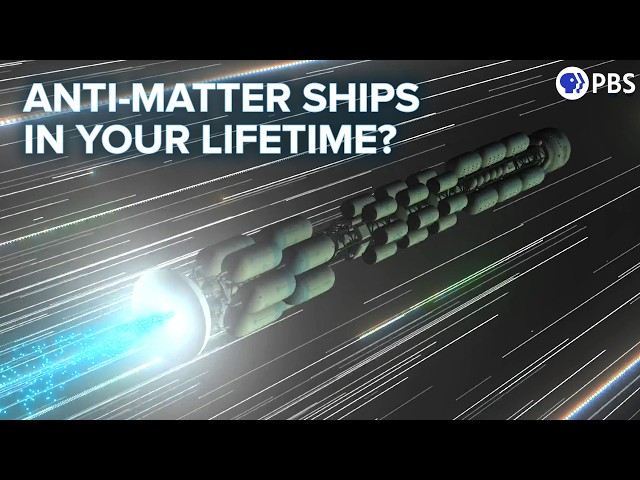
Why Antimatter Engines Could Launch In Your Lifetime
PBS Space Time
0:00 Thank you to Displate for Supporting
0:02 PBS Antimatter drives sound like science fiction,
0:04 but they may not be as far as you think.
0:08 There’s a version that could, just maybe, launch within your lifetime.
0:18 Hey everyone—before we get started two quick announcements.
0:22 We wanted to let your help with likes and commenting is working!
0:27 Thanks to liking and commenting,
0:29 the algorithm is sharing current episodes with more
0:32 of our community, so keep it up!
0:35 And if you haven’t yet,
0:37 subscribe and hit the bell so you don’t miss new episodes.
0:40 Next, If you believe in humanity’s propensity for interstellar travel,
0:43 we’ve got the perfect shirt for you.
0:45 It fuses the Alcubierre Warp Drive
0:47 with the X-Files “I Want to Believe” poster—and thanks
0:51 to the UV printing it glows after sun exposure even in the depths of space.
0:58 There’s 10% off for the first 48 hours.
1:00 Link in the description.
1:02 Now, on to the episode.
1:04 Warp speed, hyperdrive, jumpdrives, space folding, subspace, wormholes,
1:08 infinite improbability drives… We’re pretty good at coming
1:10 up with ways to travel faster than light, at least in fiction.
1:14 Sadly, Einstein’s relativity theory tells us it’s
1:17 almost certainly impossible to travel faster than light,
1:20 at least for macroscopic objects over meaningful distances.
1:24 Probably our future exploration of the galaxy will have to take the slow road.
1:29 That said, we can certainly do a lot
1:31 better than the current generation of chemical rockets,
1:34 which are still burning stuff for energy, you know, like a steam train.
1:39 In terms of energy per kilogram the antimatter drive is near as efficient
1:45 as you can get within the bounds of the laws of physics,
1:49 if you care about those.
1:51 As such, its also a staple of science fiction,
1:54 and it also feels as far of as the warp engine.
1:59 But there have been lots of advances in recent years
2:02 that warrant this update on the timeline of antimatter-powered space travel.
2:06 And there are early versions that you might even see launch.
2:10 Let’s start with the requisite antimatter review.
2:13 We’ve talked about antimatter before about how, in 1928,
2:17 Paul Dirac discovered it in his equations as he tried to bring
2:21 quantum mechanics into agreement with special
2:23 relativity and found negative energy electron.
2:26 And how it in 1932 it was
2:30 discovered in reality when Carl Anderson noticed cosmic
2:33 ray electrons curving the wrong way in a magnetic
2:37 field they proved to be Dirac's anti-electrons—positrons.
2:41 So what is antimatter really?
2:43 It’s pretty fair to describe it as the mirror image of regular matter,
2:47 and every particle of matter has an antimatter counterpart.
2:51 It's the Bizarro to Superman, the Wario to Mario, the Dirac to Feynman.
2:56 The same but oh so different.
2:58 Antimatter is inevitable in a universe with the symmetries of ours.
3:02 If we think of particles as swirls and vibrations in the quantum fields,
3:06 well, those fields can swirl and vibrate backwards?
3:10 The laws of physics are almost completely symmetric if we,
3:15 say, flip all quantum charges to be their opposites,
3:18 or reflect to their mirror image, or if we reverse the flow of time.
3:25 Antimatter is this—charge-reversed and mirror reflected matter,
3:28 which can equivalently be thought of as time-reversed matter.
3:32 The matter-antimatter symmetry means it’s possible
3:35 to produce particles matter out of a pure vacuum as long as you also produce
3:41 the corresponding particles of antimatter to balance.
3:44 And also as long as you have the energy to account for the new mass,
3:49 according to Einstein’s equation E=mc^2.
3:51 This process is called pair production.
3:54 But if the laws of physics are symmetric in time this process works backwards.
4:00 A matter-antimatter pair can also be un-created—annihilated—to produce energy.
4:06 And again, E=mc^2, so take the mass,
4:09 multiply it by the speed of light, which is a big number,
4:13 then multiply it by the speed of light again,
4:15 and you get a very, very big number.
4:17 And that’s why antimatter is the ultimate energy-dense spaceship fuel.
4:22 For example annihilate an espresso with an anti-espresso and you'll
4:28 get an explosion with the power of the modern h-bomb.
4:31 There are of course complications to using anti-matter or we'd be
4:35 flying around with it and blowing each other up with it already.
4:40 It's very difficult to make the stuff
4:42 in quantity and even more difficult to store.
4:46 And it's also complicated to harness it in rocket propulsion.
4:50 But before we can talk about solving those we need to dispel a misconception.
4:56 There’s a commonly repeated statement
4:58 that matter and antimatter annihilation releases
5:01 ‘pure energy.’ There’s not really any such thing as pure energy.
5:06 Energy is a property possessed by systems.
5:09 It can take many forms—mass energy, kinetic, potential, etc.
5:13 The most charitable interpretation of “pure energy”
5:16 is energy that’s easily accessible and usable.
5:19 Mass-energy is the least pure or “free” in that sense,
5:22 and that's the price of it being the most compact form of energy.
5:28 And that mass energy isn’t necessarily all liberated in annihilation.
5:33 That process will often produce other massive particles,
5:37 so some energy remains locked away.
5:41 The idea of this process producing
5:44 “pure energy” is probably from electron-positron annihilation.
5:47 In that case, the ingoing particles have such low masses
5:50 that the energy they produce typically isn’t enough to produce other particles.
5:55 Instead they annihilate into photons, and the rare neutrino.
5:59 The entire energy content of those photons can be captured pretty efficiently.
6:05 But to accelerate our spaceship we really need momentum, not energy.
6:12 Basically, we need to throw stuff out the back of our ship
6:15 as fast as possible so that momentum conservation accelerates us forwards.
6:19 Although our annihilation photons have plenty of energy,
6:24 they are massless and so carry relatively little momentum.
6:28 Also, very high energy photons are hard to direct efficiently.
6:33 Ideally we want to harness whatever energy we
6:36 produce to blast massive particles out behind us.
6:40 It’s certainly possible to do that with the energy
6:43 of these electron/positron annihilation photons in an indirect manner,
6:47 and I’ll come back to options.
6:50 But there’s another issue with this “high efficiency” type
6:54 of annihilation and that has to do with storage, which I'll also come back to.
6:58 But all of this is nudging us towards using
7:02 more massive versions of anti-matter to power our spaceship.
7:06 Massive anti-particles are much harder to create,
7:09 but let’s see where we’re at with this.
7:12 So we had position in 1932.
7:15 And the next anti-thing discovered was 2000 times heavier,
7:20 the anti-proton in 1955.
7:23 Followed quickly by the antineutron And then we
7:27 started to produce antinuclei with anti-protons and anti-neutrons together.
7:31 First anti-deuterium then anti-tritium then antihelium-4.
7:35 More exotic anti-nuclei followed.
7:38 with the current record being anti-hyperhydrogen-4.
7:42 All of these heavier particles are identified
7:45 in the debris of high-energy particle collisions,
7:48 which means they’re both rare and difficult to capture.
7:52 There are two steps to this: first slow the particle down then trap it.
8:00 These collision products start out moving fast—often at a good
8:04 fraction of light speed--and they’re moving in a random direction.
8:08 So they need to be channeled and then slowed.
8:12 The world leaders in this antimatter
8:14 trapping are at CERN’s Antiproton Decelerator.
8:19 It’s an anti-accelerator for capturing anti-protons.
8:24 Once slowed, the antiparticle needs to be trapped.
8:26 This is arguably the harder part.
8:29 If antimatter touches matter it annihilates,
8:31 which means there’s no such thing as an antimatter-resistant
8:35 material container that isn’t itself made of antimatter.
8:39 The solution is a non-material container, which means a force field,
8:44 and the electromagnetic field offers good
8:47 options for both charged and non-charged antimatter.
8:50 The most famous containment device for charged antimatter is the Penning trap,
8:56 in which electrodes at either end of the trap create an electric
8:59 field that keep charged particles in the middle along the axis,
9:03 while a magnetic field along the axis prevents
9:06 any from drifting away in the radial direction.
9:10 This is the technology used by the BASE collaboration,
9:13 who have managed to store a hundred antiprotons
9:16 for a full year in their larger Penning trap.
9:20 Electromagnetic containment like this relies
9:22 on the anti-particle having a net charge.
9:25 But that introduces a new problem.
9:28 Like charges repel, and so end up as a big diffuse
9:34 cloud—which defeats the point of using
9:37 antimatter as a compact energy-dense fuel.
9:39 Now, if you want to keep the particles close together you need a colossal
9:44 EM field with a similarly colossal
9:46 anti-matter containment device again defeating the point.
9:50 This why we can't just us positrons or just anti-protons as fuel.
9:55 Happily there’s a work around.
9:57 If you trap both positrons and antiprotons in, for example,
10:02 a Penning trap, and then cool them, they’ll combine into anti-hydrogen atoms.
10:08 Of course, now you have the problem that the resulting
10:12 anti-atom is electrically neutral and so immediately escapes the Penning trap,
10:16 which is presumably a bad thing.
10:19 A more sophisticated trap is needed.
10:21 The current trick is to use the fact that the anti-hydrogen
10:25 atom has a magnetic moment—like a little bar magnet.
10:28 It’ll try to align and move in the direction of a magnetic gradient.
10:34 So if you have a magnetic field with a minimum value in all 3 dimensions,
10:39 any anti-hydrogen in that field will move
10:42 towards the minimum and get stuck there.
10:44 This is called a magnetic minimum trap.
10:47 Because the new anti-hydrogen will immediately
10:49 escape its Penning trap after formed,
10:52 the magnetic minimum trap has to be superimposed directly over the Penning trap.
10:59 Now, the magnetic minimum trap is far weaker than the Penning trap.
11:04 And so anti-hydrogen needs to be really cold,
11:07 colder than around 1 Kelvin to have a chance of remaining trapped.
11:12 Various novel methods like laser cooling
11:15 are used to further chill this antihydrogen.
11:18 But despite best efforts, this whole process is still very inefficient,
11:22 with only a tiny fraction of produced
11:26 anti-protons and positrons being converted to captured anti-hydrogen.
11:30 It’s also difficult to keep the much of this stuff trapped for long.
11:34 The current record is by the ALPHA collaboration.
11:37 The team trapped 112 antiatoms for times ranging from one-fifth of a second
11:43 to up to 1,000 seconds.Not exactly long enough for an interstellar journey.
11:48 But now that we have actual anti-hydrogen, a new possibility opens up.
11:54 Anti-hydrogen is expected to behave essentially identically to regular hydrogen.
11:59 And that means that if we have enough of it
12:02 it can undergo phase transitions into more useful forms.
12:06 Hydrogen freezes at 14 Kelvin at atmospheric pressure,
12:10 and so the hope is that enough antihydrogen would solidify at that point.
12:16 That’s the dream actually— antihydrogen ice
12:20 fuel pellets suspended in magnetic fields.
12:24 OK, so we have our antimatter fuel.
12:26 Let’s look at how we can use it.
12:29 Bring a hydrogen and antihydrogen together and first
12:33 the electron and positron annihilate producing high-energy gamma rays.
12:37 The following proton-antiproton annihilation is way more complicated.
12:41 That’s because we’re really annihilating three quarks with three antiquarks.
12:45 When the hydrogen and antihydrogen come together,
12:46 the individual quarks don’t all annihilate.
12:48 That only happens to the first quark and antiquark to make contact.
12:53 They’re likely to produce particles like a gluon or W boson,
12:57 which in turn creates more quarks,
13:00 fragmenting the two baryons into a shrapnel of particles like pions.
13:05 Sure enough, this is exactly how antiprotons were discovered
13:09 in collision experiments by Segre and Chamberlain in 1955.
13:15 These pions give us another approach at antimatter propulsion.
13:19 They can be used directly as our “working mass”,
13:23 which means the stuff you throw out the back for momentum exchange, your thrust.
13:29 This design is called a ‘pion rocket’.
13:31 It’s possible because the charged pions can be channeled by a magnetic field.
13:37 Unfortunately, the energy released in hydrogen-antihydrogen
13:40 annihilation also ends up as neutral pions,
13:43 gamma rays, and neutrinos that ignore our magnetic field.
13:46 If we really don’t want to waste the energy
13:50 from these, there other ways to capture it.
13:52 One approach is to capture the photons
13:55 and kinetic energy of the particles to generate electricity.
13:58 That electricity can then be used
14:00 to accelerate other particles to provide thrust,
14:03 as in an ion drive, which we already employ for very steady,
14:08 if slow acceleration in space craft.
14:11 That can be done whether or not
14:13 the annihilation products are also used for propulsion.
14:16 And that makes it also an option for electron-positron annihilation.
14:21 OK, so how long before we get our first antimatter craft?
14:25 Well, quite a while for our first crewed interstellar craft,
14:29 but maybe not so long for our first unmanned probe,
14:32 especially for our own solar system.
14:34 That might be possible if we use antimatter
14:37 in a sort of hybrid mode with nuclear fission or fusion.
14:42 Now nuclear power is proposed in a couple of space travel scenarios.
14:48 The more prosaic it to use a fission
14:50 or fusion reactor generating electricity to power an ion drive.
14:54 A more radical, but actually perfectly within our technological
14:58 grasp is nuclear pulse propulsion like the Orion project.
15:03 In these, a series of fission or fusion bombs are
15:07 detonated behind the ship or behind a sail to propel it.
15:12 Both direct nuclear reactor and nuclear pulse propulsion suffer
15:16 from the same challenge—the size of the device needed.
15:22 Fusion reactors need to be huge to sustain a reaction with net-positive output,
15:29 and this is why we don’t yet have a commercial fusion reactor.
15:35 Nukes need to be big in order to initiate their chain reaction.
15:40 But if a small amount of antimatter can be employed to kick off the reaction,
15:46 then these devices can be made much smaller.
15:48 Let’s take the H-bomb example.
15:50 A key component of the hydrogen bomb is
15:53 some sort of fission core—typically a ball of plutonium.
15:57 This is surrounded by a layer of heavy hydrogen.
16:00 The plutonium is detonated as a fission bomb,
16:03 providing the heat and neutrons needed to ignite fusion in the hydrogen.
16:07 Because of the need for a critical mass of plutonium,
16:10 there’s a minimum size for a hydrogen bomb,
16:13 which means a minimum explosive output.
16:15 That in turn means that any Orion-type spaceship needs
16:19 to be pretty huge to capture and withstand that energy.
16:23 But what if we replace some or all
16:26 of the plutonium core with a tiny grain of antimatter?
16:29 Then we can build a much smaller device of the same style,
16:33 with the annihilation of the antimatter providing the energy
16:35 and particle bombardment needed to ignite a smaller fission core,
16:40 or even directly ignite fusion.
16:43 Either way, this enables a more manageable thermonuclear explosion,
16:48 which would work on a smaller craft.
16:51 This approach is called antimatter-catalyzed
16:54 nuclear pulse propulsion, and more generally,
16:58 antimatter-catalyzed fusion or fission may be
17:00 useful in powering spacecraft in various ways.
17:04 Really, the main advantage of doing this that we need far less
17:08 antimatter because most of the energy is from the “classical” nuclear fuel.
17:13 The amount of antimatter needed is as low as micrograms by some estimates.
17:19 It’ll take us a few decades to produce that much antimatter at current rates,
17:24 but then we can build an antimatter-catalyzed fission
17:28 craft that can reach the Oort cloud—further than
17:32 anything we've ever set out there— and that would
17:35 be in a mere 10 years travel time.
17:38 Or so at least one proposal has calculated.
17:42 Other proposals for non-crewed craft are also within distant,
17:47 but not sci-fi-future level reach.
17:50 It’s remotely possible that the first
17:53 antimatter-enabled launch will be in our lifetimes!
17:56 For some of us, anyway.
17:58 And not of all of this is just theoretical.
18:02 Early experiments have shown that antiprotons cause extreme
18:06 amplification of fission in non-critical heavy metal samples.
18:10 So we started out wanting a not-too-disappointing
18:14 alternative to the impossible FTL drives.
18:17 What’s it really going to take to build a proper sci-fi antimatter drive?
18:22 The main holdup is the rate at which we can produce and store antimatter.
18:27 Once we can make enough to solidify, it gets a bit easier with the storage.
18:33 At current rates this is going to take centuries to millennia.
18:38 So we can build more and bigger
18:41 colliders that are devoted just to antimatter harvesting.
18:45 But there’s also the possibility of harvesting it in space.
18:50 Space is full of radiation and high energy cosmic rays,
18:54 with high energy collisions making antiprotons all the time.
18:57 The PAMELA satellite discovered that Earth’s magnetic field
19:01 confines antiprotons and positrons produced by those collisions.
19:06 So maybe we can harvest this antimatter in the Van
19:10 Allen belts to fuel up for an interstellar journey.
19:14 A side advantage to harvesting in space is safety.
19:17 I’m not sure I’d want to blasting off from Earth’s
19:20 surface on top of a stash of delicately suspended antimatter.
19:24 So, that’s where we stand with antimatter drives.
19:27 They’re not quite around the corner,
19:30 but also there are plausible paths to the first versions.
19:34 And at least for those versions the technical challenges seem pretty solvable.
19:41 Our first crewed, interstellar antimatter-powered
19:44 spaceship is not in our lifetime, but if we want it to happen it will.
19:50 One day we can cross the galaxy by annihilating
19:54 the reflections in the quantum symmetries of spacetime.
19:59 Thank you to Displate for Supporting PBS.
20:02 Displate Posters are vibrant, high-resolution metal prints,
20:05 including thousands of images from JWST and NASA.
20:08 If you love engineering, Displate offers their blueprint collections—ranging
20:12 from Saturn V rockets to imagined
20:15 designs like Star Trek’s Enterprise or Star Wars’ Star Destroyer.
20:18 Some feature Displate’s Textra 3D posters with textured surfaces,
20:23 contouring, and selective gloss.
20:26 They can be bought as collectibles to start a collection or as gift ideas.
20:31 Each one attaches with an included magnet kit—no drilling,
20:34 no holes—which works for owners or renters.
20:35 If you want to switch it up,
20:37 the magnets work with any of Displate’s 2 million+ artworks and if
20:41 you want a more personalized option there’s the new Custom Displates.
20:45 With Custom Displate you just upload a photo,
20:49 artwork, or graphic, get an instant preview,
20:51 and you can turn any image into a high resolution metal poster.
20:55 Right now, by using the code SPACETIME you can
20:58 get 33% off your order of 1-2 Textra displates.
21:01 Or 38% off your order of 3 or more Textra displates.
21:05 There’s details and a link description if you want to explore more.