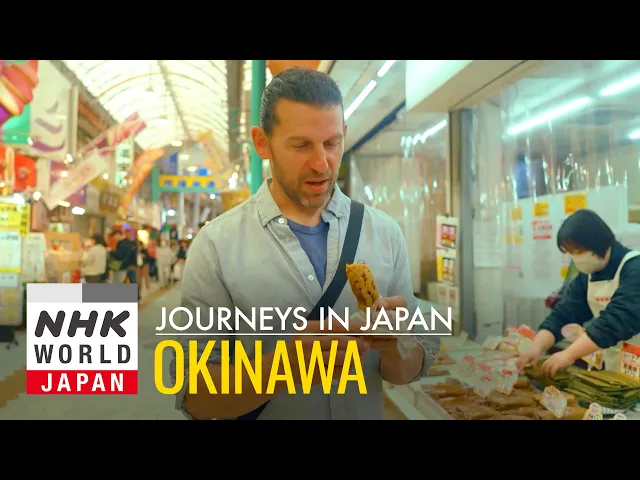
Kokuto Okinawa Island Sweetness - Journeys in Japan
NHK WORLD-JAPAN
0:01 [music] Blue and green,
0:09 the colors that define the scenery of the Okinawa Islands.
0:14 Fields of sugar cane sway and rustle in the breeze.
0:18 [music] The juice pressed from this sugar cane is carefully cooked
0:22 down to create a traditional form of sugar known as coco.
0:28 That's the way it's [music] been made here for over 400 years.
0:35 [music]
0:36 Okinawa was then known as the Ryukyu Kingdom.
0:39 Ever since, Koko has remained a staple in people's daily lives.
0:52 You do like this.
0:53 On this edition of Journeys in Japan,
0:56 Michael Kea explores the [music] enduring appeal of this homegrown
1:00 source of sweetness that encapsulates the spirit of these southern islands.
1:08 [music] [singing] [music] Around 1500 kilometers southwest of Tokyo,
1:25 Okinawa's main island lies on the edge of the East China [music] Sea.
1:33 Drawn by its subtropical climate and unique history and [music] culture,
1:37 tourists find this island archipelago has a very
1:41 different flavor [music] from the Japanese mainland.
1:49 Michael [music] lives in the countryside outside
1:51 Tokyo where he runs an organic farm.
1:59 Hi, I'm Michael Ke.
2:00 This time I've come to Okinawa.
2:02 Now, one thing I love about Okinawa is it has a wide variety
2:05 of foods that you can only find here and not on the mainland.
2:07 And this time I'm going to learn all about coto or black sugar.
2:11 Now, it's a sugar that looks like brown sugar, but it's completely different.
2:14 Has a new texture, flavor, and aroma.
2:17 And I'm sure if we look around, we're going to find it right away.
2:19 So, let's get started.
2:24 I found it.
2:25 It's over here.
2:28 If you look at it, you can see it's got a much darker,
2:31 richer color than uh your typical brown sugar does.
2:36 So, this must be a Okinowan sweets shop.
2:55 Just opening, I could smell that coto aroma.
2:58 It's absolutely strong.
3:03 That's really good.
3:04 It definitely has that distinct flavor that only kto has.
3:18 In the heyday of the Ryuku Kingdom,
3:21 [music] Okinawa was an important hub for trade between East Asian countries.
3:30 Sugar making was introduced from China in [music] the 17th century.
3:34 It's done by boiling down the sugar cane juice,
3:37 adding a small amount of lime powder to help it solidify.
3:42 To this day, cocoa [music] is still produced by this same simple method.
3:47 It's an Okinawan specialty.
3:55 Most coca is produced on eight small islands away from the Okinawa mainland.
4:04 Michael is set off to visit one of those islands.
4:07 It's called Eima.
4:12 Eima was formed by the uplifting of a coral reef.
4:17 The islanders have produced cocoo here since the days of old.
4:37 Looks like you're busy harvesting right now.
4:54 Looks like they have uh sugar cane here.
5:05 Tommo Chinati is a sugarcane farmer.
5:09 He was born and bred on Eima.
5:25 Fresh sugar cane.
5:41 the soil in Eima is dry as it doesn't hold the water well.
6:09 Just wait.
6:18 Harvesting sugar cane is hard work as the leaves and husks
6:22 have to be stripped off one cane at a time.
6:33 [laughter] Yeah.
6:58 [laughter] [music] The locals also work together to produce their cocoa.
7:14 The harvested sugarce is taken
7:16 to the local refinery where it's immediately pressed.
7:20 The juice is then boiled down until it can be solidified.
7:27 The finished coco is packed with flavor, sweetness,
7:31 and the concentrated nutrients of the sugar cane.
7:55 Wow.
7:55 You can see the entire island from up here.
8:02 From this vantage point down below,
8:04 you can see why sugarce would be such a staple on this island.
8:15 The ferry is waiting to take Michael back to the main island.
8:26 What's this?
8:29 [music] This building was a welfare institution offering loans to the villagers.
8:38 Built almost a 100red years ago, it suffered severe damage in World War II
8:42 and has been preserved as a heritage site.
8:52 In the final months of the war, Okinawa was the site of fierce ground combat.
9:00 The fighting left the islands scorched and in rubble.
9:04 About a 100,000 civilians are thought to have died.
9:10 But the islanders found strength and reassurance
9:13 in the resilience [music] and sweetness of their sugar cane,
9:16 which quickly springs back up even after it's knocked down.
9:40 Hey, how you doing?
9:42 Hey, I'm Michael.
9:42 Are you Crystal?
9:44 Yes.
9:44 Nice to meet you.
9:44 Nice to meet you.
9:47 Crystal Bernett is from the US.
9:49 She's lived on Okinawa's [music] main island for 10 years.
9:53 Her deep interest in health [music] and longevity
9:55 has led her to study Okinawa's food traditions.
9:59 She also leads [music] tours for visitors to experience life on the island.
10:05 [music] They drive north.
10:07 They're heading to Higashi,
10:08 a village where Koko plays a part in people's everyday lives.
10:17 [music] Nice to meet you.
10:42 Nice to meet you.
10:42 [laughter] 73-year-old Moto Mura Tamiko has lived in this area all her life.
10:49 She's an Okinawan through and through.
10:54 She takes them around her fields.
11:00 Take it.
11:14 Tomato.
11:34 All right.
11:34 So, I've uh been in Okinawa for a few days now,
11:38 and I'm looking forward to getting breaking a sweat and helping out.
11:41 I love digging soils.
11:43 So, let's get started.
11:50 Okay.
12:07 [music] So, this is basically how I spend most of my days back in Kanagawa.
12:19 So, I'm kind of on uh cruise control while doing this.
12:31 [music] Easel.
12:32 Crystal, how you getting along over there?
12:35 Apparently, I need more power.
12:36 [music] Need more power?
12:38 Apparently, I'm not strong enough.
12:40 She's She's stronger than me.
12:46 [music] Oo.
12:49 Wow.
12:50 It's not necessarily [music] the biggest farm,
12:52 but in this Okinawa sun, it's really hot out here.
12:56 I'm breaking a sweat.
13:23 What I always say about coto is that it's like the equivalent
13:26 of the energy drinks that people drink now these days when they work out.
13:31 Yeah.
13:31 So this this dark brown sugar was like
13:32 a Okinowan's energy drink back in the day.
13:36 It has a lot of vitamins and minerals in it
13:38 that really replenish everything that you lose through your sweat.
13:40 Oh, nice.
14:09 Moto also uses coca in her everyday cooking.
14:17 She's preparing local wild boar seasoned with coca, salt, and sake.
14:44 It's so good.
14:45 Um, unlike regular white sugar, it's got a lot more depth in the sweetness.
14:49 I'm tasting different minerals in there and it uh really
14:53 makes for a lot more depth in this type of recipe.
15:13 Despite [music] its long reputation as a healthy food,
15:16 demand for coca has been hit by [music] changes in people's
15:20 diets and the drastic drop in tourism during the co pandemic.
15:25 In 2021, [music] unsold inventories rose to a critical level.
15:31 However, that challenge has given rise to even greater possibilities.
15:47 This distillery produces aamorei, the [music] local liquor of Okinawa.
15:55 It's a distilled spirit made from rice and a black type of cooji mold.
16:04 Drawing on his [music] expertise in distilling awamorei,
16:07 Nakazato Akida has developed a line of rums,
16:11 each made [music] with a different type of coco.
16:44 Oh, it's so good.
16:46 It's got It actually breaks down much easier.
16:49 It's a very soft texture and it has almost
16:52 like a like a almost a fluffy type of flavor.
17:07 Wow.
17:07 It's got a much stronger bitterness to it.
17:10 Heavier flavor.
17:12 This one actually kind of reminds me of molasses.
17:29 Michael tries the rum made with cocado from Auni.
17:33 It has a mellow sweetness.
17:36 Oo, it's got a buttery type of uh aroma to it.
17:46 That's really smooth.
17:49 It's got it's it's a little bit of a higher alcohol content,
17:52 so it's got a bit of a spiciness to it,
17:55 but uh yeah, it doesn't have any aggressive tones in it.
17:58 Very uh nice melt.
18:30 Nakazato's [music] passion has given rise to a new line of Okinawan liquor.
18:38 Wow.
18:42 Wow, this place is beautiful.
18:44 Thank you.
18:47 Bartender Sugioda Satoshi has a growing international reputation.
18:52 [music] He's developed a range of spiced rums that combine
18:56 Nakazato's Kokoto rum with flavors drawn from Okinawa's [music] food tradition.
19:07 This is another approach to the cocado to see the cockto's [music] potential.
19:14 M.
19:17 Oh, it's completely different.
19:18 [music]
19:19 Actually, this is a main flavor come from the assa,
19:21 which is like a sea lettuce in Okinawa.
19:23 It's quite an important ingredient for the Okinawan cuisine.
19:27 Oh, sea lettuce.
19:30 Assa or sea lettuce is a local seaweed
19:33 [music] that is harvested in the early spring.
19:37 The reason why we use this like a botanical because like
19:41 uh the the harvest time of the sea lettuce is very limited.
19:45 So but we can see like a sho lettuce on the table in entire year in Okinawa.
19:50 But how could they keep it?
19:52 They keep inside a freezer.
19:54 But sometimes like a surface of the sea lettuce became a bad color.
19:58 Yeah.
19:58 Then they try to put it back to the ocean.
20:00 Even the flavor is still fine.
20:02 So we just try to let them stop.
20:04 Please, we just use it for the distilleration.
20:07 Oh, so rather than it being wasted,
20:09 you decided to turn it into delicious alcohol.
20:12 Oh, that's a point.
20:15 Other examples [music] include shiquasa limes,
20:18 which are mostly discarded after being squeezed for juice,
20:22 [music] or local bonito flakes, which are facing a drop in consumption.
20:28 Sugi [music] is promoting his cocoo rums abroad
20:31 as a way to support Okinawa's food [music] producers.
20:47 [music] Wow.
20:49 Absolutely incredible.
20:52 He also [music] adds a playful touch to some of his creations.
20:55 The inspiration for this one is Okinawa soba noodles.
20:59 [music] It's made with rum flavored with bonito flakes.
21:05 M.
21:08 Oh wow, that's so good.
21:11 There.
21:11 So there's a depth and there's so many different flavors.
21:13 A little bit of sweetness, sour, and that umami coming through.
21:18 So much happening at once.
21:19 My mouth is surprised.
21:22 I just work in the big city.
21:24 This is my first challenge to work in the local bar
21:27 but uh I realized like it's quite easy to connect
21:31 with our the first industry see like a master distiller aan
21:37 like local factory like a local farmers and we decided to support
21:41 them in somehow what we can do as a like a bar team
21:46 we have like a strong connection to the world so we just want
21:49 to support them for introduce how Okinawa has a great product in here.
21:54 That's beautiful.
21:55 Thank you.
22:12 [music] The roots of Koko culture run deep in Okinawan society.
22:22 In the old [music] days,
22:23 each village had its own small refinery producing its own local cocoa,
22:29 even on the Okinawa [music] mainland.
22:44 Toguchi Suguru is one of the few
22:46 Kokoto artisans [music] left on the main island.
22:50 He continues the tradition passed down by his grandfather.
22:54 He also offers hands-on coca workshops.
23:13 Toi goes to great lengths to capture the flavor of the fresh sugar cane.
23:26 He pours about 25 L of juice into his cauldron
23:30 and simmers it down over a wood fire, reducing the liquid fast.
23:43 H smells almost like roasted marshmallows.
24:01 As he works, he draws on his memories
24:03 of the aromomas and textures he learned from his [music] grandfather.
24:08 He was a true artisan, and he taught Toguchi everything he knows.
24:23 Toguchi worked as a salary man until his 30s.
24:27 But after his [music] grandfather died,
24:29 he quit his job and became a Kokoto craftsman.
24:39 foreign.
25:17 sticky.
25:21 After just an hour and a half, it's done.
25:31 Oh, okay.
25:34 Once the pot is removed from the fire,
25:36 the thick syrup has to be stirred constantly as it cools.
26:12 It's still really warm and it's bringing that really nice rich aroma.
26:28 Coco when it's still only half hardened.
26:32 It's a very special treat.
26:45 All right.
26:56 [music] Cotto has always reminded me of the southern Japanese islands,
27:01 but I never pondered exactly why.
27:03 [music] On this journey,
27:05 I learned that the connection between sugarcane and Okinawa
27:08 goes deeper than the soil in which it is grown.
27:11 Historically, it [music] has helped sustain the society here
27:14 thanks to its ability to be grown in difficult conditions.
27:17 And culturally, I learned that to this day,
27:20 it is still [music] tightly woven into the fiber of the local's lifestyle.
27:24 And this can be easily seen in the food culture as well as in Yuimaru,
27:27 [music] or a community of mutual support.
27:30 And I hope that this culture continues for future generations.
27:39 [music] From Tokyo, flights to Naha take around 3 hours.
27:45 To reach Eajima, it's about 30 minutes by ferry
27:48 from Moto Port in the [music] center of Okinawa's main island.
27:56 [music]