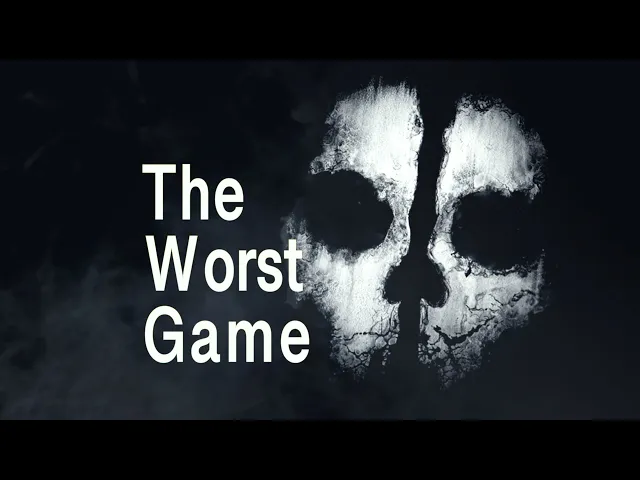
Call of Duty: Ghosts – Power, Paranoia, and Orbital Tungsten Rods
Folding Ideas
0:00 [explosions] [ominous music] Call of Duty Ghost
0:22 might be the worst game I've ever played.
0:25 Now, that requires a lot of qualification
0:27 and humming and hawing and generally being annoying,
0:29 but such is the cost of these things.
0:32 Ghosts occupies an odd place within
0:34 the megalithic franchise that is Call of Duty.
0:36 At this point, it sits roughly in the middle,
0:39 being the 10th main title in a series with 21 full banner annual releases.
0:43 It begs us to ask, It begs us to ask: what is a Call of Duty?
0:47 Well, back in the late 18th century, modern nation states as we know them began
0:51 to coalesce within a new ideology called nationalism,
0:54 which will differentiate with a small n to distinguish it
0:57 from the Nationalist political movements that would arise in the 20th century.
1:01 Within small-n nationalism, people began to view themselves as part of a new
1:06 national identity that encompassed or even
1:09 superseded their local ethnic identities.
1:12 This would lead to...
1:13 a bunch of stuff.
1:15 [ticking clock] As the story goes,
1:21 when US soldiers started killing and dying during the Great War,
1:24 it became necessary to start giving medals for doing
1:27 a particularly admirable job of killing or dying.
1:30 Additionally, it was felt that the US Medal of Honor
1:33 had been handed out too frivolously during the Civil War,
1:36 and the Medal risked being trivialized as over 3,000 had been awarded.
1:40 Okay, this is just It turns out this was a huge boondoggle.
1:45 Actually, a double boondoggle.
1:47 Look, I had to play Call of Duty Ghost like a dozen times to make this.
1:51 Y'all are going to sit there and listen to my goddamn research.
1:54 President Woodrow Wilson ordered the War Department to do a review
1:57 of the system and the committee in turn revoked 911 legacy Medals of Honor.
2:03 Boondoggle one is that apparently in the Civil War, tons of medals of honor,
2:07 being the only award the military had at the time,
2:11 were handed out for some pretty suspect reasons.
2:13 Many had been promised basically as a recruitment bonus,
2:16 over 500 were awarded to a unit that had
2:20 already gone home for a mission they didn't do,
2:23 and Buffalo Bill wasn't even in the military at the time
2:26 he did the thing that got him the medal.
2:29 Boondoggle number two was that Buffalo Bill,
2:31 for better or worse an American icon,
2:33 had his Medal of Honor stripped from him the week that he died.
2:37 Battlefield surgeon Dr.
2:38 Mary Edwards Walker, who got her recommendation from Sherman himself and spent
2:41 four months of the war in a Confederate POW camp,
2:45 was one of nine civilian surgeons to be awarded
2:48 the medal and the only one to have it revoked.
2:51 She was also the only woman to have ever,
2:54 even to this day, been awarded the Medal of Honor.
2:57 Just to not leave that story hanging,
2:59 she refused to return it to Congress and wore it
3:02 proudly until she died in 1919 at the age of 86.
3:06 Congress did eventually reinstate her award...
3:10 in 1977.
3:11 However, amidst the bureaucracy and sexism, a phrase was born.
3:16 Miller, Oscar F., Major,
3:18 361st Infantry is awarded the Medal of Honor for conspicuous
3:22 gallantry and intrepidity above and beyond the call of duty.
3:26 And 85 years later, we've got a video game franchise.
3:30 Since its inception in 2003,
3:31 the Call of Duty first-person military shooter brand has produced 21
3:34 mainline titles and has produced 21 mainline titles and 22 spin-offs.
3:39 Originating as a cinematic shooter in response
3:42 to Electronic Arts' Medal of Honor games,
3:44 which were themselves soft adaptations and expansions of the film
3:48 Saving Private Ryan under the supervision of Steven Spielberg.
3:51 The games are known for their giant setpiece levels, heavily scripted sequences,
3:55 extensive voice cast, cutting edge visuals,
3:58 and just all-around high production value.
4:01 Quickly though, let's introduce our corporate cast of characters.
4:05 The franchise as a whole is published by Activision,
4:09 now Microsoft Activision Blizzard King.
4:11 The original game was developed by Infinity Ward,
4:13 but after the success of the first game,
4:16 Activision brought in a second studio, Treyarch,
4:18 to begin working on a third game, while Infinity Ward worked on the second.
4:23 The idea being that the sequel would drop in 2005,
4:26 and then Activision would already have a sequel to that game,
4:29 ready to go for 2006, which would give Infinity Ward 2 years to make the game
4:35 after that, and then the game of Leapfrog would continue.
4:38 Eventually, they would need to bring in two more studios,
4:41 Sledgehammer and Raven, to wrangle the ever ballooning scope.
4:45 But we're getting ahead of ourselves.
4:47 This plan for a yearly release paid off huge when the fourth game,
4:52 subtitled Modern Warfare,
4:53 smashed sales records and catapulted Call of Duty from being
4:57 a merely successful franchise into being the video game franchise,
5:02 a cultural shorthand for the idea of a video game.
5:07 Indeed, Call of Duty was pushing the leading edge of production value
5:10 so hard that the franchise became the definition of AAA video games.
5:15 In the same way your grandmother could
5:17 describe all video game consoles as a Nintendo,
5:21 AAA video games could be simply a Call of Duty.
5:25 Ghost, released in 2013, is the 10th mainline title in the series,
5:29 the sixth made by developers Infinity Ward.
5:32 The game follows two brothers, Logan and Hesh Walker,
5:35 as they shoot their way through a series
5:37 of nonsense levels strung together by a jingoistic plot rooted
5:40 deeply in American insecurity that was bubbling up
5:43 as the global war on terror solidly entered its second decade.
5:47 It is the near future, the quote "great energy producing deserts"
5:50 in the Middle East have been destroyed by war,
5:53 cutting off much of America's energy, leading to a collapse and decline.
5:57 In the power vacuum that followed,
5:59 South America has been united or conquered under
6:02 the banner of the Federation of the Americas,
6:04 often simply referred to as the Fed.
6:07 The game opens as two astronauts perform maintenance
6:09 on the control station for the orbital weapon ODIN,
6:12 a kinetic bombardment system utilizing tungsten rods dropped from space,
6:16 an impractical but popular pop culture
6:19 weapon often shorthanded as rods from God.
6:22 As they are performing the finishing
6:24 checks on this decidedly military super weapon,
6:26 the station is attacked and hijacked by Fed forces
6:29 who gain entry by posing as an American supply shuttle.
6:32 The Fed successfully target and bomb
6:34 a large swath of Southern California, Texas,
6:37 and Florida before the temporary prologue protagonist, or prologist,
6:41 destabilizes its orbit and burns up in the atmosphere.
6:45 That sounds grammatically incorrect.
6:46 So ju- just to be clear,
6:49 both the prologonist and ODIN burn up in the atmosphere.
6:53 Parallel to this, Elias Walker tells his sons the origin
6:56 story of a fabled special ops team called the Ghosts.
7:18 In this other backstory, in another time, another war,
7:21 60 men from a joint special ops team were tasked with guarding
7:24 a hospital and they get obliterated over the course of a couple nights.
7:28 60 become 15 and eventually these remaining 15,
7:31 they evacuate the hospital and send one of their own as an escort.
7:36 Then the remaining 14 cover themselves in blood and sand
7:39 and hide under the bodies to ambush the enemy fighters.
7:42 The prose in this story is florid, reverential, bordering on spiritual ecstasy.
7:47 They are baptized with blood and anointed by the sand,
7:51 then massacre the opposition with hit-and-run tactics that are so
7:55 sick and badass that the one remaining enemy fighter goes crazy.
8:13 Goddammit.
8:14 It's even got the ellipsis right there in the subtitles.
8:18 I feel- I feel like I feel like this is what
8:22 Folding Ideas sounds like to people who don't like Folding Ideas.
8:25 This literal campfire story is then interrupted
8:27 by the rods from God falling on San Diego as the Fed uses ODIN
8:31 to obliterate basically everything south of Santa Monica.
8:34 The body of the game takes place 10 years later,
8:37 long after the war with the Fed has come to a stalemate.
8:41 It's not really relevant to anything,
8:42 and you need to dig into the codex entries to sort it out,
8:45 but basically the US military doesn't have branches anymore.
8:48 It's all just one big blob,
8:50 which is really just the underlying justification for the main characters,
8:53 Logan and Hesh, to run around doing whatever the designers thought was cool.
8:57 After a tutorial mission and some walk-and-talk,
9:00 the boys are sent out to scout some fed salvage operation back in San Diego,
9:04 their first big mission beyond the massive border wall the US has built.
9:08 They are assisted on their missions by the game spectacle feature,
9:12 Riley, a trained German Shepherd and his doggy cam sneak attack.
9:17 [dog growling] Despite the lengthy geopolitical setup and helldump of backstory,
9:23 the game's lore is extremely front-loaded and the meat
9:26 of the game revolves around a man named Rorke,
9:29 a Ghost and dad's former commanding officer.
9:32 Oh, spoiler.
9:33 Dad's a Ghost.
9:34 Like, that's why he knows all their backstory and stuff,
9:36 but not like a cool Ghost.
9:38 He's just he's a he's an assassin special ops badass.
9:43 I- It's It's treated as a twist.
9:46 It's- You're supposed to find- You're supposed
9:48 to- You're- It's treated as a twist.
9:51 They play it like it's a real twist that you didn't that you didn't see coming.
10:09 So Rorke, along with your dad, was one of the original 14 ghosts who
10:12 were anointed with sand after defending the hospital.
10:15 And his psych profile is basically that he's Rambo,
10:18 but like Rambo III or Rambo 4 Rambo, not really First Blood Rambo.
10:25 Rorke went missing in Caracas two years
10:27 before the ODIN incident and was presumed dead.
10:30 When the Fed threatened all of South America
10:32 and ordered all US-born residents killed or imprisoned,
10:35 the US preemptively invaded Venezuela and sent
10:38 the Ghosts to assassinate Fed leadership in a mission
10:41 that culminates in Federation leader General Almagro ordering
10:44 a missile strike on a massive dam overlooking the city.
10:48 Now, this self-destructive action here,
10:50 we're going to have to set aside the fact
10:53 that America's enemies are so insane they'll nuke themselves,
10:56 was already a recurring plot beat in the franchise by this point,
11:00 so we can instead focus on the silliness of the scenario.
11:04 If Western media gets accused of playing fast and loose
11:07 with its audience's lack of knowledge of the rest of the world,
11:11 few other instances will really compete with this game stashing a billion
11:16 gallons of water a kilometer in the air above the Caribbean Sea.
11:20 So, the Ghosts do successfully assassinate General Almagro,
11:24 you play as your dad, Elias, for this mission and shoot him yourself.
11:27 But the helicopter crashes, Rorke falls into the water,
11:29 and after weeks of searching for his body,
11:32 the Ghosts are pulled from Caracas, and Rorke is declared MIA.
11:36 Since he's the antagonist, he obviously survived and now he holds
11:39 a grudge against the Ghosts for a combination
11:41 of not rescuing him and not having the decency to die trying to rescue him.
11:46 He was instead captured by the Fed and tortured
11:48 in a jungle pit where they used all the old standards:
11:52 isolation, temperature extremes,
11:53 sleep deprivation, stress positions, keeping him wet,
11:56 presumably direct physical and verbal abuse,
11:58 and they feed him psychoactive poisons implicitly, implicitly ayahuasca.
12:02 This process, stylized for the cinematic blows all of the white
12:06 off of him as black alien crystals burst out of his skin.
12:10 That's interesting iconography.
12:11 That might come up later.
12:21 He becomes the main villain of the entire game.
12:23 And he's Bane, the Batman villain.
12:25 Specifically, the Bane from The Dark Knight Rises,
12:28 a two steps ahead criminal mastermind with seemingly
12:30 limitless resources to pour into a plan that uses
12:33 lofty geopolitical ambitions as a smoke screen
12:36 for a personal grudge against a couple specific dudes.
12:39 There's a series of Rorke focused missions, including backstory,
12:42 then an infiltration mission to find where he's hiding,
12:45 an assault on the hideout, capturing Rorke, then getting hijacked by Rorke's
12:49 people and dumped in the jungle,
12:50 after which the game switches to hardcore filler mode.
12:53 There's a winter science facility level in Chile,
12:56 then an oil rig level in Antarctica, then an underwater level in the Atlantic,
13:00 then a factory level in Brazil somewhere north of Rio.
13:03 After blowing up the factory,
13:05 the team heads to a safe house in the remains of Las Vegas to hang out,
13:09 where they get ambushed and captured by Rorke again.
13:25 There's a sinking aircraft carrier, then a tank mission,
13:28 and a second space mission, and then finally you fight Rorke on a train.
13:32 The thing you learn in all of that faffing about,
13:34 maybe a nugget per mission, is that the Fed has cloned ODIN.
13:38 That wreckage way back in the San Diego level where Doggy Cam was a mechanic,
13:43 that was ODIN, and I guess that information isn't exactly hidden,
13:47 but it's really downplayed.
14:04 It's actually kind of amazing how good a job the game
14:07 does of making this theoretically
14:08 important discovery feel utterly beneath notice.
14:10 The crash satellite looks unremarkable in the muddy
14:14 brown gloom that pervades the game,
14:16 and all leading lines direct the player away from it.
14:19 You get a glimpse at the top of the hill,
14:21 but the shape of the hill and the people shooting at you
14:24 from down below pull your attention downwards and then to the left.
14:27 When you exit the cave, the shooting is again coming from the left,
14:31 pulling your view away from the crash site.
14:34 Even when you exit the building and traverse
14:36 a catwalk that goes right next to the satellite,
14:39 the game makes sure there's people shooting at you off to the left,
14:43 pulling your attention away from the wreckage.
14:46 In glimpses and fragments,
14:47 this crash satellite just looks like indistinct industrial wreckage.
14:51 A refinery or a silo of some kind,
14:54 not a grounded weapon of mass destruction that's
14:57 the reason everyone's in this mess in the first place.
15:00 The only way to really appreciate that it's
15:02 the wreckage of ODIN is to sit around and explore.
15:05 But this is a game that very much does not want you to explore.
15:09 Cinematic shooters are 90% high gloss hallways.
15:11 That's kind of the core pitch.
15:14 You trade freedom to wander
15:16 for extremely intricate scripted sequences and spectacle.
15:19 Wandering off is almost always tightly constrained.
15:22 A door that you aren't explicitly directed to open will almost never open.
15:27 A side hallway that isn't part of a shooting
15:30 arena will almost always deadend quickly with nothing to see.
15:34 In the case of the ODIN wreckage,
15:36 poking around is explicitly punished by falling into radioactive kill zones,
15:40 sending you back to the previous checkpoint.
15:43 Curiosity in the genre is structurally discouraged.
15:47 So, nominally, Logan and Hash were sent to San Diego
15:50 to figure out what the Fed is rooting around looking for.
15:52 But when they find it, they just go,
15:54 "I dunno some big busted thing looks expensive," and are
15:58 then immediately derailed by Rorke capturing a Ghost named Ajax,
16:02 at which point the actual mission is discarded in lieu of meeting up with Ghosts
16:07 Merrick and Keegan and heading off to rescue
16:09 Ajax from the ruins of Dodger Stadium.
16:11 So, the fact that the Federation is rooting
16:14 around in the wreckage of ODIN is uncovered
16:16 in chapter 3 and then deemed so unremarkable
16:18 that aside from a stray mention in chapter 9,
16:21 it isn't really relevant again until chapter 13 when
16:24 the team stumbles into a factory loading up Federation ODIN clones,
16:28 a project called Loki,
16:29 named after the shape-shifting infiltrator that ends the world.
16:33 Now, here's the very important thing to remember about Loki.
16:36 It is said out loud to call your attention to this.
16:39 The important thing to note about the clone of the orbital penetrating rod
16:43 weapon of mass destruction built by the South
16:46 Americans is that theirs is smaller.
16:48 It's less girthy.
16:49 It's not quite as potent, but it is significantly more numerous.
16:58 There might be some symbolism in there.
17:01 I don't know.
17:02 There's another space mission where Americans hijack Loki
17:04 and start raining hell down on South America.
17:06 You drive a tank.
17:08 You fight Rorke on a train.
17:09 You eventually shoot him and your brother
17:11 and all of the windows crack, like blow open,
17:14 and he drowns and you and your brother sit
17:16 on a beach watching the world burn as the credits
17:19 start to roll before the inevitable and tragic
17:22 sequel bait when an apparently immortal Rorke kidnaps Logan,
17:25 that's you, and drags him off with a post-credits clip implying that Logan
17:29 is being subjected to the same jungle drug torture brainwashing as Rorke was.
17:34 So, Ghosts falls apart in basically every way.
17:38 Like, if we're talking about a bad game,
17:40 what are the ways in which a game can be bad?
17:43 They can be just technically bad, unstable as software,
17:46 that doesn’t launch right, crashes frequently,
17:49 or breaks at the programming level.
17:51 That's one type of bad.
17:54 It can be just not particularly fun to push the buttons like the responsiveness
17:58 of it or the feedback that you get or the rewards that you get,
18:02 the way that it respects or disrespects your time.
18:05 Or it could be offensive on some narrative level: the story is full of holes,
18:09 it isn't told in a way that carries the player through,
18:13 character motivations are vague or thin,
18:15 actions and consequences don't really seem to line up,
18:19 and maybe it espouses some morally reprehensible worldview.
18:22 Ghosts is all of these.
18:25 So, the long story short behind all this is twofold.
18:27 One is simply that games of this scope take, as a rule of thumb,
18:31 about three years to make,
18:33 and Activision had their studios cranking them out in barely two.
18:36 While Ghosts was not noted for its development crunch,
18:39 this is because it was still so ubiquitous and normalized across
18:42 the AAA industry in the early teens that it was deemed unremarkable.
18:46 A contemporary Guardian article about the development of Ghosts
18:49 opens by talking about crunch in an extremely matter-of-fact way,
18:52 like how you would say that being a sailor involves the risk of getting wet.
18:57 The second is that around the release of Modern Warfare 2,
19:00 Infinity Ward went through a major upheaval.
19:03 Studio co-founders Vince Zampella and Jason West had wanted
19:07 to sever Modern Warfare from the Call of Duty brand,
19:10 getting Infinity Ward a bigger slice of the record-breaking pie.
19:13 When Activision caught wind of this, all hell broke loose.
19:17 The two were fired, then they sued
19:19 Activision for basically manufacturing cause for their dismissal,
19:22 then Activision counter-sued,
19:23 calling them "insubordinate and self-serving schemers who attempted to hijack
19:28 Activision's assets for their own personal gain." This got very messy.
19:32 It came out that Activision had a thing called Project Icebreaker that West
19:36 and Zampella alleged was a scheme to oust them from Infinity Ward,
19:40 while Activision insisted in their defense that Icebreaker was merely a scheme
19:44 to spy on employee emails in order to improve the relationship with the studio.
19:48 In the fallout, almost four dozen devs departed Infinity Ward in solidarity,
19:52 leaving a big old hole in Infinity Ward's dev team.
19:56 While Modern Warfare 3 would ultimately come out on time,
19:59 it was only because Activision brought in Raven
20:01 and Sledgehammer to help finish the game.
20:03 Afterwards, it was decided that the 2-year
20:06 leapfrog cycle just wasn't enough time,
20:08 and thus the third game out from that point
20:11 would be developed by Sledgehammer starting a three studio rotation.
20:14 All this required was for the folks
20:16 at Sledgehammer to be brought fully up to speed,
20:19 not just finishing assets for a game already in progress,
20:21 but working from scratch with the new engine and all
20:25 the various intricacies of making a Call of Duty.
20:28 This added workload on the remaining Infinity Ward staff,
20:31 creating a massive technical debt that would ultimately be paid by Ghosts.
20:36 None of the problems that plague Ghosts are unique to it.
20:39 Rather, Ghosts is unique for suffering from every
20:43 single problem that plagues AAA video game production.
20:46 I have taken the liberty, for the sake of pacing and shaking things up a bit,
20:51 of organizing all that into a numbered list.
20:57 The focus in development was on getting the game ready
21:00 for the launch of the PlayStation 4 and Xbox One,
21:03 which left the PC version in a pretty bad state
21:06 with numerous development problems leading to frequent crashes to desktop,
21:10 broken script triggers, and numerous soft locks.
21:13 They fixed a lot of this over the years.
21:15 It is a lot more stable these days if you play it on a modern machine,
21:18 but it's still really easy to soft lock various levels because
21:22 Call of Duty games are extremely complicated on a scripting level.
21:26 If in chapter 2 you exit the tunnel into the LA
21:29 River and immediately try and shoot down the helicopter,
21:31 you can actually sort of shoot it down,
21:33 but since it's supposed to come back later
21:36 and you've already tripped the flag saying it's destroyed,
21:38 it just never comes back for when you're actually
21:41 supposed to shoot it down and the level soft locks.
21:43 I hear more literal birds than I hear helicopters.
21:49 All right.
21:50 Well, only one option.
21:57 [explosion] The experience of the game, the game play itself is sluggish.
22:06 Even sprinting feels more like a waddle.
22:09 There is multiple vehicle segments that just do
22:11 not function the way that you'd expect them to.
22:14 The helicopter fights in particular have a very bizarre
22:17 control scheme that I still do not fully understand.
22:20 Lateral movement works more or less like you'd expect,
22:24 even if it feels terrible.
22:26 But altitude control is semi-automated within a very shallow layer.
22:31 It's very awkward if you expect the helicopter to control like a helicopter.
22:40 It's just kind of ugly.
22:41 Even at the time, Call of Duty games were
22:43 remarked on for being dominated by shades of brown,
22:46 green, brown, brown, green, gray, brown, and gray.
22:49 Online comic strips like VG Cats were already mocking this trend in 2007.
22:54 And yet, 7 years later, Ghosts somehow takes that and makes it even worse.
23:00 The brown/gray shooter has effectively become an archetype,
23:03 and Call of Duty Ghosts is its avatar.
23:06 The game's average color is taupe.
23:08 This actually brings us to our next point,
23:10 which will hand off to Folding Ideas Mexican Office.
23:14 [Mariachi music] A major marketing point was the hiring
23:24 of Oscar-winning screenwriter Stephen Gaghan to pen the script.
23:27 Now, Gaghan won an Oscar for Traffic,
23:30 a movie with its own, let's say, interesting relationship with Latin America.
23:35 Traffic can be almost single-handedly credited
23:37 with convincing audiences that Mexico looks like piss,
23:40 which in turn became the visual language of hot places that are also dangerous,
23:45 which became the visual language of war writ large,
23:48 which is in part why Call of Duty Ghosts looks the way it does.
23:52 In all fairness to Gaghan,
23:53 I just happen to have a copy of the published shooting script,
23:56 and it doesn't say anywhere, "Mexico, a land the color of piss.
23:59 Everything is a shade of piss,
24:01 even the sky." So that one's more on Soderbergh or, well,
24:05 Peter Andrews who's just Steven Soderbergh with a Carhartt beanie and a Leica.
24:10 Gaghan’s pedigree as a writer is honestly like most writers a little mixed.
24:14 He wrote Traffic and Syriana, but he also wrote Abandon and The Alamo.
24:18 And not relevant to Ghosts, but still funny.
24:21 He would eventually write and direct
24:23 the 2020 film Dolittle starring Robert Downey Jr.
24:28 Oh, good heavens!
24:29 The writing of a video game is complicated,
24:31 more so for a game like Call of Duty than most.
24:34 But there are elements that we can pretty safely put in Gaghan’s lap,
24:38 like the mission briefings with their absolutely tortured stoic prose.
24:49 This is just kind of a whirlpool of hell.
24:52 The performances aren't saving the script,
24:54 but the script isn't giving the performers material worth saving.
25:08 The bulk of the story is very stupid and is plagued with obvious
25:12 backfills that are emergent from the way that the game is made.
25:16 The cinematic shooter is so reliant on massive setpiece
25:19 events that they have become the cart leading the horse.
25:22 This aspect is basically an open secret of how
25:25 the game and an embarrassing number of modern blockbusters are made,
25:29 but it is rarely as obvious as it is with ghosts.
25:33 Cool moments were devised first.
25:35 Production was started and artists and coders and scriptors
25:38 were put to work building a sinking aircraft
25:41 carrier years before a writer would be sent
25:44 in to figure out why an aircraft carrier is sinking.
25:47 After all, enemy gunships and boats just move around on predefined paths.
25:51 The exact model of helicopter, the flags being flown,
25:55 or the uniforms on soldiers can all be swapped later.
25:58 For a big part of the process,
26:00 they're just floating cubes and other placeholders anyway.
26:04 Even the dialogue and character interactions have the hallmarks
26:08 of being as unintrusive and generic as possible.
26:12 Characters are mostly an ephemeral presence,
26:14 barking immediate orders into your ears.
26:25 The "why" of what you're doing simply needs to be kept
26:28 to a minimum presence so it can slot in easily at a later time.
26:33 This is why every mission has on average one moment that actually matters.
26:37 The character learns or accomplishes one thing,
26:40 frequently by watching a video or reading a document.
26:44 And the significance of that thing is more often than
26:47 not shuffled into the interstitial monologues that serve as loading screens.
26:51 You're sent to blow up an oil derek off the coast
26:54 of Antarctica in a bluff to lure away the Fed's navy,
26:56 but that doesn't make any sense.
26:58 Not as a plan and not as the motivation driving you through the mission.
27:02 It's simply the results that you're told afterwards,
27:05 and then later that diverted Navy just shows up
27:09 and sinks the US's last remaining aircraft carrier anyway.
27:12 The crashed ODIN in chapter 2 is so conspicuously
27:15 unremarked upon that it's entirely possible that it wasn't
27:18 even decided what rubble the Fed soldiers would be
27:21 searching through at the time the mission was started.
27:23 Like, not to get repetitive here, but this is the full exchange.
27:41 You don't interact with it, it's surrounded by killer radiation,
27:44 so you can't try and do anything with it, Merrick and Keegan don't ask about it,
27:49 and despite the fact that you were sent out explicitly
27:51 to figure out what the Fed were doing in San Diego,
27:55 this information is seemingly never relayed.
27:58 The thought that the Fed is trying to salvage ODIN
28:00 in order to make their own isn't floated as a possibility,
28:04 even as the characters are watching the Fed launch
28:08 mystery ballistic missiles that NORAD loses track of after launch.
28:20 There isn't even a beat where a character puts two and two together
28:23 the moment that they walk into the room and see Loki being loaded up.
28:27 Even the bit with Loki is like, okay, they walk into the room,
28:31 they see something, there's a bunch of radio chatter about it,
28:35 and then they move on.
28:37 This level could be 95% completed without the artists
28:42 even knowing what's going to go in that slot.
28:46 These events, these thoughts are all siloed from one another,
28:50 interacting only through the narrow tunnels between missions.
28:53 There is simply zero internal cohesion to the story.
28:57 It's so obviously and shoddily a series
29:00 of set pieces that were hastily strung together.
29:03 It's actually difficult to keep them in order in the memory
29:06 simply because there's so little logical connection between them.
29:09 In the game, you infiltrate the lab to get files on the missile program,
29:14 blow up the oil derrick to lure away the navy,
29:17 then sink the last destroyer guarding Brazil so you can sabotage the factory.
29:20 But we could just as easily make it
29:22 that during the factory sabotage mission, we uncover Loki.
29:25 Then we blow up the destroyers so we can get access to the oil derrick,
29:29 which as a one-two punch will lure the Navy in the Pacific towards the Atlantic
29:32 so we can infiltrate the lab and steal the access codes needed to subvert Loki.
29:37 All it would need to replace is
29:39 a few lines of dialogue and the interstitial monologues.
29:41 Other missions are less egregious,
29:43 but never properly escape this artifact of their creation:
29:47 missions are in the order that makes a reasonable
29:50 amount of narrative sense while breaking up the mechanics.
29:56 Many of these set pieces are extremely obvious in their influences.
30:01 Again, it's basically an open secret that Call of Duty
30:04 level designers just look for moments from movies and go,
30:06 "Wouldn't it be cool if you could play that?" But, I don't know.
30:10 It just feels so hack when the inspiration is so obvious.
30:14 Rorke allows himself to be captured for no particular reason except that it
30:18 allows the game to recreate the opening of The Dark Knight Rises.
30:21 One level is lifted in pretty equal measure
30:24 from The Dark Knight and Transformers: Dark of the Moon.
30:30 The game doesn't really have mechanics.
30:33 It has the simulation of mechanics.
30:35 In a typical game, hell, let's get saucy and say in a real game,
30:41 the player is given a suite of interactions that they can perform,
30:43 and it is then given to the player the freedom to figure
30:46 out how to best string together these interactions to accomplish their goals.
30:51 Ghosts instead gives you a gun and a context prompt.
30:54 Things like night vision goggles, thermal optics,
30:57 the dog Riley, a blinding strobe light,
30:59 a motion tracker, and gas grenades aren't tools that you are given,
31:03 tutorialized on, and then expected to deploy at your discretion,
31:07 they are gimmicks that pop up at predetermined moments and persist
31:10 in your toolkit for only as long as deemed necessary.
31:19 Now, there are a lot of compromises that are
31:21 made in the service of the "cinematic" in "cinematic
31:25 shooter." The player is ultimately on rather tight rails
31:28 with little freedom in how they approach the world.
31:31 This is not inherently bad.
31:33 Roller coasters are literally on rails
31:35 and roller coasters are really, really fun.
31:37 And at a certain level of abstraction,
31:40 this is true about basically every game with a linear story.
31:43 Using Doom 2016 as an example,
31:46 while the player can backtrack through large areas
31:48 of the game for a substantial chunk of the play time,
31:52 this is ultimately little more than the freedom to hunt for collectibles,
31:56 as the actual bang bang pew pew rip and tear gameplay remains constrained
32:00 to a predetermined chute you must climb
32:02 into if you want to rip cacodemon eyeballs out.
32:04 [Music] The argument in favor of rails is that they
32:05 are needed [monster screams] The argument in favor of rails is
32:10 that they are needed to provide a kind of tightly crafted
32:13 experience that a freer sort of sandbox environment just can't deliver.
32:17 But with that comes an unspoken contract,
32:19 that I as a player am seeding an amount of control in exchange
32:22 for something impactful and the expectations
32:25 that the rails will be reasonably well disguised.
32:29 I shouldn't feel the rails because the path forward should
32:32 simply be the one that I most want to go down.
32:36 This way for cacodemons and their eyeballs.
32:39 Call of Duty Ghost is littered with so many friction points,
32:42 the poorly laid out levels, the obnoxious characters, the incoherent story,
32:47 that the illusion, the buy-in just falls apart.
32:51 You begin to notice that you're thrust into situations
32:53 where tools you were given earlier would be useful,
32:56 but you don't have them because they weren't actually tools in the first place.
33:00 They were single scene gimmicks.
33:02 There is a veneer of realism here in the sense that your commandos aren't going
33:06 to be showing up with the same ever
33:09 ballooning kit of toys to every single mission.
33:12 But that realism shreds like tissue paper when a very useful tool
33:17 like the strobe light is only functional within a single specific room.
33:23 The fake commitment to realism results in frankly boring gunplay.
33:27 While you will occasionally stumble across a shotgun or machine gun,
33:30 by and large you will spend the campaign
33:33 cycling through a series of indistinct assault rifles.
33:36 Step after boring step of the game is
33:38 saturated with barked orders from your commanding officers,
33:41 who perpetually sound pissed off that they even need to deal with you,
33:44 giving the distinct impression that the game
33:46 not only feels obliged to hold your hand, but resents doing it, too.
33:54 Put all in a package, Ghosts is a great simulation of what an escort
33:58 quest must feel like from the perspective of the NPC.
34:04 Help, I'm trapped in a numbered list factory, the bosses stole my passport,
34:08 if you're reading this, tell my wife I'm still alive,
34:11 please send rescue Ghosts are cringe.
34:17 The amount of worshipful religious prose that is poured
34:19 out talking about the ghosts is weird and embarrassing,
34:22 especially given that the source of most of that is Elias talking about himself.
34:30 But it really reaches the next level after Elias is killed.
34:34 In the story, the ghosts are a quasi-official
34:36 inter-departmental unit consisting entirely of 14 people.
34:40 There were 15 soldiers left at the hospital,
34:42 one of them was sent to escort evacuees,
34:45 14 stayed behind to be anointed by sand.
34:48 That event in and of itself is within
34:51 the lifetime of all of the games characters.
34:53 Merrick, Rorke, Elias, Ajax, and Keegan were all there,
34:57 they are first generation Ghosts,
34:59 Logan and Hesh are implied to be the first initiated Ghosts ever.
35:04 From the events of the game,
35:05 the Ghosts are depicted as both quite new, very exclusive,
35:08 and badass to the point that prior to Rorke killing Ajax,
35:11 the unit has suffered zero confirmed casualties.
35:15 So, with all of this framing,
35:16 it's all just so deeply cringe when Hesh spends a loading screen detailing all
35:22 the Ghost funerary rites and customs like they're
35:25 a deeply rooted tradition with generations of practice.
35:48 Let's talk about the dog.
35:50 Ghost had two big elements that became
35:52 the backbone of the marketing campaign for the game.
35:54 The lesser of these is the aforementioned hiring
35:57 of Oscar-winning screenwriter Steven Gaghan to pen the script.
36:01 The big one was Riley the dog.
36:03 [Mark Rubin] This is someone you care about.
36:05 This is a squad member.
36:06 He does everything from sniffing out explosives to protecting the team.
36:10 Riley is only mechanically available to the player in two chapters.
36:14 He's less like a squad member and more like a specialty
36:17 grenade that you have access to for three specific gunfights.
36:21 He's barely in the game.
36:23 There's a whole thing in chapter 14, that's the one where your dad dies,
36:27 and Riley kind of appears out of nowhere and then gets shot
36:29 and you need to carry him through the rest of the level.
36:32 After that, they show him at the start of the aircraft carrier mission,
36:35 the one where the carrier sinks.
36:37 But since there's a 3 days later fade in between,
36:40 Riley is just sort of quietly ushered out
36:43 of existence in the uncertainty of that transition.
36:49 The political undercurrents of the story are
36:52 repulsive and reflect the madness of an America
36:54 trapped in a quagmire of its own making and desperate for a new villain.
36:58 Diagetically, America is on the backfoot,
37:00 is in decline following the collapse of the quote "energy producing
37:04 deserts" and is embroiled in a defensive war against a superior foe.
37:09 At least that's what we're told.
37:11 Since so much of the story is really about Rorke's personal grudge,
37:14 the geopolitics sink into the distant background.
37:16 America being in some nebulous decline is
37:18 simply the prerequisite to justify the conflict, to make it a fair fight.
37:23 America built an orbital weapon of mass destruction when they were in decline.
37:27 So, you know, take that for what it's worth.
37:30 So, let's actually look at how Rorke fits into all of this thematically.
37:35 We have this soup of action set pieces
37:37 strung together by a plot written around them, what emerges from that soup.
37:42 The theme that comes through loud and clear
37:45 is that Rorke gives the Fed their potency.
37:48 The plan to hijack ODIN is cooked up by Rorke,
37:51 the attack on Santa Monica is Rorke, and Loki is Rorke's doing.
37:55 All the various filler tasks ultimately revolve around getting ahead of Rorke.
38:00 Rorke is an attempt at de-racializing an inherently racialized conflict.
38:05 You simply cannot have a conflict between the United States
38:10 and Venezuela without invoking the spectre
38:13 of US interventionism in South America.
38:16 What do you mean by political?
38:18 That doesn't mean anything, right?
38:20 The question is this a political game doesn't actually mean anything
38:24 because it- it's what does the word political mean to you?
38:29 Do we touch topics that bear a resemblance
38:32 to the geopolitics of the world we live in today?
38:36 Hell yeah.
38:36 'Cause this is the- that is the subject matter of Modern Warfare.
38:40 Despite the developers insistence their games are simply good sugary
38:44 fun that happens to resemble something in the shape of geopolitics,
38:49 kind of like a candy cigarette,
38:51 they do remain aware of the implications of the things they make
38:55 and in the early teens were visibly sensitive to the push back.
38:59 They received criticism for how the Arab factions in Call
39:03 of Duty 4 were depicted with a nuclear suicide bombing,
39:06 so Modern Warfare 2 instead revolves around
39:09 the threat of a duplicitous US general, and then in Modern Warfare 3,
39:14 it was revealed that the nuke had actually been the machinations not of Al-Asad,
39:20 but of that game's antagonist, Vladimir Makarov.
39:23 Rorke is, in one sense, a safe antagonist.
39:27 It makes the game about Americans fighting Americans,
39:30 white people fighting a white person
39:32 whose most vocal motivation is simple revenge.
39:36 However, in the same way that the levels are generic
39:38 vessels for McGuffins to be placed into at a later date,
39:42 the natural end point of a production pipeline that demands endless crunch,
39:46 Rorke is the end point of corporate cowardice.
39:50 There is a potentially insightful conclusion down the path of "the greatest
39:55 threat to America is America itself," but this is not that.
39:59 The message here isn't civil,
40:01 it's not suggesting that America has invested so much
40:04 in outward strength that it has become internally brittle,
40:07 that the contradictions of American existence
40:10 threaten the concept of America itself.
40:12 The vulnerability isn't American hubris,
40:15 the vulnerability is American subversion.
40:18 The game plays to the sensibilities of an America
40:21 in tension with the war on terror, the war in Iraq, and the war in Afghanistan.
40:25 As these wars were solidly entering their second decade,
40:28 the narrative of a righteous war,
40:30 always suspect in the first place, was decidedly faltering.
40:34 America's presence was clearly not a stabilizing
40:37 force and they had become an intractable quagmire.
40:40 So in Ghosts, the Middle East is simply
40:42 written out of the picture in passive voice.
40:45 The destruction of the oil producing deserts.
40:47 No one's fault, just a thing that happened.
40:50 The Fed, which is to say South America,
40:52 is described as invasive, creeping, consuming,
40:54 an inexorable force moving northwards to take over America
40:57 for no reason but for no reason but conquest.
41:00 In the cutscenes, they are an organic oily
41:03 mass crawling across the map and staining it.
41:05 They are a perverting force, a subverting enemy that will invade American space,
41:09 take America's things, and turn them against America.
41:13 The enemy is both impossibly strong and utterly impotent.
41:16 Their power is not strength in their own right, but their ability to pervert.
41:21 Rorke does not become disillusioned with America,
41:24 that's not why he switches sides.
41:26 While he definitely harbors a grudge against specific individuals,
41:29 his heel turn is fully explained as brainwashing:
41:32 he is tortured and drugged and converted into "their Ghost." And, you know,
41:38 there's that imagery.
41:39 As the Federation torturers "go to work
41:41 on his soul," the whiteness is literally blasted
41:44 off him and black crystals rupture out
41:46 of his body as he becomes "their" operative.
41:49 In an attempt at telling an underdog story,
41:51 Ghosts creates a world where American paranoia is fully justified,
41:55 where American orbital weapons are good and right,
41:58 but Federation orbital weapons are an abomination
42:00 and also decidedly less potent, but more numerous.
42:04 It is a world where the Fed is wrong
42:05 to see America as an existential threat and behave accordingly,
42:09 but it is simply pragmatic for America to assassinate Federation leadership.
42:13 The hordes are coming.
42:14 They're sending their murderers, their drug dealers,
42:17 and their rapists to corrupt America.
42:19 The wall is simply a necessity.
42:21 [Applause, chants of "build that wall!"] I don't think much,
42:39 if any of this is intentional,
42:41 rather, it is my belief that Call of Duty: Ghosts is a thoughtless product.
42:46 These are the consequences of a bad,
42:49 albeit Oscar-winning writer simply trying to paint a broad-strokes scene
42:53 to efficiently communicate a stupid plot to an inattentive audience
42:56 after he was handed a pile of half-built set pieces
43:00 and a vague corporate mandate for the overall shape and tone.
43:04 But in that thoughtlessness, in the reliance on stereotype and trope,
43:09 Ghosts tapped into an anxiety of the moment it was created
43:12 in, a desperate need for America to be righteous and justified,
43:17 for its paranoia to be a foresight of something real.
43:21 Given that we are now living in the consequences of that paranoia,
43:25 the odious results of that anxiety, I find Call of Duty Ghosts repulsive.
43:31 The worst game I have ever played.
43:37 Wow, that sure was an episode, wasn't it?
43:40 And to think he didn't even get around to mentioning the fish AI,
43:44 the role of NORAD as the US military's head command,
43:47 seemingly implying that Canada has been annexed,
43:50 the controversy of the developers reusing
43:52 motion capture data from Modern Warfare 2,
43:55 the reality of American energy production,
43:58 or the fact that Eminem song Survival was released as a pre-order bonus.
44:03 Well, anyway, it's a long way back to Canada from here in Mexico where I
44:07 most certainly am because I am in Mexico
44:10 and most definitely not in southern Alberta.
44:12 So, I'm going to get right on moseying.
44:14 Until next time, keep your tango frosty and your LZ cleared.