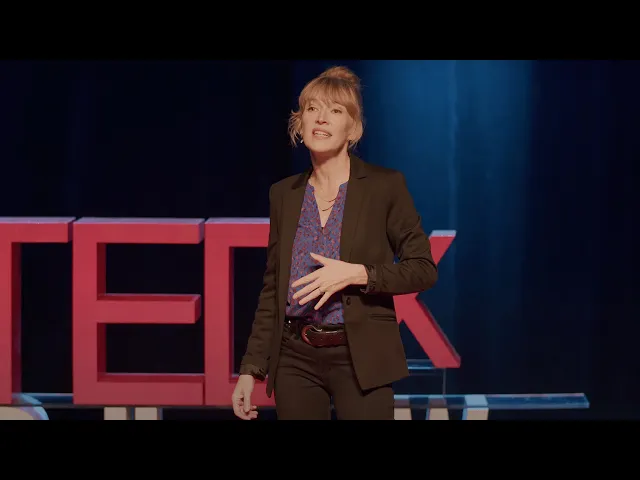
How to be confident (even if you’re not) | Montana von Fliss | TEDxBellevueWomen
TEDx Talks
0:00 Transcriber: Cristina Muñoz Reviewer:
0:04 Raúl Higareda Picture this, you’re going on a boat trip,
0:12 and you get on board with your family, and you got your bags,
0:16 and the captain comes out to greet you and says, “Hi, Um...
0:20 My name is Montana...
0:23 Von Fliss.
0:24 Uh, so...
0:25 I’ll be your captain for this journey...
0:27 (Exhales) So, uh...
0:30 (Laughter) Oh, boy...
0:32 Let’s just have a great trip.
0:34 Sorry.” (Laughter) Nope.
0:37 Get me off of this boat.
0:39 (Laughter) What we want in that moment is for the captain to walk out and say,
0:44 “Hi, my name is Montana Von Fleiss, I’ll be your captain for this journey.
0:49 Let’s have a great trip.” The point is, when you are the speaker,
0:54 you are the captain for that journey, and how you show up really matters.
1:00 For the last 17 years, I’ve coached thousands of speakers all over the world,
1:05 from big tech companies to small startups,
1:08 and everyone, from new hires to CEOs of Fortune 500 companies,
1:14 want to know, how do you show up and look confident?
1:18 So I’d like to share my top five tips
1:21 for how to be confident, even if you’re not.
1:24 So let's break it down.
1:25 What was the difference between those two captains?
1:28 What did you see?
1:29 What did you hear?
1:30 And not just, “One seemed nervous,
1:33 one seemed confident.” But what was I doing differently to make you think that?
1:39 Different volume, different words, certainly different body language.
1:45 But the truth is, I wasn’t feeling particularly confident.
1:50 I was just making certain physical and vocal choices to make you think that.
1:56 You can do that too.
1:57 Anyone can do this.
1:59 So, what are those confident-looking choices?
2:03 Number one.
2:04 Turn up the energy and speak up.
2:07 When you speak up, even just a little bit,
2:10 it reads as confident, and you don’t have to shout.
2:13 Think about it this way.
2:15 On a scale of 1 to 10, aim for a 5.
2:19 Yes, it goes to 11, (Laughter) but you can just aim for a five.
2:25 I’m here at a five right now.
2:27 I can bring it back down to a three here.
2:30 Nervous captain was here.
2:30 And we bring it back up to a five,
2:32 and it sounds prepared, positive, and confident.
2:36 So turn up the energy and speak up.
2:39 Number two.
2:41 Pause...
2:42 like a boss.
2:45 (Laughter) Nervous speakers tend to talk really fast, right?
2:49 And when they do have a pause,
2:50 they fill it in with verbal filler, likes and ums.
2:53 However, if you try to speak more slowly, it just sounds like this, right?
2:59 And that's not better.
3:01 So instead, make strategic pauses.
3:04 Pause in transition.
3:06 Pause for emphasis.
3:07 Pause...
3:08 like a boss.
3:11 (Laughter) Number three.
3:14 Superhero stance.
3:17 Imagine you are a superhero.
3:18 You can do it from your chair.
3:21 How would a superhero sit?
3:23 Yes.
3:23 Let that change your posture.
3:25 I see you.
3:27 Yes.
3:27 Let that bring a smile to your face and have some better eye contact.
3:31 All of that reads as confident, and pretending to be a superhero is just
3:37 a super quick way to have confident-looking body language.
3:42 Now, this one also goes to 11.
3:46 (Laughter) But you can just aim for a five, and that will be great.
3:52 Tuck in that cape and go save the day.
3:56 And you can stand in superhero backstage to boost your confidence,
4:00 but I’m saying bring that superhero stance on stage
4:04 so that your audience sees you as confident.
4:08 And if you need an easy shortcut, just make the shape.
4:12 Just make the shape of a confident person.
4:14 The audience cannot read your mind.
4:17 They don’t know how you’re feeling,
4:19 so just make the shape and they will go with it.
4:23 Like, if you came over to my house for dinner
4:25 and I opened up the door and I was like, “Hi,
4:28 come on in, we’re having chicken.” (Laughter) You’d be like, “Oh,
4:33 is this a bad time?” (Laughter) You know,
4:36 you’ve got to make the shape of a good host.
4:38 Make the smile shape, right?
4:41 Instead of crossed arm shape, open up.
4:44 “Hi, welcome.
4:45 Come on in.” If you’re not sure if you’re making confident-looking choices,
4:51 you can just video yourself and watch it back.
4:57 I feel like I just saw you say, “Um, not doing that one.” (Laughter) I know most
5:02 people don’t like to watch themselves, I get it.
5:05 But wouldn’t you rather...
5:07 make that adjustment before you’re in front of your audience?
5:12 Yes.
5:13 Videoing yourself is a great way to check
5:15 in to see that you’re doing the techniques,
5:18 but also to see that it’s still authentically you,
5:21 your version of confident captain.
5:25 Now, how can you do all of these things on performance day?
5:30 Number four.
5:32 Practice with purpose.
5:34 So, make yourself a rehearsal schedule.
5:37 Put it in your calendar.
5:38 You can give yourself a little treat when you do a run through.
5:42 And make it practice with purpose by giving yourself a specific
5:46 goal or layering in one new confident captain technique each day.
5:52 If it’s a week before your event,
5:54 aim to run it all the way through at least once a day.
5:59 If you have no time for a run through, just take the opening and closing,
6:02 and run that three times in a row from anywhere.
6:05 When you’re in the shower, when you’re walking your dog,
6:08 when you’re making a meal for your kids.
6:10 I know my kids are very used to me walking around the house talking to myself.
6:15 Whatever you need to do to get in those repetitions.
6:20 And don’t be afraid of over practice.
6:24 Don't let that stop you.
6:26 You can just let go of your verbatim script if it’s starting to sound robotic.
6:31 And you can still use bullet point speaker
6:35 notes to remind yourself of what you would like
6:37 to say and to invite you to say it
6:40 a little bit differently each time to keep it fresh.
6:44 And let me be clear, by practice, I mean standing up,
6:49 saying it out loud, imagining your audience
6:52 and inviting them in, clicking through your slides,
6:56 doing it as much like it will be on the day, whether it’s virtual or in person.
7:02 And I know it might feel a little funny saying it out loud to yourself,
7:08 but think about when you learn a new sport,
7:12 or when you practice a musical instrument.
7:15 If you had a piano concert on Friday, and you got new music on Monday,
7:20 would you only read your music every day and then play
7:24 it for the very first time at the concert on Friday?
7:27 No way.
7:28 And yet, I see speakers do this all the time.
7:32 Give yourself a chance.
7:34 Practice helps everything.
7:37 And it can really boost your confidence to practice
7:41 with purpose by layering in one new technique each day.
7:48 Okay, those first four techniques,
7:50 they’re all about how to appear confident, regardless of how you’re feeling.
7:56 I’ve got one more technique for you, and it’s a big one.
8:01 But this is the real gem.
8:02 It's the one that makes all the others shine.
8:06 This is number five, the silent sentence.
8:11 This is about what you choose to tell yourself.
8:16 I’ve been a professional actor since I was a kid,
8:18 and I have always loved going on stage as an actor, as a speaker, as an emcee.
8:25 And, at the same time, I have often been not just nervous,
8:30 sometimes downright terrified to step on a stage.
8:36 I’m shaking, I’m sweating, and I’m like, “What was I thinking?
8:40 Why do I do this to myself?” And all these unhelpful voices flood in.
8:44 And I just tried to make it stop, push it away.
8:48 And of course that never worked.
8:50 And I kept going on stage because I love it.
8:55 And years later, when I became a speaker coach,
8:58 I got asked to do all these professional presentations,
9:01 and they went well, but I still had no way to deal with that massive anxiety.
9:08 And I was like, “What can I do?” And I thought,
9:13 “Well, what am I telling myself?” “What if you mess up?
9:18 You better be perfect.” I realized I was
9:22 giving myself an impossible instruction to be perfect.
9:27 And that really was not working.
9:30 But what would work?
9:31 What would be a better message?
9:33 And to figure that out, I had to go back to square one.
9:36 Like, what do I want?
9:39 Why did I say yes to this speaking gig?
9:42 What is my deeper purpose here?
9:45 And I realized at the heart of it,
9:49 I just want to help my audience to the best of my ability.
9:55 And when I said that, I noticed everything change.
9:59 And that's where I found my first silent sentence.
10:03 I want to help my audience to the best of my ability.
10:07 When I said it, even silently to myself, it acted like this override switch.
10:12 Like I might still be shaking and sweating, but now I have this higher goal,
10:17 this deeper purpose, and everything aligned to that.
10:20 And that became my highest priority.
10:22 I want to help you.
10:24 And now, that thought replaced those unhelpful
10:27 thoughts and everything went better in my performance.
10:31 And I was like, “Yes, it worked.
10:36 Yay!” And then I was like, “Wait, how do I do this every time?
10:42 Especially when the stakes are high.” And it dawned on me,
10:47 if I’m writing and crafting the words I say out loud,
10:51 why not write and craft the words I say silently to myself?
10:56 Put it in the script.
10:58 It’s the silent part of the script.
11:02 So now, every time I rehearse, every time I walk onto a stage,
11:08 every time I join a virtual meeting,
11:11 I say the following, new and evolved silent sentence,
11:17 “I invite you to be here with me while I am here
11:23 with you so that I can make this easier for you.” Now,
11:31 that invitation to myself to be present,
11:36 that’s my definition of stage presence, being present.
11:41 And that invitation to the audience to be my partner,
11:44 that reminds me, these are friends, not foes.
11:48 And I am choosing to be here.
11:50 And now I’m not just making the shape of a good host.
11:53 I really am a good host because I am genuinely welcoming you to my world.
12:01 Now, how do you go about finding your silent sentence?
12:06 What do you want?
12:08 What's your deeper purpose?
12:11 You could be like me, and you might just want to help people.
12:15 Or it could be something more specific.
12:17 For example, you might want at least one person
12:20 in your audience to walk out and take a CPR class.
12:25 Or maybe you’re just super excited to have this experience
12:28 or share with them some cool solution you have for their problem.
12:33 You get to fill in the blank and decide what you want to accomplish.
12:39 And this is not about graduating to some higher
12:42 level of being where you never again feel nervous.
12:47 Yeah, I know I haven't.
12:49 I was feeling it pretty big about 15 minutes
12:52 ago (Laughter) while getting ready to walk on this stage.
12:56 And I am, and probably always will be a recovering perfectionist.
13:05 That is a well-worn pathway in my brain.
13:08 It is there, it exists, it cannot be erased.
13:12 But now I have this other pathway.
13:16 And when big moments like this come up, I get to choose.
13:20 And that's what I was doing back there in the wings.
13:23 I was choosing to gently insist on repeating
13:28 my silent sentence to set myself up for success.
13:34 What we tell ourselves really matters.
13:37 We follow our own instructions all day long.
13:40 Our whole selves are always listening.
13:44 So when you notice something isn’t going well,
13:46 or you’re fearing something might not go well in the future, use this checklist.
13:53 What am I telling myself?
13:56 What's being broadcast?
14:00 Then replace that with a better sentence to help
14:04 set you up for where you’d like to go.
14:08 And most importantly, put it in the script and practice it.
14:12 Practice it just as much as the words you say out loud.
14:15 So if you’re running your intro in the shower three times in a row,
14:19 it would go silent bit, out loud bit, silent, out loud, silent, out loud,
14:23 until it is inextricably linked and it is just a part of your process,
14:30 and it is repeatable and reliable.
14:34 And then it’s just there for you when you need it.
14:38 Now, I want to leave you with this final thought.
14:42 When you’re at home and you’re practicing some of these techniques,
14:46 like turn up the energy and speak up, pause like a boss,
14:52 superhero stance, practice with purpose, and your silent sentence,
15:00 please know that it might feel uncomfortable
15:02 at first because it’s new and that is normal.
15:06 But think back to when I was demonstrating the nervous captain at the top.
15:09 How did that make you feel?
15:12 And then when the confident captain came out, “Oh, what a relief.
15:16 Now I can just sit back and enjoy the ride.” Remember that feeling
15:20 of safety you had as an audience member and bring that into your next rehearsal.
15:25 You can give that gift to your audience.
15:29 Reach outside your comfort zone to make your audience
15:33 feel safe by making the choices of a confident captain.
15:39 And who knows?
15:41 You might even have fun.
15:44 Have a great trip.
15:47 (Cheers and applause)