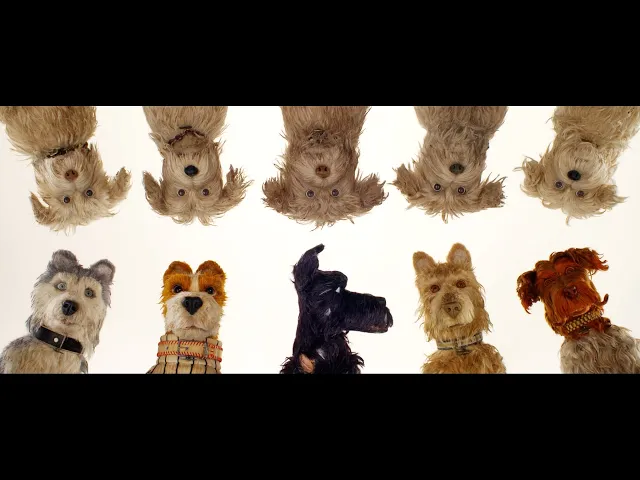
The Visual Comedy of ISLE OF DOGS | Criterion x Every Frame a Painting
CRITERION
0:05 For the past three decades,
0:07 Wes Anderson has left a distinctive fingerprint in American comedy.
0:12 With his penchant for artificial worlds,
0:15 deadpan performances, literary devices, and snappy narration.
0:19 …course of that eventful evening.
0:22 Shall I carry on?
0:23 But there’s something else.
0:25 These movies are funny to look at.
0:28 Over the years, Anderson has experimented more and more with visual comedy.
0:32 And none of this is more apparent than in Isle of Dogs.
0:39 For the sake of brevity,
0:40 we’ll define visual comedy as humor that is mainly conveyed through images.
0:45 You have to look at it to get it.
0:47 For example: This is in direct contrast to verbal comedy,
1:13 which is mainly conveyed through dialogue.
1:15 -Is he dead?
1:15 -He looks dead.
1:16 I have a question.
1:17 Are we eating him or is this a rescue?
1:19 We don’t know yet.
1:20 Nobody’s eating the Little Pilot.
1:22 And when it comes to visual comedy,
1:23 Isle of Dogs is Anderson’s most experimental film yet.
1:31 Wes Anderson is known for a particular style.
1:33 We don’t have time to go into all of it.
1:35 So we’ll paraphrase the great David Bordwell.
1:39 First, he shoots planimetric frames.
1:42 That’s where the background is perpendicular
1:44 to the camera and the characters are
1:45 usually placed as if they’re in a class photo or a mug shot.
1:49 The effect is a bit like watching a stage play or a diorama.
1:53 As a result, Anderson’s worlds have very visible
1:56 geometry and the characters move in straight lines, which is part of the humor.
2:01 To get from one shot to the next,
2:02 Anderson uses a technique that Bordwell calls compass point.
2:06 Basically, the camera can cut 90 degrees or 180, straight in or out.
2:16 And of course, all of the above can be accomplished with a whip pan.
2:21 On top of that, the camera can only move along one axis at a time.
2:25 So it can dolly one way, but then it has to stop before changing direction.
2:31 Now that we’ve established the rules of Anderson’s camera,
2:34 how does he use these parameters to his advantage?
2:37 Get ready to jump.
2:39 Atari… We’ll jump into this scene.
2:41 Yoko Ono is drinking at a bar.
2:43 The camera then jumps backwards to reveal
2:45 the bartender and a wide view of the room,
2:47 which is used for Tracy’s dramatic entrance.
2:50 We then cut 180 degrees for this close-up.
2:53 Once she starts speaking to Yoko Ono… Tracy Walker, Megasaki Senior High.
2:58 …the camera whips 90 degrees.
3:00 Anderson stages most of the scene in a planimetric two-shot.
3:03 This allows him to keep our attention centered while using the edges
3:06 of the frame to let objects exit and enter as needed.
3:10 The great thing about this sequence is that every shot has a distinct purpose,
3:14 and the staging allows Anderson to use the entire frame for comic effect.
3:18 Pull yourself together and act like a scientist!
3:21 But with such a well-defined style,
3:24 the next question is, how can he build variation?
3:30 Well, for one thing, he can subdivide the frame.
3:33 He achieves this effect photographically using deep-focus compositions.
3:37 This shot allows us to see Rex’s
3:39 dialogue and the other dog’s reactions without cutting.
3:42 I don’t think I can stomach any more of this garbage.
3:44 -Exact same here.
3:45 -Words out of my mouth.
3:47 This staging of figures is influenced by Akira Kurosawa’s 1960s films.
3:51 The foreground face plays beautifully against the background figures.
3:55 Similarly, there are numerous shots where the bottom of frame is a wide,
3:58 while the top is a close-up.
4:02 The film also makes extensive use of monitors and TV screens within frame,
4:06 which allows Anderson to play one area of the image against another.
4:10 In Fantastic Mr.
4:10 Fox, we saw an early experiment of this when
4:13 the heist from Bunce was shown only in security footage.
4:19 Isle of Dogs has expanded on that, introducing
4:22 entire action sequences that are depicted via security cam.
4:30 And of course, there is the literal subdivision of frame: the split screen.
4:35 The end result is yet another tool added to Anderson’s arsenal,
4:38 and a way for him to push his style within the restraints he’s given himself.
4:42 Now he can stage elaborate gags literally side by side.
4:55 The second major experiment of Isle of Dogs is in terms of artifice.
5:02 All filmmaking is an illusion.
5:04 And even before he worked in animation,
5:06 Anderson was building artificial constructed worlds.
5:09 But Fantastic Mr.
5:10 Fox was a fulcrum point.
5:17 There were ideas he had tried in live-action
5:20 that animation allowed him to explore even further.
5:25 Because animation is not real,
5:27 the audience has already suspended their disbelief
5:29 further than they would in a live-action film.
5:32 Which means you can get away with things that make no logical sense.
5:37 After he worked in animation,
5:38 we can see Anderson pushing believability further in his live-action work.
5:46 By emphasizing the artifice,
5:47 he can get away with humor that would not work in a more realistic film.
5:54 But it’s a two-way street.
5:57 In Isle of Dogs, Anderson has brought aspects of other mediums into stop-motion.
6:01 The film employs devices from theater,
6:03 like dramatic lighting shifts and on-stage background changes,
6:08 and techniques from live-action filmmaking.
6:10 Unlike other forms of animation, stop-motion exists in the physical world,
6:14 which means the lights, cameras, puppets, and sets are all real objects.
6:19 The film even uses other types of animation.
6:22 For instance, 2D is used to differentiate any moment on a screen.
6:26 He will be rescued promptly, returned to safety,
6:28 and grounded for the duration of his childhood year.
6:31 By stacking all these different mediums on top of each other,
6:34 Isle of Dogs moves further from realism and towards something else: abstraction.
6:42 And abstraction helps him make things funnier, particularly with violence.
6:48 In his earlier films,
6:49 violence is often shown in hand-held, shaky, slightly awkward framing.
7:00 But Fantastic Mr.
7:01 Fox reduced the violence to quick flashes.
7:11 And you can see how that choice directly influenced his next live-action film.
7:20 By Isle of Dogs, the violence became clouds of cotton balls and limbs.
7:24 When the characters stopped fighting, they froze in place,
7:28 a trend that was further expanded in The French Dispatch.
7:31 By abstracting, Anderson is able to imply some pretty violent actions,
7:36 but the humor comes from the images playing
7:38 at right angles to the text of the scene.
7:43 Which brings us to rhythm.
7:45 Visual comedy is hard to describe in words.
7:47 That’s why we often draw the jokes on paper first.
7:51 Max?
7:52 Care to try it?
7:56 I’m sorry, did someone say my name?
7:58 Anderson had always storyboarded his films until Fantastic Mr.
8:01 Fox, when he started using animatics, which are storyboards timed out.
8:06 [Bean] I don’t know.
8:07 Two, I guess.
8:08 [Mrs.
8:09 Bean] You drank three yesterday, though.
8:10 Alright, take three.
8:15 Animatics opened him up to more ambitious visual
8:18 humor because he could design the rhythm in advance.
8:21 Notice the timing of the people passing through frame.
8:25 With all of this in mind,
8:26 let’s take a look at the sushi-poisoning sequence from Isle of Dogs.
8:34 First, it’s deliberately artificial.
8:36 It is timed so elaborately and precisely that the rhythm itself becomes funny.
8:41 Second, the actual violence is never shown.
8:44 We only see an implication and the end result.
8:48 Third, it brings in elements from another medium.
8:51 The hotel operates like a theatrical set.
8:53 When Watanabe appears, the lights change so we can see inside.
8:57 Sequences like this are enjoyable in Anderson’s
8:59 work because we know they’re not real.
9:02 By taking this plot point and pushing it to such extreme artifice,
9:06 he’s disguising tragedy with humor.
9:15 Visual comedy is one of our oldest genres, and has always been a vehicle
9:19 for filmmakers to express their anxieties and fears,
9:22 whether that was Charlie Chaplin and fascism,
9:26 Jacques Tati and modernity, or Terry Gilliam and bureaucracy.
9:31 With Isle of Dogs, Anderson is following
9:33 in that tradition of exploring dark subject matter through comedy.
9:36 Upon his release from Megasaki General, Atari,
9:39 who suffered the loss of his right kidney…
9:41 Wes Anderson’s films are about some pretty tragic things.
9:44 There’s family trauma, grief, emotional baggage, murder, war.
9:50 But Isle of Dogs might be his darkest film yet.
9:54 It’s about a leader who targets a specific group, demonizes them,
9:58 exiles them to a separate location, and then plans their demise.
10:01 The only people willing to stop him are not ordinary folks who largely agree,
10:06 but rather scientists, young protesters, and a lonely orphan.
10:10 The press mostly looks on.
10:13 What shocks the ordinary people into realizing
10:15 what they’ve done is a demonstration
10:17 of how much dogs mean to them by a child reciting a haiku.
10:27 This is not funny at all.
10:30 And yet the film looks very funny, which is, arguably, the point.