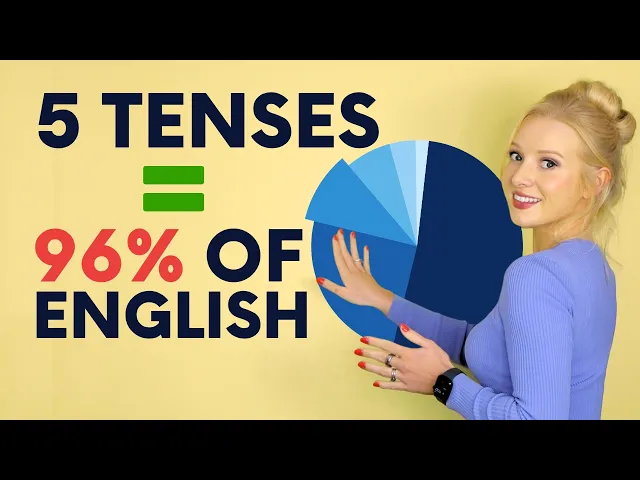
5 Tenses = 96% of English
English with Lucy
0:00 Here is something that will make you doubt everything you've learned in English.
0:05 Just five English tenses are used in around 96% of English interactions.
0:13 Yeah, out of all 12 tenses we learn,
0:18 you only need a literal handful in many conversations.
0:23 So, let's be efficient here.
0:25 I'm going to show you what those five tenses are and how we use them.
0:31 To make this even more efficient,
0:32 I think efficiency is my word of the month here.
0:35 I've also created a free PDF.
0:38 It's basically an ebook at this point.
0:41 It contains everything we discussed today,
0:44 all of the information about each tense,
0:47 extra examples, and a quiz to check what you've learned.
0:50 If you would like to download that for free,
0:52 just click on the link in the description or scan that QR code there,
0:57 sign up to my mailing list, and the PDF will arrive directly in your inbox.
1:02 Okay, here is your pie chart.
1:05 Let's start with the biggest slice.
1:09 The most commonly used English tense.
1:13 I wonder if you can guess what it is.
1:15 It is, drum roll, please.
1:18 About to do it myself.
1:20 It's the present simple.
1:22 It's used around 55% of the time in spoken English.
1:26 Next, we have the past simple at almost 21%.
1:33 So, over three quarters of spoken interactions
1:37 in English happen in just two tenses.
1:40 Following that, there is the present perfect simple at around 8.4%,
1:46 the future with will at 6.4% and the present continuous coming in with 5.7%.
1:56 The rest of the tenses are in that tiny slice of leftover pie.
2:01 Now, these figures are based on a study of spoken British English,
2:05 and as we know, there isn't just one variety of English.
2:09 There's North American English, Australian English, Indian English, and so on.
2:13 Within these varieties, there are countless dialects and regional nuances,
2:20 and people use tenses differently.
2:23 Spoken English itself changes depending on context.
2:28 A casual conversation with friends is quite different from a job interview.
2:32 And then, of course, there is written English.
2:35 In news reports and fiction books,
2:38 the past tense tends to be used more often than the present.
2:44 So, 96% here is an estimate.
2:48 The figures within it vary, but even with all of this variation,
2:52 the same five tenses rise to the top time and time again.
2:57 If you're interested in learning more,
2:59 I've put some links to sources in the description below.
3:03 But now, let's go through some of the most common uses of these five key tenses.
3:08 First, the present simple.
3:10 This is usually the first tense that people learn in English.
3:14 The structure is subject plus base verb,
3:18 or with third person subjects, a base verb with s.
3:23 I love it.
3:25 He lives nearby.
3:27 To see how to form negatives and questions,
3:31 and examples for the present simple and all the tenses to come,
3:35 make sure you download the PDF.
3:37 The link's down there.
3:38 So, why is the present simple used so much?
3:42 Well, it has a lot of functions when talking about the present.
3:46 But, it can also be used to refer to the past and the future.
3:50 It's the Swiss Army knife of tenses.
3:54 We use the present simple to talk about habits,
3:57 routines, and things that are true at the present.
4:01 For example, I often go to the gym on Wednesdays, or she lives in Belfast.
4:07 It's also used to discuss facts and general truths.
4:11 There are billions of stars in our galaxy,
4:15 and the present simple can refer to fixed or scheduled events in the future.
4:20 The play starts at 8:00.
4:23 Finally, the present simple often appears when we tell
4:26 a story or discuss what happens in a book or film.
4:30 So, I'm at the beach yesterday when suddenly
4:34 I see a massive wave coming right for me.
4:37 Or Elizabeth Bennet meets Mr.
4:40 Darcy.
4:41 Now, of course, we also tell stories in the past simple.
4:45 And that is our next most common tense,
4:48 used around 20% of the time in spoken interactions.
4:52 The past simple is formed by adding ed to regular verbs,
4:57 like start started, but some of the most common verbs in English are irregular.
5:03 Do you know the past simple of have, go, and be?
5:07 Had, went, was, or were.
5:11 Okay, and how do we use the past simple?
5:14 Well, we use it to talk about
5:15 completed actions or events that happened before now.
5:20 It might be something that happened once.
5:23 I bought a new phone last weekend, or something that happened several times.
5:29 We went camping in Wales every summer,
5:33 or something that was true for a long period in the past.
5:38 They worked together for over 30 years.
5:42 Next up, the present perfect simple.
5:45 This is formed with subject plus have or has plus the past participle.
5:52 Again, regular past participles are formed by adding ed to verbs.
5:58 Just like in the past simple.
6:01 For example, enjoy, enjoyed, enjoyed.
6:05 But, of course, there are many irregular past participles like eat, ate, eaten.
6:14 Now, my students often find the present perfect tense quite challenging,
6:18 but here's a basic overview.
6:20 Of course, there's more information in the PDF.
6:23 We can use it for states or actions that began in the past,
6:28 but continue to the present.
6:31 For example, we've known each other since primary school.
6:36 Began in the past, we still know each other now.
6:39 We also use it for describing life experiences.
6:43 I've read The Great Gatsby.
6:45 We've never been to Ireland.
6:48 And we use it when something that happened in the past
6:52 has an effect on or is relevant in the present.
6:56 I think I've broken my wrist.
6:59 It really hurts.
7:01 Now, it's worth noting that perfect tenses are more
7:04 common in British English than in North American English.
7:09 For example, in British English, we would say,
7:11 "I've just spoken to John." While in North American English,
7:16 speakers might prefer the past simple.
7:19 "I just spoke to John." Actually, can we get an American to say that?
7:24 I just spoke to John.
7:26 Thank you.
7:27 Our next tense is the future simple or the future with will.
7:32 This is my favorite tense because my husband's name is Will.
7:35 The form is subject plus will plus base verb.
7:40 I will see.
7:42 She will help.
7:44 Now in spoken English, will is nearly always contracted to apostrophe l l.
7:52 I'll.
7:53 She'll.
7:54 And so on.
7:54 They have one syllable.
7:56 It'll has two syllables.
7:59 The negative form of will is will not, usually contracted to won't in speech.
8:06 And fun fact, if my husband's ever rude to me,
8:09 I call him won't because he is not my will.
8:12 We make offers, promises, and spontaneous decisions with will.
8:18 For example, I'll give you a hand with that.
8:21 Meaning, I'll help you with that.
8:23 Or, you're going to the shop?
8:26 I'll come.
8:27 We also use it to express beliefs and make predictions.
8:31 It'll be amazing to see you again.
8:33 Or, you'll drop that glass if you're not careful.
8:37 However, a small study based on the sitcom Friends,
8:42 found that be going to appears more
8:45 often than will when referring to the future.
8:49 Be going to is definitely a key structure to use
8:52 when discussing future plans or making predictions based on present evidence.
8:58 In fast speech, we use the informal contraction gonna.
9:02 It's gonna chuck it down any minute.
9:05 It's going to rain hard soon.
9:08 All right, let's move on to our final tense, the present continuous,
9:13 formed with subject plus am, is, or are plus ing verb.
9:19 For example, I'm speaking.
9:22 Are you coming?
9:24 This tense is used for ongoing actions
9:26 happening at or around the moment of speaking.
9:31 Ellie's walking the dog.
9:33 They are creating a cycle path.
9:36 And we use it for future arrangements.
9:39 Mom's coming for dinner on Friday.
9:42 It's actually a very versatile tense.
9:44 We also use it for things we think are temporary,
9:48 things that are changing or developing,
9:51 and repeated actions that might be annoying.
9:55 Okay.
9:56 Now we've gone through our tenses,
9:58 let's do a short quiz together to test what you remember.
10:03 Use the correct form of the verbs in brackets to complete the sentences.
10:07 There are five questions, and I want you to use each tense from this video once.
10:13 One, Helen university in Glasgow last year.
10:20 The word in brackets is start.
10:23 Two, we them tomorrow morning, and your word is meet.
10:29 Three, I you back in about 5 minutes, and your word is call.
10:37 Four, bees to tell other bees where food is, and your word is dance.
10:46 And five, I Good Will Hunting, and your words are never see.
10:55 Pause the video now to have a think if you need more time.
11:04 Now I'm going to reveal all the answers.
11:06 Number one is started in the past simple.
11:10 This is a completed action in the past.
11:13 For number two, you could have used are meeting
11:17 using the present continuous to talk about a future arrangement.
11:22 We are going to meet them is also fine, expressing a future plan.
11:27 Three should be will call or I'll call.
11:32 That's a promise made with will.
11:34 Four should be dance.
11:37 The present simple for a fact.
11:40 And five should be have never seen.
11:44 The present perfect simple to talk about an experience up to now.
11:49 How did you score out of five?
11:51 Let me know your results in the comments and tell me
11:55 which of these five tenses do you need to practice the most?
11:59 That's it for today's lesson, but don't forget to download the PDF.
12:03 It is stuffed full of information, examples,
12:08 and there's another quiz because one isn't enough.
12:11 The link for that is in the description box, or you can scan the QR code there.
12:15 I will see you soon for another lesson.
12:23 [music] [music]