Learn How to Use Embedded Questions to Ask Polite English Questions 🤔❓🤷
Learn English with Bob the Canadian
0:00 So this isn't the town where I normally record my English lessons.
0:04 So I don't know where everything is.
0:07 So if I wanted to find the bank, I could ask someone, where is the bank?
0:12 But this way of asking the question is very direct.
0:15 It's not impolite, it's not rude, but it's somewhere in between.
0:19 And it would be better to ask it using an embedded question.
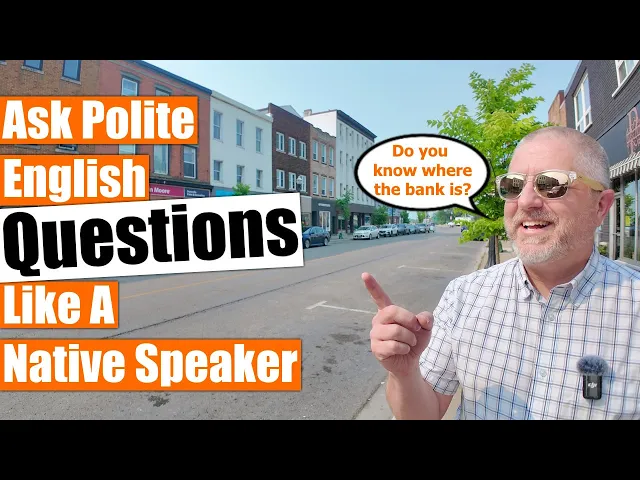
0:23 It's better to say something like this, do you know where the bank is?
0:27 An embedded question is a question,
0:29 and it can also be a statement where there's the start
0:32 of the question and then there's a question inside of it,
0:35 or the start of the statement and then a question inside of it.
0:39 Do you know where the bank is?
0:41 That's a good example of an embedded question.
0:44 So, when I ask it that way, it just sounds a little more polite.
0:48 There's nothing wrong with the first one, where's the bank?
0:51 But listen to this.
0:52 If I walked up to someone and said, excuse me, where is the bank?
0:56 That sounds direct.
0:57 But if I said, excuse me, do you know where the bank is?
1:00 That sounds a little friendlier.
1:02 Here are a few more examples.
1:03 You could say something like this.
1:06 Do you know where the bathrooms are?
1:08 There's an example in the plural.
1:09 Or do you know where the CN Tower is?
1:12 It's not in this town.
1:13 It's in Toronto.
1:15 You can also put this into a statement.
1:17 If I was with Jen and we were both in this town,
1:20 I could say, I wonder where the bank is.
1:23 So you'll notice it's not a question, but it does have.
1:26 That statement does have a little question in it.
1:29 I wonder where the bank is.
1:31 By the way, the bank's right there.
1:33 I found it.
1:34 It wasn't that hard to find.
1:36 I have been to this town before.
1:38 But those are embedded questions.
1:40 Let's look at a few more.
1:42 At some point in our lives, we've all lost something.
1:45 In particular, I sometimes lose my car keys.
1:48 And when that happens, I might ask Jen this question.
1:51 I might say, Jen, where are my car keys?
1:54 But that question sounds a little direct to me.
1:57 It almost sounds like I'm accusing Jen of taking
2:00 my car keys and putting them somewhere else.
2:02 In my opinion, a much more polite way to ask a question would be this.
2:06 Jen, do you know where my car keys are?
2:09 Jen, do you know where my phone is?
2:10 Jen, do you know where my wallet is?
2:13 And if I wanted to create a statement
2:15 with an embedded question, I could say this.
2:18 I wonder where my car keys are?
2:20 This actually might be What I'm thinking as I'm looking for my car keys,
2:24 I wonder where my car keys are.
2:26 So if, I wanted to ask an embedded question politely,
2:29 I could say, do you know where my car keys are?
2:32 And if I wanted to use a statement, I could say, I wonder where my car keys are.
2:37 Let me give you an example of an embedded
2:39 question you can use to ask about a person.
2:41 Let's say you're, at work and there's some new
2:44 person walking around and you don't know who they are.
2:46 You could ask a colleague directly, who is that?
2:49 This is a non embedded question.
2:51 It's just a very direct question, who is that?
2:53 It's not rude, but it's not polite.
2:55 It's probably something you would ask.
2:58 But I think a better way to ask it would be to say this.
3:01 Do you know who that person is?
3:03 Or do you know who that is?
3:06 Again, this is an embedded question.
3:07 It starts with a question and it has a question inside of it.
3:11 Do you know who that person is?
3:13 Do you know who that is?
3:15 If you wanted to just lean over to a colleague
3:17 and use a statement, you could say this.
3:19 I wonder who that person is.
3:21 And then maybe your colleague hopefully knows
3:23 the answer and tells you, well, that's Jim!
3:25 He started here last week.
3:27 So once again, you can use an embedded question to also talk about people.
3:32 Speaking about forgetting things.
3:34 Sometimes I forget people's names.
3:36 If I haven't seen someone for a few years,
3:38 sometimes I don't remember what their name is.
3:41 And if I was with Jen, I might ask this question, what is his name?
3:45 Or what is her name?
3:47 But if I wanted to format it as an embedded question, I could say this.
3:50 Do you know what his name is?
3:52 Do you know what her name is?
3:54 Or do you remember what his name is?
3:56 Do you remember what her name is?
3:58 And if I wanted to create a statement
4:00 with an embedded question, I could say this.
4:02 I wonder what his name is.
4:03 I wonder what her name is.
4:05 That might be what I'm thinking as I drive
4:08 home after seeing someone whose name I couldn't remember,
4:11 and I might have even had a conversation with them.
4:14 I might be driving home thinking, I wonder what his name is.
4:17 I wonder what her name is.
4:19 So again, when you don't know someone's name,
4:21 that's how you would use the embedded question, do you know what his name is?
4:25 I wonder what her name is.
4:28 So in this English lesson, I gave you several examples of embedded questions,
4:31 but they all ended with is or are.
4:34 And there are plenty of other words
4:35 to choose from when you're using embedded questions.
4:38 Words like was or do or go or want.
4:41 Here are a few examples.
4:43 Let's say there was a loud noise.
4:44 I could ask this question, do you know what that was?
4:48 Let's say you're hooking something new up to your network at home.
4:51 And because I know a little bit about technology,
4:53 I might say, do you know what to do?
4:56 Let's imagine Jen and I are in a brand new city, a city that's unfamiliar to us.
5:01 I might ask Jen, do you know where we should go?
5:04 Maybe we're looking for a parking spot or something like that.
5:07 Or imagine you're at a restaurant and you're there with little kids.
5:11 Sometimes it takes little kids a while to decide what they want.
5:15 So you might ask this question, do you know what you want?
5:18 So there's four more embedded questions examples
5:20 that you can use in your next English conversation.
5:23 Well, thank you so much for watching
5:25 this English lesson about embedded questions.
5:27 I hope you were able to learn a few more
5:29 phrases that you can use in your next English conversation.
5:32 If this is your first time here, don't forget to click the subscribe button.
5:34 Give me a thumbs up.
5:35 Leave a comment below and please do consider becoming a member.
5:39 There are more and more exciting things for members on this channel.
5:42 There's a Join button below or a subscribe plus button.
5:45 If you click that, you can get a little bit more information.
5:48 Thanks for watching.
5:49 I'll see you next week with another English lesson.
5:51 Bye.