Why 2025 is numerically the best year.
Stand-up Maths
0:00 [Past Matt] "This one, because my favourite number (for a very personal
0:03 reason) and the reason I absolutely love it,
0:06 is that in the year 2025 I will turn 45.
0:11 [Music plays] And so for a brief moment,
0:16 I will turn the exact square root of the then current year.
0:21 I mean, what a birthday party that's going to be!
0:23 It's going to go off." [Time travel music and effects play] [Past Matt]
0:25 "I'm not calling it The Parker
0:26 Square." [TV Presenter] "Obviously blue and black.
0:28 It is totally blue and black!" [Past Matt] "Ladies and Gentlemen.
0:31 I have really Excelled myself." [TV Presenter] "Pokemon Go has only been
0:34 on for a few days." [Sports Caster] "It's going to be a tough play...
0:38 The Cubs win The World Series!" [Past Matt]
0:41 "A real football has light hexagons and dark pentagons.
0:45 I don't know if I brought this up earlier, Hannah,
0:49 but it's 80% accurate." [TV Presenter] "The first ever glimpse
0:52 of a black hole in space." [Past Matt] "There it is.
0:55 That's the sign." [TV Presenter]"...
0:57 tropical rainforest to the edge of the time itself."
0:59 [Past Matt] "Made it over 4 million percent better.
1:03 Ah, ha ha ha ha...
1:07 Oww!...
1:08 Ahhh..." [TV Presenter] "Willy Wonka experience in Glasgow." [Past Matt]
1:12 "I am going to work one of these out by hand.
1:13 I'm going to try and calculate pi by hand again.
1:16 By hand.
1:17 By hand.
1:17 A record amount of pi by hand." [Music stops]
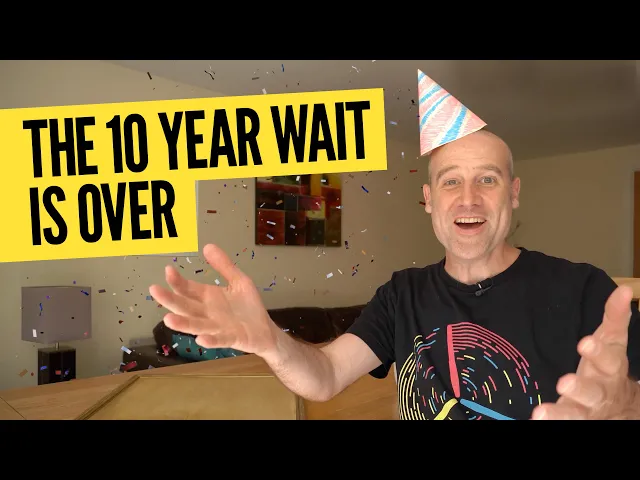
1:22 [Party popper and whistle sound] [Current Matt] It's 2025!
1:24 10 years after that Numberphile Video and we are finally here.
1:29 Of course, I had to make a video to celebrate.
1:32 Although, if you know the original video,
1:34 you realise this is not the party hat I should be wearing.
1:37 [Stand-Up Maths theme plays] [Past Brady] "You thought about what you're
1:46 going to do for your birthday?" [Past Matt] "Oh my goodness.
1:47 I don't know.
1:48 I've still, I've still got a few,
1:49 I got a decade of planning to go and it's gonna, it'll be square themed.
1:54 All the food will be square shaped and not cubes, not cuboids.
1:58 People are thinking square cake.
2:00 No, it's, it's infinitely thin slices of square cake." [Current Matt] "Now,
2:04 for the record, I haven't had my birthday yet.
2:06 It is 2025, my birthday is actually dangerously close to the end of the year.
2:10 It's like practically Christmas,
2:12 which is annoying for its separate birthday-related reasons.
2:15 However, I didn't want to do a video right at the end of the year
2:19 when I should really be celebrating it in the middle of the year.
2:22 And this is the year, 2025.
2:23 It's a square number year.
2:26 And I will turn the exact square root of 2025.
2:30 I will turn 45 later this year, as will anyone who, like me, was born in 1980.
2:36 Now, I stand by all the maths in the original video from 10 years ago.
2:40 It's maths, It's all still correct.
2:42 And in that I talked about other years where you
2:45 can turn a root of a future year in that year.
2:49 And I talked a lot about the year 2184.
2:52 You can check that out at your own leisure.
2:55 [Past Matt] "Hello from the past.
2:57 Uh, this, this, this is how we used to live.
2:59 Here are, the these are, we used to use dead trees to store information.
3:05 And although maybe all of anything digital will
3:08 be destroyed and people have no idea about YouTube,
3:11 but they'll still have these books.
3:12 We don't know." [Current Matt] "So, when I sat down to make a video about 2025,
3:15 which I knew I absolutely had to do,
3:18 I suddenly realised there's some more maths and I didn't notice
3:21 this because I was making it all about me and my birthday.
3:25 But there's another fact about 2025 that everyone
3:27 can enjoy and it's possibly more impressive.
3:30 I was so focused on the fact that 2025 is a square number of 45.
3:36 I didn't notice that 45 is a triangle number of nine.
3:42 And so you actually start with nine and then
3:45 you triangle it and then you square it.
3:48 And while square numbers are wonderful,
3:51 big fan, triangle numbers, they're pretty cool.
3:55 For example, did you realise bowling is actually named after a triangle number?
4:02 It's 10 pins because that's a triangle shape.
4:05 1+ 2+ 3+ 4 is 10.
4:08 And triangle numbers are just the sum of consecutive numbers starting at 1.
4:13 So it's not because 10's a nice round number.
4:15 It's because it's a triangle number.
4:17 That does mean you could do any other triangle number.
4:20 And we care about the ninth triangle number,
4:23 which actually means if you were to ask a bowling alley very very nicely,
4:29 it's technically possible to go 45 pin bowling.
4:32 Thankfully, we were at Murrayfield Indoor Sports Club in Edinburgh,
4:37 and they were very accommodating.
4:39 This is Graham, absolute champ,
4:42 crawling around to arrange the first ever setup for 45 pin bowling.
4:48 Look at it.
4:49 It looks like there's some kind of glitch.
4:53 Isn't that amazing?
4:54 And if you take a close look at the back row,
4:57 there are indeed nine pins side by side.
5:00 And it turns out that's the maximum number of standard
5:04 bowling pins that can fit on a standard width lane.
5:07 This is the maximum of triangle pin bowling.
5:10 [SUM theme plays] Come on!
5:21 No!
5:22 No!
5:24 Ah...
5:26 Could have been the first ever...
5:29 It was a "Parker Strike".
5:32 Unbelievable.
5:32 One pin...
5:34 So there you have it.
5:36 The first ever bowl of 45-pin bowling scored 44.
5:39 And the first (and I suspect only ever frame) was a spare.
5:44 And I can't think of a better way to celebrate
5:47 the fact that 2025 is the square number of a triangle number.
5:51 [Matt in background] "Come on!
5:53 No!" The main new fact that I only realised
5:57 this year is that if you square a triangle number,
6:00 which means you're summing the numbers from 1
6:02 through to n and then squaring the total,
6:05 that always gives you exactly the same result as if
6:09 instead you took the same numbers from 1 through n,
6:13 cubed them all first, and then sum them together.
6:17 That's true for all triangle numbers.
6:19 And because this is a very rare year, that's the square of a triangle number.
6:24 It's true of 2025.
6:26 And now to explain why there are piles of acrylic next to me.
6:29 You see, I was talking to the people at Jane Street.
6:32 They're a financial company who sponsor a lot of my videos,
6:35 including this one- bonus puzzle at the end.
6:38 And I pitched the idea of doing an installation in one
6:43 of their offices based on the interesting number facts around 2025.
6:47 I thought that could be a lot of fun.
6:50 We bounced this around between some people who work at Jane
6:53 Street and someone named Andy Neidmire suggested we take the fun
6:58 fact about 2025 being the sums of cubes and we use
7:03 the related fact that turns it into what's called the ""Partridge Puzzle".
7:09 And that's what we install in the Jane Street office.
7:12 Hear me out.
7:14 If the first nine cube-numbers add to 2025,
7:18 we could take all of those cubes and split them into layers.
7:25 So the 9x9x9 cube could be nine layers that are each 9 by 9 squares.
7:32 And the 8 cube could be eight layers that are all 8 by 8 squares.
7:36 And then all the way down.
7:38 And that's what I've got made out of acrylic here.
7:41 There's nine layers.
7:42 Now, we could have made them all thick enough.
7:44 This was an actual physical cube.
7:46 That wasn't necessary, so we didn't do that.
7:48 But there are nine squares that are all 9 by 9.
7:51 We go all the way down to two squares that on the same scale are two by two.
7:56 And then we have a single one by one.
7:59 That's technically the cube, but of course, it's a bit a little bit more flat.
8:03 Now, if you were to add up all of these squares, they should still sum to 2025.
8:09 But because 2025 is a square number,
8:13 if you had one giant square that's 45 by 45,
8:18 it will have the same surface area as all of these smaller squares.
8:24 And the reason the person who first popularised this relationship,
8:28 someone named Robert Wainwright, called it the "Partridge Problem",
8:31 is because it's a bit like the 12 days of Christmas,
8:35 but now there are nine squares of nine and then all the way down.
8:39 You can imagine how that goes.
8:41 It's once again a Christmas song busting in on my birthday.
8:44 [Song to the tune of "12 Days of Christmas"] "One, two,
8:46 three..." Music aside, we wanted to physically make one of these.
9:21 So, we put together a massive one,
9:23 got it manufactured and installed in the Jane Street office in New York.
9:28 And thankfully, I was recently able to visit it.
9:31 And I was joined by Jane Streeter, Sawyer Tabony.
9:34 We had a bit of a play and first of all
9:36 we thought we would show every side length is 45
9:39 as a triangle number by stacking one of each square from 1
9:42 to 9 to show they add to 45 which was fun.
9:45 And then we set about playing with the pieces.
9:48 We quickly realised it's quite difficult to do.
9:50 And you might be thinking well hang on just
9:53 because the numbers are the same the surface
9:55 area of the square and the pieces is
9:57 2025 that doesn't necessarily mean there is a solution.
10:01 I mean that fact is necessary but it's not sufficient...
10:05 [Matt] "And that's true in general." [Sawyer] "Um,
10:07 yep." [Matt] "For n." [Sawyer] "That's that's true for any n.
10:09 It's kind of a surprising fact but yeah,
10:12 yeah." [Matt] "And is this arrangement true for any n?" [Sawyer] "Um,
10:15 this arrangement does not exist for every
10:18 n that that's a really interesting question." [Matt
10:20 VO] It turns out yes it only works for the case n= 8 and upwards.
10:23 And Sawyer and I had a closer look at the case for n equals 3
10:27 to give an example on a smaller easier
10:30 scale of why sometimes it can be impossible.
10:33 [Matt] "Yeah.
10:34 so you, you'd have a 3x3." [Sawyer] "Yeah." .[Matt] "Which I guess,
10:37 which is one of those." [Sawyer] "One
10:38 of these." [Matt] "Let's just put that in the middle.
10:39 So that's that." [Sawyer] "Yep.
10:40 Uh-huh." [Matt] "and in theory these would cover it.
10:42 [Sawyer] "Yep, they do in fact equal,
10:44 in area." [Matt] "They do But that you have
10:46 to double-cover the centre and you get that." [Sawyer]
10:48 "And you miss there." [Matt] "And that double
10:49 cover should be there." [Sawyer] "Yep." [Matt] "But there's,
10:51 there's no other way to arrange those." [Sawyer] "Yep,
10:55 Exactly." [Matt] How about now?
10:57 Okay.
10:57 I mean, this this is a it's a lot of fun to try and solve,
11:03 but incredibly difficult.
11:04 I I think I used the one up too early, and now I've got these stacks.
11:10 I mean, I probably could get away with all nines up the side here,
11:15 but these towers of six and five,
11:17 I can't get out of that 'cos I've already used up my two.
11:21 Oh, there's not enough.
11:22 It turns out it's very difficult for humans
11:25 because when you're trying to put the last few
11:27 pieces in, whether or not they fit is is
11:30 kind of predetermined by decisions you made ages ago,
11:33 but you don't know if those decisions were right or wrong until you
11:37 have to put a lot more effort in to fit the remaining ones.
11:41 So, you're kind of at the mercy of how
11:43 lucky you were putting in the earlier pieces,
11:45 but with no way to know in advance whether or not you got it right.
11:50 And we should just have a moment's reflection for all
11:53 of Bec Hill's free time that was consumed by this puzzle.
11:56 Bec was sharing a flat with me.
11:58 We're at the Edinburgh Festival Fringe.
12:00 And despite my warning, she got a bit addicted to the puzzle.
12:04 And it's so much fun, but it's so hard.
12:07 I'm sorry, Bec.
12:08 That said, if like Bec Hill, you would like to waste vast chunks of your free
12:13 time and you can't be bothered cutting out squares of cardboard,
12:16 Matt Scroggs has made an interactive version of this which we've put online.
12:19 So, feel free to give it a go.
12:22 But, you know, you probably shouldn't.
12:25 So, while it is fun to do as a human,
12:27 oh my goodness, the odds of finding a solution are so small.
12:31 And the thing is, there are a lot of ways to do this.
12:37 There's over a million possible solutions.
12:40 There's 1,730,280 ways these can fit into that.
12:43 And the reason I know that is because we wrote some code to find them all.
12:50 Here they are.
12:51 [Sawyer] "I have never solved it." [Matt] "Yes." [Sawyer] "Solo.
12:53 Yeah, that's right.
12:54 I have never solved it the the entire puzzle." [Matt] "No.
12:57 Nor have I.
12:57 I wrote some code if we want to find the solution.
12:59 Let's let's just bring one up." [Sawyer] "Yeah, that sounds smart.
13:01 I like that." Behold!
13:02 Many, many solutions.
13:04 My good friend Matthew Scroggs put together
13:07 some code to find every single possible solution.
13:10 I then wrote some code to categorise the solution.
13:14 And first up, we have the 352,072 solutions
13:18 which have an L shape of 9x9 squares.
13:21 So these are just the solutions for n= 8
13:25 but with a big L of nines around the edge.
13:30 I don't find these very exciting.
13:33 Better are the 1,303,584 solutions which just
13:36 have a single stack, a column of nines.
13:39 I guess we call those an "I" of nines.
13:42 And the vast majority of the solutions seems to have an "I" like this of nines.
13:47 So I guess a little pro tip there if you're if you're going from scratch,
13:50 although that's technically cheating.
13:51 The point is I think these are more mixed up than the "L"'s.
13:55 Even better though are the 74,624 solutions
13:58 with no neat lined up stack of nines anywhere.
14:02 I think these are the best.
14:03 Look at them.
14:04 They're all over the place.
14:05 And it could be argued these are the best
14:07 solutions because they make better use of the nines.
14:10 For the record in the code, the 1,730,280 solutions includes all rotations,
14:17 four of them, and the two reflections, which normally we would get rid of.
14:23 And if you divide by 8, there are 216,285 unique solutions,
14:28 but we've left them in because the act of solving it,
14:33 you're solving one specific arrangement.
14:35 So if I put some shapes here,
14:38 I'm only working, they're not also equivalently here and here.
14:41 I'm only working towards one set solution.
14:43 So that's why I stand by my over 1 million claim.
14:47 So my code has taken this solution to be
14:50 different to that solution which is different to this one
14:53 and this one which I kind of stand by like
14:57 I said because when you're building it they are different.
14:59 Also it's a slippery slope.
15:00 If we count this one do we count this one?
15:03 What about that one?
15:04 All the L shapes you could just rotate the middle n= 8 case.
15:09 Or what about within that?
15:11 See those three there?
15:12 We'll spin them around.
15:13 There we go.
15:14 Is that a whole new solution?
15:15 Who knows?
15:16 You could try to slim them down.
15:18 I maintain there are over 1.7 million solutions.
15:22 Because this is such a hard puzzle to do by hand,
15:24 I made the prediction that when we installed it at Jane Street,
15:27 staff members would go away and just write code
15:30 to find a solution and come back and put it in.
15:33 And sure enough, that's what happened.
15:35 James did it and he was kind enough to come and explain how his code worked.
15:40 [Matt] "You're at work at Jane Street." [James] "Uh-huh." [Matt] "You see
15:42 this puzzle?" [James] "Uh-huh." [Matt] "Did you try and do it physically?
15:45 [James] "Yes." [Matt] "And did you find anything?" [James] "No." [Matt] "Right.
15:47 And so then you stormed off and got some old code from high
15:51 school." [James] "Uh-huh" [Matt] "And that found
15:53 a solution." [James] "Yeah" [Matt] "Okay.
15:54 Okay.
15:54 So what did the old code do?" [James] "Uh,
15:57 the old code solved um a more general set of problems of poly cube packings.
16:02 So you can think of like Tetris in 3D puzzles." [Matt] "Yep."
16:06 [James] "Um." [Matt] "Like the Soma Cube kind of..." [James] "Yeah, yeah.
16:08 Like the Soma Cube.
16:09 While solving this, I learned that there were
16:11 lots of dead ends that you can, like, fill out half the board and then, like,
16:14 the other half just has like no solution.
16:18 Um, and that means like my solver is, like, doesn't, doesn't like skip anything.
16:24 It like tries every option before like" [Matt] "Goes every branch until
16:28 it..." [James] "Yeah." [Matt] "Realises there's no solutions at the very end.
16:31 Right?" [James] "Yeah.
16:32 I ran it overnight, at work.
16:35 Um, and I only got one solution." [Matt] "Oh, wow." [James] "Uh yeah.
16:38 So like after like hours of computation time, I only got one solution,
16:43 which is like just shows how like unoptimised the solver is for this, uh,
16:49 particular situation." [Matt] "Yep.
16:50 But it found one." [James] "Yeah, I found one.
16:52 That was, that was nice." [Matt] "And did you build it out of this?
16:56 [James] "Um, yes, I did.
16:58 Okay.
16:58 So while I was home,
17:00 I like rewrote a different solver from scratch." [Matt] "[Laughs]
17:03 From scratch..." [James] "That is like much more optimised for this, um,
17:06 this..." [Matt] "Specific problem." [James] "And it, I like,
17:08 really tried to optimise it too because I
17:10 thought it would like still take like forever.
17:12 Bottom line, it finished in like a couple seconds.
17:14 Like it found a solution in like a few seconds." [Matt] "Boom!
17:17 solution." [James] "Yeah.
17:18 Like almost instantly.
17:19 Um so the next day I came to work and I,
17:23 like, like, put up, um, like, constructed that solution.
17:26 So let's say we're in like this state I guess." [Matt] "Okay.
17:30 Yeah." [James] "Yeah, Yeah.
17:31 This is good.
17:32 Um, so what we do in a partially solved state is that we look,
17:37 we scan, like, in row major order from like the bottom.
17:40 I guess it doesn't really matter.
17:42 So we scan" [Matt] "As long as you're systematic." [James] "Like,
17:45 in in some direction and eventually we'll find an empty cell.
17:47 So in this case this happens to be the the first
17:50 empty cell and we just recursively descend on that.
17:53 So we try this one.
17:55 Um, now recursively descend.
17:56 Now this is the first free cell.
17:59 Fill this in.
18:00 And now if we scan again,
18:02 we can see this one." [Matt] "And nothing that's left is going
18:04 to fit there." [James] "Yeah." [Matt] "And so it backtracks up?" [James] "Yeah.
18:08 Backtracks.
18:08 So nothing fits here.
18:10 So backtrack to there.
18:11 Fill this one in.
18:12 This is the next empty cell.
18:14 But there's only one choice.
18:15 Then you're there." [Matt] "And then you hit
18:17 the very end and you're done." [James] "Yeah.
18:18 Yeah." The only person I know of who has solved
18:23 this, the 45 squared case by hand as a human is Andy.
18:28 And Andy's obsessed with this bit of math.
18:31 Andy's the person who had the idea to turn
18:34 this into the puzzle when we were discussing things about 2025.
18:38 So, does that count?
18:40 I guess so.
18:41 Well done, Andy.
18:43 You be the judge.
18:44 [Andy] "Hi, Matt.
18:45 This is Andy.
18:46 I'm a trader at Jane Street.
18:47 Um, I'm the person who came up with the uh puzzle with the partridge tiling.
18:51 Spoiler alert, uh, the sum of cubes is a square is the message uh of the puzzle.
18:55 Uh, and so the goal was how can I kind
18:58 of like hide that in this uh in these grids.
19:01 I think one thing that's really cool about this kind of partridge
19:05 tiling style of puzzle is that it's really not guaranteed to exist.
19:09 If you if you swap out the pieces for different shapes like
19:14 say triangles or trapezoids then you know it might be the case
19:18 that um you only start seeing uh uh valid tilings at you
19:23 know different multiples like maybe for certain shapes you need a lot
19:26 more pieces before you can find any solutions or maybe you need
19:29 maybe you need fewer pieces and I think that kind of unpredictability
19:33 is pretty cool." [Matt] "and finally thank you so much to Jane
19:37 Street for also sponsoring this video among many of my videos.
19:41 And the reason they're sponsoring this one is
19:43 I'd like to share another puzzle with you,
19:45 which I will link to the URL in the description below.
19:47 The puzzle is basically this neural network,
19:50 Pi-Torch file that you download and interrogate to try
19:53 and work out what the logic is behind it.
19:56 And that's because while neural networks can
19:59 be very powerful despite being completely opaque,
20:02 Jane Street likes to know what's actually going on inside the box.
20:06 So you can see if you've got the skills to dissect this neural network.
20:11 You see Jane Street are a research-driven trading firm and they
20:14 believe that deep learning like this is the future of quantitive trading.
20:17 And so they've got a machine learning team who
20:20 build neural networks that help drive their trading strategies.
20:23 And the same team works on the infrastructure
20:26 that makes the training and inference possible.
20:29 And that same machine learning team, which if you're curious about joining,
20:32 I'll have a link in the description.
20:34 Also put together this neural net puzzle.
20:36 If you think you've solved it, please do email Jane Street and let them know.
20:41 And if you solve the puzzle,
20:42 you can be one of only currently 19 people who've done that.
20:46 Well done to those 19 people.
20:48 And if you're thinking, "Hang on a second.
20:51 I thought Jane Street were a financial company.
20:53 Why have they got well seemingly a whole department dedicated to puzzles?
20:58 Well, I asked Sawyer the same thing." [Sawyer] "We like puzzles here.
21:02 I think there's just sort of a a correlation between being a good,
21:06 good Jane Street employee and like enjoying and being good at solving puzzles.
21:11 Um, and so we I mean in a way a puzzle is a bit
21:15 of a simulation of what it's like to be a Jane Streter, right?
21:18 You we're trying to solve problems that other people haven't solved.
21:21 um we're trying to like write new code and then we
21:25 also get to like have puzzles on our website and maybe
21:28 people enjoy visiting our website and learning about our our work
21:31 and and we have like these puzzles that people can interact with.
21:35 There's a bit of a community there and it is a little bit
21:38 of a hey if you like this puzzle maybe you'd like to work
21:41 at Jane Street." [Matt] "To find out more about puzzles and indeed machine
21:45 learning jobs at Jane Street I'll put a link in the description below.
21:48 Thank you so much to Jane Street for sponsoring
21:51 this video and thanks to the a-capella group,
21:53 "Out of the Blue", who recorded our maths version of the 12 days of Christmas.
21:57 Now the reason I'm filming in a bit of a weird location is
22:00 I'm actually at the Edinburgh Festival Fringe doing 27 shows in 27 days.
22:06 Out of the Blue are up.
22:07 They are also doing the entire run.
22:09 Remember this is going out to the math community.
22:13 [To the tune of "12 Days of Christmas"] One, two, three...
22:15 On the ninth day of Squaremas, my secret gave to me, Nine squares of nine.
22:21 Eight squares of eight.
22:22 Seven squares of seven.
22:23 Six squares of six, oh Five squares of five.
22:27 Four squares of four,
22:30 three squares of three two squares of two And the sum of the tower
22:36 of three Or SUM dance where did we last week {Transcriber note:
22:43 my best guess at this line!} I turned around.
22:56 Great, great, great.