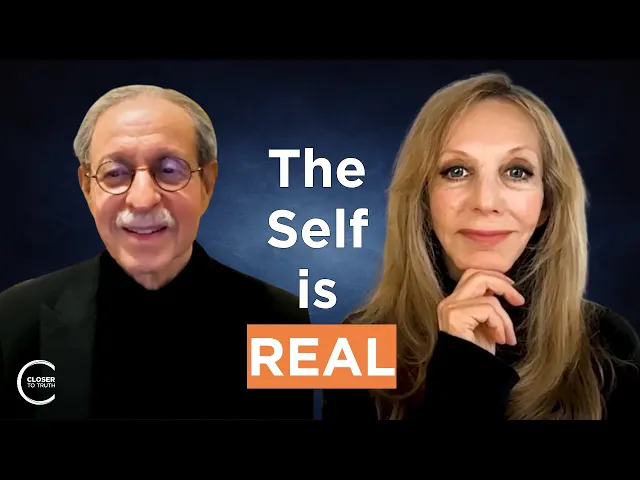
What Are Selves? | Rebecca Goldstein
Closer To Truth
0:00 Rebecca, Buddhism famously denies the existence of the self
0:05 and many philosophers deny it as well.
0:09 Marvin Minsky has a society of minds, Dan Dennett, multiple draft,
0:15 various philosophers that in fact I would say a majority,
0:20 I'm not sure of this, a majority of contemporary philosophers would say
0:24 the self has some kind of an artificial construct that really doesn't exist.
0:30 it.
0:31 In your book, an important book, The Mattering Instinct,
0:35 your concept of mattering seems to require a robust sense of self.
0:41 Is this correct?
0:42 And if so, how does it reflect on the nature of the self?
0:46 Yeah.
0:47 Yeah, no, it's I am a realist when it comes to the self.
0:52 I think it is um uh it's a it's a dynamic concept.
1:01 Uh the self, um it is what
1:03 the self is is this complicated um attentional, attitudinal,
1:10 emotional, motivational system um all connected together uh
1:19 that that that continues uh through through time.
1:24 I mean, it came into being um and it will go out of being
1:28 and we And and and if you are a a creature that has attention,
1:35 uh your sense of attention, you know, depending on how complicated it is,
1:41 uh can extend all the way, you know, to the past, to the present, to the future.
1:45 It's it's knit together.
1:48 Um I can't make sense out of human life
1:52 without uh attributing um uh reality to to the self.
2:00 I mean, yeah.
2:02 Okay, look, it's a it's a very important position.
2:05 As I said, I don't think it's
2:07 a majority position today among analytic philosophers.
2:10 Yeah.
2:11 Um and the reason is is goes back to Hume.
2:15 I can imagine smelling things,
2:17 hearing things, doing things, thinking about things,
2:20 but when I I take each one away, I don't find anything l- le- left over.
2:27 Uh Marvin Minsky says has the society
2:30 of minds that you have these different mental modules
2:34 with which he he he constructed his theory
2:39 of of mind that each mental module is there.
2:42 We have, you know, we know neuro- neuroanatomically there are
2:46 different regions of the brain that they can have very,
2:49 very specific deletions of uh of uh seeing words, hearing words, very,
2:58 very specific um problems based on brain uh
3:04 uh uh trauma uh or lesions that occur.
3:07 So, you do see physiological um uh substrates for this idea of mental modules.
3:15 And if you take all of them away, you know, what do you have left?
3:19 I mean, that's the argument.
3:20 Yeah.
3:21 So, no, I I I do think the the First of all, well, let's go back to Hume.
3:25 You know, I love Hume.
3:27 Well, but I mean, what analytic philosopher doesn't love Hume, right?
3:31 But I you know, that I I I am
3:33 not impressed by that passage where he says, you know,
3:36 when I I look inside and you know,
3:38 to find something simple that is always there, this notion of the self.
3:42 To me, the analogy I use is something like,
3:45 you know, when you you know, when you're watching a movement,
3:48 I'm watching a movie and you see all this motion and you
3:51 keep trying to stop the frame to catch the Where's that motion?
3:56 No, no, no, no, no, no.
3:57 It's this a dynamic thing.
3:59 It has to keep going.
4:00 That's how I think of the self.
4:02 You know, that and and it is internal.
4:04 I mean, it does depend on these internal um uh uh modules,
4:11 but all connected in in some way.
4:13 You know, the attention, the emotion,
4:16 the motivation, the memory, the anticipation.
4:20 You know, that this is But they're
4:22 all have a kind of self-referentiality to them.
4:26 And I you know, I I recognize, you know,
4:29 if somebody else's um impression or memory or something gets into mine,
4:36 I would I would recognize it as foreign.
4:39 Yeah.
4:40 You know, that's something There is, you know, this the familiarity,
4:43 my sense of the self that it's disseminated throughout this whole thing.
4:47 Um and the self-mattering that I think
4:51 is disseminated throughout the the whole thing.
4:54 To to another problem that you and I have discussed quite a lot that we
4:58 share our fascination with is is
5:00 the hard problem of of consciousness, of course.
5:03 And um you know, the the notion that, you know,
5:06 to to be a subjective self is to have
5:08 a is a first-person perspective and how can science accommodate science,
5:15 which is quintessentially a third-person perspective,
5:19 how can it accommodate um this this first-person perspective?
5:25 I would say this first-person perspective at least
5:29 in us is so much a perspective of of self-mattering.
5:34 Um We matter to ourselves.
5:37 We can't be ourselves without mattering to ourselves.
5:40 Our past matters to ourselves.
5:42 We regard it with regret, remorse, nostalgia.
5:45 Our future certainly matters to ourself.
5:48 So much of our life is is is planning our future.
5:51 So that this you know, self-mattering which requires some some kind of self is
5:58 disseminated throughout uh what it is to be us,
6:02 what it is like to be a human being.
6:04 I can't make sense of it without that notion of self.
6:08 Now, many realists about the self, of course,
6:11 uh call upon something non-physical, a soul or a spirit.
6:16 And that makes their um realism about the self uh
6:21 a kind of an easy problem or it seems to be easy.
6:24 That's a solution.
6:24 That's not your solution.
6:26 That's not your solution.
6:28 So you you have a harder a much harder problem uh to deal with.
6:32 Yeah.
6:32 Uh Yeah.
6:34 And uh I I I've, you know,
6:38 recognized this differentiation between self and non-self
6:41 and how you justify a self because
6:44 a lot of the energy and excitement about the self of from those who deny it,
6:49 from Buddhism to philosophy.
6:52 Uh but I did think in going through the mattering instinct that if you start
6:57 with the assumption that mattering based upon
7:02 your theoretical development from the nature of entropy
7:06 and biology and internally if you if you
7:08 buy that, that can give an independent uh
7:13 justification for a uh a real a realist
7:18 about the self without calling on non-physical stuff.
7:22 Yeah.
7:23 It It's a It's It's for me it It's a system.
7:26 Right?
7:26 The self is a system.
7:28 Uh an extremely complicated system.
7:31 Uh and we can use the laws of nature to explain explain the system,
7:37 but how it is a how it is
7:39 a system with these various pieces of it working together.
7:43 Um and it's you know, we're not going to get a simple
7:47 perception impression in Humean terms of this system.
7:51 This system is us.
7:53 The system
7:54 Yeah, I like I like your approach of dynamism as opposed to a static picture.
7:58 If you if you take just a snapshot,
8:00 the one frame of your movie, that's not a self.
8:04 That's not a self.
8:04 And and that and that would be susceptible to the arguments
8:08 of the philosophers who deny the self if you take the frame.
8:11 But if you take the you know,
8:13 the what 32 per second flow of the movie and you take that as a as a whole,
8:21 then then that is a self that would not require a non-physical component.
8:28 Exactly.
8:29 Exactly.
8:29 I think that analogy I mean, for me that analogy is very clarifying.
8:34 So, um you know, again I feel like a heretic uh saying anything counter Hume,
8:42 but you know, I would say you know that he you know,
8:44 he has a certain um theory of uh where our concepts
8:48 come from and they have to ultimately be traceable back to impressions.
8:52 And I would say the self is a good counter example to that Mhm.
8:57 notion of of of of of concepts um because
9:01 I think we do have a concept of the self.
9:04 Very very uh complicated um and it doesn't fit into this simple
9:09 picture uh of uh tracing back to to some impression.
9:14 And I think there are other concepts that are that are of that sort as well.
9:19 um uh certain mental illnesses that that have
9:22 a dissociation of self or multiple selves?
9:25 Yeah.
9:25 Yeah.
9:26 how does that reflect on the reality of self?
9:28 Yeah, so that's really interesting to me.
9:30 I've done not enough,
9:31 but I've done some reading um and and uh, theories of schizophrenia.
9:37 And, um, and what seems to be missing, according to some theories,
9:44 is this unifying sense of self disseminated throughout the whole system.
9:49 They call it, um, ipseity, i p s e i t y, uh,
9:55 from the Latin for self, uh, which is sort of sort of interesting.
10:02 And I've always been impressed with uh, something that the poet, uh,
10:07 Gerard Manley Hopkins had said, uh, and he introduced this notion of selving.
10:15 He made it into a verb.
10:17 Um, and in this way he he seemed to be capturing uh,
10:21 the dynamic aspect of what it is to be a self.
10:25 It's not something static.
10:27 It's something dynamic, uh, something that we do.