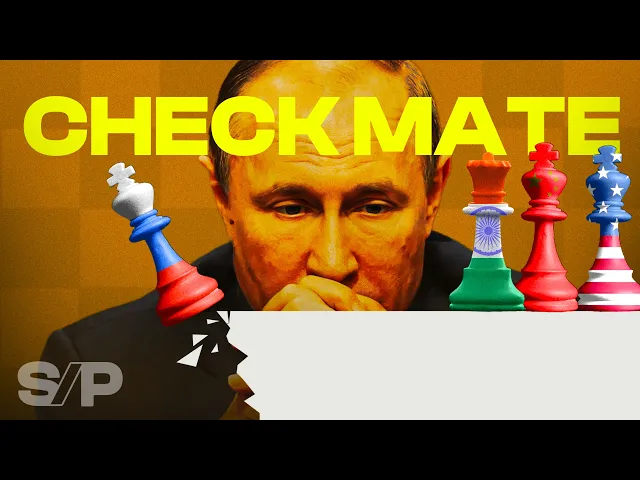
How Russia lost chess
Search Party
0:00 [Sam] Vladimir Putin loves sports.
0:02 He's mastered soccer, weightlifting, and badminton.
0:05 He schooled the Russian Jujitsu team, and in this ice hockey all-star game,
0:09 he scored eight goals while skating beautifully.
0:13 [Announcer] Putin!
0:16 [Sam] But I imagine the sport Putin probably loves the most is chess,
0:20 because Russia dominates chess.
0:23 (dramatic music) Russian and Soviet chess
0:25 players have won 26 world championships, far more than any other country,
0:31 and at least 200 grandmasters are Russian,
0:33 more than double the next nationality.
0:37 Russians have also led chess's governing body for three decades.
0:42 In chess politics, Russia has played a dominating role.
0:45 It is definitely important for the Russian
0:48 leadership to maintain its historic control.
0:53 But take a closer look and it's quite clear that under Putin,
0:57 Russian chess is in decline.
1:01 When Putin rose to power in 1999,
1:02 nearly half of the top 10 chess players were Russian.
1:05 But in July 2025, none of them are, for the first time ever.
1:10 And if you're at a major chess tournament,
1:11 you won't see a Russian flag anywhere.
1:16 Russia is losing the dominance,
1:17 but there is obviously also political reasons behind this.
1:22 They have completely collapsed.
1:25 [Sam] This is the story of how Russia took control
1:27 of the chess world and how it's letting it slip away.
1:31 (dramatic music) (keyboard clacks) (calm music) In the sixth century,
1:50 chess was invented in India, but it was a much slower game than today's.
1:54 The queen, for example, could only move one square diagonally.
1:59 But in the 15th century, chess spread to Europeans,
2:01 who created the modern quicker version.
2:04 The queen, for example, could move to any number of squares in any direction.
2:08 In the 1700s, Russian czar Peter the Great
2:10 came across it and brought it to Russia.
2:14 There, chess was played mostly by Russia's elite.
2:17 But in the 1920s, Bolshevik leader Vladimir Lenin gave chess to the people.
2:22 (dramatic music) Lenin believed chess could
2:26 help sophisticate his mostly peasant population.
2:29 Plus it was cheap to play, so anyone could do it.
2:34 By the 1930s, the Russian government was building chess clubs for workers,
2:38 publishing chess magazines,
2:41 and establishing rigorous chess schools for children.
2:46 By getting everyone to play chess, the Soviets built a fire hose of talent.
2:52 From 1948 to '72, every Open Chess World Champion was from the Soviet Union,
2:57 every Woman's World Champion was from the Soviet Union,
3:00 and every Chess Olympiad, a biennial tournament between national teams,
3:04 was won by the Soviet Union.
3:07 It's hard to think of another country
3:08 that dominated one sport like the Soviets dominated chess.
3:13 I think it was a bit of a snowball effect.
3:14 [Sam] Peter Doggers is a chess journalist and author
3:16 of "The Chess Revolution."- They would more quickly than,
3:19 let's say, Western talents, get access to strong trainers,
3:23 to a library of books,
3:25 which was very important in a pre-internet area that you had access
3:28 to the theoretical books and the magazines that were showing the latest games.
3:32 In Russia, that was all centrally organized.
3:36 [Sam] The Soviet's chess champions were smart, disciplined, and cultured,
3:39 and the Soviet state used them to prove its superiority over its rivals.
3:45 Here is where a Russian called Boris
3:47 Spassky and an American called Bobby Fischer
3:49 are to fight out the most intellectually
3:52 exhausting battle known to the mind of man, the World Chess Championship.
3:57 [Sam] The 1972 World Championship match was more than a chess match.
4:00 It was America versus the Soviet Union, capitalism versus communism.
4:05 (dramatic music) The match was even played
4:10 midway between the two rivals in Iceland.
4:17 Fischer beats Spassky,
4:18 but the Soviets regained the title and held it for several more decades.
4:22 It also held onto the women's World titles and won most Chess Olympiads.
4:26 In 1991, the Soviet Union collapsed, but Russia continued to dominate chess
4:31 and eventually dominate the politics of chess.
4:34 (playful music) Meet Kirsan Ilyumzhinov.
4:38 In 1995, he was elected the president of the International Chess Federation,
4:42 or FIDE, and he believes that chess comes from space.
4:46 I was taken by my apartment in Moscow through this space ship,
4:51 and we went to some star.
4:56 Russia's all over the news, but I'm keeping my eye on one story in particular,
4:59 Russia ending its moratorium on nuclear capable submarines.
5:03 And what really stands out to me is how different outlets are covering it.
5:06 This level of insight is possible thanks only to Ground News,
5:09 the sponsor of today's episode.
5:11 Ground News is the only website and app
5:13 that doesn't just track global events, but dissects them.
5:16 It gathers news stories from all over the world
5:18 and tells me exactly how they're being covered,
5:20 whether that's political bias, reliability, even ownership.
5:24 So in this case, 220 news outlets covered
5:27 this story and most are from the center and right.
5:29 Comparing some of the headlines can reveal some interesting points.
5:32 Outlets on the right are emphasizing how the move
5:34 is a warning from the Kremlin to the west,
5:36 while outlets on the left focus on the new reality.
5:39 In other words, how this could spark a new arms race.
5:41 Ground News also lets me explore stories from all over
5:44 the world and see what might be overlooked by Western media.
5:47 Basically, Ground News makes it easy to understand the news.
5:50 My job isn't just to know what's being covered, but how.
5:53 Ground News makes it easy.
5:54 And I'm sure a bunch of my viewers want
5:56 that same level of insight when they read the news.
5:58 So we've partnered with Ground News to offer you 40% off their Vantage plan.
6:02 That's what I use every day.
6:03 And you can go to ground.news/searchparty or use this QR code.
6:07 Ground News and I share the same mission.
6:09 That's to bring transparency to the news.
6:11 So thanks again to Ground News for your support.
6:12 And now we'll take you back to the episode.
6:17 FIDE is a lot like FIFA, football's governing body.
6:20 It declares the world champions and runs the major tournaments.
6:24 Many of its decisions are voted on by over a hundred national federations.
6:28 And its leaders tend to be pretty shady guys.
6:33 Kirsan Ilyumzhinov was the president of a small Russian
6:36 republic when he was elected FIDE president in 1995.
6:39 He was eccentric, insisting that aliens once abducted him.
6:43 I talked with them, yeah.
6:44 I understand.
6:45 [Sam] And he was corrupt.
6:47 Ilyumzhinov was linked to offshore firms
6:49 that held the commercial rights to chess events,
6:51 was suspected of rigging FIDE votes, and most importantly,
6:56 Ilyumzhinov often acted in the interests of the Russian state.
7:00 He favored selling sponsorships to Russian companies,
7:02 like the state-owned oil company, Gazprom.
7:04 And while traveling the world for FIDE,
7:06 he served as a sort of shadow Russian diplomat.
7:09 He was making visits with some of country leaders
7:12 that we look back on as, well, let's say dubious.
7:16 Hard to believe that he really only played a game
7:18 of chess and they really only talked about chess there.
7:21 [Sam] His corruption and connection to Russia attracted a lot of criticism.
7:24 The chess world deserves a much better choice than Kirsan,
7:28 who has brought the organization to the brink of financial ruin.
7:34 Basically serving as a Kremlin envoy.
7:36 He saw the critical points,
7:37 and of course numerous cases where corruption were quite apparent.
7:43 [Sam] In 2015, the US sanctioned Ilyumzhinov
7:45 for having business dealings with Syrian dictator Bashar al-Assad.
7:48 And in 2018, after leading FIDE for 23 years, he resigned.
7:54 But since FIDE proved to be such a powerful tool for Russian soft power,
7:59 Vladimir Putin pushed for a replacement, Arkady Dvorkovich.
8:03 He was another Russian politician, but even closer to Putin.
8:07 And in 2018, he was easily elected to be FIDE president.
8:11 Even though many in FIDE didn't want a second Russian president,
8:14 Dvorkovich was viewed as a major improvement.
8:17 He was a down to earth career politician and he had some very good ideas.
8:21 One of the things he announced when he was
8:23 a candidate is that he wanted to introduce term limits.
8:27 [Sam] Dvorkovich also increased FIDE's budget substantially,
8:29 but he also continued to keep FIDE close to the Russian state.
8:34 A 2024 investigation found that up to half of FIDE's
8:37 tournament budget comes from companies in or connected to Russia.
8:41 And he had many Russians serve in key positions in FIDE.
8:45 But despite all these Russians leading chess,
8:47 Russians weren't winning chess like they used to.
8:51 Technology was killing their advantage.
8:54 (calm music) Chess was one of the first games
8:57 we taught computers to play as early as the 1950s.
9:01 By the 1990s, so-called chess engines were defeating grandmasters,
9:05 even Russian grandmasters.
9:07 [Announcer] Garry is not...
9:09 He looks, he looks disgusted, in fact.
9:11 Are we missing something on the chess board now?
9:13 And whoa, Kasparov has resigned.
9:17 (audience applauds)- [Sam] Chess engines, then chess websites,
9:19 made it easy for players anywhere to play and train against top talent.
9:24 Meaning you didn't need a Russian coach to get good at chess anymore.
9:27 In my youth, living in a Danish city, I had no one to play with.
9:31 I would travel to Moscow to get some knowledge, some atmosphere.
9:35 That, of course, is completely different.
9:37 [Sam] Peter Heine Nielsen is a Danish
9:39 grandmaster and coach for several world champions,
9:41 including the most famous player in the world, Magnus Carlsen.
9:45 Magnus Carlson was also living in the outskirts of Oslo,
9:48 but he could just log on and play online chess all the time, right?
9:51 That, of course, makes a difference and makes the game much more democratic.
9:56 [Sam] In the 2000s, non-Russian players started winning a lot of chess.
9:59 World champions emerged from former Soviet states,
10:02 but also India, Norway, and China.
10:06 In women's chess, China built a dynasty.
10:08 And almost every Chess Olympiad after 2002 was won by a non-Russian country.
10:14 Russia was still producing great chess players,
10:16 but the internet let other countries produce great players too.
10:19 Now China has been quite successful on the elite level,
10:23 but India is perhaps taking over.
10:25 There are so many Indian kids who cares about chess.
10:28 They have now building a coaching tradition,
10:31 but it's just an incredibly popular sport.
10:37 Now, the internet revolution isn't Russia's fault, but what happened next was.
10:41 (suspenseful music) Russia's invasion of Ukraine has killed tens
10:45 of thousands of Ukrainians and possibly a million Russians.
10:49 Pretty much every sport has banned or punished
10:52 Russian teams and chess is no different.
10:56 In 2022, FIDE cracked down on Russia,
10:58 banning it from sending teams to the Olympiad,
11:01 and barring Russian players from competing under the Russian flag,
11:04 leading to a massive exodus of talent.
11:07 Several Russian grandmasters switched to play for different countries,
11:10 dramatically reducing Russia's talent pool.
11:12 And Russian players are receiving fewer invites to major tournaments,
11:16 meaning fewer opportunities to climb up the rankings.
11:19 More invites are going to Indian players.
11:22 Russian players who support the invasion are being shunned from tournaments.
11:26 Russia's top grandmaster, Sergey Karjakin,
11:29 is somewhat of a spokesperson for the Russian war effort.
11:32 (Sergey speaks in foreign language)- [Sam] He would
11:40 be close to ranking among the top 10 players,
11:42 but he's listed as inactive for not playing in enough major tournaments.
11:46 They still have their super talents
11:48 that are showing great results here and there, but at the same time,
11:52 as long as this war is continuing,
11:53 it will remain problematic for some tournaments to invite them.
11:58 [Sam] While the internet allowed other countries
11:59 to produce players as good as Russians,
12:01 the war in Ukraine is preventing Russian players from keeping up.
12:05 It's also dividing the chess world, with Arkady Dvorkovich,
12:09 the Russian FIDE president, right in the middle.
12:14 It's clear the Russian government is pressuring
12:16 Dvorkovich to maintain Russia's influence in FIDE.
12:19 After the invasion, Dvorkovich said his thoughts were with Ukrainian civilians,
12:23 but then backpedaled by saying the war is a campaign against fascism.
12:28 In 2024, the Russian Chess Federation annexed some Ukrainian chess clubs.
12:32 FIDE decided to suspend it, then reversed its decision.
12:36 And major FIDE sponsors are still companies like Freedom Holding Corp,
12:39 a Kazakhstan-based bank linked to Russia.
12:42 Dvorkovich scrapped the term limits he promised,
12:45 paving the way to stay in power longer.
12:47 Like every grandmaster,
12:48 Peter Heine Nielsen is looking for the strategy behind it all.
12:52 He's trying to kick the can down the road and try to balance it.
12:55 They allowed, I think, youth teams back in team competitions and now the most
12:59 recent decision is that female teams can come back, but not in the open section.
13:03 It's a typical Kremlin strategy.
13:05 Perhaps time will solve the problems.
13:08 [Sam] But Dvorkovich is also being pressured by the rest of the chess world.
13:11 Many players are opposed to letting Russian players in major tournaments.
13:15 I would say, at least in Garry's honor,
13:18 I'm sure he would take the opportunity to advise
13:22 against reinstating the Russian and Belarusian chess federations.
13:26 That is what I will do as well.
13:29 And despite leading FIDE,
13:30 Dvorkovich hasn't lifted any of the major punishments on Russia.
13:34 But what does a divided, embattled FIDE mean for chess?
13:39 (calm music) The sport is booming.
13:43 Newer, faster formats are gaining popularity
13:45 and more chess is being played online.
13:48 The attention and money are following.
13:51 So what Russian influence does remain may just be holding chess back.
13:56 We should ask ourselves,
13:56 are we actually happy with this deal that we are sort of Russian soft power too?
14:02 For me, the answer is extremely obvious.
14:04 It's a hard no.
14:06 But it's a completely hypothetical question.
14:08 It's not gonna change.
14:12 Alright, thanks for watching.
14:14 That's our 33rd episode.
14:15 If you're new here and you haven't subscribed to Search Party,
14:17 now is your chance to.
14:18 We cover sports and geopolitics.
14:21 We're back in two weeks with a story about the US-China rivalry.
14:24 And yeah, keep sending me story ideas.
14:26 I'm looking forward to doing a few of those later this fall.
14:29 And yeah, we'll see you in a couple weeks.