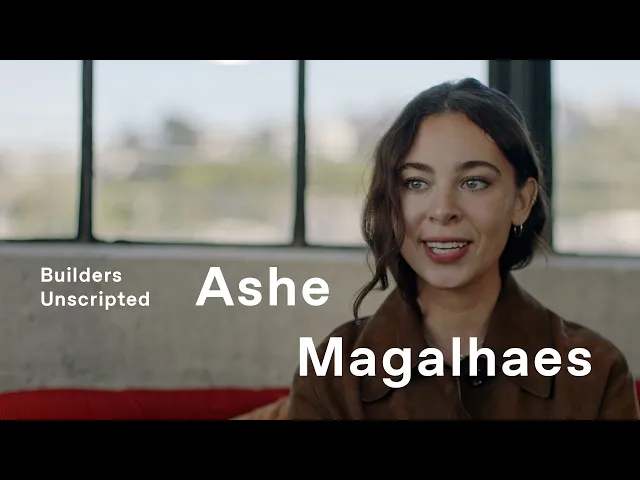
Builders Unscripted: Ep. 2 - Ashe Magalhaes, Founder of Hearth AI
OpenAI
0:10 Hey, Ashe.
0:11 So great to see you.
0:12 Thank you for doing this.
0:13 Thank you for having me it’s awesome to be here.
0:15 I actually remember the very first time we met was in this OpenAI office.
0:20 And at the time, you were building Hearth, right?
0:23 Can you tell us a bit more about what it was?
0:25 Yes.
0:25 Hearth AI was founded in 2022, and it was the first agentic CRM.
0:30 So 2023, we're using GPT 3.5, and we were trying to kick off all these agentic
0:35 workflows when the underlying systems were still pretty fragile.
0:38 So I was trying to wrangle you and other people.
0:41 And I remember, you had great feedback for the API at the time.
0:44 And one of the things that you were trying to get
0:47 done was like structured outputs before we even had them.
0:50 You were trying to do like retrieval with JSON schemas.
0:52 You were so early.
0:53 What was it at the time to like build in AI?
0:56 Yeah.
0:56 So, I mean, my history was as an ML engineer.
0:59 So I had been studying and I really rode
1:02 the wave of deep learning and the commercialization of deep learning.
1:05 And then when kind of agentic infrastructure,
1:07 and LLMs came out for the first time, it was totally different, right?
1:10 It was non-deterministic,
1:11 and it was seeing what we could stabilize within a product
1:16 experience because our users didn't care that, like LLMs were new,
1:19 they wanted to see the flexibility of what was just then possible.
1:23 Yeah.
1:23 That's amazing.
1:24 And speaking of your ML background,
1:26 I think what I find fascinating about you is the wide range of like,
1:31 life technical experiences you've had.
1:32 Like you were an ML engineer at Airbnb, you worked on satellites at NASA,
1:37 but you also started by building a solar powered racing car.
1:40 Like, I want to hear that story.
1:43 Yeah.
1:43 So I really try to stay within frontier tech and Stanford has
1:47 a solar car team with strong ties to like Tesla and SpaceX.
1:51 So for two years I was building, heads down, a solar powered car with that team.
1:57 I was on telemetry, CAD modeling, meshing, and then autocross.
2:00 I was one of the drivers,
2:02 so I was training within autocross clinics throughout California.
2:05 That's crazy.
2:06 And so did you actually, like, race in that car that you built?
2:10 So we shipped the car to Australia.
2:12 Every two years Australia has an international solar car competition,
2:16 the Bridgestone World Solar Challenge, and we spent three months there prepping.
2:20 We were camping in the Australian Outback,
2:23 and then I would drive for six hours at a time through the outback,
2:27 and then we did the race, which was five days from Darwin to Adelaide.
2:31 Wow, was that scary?
2:32 Yeah, we were going 90 Kph, which is around 60 miles an hour,
2:36 and we built the car end to end, so it wasn't like a company came in and did it.
2:42 And teams were crashing, Cambridge's team had crashed.
2:44 And so I was very aware that I had spent two years building something
2:48 with a team that I would put my body into and that level of rigor,
2:53 like really played into later experiences.
2:55 Right?
2:56 Because like that level of risk and like
2:58 rigor that you need to have is extremely high.
3:00 Yeah, but it was so amazing because I think that was a form of like
3:04 frontier tech to really be in the weeds with a team where you know,
3:07 it is your body on the line, it's your teammates body on the line.
3:10 How do you make safe decisions and also
3:12 really push the bounds of what's technically possible?
3:14 Amazing.
3:15 And so what got you into building in the first place,
3:18 starting on that project all the way to like being a founder?
3:21 Yeah, I think just a lot of curiosity
3:24 and really interested in, bringing things to life.
3:27 So I view the builder archetype as quite close to the artist archetype.
3:31 I think I'm happiest viewing myself as like a conduit for creativity.
3:35 And I think engineering for me has always felt like a tool for creating
3:40 and incarnating and to be able to do it with satellites and cars and code.
3:45 But also like, you know, poetry and videos and other mediums.
3:48 That is such an energizing way to spend every day.
3:52 Incredible.
3:52 And so when you were so early building like an AI product, like three years ago,
3:58 when you look back now, like, how do you think about that experience?
4:02 Like what were the hardest parts or the things you did not expect.
4:05 Yeah, I think there were so many norms that were being disrupted.
4:09 So the fact that our team was tearing
4:12 down our like agentic stack every couple of weeks,
4:15 that was really hard to maybe explain to folks
4:18 around us because the history of tech had been,
4:20 okay an ML you maybe spend a year laying the data pipes,
4:23 and then and only then can you do
4:25 something predictive and interesting with the ML product.
4:28 And for us, it was like,
4:29 no we want to surface an experience to users that is flexible,
4:33 but it was so open world that there
4:35 wasn't consumer behavior yet around querying an agent.
4:37 So for example, like folks didn't know in 2023 that in Slack,
4:42 the Slack bot could respond.
4:44 They just thought that it was an outbound ping so
4:46 there was a lot of new behavior from the eng.
4:49 side, but also from the user side to educate them on.
4:51 And I remember, on my side,
4:53 I was trying to build agents too, before joining OpenAI.
4:56 And, you know, this was the era of NanoGPT, BabyGPT,
5:00 people were like trying to find like
5:02 the early incarnation of what an agent would be.
5:05 But most people outside of the space would not really understand and grasp,
5:08 what an agent could do.
5:10 And I think for me it underlined
5:13 the importance of having relationships with other builders.
5:16 You know, we were really all in the same plane of learning
5:19 this stuff for the first time and to have friends that were like open
5:22 and transparent and we were sharing tricks and also friends within AI labs
5:26 that really made the difference with creating
5:28 products that worked in some capacity.
5:31 And so you've worked on very deep tech and very deep systems, right?
5:36 What got you to think about like this human connections,
5:39 human relationship which is kind of like the core thesis of Hearth right.
5:43 Yeah.
5:43 There is this amazing book,
5:45 “When Breath Becomes Air”, written by Paul Kalanithi.
5:48 And I didn't realize it, but he had sat in on a neuroscience class that I was
5:54 in, and he was presented as this guest that had a terminal illness.
5:58 And he was like, you get to ask this person anything.
6:01 And, you know, he has this terminal illness and how is he viewing life?
6:04 And, what he talks about is all achieving all of these accolades and making it
6:08 to the top of the mountain and essentially
6:10 looking around and being like, and now what?
6:12 And I think from a young age I had
6:15 all of this access to like really interesting frontier tech,
6:18 but I was realizing I kind of missed that like spiritual footing.
6:21 And for me, after some soul searching, I think like for so many people,
6:25 what do I think I'll care about on my deathbed?
6:28 You know, the satellites are amazing,
6:29 the solar cars are amazing, all the ML stuff is cool.
6:31 But I think what I'm going to care about is how
6:35 connected I was to myself and to other people in my life,
6:38 and how much presence and love I exchanged.
6:41 And then it became obvious I want to push the needle on that, on connection.
6:45 And I think, I say this a lot,
6:48 but the arc of human progress bends towards love and connection and innovation.
6:52 And AI I believe, should push the needle on that.
6:55 And do you think now that like what you
6:58 were exploring a few years ago with like this like
7:01 AI agentic CRM was the first kind of manifestation
7:04 of something like broader that you were gonna explore basically now?
7:08 Yeah.
7:09 And, you know, even before that I had been working
7:12 on teams where they had an external network of people,
7:15 and the task was to mine that network
7:18 to match people with other people or opportunities or capital.
7:21 And so it's kind of this age old problem of as modern humans,
7:25 we are connected to so many more people than ever before,
7:29 and maybe feeling lonelier and less able to act on it,
7:33 both individually and as part of any cooperative team.
7:35 And so I've been fixated on this for so many years.
7:39 And the agentic CRM was a multiplayer pass at it.
7:43 But, you know, my thesis is on relational intelligence.
7:46 Its this belief that AI should augment the human experience and allow
7:50 us to feel more connected in the time that we have,
7:53 and that AI should extend our brain's ability
7:55 to reason on who we’re connected to and why.
7:57 And speaking of brain, I see you mentioned a few times like,
8:00 on your post, like the idea of a second brain.
8:03 Can you tell us more about this and how you think about it?
8:05 I love the phrase second brain because it's a little bit less technical.
8:09 So I think anyone in the world can
8:12 maybe visualize what a second brain looks like.
8:14 And it's this idea that we will
8:17 have a symbiotic relationship with our AI products,
8:20 and have a relationship with the product is the key word.
8:23 So it will be this continuous feedback loop,
8:26 on our stream of consciousness in which the AI is
8:29 trusted as maybe this bird's eye intelligence to guide us,
8:32 to see farther than we could with our own cognitive limitations.
8:36 So one thing that I find very interesting, as you're exploring these topics now,
8:39 and maybe compared to what you were building a few years ago,
8:42 is that the tools have changed drastically.
8:44 And I'd love to hear more about, like, what's your workflow today?
8:49 Like the way you approach, like new ideas,
8:53 following your own creativity, like what's Ashe's workflow?
8:57 So a big thing I'm leaning into this year is really building while connected.
9:03 And I think for so many years as a founder I built in more of a silo
9:08 and I'm very excited to be building in public
9:11 to be connecting with folks on these different
9:14 agentic workflows or products and leaning
9:16 into the variance that you get when you build
9:19 in public and you allow all of these folks
9:21 to comment on what you're putting out there.
9:24 And so something I've enjoyed doing is I have my Ashe.ai public facing website,
9:29 which you could go on, but there's a whole
9:32 back-end system that is behind a secrets page.
9:35 Where I will, if I have a product idea, I'll kick it off.
9:40 Now I'm using Codex 5.4 but, you know,
9:42 I'm driving really fast to like test what I should
9:45 be experimenting with, and then I'll have it within ashe.ai.
9:48 I'll put it on on X, and if people are reacting to it,
9:52 I'll have 5.4 extract it into a standalone product quite quickly, which is cool,
9:55 or open source a part of it, because a lot of folks are asking for like
9:58 an open source version to pull into their own personalized software.
10:00 That's super cool.
10:01 So you are exploring different ideas in parallel.
10:04 You're putting them on your own personal website,
10:08 using Codex to build many of these ideas.
10:11 But then as you see them kind of getting traction,
10:14 you're extracting them into complete products.
10:16 Yeah.
10:16 So the name of the game is speed.
10:17 And I think the key thing is you could build so much software nowadays,
10:21 but what will you build that you yourself use every
10:24 day that you find to be a beautiful and elegant experience,
10:27 and that you can surface to users in a way that is sustainable
10:31 and isn't just breaking with the fragility of maybe a vibe coded product.
10:36 And so to be able to drive 5.4 and Codex really fast,
10:41 but still have kind of a reliable,
10:43 foundation, which is new, I think this is new as of the past two months.
10:49 Has let me put out, like aesthetic video
10:52 as a platform where I'm doing a lot of video editing.
10:55 And I'll have guests, but I want them to have access to everything
10:58 they say in case any part is sensitive.
11:00 And I was able to really quickly put out that platform.
11:03 And I use it every day and guests use it
11:05 every time I film something for collaborating for agentic clips.
11:08 And that's just one example.
11:10 That's awesome.
11:11 And is there anything like surprising to you or in your workflow,
11:15 like the way you use Codex, anything that has been like, fascinating to you?
11:20 I think the speed is really important where I want
11:25 to be able to drive the agent very fast in productizing,
11:29 because I need to still validate it with a user base.
11:34 Like just because you can build many things
11:37 nowadays doesn't mean it will be a product
11:39 that users understand or could come on, or that you
11:42 yourself will want to use every day.
11:44 So being able to have that rapid feedback
11:46 loop building in public has been very important.
11:49 And the other layers instrumentation.
11:51 So I have my Ashe.ai system on Slack and then
11:54 I have all my agentic workflows broken up by channels.
11:57 For every product that I put out,
11:59 I have a layer of instrumentation and observability so I can
12:02 validate are people using the tool in the way that I expect,
12:06 let alone like any errors or things that are worth me,
12:09 like quickly trying to patch.
12:11 That's awesome.
12:11 I would love to see it.
12:12 Do you want to show it to me?
12:13 Yeah.
12:17 Okay, so this is my Ashe.ai Slack workspace.
12:19 And you can see with all of my channels,
12:21 these are all agentic workflows that I have here.
12:24 And I'll get alerts and up manage throughout the day.
12:27 And I have all of these errors for aesthetic.video.
12:30 So I should probably kick off something because I do have people on this.
12:34 And I think I know what this is.
12:35 “Kick off a task to fix the infinite load
12:39 on the drafts page.” So I trust 5.4 will figure that out.
12:44 And yeah, so this is Ashe.ai.
12:46 This is public.
12:47 This has kind of my portfolio and products and also goals.
12:51 But then I have a secrets page,
12:53 and this is where I have everything from different templates.
12:56 So I'll reuse the same Stripe template.
12:58 I have these animations, to prototyping potential products.
13:01 So I have my Oura integration here.
13:04 Videos was the start of aesthetic.video.
13:06 And then I got enough validation where I went
13:10 ahead and built this out as a standalone product.
13:13 So here I built it out and then told 5.4 “hey,
13:16 like break off this chunk.” But obviously we have
13:18 so much happening in Ashe.ai and put it on aesthetic.video.
13:22 And then from here, this is how I organize the content that I'm putting out.
13:26 I have an automatic X integration.
13:28 And then when I want to collaborate
13:30 with my interview guests I will have the video here.
13:33 They can add comments and it'll be time stamped.
13:35 I have an auto generated video guide.
13:38 I even have an agentic clipper to get those fun reels.
13:42 Wow, that's really cool.
13:43 I loved, like seeing your video hub on X did you, simply just ask,
13:48 Codex to extract all of the prototype and make
13:51 it a standalone product, like in one shot?
13:53 Yeah.
13:53 So actually it did really well with one shot.
13:56 So I had my template here and I need to use this for myself.
14:00 So I tried it out with Ashe.ai.
14:01 I posted it, I had enough people be like “hey can you
14:04 open source this, can you put this out?” And after getting that validation,
14:07 I told it to to break off a chunk.
14:09 I let it, let it go.
14:11 And then I had a good bit here and then I've added things to it.
14:16 So I have like Google storage for all my videos.
14:20 I pulled in, the Gemini embeddings too,
14:23 to do some smart things with searching on videos.
14:26 So I have like search over here and I could search for people laughing.
14:30 Yeah.
14:30 And then I play with it, like I have my chat here.
14:33 Sometimes I'll use Opus 4.6 for the chat,
14:35 sometimes I'll use 5.4 it's really fun in this moment
14:37 to pull in all of these different agentic tools and model providers.
14:41 Cool.
14:42 I guess, like I need to, ship more video content and use the hub for myself too.
14:46 We can put this video on here.
14:48 Exactly.
14:48 We should.
14:49 Amazing.
14:50 Wow, thank you so much for showing me that.
14:52 That's really, really cool.
14:53 And what I love too is that you were a solo founder before,
14:57 and, like, you were able to build so much by yourself one more time.
15:00 Like, this is incredible.
15:01 Like, how have the tools, like, changed to help you build all of this?
15:06 Yeah.
15:06 So I think what's interesting is, as an engineer,
15:09 kind of one of my defining attributes was speed.
15:12 And I've always really valued running at a problem.
15:15 And then instead of living in my head for so long,
15:19 getting real world feedback loops to kind of coalesce my vision with reality
15:23 and the magic of this moment is being able to drive like 5.4 incredibly fast.
15:28 And obviously I also have that like autocross training.
15:29 I want to go fast and trust that it's going to kind of have
15:33 a foundation that isn't so fragile that I’ll to spend a ton of time redoing it,
15:37 and then having that, building in public kind of feedback loop where I can put
15:41 things out into the world and see
15:43 the variants and creativity that comes back in.
15:46 So, for example, maybe last week I had my Oura ring and I pulled the Oura API,
15:51 and on my Ashe.aI goals page,
15:53 I put up my wakeup times because I really love waking up at 5 a.m.
15:57 and someone commented like, ‘hey,
15:58 you should create a social version of this where we can
16:01 all have a level of accountability for waking up at 5 a.m’.
16:04 and the magic of this is now I can quickly
16:07 sprint at this without it taking up so much time.
16:10 And I think what's been cool about 5.4 specifically
16:13 around productizing is I'll have my whole Ashe.ai system,
16:16 I'll build the prototype,
16:17 I'll see if I actually use it, because that's important.
16:20 And then if it's validated in some way,
16:22 I'll tell 5.4 hey go split this off into an open source repo,
16:26 or go split this off into its own standalone product.
16:29 And I'm seeing it do it quite reliably.
16:31 Like I think that's kind of a huge difference,
16:34 even, going back like six weeks ago.
16:37 That's incredible.
16:38 I have an Oura ring too.
16:40 So I guess I should look at the leaderboard,
16:41 but I'm not sure if I'm if I'm waking up early enough to be up there.
16:45 That's really, really cool.
16:46 And I love the fact that now that, like, we can build so much,
16:49 it's really down to the creativity and the process you
16:52 have around capturing your ideas and bringing them to life.
16:56 And I love how you're describing the fact that you
16:59 have this kind of secret space where you can experiment freely,
17:02 and then you're waiting for a sign or a signal
17:04 that, like things are picking up to then extract them, do well, is that right?
17:07 Yeah.
17:08 And I think, you know, our time is is zero sum.
17:11 And I think especially as the builder archetype moves closer
17:14 and closer to the creative archetype or to the artist archetype,
17:17 You want to channel kind of your full self into what it is that you're building.
17:22 Otherwise maybe why would people resonate with it?
17:24 I think there's a real moment right now in which folks are inundated with AI
17:29 generated content and have like maybe a repulsion
17:32 to, to that video or to that product.
17:36 And so I'm asking myself a lot, hey,
17:38 what does it look like to step into this new world in which I'm building
17:41 with my full self and being vulnerable enough
17:44 to share that with other builders or potential users?
17:47 And one of the things like, speaking of builders,
17:50 that I love about your process is how much you're building in public, right?
17:54 Like you're learning as you go it looks like.
17:56 And you are also talking to a lot of builders making your own videos.
18:00 What have you learned in that process?
18:02 Has that helped you, like, build better products and get better ideas?
18:06 Yeah.
18:06 So a big thing for me is I want to live a very aligned life in day to day.
18:12 And, the thing I'm trying to improve upon is,
18:15 for a while I built feeling quite disconnected.
18:18 And so if I'm building for relational intelligence,
18:21 I want to live relational intelligence.
18:23 And I have found that having these conversations
18:26 where I'm really present and really curious, I mean it feels amazing.
18:31 I think we're wired as humans to be
18:34 connected and to kind of bring that into conversations
18:38 around frontier tech feels like I'm stepping
18:41 into the Renaissance moment that exists right now,
18:44 and I feel very excited and I feel very abundant.
18:47 And I know that there's a lot of fear in the world which is validated,
18:51 which is which is valid.
18:52 But, I think we have so many reasons to feel
18:55 excited with the new wave of creativity being unlocked.
18:58 I agree, I think like there's so much like exciting,
19:01 so many exciting things we can build now.
19:04 So for us engineers and for, like, all the builders watching,
19:08 like you're mentioning these like Renaissance moment,
19:10 how do you think they should grab it?
19:13 Like there is so much potential.
19:16 There's also some grief in some ways about
19:19 like the work changing so much because now
19:22 there's models that like GPT 5.4 are so
19:25 good at writing very high quality production code.
19:29 The role of being an engineer is changing.
19:31 Like, what's your view on all of this?
19:33 Yeah, I think this is the moment to lean into creativity as the North Star.
19:38 I mean, if we go back to the Italian sculptor Bernini,
19:42 he worked very diligently for like four hours and spent the rest of the day
19:47 strolling or going to drinks or dancing or like really being having fun.
19:51 And I know, like Peter talked a lot
19:53 about the competitive edge, being having fun.
19:55 And I think the, the exciting part of this moment is,
19:58 you are incentivized to bring your full self to the table as a builder.
20:03 And I think in part that's because there's
20:05 so much noise with so many people trying to maybe sell you something when you go
20:09 on X or, vibe code their own internal tool,
20:13 or create AI generated content or AI generated movies.
20:17 I think the premium now is on risking something by being vulnerable,
20:22 by sharing and creating kind of a trust layer,
20:26 or more relationships with folks for why they should engage
20:29 with you not only as a builder to use your tool,
20:33 but like as a human that they trust with, their data and whatever else.
20:38 Yeah.
20:38 And attention really because, I think this was in the news,
20:42 but this question of putting out an article that's like AI written,
20:45 I think a lot of users felt a lot of readers felt disrespected.
20:49 And I think the premium is on feeling authentically connected
20:52 to the person on the other end in this moment.
20:55 And that's a call for all of us to share more, I think, about ourselves.
20:59 And when you think about engineers and builders,
21:03 do you think that naturally they should have
21:06 more taste and interest for the customers and like,
21:09 kind of like the role starting to blend when you work on the team, right.
21:13 Because those tools are giving super powers to everyone.
21:16 Like what do you see kind
21:18 of the interplay between different roles and different teammates?
21:21 Yeah, I think this is a moment to really
21:25 attune to yourself individually first and to ask yourself,
21:29 what is beautiful to me, what is impactful to me?
21:32 What am I here to put out into the world?
21:37 And have that individuality and creativity and from that place,
21:42 then cooperate and build.
21:44 I think we had a previous era in which,
21:47 we were building for so many people in the world that we're in ourselves,
21:51 maybe addressing markets first.
21:53 I think the era of personalized software is now
21:55 a mirror back to us to really figure out,
21:58 okay, what is it that I want to bring to life?
22:01 Absolutely.
22:02 And you were mentioning Peter from OpenClaw that we had for this first episode.
22:06 And it sounds like when you're working on your projects,
22:09 you're no longer just working in projects.
22:11 You're also working in systems.
22:12 Right?
22:13 That's something very interesting.
22:14 I'd love to hear more about your workflow.
22:16 Sounds like you're also using OpenClaw
22:18 to build a system around your distribution.
22:21 I would love to hear how you're thinking through that.
22:23 So I'm very quick to pull out whatever state of the art thing comes
22:28 out into my full agentic stack and all of the different workflows that exist.
22:33 So I went deep into OpenClaw.
22:35 And for me, you know, I don't have a marketing background,
22:39 let alone like distribution across all of these different platforms.
22:43 I will say the area that OpenClaw kind of shined for me was
22:47 to figure out distribution for, you know maybe I'm really present on X
22:51 and put out a post there to be able to then lean
22:55 on OpenClaw and agents to re-share that on Reddit and what other platforms.
23:01 Not in a way that feels spammy.
23:03 And this is a really fine line, but in a way that allows me to get that idea
23:07 out there in the language that is specific to that platform,
23:10 because they are all different.
23:11 So it was able to do this pretty impressively on Reddit,
23:17 with seemingly human responses back pretty quickly.
23:21 So I think for anyone that's looking to figure out distribution,
23:24 which I certainly am, it's an interesting moment of like,
23:27 okay, maybe I don't need to spend all this time on Reddit,
23:30 on LinkedIn, on Instagram, whatever else.
23:32 Maybe I can have my agents help me out so that I can be present with the idea.
23:36 That's very cool.
23:36 Any favorite way to talk to your OpenClaw?
23:38 Where do you have it set up?
23:40 So I will say I'm a big Slack person
23:43 and OpenClaw is one piece in my full agentic system.
23:47 So I do love Slack for naturally breaking up my agentic workflows by channel.
23:53 So I have like a news channel,
23:55 a birthdays channel, a goals channel, a money channel,
23:57 basically anything in my life that I'm doing repeatedly
24:01 there's a channel on slack with agents tied to it,
24:04 and the important thing is the agents are up managing me to try to like,
24:08 reduce my screen time and let me be really present with people.
24:11 That's incredible.
24:12 I love that.
24:13 Really, really cool.
24:14 I need to like, upgrade my setup.
24:15 It gives me some ideas now.
24:17 Yeah, I'll show you.
24:18 I showed someone at a bar once and they were like,
24:20 are you the only person on this Slack workspace?
24:22 I was like, yes.
24:23 And they started laughing.
24:24 But it's the future!
24:25 It’s you and your agents.
24:26 Using all my agents.
24:26 I'm not alone.
24:27 You have a whole team with you.
24:29 That's really cool.
24:30 One thing that I love, that we don't,
24:32 I don't think we have talked about yet, is the fact that, like,
24:36 as you think through these systems for yourself and as you're going
24:39 to pursue this thread around connections across humans in this AI era,
24:43 you also thinking about wearables and hardware a lot, right?
24:46 And you're working on one.
24:49 Tell me more about like why that matters.
24:52 Yeah.
24:53 So I am very driven by I think,
24:57 a life that feels present and that feels connected.
25:02 And I want to be across from someone looking at them, fully present with them.
25:07 And I really do want to minimize my screen time,
25:09 my time on my phone and my time on my desktop.
25:12 And so I'm excited.
25:14 First about the social etiquette layer.
25:16 I don't like ambient recording.
25:18 I do think we will need a stream
25:21 of consciousness that is systematized for our second brain.
25:24 When I think a lot about a second brain for my people,
25:27 I think there will be some social
25:29 etiquette around you saying something really interesting.
25:31 You seeing me touch a part of my body
25:33 and agree that that will be put into my second brain,
25:36 or pull me back and say, actually, hey, I'm not comfortable with that.
25:39 So first I want to play with what might the future
25:43 social etiquette be in a way that feels elegant and not gauche?
25:46 And then second, just an analog experience that lets me have that second brain
25:51 for my people so I can focus
25:54 on really listening to what the other person's saying.
25:57 So being fully present, but also thinking through the social norms of what
26:01 that means to have such ambient intelligence almost.
26:04 Yeah.
26:04 And I think when it comes to our relational landscape,
26:08 the human brain is naturally pretty limited.
26:11 So if you think about each person in your life,
26:14 there are so many facts and dimensions to who they are.
26:17 Because a relationship is, who am I?
26:20 Who is this person and who are they to me, over time?
26:23 And relationships are mirrors back to ourselves.
26:25 And so I'm excited for an intelligence layer that guides
26:30 me on the abundance of who I'm connected to.
26:33 That's really great.
26:34 And so in this era of like building being easier
26:38 and you exploring the frontier of the intersection of like software,
26:42 hardware and wearables, very, very exciting.
26:45 How do you foresee like, you own part in this journey and like,
26:50 like in some ways influencing other builders to follow,
26:54 that journey and that same like, that same chain of thought almost like,
26:59 do you think engineers will also have to explore
27:02 a lot more like that software to hardware frontier,
27:05 or do you think they need to bring their own
27:08 taste and their own vantage point to the solutions,
27:10 like how you thinking through that?
27:12 Well, first I want to lean into my own sense of self.
27:16 And I think what's nice about this moment is the way
27:21 it's empowering people to build their own personalized software layers,
27:25 but hopefully present more authentically, with that building in public layer.
27:30 And so I think a lot about aesthetic for example, and visuals and beauty.
27:36 And I think anything I build in the future,
27:39 I want to interact with it in a way that feels beautiful to me,
27:44 even down to managing my agents.
27:46 And we've talked about this, but part of what
27:48 was cool about Codex is it feels like a really
27:51 beautiful experience to start to manage all of these different
27:54 agents and sub agents that are being kicked off.
27:56 And I think what's exciting looking ahead is that you
28:00 can imagine every touchpoint with agents in the future,
28:03 or these systems that you're building or hardware
28:05 or hopefully board design feels like a piece of art,
28:08 feels like something that feels resonant and inspiring to interact with.
28:12 Yeah, and it's amazing how fast we've transitioned from, you know,
28:16 AI systems that were able to, like, write a bit of code all the way to like AI
28:22 systems that can reliably take on, like a huge chunk of work,
28:26 in your case like extracting an entire prototype
28:28 and turning it in one shot into a complete product.
28:32 Is there anything that has like,
28:34 surprised you or delighted you along the way as you've been using like Codex?
28:39 I assume you're using the Codex app now?
28:41 I'm using the app.
28:42 I switch between all of these different systems, all the time.
28:46 So still using Cursor, still using Claude Code,
28:49 using Codex, using all of these different systems.
28:52 And I think what's defining about this moment is no two days are the same,
28:56 like the whole ecosystem is moving too fast,
28:58 that I really feel like a creative operating in bursts.
29:02 So you know like, I'll have a product
29:05 like the aesthetic.video and right away saw 5.4 was
29:08 like the right partner for that because it
29:10 was moving really fast but reliably with understanding okay,
29:13 there was going to be like a user authentication layer,
29:16 like this was going to be a product I put out.
29:17 There was going to be a Stripe layer to this.
29:18 and then having that like sprint for however many hours
29:21 and then pausing and putting it out into the world
29:24 and doing videos and doing something different and having
29:26 a lot of variance in my day and workflows.
29:28 And that feels really new to this moment.
29:31 I think in the past, as an engineer, you know,
29:33 I would be doing really similar things for like
29:35 11 hours or like day in and day out.
29:38 And now I know I keep mentioning the artist archetype,
29:41 but I'm best served by, okay,
29:43 when am I most creative versus like just sprint, just like a marathon?
29:48 Yeah.
29:48 so now builders can truly build anything with these tools, like Codex.
29:53 Do you think like there’s any, quality, like maybe like thinking through taste
29:59 or the curiosity that matters more these days?
30:02 Like what?
30:03 What would be like, top of mind?
30:05 I think the call is for folks to be really present within themselves,
30:09 within their bodies.
30:10 I do think there is a pull in the direction
30:14 of what you want to create and what you want, what is resonant to you,
30:18 whether that's film, whether that's photography,
30:21 whether that's like products, whatever that pull is,
30:24 I think aggressively pursue it and curate things that are similar.
30:29 And, for me, the advice I would give my younger self is to be uncomfortable,
30:34 you know, like there is discomfort in growth or in putting yourself out there.
30:38 You know, anytime I've put something out there
30:41 that has a little piece of me in it,
30:43 it is scary and there is discomfort and I'm risking something by being seen.
30:47 But it's so worth it to build that reflex and that muscle,
30:51 because that's what's meaningful.
30:52 And that's also what lets you pull in the variance of real
30:56 world feedback and get more creative and keep, you know, building.
30:59 Just to talk about Peter and OpenClaw one more time.
31:02 I think that was an amazing example of putting something out
31:05 into the world in which so many people poured energy back into it,
31:10 and it had this emergent quality
31:12 of growing beyond what anyone would have guessed.
31:15 Right?
31:15 And I think that's kind of the magic of what's possible now,
31:19 when you have these relationships and feedback
31:21 loops with all of these other builders.
31:23 Yeah.
31:24 And I think what has like, really,
31:26 amazed me with OpenClaw was not just the unique
31:30 insight that Peter had to put something amazing out there.
31:33 It's also the community around it, like the number of people now,
31:38 like wearing lobster hats and like really
31:40 passionate about making their own personal agents.
31:42 That's quite special.
31:43 Yeah, yeah.
31:44 So back to your question about taste.
31:47 I think that's really a question on self attunement and individuality.
31:52 And if something is resonant to you that's worth passionately pursuing
31:56 and sharing and let it like go out into the world,
32:00 let it breathe and allow there to be a surprise in what could happen.
32:05 Right?
32:05 And maybe as we wrap, you were talking about advice for your younger self.
32:09 Yeah.
32:10 You've had like all these experiences from being an ML engineer,
32:13 like building satellites, those racing cars that we talked about.
32:17 You've been the founder a couple times and you're
32:19 now kind of embracing these tools every day.
32:22 What would be your advice for builders around
32:24 the world like that maybe like earlier in their journey,
32:28 just starting to explore these AI tools like
32:30 how should they approach this brave new world?
32:33 First, curiosity, you know, and having fun, I think is great advice.
32:39 And really honoring that curiosity, you know,
32:41 if we have these desires, I think it's for a reason.
32:46 And to let those pulls guide us and to to take
32:50 that risk because you want to know what happens.
32:53 You know, I think curiosity is such a magical
32:56 part of the history of being an engineer.
32:59 And I think as everything is changing, that is the same pillar.
33:04 It's to be driven by curiosity,
33:06 to bring something to life that is newly possible.
33:09 And I love how it's a very similar advice to what Peter shared.
33:13 Also, trying to have fun along the way
33:15 and trying to follow your passion, your curiosity.
33:17 That's awesome.
33:18 Well, I think it's a great way to end.
33:20 Thank you so, so much for spending time together,
33:23 and I can't wait to see what you build next with all
33:26 of these great ideas that you're putting on X, every day.
33:29 And, can't wait to see the device too, that you're working on.
33:32 Thank you so much.
33:32 This was so fun.