Why is One Man Always Blamed For Everything Wrong With America?
How History Works
0:00 If you spend long enough looking at the financial and economic data,
0:03 you would be forgiven for thinking that almost
0:05 everything is getting worse all the time.
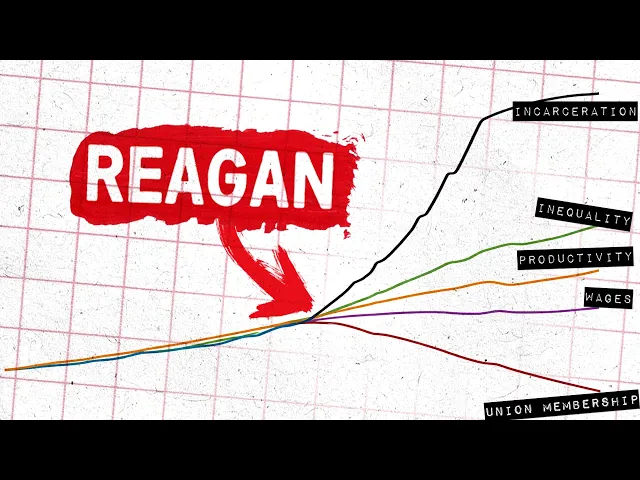
0:07 Our national debt has become an almost unsolvable issue.
0:10 Inequality has reached guilded age levels.
0:12 Union membership has collapsed.
0:14 Wages have stagnated even as productivity soared.
0:16 People are saving less of the money they do make.
0:19 Corporate bankruptcies are up over a,000%.
0:21 Our life expectancy has fallen behind almost every other advanced economy.
0:25 and our incarceration rates have more than
0:27 quadrupled in the last 40 years alone.
0:30 It's pretty bleak stuff, but if you look closely enough,
0:33 you might notice that these numbers all started moving
0:35 in the wrong direction at around about the same time.
0:38 Depending on who you ask, Ronald Reagan was either one of the best presidents
0:42 in history or one of the worst presidents in history.
0:44 And it's that disconnect that makes a candid recount
0:47 of his achievements and failures so hard to find.
0:49 This split of opinions is not helped by the fact
0:52 that political polarization is at its highest level since the Civil War.
0:56 Ironically, another trend that started right
0:58 here with the election of Ronald Reagan.
1:00 No matter what side of the fence you sit on, one thing nobody can take
1:04 away from him is that more so
1:06 than perhaps anybody else in modern American history,
1:08 his marks can clearly be seen in almost any metric you might look at.
1:12 For better or worse,
1:13 no other president has altered the course of the economy this significantly.
1:17 But it is possible that old Ronnie gets a lot
1:20 of credit and or criticism that he wasn't directly responsible for.
1:24 Before blaming all of our problems on just one man,
1:27 it's important to understand the circumstances
1:29 that made him possible in the first place.
1:31 What really compelled so many people to vote against their own best interest?
1:34 And why haven't we been able to undo these changes in the last 40 years since
1:39 now in violation of the laws that one
1:42 supervisor referred to with regard to his children?
1:44 And I am hoping that they will
1:46 in a sense remove themselves from the lawb breakaker.
1:49 We'll protect the needy while it triggers
1:51 a recovery that will benefit all Americans.
1:53 It is no coincidence that our present
1:56 troubles parallel and are proportionate to the intervention
1:59 and intrusion in our lives that result
2:02 from unnecessary and excessive growth of government.
2:04 It is time for us to realize that we are too great a nation.
2:09 Tear down this wall.
2:12 Ronald Reagan had one of the most
2:14 unusual origin stories in American political history.
2:16 A story that he was able
2:18 to leverage very effectively throughout his entire career.
2:21 Reagan was born in Dixon, Illinois, the son of a struggling shoe salesman
2:24 and a mother who by most accounts was emotionally distant.
2:27 She reportedly raised him with a lot of religion but not a lot of warmth.
2:32 He moved to Hollywood with the hopes of becoming a movie star.
2:35 And while he succeeded in getting roles,
2:37 he was never particularly good at filling them.
2:39 Over the next two decades, he appeared in dozens of forgettable bee movies,
2:43 mostly supporting roles that nobody remembers today.
2:45 But what he lacked in talent, he more than made up for in other assets.
2:50 The man was handsome, charismatic, and genuinely believable on screen in a way
2:53 that had nothing to do with his ability to act.
2:56 More importantly, Reagan was a joiner.
2:58 In the 1940s, he became politically active in Hollywood,
3:02 joining various progressive and left-leaning organizations,
3:05 eventually resulting in him becoming elected
3:07 president of the Screen Actors Guild,
3:09 a body representing film actors in negotiations with the studios.
3:12 For the next 8 years,
3:14 Reagan would negotiate contracts, fight for better conditions,
3:17 and defend the rights of his members against studio
3:19 executives who wanted to pay them as little as possible.
3:22 During this entire time, he insisted he was a committed Democrat
3:25 and a friend of the people making the movies.
3:27 Now, the Hollywood studios were not particularly thrilled about any of this.
3:31 Organized groups of performers demanding higher pay
3:33 was a threat to their profit margins, so they pushed back.
3:36 While he was still on the board of the union,
3:39 Reagan was given a job hosting General Electric Theater.
3:43 The rule paid a reported $125,000 a year in 1950s dollars,
3:47 which was extraordinary even by Hollywood standards at the time.
3:51 The only problem was that General Electric was one
3:54 of the most aggressively anti-UN companies in the country.
3:58 Reagan's politics began to change.
4:00 By the late 1950s, his speeches sounded distinctly different.
4:03 The man who had spent a decade
4:05 defending performers against exploitations was now warning
4:08 that organized groups demanding better conditions were
4:10 the real threat to the American economy,
4:12 leaning on messaging about communist sympathizers in the ranks.
4:15 Throughout history, these kinds of political flip-flops have not been unusual.
4:19 It's easy to fight for the working man until it becomes profitable not to.
4:23 Just last month, we explored how Mousolini went from a staunch
4:26 socialist to the father of modern fascism within the span
4:28 of a few months as it became more advantageous
4:30 to align himself with the industrialists that could support his messaging.
4:34 Now, hopefully it should go without saying
4:36 that Reagan's messaging was never that extreme.
4:39 But this behind-the-scenes flip-flop would actually later become the centerpiece
4:42 of his political messaging as he could simultaneously present himself as a man
4:46 of the people union leader and at the same time also
4:48 being a wealthy friend of business depending on who was listening.
4:52 To complete the transition,
4:53 Reagan formally switched parties and became a Republican in 1962,
4:56 just one year after leaving his second term
4:59 as the president of the Screen Actors Guild.
5:01 The interesting part though was how he sold it.
5:04 He was very hard to debate over his anti-worker stances because he could
5:08 always fall back on the gotcha factoid that he was a union president,
5:11 something that none of his political opponents could challenge him on.
5:14 What he rarely mentioned were the 15 years spent
5:17 working against those same interest once the right check arrived.
5:21 Rean ran for governor of California.
5:23 Back then, California was a solidly Republican state.
5:26 The deep blue liberal stronghold we know today was at that time
5:30 governed by Republicans and voting Republican in nearly every election.
5:34 Reagan's campaign was simple.
5:35 The government was too big.
5:37 Taxes were too high.
5:38 California needed someone who believed in business,
5:40 but somehow also still had the best interest of the little guy in mind.
5:44 As governor, Reagan proved radical in his ambitions.
5:47 He cut social spending,
5:48 reduced benefit eligibility, and fought environmental regulations.
5:51 He also became an early champion of what would later be called the war on drugs,
5:56 an approach that treated substance abuse as a criminal problem rather than
5:59 a medical one and would eventually
6:01 lead to mass incarceration on unprecedented scales.
6:03 But before that, there was the matter of becoming president.
6:07 By the late 1970s, America's economy was in serious trouble.
6:11 Inflation had risen to nearly 14%, interest rates were astronomical,
6:15 and the average American's purchasing power was declining steadily.
6:18 Families who had felt secure were now struggling to pay their bills.
6:22 Jimmy Carter was widely blamed for these problems.
6:24 Whether fairly or not, Carter had become associated with weakness, humiliation,
6:28 and a country that felt like it was losing its way.
6:31 Americans were hungry for change in whatever form it would take.
6:35 Ronald Reagan promised that change.
6:37 Lower taxes, deregulation,
6:38 the removal of rules governing how businesses could operate,
6:42 strength abroad, and prosperity at home.
6:44 The core of his economic message was that if
6:46 we just got out of the way of business, everything would improve.
6:49 Reagan won the 1980 election in a landslide carrying 44 states.
6:52 He had a mandate.
6:54 He had the charisma to sell almost anything, but he did not have Congress.
6:59 The Senate flipped Republican,
7:00 but the House of Representatives stayed firmly Democrat by a significant margin.
7:05 Now, this was actually one of the most interesting parts of the story because it
7:09 showed that split ticket voting was far more common back then than it is today.
7:13 Millions of Americans voted for Reagan as president and then
7:16 turned around and voted Democrat for their local representative.
7:19 It arguably showed that Reagan's landslide was just as much about
7:22 people liking his messaging as it was about people hating Carter.
7:26 And it also meant that to get anything done,
7:28 Reagan would have to convince Democrats to vote with him, which he did.
7:32 Within his first year,
7:33 Reagan signed one of the largest tax cuts in American history.
7:37 The top marginal rate dropped from 70% to 50% overnight.
7:40 Lower earners got smaller cuts.
7:42 And that was just the tax policy.
7:44 At the same time, he began gutting
7:47 regulations across every sector of the economy.
7:50 Banking, environmental protection, workplace safety, all of it.
7:52 When the air traffic controllers went on strike for better conditions,
7:56 Reagan fired all 11,345 of them and banned them from the profession for life.
8:01 And that was just the first year.
8:03 So, it's time to learn how history works and to find out what happened when one
8:07 of the most charismatic presidents in American history got
8:10 everything he asked for and why 40 years later, nobody has been able to undo it.
8:15 This video is sponsored by the book from Hungry Minds.
8:18 Hungry Minds is an international creative group of artists,
8:21 scientists, architects, and designers working together to make cultural
8:24 projects that feel both beautiful and meaningful.
8:26 Their latest release, The Book, The Ultimate Guide to Rebuilding Civilization,
8:30 is a captivating illustrated encyclopedia
8:32 of humankind's greatest inventions and discoveries.
8:35 We're talking 400 pages covering everything
8:37 from agriculture and engineering to medicine and manufacturing,
8:41 all told through these incredible illustrations
8:42 that blend engineering drawings with medieval art styles.
8:45 What I find interesting about it is that it's
8:48 not a survivalist manual or a dry textbook.
8:50 It's actually a really engaging visual journey through how civilizations figured
8:54 out the basics and why understanding those basics still matters today,
8:57 even if you never have to rebuild anything from scratch.
9:00 It raised over 2.3 million on Kickstarter.
9:02 And flipping through it, you can see why.
9:05 It's a collectible, high-quality hardcover edition
9:07 with 23 chapters and 180 topics.
9:09 And it's the kind of thing you pick up thinking you'll
9:12 read one chapter and end up going through the whole book.
9:15 For a channel like ours that's constantly
9:17 exploring how the past shape the present, this felt like a natural fit.
9:20 Get your copy of the book in the link
9:22 in the description or scan the QR code on screen right now.
9:26 And use my promo code how history works 10 for a special discount.
9:31 Now, behind the headlines about tax cuts and deregulation,
9:34 something much larger was quietly taking shape.
9:36 The rules governing how wealth was distributed, how information was consumed,
9:39 and how ordinary people could push back against
9:42 those in power were all being rewritten at the same time.
9:45 The economy recovered, markets climbed, inflation fell,
9:47 and nobody paid much attention to what else was
9:50 changing because things felt like they were getting better.
9:53 By the time the consequences became visible,
9:55 it was far too late to reverse them.
9:57 Now, at the time, Reagan's ideas were not entirely wrong.
10:01 The economy was genuinely broken.
10:03 Inflation was destroying savings.
10:05 Productivity was stagnant, and many economists, including left-leaning ones,
10:08 believed something radical had to be done.
10:11 Tax cuts and deregulation seemed like
10:13 potentially reasonable responses to an economy
10:15 that had been suffocating under the weight of its own bureaucracy.
10:18 The problem is what came after.
10:19 Remember those House Democrats who kept their seats?
10:22 Many of them held views that would
10:24 be considered quite conservative by modern standards.
10:26 They believed in cutting social programs and strengthening the military.
10:29 This mattered enormously.
10:31 When Reagan came into office,
10:33 many of them were willing to negotiate and many of them agreed to.
10:36 Reagan used a budgetary mechanism called a reconciliation bill
10:39 to bundle massive policy changes into a single legislative package.
10:43 Instead of debating each tax cut, each regulation change,
10:46 each spending decision individually, it all went through at once.
10:50 Congress passed the Economic Recovery Tax Act.
10:52 The wealthy got massive tax cuts relative to the lower earners.
10:56 By 1986, Reagan had cut the top rate again to just 28%
11:00 which meant it had been reduced by more than 60% in 5 years.
11:05 Simultaneously, the government removed rules governing everything
11:07 from banking to environmental protection to workplace safety.
11:10 The theory behind all of this was called supply side economics.
11:14 Tax the wealthy less and they will invest more,
11:16 create more jobs, and grow the economy faster.
11:19 The extra growth will then generate more tax revenue,
11:21 which will ultimately balance the budget.
11:23 Now, whether or not you think that sounds too
11:25 good to be true is kind of besides the point,
11:27 because in the short term, it kind of worked.
11:30 Inflation began to fall.
11:31 The economy started recovering.
11:33 unemployment dropped.
11:34 It looked like Reagan had fixed what Carter could not.
11:37 So far so good, right?
11:38 But the short-term success of these policies
11:40 was used to justify maintaining them forever.
11:42 If someone is having a severe allergic reaction,
11:45 the correct response is adrenaline.
11:47 Adrenaline works.
11:48 It is life-saving, but you should not administer
11:51 it every day for the rest of their life.
11:54 Once the emergency passes, the same treatment becomes counterproductive.
11:57 Reagan and his successors never grasp that distinction or chose not to.
12:01 Tax cuts and deregulation worked in the crisis of 1980 to 1983.
12:05 They continued these same policies for the next
12:08 four decades and the consequences are still unfolding today.
12:12 Now remember that air traffic controller strike?
12:14 Well, the full story gets much worse.
12:16 These were people guiding planes in and out of airports.
12:19 One of the most stressful jobs in the country.
12:22 Long hours, dangerous conditions, and relatively modest pay at the time.
12:26 Patco, the union representing them,
12:28 had been negotiating for better compensation.
12:30 management had refused to budge, so they went on strike.
12:33 Reagan declared the strike illegal and gave
12:35 the controllers 48 hours to return to their posts.
12:38 When they did not, he fired every single one of them.
12:42 Sounds pretty bad, right?
12:43 Well, after they didn't go back to work,
12:46 he banned them from working in the profession
12:48 and government ever again for life.
12:50 Reagan replaced them with non-members and military personnel.
12:53 The message to every organized body in America was unmistakable.
12:56 If you try to bargain, if you challenge your employer, you will be destroyed.
13:01 Across the country, the threat
13:03 of collective action effectively disappeared overnight.
13:05 For decades, the ability to withhold services had been
13:08 the primary tool available to people negotiating for better pay.
13:12 Now, the government had demonstrated it would simply crush anyone who tried.
13:16 Membership in these organizations began to decline immediately.
13:19 As that negotiating power evaporated, wages stagnated, and they never recovered.
13:24 Reagan also changed immigration policy in ways that reinforced this dynamic.
13:28 The Immigration Reform and Control Act expanded temporary
13:31 visa programs that tied people to specific employers.
13:33 If a visa holder left their job, they lost legal status in the country.
13:38 Critics pointed out that this was another mechanism
13:40 for suppressing the ability for ordinary people to demand
13:44 better conditions by introducing a supply of labor who
13:47 could not push back even if they wanted to.
13:49 Now, throughout all of this, Reagan
13:51 continued to reference his time representing performers.
13:53 He would mention it in speeches, interviews, and campaign advertisements.
13:57 I was president of the Screen Actors Guild.
14:00 I understand the concerns of everyday Americans.
14:02 The public believed him.
14:04 They saw a man who had once fought for better conditions.
14:07 They did not necessarily connect that with the subsequent years spent
14:10 quietly dismantling those same protections once
14:13 General Electric started signing the checks.
14:15 But Reagan's impact extended far beyond economics.
14:17 Remember those House Democrats who voted
14:19 with Reagan on tax cuts and deregulation?
14:22 They did so because back then, broadcasting rules actually forced politicians
14:26 to engage with opposing viewpoints.
14:28 The Fairness Doctrine was an FCC rule that required
14:31 broadcasters to give roughly equal airtime to different political perspectives.
14:35 If a network ran a segment supporting Reagan's tax cuts,
14:37 they had to give airtime to someone arguing against them.
14:40 This mattered because it meant voters were exposed
14:42 to both sides whether they liked it or not.
14:45 Democrats and Republicans had to coexist in the sameformational universe,
14:48 which is partly why so many of those House Democrats were
14:51 willing to work with a Republican president in the first place.
14:54 Reagan believed this was government overreach, so he removed it.
14:58 What followed was the birth of explicitly partisan broadcast media.
15:02 Rush Limbbo show became the perfect example.
15:06 Cable news networks began creating openly
15:08 partisan programming instead of attempting balance.
15:11 Fox News took this to its logical conclusion.
15:13 Within a decade, Americans could
15:15 live in completely separateformational universes.
15:17 Conservatives consumed only conservative media.
15:20 Progressives consumed only progressive media.
15:23 They stopped sharing basic facts about reality.
15:26 They stopped being able to have productive conversations about anything.
15:30 This was not inevitable.
15:32 The conditions that made it possible were created by a specific policy decision.
15:36 Now, it's worth pointing out that one of the reasons split ticket
15:39 voting was so common before Reagan is because of the fairness doctrine.
15:43 Voters were exposed to nuance arguments from both sides,
15:46 which made it much easier to vote for the best candidate regardless of party.
15:50 Once that rule disappeared, so did nuance, and so did the split tickets.
15:55 The escalation of the war on drugs had similarly devastating consequences.
15:59 The rhetoric framed substance abuse as a national emergency.
16:02 The threat was overstated.
16:04 The science was questionable, but politically it was perfect.
16:07 Drugs were presented as an enemy requiring military-style force.
16:10 What followed was unprecedented expansion of law enforcement and incarceration.
16:15 Mandatory minimum sentences increased.
16:17 Police funding exploded.
16:18 And a prison industrial complex emerged that incentivized
16:21 locking people up rather than rehabilitating them.
16:24 The United States now incarcerates more people
16:27 per capita than any other developed nation,
16:29 more even than many authoritarian regimes.
16:32 This did not happen by accident.
16:35 So, how was one man able to accomplish all of this?
16:39 Several things aligned perfectly.
16:40 First, Reagan inherited a genuine crisis.
16:43 Carter left office with 14% inflation and public confidence had been shattered,
16:48 which gave Reagan enormous political capital.
16:50 When the economy was breaking,
16:52 voters will tolerate radical solutions they might otherwise reject.
16:56 Second, charisma.
16:57 27 years as an actor had taught Reagan how to deliver
17:01 a message that felt authentic even when the substance was questionable.
17:04 Wealth will trickle down.
17:06 We will all rise together.
17:08 People wanted to believe that, so they did.
17:11 Third, timing.
17:12 The baby boomers were entering the peak of their earning years.
17:16 They were a massive generation and a powerful voting block.
17:19 Affluent people tend to vote for lower taxes,
17:22 even when those cuts come at the expense
17:24 of services that help people who are not them.
17:27 Fourth, Democrats were weak.
17:29 Many congressional Democrats held conservative
17:31 views and sympathized with Reagan's agenda.
17:33 No unified opposition emerged because in many
17:36 ways there was significant agreement across party lines.
17:40 Fifth, the reconciliation mechanism by bundling enormous
17:43 policy changes into a single legislative package.
17:46 Reagan avoided having to defend each decision individually.
17:49 Tax cuts, deregulation, and spending changes all went through together
17:53 before most Americans fully understood what was happening.
17:57 And finally, Reagan had an enemy, communism.
18:01 Anyone who organized could be painted as a communist sympathizer.
18:05 Environmentalists became enemies of prosperity.
18:07 You were with Reagan or you were with the communists.
18:11 There was no middle ground.
18:13 Now, here is where it gets complicated.
18:15 Because Regan's legacy is not as simple as one man ruined everything.
18:19 Many of the trends people blame on Reagan
18:21 were already in motion before he took office.
18:24 Manufacturing had been declining since the 1960s.
18:27 Globalization was reshaping economies around the world
18:30 regardless of who occupied the White House.
18:32 Reagan did not create these forces,
18:34 but he removed every guardrail that might have managed them.
18:38 When manufacturing moved overseas,
18:40 there was no retraining programs because Reagan had cut them.
18:43 When corporations consolidated into monopolies,
18:45 there was no enforcement because Reagan had gutted the agencies responsible.
18:49 When wealth concentrated at the top, there was no progressive tax structure
18:52 to redistribute it because Reagan had cut taxes.
18:55 The trends were already happening.
18:57 Reagan ensured that there was nothing standing in their way.
19:01 And perhaps the most lasting damage was psychological.
19:04 Reagan sold a story about how the economy works that 40 years later,
19:09 Americans still largely believe.
19:10 The idea that wealth created at the top
19:13 eventually benefits everyone at the bottom.
19:15 That government is always the problem, never the solution.
19:17 that if you are struggling, it is because you have not worked hard enough.
19:21 This narrative was enormously comforting to people who were doing well
19:25 because it absolved them of any responsibility for people who were not.
19:29 And it was quietly devastating to people who were struggling
19:32 because it told them their suffering was their own fault.
19:35 By the time the evidence made it clear that wealth was not trickling down,
19:39 the fairness doctrine was gone.
19:41 The media landscape had fractured and a significant portion of the population
19:45 was consuming information that reinforced
19:47 the Reagan worldview rather than challenging it.
19:50 The feedback loop was complete.
19:53 Policies created conditions.
19:54 Conditions were reinforced by media.
19:57 Media shaped public opinion and public
20:00 opinion prevented the policies from being reversed.
20:03 So we return to the original question.
20:06 Did Reagan ruin everything?
20:07 The honest answer is he inherited
20:10 a genuine crisis and applied genuine solutions.
20:12 Those solutions worked in the short term and that short-term success was real.
20:17 But those short-term solutions became permanent policy.
20:20 And permanent policy created structural damage
20:22 that has compounded over four decades.
20:25 stagnant wages, shattered collective bargaining, mass incarceration,
20:28 a media landscape so fractured that Americans cannot agree on basic facts,
20:33 and an economy where the gains go almost
20:35 exclusively to the people who are already winning.
20:37 Reagan did not ruin everything.
20:40 He changed the rules, and nobody has changed them back.
20:44 Reagan also undid efforts that were
20:47 a historical anomaly rather than the expectation.
20:50 Go and watch his video next to find out why
20:53 the 30 years before he took office were truly unique economically.
20:55 And don't forget to like and subscribe to keep on learning how history works.