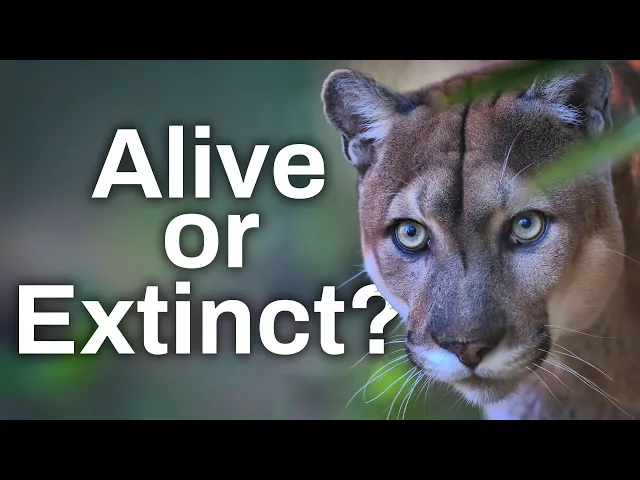
How We "Rescued" The Florida Panther
Bizarre Beasts
0:10 for Foreign speech.
0:33 Foreign speech.
0:34 Foreign speech.
1:02 IC.
1:24 Puma conqueror once had no shortage of room to exist.
1:29 In fact, historically,
1:30 it had the greatest range of any land mammal in the Western Hemisphere.
1:34 And in North America, populations of this cat stretched from coast to coast,
1:39 representing either multiple subspecies or distinct
1:42 populations of the same subspecies, depending on who you ask.
1:46 With that huge range came a variety of names.
1:49 Mountain lion, cougar, puma, and panther to name a few.
1:53 But over hunting by European settlers and habitat loss eventually drove
1:58 them almost entirely out of the eastern half of the United States.
2:02 And by the early 1900s,
2:03 only one breeding population was still recognized east of the Mississippi,
2:07 the Florida panther.
2:09 A group of small, isolated,
2:11 rarelyseen survivors that stalked the swamps and forests of South Florida,
2:15 as described in the quote we started off with from Betty Oyola,
2:19 a member of the Mkasuki tribe of Indians of Florida.
2:22 But these last eastern cougars were barely holding
2:24 on as urbanization ate away at the space they needed.
2:28 And by the late 20th century,
2:30 the Florida panther was down to just 20 to 30 individuals.
2:33 Not quite endling status, but too close for comfort.
2:37 Now though, there are about 200 of them.
2:40 Or are there?
2:41 See, to some degree,
2:42 it turned out that saving the Florida panther meant expanding the definition
2:47 of what it means to be one in the first place.
2:50 New individuals were brought into the area
2:52 that technically became panthers in Florida.
2:56 But is that alone enough to make them Florida panthers?
3:00 What if preserving an animal means changing it?
3:03 Hybridizing away whatever makes it distinct?
3:05 And if a group goes extinct, but its genes live on, is it really gone at all?
3:12 In ancient Greek philosophy,
3:14 there's a paradoxical thought experiment called the ship of Thesus,
3:18 which explores the nature of identity and how it can change over time.
3:21 In the paradox, the mythical king Thesus
3:24 returns to Athens from an epic adventure,
3:26 and his people decide to celebrate his heroics
3:28 by preserving his famous ship for future generations.
3:32 Over time, as the ship aged and decayed,
3:34 the Athenians started replacing parts of its structure bit
3:37 by bit to preserve the vessel as a whole.
3:40 While the replacement process began with just a beam here and a plank there,
3:44 eventually nothing of the original ship was left,
3:47 was this still the ship of Thesius?
3:50 Or was it an entirely new boat with a distinct identity
3:54 from the one that had carried the ancient king across the sea?
3:57 And if it's the latter, when in the process did it lose its initial identity?
4:02 when the first replacement part was added or when the final
4:06 original part was removed or at some point in between.
4:10 Today, Florida Panthers are facing a similar identity crisis,
4:14 emerging from an effort to save them.
4:16 See, the last few centuries have not been kind to the Florida panther.
4:20 They were once part of a single continuous
4:22 cougar population that roamed throughout the southeastern United States.
4:26 But a mixture of habitat loss, over hunting,
4:28 and other pressures gradually reduced their range
4:31 by around 95% over the 19th and 20th centuries.
4:35 But in the southern tip of Florida, they've held on in small numbers,
4:39 isolated for over a 100red years,
4:41 more than a thousand km away from any other mountain lions.
4:45 Now, historically, attempts to neatly organize the various
4:48 cougar populations of the Americas into different subspecies,
4:51 have come to wildly different conclusions.
4:54 Studies have taken them from 32 distinct
4:58 subspecies to six to most recently just two,
5:01 making the Florida panther part of just one subspecies found in North
5:05 and Central America with the second subspecies found in South America.
5:09 Taxonomy is often messy and subjective,
5:12 but thousands of years of adapting to their local environment,
5:15 plus a century of genetic isolation, has made Florida panthers kind of different
5:19 from the other mountain lion populations in North America.
5:22 They tend to be darker in color and smaller on average,
5:25 though with longer legs and a pretty broad, flat skull with arched nasal bones,
5:30 a possible adaptation for coping with Florida's notorious humidity.
5:34 Plus, they often have a kinkedked tail and a patch
5:37 of fur on their backs like a cowick.
5:39 These traits are common in the population
5:41 due to generations of genetic isolation.
5:44 Their geographic and physical distinctiveness meant that they
5:47 became an iconic part of Florida's cultural identity.
5:51 Adopted as the official state animal and as the namesake
5:53 of one of the state's professional sports teams.
5:56 From ancient figurines to modern merch,
5:58 the panthers fame among the peoples of Florida has endured
6:01 for over a thousand years in some form or another.
6:04 Even though the panthers themselves nearly vanished.
6:07 Hunting them was banned in 1958, and they were one of the first animals to be
6:11 added to the federal endangered species list in 1967.
6:15 But it wasn't enough.
6:17 Habitat fragmentation, collisions with vehicles,
6:20 and increasing inbreeding meant that this final
6:23 eastern population became chronically tiny,
6:26 hovering at around an estimated few dozen individuals through the 70s and 80s.
6:31 Things were looking so bleak that it seemed
6:33 like this beloved icon might be doomed to gradually
6:37 but inevitably fall victim to a process known
6:40 in the field of conservation as inbreeding depression.
6:43 Inbreeding depression is when a population's fitness,
6:46 its ability to survive and reproduce is
6:48 decreased by the loss of genetic diversity.
6:50 When a gene pool is small and full
6:52 of closely related individuals who interbreed with each other,
6:56 the chances they'll produce offspring carrying two
6:58 copies of the same bad gene are increased.
7:01 The buildup of so many harmful genes from generation upon generation
7:05 of imbreeding can overwhelm a population and lead to a literal dead end.
7:11 The king's tail and cowlicked fur patch were just the beginning.
7:14 Heart problems and fertility issues became common in Florida panthers, too.
7:19 Their odds had gotten so bad that some began to wonder if the best way
7:22 to save the panthers of Florida was like the ship of Thesius to change them.
7:28 It's a process called genetic rescue.
7:30 In theory, the antidote for inbreeding depression.
7:33 By introducing new breeding age animals from other populations or subspecies,
7:37 you can rapidly inject a bunch of new genetic
7:40 variation into a small and isolated group's gene pool,
7:43 saving it from falling into an extinction vortex.
7:47 And in 1991, the US Fish and Wildlife
7:49 Service announced that it was hatching a plan
7:51 to do just that, releasing new cougars
7:54 from other populations to genetically enrich the Florida panther.
7:58 Some argued that it wouldn't tackle
8:00 the root cause of the Florida panther's decline
8:02 and that conservation resources should instead be focused
8:06 on providing more connected and better protected habitat.
8:09 As one scientist put at the time,
8:11 genetically fortified kittens will soon be loosed upon a South
8:14 Florida landscape that has repeatedly
8:16 demonstrated its inability to nurture them.
8:19 Plus, it opened up the possibility of weird
8:22 conflicts between our taxonomic and legal systems.
8:25 Would introduced cougars and future
8:28 hybrids be officially considered Florida panthers
8:31 and have the same protections in the eyes of the law,
8:34 even if their technical scientific classifications were to differ.
8:37 There were also concerns that blending populations
8:39 in this way could actually reduce the animals survivability
8:43 by diluting any useful adaptations that the Florida
8:46 panther might have evolved for its distinctive environment.
8:50 It was a desperate conservation gamble.
8:52 Genetic rescue worked in theory, but it had few wellstudied precedents,
8:57 and it came with many long-term unknowns that threatened to forever
9:01 alter the identity of the very animal we were trying to preserve.
9:05 But time was running out, and the decision was made to try anyway.
9:09 In 1995, eight female cougars were introduced to South Florida from Texas.
9:14 These were cats from a different kind of ecosystem over a thousand km away,
9:18 and they'd been historically classified as a different subspecies.
9:22 They were still the Florida panther's
9:24 closest geographic and genetic relatives, though.
9:27 And it's likely that the two
9:28 populations had occasionally interbred in centuries past,
9:31 so they were the best cats to provide a genetic rescue.
9:34 and the Fish and Wildlife Service determined that upon their release,
9:38 the federal government would consider them
9:40 and their offspring to legally qualify as Florida panthers,
9:44 even if their scientific classification might be messier.
9:47 Of the eight introduced females, five successfully bred with local males,
9:52 resulting in a generation of 20 hybrid kittens.
9:55 And from there, the gradual dispersal of Texas genes
9:58 through the rest of the population was set in motion.
10:01 Within just 10 years,
10:03 the overall Florida panther pool contained 44% Texas cougar DNA.
10:08 In fact, surviving introduced cats had to actually be removed out of concerns
10:12 that Texas DNA could soon become excessive in the Florida panther gene pool.
10:17 But today, that experimental genetic rescue seems to have paid off.
10:21 The population has jumped from the low dozens to the low hundreds.
10:25 Genetic variation is up relative to before
10:28 and the most visible signs of inbreeding like the tail
10:32 kinks and the cowicks have dropped in prevalence
10:34 from over 75% of the population to around 30.
10:38 And a 2024 study found improvements in the health of the population
10:42 by virtually every metric across five generations after the genetic rescue.
10:47 But there are also signs that the boost
10:50 may be starting to wear off since around 2016.
10:53 The growth of their population size and genetic diversity
10:56 has stalled and even begun to trend back down again.
11:00 The population is still dangerously small and without the right
11:03 conditions to grow further or a regular supply of new DNA,
11:07 inbreeding depression can't be kept at bay for long.
11:11 Some modelers have recommended that we should probably
11:13 add 5 to 10 cougars from other populations every 20 to 40 years or so to prevent
11:18 the small and isolated gene pool from stagnating over time.
11:22 Plus, the factors that push them into decline
11:24 are still holding back their population growth today.
11:27 You can't genetically enrich a panther out of the way
11:30 of an oncoming truck or safely through a fragmented habitat.
11:34 In 2024 alone, 28 Florida panthers were killed in vehicle collisions,
11:39 which might be over 10% of the entire population.
11:42 If the landscape can't support them in large numbers
11:45 like it used to, genetic rescue only buys them time.
11:48 Florida panthers may end up as a chronically endangered group,
11:52 limited by urbanization to just a few hundred individuals max,
11:56 propped up only by occasional emergency injections of diversity
12:00 from outside that keep them dangling on the edge of existence.
12:04 And whatever remains of the original Florida panther in the gene
12:07 pool will become fainter and fainter with every genetic rescue.
12:11 There are only so many conservation tricks in the book,
12:13 and in the end, there's only ever one sustainable conservation solution.
12:18 Providing enough safe and connected habitat
12:21 for an endangered species to thrive and multiply in.
12:24 If we can't do that, it'll always be endangered.
12:27 Nothing else really matters.
12:29 Not how intensely we manage its genetics, not what legal protections we give it,
12:34 and not how we choose to view its identity.
12:37 There's no objective measure for deciding how many genes make
12:40 a species or even how to define species in the first place.
12:44 All that really matters is whether or not we can
12:47 make space for these panthers of thesis in the modern world.
12:51 Keeping them on genetic life support may be necessary to save them.
12:55 But it is far from sufficient.
12:57 And without addressing their ecological crisis,
13:00 their identity crisis will remain the least of their worries.
13:08 Endlings is filmed in the Harry Plumbley studio and was
13:11 made possible by hundreds of you who supported our Kickstarter.
13:15 Thank you so very much.
13:17 We could not have done all of this without you.
13:20 We'd like to thank the National Geographic
13:21 Photo Arc for their help on this episode.
13:24 Finding images of these critters is not easy,
13:26 so we really appreciate the ability to work
13:28 with them to show these animals to you.
13:32 Heat.
13:41 Heat.