The Interstellar Visitor You Should Hope Never Arrives
Astrum
0:00 Meteors have the power to transform our planet,
0:04 to wipe out huge swaths of life on Earth in one impact.
0:08 But, not all of that dramatic.
0:11 We are hit by more than 100 tons of small sand-sized particles every day,
0:17 and they are essentially unnoticeable.
0:20 About once a year, a car-sized meteor comes crashing through our atmosphere,
0:25 but the resultant impressive fiery streak
0:28 burns up long before hitting the ground.
0:32 It's only on the scale of millions of years that we are
0:35 in danger of being hit by meteors a kilometer or two wide,
0:39 big enough to do some serious damage.
0:42 But, we've not seen one of those since the dinosaurs, lucky for us.
0:47 But, size isn't everything.
0:49 In fact, the biggest impacts may not even be from the largest objects.
0:54 If one particularly interesting theory is true,
0:58 some very rare meteors may be made of something a little more exotic than rock.
1:05 Externally, there would be not much to differentiate these rarer meteors.
1:10 In the vacuum of space,
1:11 they would appear exactly the same as any other space rock.
1:15 But, while regular meteors might create a fiery streak in the sky,
1:19 these outliers would have impacts that exceed the largest of nuclear bombs.
1:26 And those are just the small ones.
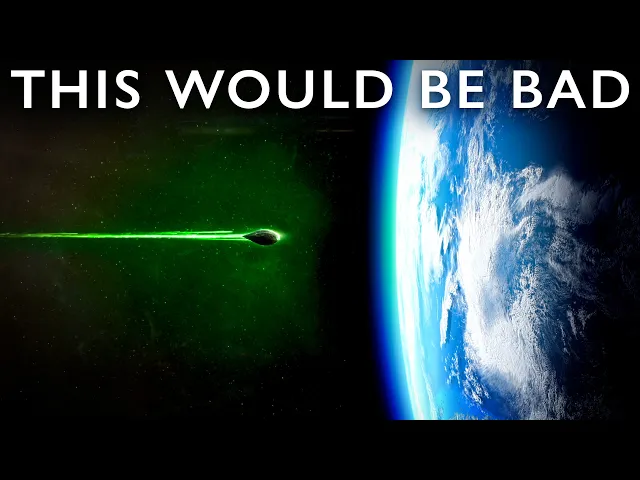
1:28 If a kilometer-sized meteor of this variety hit the Earth,
1:33 similar in size to the normal meteor that killed the dinosaurs,
1:37 we might not have a planet anymore.
1:40 That is the power of a meteor made of antimatter.
1:46 Could antimatter meteors really exist?
1:49 What clues would help us identify them from regular matter meteors?
1:54 And how big would they have to be to become a major problem?
1:59 I'm Alex Holligan, and you're watching Astrum.
2:02 Join me today as we test the scientific theory behind antimatter meteors,
2:07 and explore the odds of such objects lurking in our solar system.
2:13 Antimatter is a funny substance.
2:16 The fact that it exists means that we shouldn't be here.
2:20 It is almost identical to regular matter with a few key differences.
2:25 One is that it has an inverted charge.
2:28 Another is that when antimatter meets regular matter,
2:32 the two annihilate each other completely,
2:35 converting almost entirely into energy.
2:40 Now, in the early universe, it wasn't just matter that was created.
2:44 In theory, an equal amount of antimatter came [music] into being, too.
2:49 All the matter should have bumped into the antimatter,
2:52 and everything would have canceled each other out.
2:56 This would have left no universe for us,
2:58 as there would be nothing to make the universe out of.
3:02 It is one of the mysteries of science that this did not happen.
3:06 And for some reason,
3:07 a slightly larger amount of matter coalesced into existence than antimatter,
3:12 perhaps as small a discrepancy as a billion
3:15 and one matter particles to every billion antimatter ones.
3:20 Scientists are still trying to figure out why this might have occurred,
3:24 but the mystery remains unsolved for now.
3:28 [music] Perhaps there is some rule at play that we've not yet identified.
3:31 Whatever caused it, this imbalance is the reason the universe
3:34 we see around us is almost entirely made of regular matter.
3:39 And the only place we reliably see antimatter is when
3:42 they make tiny amounts of it in experiments at CERN,
3:46 and in other particle accelerators.
3:48 Some hospitals even have small particle
3:50 accelerators to create positrons for PET, or positron emission tomography scans.
3:58 However, just because we don't see it,
4:01 doesn't mean that tiny pockets of antimatter [music] couldn't exist.
4:06 When the raw primordial soup quark-gluon plasma
4:10 of the Big Bang began to form into particles,
4:12 while overall there would have been more matter than antimatter,
4:17 in local areas there were fluctuations.
4:18 [music] So, it's logical that clumps of antimatter could
4:22 have emerged and dominated as gravity pulled them together.
4:27 After all, if you flip a coin enough times,
4:30 you'll inevitably end up with runs where you
4:32 flip nothing but heads or nothing but tails.
4:36 If these clumps were large enough in scale,
4:38 they wouldn't annihilate away in a burgeoning solar system.
4:42 Instead, they would be the solar system,
4:45 and it would be pockets of matter that would eventually annihilate out,
4:50 leaving behind stars and protoplanetary disks made entirely of antimatter.
4:57 This seems highly theoretical,
4:59 but could such solar systems [music] actually exist?
5:03 I personally think it would be really cool if they do,
5:06 and should we ever find one, it will certainly be breaking news.
5:10 If you want to be the first to know when a story like this does [music] break,
5:14 and keep up to date with other slightly more likely discoveries,
5:17 too, then the best place to find them is the Astrum newsletter.
5:21 This is a weekly update sent straight to your inbox,
5:24 specially curated by the Astrum team,
5:26 and packed with not only the latest spectacular space stories,
5:30 but images, links to some of my all-time favorite Astrum videos, [music]
5:34 and the chance to get in touch with us directly.
5:37 Ask us a space question, and we'll do our best to answer them.
5:40 For now, though, let's get back to the antimatter at hand.
5:46 For the most part, an antistar would be visually identical to a regular one,
5:52 [music] as antimatter behaves in all the ways you might expect matter to.
5:55 It obeys the same laws of gravity, and mostly looks the same.
6:00 The only telltale giveaway would be when regular matter interacted with it,
6:05 such as when the interstellar winds met the edge of the fledgling solar system,
6:10 and resulting annihilations would emit gamma radiation.
6:13 And curiously, there are some systems that seem to do this.
6:18 14 such gamma-ray emitting star candidates were found in the Milky Way,
6:23 thanks to the Fermi Large Area Telescope in 2021.
6:28 If these are antistars,
6:31 and their profiles do match what we would expect out of antistars,
6:35 so this is not ruled out, and [music] they're not other objects that emit
6:39 gamma rays like pulsars or black holes,
6:43 then systems made of antimatter with planets and asteroids do exist.
6:49 The ratio of antistars to stars would be about one in 400,000.
6:55 So, the stage is set.
6:57 If antistar systems could exist,
7:00 it's not illogical to think that antimatter meteors do, too.
7:04 And that leads us to the question, what are the chances of them coming to Earth?
7:11 The idea of antimatter meteors striking our planet is not a new one.
7:16 Even back in 1940, only a decade or so
7:19 after the discovery of antimatter as a concept,
7:22 Russian-American physicist Vladimir Rojansky began
7:25 to speculate about their existence.
7:28 All it would take was for our solar system to have passed
7:31 one of these antimatter solar systems at some point in the past.
7:35 The sun's gravity would then knock a few outlying
7:38 antimatter meteors out of their precarious orbits and into ours.
7:43 Antimatter meteors may not have been able to form in our solar system.
7:47 Their particles would have been annihilated by interaction
7:49 with matter far too early for that.
7:51 But, in space, just an empty vacuum somewhat devoid of matter,
7:56 there would be nothing for them to annihilate with.
8:00 So, there's a chance they could be among us.
8:03 And if they were, would we even notice?
8:07 Soon after Rojansky,
8:09 American astronomer Lincoln LaPaz began to wonder whether any
8:13 of the craters on Earth could be attributed to antimatter meteors.
8:17 So, perhaps this is the time to consider what an antimatter
8:20 meteor could do if it came in contact with the Earth,
8:24 so we know what to look out for.
8:26 Thankfully, it's not necessarily a simple journey.
8:31 The first issue such an antimatter meteor would
8:33 encounter before reaching Earth would be our atmosphere.
8:37 To be fair, this is a problem for regular meteors, too.
8:41 When one of those trades vacuum for air,
8:44 the speed at which it's traveling causes it to generate incredible friction,
8:48 causing some or all of the meteor to burn up on the way down,
8:53 depending on its starting size,
8:54 leading to the fiery streak I mentioned at the start.
8:58 However, antimatter meteors would have it much worse.
9:02 Each particle of atmosphere that the antimatter meteor encountered
9:05 on the way down would annihilate a similar amount of the meteor.
9:09 So, to understand what happens next,
9:11 we need to turn to Einstein's famous equation, E= mc².
9:17 The meteor's mass, multiplied by the speed of light squared,
9:21 tells us how much energy would be released by the meteor on the way down.
9:25 Technically, twice that.
9:27 As for each particle of the meteor that's annihilating,
9:30 a particle of atmosphere is doing so, too.
9:34 This is potentially a huge amount of energy being released.
9:38 Let's do a bit of a thought experiment to work out how much.
9:43 While the dividing line between the atmosphere and space is either 100 km up,
9:48 if you're talking to Europeans, or 80 km up, if you're talking to Americans,
9:52 as the two haven't reached a consensus on that point yet,
9:55 over 90% of the mass of Earth's atmosphere is actually clumped below 16 km,
10:01 clinging to the planet as closely as possible thanks to the pull of gravity.
10:05 So, by working out how much air
10:07 exists between this line and the Earth's surface,
10:10 we can get a rough idea of how much antimatter
10:12 you'd need to have before an antimatter meteor hits the ground.
10:17 This is a little tricky to calculate, but thanks to a chart
10:20 released by the International Standardization Organization,
10:23 I was able to add up the sum total of the atmosphere
10:26 at different elevations between the surface and 20 km high,
10:30 and found that in a 1 m by 1 m corridor between space and the surface,
10:35 you'd have roughly 10,132 kg worth of atmosphere.
10:40 A meteor would need to be roughly this large to even hit the surface,
10:44 assuming it traveled the most direct route straight down.
10:49 Now, antimatter is similar in mass to matter,
10:52 so we can assume that they would have comparable compositions, too.
10:56 Most meteors are made of chondrites,
10:59 so assuming an average antimatter meteor made
11:02 of the antimatter version of the same stuff,
11:04 we can put the density of our antimatter
11:07 meteor at around 3,400 kg per cubic meter.
11:11 Of course, there's then a balancing act you need to do.
11:15 The bigger the meteor, the larger the surface area,
11:17 and the more air it thus encounters before it reaches the surface.
11:21 However, as volume scales up in cubes while surface area is only squared,
11:26 there is a sweet spot you can hit where the amount of air being
11:28 annihilated by the meteor would theoretically perfectly
11:32 match the amount of mass the meteor possesses.
11:35 And then we know that any mass of meteor above
11:37 that would make it through the atmosphere to hit the ground.
11:41 Using very rough math, I found that a 3 by 3 by 3 m meteor, or 27 cubic meters,
11:48 worked best for this calculation, which had a mass of 91,800 kg,
11:54 or 3,400 kg per cubic meter times 27 cubic meters.
12:00 This would only encounter 91,191 kg worth of air on the way down,
12:07 meaning 608 kg worth of meteor would actually hit the surface.
12:13 That's approximately the mass of a large grand piano.
12:17 How much damage could 600 kg of antimatter actually do?
12:22 It's time for our equation, E= mc².
12:26 Using this calculation,
12:27 we learn that 600 kg of remaining meteor releases 5.4* 10^ 19 J of energy,
12:37 or 54 quintillion joules.
12:41 Then double that, as the ground being annihilated releases that amount, too.
12:46 So, 108 quintillion joules.
12:49 For a point of reference, a 1 megaton nuke gives off 0.18* 10^ 15 J of energy.
12:58 Even if we scaled up to the largest nuke ever detonated,
13:02 the Tsar Bomba, which had a yield of 50 megatons,
13:07 we're still only looking at 2.09* 10^ 17 J,
13:12 a full 5,000 times weaker than our antimatter grand piano.
13:17 And the Tsar Bomba blast was so great,
13:20 towns within 55 km, like 70, were leveled.
13:26 Wooden buildings 160 km away were reportedly damaged.
13:31 The light from the blast was seen 1,000 km away.
13:35 Windows in Norway and Finland were shattered by the explosion.
13:40 If just 600 kg of our antimatter meteor
13:44 impacted in the middle of a state like Texas,
13:47 the whole state would be destroyed, the center vaporized, the rest devastated.
13:55 This is just the energy released
13:56 from our antimatter meteor annihilating on the ground,
14:01 not even going into things like kinetic energy.
14:04 But even then, it's actually not just the 600
14:07 kg that hits the ground we need to worry about.
14:10 When you consider the rest of that 91,200
14:14 kg of mass that was annihilated in the atmosphere,
14:18 the blast radius becomes a lot bigger.
14:22 While some of that energy would travel upwards into space,
14:25 minimizing the damage below, suddenly you're not just worrying about Texas.
14:31 You're worrying about the entirety of the USA.
14:35 All that's just from an antimatter meteor that's comparable in size to a car.
14:41 We really do not want to get hit by an antimatter meteor.
14:47 So, what actually are the risks here?
14:49 Let's say that an antimatter meteor had got swept up
14:52 in the sun's gravity well millions to billions of years ago.
14:56 Could it now be one of the 40,155 near-Earth asteroids that NASA tracks?
15:03 The good news is, no.
15:06 For one simple reason.
15:09 Space isn't actually empty.
15:12 While we talk of space being a vacuum, even in space,
15:16 there are trace amounts of dust floating in the void.
15:20 As such, an antimatter asteroid traveling
15:23 even through the interstellar medium would
15:25 not likely have a survival rate of longer than around 300 years.
15:30 As we last clipped another star 70,000 years ago,
15:34 Scholz's star, in case you're interested,
15:36 it would have to have been an exceptionally lucky antimatter meteor
15:41 to not only dodge all the other asteroids in that time,
15:44 but also to have not encountered enough dust since
15:48 then that it would have disintegrated into gamma radiation.
15:52 For this same reason,
15:54 an interstellar antimatter comet coming our solar system would be unlikely.
15:59 Small ones would burn up before reaching us,
16:02 and larger masses would be noticeable.
16:04 They would emit a steady stream of gamma rays as they traveled,
16:07 making them detectable to our telescopes.
16:10 No such sparkling asteroids have ever been detected.
16:14 So, all in all, while it would be devastating to be hit by an antimatter meteor,
16:20 it is unlikely that one would survive long enough to reach our planet,
16:24 assuming they and antimatter stars exist in the first place.
16:29 We are probably quite safe.
16:31 Besides, if antimatter meteors existed,
16:34 we might have seen some evidence of them before.
16:36 Meteor impacts with unusual destructive capacity,
16:40 but leaving no traces of the meteor that caused it.
16:43 We've not seen anything like that.
16:46 Have we?
16:48 In June 1908, a fireball lit up the sky in a remote part of Siberia.
16:54 The meteor exploded before hitting the ground,
16:56 its detonation causing massive forest fires and sending trees crashing
17:01 to the ground like bowling pins in an area of destruction kilometers wide.
17:06 Witnesses more than 30 km away reported seeing a flash brighter than the sun,
17:12 followed by a roar of thunder.
17:15 Due to its remoteness, scientific teams did not arrive at the site until 1927,
17:20 but even then, the destruction caused by the blast was easy to see.
17:25 Strangely, for an object that caused such destruction,
17:29 almost no trace of the meteor was ever found beyond a few microparticles.
17:36 But the Tunguska event couldn't have been
17:38 caused by an antimatter meteor, could it?
17:43 Don't worry, we know that it probably wasn't an antimatter meteor,
17:48 but there was a lot of debate about the topic in the past,
17:50 and we couldn't resist being a little spooky.
17:57 I'm happy to announce we have a weekly newsletter
17:59 to keep up with all the discoveries in our cosmos,
18:02 and our designer Peter has made the most beautiful email you'll ever receive.
18:07 Sign up with the link down below.
18:09 It's the best way to stay connected between videos.
18:12 Short, focused updates on what's new and fascinating in space each week.
18:17 No spam, no filler, just the good stuff.
18:20 You'll get the latest news, visuals,
18:22 and insights delivered straight into your inbox.
18:26 If you enjoy Astrum videos, you'll love this.
18:28 Join the newsletter and stay curious with us.