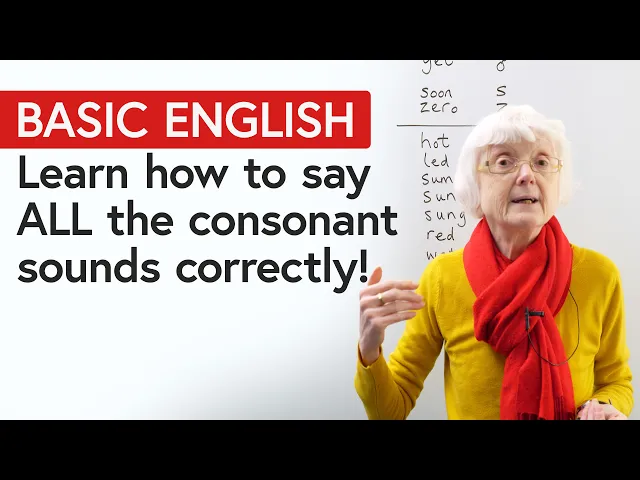
English for Beginners: Learn all the CONSONANT SOUNDS
Learn English with Gill · engVid
0:00 Hello.
0:00 I'm Gill at engVid, and today's lesson is on consonants in English.
0:07 Okay?
0:08 So all the consonant sounds, not the vowel sounds, but the consonant sounds.
0:16 So, just to explain that the way I've got them
0:20 written up on the board here is this column here,
0:25 and then down in this column down to the line,
0:30 they are pairs of consonants because they are formed in the same way,
0:36 the way you shape your mouth to make that sound.
0:41 They're the same way that you form your mouth,
0:45 but you put more force behind some of them than the others.
0:51 They're lighter and heavier, but they're the same shape.
0:54 And then the rest of them below this line
0:58 are single consonants that don't belong in a pair.
1:03 So, I think that will become clearer as I start
1:07 to go through them and demonstrate how to make the sound.
1:13 Okay, so first of all,
1:16 and also to explain that I've put the phonetic symbols at the side for...
1:22 Don't worry if you don't know the phonetic symbols; you don't need to know them.
1:29 This is maybe for people who have
1:32 learnt the phonetic symbols who find them useful, so don't worry if...
1:38 You certainly don't need to learn these.
1:42 I have difficulty remembering them all myself, so don't worry.
1:46 As long as you know how to pronounce it, that's the main thing.
1:51 But these are to show that each one is a different sound.
1:57 So, the first pair, then, is "p" and "b",
2:02 so as they appear in the example words "pen" and "back".
2:08 So, it's "p", "p", "p", "b", "b", "b".
2:13 So, you can see what I mean by the pair
2:17 of consonants formed in the same way by your mouth.
2:22 You put your lips together, "p", "p", "b", "b".
2:27 And the difference is just that the "p",
2:32 the "p" sound is lighter, and the "b" sound is heavier.
2:37 You use your vocal cords more to make the "b" sound.
2:43 "p", "p", "p", "b", "b", "b".
2:45 So, feel free to repeat them after me, each one as I say it.
2:52 "p", "p", "p", "b", "b", "b".
2:56 So, "pen", "back".
2:58 Okay?
2:59 So that's the first pair.
3:03 Then the second pair is "t" and "d".
3:09 So, again, in your mouth you'll feel that your tongue
3:14 is going up to the roof of your mouth,
3:19 "t", and then coming away again, "t", "t", "t", like that.
3:25 "d", "d", "d".
3:27 So, the "t" is lighter, "d" is heavier.
3:32 So, we've got "t" as in "tea", "tea", "tea", and "d" as in "day", "day", "day".
3:45 Okay.
3:46 Good.
3:47 Right, the next pair, so we have "ch", "ch", "ch", and "j", "j", "j".
3:58 And you can feel, I hope, in your mouth,
4:03 your tongue is in the same position for both of those, "ch",
4:10 "ch", "ch", "j", "j", "j".
4:12 And the only difference is the "j" is a strong sound.
4:19 Okay?
4:20 So, "ch" as in "cheer", "cheer", and "j", spelt with a "j",
4:29 but this is the phonetic symbol for it, "j", "j", "j".
4:35 So, we have "cheer" and "jump", "cheer", "jump".
4:41 "Ch", "ch", "ch", "j", "j", "j", "j".
4:48 Okay?
4:49 Good.
4:50 And the next pair are "th", "th", "th", "th", "th", "th".
4:58 So, for this one, if you do it, you can feel your top teeth on your bottom lip,
5:06 like that, almost as if you're going to bite your lip, like that.
5:12 "Th", "th", "th", "th", "th", "th".
5:16 You might feel it tickles a little bit, "th".
5:21 If I do that...
5:23 See if you can do that as a long, continuous sound,
5:27 "th", it really tickles at my bottom lip when I do that.
5:34 So, "th", "th", "th", "th", "th".
5:39 So, "few", "few", "few", and "view", "view", "view".
5:49 Right?
5:51 Then we have...
5:52 You might think "th", we have "th" twice.
5:56 You might like to watch my other video
6:00 on the two different ways of pronouncing "th",
6:03 because again, one is lighter, the other is heavier.
6:08 So, it's "th" as in "thing", and "th" as in "then".
6:17 "Thing", "then".
6:18 So this second one is heavier, using more of your vocal cords.
6:24 Okay?
6:24 And those are the symbols for those.
6:28 So, "thing", "then", and your tongue is touching your front teeth, top teeth.
6:35 "Th", "th", "th", "th", "th", "th" for both of those.
6:41 Okay?
6:42 And then the next pair is "sh", "sh", "sh" as in "fish",
6:48 and "zh", "zh", "zh" as in "pleasure", "pleasure", "zh".
6:55 So, "sh", "zh", "sh", "zh".
6:59 And the second one, all...
7:02 All of these, the first is light, the second one is heavy.
7:10 "Sh", "zh", "fish", "pleasure".
7:13 Okay?
7:14 Good.
7:15 And the next pair is "k", "k", "k" as in "key", "k", "k".
7:22 So if you can feel where your tongue is
7:26 sort of going towards the back of your throat,
7:30 "k", "k", "k" to make the "k" sound.
7:34 And then "g", "g", "g", much heavier, "g", "g", "g",
7:38 but your tongue is in the same place for that.
7:43 So, "k" as in "key", and "g" as in "get".
7:51 Okay?
7:52 And then the last pair is "s", "s", "s",
7:58 "s" as in "soon", and "z", "z", "z" as in "zero".
8:06 So, "s", "s", "s", "s", "z", "z", "z", "z", "z",
8:09 you'll feel your tongue is in the same position for both of those.
8:15 Okay.
8:15 Good.
8:17 Right, so those are all the pairs,
8:20 and now these are just the single ones that don't belong in a pair.
8:25 So, we have the "h" sound, "h".
8:28 If you "h", "h", "h", breathe on your hand, "h",
8:33 you should be able to feel "h", "h", the heat from your breath, "h".
8:40 So, "hot", "h", "hot", "h", "h", "hot".
8:45 So that's "h" as in "hot".
8:49 And then the "l", "l", "l",
8:51 you have your tongue touching the roof of your mouth, "l", "l", "l", "l", "l".
8:58 So, "l" as in "lead", "lead", "lead".
9:02 Okay.
9:04 "M" as in "some", so you bring your lips together, "m", "m", "m", "m".
9:14 "Some", "some".
9:15 Okay.
9:16 And then "n" as in "sun", so your lips aren't totally together,
9:23 you've got "n", "n", "n" as in "sun",
9:27 but then "sun", and you keep your lips a little bit more open,
9:34 "n", "n", "n", "sun", "sun".
9:36 And your tongue should be up on the roof of your mouth, "sun", "n", "n", "sun".
9:44 Okay.
9:46 And then this is "sun" with a "g" added,
9:51 so "sung", "ung", "ung", "ung", "ung", "ung".
9:55 So this is the symbol for "ng",
9:59 "ng", so "ng" together, "sung", "ng", "ng", "ng".
10:04 Okay.
10:05 And then "r" as in "red", "r", "red", "red".
10:12 Okay.
10:12 Where your tongue will curl back into your mouth to make the English "r" sound.
10:22 It's not like, for example, a French sounding "r", "r", "r",
10:28 "r", where your tongue is catching at the back of your throat.
10:33 The English "r", "r", "r".
10:36 You bring your lips together, "r",
10:38 but curl your tongue back towards the back of your throat, "r", "r", "r", "r".
10:45 "Red", "red", "red".
10:47 You'll see another of my videos all about pronouncing "r" in English,
10:54 so have a look for that one if you'd like to practice that.
11:00 Okay.
11:00 And then "w" as in "wet", "w".
11:05 So, "w", "w", "w", "w", "w", "w", "w", "w".
11:11 Bring your lips together like that.
11:15 Okay.
11:15 "Wet".
11:16 And finally, although it looks like a "j", this is the symbol,
11:23 phonetic symbol, it's actually "y", "y", "y", "y", "y", as in "yet", "yet".
11:30 Okay.
11:31 So, I hope that's been a helpful run-through
11:37 of all the consonants that you use in English,
11:44 whether it's British English or American English,
11:48 it's the same more or less, except "r" in American English,
11:55 sometimes you hear a more pronounced "r",
11:59 and also in some parts of the UK, some areas,
12:04 different regions might make more of an "r" sound,
12:09 but that is a variation within the UK.
12:15 So, I hope that's been helpful.
12:19 So, thank you for watching, and I hope to see you again soon.
12:24 Bye for now.