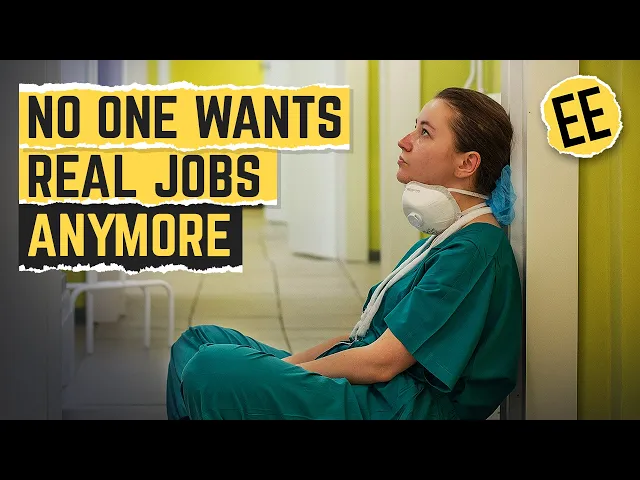
Why Essential Workers Are Going Extinct
Economics Explained
0:00 We're living through an age of job anxiety.
0:02 Every week there's a new headline warning
0:04 that artificial intelligence is coming for our livelihoods.
0:07 We're told it could reshape everything from office jobs
0:09 to creative work and even professions that once seemed untouchable.
0:12 And that fear isn't irrational.
0:14 Big technological shifts have always reshaped labor markets.
0:17 But while we're fixated on jobs that might disappear someday,
0:20 something far more concrete is already happening.
0:23 Countries around the developed world are
0:24 quietly running out of teachers and doctors.
0:26 These are some of the most stable jobs in the economy.
0:29 They don't vanish in recessions and societies
0:31 quite literally cannot function without them.
0:33 Yet across the OECD, the teaching workforce is aging fast just
0:37 as fewer people are coming in behind them.
0:39 Shortages have existed in education for a long [music] time,
0:42 but they were usually manageable.
0:43 Lately they haven't been.
0:45 According to UNESCO,
0:46 maintaining today's education systems alone will require
0:49 millions of new teachers [music] by 2030.
0:51 In healthcare, the picture is even starker.
0:53 The World Health Organization warns of a global
0:55 shortfall of around 11 million health workers by 2030,
0:58 driven by aging populations and medical
1:00 staff retiring faster than they're being replaced.
1:03 Everyone agrees this is a problem and [music] in practice
1:06 many developed countries have already leaned on the same solution.
1:08 Instead of training more teachers and doctors,
1:10 they've increasingly relied on immigration
1:12 to keep schools and hospitals running.
1:14 At first glance that seems like a win-win,
1:16 but this fix only works for as long as people stay and increasingly they don't.
1:21 So, as always we've got some important questions to answer.
1:25 Why are essential workers disappearing in the first place?
1:28 [music] Why can't migration continue to be the solution for this issue?
1:31 And what happens if this shortage becomes permanent?
1:35 When making these videos, I go down a lot of rabbit holes online and it
1:38 can be easy to forget that not all websites are safe.
1:41 Most are trying to take your information and sell
1:43 it to the big tech [music] companies for their gain.
1:45 That's why I use Surfshark.
1:46 It's a VPN, a virtual private network that encrypts
1:49 your internet traffic and hides your real IP address,
1:52 keeping these companies from ever getting your information.
1:54 But it can do much more than simply protect you.
1:57 Surfshark allows us to switch digital locations so
1:59 we can see content made around the world.
2:01 And the clean web feature blocks pop-ups and ads before they even load,
2:04 saving you loads of annoyance in today's digital landscape.
2:07 You can install Surfshark on unlimited devices and we
2:10 make sure everyone on our team uses it.
2:12 Right now Surfshark is offering Economics Explained viewers a special deal.
2:15 With our code you can get four extra months for free.
2:18 Go to surfshark.com/economics or use code economics at checkout
2:21 to get four extra months of Surfshark VPN.
2:24 On paper, becoming a teacher or a doctor still
2:27 looks like one of the safest bets you can make.
2:29 Teachers tend to have stable contracts,
2:31 predictable career paths and regular hours with pay that often catches up
2:34 to or exceeds the national average wage over the course of a career.
2:37 In the UK, for example,
2:39 a qualified teacher's salary starts at about 32,916 pounds a year but can rise
2:44 to around 51,000 pounds or more
2:46 with experience with even higher scales in London.
2:49 By contrast, the median full-time UK worker
2:52 earns roughly 39,000 pounds a year before tax.
2:55 In other advanced economies, the pattern is similar.
2:57 Across the OECD, teachers earn statutory
2:59 salaries that cluster around 56,000 [music]
3:02 to 64,000 US dollars depending on the country
3:04 and the education level they teach.
3:06 That puts teacher pay around or slightly above the OECD's
3:09 average annual wage which sits at roughly 61,000 US dollars.
3:13 Doctors go even further.
3:14 By the time they are fully qualified,
3:16 physicians earn more than the average worker with strong job security,
3:19 global demand and skills that remain extremely difficult to automate.
3:23 [music] In the US, the average doctor earns roughly 230,000 dollars a year
3:26 with primary care physicians earning
3:27 less and specialists earning significantly more.
3:30 [music] Meanwhile, the average US worker earns around 69,000 dollars annually.
3:34 The same pattern holds across other high-income
3:36 countries even if the absolute numbers are lower.
3:39 According to the OECD, general practitioners typically earn two times
3:42 the average national wage while medical specialists
3:44 often earn two and a half times the average depending on the country.
3:47 Schools and hospitals are built on the assumption
3:49 that teachers and doctors will always be there.
3:52 Yet across rich countries,
3:53 that assumption is on a collision course with reality.
3:56 Despite all the apparent advantages,
3:57 schools and hospitals are finding it harder to stay fully staffed.
4:01 For most of the past century, the way rich countries supplied essential
4:03 workers followed a fairly predictable pattern.
4:06 Teachers and doctors were trained domestically,
4:08 usually through heavily subsidized public systems,
4:10 because governments understood these roles as core
4:12 national infrastructure rather than ordinary market jobs.
4:15 Each year a new cohort of graduates would
4:17 enter classrooms and hospitals while older workers gradually retired.
4:20 As long as the number coming in roughly matched the number leaving,
4:23 the system stayed in balance.
4:25 Schools remained staffed,
4:26 hospitals kept functioning and shortages were rare and usually temporary.
4:30 That model worked because the underlying demographic supported it.
4:33 Back then, populations were younger,
4:35 birth rates were high enough to guarantee a steady flow of future
4:37 workers and demand grew slowly enough for systems to keep up.
4:40 Training capacity didn't need to expand aggressively
4:43 because replacement was gradual and largely self-sustaining.
4:46 But now, the system is breaking down.
4:48 Across almost every high-income country,
4:50 populations are aging rapidly which puts pressure
4:52 on healthcare from two directions at once.
4:54 Many doctors are approaching retirement just
4:56 as the population itself is getting older.
4:59 In countries like Japan, Italy and Germany,
5:01 more than one in five people is already over
5:03 the age of 65 and that share continues to rise.
5:06 And older societies need more healthcare, not less,
5:09 because people live longer and spend a greater
5:11 share of their lives managing chronic conditions.
5:13 At the same time, birth rates across developed countries have
5:16 fallen well below the replacement level of 2.1 children per woman.
5:20 In countries such as South Korea, Italy, Spain and Japan,
5:22 fertility rates now sit closer to 1.2 or lower
5:25 and even historically higher fertility countries like the UK,
5:28 France and the Nordics have seen sustained declines.
5:30 [music] In practical terms, this means fewer young people entering the workforce
5:34 just as demand for teachers and doctors is accelerating.
5:37 So the obvious question becomes, why don't we train more of them?
5:41 The problem is that training new teachers takes years and training doctors
5:44 often takes a decade or more from university entry to full qualification.
5:48 That means the shortages visible today are not the result
5:50 of recent policy failures but of decisions made 10, sometimes 20 years ago,
5:55 like how many training sites to fund or how
5:56 much strain these systems could be expected to absorb.
5:59 When retirement waves arrive,
6:01 there is no way to accelerate the pipeline quickly enough
6:03 to compensate and the pandemic just made this timing problem worse.
6:07 COVID-19 didn't create the underlying shortage
6:09 but it experienced teachers and healthcare
6:13 workers into early retirement at exactly the moment demand was spiking.
6:17 And once those workers leave, they can't be replaced quickly enough.
6:21 But the deeper problem is that these shortages aren't just about timing,
6:24 they're about incentives.
6:26 While teachers and doctors earn above average wages,
6:28 in many countries they earn less than
6:30 other professions requiring similar levels of education,
6:33 responsibility and time investment.
6:35 Also, public sector pay structures tend to place
6:37 a ceiling on earnings over the course of a career
6:39 with defined salary bands that contrast with private sector
6:41 professions where pay can continue to scale with experience,
6:44 performance or market demand.
6:46 At the same time, getting into these professions has become
6:48 a longer and more expensive process with [music] higher student debt,
6:51 rising housing cost in the cities where the work actually is
6:54 and a payoff that comes only after many years of training.
6:56 [music] Day-to-day work has also become more demanding.
6:59 Long hours, administrative overload and high
7:01 responsibility have become normal particularly in healthcare
7:04 where staff shortages feed directly into heavier workloads for those who remain.
7:08 For many high-performing students,
7:09 private sector alternatives often offer faster financial rewards,
7:12 more flexibility and fewer constraints,
7:14 making teaching and medicine comparatively
7:16 less attractive despite their long-term stability.
7:19 So, the result is a slow compounding erosion.
7:22 Fewer people begin training, more leave earlier than expected and the workforce
7:25 ages faster than it can be replaced.
7:27 So, how have governments managed this problem until now?
7:30 Pay raises and retention policies have helped
7:33 but when faced with shortages they can't fix quickly,
7:35 most governments have reached for the same lever.
7:37 If you can't train enough teachers and doctors at home,
7:40 you bring them in from elsewhere.
7:42 Migration is a faster fix than expanding universities.
7:45 It's also cheaper than raising pay across the public
7:47 sector and far easier politically than long-term reform.
7:50 So governments redesigned their visa systems to compete for essential workers.
7:54 Doctors and nurses were fast-tracked with processing
7:56 times shortened compared with standard skilled visas.
7:59 In the UK, that led to tens of arrivals in a single year.
8:03 In 2022 alone, over 73,000 health and care workers were sponsored
8:07 on skilled visas and the number continued to rise into early 2023.
8:11 So in the short term, visa changes did what they were meant to do.
8:15 Over the past decade,
8:16 this approach allowed schools and hospitals in developed countries to keep
8:19 running without sudden spikes in class cancellations and hospital waiting lists.
8:23 Even as some countries expanded training
8:25 opportunities or experimented with retention bonuses,
8:27 migration remained the fastest way to relieve pressure in the short term.
8:31 The problem is that migration doesn't create new workers,
8:33 it just moves them around.
8:35 So when high-income countries recruit teachers and doctors trained abroad,
8:38 they're often pulling talent out of places
8:40 that already have shortages of their own.
8:42 In theory, that should at least protect developed countries from shortages,
8:45 but in practice it rarely does for long.
8:48 Migrant professionals are less tied to a single system
8:50 and more willing to move again once better opportunities appear,
8:53 which means migration can keep filling gaps
8:55 but it struggles to build a stable workforce.
8:58 You can see this clearly in the UK.
9:00 For decades, the NHS has relied heavily
9:02 on foreign trained doctors to plug staffing gaps.
9:04 Today, around 1/3 of doctors working in the UK were trained
9:07 abroad and roughly a quarter of NHS nurses are non-UK nationals,
9:11 making their health service one
9:12 of the most internationally dependent in the OECD.
9:15 Many arrive, gain experience and do essential work.
9:18 But a significant share doesn't stay.
9:20 Once they've built skills and credentials,
9:22 some move on to better paying systems like
9:24 the US or Australia where salaries are far higher.
9:27 So, the UK becomes a stepping stone rather than a destination.
9:31 In the end, new doctors arrive and others
9:33 move elsewhere which leaves the underlying shortage largely unchanged.
9:37 So, why not fix the problem at the source?
9:39 Because the alternatives are politically and economically hard,
9:42 so many policy makers are opting to just
9:44 hit the snooze button on this problem for now.
9:46 [music] Governments can raise pay for teachers and doctors,
9:49 but that strains public budgets and risks
9:50 backlash from voters who don't benefit directly.
9:53 Expanding domestic training is another option,
9:55 but that takes years and requires sustained funding long before results show up.
9:58 The UK government's NHS long-term workforce plan, for example,
10:02 is backed by more than 2.4 billion pounds in investment
10:04 and aims to expand training and recruitment over the next 15 years.
10:08 But a medical student who starts training today won't fully
10:10 relieve pressure on the system [music] for a decade or more.
10:13 So, for politicians, the costs arrive immediately,
10:15 but the benefits come far too late for an election cycle.
10:18 That's why migration keeps being asked
10:20 to do more than it can realistically deliver.
10:22 It's the only tool that works quickly, [music] but it comes at a price.
10:26 It shifts shortages across borders, increases turnover,
10:29 and delays the deeper reforms needed
10:30 to make education and healthcare workforces sustainable again.
10:33 And this is where the real risk sits.
10:35 When shortages stop being temporary, systems adapt in ways that look functional
10:39 on the surface while slowly degrading underneath.
10:42 In education, it starts with class sizes creeping up.
10:45 Once that happens, individual attention drops,
10:47 and schools quietly narrow what they can realistically teach,
10:50 especially as less experienced teachers are asked to carry heavier loads.
10:54 At first, the impact can seem manageable.
10:55 [music] Students still graduate, and schools are still open.
10:59 The real cost only shows up years later because weaker
11:01 skill formation today means lower productivity decades down the line.
11:06 [music] In fact, World Bank research shows that the quality of education,
11:08 so how much students actually learn,
11:10 matters [music] far more for long-term economic
11:12 growth than how long they stay in school.
11:14 Countries where students leave school with stronger
11:16 skills end up far richer over time,
11:18 while those that fall behind on learning lock in lower growth for generations.
11:22 Healthcare moves faster, so the consequences are even harder to ignore.
11:25 When staff become chronic, waiting times grow and diagnoses are delayed.
11:29 Once this happens, outcomes worsen for conditions that are otherwise treatable.
11:33 In England, for example,
11:34 long waits in A&E have become so severe that the BBC reports there
11:37 are 250 preventable deaths every [music]
11:39 week among patients waiting to be admitted.
11:41 And a less healthy population is a less productive [music] one.
11:44 Fewer people are able to work consistently, more leave the labor force early,
11:48 and healthcare systems end up treating preventable problems
11:50 instead of preventing them in the first place.
11:53 If you zoom out far enough, you can even see how shortages
11:55 in schools and hospitals quietly reshape the economy.
11:58 On one side, growth slows as skills and health erode.
12:01 At the same time, access to education and healthcare becomes more
12:04 [music] unequal because those who can afford private alternatives opt out,
12:07 while everyone else waits longer and gets less.
12:10 Globally, the same dynamic plays out between countries.
12:13 When high-income countries pull essential workers from abroad,
12:16 lower-income countries lose the very professionals they need
12:19 to build their own education and health systems,
12:21 making future shortages even harder to escape.
12:24 In Ghana, for example, roughly seven out of 10 doctors [music] trained during
12:27 the 1990s were working overseas just a few years after graduating.
12:31 The country invested [music] in their training,
12:32 but the benefits were largely realized elsewhere.
12:35 Something similar happened in Kenya,
12:37 where it's estimated that the immigration of just 167 doctors
12:40 represented a loss of around $86 million in training investment alone,
12:44 money that could have gone towards
12:45 starting hospitals and expanding care at home.
12:47 The truth is that North America and Europe employ roughly 2/3 of the world's
12:51 health workers despite carrying only about
12:53 1/5 [music] of the global disease burden.
12:56 Africa, by contrast, bears nearly a quarter of the disease burden
12:58 with only 3% [music] of the global health workforce.
13:01 This is the long-term result of health workers moving from systems
13:04 that need the most to systems that can pay more.
13:07 So, shortages affect everything from inequality to growth,
13:10 but there's also evidence that this dynamic
13:12 can be slowed and, in some cases, reversed.
13:15 In countries where pay, working conditions,
13:17 and training capacity were adjusted earlier,
13:19 shortages have been easier to contain.
13:21 Portugal, for example,
13:22 spent two decades steadily expanding medical school capacity,
13:25 [music] eventually reaching around 5.8 doctors per 1,000 people,
13:29 one of the highest ratios in Europe and well above countries like the US,
13:32 which sits closer to 3.5 doctors per 1,000.
13:35 With this approach, Portugal reduced its reliance on foreign
13:38 inflows and helped stabilize staffing in primary care.
13:41 Romania followed a different path.
13:42 After heavy outflows in the 2010s,
13:44 it raised pay, expanded training, and improved working conditions.
13:48 Doctor immigration fell sharply,
13:49 from around 1,500 a year in 2012 to fewer than 500 by 2021.
13:55 This allowed the system to retain more
13:56 of its own graduates and rebuild capacity from within,
13:59 which tells us something important.
14:01 Outcomes depend on policy choices.
14:03 Where workloads are kept manageable and career paths remain attractive,
14:06 systems are far better at holding onto the workers they train.
14:10 Technology could help ease these shortages, too,
14:12 but only if it's used in the right way.
14:14 AI shouldn't be a replacement for teachers and doctors, but a force multiplier.
14:19 By reducing administrative work, speeding up routine tasks,
14:21 or freeing professionals to focus on the parts of the job only humans can do,
14:25 it can make these careers more sustainable rather than hollowing them out.
14:28 In the end, the real danger isn't that society
14:30 suddenly wake up one day without teachers and doctors.
14:33 It's that the system stop treating understaffing
14:35 as a temporary problem to be solved.
14:37 Once we start slowly accepting understaffing as the norm,
14:40 the cost doesn't stay confined to classrooms and hospitals.
14:43 It shows up in slower growth, weaker skills, poorer health,
14:45 and a society that gradually loses the ability
14:48 to replace the workers it depends on.
14:50 And that brings us back to where we started.
14:52 We're living through an age of job anxiety.
14:54 In many parts of the economy,
14:55 people are worried that technology won't just change jobs,
14:58 it might eliminate them entirely.
15:01 So, what happens in sectors where technology might make humans less necessary?
15:05 If you want to push that original question further
15:07 and see what happens when capitalism doesn't need workers anymore,
15:09 we made an entire video exploring that exact thought experiment.
15:13 You should be able to click to that on your screen now.
15:15 Thanks for watching, mate.
15:17 Bye.