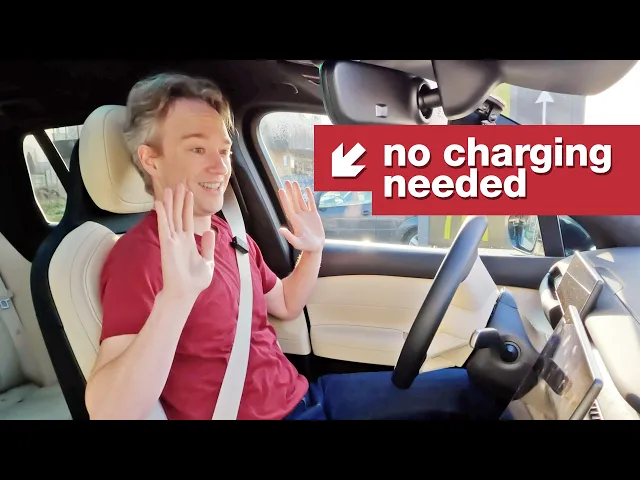
A robot just swapped my electric car's battery
Tom Scott
0:00 One of the problems people have with electric cars is charging time.
0:04 Yes, modern fast chargers can get your car to 80% in about half an hour,
0:08 maybe even a little quicker if you're lucky,
0:09 but that's a long time compared to the three or four minutes
0:13 that it takes to fill up with petrol or diesel.
0:15 So when I first heard there was a car company
0:17 building automated battery swap stations,
0:20 where robots will switch out your car battery
0:22 in just a few minutes, while you stay in the car...
0:25 I assumed it'd be a weird prototype,
0:27 some pie-in-the-sky technology from a university
0:30 that would never become practical.
0:31 But that is a battery swap station,
0:34 right there, open to the public,
0:36 so let's see if it works.
0:37 - Nio has more than 2,100 stations operational in China,
0:43 and the goal is to reach 2,300 by end of year.
0:47 In Europe, we started around two years ago,
0:49 and we have now 30 operational stations.
0:52 In China, every day we have more than 40,000 battery swaps being performed,
0:58 one every two seconds.
1:00 And we have had peaks during holiday season,
1:03 more than 60,000 a day.
1:05 We're not just piloting this, it's already proven at scale.
1:07 - As ever, this is not an advert, they haven't paid me,
1:11 I reached out to them,
1:12 they have just let me borrow a car.
1:14 [Car] "Please press the brake pedal."
1:17 "Nicely done!"
1:19 "Now you can tap to start parking into the Power Swap station."
1:22 - You drive the car in front of the station,
1:24 and once you park in front of the station,
1:26 the car takes over. And it's fully automatic.
1:29 [Car] "We are parking now."
1:31 "Be aware of your surroundings."
1:33 "Do not open any door or take over the steering wheel."
1:37 "You can press the brake panel to control the speed."
1:42 - Nio users, if they want to access the Power Swap network,
1:49 they need to choose "Battery as a Service".
1:51 So that means they don't own the battery,
1:54 they lease the battery,
1:55 and so they can get access to the Power Swap station network.
1:58 You can purchase the battery and the car.
2:01 Or you can purchase the car,
2:02 but choose access to the swapping network.
2:05 You can also just subscribe to both the car and the battery.
2:08 - The idea is that you're not renting or buying a specific battery,
2:12 but you're just paying for there always being a fresh battery in your car.
2:17 Charging is still a cheaper option,
2:18 but there are plenty of people who'll pay a fee for convenience.
2:21 [Car] "Preparing. Please wait."
2:24 - We can serve the same amount of users comparable to a charging hub,
2:29 but we need only one third of the space
2:31 and we need one third of the grid connection
2:33 because we can charge the batteries at their low speed.
2:36 We provide frequency balancing services.
2:39 We charge the batteries at specific points in time
2:44 where there is a need to get rid of all that power and balance the grid.
2:49 - The thing is, I've driven electric cars on long trips before,
2:52 and charging wasn't really a big problem:
2:55 it needs a little more planning than using fossil fuels,
2:57 but turns out, I want to rest
2:59 at about the same interval the car wants charging.
3:02 Folks out there who can drive eight hours in one go...
3:05 good luck, but I am not one of you.
3:07 - The best way to charge a vehicle is at home if you have a socket, right?
3:11 With EV becoming more affordable,
3:13 there are more people who want to access an electric vehicle,
3:16 and don't have the opportunity
3:18 to have a socket close to where they park their car.
3:20 Shanghai, a city with more than 20 million inhabitants,
3:24 people live in big apartments, and so, on-street charging,
3:29 it's much less than in Europe.
3:31 People don't have access to home charging because it's a much more dense city.
3:35 Power Swap offers a great opportunity
3:38 to just leave your home, drive to the station,
3:41 swap your battery and continue your trip.
3:43 - And of course, there is the catch that this battery swap station
3:46 only works for cars that are built for it.
3:48 You can get a Nio battery swapped here,
3:49 but there's no other car on the market that can use this.
3:52 At least, not yet.
3:54 - We have been signing strategic agreements with big groups like Changan and Geely Group.
4:00 We have gained the confidence of also the other auto makers.
4:04 There's a opportunity to standardize this technology,
4:08 in China, but perhaps also in Europe.
4:10 We're going to invest in Battery as a Service.
4:13 And we're going to invest in the Power Swap network.
4:16 If you take the whole economics,
4:18 we do believe that this is better than just selling a car.
4:21 - Plenty of people,
4:22 electric vehicle enthusiasts, stock brokers,
4:24 people who've bought Nio stock,
4:26 have a running analyses on whether the company's financial model will work.
4:29 Building these stations is incredibly expensive,
4:32 and it's no secret that Nio is losing a staggering amount of money right now,
4:35 but that's the way that colossal startup companies
4:38 and finance work these days.
4:39 They hope the initial outlay will be worth it in the end.
4:42 That strategy has paid off for a lot of big corporations...
4:45 and not paid off for many more.
4:47 I looked at a lot of those financial analyses
4:49 while I was researching and my conclusion is:
4:52 I don't know!
4:52 Predicting anything about electric vehicles is almost impossible:
4:55 it's an industry filled with both radical inventions and broken promises.
5:00 I'm just astonished that something I thought was science fiction
5:03 does appear to be an actual real-world option right now...
5:07 and that a robot just swapped out my car battery.