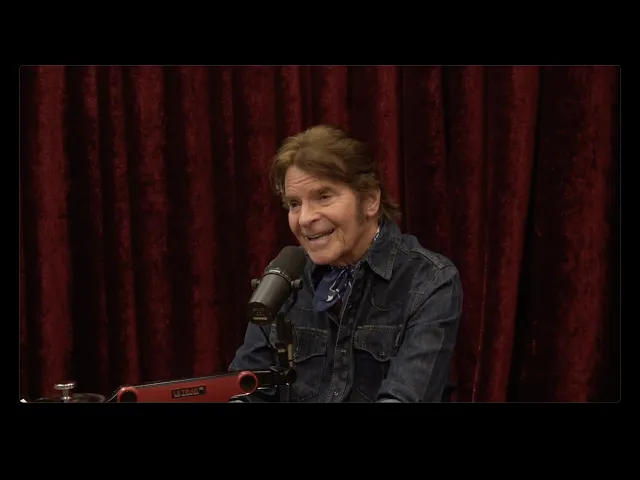
Joe Rogan Experience #2485 - John Fogerty
PowerfulJRE
0:01 Joe Rogan podcast.
0:03 Check it out.
0:04 The Joe Rogan Experience.
0:06 TRAIN BY DAY.
0:06 JOE ROGAN PODCAST BY NIGHT.
0:09 All day.
0:13 Put your stuff on the floor.
0:14 It doesn't matter.
0:14 You can keep it on the table.
0:17 It's fun.
0:19 There's water there, too.
0:20 Uh, in this metal cup.
0:22 And then there's coffee.
0:23 Oh, thanks so much.
0:24 Coffee here.
0:24 He's ready to [snorts]
0:27 I have some notes that I'll probably never look at.
0:30 But
0:30 you got notes?
0:34 Me?
0:34 What What's on the notes?
0:36 Uh, just stuff like what I went through
0:38 with CCR and all that, but tell me something.
0:43 Did you Did you read up on me or anything or I'm a huge fan.
0:47 I don't have to read up on you.
0:49 Okay.
0:49 I read up on you a little bit just to catch
0:51 up about how you got out of the the Well,
0:54 you did do military service,
0:56 but you got out by smoking a lot of weed and not eating.
1:00 I read that.
1:00 Is that true?
1:02 No.
1:02 Is that true?
1:02 They lied.
1:04 There was a story about you smoking a lot of weed
1:06 and uh getting emaciated so you can get out of the army.
1:10 Well, it's not quite in that sequence, but those things did happen.
1:17 [laughter] Yeah, I had I had determined to lose a lot of weight, right?
1:27 So, I was kind of really skinny about 1967 68.
1:33 Uh I mean likeund I think it was 129 pounds.
1:40 Whoa.
1:38 Yeah.
1:38 Um, and then I was going to go uh to the I think
1:43 it was the procedio and I had to meet with the army doctor, right?
1:49 And my friends gave me a couple of joints and I stuck them in.
1:55 You know, I used to smoke and it was cigarettes.
1:58 I stuck it in the cigarette and going across the Bay Bridge, I smoked them.
2:04 That's so I had even thought about So, yeah, man.
2:07 He he he went on a starvation diet, a protest diet,
2:11 and then smoked a lot of weed that way.
2:14 But yeah.
2:15 Okay.
2:15 But it's it's essentially some truth.
2:19 Some truth to it.
2:21 Uh you had a legendary career, my friend.
2:23 Legendary.
2:25 Thank you.
2:25 Still working on it.
2:26 It's incredible, man.
2:27 You You are like one of the main voices of rock and roll in America.
2:32 If you really think about it, your songs, I mean,
2:36 there you have so many gigantic hits, you know,
2:39 when uh the UFC uh has a lot of walkout songs, you know,
2:43 when fighters come out and walk out and a lot of guys walk out to your music.
2:47 I don't even know if you're aware of it, but Fortunate Sun is a big one.
2:52 Yeah.
2:52 Bad Moon Rising, that's another big one people walk out to.
2:55 Great.
2:56 Wow.
2:56 It's pretty awesome.
2:58 Wow.
2:58 Yeah.
2:58 I'm I'm not that aware of that.
3:01 UFC stuff, but it, you know, everybody whatever floats your boat.
3:05 Well, people just love your music.
3:07 You So, you went through many generations.
3:10 Like, you got your first record contract.
3:13 How old were you?
3:17 Um, I know I signed one when I was around 19.
3:20 Of course, it would have been uninforcable.
3:24 It's not legal at the time, right?
3:25 You had to be 21 the deal.
3:27 I I believe so.
3:29 Yeah.
3:29 There's Well, you're also one of the first
3:32 rock and roll artists that wrote songs
3:35 uh that became very popular about how
3:37 you're getting screwed over by the record business.
3:40 [laughter]
3:40 You know what I mean?
3:41 Well, so Leonard Skitter did it working for MCA.
3:44 They did that song, but you had Vans Can's Dance.
3:48 It was actually Zance Can't Dance, but you had to change it, right?
3:51 Yeah.
3:52 The name of the person was Zance.
3:54 Uh it's it sold about a half a million copies as Zance,
3:59 but the record company Warner Brothers in their way
4:03 of settling somewhat um had me change it to Vance.
4:12 Yeah.
4:11 Cuz the guy's name was Zance that it was screwing up.
4:17 Um that's right in the middle of that whole thing was a mess.
4:21 I got sued for sounding like myself.
4:26 What?
4:27 Yeah.
4:27 How'd that happen?
4:29 I'll tell you.
4:30 [laughter] So, and I didn't find this out.
4:33 And there was eventually a trial.
4:35 So, it's not [clears throat] Many people think that that's funny.
4:41 He got sued for sounding like you're so w that's funny.
4:44 Well, no.
4:44 you're getting a legal lawsuit that's probably going to take away a lot
4:50 of your uh money and you're going to go through three four years of anguish.
4:56 Well, anyway, um ended up in a trial.
5:01 He was suing me for at the time was an enormous amount of money,
5:05 $144 million for his uh whatever metal anguish or something.
5:12 Um I the the logistics, I guess you'd call it.
5:19 I had made a new song called The Old Man Down the Road.
5:22 It was on my album.
5:23 It was my comeback on Center Field
5:26 and I had finally gotten away from Fantasy Records,
5:30 which is where Credence was and Solands who owned it.
5:35 So, you know, when you finally escape and get success over somewhere else,
5:41 the former people tend to be jealous, I guess.
5:45 And uh so he was suing me.
5:48 What had happened though, I found out in the trial,
5:52 the bass player from Credence uh was another one of those people,
5:56 I guess, that couldn't stand that I'd now had success in a later life.
6:03 um he went down to fantasy and saw Mr.
6:06 Saul's aunts and said, "John is ripping off Credence.
6:10 You should sue him." The irony in in all of that is
6:14 that I had taught Stu every single note that he ever played in Credence.
6:20 It was not his own cre.
6:21 As we talk, you'll you'll see.
6:24 Um I was the guy inventing the arrangements.
6:28 And so to take possession of Credence was pretty ironic and pretty over the top.
6:35 Anyway, he talks Saul into suing me and that Saul had unlimited funds and so it,
6:43 you know, went to a trial.
6:44 I pre prevailed at trial and got that over with.
6:50 But they torture you during the process because it takes years
6:53 and it cost an enormous amount of money to fight yourself.
6:57 Yeah.
6:57 all that stuff.
6:58 That is so crazy that they can sue you for sounding like you.
7:03 Well, it's a blessing to the world, I think, that I prevail.
7:07 I mean, you know what we're really talking about
7:10 is when you come into the consciousness of the world,
7:14 I guess, and you have a certain style if you're lucky.
7:18 And so, you start creating whatever your art is.
7:21 You're an actor or you're a painter or in my case a musician.
7:26 and people start liking the style.
7:29 Well, how unfair would it be that at some point somebody takes ownership
7:35 of your and style and now says you have to go back and invent some other style,
7:40 be some other person.
7:41 You know, it's just that would be really difficult.
7:43 Imagine Dylan or Springsteen or all the other people
7:47 that have their own style having to, you know,
7:51 reinvent and change to something else.
7:53 Well, it's just insane to even ask an artist to do that.
7:57 It's insane because look, so many artists sound like art other artists anyway,
8:02 and no one has a problem with that as long
8:04 as they're not ripping off the notes and the lyrics.
8:06 There's a lot of people that sound like people,
8:08 but the idea that you could get sued for sounding like you with new music
8:14 and new lyrics is that's one of the most insane things I've ever heard of.
8:19 I can't believe that didn't get thrown out immediately.
8:21 Immediately, right?
8:22 Um, well, that shows the the I guess
8:26 the ego and the possessiveness that people want to have.
8:31 Um, you know, I had written a new song and he didn't want me to.
8:35 He wanted to own the new stuff.
8:37 He wanted to own me basically.
8:39 That was the idea.
8:41 Well, you can never do anything unless you do it for me, you know.
8:44 Um, so I was but not just for myself, for everyone, for all artists.
8:51 It was kind of a major ruling and thank God it went that way.
8:57 Well, thank God it also was public like with that song
9:01 and the lawsuit around the song have you having
9:03 to change the name of the song cuz back then
9:06 at least at the time like this was probably what the 80s.
9:12 Yep.
9:11 Most people had no idea how evil the music business can be unless
9:16 they were told they had no idea what they they bought the albums.
9:20 They loved the musicians and they just liked the music.
9:23 They didn't know what was going on behind the scenes.
9:26 They didn't know how these people own your catalog.
9:29 They own the music.
9:30 They own the publishing.
9:31 They try to just get as much money out of you as humanly possible.
9:36 Own your name, own your likeness.
9:38 You know, most uh fans had no idea.
9:42 And that's probably the way it really should be.
9:44 When I was young, I just cared about Elvis and his guitar player.
9:48 You know, I didn't want to know all I
9:50 didn't even know there was stuff behind it to know.
9:54 Yeah.
9:54 Yeah.
9:55 Yeah.
9:55 Oh my god.
9:56 Right.
9:56 I picked a good one there, didn't I?
9:58 Colonel was evil.
9:59 That's just too bad.
10:01 Another similar situation.
10:03 Like there's all a lot of these great artists get like Prince.
10:06 He got wrapped up to the point where he had to change
10:08 his name to a symbol because he didn't own his name anymore.
10:12 Prince.
10:13 Yeah.
10:13 I remember going, "Well, if he doesn't want to use it,
10:15 you I'll take it." [laughter] Yeah.
10:20 Yeah.
10:20 It's just the the business itself.
10:22 I mean, you have these creative artists that make this music
10:27 that everybody loves and then you have these hyenas that work
10:30 behind the scenes that are the ones that are collecting the majority
10:33 of the money from it and they're not making any music.
10:36 And to the average fan like myself, like that's abortant.
10:39 That's disgusting.
10:40 Like you you see that it just it just drives you nuts.
10:44 Well, also um you know the the create creative people are special and I
10:51 mean you know look around there's way more of other types of people
10:55 than there are creative people and to douse that you know to or own
11:01 that which is what was going to happen is just a an ownorous thing.
11:07 Um I'm I used to be a lot more angry about all this stuff.
11:12 I'm a lot older.
11:14 I can't say wiser.
11:15 It's more like um I came out on the good side of it.
11:20 I try not to worry about it too much.
11:23 But it's great that you came out on the good side of it,
11:26 but it's also great for people to know and it's really
11:29 great for young artists to be aware as they're coming up,
11:32 especially as they're beginning their journey that this could happen to them.
11:38 Yeah.
11:38 And there's all kinds of, you know,
11:40 u bad people around just waiting for you to slip up
11:45 and sign something that will give your rights away, that sort of thing.
11:50 Um, I get such a joy out of music, you know?
11:55 I mean, I just I it started that way when I was a little kid.
11:59 I mean, didn't even know what I was doing.
12:01 I was or what that was.
12:03 I was hearing this sound and you know and I
12:06 liked it and I just kind of went with it.
12:08 I didn't try to analyze it too much.
12:11 And of course later with all the things you know
12:15 the different roads you you go through trying to get to someplace.
12:21 Um happily I still get that same joy.
12:27 I mean, I I just I'm just so glad.
12:30 You know, I a lot of this, of course, is from the care of my wife, Julie.
12:35 Uh if I hadn't met her, I probably would be dead.
12:40 Simple as that.
12:42 Really?
12:43 Yeah.
12:44 Wow.
12:44 Why do you think you'd be dead?
12:47 Um I didn't see any way out, you know.
12:50 Um I was really abusing myself, alcohol mostly.
12:56 I really felt bad inside.
13:00 I mean, it it's when you get like that, uh, Joe, uh,
13:04 you're not really operating on the same plane in the world
13:08 that all the other people that you see are,
13:10 you know, you walk into a market or something and look
13:13 around and probably most of the people are kind of normal,
13:16 you know, whatever we call that.
13:18 But when you're when you're really hurting inside for whatever reason,
13:23 I mean, in my case, something really unjust had been done to me.
13:29 Um, but you know, however you get there and then
13:33 you start abusing yourself with uh drugs, alcohol, whatever.
13:39 Um, you just kind of it's becomes a habit.
13:42 You just stay there, right?
13:44 And so you're not really enjoying the sunshine and the love
13:49 that's around you and all the rest of it.
13:51 You become kind of a um pathetic person.
13:55 Sad certainly.
13:57 So that you know that was the deal that when Julie met me I was that guy.
14:03 Um there was sort of a certainly an anger I mean but a a bitterness too.
14:11 almost like a self-fulfilling um prophecy where you look for something
14:18 to go wrong and then it goes wrong and you go,
14:22 "See, I told you." You know, I mean,
14:24 it's a terrible mental place to be and I was there.
14:28 Do you think this was a loop that you got in because of the lawsuits?
14:32 Oh, yeah.
14:32 It did that it really just got you that hard.
14:35 Well, there was there was more than one lawsuit,
14:38 but the betrayal by uh the people in my band,
14:42 you know, uh I just told you about a very evil man, right?
14:47 Yeah.
14:46 And I'm the only guy from Credence who's ever
14:49 actually mentioned that he's an evil person to the extent
14:54 that quite publicly my brother Tom right during the same
15:00 time was saying that Saul was his best friend.
15:03 Oh Jesus.
15:04 It was just really hard to uh deal with.
15:08 The other two guys in the bands were
15:10 in the band were kind of just more cowardly about it.
15:14 They just never spoke up.
15:15 Just kind of give me the money.
15:17 And you know, how the[ __] was your brother saying that guy
15:21 was your best friend while he was suing you?
15:25 Um he wanted he was signed ressigned after the break of breakup of Credence.
15:31 he kind of shopped around and didn't have uh much success finding a label
15:38 and so he went right about the time that this trial was going to happen.
15:43 Uh he resigned with Fantasy.
15:46 I'm talking about the first trial.
15:49 Mhm.
15:49 Which was the first trial?
15:50 The first trial was about uh basically the band had lost its life savings.
15:57 all of us in credence.
15:58 Um, the record company had gotten us into this offshore tax plan.
16:07 And I'm saying this with a smile because nowadays it just sounds so, you know,
16:12 some guy comes walking up to you and got
16:15 a trench coat on on a corner in New York City.
16:18 Hey buddy, [clears throat] you want, you know, probably going to avoid that guy.
16:22 But the record company was in this tax thing and for all
16:30 we knew we were going to be paying 90% income tax, right?
16:35 I mean, the tax laws are pretty pretty stringent and pretty high.
16:41 Um, and so they offered us or basically kind of ushered us into this plan,
16:51 a t offshore tax plan,
16:54 and it would allow us to pay a lot less taxes,
16:58 probably somewhere between 10 and 20%, something like that.
17:03 Uh, so it was a huge financial savings for us.
17:08 I can tell you that the name of this particular
17:12 thing was a bank in the Bahamas called Castle Bank.
17:17 And we had it checked out.
17:19 I mean, the the people on our side in the van had it checked out by our people.
17:25 Our own accountant um uh the bass players father
17:31 was a an entertainment lawyer and had a big firm.
17:35 They among other people represented the Oakland Raiders.
17:39 So we thought they were pretty solid and they
17:41 checked it all out and said that it was okay.
17:44 It was legit.
17:45 So we did it.
17:47 But time went on and it uh seemed to be not legit to the point
17:54 that somewhere in the 70s the bank
17:58 disappeared and all our money in it disappeared.
18:02 So we sued Oh Jesus.
18:08 Yep.
18:08 So here it is.
18:08 The bank was being used by the CIA
18:10 to funnel money for covert military operations,
18:14 including those at Andros Island, a staging area for anti-Castro activities.
18:20 So you they were stealing your money.
18:25 How?
18:25 I just found that.
18:25 I don't know.
18:26 I just typed it in and went to the Wikipedia and I was like,
18:28 whoa, that's interesting.
18:30 So insane.
18:31 See, I didn't know any of that.
18:32 You didn't know until now?
18:34 Oh, I knew that now or I suspect.
18:39 Yeah.
18:38 Did you know that up until now or did you just find it out just now?
18:43 Um, you could tell me a lot of things right now and I'd say, "Oh, yeah.
18:46 I just assumed all that stuff was kind of happening,
18:50 but I didn't know it at the time in the early
18:53 '7s when we or late60s when we got into this thing.
18:57 It was actually
18:58 Do you know how anti-American that is?
19:00 the CIA stole from Credence Clearwater Revival.
19:05 How[ __] crazy that is.
19:07 That is so wild.
19:10 No, I didn't know that part.
19:12 The [laughter] um the funny thing the the funny thing is
19:17 um I had decided to get out of that plan, right?
19:22 and I'd gone down to see my own people, my accountant,
19:26 my attorney uh in Oakland and told him, I just want out of this thing.
19:32 I don't like the idea that you got to call,
19:34 you know, whenever I want some money, like an allowance,
19:38 you got to call up some bank account somewhere over there and it takes,
19:43 you know, some time, some few days before I actually receive my money.
19:49 and it was starting to just smell.
19:51 It was starting to and this now we're talking 197576.
19:58 Um and so I actually had the meeting and I said I want to be out of this plan.
20:06 I don't want to.
20:06 Oh, I said one of the things I said to the meeting of professionals, look,
20:12 take a shoe box, put all the money I've ever earned into the shoe box,
20:19 and now hand me the shoe boxes so I can
20:21 see how much money have I earned because I didn't know.
20:25 It was just going straight into this fund, right, into this Castle Bank.
20:30 But they couldn't tell me.
20:33 So, I leave.
20:34 I get down to the uh parking lot in the basement of this tall
20:38 building in Oakland and I'm with my uh the guy that runs
20:42 my office and I say[ __] we're going to have to have another meeting
20:47 because even though I told him I want to get out of the plan,
20:50 I didn't stand up like on the table and get I'm
20:53 ordering you and you and you get me out of the plan.
20:56 I realized they could weasle some more time until I actually pointed.
21:02 So the next week I showed up and did that.
21:06 I'm ordering you get me out.
21:08 Okay.
21:09 Out of the plan, right?
21:11 Um pretty quickly after that uh a week or two, we hear that the bank has closed.
21:25 There's a telegram that apparently was sent
21:27 on Valentine's Day and the bank president has died.
21:34 He died in a sauna.
21:39 Whoa.
21:39 I've seen that movie.
21:40 You know where [laughter] Abbott and Costello,
21:43 they're in the the mob comes in and they're in those uh heat things that are up
21:47 here and the guy sticks a broom in the in the door so you can't get out.
21:52 You know, I mean, except that this was serious and
21:56 there will be no more withdrawals until until this thing is understood, right?
22:03 You don't a bank president dies, you don't close the Bank of America, right?
22:07 You still can go get your money.
22:10 And so, pretty quick after that, it all just disappeared in a puff of smoke.
22:15 So,
22:15 they just stole the money.
22:16 Gone.
22:16 Yep.
22:17 And it was the[ __] CIA.
22:19 That is crazy.
22:22 That is so crazy.
22:23 How much money was involved with all the different people that lost their money?
22:27 Like how much money was this bank holding?
22:28 Do you know?
22:30 Oh, well, there were other names that I never saw in those days.
22:35 Uh, a lot of sort of mobby kind of sounding names.
22:40 Uh
22:41 um I will tell you after the thing closed and I we got the telegram that the p
22:48 I started I literally started checking under my cars
22:53 looking for wires and what you know something funny.
22:56 I did that for about three months.
23:00 Whoa.
22:59 I finally just Well, I was scared.
23:01 Yeah.
23:01 I would be because I was the guy who said I want to get out
23:04 of this thing and suddenly it goes kaboom and the president dies.
23:10 Right.
23:08 Right.
23:09 And I just figured that I was some kind of whistleblower
23:13 to them or something and you know I'm in their way.
23:16 Uh Wow.
23:18 I guarantee you're the reason why it happened.
23:21 I don't think No, I don't believe that's true.
23:23 Well, no.
23:24 I mean, you you probably caused the whole thing to close down.
23:27 I mean, it's not a coincidence that it closed
23:28 down right after you asked for your money back.
23:31 Yeah.
23:31 I I don't know.
23:32 You're a big public name and a big voice.
23:35 You get out.
23:36 you take your money.
23:37 After that point in time, I really never wanted to
23:41 talk too loudly about stuff anymore.
23:43 Oh my goodness.
23:45 Um, so there eventually was our lawsuit.
23:49 Um, well, actually it was my lawsuit.
23:53 I got with a lawyer, a tall building I call it,
23:57 and proceeded to start proceedings against this fantasy,
24:04 our own attorneys and experts, uh,
24:07 the people that designed this plan, all the rest.
24:10 Right.
24:12 But I was the only one in the band that did that.
24:14 The the rest of the guys kind of just went along and weren't m making any waves.
24:20 But I, you know, I was pretty adamant.
24:24 Uh I'm telling you this because at some
24:26 point later more than a year had passed maybe
24:30 a maybe [clears throat] a year and a half
24:33 uh my PL my lawsuit had been rolling along a while and then the other guys asked
24:41 to join my lawsuit because the statute of limitations had
24:47 run out on them being able to sue anyone
24:51 because they they literally tried to stay in the plan.
24:55 I was [laughter] I was I was willing to take the penalty, whatever it was,
25:01 for being the dumbass that let himself
25:04 get into some financial thing like this, right?
25:08 I felt like I used to say I felt like Joe Lewis.
25:11 I thought I was going to need an act of Congress to forgive the debt.
25:15 Uh these experts in the meeting that I talked about who were
25:21 trying to dissuade me from making a noise and trying to get
25:25 out of the plan told me eventually John if you receive all
25:29 the money at once you will pay more than 110% in taxes
25:35 of what you have earned.
25:37 In other words, you going to go in the hole.
25:41 Yeah.
25:40 Yeah.
25:40 For receiving it all at once, right?
25:42 That sounds insane.
25:43 That's why I felt like Joe Lewis.
25:46 That's the most insane thing I've ever heard.
25:47 Well, they were trying to in trying to intimidate me for sure.
25:51 Yeah.
25:52 Um,
25:52 how much money were we talking about?
25:53 How much money did they steal from you?
25:54 When it finally was over, the headline in the San Francisco Chronicle,
25:59 I mean, you're going to laugh at this.
26:01 Rock band victorious wins 8.1 million.
26:08 That was our entire take for everybody in the band.
26:11 Each guy had a little bit different amount, but you know those numbers.
26:16 I mean, I don't know.
26:19 Dion once made a joke at the Rock and Roll
26:21 Hall of Fame about Bruce and [laughter] Dion says,
26:26 "Well, I sold 40 million." Meaning, you know, you you sue me.
26:31 Well, Bruce has that on him.
26:34 [laughter] It was It was pretty funny.
26:38 Yeah.
26:38 I mean, 8 million was that was it.
26:41 That was our take from all the sales of Credence time.
26:45 So, was that the amount of money that was in the bank that they stole from you?
26:49 That was what we got returned to us.
26:51 So, you did get the money back.
26:55 Mhm.
26:54 Oh, okay.
26:55 I figured they would just vanish.
27:01 Um, the money didn't come back from Saul's ants
27:04 or capital or Castle Bank or any of those people.
27:09 What had happened was Fantasy was let out
27:13 of the lawsuit by the local judge in the Bay Area.
27:17 I don't know why because they're the ones that got us into the plan,
27:20 but anyway, they were let out of the whole thing.
27:23 So, who was left was this guy named Bert Caner in Chicago
27:27 who designed the plan and our own our own accountant and lawyers.
27:34 And so what most of them did was settle for pennies on the dollar.
27:40 You know, we said that you owe us u a million dollars or whatever.
27:45 And they settled for like $10,000
27:50 really, right?
27:49 Rather than go to trial.
27:50 But our own accountants legal team said, "Ah, we got these guys.
27:57 They can never win this." So, I mean, ironically,
28:01 they wanted to go to trial and put the poor accountant,
28:05 you know, who was an old guy, uh, throw a whole trial and Credence got we we
28:12 retained the money we had lost in that plan,
28:15 the 8 million I just mentioned, uh, from the law firm, uh, the insurance firm.
28:23 It was his insurance company's lawyers that were
28:26 representing him and they had to pay.
28:29 Nobody else had to pay.
28:32 Interesting.
28:31 And the CIA or whoever you're talking about got away with it.
28:35 Of course they did.
28:37 Yeah.
28:36 They know how to do that.
28:38 It's kind of crazy, too, that it's only $8 million when you think about
28:41 how much money you probably made the record companies.
28:43 Yep.
28:43 Well, there was a hundred million records plus.
28:46 So, Right.
28:47 Do the math.
28:48 How much was an album back then?
28:50 Four bucks.
28:51 Yeah.
28:51 So 400 million plus operating expenses, costs, all that stuff.
28:58 See, you know, you guys got a small percentage.
29:02 That's how it works though.
29:03 That's why the business is so dirty.
29:05 That's what's so, you know,
29:06 the idea is that they help you and they bring you up.
29:08 But the reality is they sell art
29:11 and if they don't have artists, they have nothing.
29:14 The artists are what fund their very existence
29:16 and they make the majority of the money.
29:18 It's It's pretty dark when you really think about it.
29:23 Yeah.
29:23 And Joe, I gotta tell you,
29:25 um I love making music and I don't do it for the money.
29:30 I mean, I know that sounds a little naive,
29:32 but just the happiness in my heart from doing this is from the music,
29:39 you know, from the joy.
29:40 I believe you because
29:41 the only thing is when you I mean I'll say I'm
29:44 not like well maybe I'm an idiot but probably not about this.
29:48 When you find out that there was money but somebody
29:51 else got it then that kind of gets your attention
29:56 right you know but um the for me at least it was it
30:00 wasn't even about being famous [laughter] literally if you could believe that.
30:04 It was the joy of of understanding, you know,
30:08 what the the music from other people that you loved.
30:12 And as you grew up from a, you know, that little first inspiration,
30:17 you began to kind of understand what it was you liked about what they did.
30:22 And at some point then started to try and do it yourself.
30:26 But that was a that was a long long time
30:29 after the initial joy of just enjoying what they did.
30:35 Yeah.
30:35 It's it's kind of sad that money always does kind of distort things.
30:40 But if you were only interested in money and only
30:43 interested in fame or if that was your primary concern,
30:46 there's no way the music would be that good.
30:49 It's like that that has to come from a real place.
30:51 It's a real place of creativity and enjoyment.
30:54 100%.
30:55 Yeah,
30:57 100%.
30:57 You know, well, [clears throat] for me it did.
31:00 I just it it and also the prospect of creating something new tomorrow,
31:07 you know, and and the what's the word?
31:10 You you get certain feelings.
31:12 Well, we all do, but um I've learned to how can I say it?
31:18 Sort of it's like being in a big swimming pool or something, you know?
31:22 That's all.
31:23 It just surrounds you.
31:25 Let letting yourself enjoy that feeling and then try
31:30 to figure out a way to put that into the music, you know, express it in.
31:36 Yeah.
31:36 Well, you did it, man.
31:37 It's just it's it's a long story with all these different
31:42 artists that have had to deal with all these horrific managers.
31:45 And I was reading this article about um Jimmyi Hendrick's manager.
31:49 Uh so one of his bodyguards uh wrote a book
31:53 where he's blaming Hendrick's manager for his death and he
31:57 was essentially saying that Hrix was murdered and Hrix was
32:00 about to leave his manager and that's why he killed him.
32:03 And I don't know if you know the story about Hrix,
32:05 but his girlfriend fell from a roof
32:08 or jumped off a roof shortly after Hendrickx died.
32:12 And apparently they were trying to get rid of her as well
32:14 because they knew that she knew the whole deal behind it.
32:16 Was this the one with kind of a funny foreign name?
32:21 Yes.
32:21 Yes.
32:22 Yeah.
32:22 Yeah.
32:23 They
32:23 I read a couple of Jimmy biographies, but you know Yeah.
32:28 Um so many of these guys had mobbed up managers.
32:32 Yeah.
32:32 I do know that there was some manager
32:34 of his that I mean Jimmy owned his masters.
32:38 That was remarkable.
32:40 That's why that's why his family has the masters, his estate, you know.
32:45 They're the ones that decide because every so often
32:48 a new Jimmy album would come out, that sort of thing.
32:52 Um, I didn't know any of this way back then.
32:54 I just wondered, you know, who was driving the bus.
32:57 So, I mean, that part was was pretty good.
33:00 Uh, he had to talk to somebody at Repre Records,
33:04 and some of those people were Repre uh Warner Brothers.
33:08 In other words, about the time I was at Warner Brothers,
33:12 it must have been a couple of them,
33:14 you know, that decided that way back in the 60s.
33:18 Um, I guess I was a little envious because
33:21 I sure didn't own my masters, that's for sure.
33:23 How many people owned their own masters back then?
33:26 Um, nobody.
33:27 That's crazy.
33:27 How do you think he got that deal?
33:30 That I don't know.
33:31 I don't know how it how it came about
33:33 that he was able to have that much influence.
33:37 I mean, that's the part I I did I did get the inference from the at least one
33:45 of the books I read about Jimmy that um he they didn't try too hard to save him.
33:53 [laughter] Jimmy was I guess was just really effed up
33:57 for a couple of weeks there and no one tried.
34:02 You know, they were almost I mean,
34:04 I almost got the sense that somebody took a bottle
34:06 of wine and just poured it in him, you know.
34:09 Yeah, that's what I had heard.
34:11 Yeah, that's that was the what the bodyguard was inferring
34:13 that they poured pills and alcohol down his mouth.
34:17 Yeah.
34:19 Yeah.
34:18 Terrible.
34:18 Well, I I hope to never be in such
34:21 a state that I can't protest something like that.
34:25 Right.
34:25 [laughter] Well, yeah.
34:26 Yeah.
34:28 It's dark because uh apparently he was ready to leave.
34:31 if he wanted to leave his manager and obviously Jimmy was a gigantic star
34:37 and that guy saw all the money.
34:38 Well, he still is.
34:39 Still is to this day.
34:40 Every single guitar survey that ever comes out,
34:43 you know, it change all the other numbers after two, right?
34:49 Keep changing with fashion and all
34:51 that, but it's always number one is Jimmyi Hendris.
34:54 Always.
34:54 Yeah.
34:54 Kind of extraordinary when you think about it.
34:56 The guy died at 27 years old,
34:59 you know, and was already just from another planet.
35:03 Like you listen to his like you listen to Voodoo Child Slightly Turn.
35:07 You listen to that song, you're like, is this guy from Earth?
35:11 Like this was so different than any other
35:13 guitar playing that had ever taken place before him.
35:16 He was a complete revolutionary.
35:18 Like just a completely new creative artist,
35:22 you know, and one of my favorite musicians absolutely of all time.
35:25 That's why I named the podcast the Joe Rogan Experience.
35:28 I wondered about that.
35:29 Well, there it is.
35:30 That's it.
35:31 Stole it from Jimmy.
35:32 You Yep.
35:35 I should have named it the John Fogerty Experience [laughter]
35:40 instead of Credence.
35:41 Yeah.
35:41 Well, I did create that name.
35:44 Um, what was the crazy name that the record
35:47 company called your one of your first bands?
35:51 They Well, it was the same people.
35:53 Same people.
35:53 Yeah.
35:54 Same.
35:54 I mean the same individual musicians.
35:57 Um in high school or junior high actually I
36:02 started a band and called it the Blue Velvets.
36:06 Not all that cre you know earth shaking but kind of a cool vibe.
36:11 Um and we were really the Blue Velvets by you know I
36:16 mean this this was really a trio but my brother was older.
36:20 He was in another orbit.
36:22 [snorts] Uh, so we kind of went through high
36:26 school seeing each other every once in a while.
36:29 It wasn't like we were all trumping around playing gig after gig.
36:32 It was more like, you know,
36:34 every few months there might be a sock hop or something like that.
36:39 Um, and then after high school and Tom Tom would come and sing.
36:45 He was my older brother.
36:46 He would come and sing once in a while with us.
36:50 We made a couple of recordings during that time with real record companies,
36:56 but it was always kind of just haphazard.
36:59 Um, and finally around the age of 19,
37:02 I went over and knocked on Fantasy Records door.
37:06 They had done this special about Bench Galdi and they were in the Bay Area.
37:10 So, I, you know, went over there and introduced myself.
37:14 Anyway, so, you know, one thing led to another.
37:17 Finally, we're recording Uh,
37:20 and at that time I think we made a record with only three of us.
37:23 Me and Tom and Doug the drummer and I I overdubbed
37:28 a bass part and this is early or this was in 1964.
37:34 Uh, when they finally pressed the single, one side was called Little Girl.
37:39 It's kind of a four chord doo watt song.
37:43 The other side was sort of a English
37:46 uh or a British invasion answer kind of thing.
37:52 Mod music.
37:53 It was called Don't Tell Me No Lies.
37:56 Anyway, we excitedly go over to San Francisco to their warehouse
38:00 and open up the package and it says the gollywobs.
38:04 And we look at each other and go, "What the hell?" No, no, no.
38:08 I think we had chosen our name to be the Visions.
38:12 It was just something at the last minute because we
38:16 weren't really the Blue Bevels anymore, but that was it.
38:19 We thought it was going to say Visions.
38:22 Um, but the record company had decided they
38:26 wanted to get in on the British invasion mod,
38:29 whatever, and named us the Gollywogs.
38:32 Sounds like Polywog.
38:34 Yeah.
38:35 He said, 'Well, a gollywag, you see,
38:36 is this doll that when the British soldiers were in India,
38:41 there would have this little doll called a gollywag.
38:46 And so that's all we knew about it.
38:48 Um, [snorts] as time went on, I mean, years and years later,
38:53 a long after I had been we renamed the band or I'd renamed the band Credence,
39:00 found out that[ __] was a this was a very racial thing.
39:03 This was the British soldiers calling the people Whoa.
39:09 wags or gollywags.
39:10 Yeah.
39:10 That's a gollywag.
39:11 Yeah.
39:12 __] right?
39:13 Wow.
39:13 Same sort of.
39:16 Yep.
39:16 And they didn't know this either.
39:17 Obviously, there was no Wikipedia back then.
39:19 I don't know.
39:19 No, I don't know.
39:20 I didn't know that.
39:22 That's crazy that they could just change your the name
39:24 of your band without you having any knowledge of it at all.
39:27 You open up the record and it's right there.
39:30 Yep.
39:30 And they kind of insisted, you know, it's that same thing that, well,
39:34 we're going to own the publishing to your song.
39:36 No, no, I should own it.
39:38 Well, then we're not going to make any records.
39:41 Oh, okay.
39:43 You're 19.
39:45 Yeah.
39:44 Yeah.
39:45 Yeah.
39:45 That's how they get you.
39:46 You don't know any.
39:47 Well, and you kind of want to make a record.
39:49 Yeah.
39:49 You want to make a record.
39:50 It's right there.
39:51 You You taste it.
39:52 Oh my god, I'm going to be signed to a record label.
39:55 I'm going to be a rock star.
39:57 And then they come to you with a shady contract.
39:59 And that's their modus operendi.
40:01 So what they do with everybody and for I know they call it business.
40:08 Um funny term.
40:11 Yeah.
40:12 Um most of those people I mean it's like lottery to them.
40:18 It's like gambling.
40:19 Um they don't have a clue what creativity is.
40:24 And at that age, the young art I mean,
40:27 I guess I'm looking at you and saying, "If I only No, what's that like?
40:30 If I didn't know now what I didn't know then.
40:33 Um, [snorts] you're a young artist.
40:36 You don't even know what you got.
40:41 Right.
40:40 Right.
40:41 You know, you have feelings about music and but you don't,
40:46 you know, you're less than a rookie, right?
40:48 You know, you maybe you were good in junior high,
40:51 but that doesn't mean you're Willie Maize,
40:53 right?
40:53 You know, so that's sort of how that works.
40:56 And they sign you up before any of that self-realization happens.
41:02 And then you're messed.
41:05 Yeah.
41:06 Again, that's what happened to Prince.
41:07 That's what happened to Skinner.
41:10 That's what happened to most bands.
41:12 I mean, they're very clever in how they do it.
41:14 They sign a bunch of people that are emerging and some of them are going to hit.
41:19 Yep.
41:19 and they bankroll it and then they make
41:21 the majority of the money when those people hit.
41:24 Well, in our case, Credence was the only thing that ever happened.
41:29 Fantasy became a very wealthy record company.
41:35 Uh Saul origin eventually went into making movies.
41:39 So, he that money that I had made for him at the record company,
41:44 you know, turned into one flew over the cuckoo's nest.
41:48 Oh wow.
41:49 Some other uh Saul even had and in those times
41:55 had bought the movie rights for Lord of the Rings.
42:00 So you know his he his [clears throat] ticket got punched way up high
42:08 and we never got a dime a course of any of that.
42:11 It's crazy how bad people can get ahead like that.
42:14 Well that see that's Yeah.
42:16 That's what's disturbing.
42:16 It's a different That's why I had
42:21 a little hesitation when you were talking about that you thought the music came
42:25 from a or creativity came from a joyful good place.
42:29 But boy, you can sure look in different parts of entertainment and or business
42:35 in general and see some really bad people have made a lot of money.
42:40 Well, it takes the good people to create things though.
42:44 the creative people make the things and there's always just going
42:47 to be people taking advantage of people being naive about business.
42:51 I choose to believe that at least it works for me.
42:56 I choose to believe that you've got to have a good heart.
43:00 You've got to try to use the golden rule basically.
43:07 You know, don't do don't do something bad to him
43:10 that you wouldn't want to have done to you.
43:12 So the do unto others as you would have them do to you.
43:16 Yes.
43:17 Um I I believe in God and I believe God is watching me all the time,
43:23 you know, all of us.
43:25 So that that part helps me to feel like there's a a reason,
43:32 you know, to try and be a good person.
43:35 Um the reason being you're in God's grace if you do those things if you
43:44 try to live a good life honest and I guess we call it transparent nowadays.
43:51 Yeah.
43:50 Um you know don't get me wrong I'm not running
43:53 around the world with a thumping a Bible or something.
43:55 I just think it's [sighs] common sense about how
44:04 ultimately you want to exist in the universe, right?
44:10 Yeah.
44:12 Um so, you know, that that's how I operate.
44:14 And so when I certainly now at my age,
44:17 when I see other people really getting away with stuff,
44:20 I just it it isn't like I gee that's not fair.
44:23 I should get the I don't see it that way now.
44:27 I just look at that poor sap who's being so evil and go,
44:31 you know, he's going to get his comeuppance someday.
44:34 Well, it's a horrible existence because nobody loves you when you're like that.
44:38 If you're if you're doing that and[ __] people over,
44:40 all your relationships are adversarial.
44:42 It's a bad way to exist.
44:44 You're on a very bad frequency the way
44:46 you you exist with the people in your circle.
44:50 I think that's true.
44:51 I believe that
44:52 there's a lot of people that choose that life just for financial benefit.
44:56 They choose to just[ __] people over and be in that bad frequency all the time.
45:02 But that's not a good life.
45:04 And I agree with you.
45:05 I think uh if you live your life like God exists,
45:08 you'll you'll have a much better life.
45:10 And the golden rule is just it's provable.
45:13 Like if you're a nice person and you treat people well and it spreads
45:18 a lot of good energy around you
45:21 and positive momentum with all these other people,
45:26 it it's the butterfly effect.
45:27 It carries on to other people that they encounter, too.
45:30 They're inspired by how kind and friendly and generous you are.
45:33 And it it's good for everybody.
45:35 It's good for you.
45:36 It's good for the people that you're generous and friendly to.
45:39 It's good for the other people
45:40 that they encounter because they're inspired by it.
45:43 This is good for everyone.
45:44 That's how people should exist.
45:46 Yeah.
45:46 I I literally I believe everything you have just said
45:51 and literally have sometimes asked God for a you know
45:56 I I never sat around asked for money or a hit
46:00 record or I I always thought that's kind of poor.
46:03 That's bad [laughter] you know.
46:05 Yeah.
46:05 I mean that's selfish or greedy or something.
46:08 But I would ask for clarity or, you know,
46:11 I would ask God to help me figure something out.
46:16 And amazingly, there would be through a relation, you know,
46:24 somebody I was dealing with, there would be something.
46:27 It was like karma, good karma coming back.
46:31 And I could see the see the, you know, to me it was a result of my prayer
46:37 or my openness of wanting to help get a situation resolved.
46:43 Um, so for me, I've to me there's evidence that it all works that way.
46:50 Did you always have a belief in God?
46:54 Yeah, I think there was times um, yeah,
46:58 be because I was just brought up that way.
47:01 Um, again, I don't believe my I I was just was
47:05 just taught in a kind of nice and simple way about God.
47:10 It it wasn't beat over my head or anything.
47:12 I was raised Catholic, so in some sense,
47:14 you can't avoid having it beat over your head, I suppose.
47:18 And and some of that I resisted.
47:21 Um, but I went through the normal things.
47:23 I did [clears throat] my first communion, my first confession.
47:28 I did uh what do you call that when you're 12 years old that confirmation.
47:34 Um I chose the name for for St.
47:37 Jerome basically because there's a song by do Bo
47:42 Diddley called Bring It to Jerome [laughter] and uh
47:46 Jerome was his I think Jerome Green was his Morocco
47:49 player and I really like the vibe of that.
47:51 So I'm going to be Jerome.
47:53 That's my confirmation name.
47:55 Um, yeah, it was it was there in those ways.
47:59 There was times I was boy,
48:02 you've opened a can of worms here because I was so invested in being a Catholic,
48:09 even though my parents tried to have me go to parochial school, Catholic school.
48:15 Um, I was in the first grade and then I want to say they kicked me
48:21 out and then I tried she my mom had me start again in ninth grade at St.
48:26 Mary's High School and they kicked me out again.
48:30 Um, but it wasn't my fault.
48:33 Anyway, the the one that happened is funny.
48:37 I mean, it's just the one that happened in the first grade.
48:41 Uh, I had to take a bus to get there.
48:43 I lived in El Certo and the it was the school
48:46 of the Meline in Berkeley and I'm in the first grade.
48:50 I'm six years old.
48:52 So you had to go to the bus stop, get on a bus, get a transfer.
48:57 So that then when the bus came to a certain stop over in Albany,
49:01 you then got on a train, you transferred, in other words,
49:05 got on the train and that went another mile or so
49:08 into Berkeley and at a certain stop right behind the the school,
49:12 the school of the Meline Catholic school,
49:16 you get off the train and go on down into school.
49:19 Now, what happened?
49:22 My mom was a my parents had split up.
49:25 So, it was only my mom in the house and she's leaving early because she's
49:29 got a job as a teacher and she's so she's out of the house before me.
49:35 And so, it's up to me to get myself together and get to the bus stop on time.
49:40 Many, many times I was late.
49:43 I missed it.
49:44 So, I had to get the next bus.
49:46 So, I'm late.
49:47 So I'm rushing to school, but I get there after they've already they
49:52 would march every morning to John Philips Souza
49:55 and you know all that and go on into school and I I get there now I'm late.
50:05 The schoolyard is empty.
50:07 I literally have to climb over the fence because they've
50:10 locked the fence at boom 8:00 or whatever it was.
50:14 and I have to scale the fence, run the class without going to the bathroom.
50:19 This was my first grade experience.
50:22 Sat down in my chair.
50:24 Within an hour, I really got to pee.
50:27 And Sister Damian would not answer me.
50:31 I got I got to I got to And so she would one day I peed in my seat.
50:42 It happened again.
50:43 It became a habit.
50:47 Sister Damian John Fogerty has a puddle under his chair.
50:52 Oh, no.
50:55 Right.
50:55 That was so traumatizing to me.
50:57 Yeah.
50:57 But ask yourself, how is a six-year-old, getting on a bus all by himself,
51:05 traveling three or four miles, then getting out of the bus,
51:09 going over to where the train station thing is, getting on a train,
51:13 going over there, and I mean,
51:15 I certainly never let my six-year-olds do anything like that.
51:20 I know it is kind of crazy how kids were just
51:24 able to just leave the house and do anything back then.
51:27 I think about that.
51:28 When I was a little kid, I used to just leave my house.
51:32 Yep.
51:31 Seven years old, just leave the house.
51:33 You were home for dinner time.
51:34 Yeah.
51:34 [laughter] It's kind of crazy.
51:36 I mean, it's kind of amazing.
51:37 We all lived
51:39 Yeah.
51:39 if you stop and think about it.
51:40 But to have to take a bus and then a train
51:42 and go to school when you're six years old, that's nuts.
51:46 So, uh, I went to Catholic school, too, for first grade only.
51:50 And uh that screwed me off of religion for a long time
51:55 cuz I thought of God back when I was a little kid
51:59 before I went to Catholic school as you know God is all
52:02 knowing and God is love and God created the universe and God is
52:06 God's looking out for you.
52:07 He's just got some rules you have to follow.
52:09 Made sense to me.
52:10 And then when I went to Catholic school there was a lady I
52:12 don't remember anybody's name from back then
52:14 but I remember her Sister Mary Josephine.
52:17 She was so mean.
52:19 She was just a mean lady.
52:21 She did the whole thing.
52:22 The whacking people with rulers,
52:24 tell you you're going to have to stay overnight and you're
52:27 going to have to sleep on a nail in the closet.
52:29 Like just evil.
52:31 Like wanted you to cry.
52:32 When I would cry, she'd call me a crybaby.
52:35 And I remember thinking after that, like,
52:36 I don't want to have nothing to do with religion ever again.
52:40 Right when I left first grade.
52:44 Yep.
52:43 I hated it.
52:44 And I was like, whatever God is, this is not God.
52:47 Like these people have nothing to do with God.
52:48 this lady, there's no way this lady is the messenger of God.
52:51 This lady's mean.
52:53 That took a whole lifetime to figure out,
52:57 to realize, well, this is just a man-made thing.
53:01 You know, God's there and some man-made thing over here, you know,
53:05 they became Mormons and some man-made thing over there,
53:09 they became Muslims, you know, and it's just all man-made.
53:13 It isn't actually God.
53:17 Right.
53:16 Right.
53:16 And so you and man is fallible.
53:20 Of course, he's not infinite and he's not infallible.
53:24 And so all these things were that but that took a lifetime for me.
53:28 I I'm sure I was in my 40s still working on that trying
53:34 Yeah.
53:34 that God's okay, John.
53:35 You don't have to resist when somebody wants to make a prayer or so.
53:39 You know, it's it it isn't God's fault that you peed
53:43 at your desk when you were in the first grade.
53:47 [laughter] etc.
53:48 It's the mean none.
53:51 Yeah.
53:50 Yeah.
53:51 I uh I have a similar perspective.
53:53 I I think uh I think all religious scriptures,
53:58 they're trying to document a a real thing.
54:01 Espe especially Christianity, which is the one I've paid the most attention to.
54:05 I think they're trying to document a real thing,
54:08 but the hand of man is clearly all over it.
54:12 That's the problem.
54:13 The problem with anything that's written down and we
54:15 know that just in like the religious cannon,
54:17 the books that were included in the Bible,
54:19 human beings had a decision on what goes in and what doesn't go in.
54:23 You know, there was rabbis that kept the book of Enoch out of the Old Testament.
54:27 There's a lot of this weird stuff to it that you go like,
54:30 well, why do pe why do people have any say?
54:32 Why is a human have any say in what the word of God is?
54:38 That sounds crazy.
54:39 And when you read the scriptures, you're like,
54:41 somebody wrote that down and someone told that story for who
54:45 knows how many years before it was ever written down.
54:48 But I think the origins of it, there's truth to it.
54:52 It's just you have to get through all these many layers of confusion to try
54:58 to decipher what what God's original message
55:01 was and like what how was it received?
55:04 Who got it?
55:05 How did it how did it even get relayed?
55:08 like what was was the original event that led
55:11 to this oral tradition that led to it being written down?
55:15 I'm smiling because this sounds exactly like a young musician has come
55:22 to see this more [clears throat] learned person and tell him about
55:25 his experience and the more learned person turns into the manager
55:31 or the record company [laughter] and he says I want to own this.
55:35 Right?
55:35 And you know, they take all that all
55:38 that good intentions and faith and somebody ends up
55:43 owning it and you end up paying a tithe, you know,
55:47 into a plate and [laughter] they make a lot of money.
55:50 See, in organized religion,
55:52 especially when it gets to like these huge megaurches and preachers,
55:55 like that's exactly what it is.
55:57 It's someone taking advantage of this good
56:00 thing and profiting off of it immensely.
56:03 Yeah.
56:04 But the thing I think the point of like if you live your life like God's real,
56:08 it'll be a better life.
56:10 I agree with that.
56:11 I But I think you also know I think you can just There's something there.
56:16 It's it's sensible that you try to share that you try not to be greedy.
56:21 Yes.
56:22 You know, I don't mean you have to be a fool.
56:24 I just mean that
56:26 you don't have to be overtly always taking way more than your share.
56:30 [laughter]
56:30 Yeah.
56:30 Just be kind.
56:32 be kind and be fair.
56:33 Um, how old were you when you first started playing music?
56:37 You mean as an instrument?
56:40 Messing around.
56:40 Like, how did you get into it?
56:42 Right.
56:42 Well, I was actually I was given a snare drum.
56:48 Uh, I think I was about four years old.
56:51 It was a really cheap paper one.
56:53 Was your family musicians?
56:55 Uh, not really, but they were musical.
56:58 Both of them, my mom and dad.
57:01 Um, one of my one of my finest and favorite memories is uh there
57:08 was we lived in the Bay Area of of the East Bay from San Francisco.
57:14 And my parents would go up
57:16 to this place in Northern California near Winters, California.
57:20 That's up like toward Sacramento.
57:23 And there was this uh creek, this body of water called the Puda Creek.
57:28 Eventually they damned that up and made Lake Beressa.
57:33 [snorts] Uh but anyway, back then it was just a a running
57:37 water and there was some people could camp there.
57:41 There was at this one place they took me um reputedly was owned
57:48 by a man named Cody and he was a direct descendant of Buffalo Bill Cody.
57:54 I actually met him one day when I was about four and he was probably
57:59 coming to collect the the payment for the cabin and the you know little space.
58:04 Anyway, um and I I remember looking at him and wow.
58:09 So I was told that story and he was he would have been about 75.
58:13 He literally could have been a son of Buffalo Bill.
58:17 He would have been born at that point.
58:19 It was probably 1949.
58:22 the story I'm relating and he, you know, would have been born in 1875.
58:27 I mean, it's mind-boggling to think that.
58:30 Um, but the the my favorite memory thing other other than
58:34 the fact that that whole place inspired my song Green River.
58:38 That's all the little parts are in Green River.
58:41 Um, but one of the things my parents had this old Ford, old Green Ford,
58:46 and they'd be driving along at night up there is what I mean.
58:50 I guess they were more happy or something there.
58:53 And they I remember sitting between them, you know,
58:56 it was just a big couch in the front
58:58 seat and they were singing songs in the dark
59:02 and they were singing like By the Light
59:04 of the Silvery Moon or Baby Face uh and harmonizing.
59:11 One was taking the melody and the other was harmonizing.
59:15 The reason I know is because I'd sat there and I'm probably three,
59:19 four, five years old right in there.
59:22 I said, "What are you guys doing?" Because I knew the melody,
59:25 but but I hear two notes.
59:28 What What are you doing?
59:29 And they explained they were harmonizing.
59:31 And it was just the coolest thing.
59:34 And it was so such a happy time.
59:37 I mean, I really I felt what's that bonded to that, I guess, like that.
59:42 I really like this whatever it is.
59:45 So that was the initial spark.
59:47 Well, they began to notice that I I was musical.
59:50 So at some point I know I again at my fourth birthday there
59:54 somebody gave me a or I had a little toy harmonica and my dad,
59:59 you know those little plastic kind of things.
1:00:01 My dad picked it up and he played Oh Susanna in the cowboy style.
1:00:06 In other words, it's probably a C harmonica.
1:00:08 He played in C, not like blues players do bending notes.
1:00:13 He played that thing you see in the cowboy movies
1:00:15 when they're sitting around the campfire and that sort of thing.
1:00:21 I was just shocked.
1:00:22 I'd never seen my dad do anything like that.
1:00:24 Wow.
1:00:26 And then uh on top of that, my mom could play piano,
1:00:30 what we now call stride piano.
1:00:32 She would hit the and then play a chord like
1:00:35 a octave of bass notes and then a chord above it.
1:00:40 keep that going as like the drummer in the thing
1:00:43 and then play melody and high notes up above.
1:00:47 And it was, you know,
1:00:48 she did she would one of my favorite ones was um Harvest Moon,
1:00:54 Shine on Harvest Moon, which is a great song and it just was magical to me.
1:01:00 So that that kind of opened the door to let me know that, oh why,
1:01:07 we can do this in our own house.
1:01:10 Um, so the piano was around and then we also,
1:01:14 I don't know whose it was, but we had an old Stella acoustic guitar.
1:01:20 Stella is a name going back into the 30s, 20s.
1:01:24 And this thing was built like a tank.
1:01:28 Um, just it was hard to play.
1:01:30 The strings were like way high and all that.
1:01:33 Eventually, Brother Bob told me at some point,
1:01:36 "Yeah, we used to play baseball with that guitar.
1:01:39 we'd hit ball.
1:01:40 [laughter] That's how sturdy it was.
1:01:44 But that was around so that I would every once in a while mess with it.
1:01:49 Um, but somewhere literally in the seventh grade is where I started
1:01:57 to really try and learn a chord and that sort of thing.
1:02:02 Is that when you thought I'm going to be a musician?
1:02:09 I think that moment was a little bit earlier.
1:02:12 It was again up at this place, Winters.
1:02:15 Um, my dad had driven into the town from our little cabin, our campsite,
1:02:22 and I was with him and he'd gone
1:02:24 to this general store and in the general store had everything,
1:02:28 had food and stuff, but also had uh fishing tackle and, you know,
1:02:32 various weird things.
1:02:34 So, I'm standing there sort of near the counter
1:02:36 and my dad's doing some kind of business.
1:02:38 I'm just looking and suddenly I hear music and I'm What the heck is that?
1:02:45 Well, I didn't even know they had a jukebox in this place, right?
1:02:48 And somebody had started the jukebox.
1:02:51 So, that it's playing music that I really like.
1:02:55 It's rock and roll.
1:02:56 And I'm, you know, I'm about 10 years old.
1:02:59 Man, that's good.
1:03:00 And I don't know who it is.
1:03:02 It's just got a really bluesy sound, but it's it's fast.
1:03:06 It's rock and roll.
1:03:08 I run over and I finally determined it's Elvis Presley.
1:03:12 I could I never heard this.
1:03:13 I knew of Elvis, of course, on TV.
1:03:15 He had done Heartbreak Hotel.
1:03:17 I I had seen the the Tommy Jimmy Dorsy show that he'd been on three times.
1:03:24 He was on there, I think, five times.
1:03:26 Anyway, um and so, wow, Elvis did this.
1:03:30 What is this?
1:03:31 So it turned out it was the other side of his second big
1:03:34 million seller which was I want you I need you I love you.
1:03:38 This was a song called My Baby Left Me.
1:03:41 And this was basically classic Sun Records vibe even though he was now on RCA.
1:03:48 It was that thing they did on Sun Records that just
1:03:52 that kind of country whale with guitar that was more country than blues.
1:03:59 and the guitar especially just I said what
1:04:02 is that I'm watching and this Scotty Moore who
1:04:05 I didn't know his name at the time
1:04:06 but he's just playing this otherworldly stuff and that was
1:04:12 I looked at that and I I mean literally my head made I don't know I
1:04:16 said this to myself I don't know what
1:04:19 they're doing but that's what I want to do.
1:04:24 Wow.
1:04:23 And I made up my mind right there in that three minutes of that song.
1:04:27 That's amazing.
1:04:28 Yeah.
1:04:30 Wow.
1:04:29 Well, it was transformative.
1:04:31 It still is.
1:04:32 It's just a pretty unique slice of American music.
1:04:37 I don't think I'm aware of that song.
1:04:39 I I'm going to listen to it after the podcast.
1:04:41 You probably know his song, Elvis's song, That's All Right, Mama.
1:04:46 Sure.
1:04:45 Right.
1:04:46 Well, this is in that vein.
1:04:47 It's actually the same writer,
1:04:51 uh, Arthur Credup.
1:04:54 Arthur Big Boy Cut Up.
1:04:56 So, your family was musical, but you didn't know any musicians.
1:04:59 So, what did you think you were going to do?
1:05:01 Like, how did you think you were going to eventually become a musician?
1:05:04 Did you have a plan?
1:05:06 [laughter] Um, at some point, you know what?
1:05:15 At some point, a little earlier than that, but right around that time,
1:05:20 it was the era of DooWap, right?
1:05:24 This is the way I mean a kid can you can just go anywhere
1:05:29 in your mind right and I suppose the Corvette automobile of course had come out.
1:05:37 So in a very young mind but one of those cool I guess we call
1:05:44 them mashups I was going to have a group but it was a all singing.
1:05:50 I was gonna have a group and it was going
1:05:52 to be called Johnny Corvette and the Corvettes, [laughter] right?
1:06:00 And there was four.
1:06:02 I'm Johnny and three other guys.
1:06:05 And we're all in sparkle jackets, you know, the the show business, right?
1:06:11 And we're black.
1:06:13 All of us.
1:06:16 That was your idea?
1:06:18 That's what I saw.
1:06:19 I was referring to what I was seeing to be Johnny Corvette in the Corvettes.
1:06:26 That was one of the ingredients.
1:06:29 How are you going to be black?
1:06:30 I don't know.
1:06:31 I didn't have to worry about that.
1:06:33 [laughter] I mean, the the funny thing is that's
1:06:37 so similar here is like when I was little,
1:06:41 I wanted to be a baseball player, right?
1:06:43 But some kids dream of being in the NBA.
1:06:47 Mhm.
1:06:48 But you got to be 9117, right?
1:06:51 [laughter] You know, I mean, so how's that going to happen?
1:06:54 I mean, you just said it in a really innocent way,
1:06:56 but a kid just I'll eat spinach or something, you know.
1:07:00 You eat spinach and become black [laughter] and tall.
1:07:05 Tall, you know, I don't know, but it worked for me.
1:07:07 I mean, literally when I, you know,
1:07:09 one of my dreams as a kid really was I wanted I love baseball.
1:07:12 Still do.
1:07:14 I wanted the, you know, okay, what do I got to do?
1:07:17 And I'd start throwing a I was throwing a ball against the side of the house.
1:07:21 I'd made a big like a target, you know, bullseye.
1:07:24 And I I don't know why I did it that way.
1:07:27 And my mom caught me.
1:07:28 I was throwing a actual hard ball and it
1:07:31 was bent the clapboard, you know, the wood.
1:07:34 It was I was [clears throat] tearing the house down.
1:07:37 So, [laughter] she got me a tennis ball and that was okay.
1:07:41 I was no good, you know.
1:07:42 I wouldn't.
1:07:43 It was I was that dream was never going to happen.
1:07:46 Is that what inspired put me in coach?
1:07:48 Of course.
1:07:50 Yeah.
1:07:50 Oh, yeah.
1:07:50 What a great anthem.
1:07:52 Thank you.
1:07:53 It's amazing.
1:07:53 Thank you.
1:07:54 Yeah.
1:07:54 Well, I mean, how many baseball games have played that song?
1:07:57 My my god.
1:07:59 I mean, at least, you know, I mean,
1:08:01 there's a lot of us semi- nerds, I guess, you know, wanted to play ball,
1:08:06 wanted to be a jock, and just really at some point,
1:08:10 you know, the ones that really have it pass you by, right?
1:08:13 Of course.
1:08:14 And you just kind of But in your mind,
1:08:16 everybody got their scorecard and, you know,
1:08:19 and they're following the game and all that.
1:08:21 And that that vicarious joy of watching Otani
1:08:25 or Aaron Judge or whoever it is you love.
1:08:28 Uh you get to have that in your heart anyway.
1:08:33 But I mean I'm the luckiest guy in the universe.
1:08:38 Okay.
1:08:39 I didn't get to play but I wrote a song and my song's there all the time.
1:08:45 It's just it's just the coolest feeling.
1:08:48 the song my that song's in the Baseball Hall of Fame.
1:08:51 That's amazing.
1:08:53 It is amazing.
1:08:53 It's ridiculous.
1:08:55 [laughter]
1:08:55 But it's just like that [snorts] happened to me, you know?
1:08:58 It's like, God, I could cry over that.
1:09:01 But when they had sent a letter to me and they were going to, you know,
1:09:04 and put the music in the hall, I just was God, who do I tell?
1:09:09 [laughter] Geez.
1:09:10 Yeah, it was so good.
1:09:12 That's amazing.
1:09:13 That's amazing.
1:09:13 So, when we when did you start writing your own songs?
1:09:16 I was eight years old.
1:09:19 Wow.
1:09:19 Do you remember your first song?
1:09:21 Yes.
1:09:21 Or at least the one I remember is I call it the one I can remember.
1:09:29 It was u morning.
1:09:31 I was getting ready to go to school.
1:09:33 I could walk to school was like two and a half blocks from my house,
1:09:38 something like that.
1:09:40 I lived on Ramona.
1:09:41 You go past Pomona and then the next street was Ashberry
1:09:48 and the school was on Ashberry up about two blocks, Harding School.
1:09:55 Um, it was a grammar school.
1:09:56 Anyway, I'm getting ready to go to school.
1:09:58 Got my lunch.
1:09:59 I about to turn off the radio and this commercial comes on.
1:10:04 I was listening to R&B, right?
1:10:06 The rhythm and blues channel from Oakland.
1:10:09 And the DJ suddenly says, "Do you have the wash day blues?
1:10:15 Is this day going to be drudgery becau?
1:10:17 Well, maybe you're using the wrong and they
1:10:19 went off talking about laundry soap, right?
1:10:23 I don't know if there was a song involved in the commercial.
1:10:26 I think it was just a red because it was probably live,
1:10:29 you know, right there on old time radio.
1:10:33 So, I went out the door when, you know,
1:10:34 carrying my little sack with the lunch in it.
1:10:37 It's a wash day blues.
1:10:39 Wow.
1:10:40 I get kind of to the end of the street.
1:10:42 I think that's Lynn.
1:10:43 I got to go down, you know, three streets.
1:10:46 I'm walking along.
1:10:47 Say, "Wow, what?
1:10:49 [clears throat] I got the white blue." I'm making that noise.
1:10:54 It's Muddy Waters.
1:10:55 It's the riff from um probably Hoochie Coochie Man, you know,
1:11:02 right?
1:11:01 Uh and it all comes together.
1:11:04 I'm just walking down the street singing about
1:11:06 all the stuff that because it's blues, right?
1:11:08 Right.
1:11:09 And I'm hearing all these guys on this, you know,
1:11:11 channel I listen to sing the blues and about blues.
1:11:15 So I got wash day blues.
1:11:16 That's my that's my song.
1:11:18 [laughter] You know, for years and years.
1:11:21 I thought I thought I was embarrassed about that story.
1:11:24 It's God, John, why couldn't you have a great
1:11:28 story about the sinking of the Titanic or something?
1:11:31 You watch day blues it because it just seems so mundane.
1:11:36 But now I kind of recognize because of the the two
1:11:39 elements I had put together um it it's just kind of natural.
1:11:44 It's really the process of writing songs.
1:11:48 That's amazing.
1:11:50 And so when when you wrote songs like I I I saw this uh
1:11:54 video clip where you talking about I think it was Old Man Down the Road.
1:11:58 Is that the the the beginning riff?
1:12:01 You had it.
1:12:02 Yeah.
1:12:02 And you were talking about how that riff just hit you.
1:12:06 Yep.
1:12:07 Is that Well, yeah.
1:12:10 Um, I had this place.
1:12:12 Uh, it was my studio.
1:12:14 It was a convert basically the garage of a house
1:12:18 that I had bought to be my my office and my place.
1:12:22 So, it was a size of a garage uh that I would go there every day.
1:12:27 So in the morning I'd get in, I'd turn on my tape recorder and, you know,
1:12:32 various pieces of equipment and stuff.
1:12:35 That was my process certainly every weekday morning, sometimes on Saturday,
1:12:40 Sunday, whatever, but certainly the five days a week.
1:12:44 Um, and I'd walk in there and uh work on music.
1:12:49 I did this every day for I mean years and years
1:12:51 from 74 until center field came out basically which was 11 years later.
1:13:00 Um and so one morning I walk in and I haven't even turned on the the stuff yet.
1:13:07 I just for some reason I went right to the guitar and I turned on the amp
1:13:13 and picked up the guitar and just kind of noodling because I like to do that.
1:13:17 A lot of my songs have started this way but suddenly just played
1:13:23 and it really had that sound to it and I I got my attention
1:13:28 because I knew that it wasn't anything else and I also I mean
1:13:33 this is like in a this is how quick our brains can work,
1:13:36 you It's taken me way longer to tell it than the actual thing.
1:13:41 But so I've played the and I realize it's not complete.
1:13:48 It needs an answer.
1:13:50 And I'm also aware that it's like being
1:13:53 on a tight rope or something over Niagara Falls.
1:13:56 You know, you got to have the right answer
1:14:00 and there's probably only one cuz all the other
1:14:03 ones are going to kill it and you'll never
1:14:05 remember this again because that happens all the time, right?
1:14:08 You know, it'd be lame.
1:14:09 You you there, it's precarious.
1:14:12 It's hanging in the air and you got to come back with the thing
1:14:18 to make it complete and it has to be the right thing.
1:14:29 Yeah.
1:14:30 [laughter] Yes.
1:14:31 And so I Oh my god.
1:14:37 Yeah.
1:14:37 And I've you know I play it over and over probably for five minutes.
1:14:40 I just tend to do that.
1:14:42 That's that's the joy of music.
1:14:45 That's the joy right there.
1:14:47 That because I knew it wasn't anything else.
1:14:49 There was no question in my mind.
1:14:51 Well, is this coming from, you know, the Beatles or Howland Wolf or something?
1:14:56 Right.
1:14:57 Um, so immediately I I had kept this little song book that's only about that big
1:15:05 uh with titles in it and I go flipping through the the book
1:15:10 and I think I see something that's somewhere down the road.
1:15:16 Okay, that for some reason appealed to me and I stuck with Okay,
1:15:20 that's what it's called.
1:15:21 This song is going to be somewhere down the road and that day I start.
1:15:26 So now I turn on my tape recorder and all that.
1:15:29 I play some because I had to play real
1:15:31 drums and um that's what took me so long folks.
1:15:35 [laughter] Anyway, um, so I make a little thing that's just the riff
1:15:41 and then make a space of just the drums playing
1:15:45 and nothing else so I can kind of listen
1:15:48 to it and improvise what's what's going on after this riff,
1:15:52 what's somewhere down the road.
1:15:54 And of course, I start talking about uh he get the thunder from the mountain,
1:16:01 he bring the lightning from the sky, you know, and all that.
1:16:04 and these things are going on and some
1:16:08 you got to shoot forward probably a few weeks.
1:16:11 I realize I'm starting to write a song but the title
1:16:15 somewhere down the road to me just seems lame.
1:16:18 It seems undefined, not cool enough,
1:16:22 not focused and probably not going to remember it
1:16:27 because it it sounds like just what it is.
1:16:30 You won't remember that.
1:16:33 Right.
1:16:32 Right.
1:16:32 You know, if you say,
1:16:34 "I've got a polka dot Chevy sitting on top of a bull moose or whatever,
1:16:42 and that's your title." You probably get
1:16:44 a picture in your head, you know, right?
1:16:46 It's going to stick.
1:16:48 So, I'm hunting around.
1:16:49 What are you doing here?
1:16:50 What are you talking about in this song?
1:16:52 We're talking about this guy.
1:16:53 He's He's evil.
1:16:55 He's the old man.
1:16:57 He's the old man down the road.
1:17:00 Oh, [sighs] that's way better.
1:17:02 So, it the song became that.
1:17:05 The the deal is with my little song book.
1:17:09 Probably two years later after the that album had come out,
1:17:13 I said, "You know what?
1:17:14 I want to I want to check on where Somewhere Down the Road
1:17:18 came." And I went cover to cover and it's not in there.
1:17:24 There is no place where I've written Somewhere Down the Road.
1:17:28 I just thought I saw it and that led me to a really cool song.
1:17:37 Wow.
1:17:37 The reason I'm telling you this is there was a time
1:17:39 I I had an office in Warner Brothers and I
1:17:42 would when I was staying down in uh LA
1:17:47 and I would go in there all the time and write,
1:17:51 had some keyboards and stuff.
1:17:54 And one day I thought I needed a break.
1:17:57 I took my book and I went out and sat.
1:17:59 It was Warner Brothers parking lot.
1:18:00 My car is went out to my car and sat down
1:18:03 because I was trying to give myself some in, you know, get going, do something.
1:18:11 And I thumb through the book and I saw change in the weather and I said, "Man,
1:18:17 I like that." And I look up and it's kind of a cloudy,
1:18:22 gloomy sky, you know, and Yeah.
1:18:26 Changing the Yeah.
1:18:27 So, I ran back in my room and I started I went off.
1:18:30 I was inspired and I wrote a song called Changing the Weather.
1:18:35 Well, same deal.
1:18:37 After that album came out, I decided to check my It ain't in there.
1:18:43 Is nowhere in my book where it says change in the weather.
1:18:47 So I nowadays tell people, you know,
1:18:50 maybe it's a shape shifter [laughter] and there's
1:18:54 stuff in there it can just kind of go,
1:18:56 John, listen to this.
1:18:58 I got an idea for you.
1:19:00 Right.
1:19:00 Well, the creative process is so mysterious.
1:19:02 Yes.
1:19:03 Cuz everybody that I talk to, whether it's comedians or authors or musicians,
1:19:08 they say the ideas almost don't feel like they're theirs,
1:19:11 like they're receiving them from somewhere for certain.
1:19:14 That's how you feel?
1:19:15 Yep.
1:19:15 To me, it's it's like tuning in a radio.
1:19:20 Yeah.
1:19:19 Right.
1:19:20 And [laughter] and a lot of it there's I guess it's the way I was raised.
1:19:26 You kind of have to be worthy, right?
1:19:29 You know, I mean, there's a a big dose of if you're all
1:19:33 angry and treating people mean and doing all that, I'm closing the book.
1:19:40 I'm not sending you nothing.
1:19:41 I think that, too.
1:19:43 Yeah.
1:19:43 I think that, too.
1:19:44 You got to be receptive and and honor
1:19:47 this process that we're going through here.
1:19:49 And you if you are in that frame of mind and
1:19:53 some humility about this whole thing,
1:19:56 maybe I'll send you something.
1:19:57 The Muse.
1:19:59 Yeah.
1:19:59 Yeah.
1:19:59 Have you ever heard of Steven Presfield?
1:20:03 Huh?
1:20:03 Steven Presfield.
1:20:03 He's an author.
1:20:04 He wrote a great book called The War of Art.
1:20:07 And uh I give this book I have boxes of this book out front and I give it
1:20:11 to comedians and artists all the time because it's
1:20:14 just a book about the creative process about writing.
1:20:17 And one of the things that he talks about is
1:20:19 the muse about giving honor to the muse and sitting
1:20:23 there and and calling upon the muse for these ideas
1:20:26 that if you treat it like it's a real thing, it will provide you.
1:20:29 If you show up every day and you put in the work,
1:20:32 the muse will give you these ideas.
1:20:34 Yep.
1:20:34 But they do feel like to everybody that I talk to that's really creative,
1:20:38 they feel like they're coming from somewhere.
1:20:41 Yeah.
1:20:42 And Yeah.
1:20:42 It it feels like it's always been there, right?
1:20:46 And it's just up to you to be able to actually be able to see it or hear it.
1:20:51 Right.
1:20:53 Yeah.
1:20:52 So I I do a lot of I get ideas in my head.
1:20:54 I'm just walking around and it'll play
1:20:58 to say to me the same as if you're listening to the radio.
1:21:01 It just gets in the head.
1:21:02 You start feeling it.
1:21:03 But um I I do believe you have to you have to be doing it all the time.
1:21:12 Like for me it was a process to actually sit down,
1:21:16 be ready, and a lot of times nothing happens.
1:21:19 You know, you got a blank sheet of paper and it stays blank, right?
1:21:23 [laughter] You know, um
1:21:25 but if you do that enough times,
1:21:29 at certain times you'll get a really good inspiration.
1:21:33 Yeah,
1:21:33 you'll be that's the way I You'll be allowed to receive it.
1:21:39 Yeah.
1:21:38 Right.
1:21:38 But it it really isn't you, right?
1:21:41 That's the way I I think of it.
1:21:43 What it is is you have talent.
1:21:45 You're supposed to honor your talent.
1:21:48 And so I'm going to give you something if you're worthy.
1:21:52 And now it's up to you to honor, you know, use yourself.
1:21:55 Don't just go, I got it.
1:21:56 We're done.
1:21:57 No, you got to work it now.
1:22:00 Punish it.
1:22:00 You know, make it.
1:22:02 Yeah.
1:22:03 Yeah.
1:22:04 I I I feel the exact same way.
1:22:06 I think I think there's truth to what you're saying.
1:22:08 Um I want to ask you about Fortunate Son.
1:22:12 How did you write that?
1:22:13 Like how did how did that come about?
1:22:15 That is like one of the greatest rebellion songs of all time.
1:22:20 Appreciate that.
1:22:20 It's an amazing song.
1:22:22 I love it.
1:22:23 It's It's also a fantastic workout song, by the way.
1:22:26 That song gets you jazzed up.
1:22:27 If you're doing like a treadmill or something
1:22:29 like that, you're starting to get tired, crank that sucker up.
1:22:33 Well, um, first of all,
1:22:36 I think the first thing I got to say about it is I was drafted,
1:22:40 so I was in the military and I I've got in the Army reserves,
1:22:45 but um was well and was on active duty and all the rest.
1:22:50 So I well understood the position of uh
1:22:59 you might say the military mindset, right?
1:23:02 Even though I was a I was a young
1:23:04 person and this is right during the Vietnam era.
1:23:08 And I think I I I really need to say that almost no
1:23:11 one my age wanted to be in the army and go to Vietnam.
1:23:16 I just that was something you no I don't want to do that right
1:23:22 so I got my draft notice um was got into the army reserves so
1:23:29 I understood that side of the coin and that side of fate you might
1:23:35 say um the deal I think the deal being okay I'm in the military
1:23:42 so now I got to play by the rules I got to do everything.
1:23:46 That's This is what I am, right?
1:23:51 Yeah.
1:23:50 Um there's a little there's a little bit
1:23:53 of the whole idea of being American and serving your country.
1:23:57 What I'm I'm trying not to trying not to say, "Oh yeah,
1:24:01 now I'm gung-ho and I'm John Wayne and I'm going to take
1:24:04 take on Eroima or something." You know, it was more like,
1:24:07 "Yeah, but you got to do this right." you know,
1:24:10 you you can't just be a some guy that's on awall all the time and being a mess,
1:24:16 you know, I wanted to do it right.
1:24:18 So, um I I went through all of that and it's it's another story,
1:24:26 but eventually got my honorable discharge,
1:24:29 which led to another song, but it's a different song.
1:24:33 Um, and that was just before just as the Credence career was getting started.
1:24:40 But anyhow, um, during the Vietnam time, you began to, you know,
1:24:50 there were there was a lot of unrest,
1:24:52 civil unrest in America and around the world.
1:24:55 Those times were very volatile.
1:24:57 But especially in America,
1:24:58 there was a lot of protests and discussion about the war itself.
1:25:05 Remember, there was a draft.
1:25:06 So, young people kind of by nature were against the war
1:25:11 and against the draft because it seemed to be sort of not logical.
1:25:16 How's that?
1:25:17 Um, and in some instances you would see on the news, you know,
1:25:23 some senator who had the political clout that he could keep his teenage
1:25:30 son from being drafted or get his teenage son into some cushy job.
1:25:37 And you you kind of saw it a few times.
1:25:39 These guys were the fix was in, you know, right?
1:25:43 And that just really didn't seem fair.
1:25:48 [cough]
1:25:47 Not not just in my own case,
1:25:49 but I I more identified with the people that were protesting the war.
1:25:54 No one had ever really explained why we were having that war.
1:26:00 To my mind, we still don't know,
1:26:04 right?
1:26:03 You know, it just somebody's ego decided they wanted
1:26:06 to have a war and they had a war.
1:26:08 So most of these things that have cropped
1:26:11 up ever since have always ended kind of miserably.
1:26:16 Um and we never they never were one.
1:26:20 They just sort of dissolved, right?
1:26:23 Um so there was no marching band and all that stuff to get to, you know,
1:26:28 like World War II ended with a decisive victory.
1:26:31 Anyhow, that angst and anger within me about that situation
1:26:40 uh was fueling my thoughts about the current times.
1:26:47 This was 1969.
1:26:49 So I started showing the band all the songs
1:26:52 that the band learned and played uh throughout the the Credence career.
1:26:59 They literally learned them as instrumentals.
1:27:02 They didn't hear the song.
1:27:04 I didn't show them the song.
1:27:07 So they, in other words, a bass player, I would show the bass player his part.
1:27:11 Here's how your part goes.
1:27:13 Here's how the drums will be.
1:27:15 Here's the rhythm guitar part.
1:27:17 And the band wouldn't actually hear the whole song until I had
1:27:21 gone into the studio after that recording process and added my vocal,
1:27:27 sang the background vocal parts.
1:27:29 Oh wow.
1:27:30 Uh played the conga drum or the shakers or tambourine or piano,
1:27:36 you know, all the other stuff.
1:27:37 Then they heard how the song went.
1:27:39 Um, so they learn their parts as instrumentals and this was ex exactly that way.
1:27:48 I showed them how the to play what was the form of the song and that I
1:27:54 didn't even I don't think I had told them the name of the song yet.
1:27:57 I thought I was writing a song called Favorite Son
1:28:02 because um starting in 1952 when they sent my second grade class I
1:28:08 think home to watch um to watch the inauguration I believe of Eisenhower.
1:28:16 Uh I think that's what it was.
1:28:18 And all you you know we had a tiny little TV.
1:28:21 All I saw was big black limousines.
1:28:24 It's that was my entire impression of the presidential thing.
1:28:29 Right.
1:28:30 And politics.
1:28:30 So after that, I kind of would watch uh parts of the conventions in the summer.
1:28:37 uh you know there'd be these gigantic you know I didn't know what they were then
1:28:42 but these big rooms full of smoke and every
1:28:47 once in a while somebody your honor the great
1:28:51 state of Texas would like to nominate
1:28:55 her favorite son Billy Saul Estus or whatever right
1:29:01 and they all said that you know the state
1:29:03 of Vermont would like to nominate her favorite son.
1:29:07 And so that I had written that one down in my book
1:29:10 and I thought I was going to write a kind of a political song.
1:29:14 So the band was getting pretty solid
1:29:18 in the in the backing track and that told me,
1:29:22 you know, I was driving a career.
1:29:25 I mean, I there wasn't someone else telling me.
1:29:29 I was the one deciding and pushing and I think pushing pretty hard.
1:29:33 I just I wanted a new single to be ready and this seemed like it might be it.
1:29:39 So I at one point after the band had been rehearsing the music for that song,
1:29:45 Unfortunate Son, uh for a few weeks, it was getting pretty good.
1:29:49 All right, I got to write the words.
1:29:51 I got to get the whole song together.
1:29:54 I took a little yellow tablet like that went
1:29:57 in my bedroom and sat on the bed and instead of what
1:30:02 I thought it was going to be the first thing
1:30:05 I said some you know this idea of the red,
1:30:08 white and blue and they're always super patriots you know all this stuff
1:30:12 and bluster and all that right and I how do I get that?
1:30:19 How do I get that?
1:30:19 Well, they're waving the flag and yeah, but what's going on now?
1:30:24 They're pointing the cannon at you, right?
1:30:28 Yeah, but it ain't me.
1:30:30 And I realized, oh, wow, that's something I can repeat.
1:30:33 It ain't me.
1:30:34 I ain't I that ain't no, you know,
1:30:36 and literally that I mean it I just sort of did it in front
1:30:40 of you almost the way it played out of me sitting on that bed.
1:30:45 literally walked in and 20 minutes later walked out with the whole song.
1:30:52 Wow.
1:30:52 Coming from the I didn't have anything other than favorite son.
1:30:56 The rest was just the stuff that was boiling in my head at the time of course.
1:31:02 Um basically because of wellhealed people uh getting out
1:31:08 of the draft which kind of pissed me off.
1:31:11 Yeah.
1:31:11 You know, I just, you know,
1:31:13 there were a lot of guys now that I was in the or had been
1:31:15 in the military and I knew there were a lot of other guys felt just like me.
1:31:20 Wasn't like they I didn't grow up that I wanted to be a soldier and go do that.
1:31:25 It was just fate that made that happen.
1:31:27 So, the unfairness of the situation made me want to talk about that.
1:31:34 Well, you nailed it.
1:31:36 It's such a great song.
1:31:38 So, did you have the music all settled out when you went
1:31:42 to the musicians and explained to them how the song was going to play out?
1:31:45 Did you have that before the lyrics?
1:31:48 Yes.
1:31:48 Almost always.
1:31:49 So, what did you think the song was going to be
1:31:51 about when you when you just brought them to music?
1:31:55 Well, I as I said, I thought it was going to be favorite son.
1:31:58 So, you you kind of still had the theme in your head of how
1:32:02 it was something around that stuff.
1:32:04 I just didn't know what it would.
1:32:05 And I also,
1:32:08 you know, how there's a t-shirt though,
1:32:10 the older I get, the better I was, you know.
1:32:13 [laughter] Um, I was pretty good then, you know.
1:32:16 I guess what I'm trying to say is I didn't know what the song was going to be,
1:32:21 but I mean, now I would certainly have a little trepidation.
1:32:25 I'd go in a room with a blank.
1:32:27 I'm probably going to come out of there with a some,
1:32:30 you know, a smiley face that I doodled or something.
1:32:33 no [snorts] words.
1:32:34 Meaning somehow I was counting on myself to do it.
1:32:39 [snorts] But that's that's pretty precocious, right?
1:32:44 Yeah.
1:32:44 But that's also that divine intervention of the muse like you put in the work
1:32:50 and you called you called upon it
1:32:53 for inspiration and your mind started lighting up
1:32:56 and then you started putting the pieces together.
1:33:00 Yeah.
1:32:59 Oh, that's a wonderful Joe.
1:33:00 That's that's an amazing process when cuz that's what I do.
1:33:06 I'm not a prize fighter, you know.
1:33:09 I'm not a baseball pitcher, let's say,
1:33:11 because there would be an evolution in his work, right?
1:33:14 you know, or something that you can I'm I'm not those things,
1:33:17 but I I am a songwriter and that that it plays out over some it isn't just once,
1:33:25 you know, it plays out over some time and that incidence where you
1:33:32 suddenly get a hook into an idea and then the the gods, the muse,
1:33:41 they let you continue forward with something that was way better
1:33:46 than you ever dreamed was going to be it and suddenly
1:33:49 it wow this is really cool and you're excited and you're
1:33:53 happy and and it's coming to be and you realize
1:33:58 as I said that was by the way by far
1:34:00 the quickest I ever wrote a song and that's so quick so
1:34:04 fast that you I mean it's almost like instant replay
1:34:11 that was so fast that you you or at least I did.
1:34:14 I man this is really good.
1:34:17 I mean and you just like a minute ago
1:34:20 I was taking a breath hoping that something would happen.
1:34:23 Yeah.
1:34:24 Well, that's what's amazing about great songs sometimes.
1:34:27 Like John Melanchamp was telling me a story about uh
1:34:30 uh I need a lover that won't drive me crazy.
1:34:33 Like that song he wrote in the shower.
1:34:37 Oh, like all day in one shower.
1:34:38 In one shower.
1:34:40 He was just taking a shower and all of a sudden
1:34:42 I need a lover that won't drive me crazy.
1:34:45 Right.
1:34:46 And then next thing you know he's got it.
1:34:49 Yep.
1:34:49 And it's an alltime classic.
1:34:53 Yep.
1:34:51 It's amazing.
1:34:53 Well, that the the songwriter and especially when he's on his game,
1:35:00 he he knows it's and and it it relates to your own personality,
1:35:06 the kind of whatever it is you like, the stuff you have gravitated towards.
1:35:12 And so when one of those comes along,
1:35:14 it really makes you smile because you're going,
1:35:17 "Yeah, this is this sounds like me.
1:35:19 This is the stuff I like." and you you go with it cuz
1:35:24 I mean you know I I am I I would say notoriously corny you
1:35:29 know at least I think I am you know the it it's like they
1:35:33 make all these jokes nowadays about dad bod and all those kind of things.
1:35:37 Yeah.
1:35:38 I mean I literally think that's me right [laughter]
1:35:42 and some of this I mean center field is
1:35:45 the corniest thing that was ever in invented.
1:35:48 I mean I love it.
1:35:49 I unashamedly want to be corny.
1:35:52 It it's that's who I am.
1:35:53 I'm corny, right?
1:35:55 But it I mean in that song it just that resonates with I'm h I'm
1:36:02 I'm I'm glad I'm happy.
1:36:04 I'm happy to be happy.
1:36:06 I want to be happy.
1:36:07 Right.
1:36:08 In other words, I don't have to feel because rock and roll is all about
1:36:10 dark colors and leather jackets and piercing
1:36:14 and you know tats and everything and a scowl.
1:36:17 You know, Elvis would all that stuff.
1:36:20 That's good.
1:36:21 I mean, you know, but I like, you know, well, it seems to be me.
1:36:28 I can just be unashamedly happy and I'm glad,
1:36:32 you know, like Center Field is so optimistic and just great.
1:36:35 It's an awesome song.
1:36:38 Yeah.
1:36:37 I I don't think rock and roll is all dark.
1:36:39 I think there's aspects of rock and roll
1:36:41 that people like that are dark because it's mysterious.
1:36:44 These guys are rock stars.
1:36:45 But, you know, rock's everything.
1:36:47 It's like there's so many layers to it.
1:36:49 There's so many different types of personality and you happy
1:36:52 to be happy is also an awesome part of rock.
1:36:57 Yeah.
1:36:58 Clearly.
1:36:58 Yeah.
1:36:58 Well, because actually a real people all as humans
1:37:02 sort of have all those different parts, right?
1:37:05 Yeah.
1:37:05 That's why we identify with it.
1:37:07 I think the the brooding dark rockstar is like
1:37:11 it's a fantasy idea that people want to they they want to believe that there's
1:37:16 that part of them you know there's this just you know what I mean
1:37:20 I'm going to say abs it's absolutely and um you know Marlon
1:37:26 Brando on the motorcycle in the is it the wild ones I guess yeah I think so
1:37:33 um
1:37:33 you know that he's just So bad.
1:37:39 Yeah.
1:37:39 And so rock stars in well other I guess but rockstar because it was right
1:37:45 in that era they invented or gravitated
1:37:49 to in other words one picture defines me.
1:37:53 Yeah.
1:37:52 This is my uniform.
1:37:54 You know I sleep in this.
1:37:57 Yeah.
1:37:56 You know [laughter] I mean and so you know
1:37:59 I've got a big chain and a leather jacket.
1:38:02 you know, now I mean it got more and more violent or dark,
1:38:05 you know, hoodoo voodoo, you know, and all that.
1:38:08 Um, but and it's it's funny because it's basically I'm all this all the time.
1:38:17 Yeah.
1:38:16 This this one picture does it.
1:38:18 And I I kind of my wife and I
1:38:21 joke about it because she'll kind of say something like,
1:38:24 "Well, you don't dress like a rock star." And then of course I'll say,
1:38:27 "Cuz I'm not right." [laughter] Um I I I always sort
1:38:33 of I mean I have a leather jacket somewhere, [laughter] right?
1:38:37 Or two even.
1:38:38 Uh [snorts] and it it how can I say it?
1:38:43 To me it was it was a uniform.
1:38:46 To me it was a pose.
1:38:48 And so you know I tend to actually just put on clothes
1:38:52 you can buy in the store when I get up in the morning.
1:38:55 Got to take my kids to school.
1:38:57 You know I didn't put on the whole like just got off the stage
1:39:01 at at uh I don't know name some place at the whiskey, right?
1:39:05 You know, and now I'm bringing my kids to school.
1:39:08 Hey, Mrs.
1:39:09 What?
1:39:10 How you doing?
1:39:11 Flip my cigarette over into the I guess I could be a sitcom or something,
1:39:17 but uh that wasn't me.
1:39:19 I just I kind of was normal dad to my And I'm
1:39:22 glad they saw me that way, tell you the truth.
1:39:25 Yeah, absolutely.
1:39:26 Look, the the idea is silly that everybody has to be one way.
1:39:30 It's ridiculous.
1:39:30 It's ridiculous.
1:39:32 Yep.
1:39:32 Well, clearly when you look at what you produced,
1:39:34 like you clearly are a rock star and you did it by being yourself.
1:39:39 Like
1:39:40 actually, I think you nailed it there.
1:39:42 Um, here's a real truism.
1:39:46 when you're making something and it's and we
1:39:48 talked about this and it's resonating with you.
1:39:50 It just seems like in your wheelhouse it's
1:39:53 you it's that's probably going to be really good.
1:39:57 It's comfortable.
1:39:58 Sounds like this you or you relate you relate.
1:40:01 It's great.
1:40:02 If you ever get yourself as a songwriter, singer, whatever.
1:40:06 Well, so and so is going to really like that I did
1:40:09 this and you're off on some weird thing trying to, you know,
1:40:13 be a change or different or something.
1:40:16 That's not going to work.
1:40:19 Absolutely not going to work because you're you think somebody else sees it
1:40:24 a certain way and you're doing it for them and God knows whatever that is,
1:40:30 but it isn't you at all.
1:40:32 you you probably are just out of your element.
1:40:36 Off the rails, you might say, and guys do get off the rails.
1:40:40 Oh, I've done it myself.
1:40:42 You know, oh yeah, especially being preachy and that kind of thing.
1:40:45 You know, there's some songs that Oh, God.
1:40:48 John, [laughter] shut up.
1:40:50 Where where does that come from?
1:40:51 Does that come from just you have a big audience and you all
1:40:55 these people look up to you and you just start feeling you're important?
1:40:59 Um, I think I think some of it I don't I don't know all the answers.
1:41:05 Who does?
1:41:06 But, um, you're in a in a mood where you're
1:41:10 or a mode you're you're you want to get some material together.
1:41:15 You want to make a record.
1:41:16 You want to have some stuff finished and maybe you're not so inspired, right?
1:41:23 So, okay.
1:41:24 Well, I'm going to How about if I talk about whatever and you
1:41:27 start trying it's almost like a square peg in a round hole.
1:41:32 Well, yeah, I got to do something
1:41:33 because there's there is some credence to that.
1:41:40 Just work.
1:41:41 Just start working.
1:41:42 Just start moving, you know.
1:41:43 Don't just sit there.
1:41:44 Do something.
1:41:46 Sorry.
1:41:46 And keep grinding and maybe eventually it'll get to where it's natural.
1:41:51 You know, the good part.
1:41:52 Yeah.
1:41:52 because just sitting and doing nothing,
1:41:54 which I've certainly been accused of, is that's nothing for no one, right?
1:42:01 So, you start moving your feet and trying
1:42:03 to get the juices to flow and all that.
1:42:05 Um, but like I said, yeah, I wrote some songs,
1:42:09 a whole album really, uh, called Eye of the Zombie.
1:42:12 It was the followup to, uh, Center Field.
1:42:16 And I think well I I had some other some ulterior not
1:42:25 that I did it on purpose but some other ingredients came into my mix.
1:42:30 I I'll get there in a minute.
1:42:32 But anyway, the album as a whole is pretty
1:42:34 dark and pretty and not doesn't ring true to me.
1:42:40 I I think it's kind of misses the mark.
1:42:44 It's off.
1:42:47 That's a that album and that period of my life
1:42:50 is a really interesting um really interesting phenomenon.
1:42:58 I think that I'm not the only one.
1:43:00 It's just that I consider myself lucky.
1:43:04 So, I worked for, you know, I I had this enormous band, number one in the world.
1:43:10 um get screwed by the record company, lose my life savings, band breaks up,
1:43:16 bands in the in the newspaper saying nasty things about me, etc.
1:43:23 Uh I'm held kind of in a dungeon by the record company
1:43:27 and I got to either give them my music or no one else, [laughter] you know.
1:43:34 [snorts]
1:43:32 Um, and I somehow managed to get through all that and it's 15
1:43:39 years after Credence breaking up basically finally
1:43:44 come out with an album called Centerfield.
1:43:46 There's happy joyful music on it.
1:43:48 It goes to number one.
1:43:50 It's acclaimed which is a wonderful thing and it's a hit.
1:43:56 Uh, I think what happened, this is the story I tell about it.
1:44:01 It's as if you'd been unjustly in prison, you know, convicted of a crime,
1:44:08 put in the penitentiary for a long time,
1:44:11 and one day they decide, oops, you're right.
1:44:15 We made a mistake.
1:44:17 You're free because you didn't commit any crimes.
1:44:20 We're going to let you free.
1:44:22 And you're so happy you walk out the door.
1:44:25 That's center field coming out and you come out into this big meadow
1:44:30 where you know green grass and bluebirds and you know it's a Disney cartoon.
1:44:34 Right.
1:44:36 Right.
1:44:35 And then you turn around and you see freaking San
1:44:39 Quentin the prison that you were in and now you're angry.
1:44:43 You look at that and you're just what the That's what happened.
1:44:50 I you know I when centerfield came out I should have and was a success.
1:44:56 In other words I was exonerated or vindicated.
1:45:00 I should have immediately gone to therapy right seen a shrink but that kind
1:45:05 of not my that I wasn't raised anywhere near any of that kind of stuff.
1:45:10 So I didn't know to do that.
1:45:12 uh instead all that stuff that I was repressing
1:45:17 so that I could do center field it just
1:45:20 came out like and I was instead of being
1:45:23 overjoyed I was miserable bitter and it happened all
1:45:28 at once it didn't like develop it was bam and for like two years it was like you
1:45:36 could say Saul's name I would implode like the werewolf
1:45:41 in uh and uh werewolves of London or something,
1:45:45 you know, or the what's that guy?
1:45:47 Uh the Hulk.
1:45:49 Yeah.
1:45:49 [laughter]
1:45:53 Um and so I made that album and that's all that stuff.
1:45:55 I mean, I just didn't have the sense to see
1:45:57 that it was it was nothing like Center Field, right?
1:46:01 Not a good This guy's not happy.
1:46:04 It was not a good followup.
1:46:08 Um how did you bounce back?
1:46:10 I met Julie.
1:46:11 uh you know right in the middle of that tour in' 86 for um
1:46:21 Eye of the Zombie or as we so I am a zombie you know [laughter]
1:46:26 uh I met Julie and even though I didn't know I I thought I
1:46:34 was in perpetual binge mode uh basically okay I'm going to go out and tour.
1:46:41 Now I'm just going to be a rock star on the road
1:46:45 and be be everything I never got to do for 20 years.
1:46:48 Right now I'm like a I'm a little kid musician again.
1:46:53 That's what I thought I was doing.
1:46:56 Obviously that comes from some anger to talk like that.
1:47:01 Yeah.
1:47:00 And so I just thought I was going to make
1:47:04 my way through the Hollywood Hills, you might say.
1:47:06 I think I actually said that in those days.
1:47:10 And one day just suddenly met Julie not expecting to meet the love
1:47:18 of my life as the person I feel that was that I was
1:47:22 destined to meet and the person that would through her good graces help
1:47:30 me find myself and help me enjoy and find the joy of life again.
1:47:37 Um, and it all it all changed.
1:47:41 That's awesome.
1:47:42 That's awesome.
1:47:43 It's great that you bounced out of that because a lot of people don't.
1:47:47 You know, when something bad happens to them, they they just go into a spiral.
1:47:51 They get
1:47:52 It's kind of amazing that you were joyful at first,
1:47:55 but then you started getting resentful and thinking about it,
1:47:58 which is totally understandable.
1:48:00 Well, you said a spiral, and that's just what it felt like.
1:48:02 You're just kind of getting it's getting worse and worse, not better.
1:48:06 alcohol as well, right?
1:48:08 Yep.
1:48:10 Yeah.
1:48:09 And boy, you don't you know they call it takes
1:48:12 you a long time to figure out it's a depressant.
1:48:16 Yeah.
1:48:15 You are you're drinking.
1:48:16 You think you're drinking to forget stuff,
1:48:20 but you're getting more and more depressed, right?
1:48:22 Yeah.
1:48:23 And it's weakening your resolve, your your your body.
1:48:27 It's weakening your vitality.
1:48:28 So, you're tired and you're angry.
1:48:31 That too.
1:48:31 And your and your mindset.
1:48:33 Yeah.
1:48:33 you're just in a in a miserable mood.
1:48:37 And it's also that's also in the the rock and roll stereotype,
1:48:40 you know, the the drinking, hard partying.
1:48:44 Like one of my favorite songs when I was
1:48:46 a kid uh was uh Bad Company Shooting Star.
1:48:50 And every kid that used to listen to that thought they were Johnny.
1:48:54 Like Johnny was a school boy when he heard his first Beatles song.
1:48:57 It's a sad song.
1:48:58 The guy dies young, becomes a rockstar, and winds up dead.
1:49:01 And everybody like was romanticizing this song
1:49:05 of this terrible lifestyle that this guy lived.
1:49:08 This guy was super talented and had the gift.
1:49:12 Well, it's based on, you know, some reality there, of course.
1:49:15 Sure.
1:49:15 [laughter] Yeah.
1:49:17 Yeah.
1:49:17 Um, unfortunately, yeah, we we really romanticize the idea of dying young,
1:49:24 bring burn bright, die young.
1:49:27 And it's it's all cool until they're pointing
1:49:31 at you and you're the one that's going to die.
1:49:33 I mean, at that moment in life, most people, no, I don't want to die.
1:49:38 I know.
1:49:38 You know, up until then, there just sort of a vague idea out there somewhere.
1:49:44 Right.
1:49:44 Right.
1:49:44 Right.
1:49:45 But weird that it's a romantic vague idea, you know?
1:49:48 Johnny died one night, died in his bed,
1:49:50 bottle of whiskey, sleeping tablets by his head.
1:49:53 Like we just just like assumed like this is how it goes,
1:49:57 you know, like this is the rock and roll romantic story.
1:50:01 Well, you you hear those words when you're young, of course,
1:50:03 and right that actually sounds kind of positive,
1:50:08 you know, because rock and roll, man.
1:50:10 Yeah.
1:50:10 When you're older, you can hear the same words and you say,
1:50:16 "Yes, that's real." But it's not a positive thing anymore.
1:50:20 It's just sort of a statement of fact, right?
1:50:25 Yeah.
1:50:24 I mean, there's a I'm I'm sitting here now, you know,
1:50:28 talking about some parts of me that are
1:50:32 certainly embarrassed about and probably ashamed of.
1:50:36 I've I've let the shame part go.
1:50:38 it just happened, right?
1:50:40 I mean, I don't encourage anyone and I try to tell them,
1:50:43 "No, stay away from don't do what I did." Um,
1:50:48 and but I used to beat myself up a lot with the shame part.
1:50:51 And I think that might be part of the healing,
1:50:54 part of the getting out the other end.
1:50:57 Um be because the more and more solid you get in the resolve
1:51:03 of the way you're going to really live your life and not that
1:51:08 the kind of more the shame dissipates and you
1:51:11 you you're not so it's not tenuous anymore like oh I might fall back you know
1:51:16 you're not so scared that that could happen anymore.
1:51:19 I think the shame is an important element.
1:51:21 Yeah.
1:51:21 I think the shame of your your past and the mistakes
1:51:24 that you've made motivates you to never make them again.
1:51:27 Yes.
1:51:27 As long as you don't think you're still that person.
1:51:30 That's the problem with some people.
1:51:32 They'll do something in high school and they
1:51:33 carry that for the rest of their life.
1:51:35 Like that whatever it is, whatever stupid mistakes they made,
1:51:38 whatever behavior they they think that's them forever.
1:51:41 And that's what's crazy.
1:51:44 Be able to grow up and and be I mean,
1:51:48 you know, kids I got married the first time at 20.
1:51:52 I mean, there just should be a law.
1:51:55 Um, you know, you're you're just too young.
1:51:58 You don't you don't know what you're doing.
1:52:01 You don't know what all this really means, right?
1:52:06 Um, certainly by the time I met Julie, you know, you know what though,
1:52:11 that experience made me shy away for a few years
1:52:16 there from the whole idea of a a marriage commitment.
1:52:19 I was committed, but the marriage part scared me.
1:52:24 You know, it just, oh my goodness.
1:52:26 And then one day I realized I was sort of, well,
1:52:29 wait a minute, go back to square one.
1:52:32 What's the most joyful, happy thing you can do?
1:52:35 Well, I want to marry her, right?
1:52:37 And have children and have a white picket fence
1:52:40 and a house and we go to kindergarten and all those things,
1:52:44 you know, we bake cookies at the PTA.
1:52:46 I want all that.
1:52:47 Yeah.
1:52:48 So, sure.
1:52:50 It's crazy because that's not what anybody thinks
1:52:52 of when you think of a rock and roll life.
1:52:55 Uh oh.
1:52:58 Right.
1:52:57 I suppose.
1:52:57 See, I'm corny again.
1:52:59 It's not corny.
1:53:00 I think it's authentic.
1:53:02 I don't think there's anything wrong with the way you think at all.
1:53:04 I think it's it's healthy.
1:53:07 It's healthy.
1:53:07 You know, I I just really even though my my mom I mean,
1:53:12 she was a warrior, you know.
1:53:14 Think of it.
1:53:15 There were five boys.
1:53:16 That was my family.
1:53:18 Uh my parents split up when I it was kind of a long ongoing thing,
1:53:22 but somewhere around 8 years old.
1:53:25 And so it was my mom's job to raise these five boys.
1:53:30 And I, you know, at some point being a teenager, a little later, I said,
1:53:33 "It's a wonder we're not all in San Quinton." You know,
1:53:37 I mean, somehow she had enough of her.
1:53:40 She gave enough of her to inspire us, all of us really, to be good people.
1:53:48 I mean, you know, we all had our faults and foibless and fell
1:53:52 down and all that, but yet the ideal was to try and reach
1:53:56 up here and be a good person and and that was because
1:54:01 our family wasn't in in some sense to try and have a normal family,
1:54:06 you know, leave it to be and all that sort of thing.
1:54:09 Yeah.
1:54:09 So that was a that was a big goal to me, a big inspiration to to want that.
1:54:18 Well, it's a beautiful thing.
1:54:19 There's nothing wrong with that idea.
1:54:22 Not at all.
1:54:22 Not at all.
1:54:23 It's just the idea that there's something wrong with it.
1:54:25 It's that that's the fake rock and roll vision.
1:54:29 That's the vision of the dark artist.
1:54:31 You know, [laughter]
1:54:33 I think um I don't know if I talked with Julie about this.
1:54:37 Sometimes we show up at stuff and there'll be a lot of characters.
1:54:41 I'm talking about musical things.
1:54:42 A lot of characters roaming around there, you know, and you know,
1:54:46 I kind of look like um Ward Clever, Beaver's dad, you know, Mr.
1:54:54 uh Mr.
1:54:55 Boy Scout or something walking around, you know, and she's looking at me like,
1:54:59 "Well, couldn't you have worn something a little more I don't
1:55:02 little more rock and roll?" Yeah, maybe.
1:55:04 And I I I'm just not bothered.
1:55:06 I mean it it it is kind of funny though.
1:55:10 Actually I worn some cool clothes at some of the stuff
1:55:13 that would that would all be Julie's doing of course.
1:55:17 Um yeah I mean it's
1:55:22 it's almost like you know could you could you show up
1:55:25 at a reunion of uh rock guys you know in their 50s or something?
1:55:31 Everybody pull out their blotter you know their police blood.
1:55:35 Oh yeah, I got busted for me.
1:55:37 And everybody would have a a wrap sheet.
1:55:42 Yeah.
1:55:42 Yeah.
1:55:42 [laughter] I mean, it would be a badge of honor,
1:55:44 but I suppose to me I'm I'm just really glad that it wasn't like that.
1:55:50 Well, it's just you being authentic.
1:55:51 It's a powerful thing.
1:55:53 It's it's great too because the influence is to not
1:55:57 the influence is to create an image, you know,
1:56:00 and a lot of people cultivated that image, you know,
1:56:03 course and they get kind of captured by it.
1:56:06 Yeah.
1:56:06 And then you have to be that person forever.
1:56:07 You can't like switch Letterman to Pee-Wee Herman on his show.
1:56:14 Just think Pee-Wee, you're going to have to dress
1:56:16 like that for the rest of your life.
1:56:19 [laughter] It's true, right?
1:56:21 Right.
1:56:22 Yeah.
1:56:22 You become a character and then that's what people love.
1:56:25 They don't love you.
1:56:27 They love this fake thing that you've presented.
1:56:30 It's the cowboy thing, the motorcycle,
1:56:33 whatever.
1:56:34 I I look I like all those too actually.
1:56:38 Yeah.
1:56:37 I you know I love the I I like keeping it as a a fantasy.
1:56:43 Um, I watch some TV shows and my favorites are the the the modern,
1:56:50 you know, like Yellowstone and all the other ones after that.
1:56:54 It's probably a lot of a lot of what
1:56:58 do you call that literary license, you know?
1:57:02 Sure.
1:57:01 For imagery, but I love the imagery.
1:57:04 Yeah.
1:57:04 I mean, I can sit there and watch that river flowing back past
1:57:07 those rocks and the pine trees forever and some cows going over the That's okay.
1:57:13 Stoic cowboys living this rough life.
1:57:16 I like all that.
1:57:17 Of course, everybody does.
1:57:18 It's very romantic when you're looking at it from the outside, especially.
1:57:23 Yep.
1:57:22 I mean, how many people moved to Montana because of that show?
1:57:25 They're hoping not so many.
1:57:27 I bet a lot did, though.
1:57:28 A lot did, and I think a lot left.
1:57:32 Yeah.
1:57:31 Yeah.
1:57:31 I think they realize how hard the winters
1:57:33 are and they're like, "All right, whoa,
1:57:34 this ain't this ain't my uh romantic idea."
1:57:38 Yeah.
1:57:38 And it's a long winter up there.
1:57:41 Yeah.
1:57:40 Oh, boy.
1:57:42 Yeah.
1:57:42 Music is uh it's one of the most powerful things in American culture
1:57:47 because a great song like Fortunate Son
1:57:50 can inspire people to change their lives.
1:57:52 It can inspire people to make decisions.
1:57:54 It does it does things to people.
1:57:57 It gives you fuel.
1:57:58 Like I was saying, like if I listen to that song when I'm working out,
1:58:01 it's like I took an energy pill.
1:58:03 Like all a sudden I have more energy.
1:58:05 Like that's real.
1:58:06 It's a It's a powerful thing that you've created.
1:58:09 It really is, you know,
1:58:11 and the fact that you did it out of love and enjoyment
1:58:15 speaks to why the music is so it resonates so much with people.
1:58:19 Well, you know, especially with that song, um, at that point in, uh,
1:58:24 in in the career of my band, remember, I was writing all the songs.
1:58:30 Um, I'll talk about that after this, I guess, in a minute.
1:58:34 Um, but I wanted to have a just a allout screaming rocker,
1:58:41 which we didn't have yet.
1:58:45 you know, the career was about a year and a half old.
1:58:48 And so, I mean, I commissioned myself to I I I want
1:58:53 to have that that absolutely loud screaming song with the guitars and all.
1:59:00 And so, that was sort of the commission I gave myself to create
1:59:06 as opposed to something like, "Have you ever seen the ring?" Yeah.
1:59:09 Or even Down on the Corner, which is a different vibe, right?
1:59:12 You know, I wanted to because I like that.
1:59:14 I like when bands, you know,
1:59:16 uh the Beatles actually I want to hold your hand or she was just 17.
1:59:22 Saw her standing there, I guess.
1:59:24 Um you know when or uh it's not really fast, but it certainly had that vibe.
1:59:31 You know, the instrumental Rumble by Link Ray.
1:59:37 I See, I've missed you.
1:59:38 Cool.
1:59:39 Yeah.
1:59:39 I don't know that song.
1:59:40 Can you put that one up?
1:59:41 Yeah, pull that one up.
1:59:43 [laughter] We'll get We'll get flagged.
1:59:45 We'll remove it.
1:59:46 Do you do that?
1:59:47 You play little snippets of music?
1:59:48 We can play snippets, but the problem is,
1:59:50 you know, everything we just been talking about.
1:59:53 Yeah.
1:59:53 Everything, including the guy.
1:59:55 If there's a clip of him playing that,
1:59:58 the the only problem is we'll we can't put
2:00:00 it on the podcast itself or we'll get flagged.
2:00:02 But we can listen to it right now and then we just cut that part out.
2:00:06 That was the musical scale right there.
2:00:09 What's What is that?
2:00:10 I took so much out of that.
2:00:12 But anyway, he was look then Rumble the song.
2:00:15 Who's the guy?
2:00:16 Link Ray.
2:00:18 Oh god, that's so cool.
2:00:20 And when you saw him, black leather jacket,
2:00:22 skinny as a rail, probably had a probably a motorcycle there.
2:00:27 I mean, it was the entire thing in one little two and a half minute saw.
2:00:33 Wow.
2:00:33 Look at him there.
2:00:34 God, does he look He's a little older there, but it's Yeah, he's bad.
2:00:40 Wow.
2:00:41 [laughter] He looks cool as hell.
2:00:43 Yeah.
2:00:44 It's It's always fascinating to me um where artists had like one incredible song
2:00:51 and then never made it like and you'll find out about that song and you go,
2:00:56 "This is incredible.
2:00:58 How did this guy never make it?
2:01:00 How am I Do you know who Johnny Thunder is?
2:01:02 I've heard the name." Okay, play I'm Alive for him.
2:01:06 There's a song that my friend Brian Simpson told me about.
2:01:10 God, it must have been like a couple years ago now.
2:01:12 And uh he played it for us in the Mothership, the comedy club, the Green Room.
2:01:16 He goes, "You're going to love this song." And I went,
2:01:19 "Who is this?" We got to figure out who it was.
2:01:21 It's a song from 1969 by this guy, Johnny Thunder.
2:01:28 69.
2:01:27 1969.
2:01:28 And it's[ __] incredible.
2:01:29 It's such a good song.
2:01:31 And I'm like this if if I didn't know any better, I'm like, "Oh,
2:01:35 this guy must have been a huge star." Like if I know,
2:01:38 but if I heard that and someone said,
2:01:40 "This guy's a huge star." Have you heard the song about, "Oh my god,
2:01:42 it sounds like a huge star." Like, "This guy's fantastic." Listen to this.
2:01:46 Listen to this.
2:01:47 How good is that?
2:01:48 It's great.
2:01:49 How good is that?
2:01:50 Song's phenomenal, right?
2:01:52 Yeah.
2:01:52 Did he ever like under a different name or anything?
2:01:55 How?
2:01:56 Nope.
2:01:56 Oh my goodness.
2:01:58 Nope.
2:01:59 Isn't that crazy?
2:02:00 Now, we started playing that song.
2:02:01 The attitude's great.
2:02:02 He's saying a lot of great stuff.
2:02:04 The drum's great.
2:02:05 It's incredible.
2:02:07 Yeah.
2:02:06 The the voice is incredible.
2:02:08 The sound's incredible.
2:02:09 We played that song on the podcast and a couple years
2:02:12 ago and now the song's in commercials and all these different things.
2:02:15 Oh, is that true?
2:02:16 Yeah.
2:02:16 Yeah.
2:02:17 But he's dead now.
2:02:18 He's dead.
2:02:18 He He [laughter] died I think he died in 2019 or something like that.
2:02:24 Died in 2024.
2:02:25 2024.
2:02:26 Wow.
2:02:26 Oh, wow.
2:02:27 So, he probably died like right after we discovered him.
2:02:31 Isn't that crazy?
2:02:33 [laughter] Isn't that crazy?
2:02:34 I mean, you hear that, you're like,
2:02:36 "How did that guy not be one of the biggest artists in the world?"
2:02:41 Or at least have that song be a big thing.
2:02:44 That song wasn't even a big hit, right?
2:02:46 It's crazy.
2:02:47 It's it it just you realize the the slippery nature of success,
2:02:56 especially with art.
2:02:58 Like sometimes guys just catch lightning.
2:03:01 They got that one.
2:03:03 Yep.
2:03:03 And that's it.
2:03:04 I be, you know, I think any artist that's been around a while,
2:03:08 he had another hit.
2:03:09 Yeah.
2:03:09 That was his biggest doop.
2:03:11 Oh, I know that song.
2:03:13 Oh, Johnny Thunder featuring the Bobettes.
2:03:15 When did when did this come out?
2:03:18 1963.
2:03:18 Number four.
2:03:19 Oh, that's the song.
2:03:20 I I know that one.
2:03:23 Wow.
2:03:22 I didn't know who the uh the name Here we go.
2:03:25 Loop.
2:03:27 Isn't that crazy?
2:03:28 That song was Johnny Thunder's only top 40 hit.
2:03:31 That's incredible.
2:03:33 How high did it say it got?
2:03:35 Said number four.
2:03:36 Number four on the US pop charts.
2:03:39 Wow.
2:03:38 Number six US R&B charts.
2:03:41 Wow.
2:03:41 And the the album uh in Canada reached number 14 two separate weeks.
2:03:47 It's incredible because if you hear that other song
2:03:51 like that other song is that should be gigantic.
2:03:55 I'm alive should be a huge hit
2:03:59 right statement of you know it's like I'm a man or something.
2:04:01 I've played that for so many musicians
2:04:04 and they listen to it and they never heard it before and so many guys like, "OH,
2:04:08 OH MY GOD." YOU HEAR like you hear them like, "Oh, baby." It's just cracks.
2:04:13 It's a perfect song.
2:04:15 It's an amazing song, but it's like the slippery nature of art, you know?
2:04:21 It's just like sometimes Yeah.
2:04:22 So, why why would something that good just, you know, there's something
2:04:29 I don't know.
2:04:29 the the week it came out was 911 or something.
2:04:32 [laughter] Well, you know what my fear is?
2:04:34 My fear is that he got trapped up in the music business
2:04:40 side of it and they just decided not to promote him or something,
2:04:44 you know, he ran a foul with the music company or something.
2:04:47 I It just doesn't make sense that a guy who can make a song that good,
2:04:51 if you can make that song that good, you can make a ton of songs.
2:04:54 You just think so.
2:04:55 Yeah.
2:04:55 You just need the right people with you.
2:04:57 Yeah.
2:04:57 He had the voice.
2:04:59 Always do that.
2:05:00 The voice, the sound, the the the soul to his his music,
2:05:04 the way he sang that part.
2:05:06 I'm a man.
2:05:07 Yeah.
2:05:08 Hey.
2:05:08 Oh my god.
2:05:09 It's so good.
2:05:10 It's so good.
2:05:12 It just it's a very difficult thing to capture and even capturing
2:05:21 it only once doesn't ensure a long career of getting it right.
2:05:27 of finding that thing.
2:05:31 Well, yeah, we were talking about that a little bit a while ago.
2:05:34 You know, that that first blush when you realize
2:05:37 you can do it because you've never done it before.
2:05:40 Yeah.
2:05:40 you know, when you cross that particular threshold,
2:05:44 that's an that's an amazing transformation, I guess,
2:05:49 in a in an artist's uh the way he grows because until you actually do it,
2:05:58 it's all just a dream, you know.
2:06:00 Um I mean, I I had grown up writing songs.
2:06:05 They, you know, they weren't great songs.
2:06:07 I mean, I kind of knew it.
2:06:09 I I was watching all the people I loved.
2:06:12 I'm talking about from being four or five years old all the way
2:06:16 through growing up and you're you know things happen Elvis uh Mottown
2:06:22 and Beatles and all these things happen and wow you really like
2:06:25 all that and meanwhile you're having the dream of being in music somehow.
2:06:32 Um, but you never really know if you're going to be able to do that or not,
2:06:41 right?
2:06:39 I mean, this this sort of spreads out in a lot of strange ways in entertainment.
2:06:47 I mean, I I I kind of make it similar to what what if you're
2:06:52 a baseball player and you dream of growing
2:06:57 up and getting to the major leagues, right?
2:06:59 And somebody becomes Willie Mays, right?
2:07:04 And a lot of people don't, you know, and there's you just don't know.
2:07:09 There's that realization.
2:07:11 I mean, for Willie, actually, he was it was slow.
2:07:15 If you read about him,
2:07:16 him and D Roer were kind of, you know, D Roer could see it.
2:07:19 Willy's kind of Yeah.
2:07:21 Um, so if you're lucky enough and you become Willie Mays,
2:07:27 I mean, God bless you, right?
2:07:29 But there is that for most of us that moment that, well,
2:07:34 sorry kid, you know, you you just you're average, but we don't need average.
2:07:41 Right.
2:07:41 Right.
2:07:41 And that just happens a lot.
2:07:43 Uh, in music, there was people like me.
2:07:47 Well, when when the four people that became Credence sort of got
2:07:52 together in uh 1967 after I got off active duty and we okay,
2:08:00 we're going to go for broke.
2:08:03 Yeah.
2:08:03 Okay.
2:08:04 We'll have a democracy.
2:08:06 Yeah.
2:08:06 We'll vote on everything.
2:08:08 Yeah.
2:08:09 We'll all write songs and everything.
2:08:11 Right.
2:08:12 Okay.
2:08:14 One of the things that happened going along those lines.
2:08:18 I would show up at the rehearsal, you know,
2:08:22 because we at that point we started, we said,
2:08:24 "We got to do this all the time if we're ever going to get any good." So,
2:08:27 every day during the week,
2:08:29 we'd meet at noon or actually a little before that, maybe 11, and sit and talk.
2:08:34 And then noon was rehearsal time.
2:08:38 Um, and so I'd say, "Okay,
2:08:41 anybody got any songs?" and people started looking down you.
2:08:46 All right.
2:08:46 Well, look, I got something and we'd work on my song, right?
2:08:51 I mean, we're just sort of getting organized.
2:08:53 I've just come off active duty.
2:08:55 I've been away from the world, you might say.
2:08:58 Uh, then next day, same thing, you know, at home, I'd work on some stuff.
2:09:04 Anybody got any songs?
2:09:07 Kind of every I mean, it was the weirdest quiet.
2:09:10 A week later, you know, same thing.
2:09:13 And finally I just well look I've been you know I
2:09:16 began to feel this thing inside that I got to push.
2:09:20 I mean I got I I think I can do this.
2:09:24 And so eventually I I got the idea.
2:09:28 The songs I'm working on aren't quite there.
2:09:32 How about if we take an old song and I'll just trick it up
2:09:39 like psychedelicize it because I I'll pick a song I already know is good.
2:09:44 It's got good stuff in it.
2:09:46 And that's what I did with Suzie Q.
2:09:48 It just kind of really arranged it and had all this cool stuff going on.
2:09:52 It wasn't something I wrote.
2:09:54 It kind of relieved me of the pressure of having to do
2:09:58 that and was able to just hey just the that blank page turned
2:10:05 into a different rainbow full of all nobody can fault me because it's not
2:10:09 my song right did all this great stuff this cool musical stuff to it.
2:10:16 Um, it got it.
2:10:19 The whole point was to get that tape
2:10:21 on a local underground station that was actually playing unpublished tapes,
2:10:29 you know, by certain bands.
2:10:31 The most famous one you ever heard about was there was
2:10:33 a tape of Janice Joplain singing Hesitation Blues and Yorma's playing guitar,
2:10:40 but in the background somebody's typing their term paper.
2:10:43 It was done in their kitchen, right?
2:10:46 And so they would, it was just a amateur unauthorized thing,
2:10:51 but they played it on this one station.
2:10:53 It became a hit on that station.
2:10:55 People requested it.
2:10:56 There were a couple other bands that had tapes like that.
2:10:58 And you could hear the typewriter in the background.
2:11:00 Yeah.
2:11:01 Going [laughter] Yeah.
2:11:02 Yeah.
2:11:03 She's singing Hesitation Blues.
2:11:06 Wow.
2:11:07 Wow.
2:11:06 So that became the Let's do that.
2:11:09 let's do an end run around record companies
2:11:12 and just bring the thing straight to the station.
2:11:15 Well, they loved Suzie Q.
2:11:17 They started playing it probably eight times a day.
2:11:19 Each different disc jockey would play it.
2:11:22 It's eight minutes and 20 seconds long or whatever, right?
2:11:26 And that was really the true beginning.
2:11:28 Um finished that album.
2:11:33 My songwriting was, you know, wasn't great.
2:11:40 It was competent, but somewhere right after uh the album came out, oh,
2:11:50 I I wanted to make that point that everybody had ample
2:11:55 opportunity to write a song and it just kind of wasn't coming.
2:12:00 I would show up at the at the rehearsals, well,
2:12:04 anybody got a song, you know, and and everybody got real quiet.
2:12:09 And so I said, well, look, okay, let's work on this.
2:12:12 And I I began to realize inside that it was going to be up to me.
2:12:19 It wasn't It wasn't I want to control everything.
2:12:25 it was I got to start rowing this boat
2:12:27 or we're we're gonna sink in the middle of the ocean.
2:12:31 So, I started pushing myself harder and harder.
2:12:34 Um, the first album comes out on my birthday um 1968.
2:12:41 I'm 23 years old and within sometime shortly after that, I
2:12:48 can't really pin down the I'm still in the army, right?
2:12:51 But I'm working on getting released, getting out.
2:12:56 Somewhere, I think in June or July, I don't exactly know.
2:13:00 My honorable discharge shows up.
2:13:04 I open this package that's been sitting there
2:13:07 for a couple days because it said official government business.
2:13:11 Who's that for?
2:13:12 And I find it was for me.
2:13:14 It was a, you know, an apartment house.
2:13:16 I'm overjoyed.
2:13:18 I mean, this is the biggest struggle has been of my life.
2:13:22 Wow.
2:13:22 Wow.
2:13:24 Wow.
2:13:24 I turned a little cartwheel on the lawn because
2:13:26 I want to remember that I turned the cartwheel
2:13:30 and ran in the house and picked up my guitar
2:13:32 and started playing these chords that are somewhat like Beethoven.
2:13:47 Oh, I start strumming this beat.
2:13:50 I start hearing this chorus.
2:13:56 See, left.
2:13:56 The first thing I said was left a good job in the city.
2:14:00 That was getting out of the army.
2:14:03 Wow.
2:14:04 Working for the man every night and day.
2:14:06 Wow.
2:14:07 What is this?
2:14:08 Eventually, I arrive at this thing where I say,
2:14:11 "Rolling, rolling." Oh, I like that.
2:14:14 rolling rolling on the river.
2:14:18 It's starting to be beyond me, out of me.
2:14:26 Right?
2:14:28 I look in my book because I said, "What is this thing about?
2:14:30 What am I doing here?" The very first thing I had
2:14:33 written in my little book of song titles was Proud Mary.
2:14:39 It's the actual first line, first thing.
2:14:43 I looked at that and I said, "Wow, this is about Proud Mary's a river boat.
2:14:50 This is a a boat named Proud Mary.
2:14:52 That's what we're doing here." And I finished the song, right?
2:14:56 I mean, it was kind of Mark Twain.
2:14:59 Uh kind of Jimmy Stewart, Gary Cooper, you know,
2:15:06 uh had a little bit of kind of gospel flavor and the old South in it.
2:15:11 It's Wow.
2:15:14 When I got done, which was about an hour,
2:15:16 I was about an hour from when I'd opened my honorable discharge.
2:15:21 I'm actually holding the the little yellow tablet I've been writing on.
2:15:28 John, you've written the classic.
2:15:31 I realized that this song was I had evolved.
2:15:36 It was way better than anything I'd ever done before, you know.
2:15:40 And so those meetings I'd been having going
2:15:42 to see the band and was anybody got anything
2:15:45 and no one ever did and I'd show my little piece of something I was working on.
2:15:50 That kind of led, can I say it?
2:15:54 To the confidence to do something really great by just doing it right.
2:16:02 And the knowledge I mean I had I was self-aware.
2:16:06 I'm looking at this, [laughter] Proud Mary, and it's it's got Americana in it,
2:16:10 although I don't think I had a word then.
2:16:12 It's got I knew it was Mark Twain in the river and right all this soulful stuff.
2:16:19 And wow, this for sure is the best thing I'd ever done.
2:16:24 I knew it was a great song.
2:16:25 And then the next re God,
2:16:29 I hope I get to do this again [laughter] because you just don't know.
2:16:34 Right.
2:16:35 Right.
2:16:36 But that that was
2:16:38 a bolt of lightning and inspiration charged up from the discharge.
2:16:43 Yep.
2:16:46 Right.
2:16:45 Yeah.
2:16:45 But but yes, and and something led me to be better than I was.
2:16:52 Wow.
2:16:51 I mean, I I think what my point was it was kind of the Willie Mays thing.
2:16:56 I never knew if I would be able to do that or not.
2:17:00 Right.
2:17:00 Right.
2:17:01 you you're going along.
2:17:02 You're just plunking along clubs, whatever, learning a chord here and there,
2:17:07 learning something off a record,
2:17:10 hoping you have a career in music because you like music.
2:17:14 Me, I because my mother had focused had kind of pointed out songwriters.
2:17:22 Um, it put me in that realm.
2:17:25 It put it it it it made me at least
2:17:29 realize that that was one of the functions of music.
2:17:34 That's that's another story I could tell you.
2:17:37 I don't know if you want to hear that.
2:17:38 I want to hear every story that that that's
2:17:40 a that's a fantastic story though because
2:17:43 that that that you just getting that notice that you've
2:17:48 been relieved and you're no longer in active duty.
2:17:51 You've got an honorable discharge.
2:17:53 You're free.
2:17:54 And then the inspiration comes and you write
2:17:57 your greatest song of all time like that.
2:17:59 Yep.
2:18:00 Or at least the greatest song to that moment
2:18:02 and realize this can be this can happen.
2:18:06 You really have it.
2:18:07 You really have it cuz you don't know until you try and
2:18:10 you don't know till it happens.
2:18:12 Yeah.
2:18:12 You don't know.
2:18:13 You know until Willie Mays one day did something on the field, right?
2:18:18 He didn't know.
2:18:20 Right.
2:18:19 And there was a point I as I alluded to I've read about D.
2:18:22 brochure knew when he saw him and Willie wasn't so sure yet.
2:18:26 [laughter] Yeah, that's crazy.
2:18:28 That's crazy.
2:18:29 Bad Moon Rising is another great fantastic song.
2:18:32 Another huge favorite of mine.
2:18:35 But uh also because it's in one of my all-time favorite movies,
2:18:39 American Werewolf in London.
2:18:42 Yeah, that scene where that song that must have been
2:18:44 cool to have that song play in that movie.
2:18:48 It's very cool to me now.
2:18:51 At the I don't even know if I saw the movie at the time it came out.
2:18:56 Um that was during the time I was still,
2:18:59 you know, away from music and kind of angry and pissed off about my situation.
2:19:06 So when something would get done with my music,
2:19:10 it kind of made me mad because nobody asked me.
2:19:13 Oh, [laughter] really?
2:19:15 Yeah.
2:19:14 Oh, right.
2:19:15 Because you didn't have the rights to it.
2:19:16 Yep.
2:19:16 Oh wow.
2:19:18 Still phenomenal song.
2:19:20 Phenomenal song.
2:19:22 Did So did you write all the songs?
2:19:25 I wrote all the songs from Credence.
2:19:29 Wow.
2:19:27 Until the the last album, the seventh album.
2:19:32 That was basically a result of the guys saying,
2:19:35 "We want to, you know, there was a big band meeting.
2:19:38 We want to write the songs and we demand that we get
2:19:41 to write the songs and sing the songs and make up our own
2:19:44 musical parts." then been resisting that because I just I thought it
2:19:51 was going to really I literally thought it would be career suicide,
2:19:56 you know, change everything now, right?
2:19:58 Yeah.
2:19:58 Cuz Well, here's here's another part of it.
2:20:01 You're you're struggling in, you know,
2:20:03 the the early days of your career and the all your life getting to that point,
2:20:08 you're trying to figure out what works, right?
2:20:11 Right.
2:20:11 I mean, it's just everyone goes through
2:20:12 that because clearly you don't know what works yet.
2:20:15 I haven't haven't figured it out.
2:20:16 And one day when some stuff starts happening and well that's how you do it.
2:20:21 This and this and this this works and I I got very good at that.
2:20:26 And you had put in that work and they hadn't
2:20:29 so they weren't really contributing and I they must have
2:20:32 gotten resentful that you were the one who wrote all
2:20:34 these big hits and eventually they're like we want to try.
2:20:37 We're Credence too.
2:20:39 Right.
2:20:39 Well especially because two of them had never written a song in their life.
2:20:43 Oh that's crazy.
2:20:44 And then they wanted to write a song for Credence.
2:20:47 While Credence was huge.
2:20:49 Yeah.
2:20:49 I mean, there's a bit of what's the word?
2:20:54 Boulder dash in to that.
2:20:55 I mean, it's Wow.
2:20:57 But maybe you should, you know, rehearse a little prayers.
2:21:01 I mean, I've been writing songs since I was eight.
2:21:04 Not that they were jumped in.
2:21:05 They could have jumped in when in the beginning.
2:21:10 Yeah.
2:21:09 When you were writing all the songs and they weren't coming up with anything.
2:21:12 If they did, you probably would have did their songs
2:21:15 as well if they went on a similar path.
2:21:17 It would have been like Yeah.
2:21:18 Um, my songs weren't that good at that time, but they were,
2:21:24 how can I say, they were maybe better than average.
2:21:27 They weren't great songs yet.
2:21:29 They were they were album songs or something.
2:21:32 Right.
2:21:33 Right.
2:21:33 But what I'm getting at is that the other guys were there was no songs.
2:21:36 So, um, that's that's that thing in I I keep using the Mooy Maze,
2:21:47 you know, metaphor, if that's what it is.
2:21:49 Uh, you know, that example at some point you're
2:21:52 you're you're working with the elements in the field
2:21:56 that you love and then you realize how to put
2:22:01 it together and to make it happen if you're lucky.
2:22:05 And then comes the time when you actually make something that's good, right?
2:22:10 And that I mean, but that I can't think of anyone that the first
2:22:14 song they ever wrote boom was uh a Maria or something, you know, right?
2:22:20 I mean it's you know so um I I just thought it was a journey
2:22:26 and I mean I had been on the journey myself and seen it come
2:22:30 but I think now I look at it I was excuse me I was probably
2:22:34 destined you know it was what I loved and that was what was calling me.
2:22:40 Yeah.
2:22:40 I mean I that that was my my motivation the whole time since I was a child.
2:22:48 I just loved it and wanted to do that whatever it was.
2:22:52 Well, that's why it worked.
2:22:55 Yeah.
2:22:54 You put in the work and you loved it and you worked
2:22:57 at it and you tried to get it better and you also got inspiration.
2:23:00 You were also open to that inspiration.
2:23:03 It's just funny that the band members didn't contribute
2:23:06 until the seventh album and they wanted to jump in.
2:23:09 [laughter] It's kind of crazy, but understandable.
2:23:12 Well, I mean, it's human nature to be resentful,
2:23:15 especially if you got a a huge band and one guy
2:23:18 is the lead singer and that guy's also writing all the songs.
2:23:23 Yeah.
2:23:23 I Well, I walked around for uh many months, you know,
2:23:28 mulling over this whole thing because right after that meeting,
2:23:32 shortly after that, my brother Tom decided he just left.
2:23:38 You know, even though I kind of gave in to all the demands, okay,
2:23:42 we'll do it that I could see that the band
2:23:44 was going to disintegrate unless I acquiesced, right?
2:23:49 I mean, it was up until then, I'd managed to keep it.
2:23:53 Don't do that.
2:23:54 Don't do it's going to wreck us.
2:23:56 Uh, so when I agreed, I mean, it was literally a couple months later Tom left.
2:24:02 And so now, oh god, what's going to happen now?
2:24:05 So I I didn't know if I was just going to go
2:24:07 n call it quits or the the image in my mind was
2:24:13 of when Elvis got taken by the colonel just kind of pulled out
2:24:18 of the other guys and they left them in alerts you might say.
2:24:22 That's it's the way it looked to me, right?
2:24:24 It's like Elvis got all new guys and just
2:24:26 kind of and and it was readily apparent because I
2:24:31 had already seen what the Elvis comeback special the the part
2:24:34 where they sat around in a circle and did
2:24:37 the old songs and he had the old guys Scotty
2:24:41 and Bill and or maybe Bill was gone by then
2:24:44 but um JD Fontana or D J D Fontana um
2:24:52 and it was just apparent that that was the best thing.
2:24:54 Everybody loved that part of his special.
2:24:57 Most people just for forget that anything else was
2:25:00 on that thing other than Elvis singing those songs
2:25:03 and that that sort of was in the back of my well maybe they deserve a shot.
2:25:08 Maybe they should, you know, maybe I should do this.
2:25:11 And so that's kind of why I went forward with it.
2:25:15 it almost like flipping a coin like well the the odds
2:25:18 I I think my own sense tells me this isn't
2:25:23 going to work but maybe they deserve a chance so
2:25:27 I kind of went at it blindly that way like that
2:25:30 what was it like in the studio when they started bringing the songs
2:25:36 well that's I mean that's it I mean everyone can hear that all of us can
2:25:41 you know you just the album's called Marty Gro And in the press it was murdered,
2:25:48 you know, Rolling Stones said, "This is the worst album ever made by a major
2:25:53 group." And I read that and I said, "I know." [laughter] I mean,
2:25:59 I literally I felt that it wasn't like I was trying to defend it.
2:26:02 It was, you know, it was just How did the band react to that?
2:26:09 Here's the deal.
2:26:11 instead of going, "Yeah, that was a mistake." Instead,
2:26:14 they said, "He made me do it." And so,
2:26:19 yeah, they said, "I made them do it." Whereas that was their idea.
2:26:24 Of course, I didn't want to do that.
2:26:27 Um, and after that, I just, you know, I think we did a we did a tour.
2:26:36 Oh, right.
2:26:37 We did a tour.
2:26:39 Um, one by one their songs dropped out of the set.
2:26:46 The songs that they had done on Marty Groth, the other two guys.
2:26:50 Yeah.
2:26:50 They I don't want to sing that anymore.
2:26:52 And so we of course went back to Proud Mary and Fortunate Son and all that.
2:26:57 And there was a point that I could tell
2:27:00 that the fans were kind of upset with this whole premise.
2:27:06 And so I which whole premise what way what of them singing songs and kind
2:27:12 of struggling along with equal time for everybody.
2:27:16 Oh I see.
2:27:16 Yeah.
2:27:17 Right.
2:27:19 Yeah.
2:27:18 And so finally it was time to I there there wasn't enough
2:27:23 there wasn't any way to put it back together that I could see.
2:27:29 Right.
2:27:28 That was it was beyond me.
2:27:31 Now, in later later years that, you know, I'm a much older guy.
2:27:36 I mean, there were, you know, there's some decisions that uh I made,
2:27:41 one of them was the decision to uh not be in the movie Woodstock.
2:27:47 They sent a tape of the band doing Bad Moon Rising.
2:27:54 It was okay.
2:27:56 But what had happened at Woodstock was the Grateful Dead was on before us.
2:28:01 Grateful Dead had all taken LSD.
2:28:04 It's we were supposed to be on at 8:00, but it's now 2:00,
2:28:10 2:30 in the morning by the time we get
2:28:12 Grateful Dead goes on kind of loses their way,
2:28:17 but they're on stage for an hour and a half or something with nothing going on.
2:28:21 So that poor audience that's been through rain and all the rest and muddy
2:28:25 and they just they just crashed a half a million str just boom,
2:28:31 you know, and that's what I get, right?
2:28:33 We come running out on stage and and we playing a few
2:28:37 songs and all I see is sleeping people [laughter] and eventually
2:28:43 the last I think 20 minutes of our set finally got them up.
2:28:46 We warmed them up for Janice.
2:28:49 That's the way I always say, you know, they got going again.
2:28:52 But that was a that was a struggle all through that.
2:28:55 So I get sent and it was a it was a bad taste
2:28:59 in my mouth about that evening because
2:29:01 every [clears throat] we'd gone to so much
2:29:03 trouble and we at that moment we were certainly the number one band
2:29:08 in the US and probably on our way to being number one in the world.
2:29:13 And so I just, you know, here's this kind of ordinary tape of Bad Moon
2:29:19 and I just thought I don't this doesn't help us.
2:29:22 It doesn't further us at all.
2:29:25 Um, nah, I'm going to pass.
2:29:28 And by the way, the Grateful Dead is not in Woodstock either.
2:29:31 I didn't really recognate dead was in Woodstock, right?
2:29:40 Um, it's probably unusable.
2:29:41 So, if there'd been an older guy around us,
2:29:44 a manager that was like 50 instead of me with my bad taste about the evening,
2:29:50 the older guy might have said, "Hey, you know, your version of Suzie Q live,
2:29:57 even though those people were sleeping, the band was cooking.
2:30:00 You know, you guys played good.
2:30:02 You can't hardly see anything anyway." That crappy old He said,
2:30:07 "But that recording's good.
2:30:10 Maybe we should demand that look,
2:30:11 you put us in the movie and give us eight minutes,
2:30:14 not two minutes or by then it was probably 15 minutes long, you know.
2:30:20 Um, I think that was a decision that could probably I could reassess, you know,
2:30:26 if it if it was someone else, but that's not what was on my plate at the time.
2:30:31 Uh, I was only offered bad move.
2:30:34 I, you know, and at the time I felt
2:30:36 I was right because we went on and did great.
2:30:40 And by the way, the band broke up before Woodstock came out anyhow.
2:30:44 So, it kind of was a mute point.
2:30:47 Did it feel better for you when you were on your own?
2:30:50 Did Did you like that better?
2:30:52 Were you It was just the John Frog band.
2:30:54 You didn't have to have all those guys and all the[ __] Well,
2:30:59 you're asking a, you know,
2:31:00 we're all human beings and we've got a lot of years behind us.
2:31:04 Um, if you're asking me right now, yeah, because I play in a band with my sons.
2:31:13 Oh, that's awesome.
2:31:14 You know, and Yep.
2:31:15 That's awesome.
2:31:16 And I don't know, there might be a picture of that somewhere.
2:31:20 Um, and so and all the other guys in the band are their age.
2:31:28 Oh wow.
2:31:29 And so it, how can I say it?
2:31:33 You don't you don't have a whole bunch of people
2:31:36 trying to prove something like their record deal or you know
2:31:43 because you asked the question kind of caught me by surprise.
2:31:46 After well after Credence I didn't play for a long time.
2:31:50 How long?
2:31:50 But the first band huh?
2:31:52 How long how long did you not play for?
2:31:55 I went on tour in' 86 with uh a a bunch of hired hands they call it, right?
2:32:04 Studio guys.
2:32:05 And that was that was it was behind number one.
2:32:10 I didn't play any Credence era songs.
2:32:13 I was so mad at my situation.
2:32:16 I just played new songs.
2:32:23 Wow.
2:32:22 Everyone on the left, that's Shane.
2:32:25 That's me.
2:32:26 That's my son Tyler.
2:32:27 That's my daughter Kelsey.
2:32:30 And then that's Jesse Wilson back there, our bass player.
2:32:34 That's awesome.
2:32:34 And so um yeah, and there's a right then
2:32:39 that might be a moment in Chuglan where we
2:32:41 all do a riff together and all that and it
2:32:44 just so cool to all be standing there.
2:32:46 That's amazing.
2:32:47 So yeah.
2:32:47 Um, I mean, you know, don't get me wrong,
2:32:50 the beginnings of Credence was magical and wonderful, right?
2:32:55 I mean, it really it truly looked and planned for your whole life.
2:33:00 Um, and it stayed that way for about a year, I think.
2:33:05 And then other stuff that I never understood.
2:33:08 I I mean, it was beyond it was unpleasant and I didn't understand why.
2:33:14 Right.
2:33:15 So after that it was it was that was difficult.
2:33:20 Then when I first started playing again um in' 86 and also
2:33:25 and much more in 97 after Blue Moon Swamp came out
2:33:30 and I had a series of bands that were I can say
2:33:36 trying to put people together parts from here and there and there.
2:33:40 So it kind of never really was one solidified thing
2:33:45 and you you would find that a lot of people
2:33:49 had personal agendas you might say you know they were
2:33:54 working on their own career and all that and there was
2:33:57 sort of believe it or not even at that level
2:34:00 different jealousies and things again there I was I could I
2:34:05 could sense it sometimes people were jealous you know like
2:34:08 oh my god When you see that picture, there's no jealous, right?
2:34:13 See, I mean, this is really fun for me now.
2:34:15 Well, that is the problem with so many bands is the conflicting personalities.
2:34:19 It's always a miracle to me that any band stays together and that they
2:34:23 could stay together like the Stones where
2:34:26 they're still touring now after all these years.
2:34:29 The Stones are a lesson in how everyone should
2:34:34 be because we've all heard the stories about the Stones.
2:34:37 We know there's problems here and there and everywhere and all that.
2:34:41 Yet, they rose above that.
2:34:43 They just decided that, you know what?
2:34:45 What?
2:34:45 Yeah.
2:34:46 Okay.
2:34:46 Well, I don't like that guy over there tonight,
2:34:49 but I'm just going to do this and they're
2:34:51 all brothers when they're out there doing that.
2:34:54 Yeah.
2:34:54 And that's great.
2:34:57 Yeah.
2:34:56 You know, there's I mean, there's times, let's say,
2:34:59 in war or whatever where you have to kind
2:35:01 of subjugate your personal stuff for the greater good.
2:35:07 Yeah.
2:35:06 Right.
2:35:06 And that kind of what they do, the Stones, and that God bless them.
2:35:11 I think the thing is everybody wants to be the man.
2:35:14 And when you got so many egos and there's
2:35:16 one guy like you who's writing all the songs,
2:35:19 all these other people, they're just like they feel less,
2:35:23 you know, and they get resentful.
2:35:25 Yep.
2:35:26 I think that's pretty normal human nature.
2:35:29 And then that has to be dealt with.
2:35:34 Yeah.
2:35:34 Sometimes you can't though.
2:35:36 You know, some people can't be reasoned with.
2:35:38 Some people just are they're not rational.
2:35:40 They see things in a distorted lens,
2:35:43 especially if they're not the people that created everything,
2:35:46 but yet they've been along for the ride.
2:35:48 They don't feel like they're getting what they deserve.
2:35:51 Mhm.
2:35:51 That's what it seems like.
2:35:52 I wanted to tell you a story about how I got into this in the first place.
2:35:58 Okay.
2:35:56 Um, I told you about my mom noticing uh the music coming out of me.
2:36:03 One day she brought me home from nursery
2:36:06 school where she was one of the helper teachers,
2:36:10 I guess, one of the moms, you know, of the staff.
2:36:13 She brought me home and sat me down on a little chair.
2:36:16 It was now I look back, it was a little ceremony.
2:36:19 She had a little yellow record, a kids record.
2:36:24 And it basically what she did was she played both sides of this little record.
2:36:29 One side was Oh, Susanna and the other side was Camptown Races.
2:36:35 Doo da da.
2:36:37 You know that one.
2:36:38 And then she asked me, "Well, do you like this music?" I said, "Yeah, man.
2:36:43 These are cool songs." Or whatever a kid says.
2:36:46 "I really like these." She says, "Well, I'm going to play them again,
2:36:48 Johnny." She plays both songs and she says,
2:36:52 "Do you know that Stephen Foster is the man
2:36:56 that wrote both of these songs?" What do you mean, Mu?
2:37:00 He said, "Well, Stephen Foster is a real person that wrote
2:37:04 this music and I wanted you to know that these are
2:37:08 his wonderful songs and that people do write songs." And then she
2:37:14 gave me the record that kind of became my little possession, right?
2:37:19 And I've reflected on that moment in my life for I
2:37:23 mean I used to tell people why did she do that?
2:37:25 What in the world was she thinking?
2:37:27 Right?
2:37:28 And all through the years uh with that I was living at home with my mom.
2:37:33 You know, there'd be somebody on TV.
2:37:34 There's Irving Berlin.
2:37:36 And I go, "Yeah, mom.
2:37:37 Hey, he's a songwriter." Or she let me
2:37:40 know Hogi Carmichael was one of her favorites.
2:37:43 So he became one of my favorites, right?
2:37:46 And of course on into the rock and roll era,
2:37:49 as you notice that the Beatles, Lennon and McCartney were writing these songs.
2:37:53 I mean, it it just became a a thing, a part of me.
2:37:57 And it all started back there with my mom and Stephen Foster.
2:38:02 And number one, he was a great songwriter.
2:38:06 So that lltilt that sort of kind of songwriting he's also very corny
2:38:14 you [laughter] know I mean that that voice that personality certainly became it
2:38:24 it got contributed it got lent to me uh through the the records
2:38:29 the recordings because Stephen didn't make any records as far as I
2:38:33 know um and those songs just sort got infiltered into my personality.
2:38:41 I mean, my mom, put it this way, I I think I even talked it over with mom.
2:38:46 I I feel like Stephen Foster could have written Proud Mary.
2:38:50 It seems like that territory.
2:38:54 Yeah.
2:38:54 Wow.
2:38:55 That's awesome.
2:38:56 Right.
2:38:56 that I don't know what my my mom was giving me a gift,
2:39:00 you know, and that you you just never know
2:39:02 how powerful those little moments with your kids are,
2:39:06 but that that was a big one for me.
2:39:08 That's awesome.
2:39:09 That's awesome.
2:39:11 Listen, John, it's been an honor having you on.
2:39:13 Thank you very much.
2:39:14 I'm a gigantic fan.
2:39:15 So, for me, it was a real pleasure to get to talk to you.
2:39:19 The story is fantastic.
2:39:21 Thank you very much.
2:39:21 And, uh, you're on tour.
2:39:23 Tell everybody where they could see you.
2:39:25 Oh, wow.
2:39:26 Well, you know, we are the Legacy Tour.
2:39:29 You may know I've just re-recorded a lot of my old
2:39:33 songs from the Credence time and I'm having a ball.
2:39:36 We're just all over.
2:39:37 Look at that.
2:39:38 Well, there you go.
2:39:41 Wow.
2:39:41 That's a picture from back in the day, of course.
2:39:43 What a cool album, too.
2:39:44 Does it really look like that?
2:39:47 Yeah.
2:39:46 Oh, nice.
2:39:48 [laughter] That's sick.
2:39:50 I love it.
2:39:51 Beautiful.
2:39:52 Thank you, sir.
2:39:52 Really, thank you very much.
2:39:53 It was awesome.
2:39:54 Bye, everybody.
2:40:00 [music]