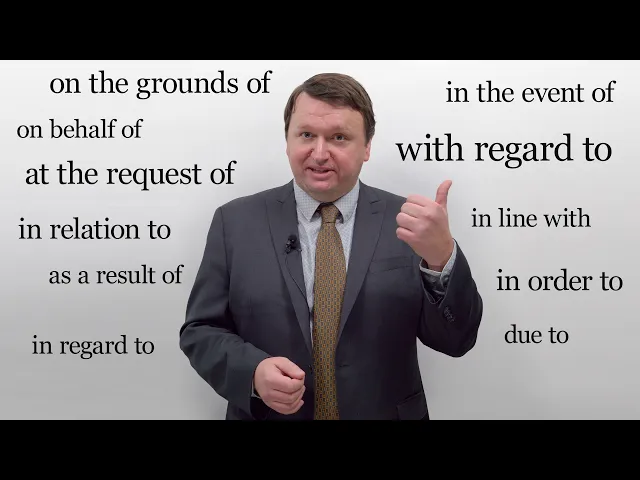
Professional Prepositions: 12 English Phrases for Advanced Learners
English with Alex · engVid
0:00 If you work in a professional environment,
0:02 you know that the English you hear inside your office
0:06 can be different than the English you hear outside your office.
0:11 Whether you are reading an email, an official company document,
0:15 or you are participating in a video call with your boss,
0:20 the English you hear or you read in those situations is specialized.
0:25 In this video, I'm going to teach you twelve prepositional phrases.
0:31 Don't worry, prepositional phrases just means there is
0:35 a preposition at the beginning of the phrase.
0:38 Let's go back.
0:39 Twelve prepositional phrases that you can use in a professional environment.
0:45 The first phrase that we will learn is
0:48 "at the request of someone" or "at someone's request." For example,
0:54 "The meeting was cancelled at the director's request." This means
0:58 that the director asked for the meeting to be cancelled.
1:03 Maybe the director got stuck in traffic or maybe he had a family emergency.
1:10 He called, he cancelled the meeting.
1:13 It was cancelled at his request.
1:15 Next, "At the request of the client,
1:19 we cancelled the order." Maybe the client realized they didn't
1:24 have enough money or they didn't want the product anymore.
1:29 They asked for the cancellation of the order.
1:32 And that's how you use "at the request of" and "at someone's request." See,
1:38 I told you, it wouldn't be so bad.
1:41 Our next phrase is "in order to" or "in order to do something."
1:46 This means so that we can do something or for the purposes of doing something.
1:53 For example, "In order to avoid confusion,
1:58 please use the file naming system in the attached
2:03 PDF." This might be an email from someone who
2:07 wants you naming your files using a specific format
2:11 so that files are easy to find in a folder.
2:16 Next, "We'll skip the next topic in order
2:20 to save time." So that we can save time,
2:24 we are going to skip the next topic in the meeting.
2:28 Maybe we talked about the previous topic for too long,
2:33 and this topic can be an email instead.
2:37 Next, we have "on the grounds of." This means "for the reason
2:42 of." This is used when you have an official reason for a decision,
2:49 an action, or a judgment.
2:51 Usually, there are negative consequences for someone
2:54 when you see or use this phrase.
2:58 Usually, it's used in an official document,
3:01 like a firing document, for example, or in an official email.
3:07 Let's look at two examples.
3:09 "He was terminated on the grounds of poor performance.
3:14 Because of his poor performance, he was fired.
3:18 This is the reason for his termination.
3:22 He was terminated on the grounds of poor performance." Next,
3:28 "The complaint was dismissed on the grounds
3:31 of insufficient evidence." So maybe one
3:35 of your colleagues accused you of doing something
3:39 bad to them, but no one saw it.
3:43 So the complaint that your colleague made was dismissed.
3:47 The next two phrases are "with regard to" and "in regard to." So
3:54 these are just fancier ways to say
3:58 "about something" or "concerning something." For example,
4:03 "I'm writing in regard to your vacation request." You can also say,
4:10 "I'm writing about your vacation request." This is a common email
4:16 that you might receive from your HR department about a vacation request.
4:22 Next, "With regard to your email,
4:26 you will receive a response by Friday." So concerning your email,
4:32 about your email, like saying this, "You will receive a response by Friday.
4:38 I have not forgotten that you sent me an email." You can use one or the other,
4:45 "with regard to" or "in regard to." Just don't
4:49 say "in regards to." If you add an S, "regards" are positive wishes.
4:56 You can end an email with "regards." For example, "Regards, Alex." That's fine.
5:04 But don't type or don't write "with regards to." It's
5:08 "with regard to" or "in regard to." A phrase that is
5:14 similar to "in regard to" and "with regard to" is
5:20 "in relation to," which means "related to" or "connected to." For example,
5:28 "Several concerns were raised in relation to the new budget." Here,
5:34 you could say "in regard to" or "about the new budget." Here,
5:40 this means "related to the new budget."
5:43 The concerns had a relationship to the new budget.
5:48 Next, "Have you heard anything in relation to the new union contract?" So,
5:55 we are negotiating a new contract, and I am anxious to hear news.
6:01 Have you heard anything in relation to, that is connected
6:06 to, that has a relationship with the new union contract?
6:11 So, "in relation to," "related to," "in regard
6:15 to," "with regard to," "about." Now, we have "in the event of something." So,
6:23 "in the event of" means if something happens in this case.
6:29 For example, "In the event of a fire,
6:32 please use the east exit." You might see this on an official
6:39 communication or even on the wall at your company.
6:43 "Please text this number in the event of illness." If you are sick,
6:49 if you are ill, if this happens,
6:53 please text this number or please text the number below.
6:58 So, basically, it means if something happens.
7:01 Make your own example in the comments.
7:04 Have you done it?
7:05 Have you left a comment?
7:08 "On behalf of everyone at EngVid,
7:11 I want to say thank you." "On behalf of" means as a representative of someone.
7:18 That's the next phrase.
7:20 For example, "They sent us a thank you gift on behalf of their CEO." So,
7:27 maybe their CEO was too busy to send a thank you gift,
7:32 but he called his receptionist or her receptionist and said,
7:37 "Hey, can you send that client a gift
7:41 basket?" "Sure." And, "On behalf of our company,
7:45 here is a gift." Or, "On behalf of our CEO," as a representative of our CEO.
7:53 Another example, "Hi,
7:55 I'm calling on behalf of EngVid.com." EngVid.com does not have a calling center,
8:04 but this is just an example that I wanted to give you.
8:09 And, "On behalf of myself," as a representative of myself,
8:13 "I would love it if you liked this video and shared it with other professionals,
8:19 if you are enjoying it so far." Our next phrase is "in line with." So,
8:25 this means that something follows or matches a certain expectation,
8:31 a rule, a standard, or a policy.
8:35 It follows it.
8:36 So, you have a line.
8:37 If you are not in line, this means you don't follow something.
8:42 You are doing something that does not
8:45 meet the expectations or the standards of something.
8:49 For example, you're not performing in line with the company's expectations.
8:56 Here are the company's expectations.
8:59 You're not in the line, right?
9:02 You're not performing in line with our expectations.
9:06 You're over here.
9:08 Here are the expectations, okay?
9:10 So, you need to improve your performance in this case.
9:15 Next, our employee salaries are in line with industry standards.
9:20 They follow industry standards.
9:24 We don't pay too much.
9:26 We don't pay too little.
9:28 Our standards, our salaries, are in line with the standards of our industry.
9:35 Finally, we have "due to" and "as a result
9:39 of." These simply mean "because of." For example,
9:44 due to low demand, we have removed the product from the market.
9:51 Not enough people want the product because of this.
9:56 Due to this, we have removed the product from the market.
10:02 Finally, the company closed.
10:06 Why?
10:06 As a result of increased operating costs.
10:12 So, the costs of running the company, paying the rent,
10:17 paying the employees, paying for management of the space.
10:21 What's the term I'm looking for?
10:24 Repairs, okay?
10:25 Repairs.
10:25 Paying for repairs.
10:27 The company closed because of this.
10:30 So, due to, as a result of, very
10:34 common in professional emails and in professional documents,
10:39 official documents, and in professional conversations,
10:43 like official conversations with your boss, for example.
10:48 Yeah, that was tough, but not too tough, right?
10:52 Good.
10:52 I hope you have enjoyed learning with me today
10:56 and that you have improved your professional English skills.
10:59 If you want to test your understanding of the material we have covered here,
11:05 make sure you do the quiz on EngVid.
11:07 If you are watching this on YouTube,
11:10 just check out the that is attached to the video.
11:14 Until next time, keep learning and keep practicing.