Cruise with Hantavirus Outbreak Set to Dock
DeFranco News Clips
0:00 we've got to talk about how a cruise ship is stranded at sea.
0:02 At least three passengers are dead.
0:03 Three more are sick, with one in critical care.
0:05 Nearly 150 people are still on board,
0:07 waiting to find out if they've been exposed to a rare and deadly virus.
0:10 Meanwhile, Cape Verde refused to let them dock.
0:12 Spain has finally agreed to take them in, and the world
0:14 Health Organization just confirmed what's been killing them.
0:17 But here's the timeline.
0:18 The Honda is set sail in April 1st,
0:20 traveling from Argentina to Antarctica over the span of a few weeks,
0:23 and by April 6th, just five days into this voyage,
0:24 one passenger started developing a fever, a headache, a mild diarrhea.
0:28 But then five days after the symptoms began, he died.
0:30 and then his wife.
0:31 She started showing symptoms shortly after,
0:33 and she left the ship with her husband's body on April 24th.
0:36 But two days later, she died.
0:37 Two.
0:38 right, and then just a few days later,
0:39 you had a third passenger dying, showing similar symptoms.
0:41 with then the World Health Organization confirming that the first
0:43 two passengers died from a hantavirus infection on May 4th.
0:46 And for those who haven't heard of hantavirus, it's a it's a family of viruses,
0:49 mostly spread through contact with rodent droppings.
0:51 as you could be exposed by cleaning up after rats
0:53 in a garage or drinking from a can that a rodent contaminated.
0:56 it's actually relatively uncommon that the US is
0:59 seeing fewer than 900 cases totals in the 2020.
1:01 but for the people who do get it, it is a severe illness.
1:04 people can develop lung failure,
1:06 heart failure, kidney failure, it's very severe.
1:09 Viral pneumonia is very often how this manifests.
1:12 and while different strains, you know, affect the body differently.
1:14 And survival rates vary for many forms of this illness,
1:17 outcomes are very difficult to predict.
1:19 so that's the situation the passengers on the Honda's
1:21 have been living with for nearly a month.
1:22 now as far as the investigation,
1:24 you have investigators really not knowing how the outbreak began yet,
1:26 though there are a couple of leading theories.
1:28 ones that rats may have stowed away on board and contaminated food or surfaces?
1:31 the another is that a passenger may have been exposed before boarding.
1:34 because reports indicate that hantavirus symptoms can take
1:36 sometimes up to two months to appear after exposure,
1:39 which means that someone they could have carried it on board without knowing.
1:41 while hantavirus is rarely contagious between people, it's not impossible,
1:44 which is part of what's made this whole situation so difficult to manage.
1:47 As far as the people that are on board this ship,
1:49 like the past month, has been just a nightmare.
1:51 What's happening right now is very real for all of us here.
1:56 We're not just a story,
1:58 we're not just headlines where people people with families,
2:03 with lives, with people waiting for us at home.
2:07 There's a lot of uncertainty, and that's the hardest part.
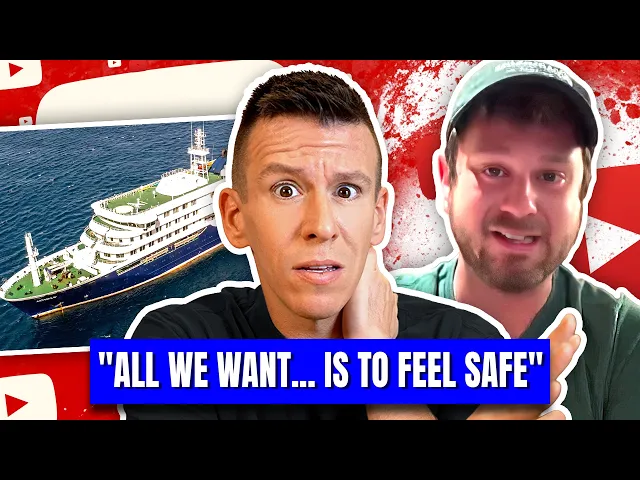
2:14 All we want right now is to feel safe, to have clarity and to get home.
2:20 Right as far as a ship.
2:21 It reached Cape Verde waters on May 3rd.
2:23 doctors there have been monitoring
2:24 the three passengers who were showing symptoms,
2:25 collecting samples, trying to support the situation medically.
2:28 But the ship also hasn't been allowed to dock.
2:30 Verde authorities, they decided not to allow the Hondas to come ashore.
2:33 and there, you know who official explaining.
2:34 It's been very tricky for Cape Verde and authorities,
2:36 saying what they have to deal with is a public health event.
2:39 And of course, they have been thinking
2:40 about the protection of the population here.
2:41 and so essentially, without knowing the full scope of this outbreak,
2:44 they're keeping their distance.
2:45 if that sounds like it gives you memories of, like,
2:47 Covid era responses, that's because it is, right after what happened with Covid,
2:50 with cruise ship outbreaks,
2:51 the World Health Organization actually updated international
2:53 regulations to address exactly this type of situation.
2:56 What's a regulation say?
2:58 And it's a legally binding treaty.
3:00 Is that a port must allow passengers who are sick to disembark,
3:10 and it can only fail to do that if it
3:17 literally does not have the capacity to care for them.
3:21 It can't just say we're afraid for our own people,
3:26 and so actually with that Cape Verde position has
3:28 been criticized as being inconsistent with its Who obligations.
3:31 what's happening now is unethical.
3:34 It's unlawful and it's dangerous.
3:37 though the counterargument that's been raised is
3:38 that this is in Cape Verde ship.
3:40 So why should they bear the burden?
3:41 they're, they're you have people pushing back saying, well,
3:43 the answer is being a member
3:44 of the World Health Organization comes with binding commitments.
3:46 it's a further down the line, one of the things to look to the situation for is
3:49 to find out whether Cape Verde is going to face legal consequences.
3:52 as far as what's happening now Spain stepped in.
3:54 right as far as what's been announced.
3:55 First, at least two of the six passengers are
3:57 going to be transferred to the Netherlands for medical care.
3:59 also the third passenger symptoms are reportedly less severe at the moment,
4:02 but that also could change and they
4:04 might eventually be added to the transfer list.
4:05 after that, the ship is going to set sail for the Spanish Canary Islands,
4:08 where who officials are prepared to conduct a full investigation,
4:10 disinfect the ship, and assess the risk of the remaining passengers.
4:13 and again while person to person transmission of the hantavirus is rare,
4:16 containment remains a priority for really anyone considered higher risk.
4:19 and so in the meantime, passengers have been asked to stay in their cabins.
4:21 the hope is that no additional cases develop before the ships able to dock.
4:24 And there's a proper assessment.