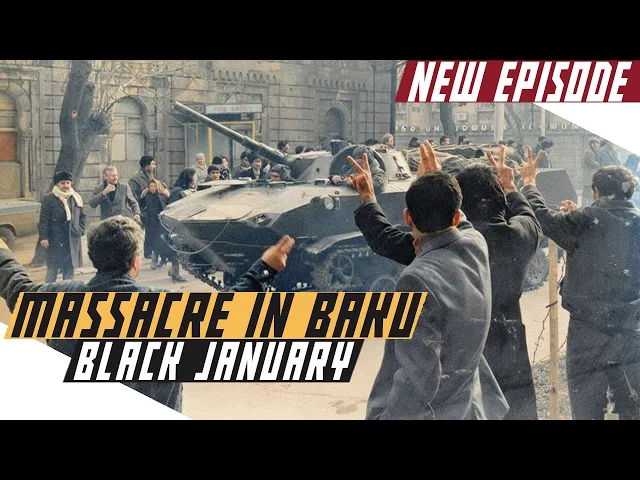
Black January: Soviet Massacre in Azerbaijan
The Cold War
0:00 The end of the communist regimes in central and eastern Europe has been
0:04 widely acclaimed for the generally peaceful nature
0:06 by which those regimes were taken apart.
0:09 With the exception of Romania,
0:10 there [music] was little violence as new democracies were established.
0:14 Even the dismantling of the Soviet Union
0:17 has been hailed for its largely peaceful nature.
0:20 But what if I told you that as the Soviet
0:23 Union was collapsing in the late 1980s,
0:25 the growing movement for democracy was so threatening to the state that it
0:30 provoked one of the most extreme crackdowns in the Soviet government's history.
0:35 The Black January massacre in the Azerbaian Soviet
0:38 Socialist Republic claimed the lives of around 150 people
0:42 and set the blueprint for the better known
0:45 controversies that would follow in the USSR's Baltic Republics.
0:49 So, where did the movement ideals come from and what happened in January 1990?
0:54 I'm your host, David,
0:55 and today we will explore the Black January massacre in Azerba.
1:00 This is [music] the Cold War.
1:08 So, this story begins in 1846 when oil was industrially
1:13 drilled for the first time in history in Baku Azeran's capital.
1:17 Over the decades that followed, companies from the United States and Europe,
1:21 including the Nobel Brothers Company
1:23 and the Rothschild Caspian Black Sea Company,
1:26 flocked to Baku, seeking to make a fortune from black gold.
1:30 By the turn of the century, Baku was supplying half the world's oil.
1:34 Despite this, the local population ostensibly did
1:37 not benefit that much from the boom.
1:39 Of the 54 oil firms working in [music] Baku in 1888,
1:43 just two were Azerbaijani owned.
1:47 [music] This being said, oil changed the city in a way
1:49 that would have lasting impacts on national culture
1:52 at a time when what Benedict Anderson called imagined
1:56 communities were being created across Europe and the world.
2:00 This is the idea of a community or group forming around a shared identity,
2:04 a birth of nationalism.
2:05 Indeed, the historian Audrey Alstat explains that quote,
2:09 "The rapid expansion of the oil industry was primarily responsible for Baku's
2:14 apparently well-deserved reputation as a wild
2:17 boom town replete with [music] grand hotels,
2:20 telephones, casinos, gas lit streets, prostitutes, and a frontier lawlessness.
2:26 Think proper wild west stuff.
2:28 Wild East, but also not miles away from being
2:32 a 19th century Caspian Las Vegas." The point is, of course,
2:36 that the oil boom brought with it
2:37 an unusually high influx of foreigners from the west,
2:41 huge sums of money, and sparked incredibly fast industrialization.
2:46 This was unusual in the Russian Empire and even more unusual in the caucuses.
2:50 And of course, it resulted in the [music]
2:52 frequent transfer of knowledge from outsiders to locals,
2:55 which naturally began to influence the burgeoning Azerbaijani cultural,
2:59 intellectual, and political elite of the late 19th century.
3:03 Indeed, as in the west, rapid industrialization and other such
3:07 changes were accompanied by Fendiskla ideas,
3:10 particularly regarding secularism, political representation and workers rights.
3:16 Allstat agrees with this view,
3:18 stating that the many wealthy industrialists and merchants form the core
3:22 of the Azerbaijani Turkish business community
3:24 and an important part of the political stratum.
3:27 Besides their economic and political clout,
3:30 this elite was instrumental in creating a cultural enlightenment movement.
3:34 Another historian Wayne Vousenich explains that in parallel,
3:38 the Azerbaijani elitees views of the nation
3:40 was developed by the experience of Russian colonization.
3:44 The Azerbaijanis viewed the Russians as foreign oppressors,
3:47 people of another language and religion.
3:50 In the eyes of the Azerbaijanis,
3:52 Russia's Caucasian policy was anti-Muslim and an outright colonial conquest.
3:57 By the end of the 19th century, Azerbaijan had its own small but dynamic
4:02 intelligencia which included literati artists and political thinkers.
4:06 Baku became a flourishing center of secular
4:09 culture and a burgeoning Azerbaijani nationalism.
4:12 So all this being established we can conclude
4:14 that by the dawn of the first world war
4:16 azerbaanis in Baku were pretty open about their disdain
4:20 for Russian colonizers and quite enthusiastic about democratic ideals.
4:26 All of these developments plus the Russian
4:28 revolution and the collapse of the Russian
4:30 Empire culminated in the creation of the Azerbaijan
4:33 Democratic Republic on May 28th, 1918.
4:37 Led by members of Azerbaian's elite,
4:39 its [music] declaration of independence stated
4:41 that sovereign rights belong to the Azerbaijani people.
4:45 Independent Azerbaijan is a democratic republic.
4:48 All citizens are guaranteed full civil
4:50 and political rights regardless of their nationality,
4:52 religion, social position, or sex.
4:56 This was remarkable for a principally Islamic state at this time.
4:59 [music] And even more remarkably,
5:01 its leaders also used the opportunity to further integrate communities
5:04 outside of Baku into their conception of the democratic Azerbaijan nation.
5:10 But the state was not to be.
5:12 In 1920, the Red Army invaded Azerbaian and put an end to the experiment.
5:17 The Azerbaijan Democratic Republic lasted just 23 months.
5:20 [music] But in the short time it did exist, it produced a homegrown experiment
5:25 in parliamentary democracy and secularism which
5:28 had [music] a lasting impact on the views of future Azerbaijani reformers.
5:33 Anyway, with this the Azerbaian SSR was created and all
5:36 of its institutions were given the appropriate Soviet titles and structures.
5:41 What happened in terms of nationalities policy was broadly
5:44 similar to what we've already covered in previous videos.
5:47 The Azerbaijani language for example retained its official
5:50 status but the alphabet was changed twice in fact
5:54 first from Arabic to Latin in 1924 [music]
5:57 and then from Latin to cerillic in 1940.
6:00 The teaching of the Russian language was expanded in schools.
6:04 When Stalin came to power,
6:05 purges against artists and intellectuals eventually followed.
6:09 The native Azerbaijani ruling elite were slowly but surely Russified.
6:13 [music] You get the picture.
6:15 Now perhaps the most interesting
6:17 and consequential development for the Azerbaijan
6:20 SSR was the creation of the Negorno Carabach Autonomous Ablast.
6:24 On July 7th, 1923, Moscow decided
6:28 to incorporate the region as an autonomous part
6:30 of Azerbaijan despite the fact that at the time of the 1926 Soviet census,
6:36 89.2 of its population was Armenian.
6:39 To be clear, a significant population of Azerbaijanis also lived
6:43 there during this period and had done so for centuries.
6:46 The populations of both nationalities was [music] in constant
6:50 flux with the changing of empires over the years.
6:53 Azerbaijani and Armenian forces had also fought
6:56 over the region after the first world war.
6:58 But this video is not about Negrono Carbach.
7:01 And while we will cover the topic properly in future episodes,
7:05 and we know the comment section is going to be full of partisan hate speech,
7:09 what you need to know for today is that neither the Azerbaijanis
7:12 nor the Armenians were ever really satisfied with the setup imposed by Moscow.
7:18 Despite this though, there was a tacid understanding that the majority of people
7:21 were Armenian while the land was Azerbaijani, broadly speaking.
7:26 Okay, so moving forward to the post 1945 period.
7:30 For much of the cold war, Azerbaijani nationalism simmered rather than erupted.
7:34 State ideology demanded that national identity be expressed culturally.
7:39 It was okay to be Azarbaijani through music,
7:42 literature, or folklore, but never politically.
7:45 As elsewhere in the USSR, poets could talk about mountains and shepherds
7:49 and the eternal soul of the nation.
7:51 But this did not change the fact that sovereignty could not be discussed.
7:56 And so the contradiction that was embedded
7:58 in the foundations of the USSR itself continued for decades.
8:02 Republics were granted a theoretical right to self-determination,
8:06 but it was ensured that they never got
8:07 anywhere close to actually exercising [music] that right.
8:11 Indeed, in 1972, Brev thought things were going so smoothly that he declared
8:16 that the national question as we inherited
8:19 it from the past [music] has been fully, definitely, and irreversibly resolved.
8:25 But Brev despite [music] an immense eyebrow
8:27 game was wrong about a lot of things.
8:30 As Alstat highlights in Azerbaijan,
8:32 it was precisely this aperture of freedom that created problems.
8:36 [music] The origins of descent, initially moderate,
8:39 sporadic and exclusively inerviani language journals and literature
8:44 went back to the Brev era when writers and scholars had begun to [music] examine
8:48 topics that were forbidden by the Soviet regime.
8:51 Thus by the time Mikuel Gorbachof came to power
8:54 in 1985 [music] and began appining about transparency that is
8:58 Glasnost a shared sense of national identity was probably
9:02 stronger [music] than it would have been without KMatsia.
9:06 So with Glasnost it was suddenly possible to openly criticize Moscow's rule
9:10 and perceive a future where Moscow wasn't [music] involved in governing at all.
9:16 The corrupt and stagnant,
9:17 some would say more abundant economy [music] most Soviet citizens were
9:20 living in by this point only added to the sense of opportunity.
9:25 Okay, so let's come back to the issue at hand.
9:27 As we explored in our recent video
9:29 on the Armenian secret army for the liberation of Armenia,
9:32 in the Armenian SSR, Soviet [music] Armenians,
9:35 unlike in almost every other Soviet Republic,
9:38 had typically directed their nationalist resentments at Turks
9:42 rather than Russians because of the [music] Armenian genocide.
9:46 As a result, the central authorities saw
9:48 national expression in Armenia as a sort
9:50 of release valve for other [music] discontents and was somewhat more lax.
9:55 But Negrono Carabach was an issue that the Soviets could not really plate.
10:00 [music] Armenia had lost a huge chunk
10:02 of its territory during the early 20th century.
10:05 [music] So the idea that Negrono Carabach,
10:07 a land that Armenians considered historically Armenian,
10:10 was officially part of an ethnically Turk Republic
10:13 in the form of the Azerbaian SSR [music] enraged many Armenians.
10:18 Thus, for 70 years, Armenians in Negrono Carbach petitioned
10:22 Moscow to be transferred [music] to the Armenian SSR.
10:25 And for 70 years, Moscow responded [music] with a no.
10:30 But in February 1988,
10:32 massive protests broke out in Yedavan demanding unification.
10:36 The same month, the Negron Cararabach Supreme Soviet [music] held a referendum
10:40 on the issue with the result showing 99.89% in favor of the transfer.
10:46 This overwhelming number was largely the result
10:48 of local Azerbaijani populations [music] boycotting the vote.
10:52 The Gorno Carabas unilateral attempt to unify
10:55 with Armenia represented a huge challenge [music] to Moscow's
10:58 authority and the Soviet leadership reacted by deploying
11:01 interior ministry troops to manage the situation.
11:05 They would not leave for another 17 months.
11:09 But even if Moscow had acted to try and calm the situation,
11:13 Armenia's ambition to incorporate Negron Karabach [music] at Azerbaijan's
11:17 expense did not go unnoticed by those across the border.
11:21 Indeed, expecting violence and [music] unrest,
11:23 local officials put Baku on lockdown almost immediately.
11:28 But in doing so, they largely forgot about the town
11:31 [music] of Sunungit on the outskirts of the capital.
11:34 Known mainly for its huge population of former convicts,
11:38 about [music] one in five of its residents had a criminal record.
11:40 Sunid had a reputation for roughness with many Azerbaijanis who had [music]
11:45 been forced to leave Armenia due to violence there settling in the city.
11:49 Many Armenian migrant workers from the hills of Karabach had
11:53 also relocated there living side by side with the Azerbaijani population.
11:57 [music] In the circumstances, it could not have been more of a powder keg.
12:02 On the 26th of February,
12:03 then just 6 days after the referendum in Negrono Carabah,
12:07 a small group of 40 to 50 people gathered in the square outside
12:10 local party headquarters and protested about
12:13 the authorities lack of action in Negro Carabach.
12:16 By the 27th, the crowd had reached several
12:19 hundred and there were reports of looting and rioting,
12:22 but the police did not intervene.
12:25 The following day, the local party boss, Jihener Muslim Zade,
12:28 tried to reassure the crowd that Nakarno Karabach
12:31 would never be Armenian, but it was no use.
12:34 In the following days, at least 32 Armenians living in Sunit would
12:38 be murdered as tensions spilled over into a procam.
12:42 And for the record, Armenians committed atrocities against the Azarbaijanis.
12:46 Also, [music] the events in Sunit set the tone
12:49 for relations between the two nations for decades to come.
12:53 A few months later on May 15th,
12:55 Baku saw [music] its first large-scale protests as approximately 15,000 people
13:00 demanded measures against what they
13:02 called further actions by Karabaki separatists.
13:06 3 days later, the number of protesters had doubled,
13:10 placing [music] Communist Party leader Cameron Bagiraov under so
13:14 much pressure that he made the decision to resign.
13:17 The May 1988 protests were largely orchestrated by a group called
13:21 the Varlique Organization led by a highly
13:23 radical figure [music] named Neimat Panov.
13:26 And Varlik was not the only such political group.
13:29 By far the most influential was a mly crew of democratic reformers,
13:33 intellectuals [music] and academics from the Azerbaijan
13:36 National Academy of Sciences and Baku State University.
13:40 Panicked by the protests,
13:41 the new first secretary of the Communist Party, Abdul Rahman Vizerov,
13:45 invited these reform-minded individuals to his offices
13:48 to try and understand what [music] they wanted.
13:51 Seeking collaboration with the local Communist
13:53 Party to quell tensions and unrest,
13:55 they told Vizerv that he should consider reforming the party
13:59 and its institutions to make [music] it more inclusive,
14:02 which he unsurprisingly refused.
14:05 This was a critical juncture in Azerbaian's
14:08 late Soviet history because alternative forces
14:11 in Azerbaian [music] ultimately couldn't find
14:13 a way to collaborate with the ruling communists.
14:16 Thus, a few months later in October 1988,
14:19 major pro-independence movements [music] began forming.
14:22 The overall movement initially lacked a big tent party seen as necessary
14:27 if a meaningful challenge to the communist party's hegman was to be made.
14:31 By July 1989, the Azerbaian Popular Front
14:34 or APF was established as that big 10 party.
14:38 But this meant merging with more radical groups like Varlig.
14:42 [music] With the burgeoning APF gaining traction across Azerbaijan by late 1988,
14:47 [music] in November,
14:48 the masses were asking why the Soviet authorities had failed to stop the exodus
14:52 of [music] tens of thousands of Azerbaianis
14:54 from Armenia amid tensions and violence over the border.
14:58 As many [music] as 500,000 people gathered in Lenin Square to protest,
15:03 but after 18 days of resistance,
15:05 [music] Soviet police aggressively cleared away protesters on December 5th.
15:09 A 10-month curfew was then imposed.
15:12 While certainly a setback,
15:13 the APF used the curfew to create a more formal structure,
15:17 electing the charismatic Abdul Fez Ali as leader
15:20 at its first congress in July 1989.
15:23 better known by his moniker Elchibbe.
15:26 He was a lecturer at the Baku State University who
15:29 had been arrested in the 1970s [music] for counterrevolutionary activities.
15:33 His objectives as summarized by historian Jalan Toku were the political,
15:38 economic and cultural independence of Azerbaian and the establishment of a state
15:43 based on law and a society based on citizenship irrespective of ethnic,
15:48 linguistic or religious background.
15:51 These were ultimately the ideals of the original
15:53 Azerbaian Democratic Republic that we mentioned earlier.
15:56 And it was this democratic secular version of Azerbaijan
16:00 around which the APF hoped to build the republic's future.
16:04 With the APF organized behind a clear vision with a firm
16:07 leader and with the 10-month curfew coming to an end,
16:11 the APF was ready to make its next move.
16:14 This would come in late 1989 when
16:17 hundreds of thousands of Azerbaijanis once again
16:19 took to the streets demanding that the Azerbaijani
16:22 Communist Party act decisively on Nakono Karabach.
16:26 But there was a rather sinister undertone to all
16:28 of this despite the flowery messaging coming from Ilchibbe and the APF.
16:34 Since the APF had become so large because it was such a big tent,
16:37 this made it very difficult to control all of the key
16:40 figures within it and maintain a unified party line.
16:44 Thus, figures like Panahov,
16:46 the leader of the radical vari group we mentioned earlier,
16:49 were becoming increasingly powerful.
16:51 A year [music] earlier,
16:52 Panahov was amongst those who had stirred up anti-Armenian sentiment in Baku.
16:57 By late 1989, [music] he was calling for a blockade against
17:01 Armenia in order to create huge gas and [music] food shortages.
17:05 Caucus' expert Thomas Dwal summarizes the situation at the end of 1989.
17:11 Azerbaian's black January of 1990 was ushered in with all
17:15 the disturbing portraits of mass violence already visible.
17:19 A defenseless Armenian population whom [music] none
17:22 of the security structures seem ready to defend.
17:24 A popular front where radical elements had squeezed out the moderates.
17:28 A local party leadership losing power [music]
17:30 and looking for ways of hanging on to it.
17:33 and the Soviet leadership in Moscow which was prepared to take any
17:36 steps it thought necessary to [music]
17:38 prevent Azerbaijan's breaking away from the union.
17:41 It was a volatile situation and on January 13th 1990 it all boiled [music] over.
17:47 Days earlier the Armenian SSR had announced that it would consider Nagorno
17:51 Carabach its own territory and give
17:54 [music] citizenship to residents of the region.
17:56 Back in Baku, men broke away from a huge rally
17:59 in the main square and headed towards the Armenian quarter.
18:03 There were reports of Armenians being beaten to death,
18:06 and there were rumors that Armenians
18:08 were even thrown from high-rise apartment buildings.
18:11 It's unknown precisely how many people were killed,
18:13 [music] although estimates say at least 90.
18:16 But what is for sure is that the number would have been much higher
18:20 had Soviet interior ministry troops in Baku
18:23 [music] not provided the Armenians with safe passage.
18:27 To say they stopped the program would be untrue.
18:30 Most stood idly by and watched it unfold.
18:33 And by this point, the local authorities were almost powerless.
18:37 But those who managed to find refuge [music] were soon put
18:39 on fairies and transported across the Caspian Sea to Turk Menistan.
18:45 Others were taken to the airport and boarded
18:47 planes [music] to Yedan to again quote Dewal.
18:50 With this terrible flourish, Armenia and Eservjan completed their ethnic
18:55 cleansing of each other's populations.
18:58 To give an idea of scale,
18:59 the number of Armenians in Baku in 1988 was as high as 250,000.
19:04 And yet by [music] the end of 1990, it was zero.
19:07 The situation in Baku would continue to escalate over the coming days.
19:11 And by January 15th, it had [music] gained Moscow's full
19:14 attention as Azerbaijani activists began actively
19:17 blockading military barracks and the main routes in and out of Baku.
19:21 The pilot bureau dispatched Yagenei Primikov,
19:24 a member of Gorbachov's presidential council to Baku to announce
19:28 that 11,000 Interior Ministry troops would soon arrive to restore [music] order.
19:33 3 days later on the 18th he spoke again
19:36 this time in front of a huge crowd to assure
19:38 protesters that troops were arriving to protect people but he
19:42 was met with fury and even booed off stage.
19:46 Then on January 19th, the Supreme Soviet of the USSR issued
19:50 a decree placing Baku under a state of emergency
19:53 effective from midnight due to a dramatic
19:56 escalation of the situation in the city [music]
19:58 of Baku and attempts of criminal extremist forces
20:01 to remove from power by organizing mass unrest
20:04 against legally acting state authorities and in the interests
20:07 of the protection of the security of citizens.
20:10 Behind all the Soviet wording,
20:12 this meant that Moscow was sending proper troops in.
20:15 That same day, Azerbaijani state radio
20:17 and television transmission center was blown up,
20:20 likely by Soviet special forces,
20:22 cutting [music] off all national broadcasting and leaving no way to announce
20:26 the curfew or state of emergency for people [music] to seek safety indoors.
20:31 At almost exactly midnight,
20:33 26,000 [music] Soviet troops crossed the city limits into Baku
20:37 and began opening fire on anybody they could see.
20:41 The troops claimed that they were returning fire,
20:43 but independent investigations [music] have concluded that there was no
20:46 evidence that anyone in Baku except Soviet troops were even armed.
20:51 Their first target was also the [music] headquarters of the popular front.
20:55 It later emerged that the Soviet defense minister,
20:57 Dimmitri Yazov, had personally given this open fire order.
21:03 All told, over the course of 2 days,
21:05 at least 150 Azerbaijanis were killed by Soviet troops.
21:09 But all this violence raises two very [music] important questions.
21:12 First, why did Soviet troops feel the need to enter Azarbaian at all?
21:16 The obvious [music] answer is to stop
21:18 the violence against Armenians even though Mikuel
21:20 Gorbachoff said the invasion of Baku [music]
21:22 was necessary to fight extremists and radicals.
21:26 He also told the foreign press that troops
21:29 were sent to root out Islamic extremists.
21:32 The truth is [music] all of these explanations are nonsense.
21:35 Astred Tumz instead considers that the Soviet
21:38 government's eventual use [music] of force
21:40 in Baku in January 1990 was ostensively intended to stop interthnic fighting,
21:45 but in reality it was designed to crush [music] the Azerbaijani popular front.
21:50 The invasion of Azerbaian marked the apex of the central
21:53 government's resolve to use force to hold the union together,
21:56 [music] a view that both Tom Dewal and Audrey Alstad share.
22:01 The second question is then who was to blame for the programs?
22:05 On one hand, as implied earlier, the local authorities were certainly culpable,
22:09 even if they had [music] perhaps lost their monopoly on violence.
22:12 Dewal is unequivocal in his criticism.
22:14 [music] The failure to declare a state
22:17 of emergency to halt the Armenian programs only
22:20 to do so when the Armenians had left
22:22 suggested deep [music] cynicism or incompetence or both.
22:26 On the other hand, though many of the moderate leaders
22:28 of the popular [music] front principally
22:30 blamed the radical elements of the party,
22:32 these radical elements were still a minority.
22:35 It's widely [music] believed that shortly before the programs,
22:38 some of these minority popular front leaders were
22:41 shouting slogans like [music] long live Baku without Armenians.
22:45 So, they could have done much more to stop things from going as far as they did.
22:49 We should also note here that there is evidence that many of the more
22:53 moderate popular [music] front activists were involved
22:56 in helping Armenians evade the violence in Baku.
22:59 Whatever the underlying causes, in the immediate aftermath of these events,
23:02 [music] the Soviet authorities placed Baku under martial law
23:05 and quickly restored the authority of the Communist Party.
23:08 They sacked the existing party leader and installed Ayaz
23:11 Mutilibbof [music] as the first secretary of the Anzubaijani
23:14 Communist Party on January 23rd who slowly agreed to some
23:18 reforms in the coming months to stabilize the situation.
23:22 Several key members of the popular [music] front at least those who
23:25 had not been shot were thrown in jail while others fled their homes.
23:29 But make no mistake,
23:31 Black January was the point at which the Soviet authorities lost Azerbaijan.
23:36 The APF would form this point on advocate
23:39 not for the reform of the Soviet system
23:42 but for Azerbaijan's complete independence from it which
23:45 it would eventually declare on August 30th 1991.
23:50 The APF and Elchibet would go on to lead Azerbaian into [music]
23:53 its first years as an independent democratic state before Hadar Ali,
23:59 the former first secretary of Azerbaian's Communist Party,
24:02 returned to power in 1993 and restored authoritarian control.
24:07 With the rise of Ali,
24:08 any lingering sense that Azerbaijanis were united by their democratic history
24:12 was eclipsed [music] by more extreme nationalism and the Negorno Carabach issue.
24:17 Though these seeds had of course been sewn much earlier,
24:21 Black January remains one of the most defining [music] moments in modern
24:25 Azerbaijani history with the 20th of January marked every year as Martyr's day.
24:31 As for Black January's impacts on the wider Soviet Union,
24:35 it is now seen by many historians as perhaps [music]
24:38 the clearest indicator that it was nationalism which brought down the empire.
24:42 Whatever your view, the fact that the authorities clearly [snorts]
24:46 learned nothing from Black January did matter in the long term.
24:50 Indeed, a Human Rights Watch report from the early 1990s said, quote,
24:54 "The [music] violence used by the Soviet army
24:56 on the night of January 19th 20th was so out
24:59 of proportion [music] to the resistance offered by Azerbaijanis
25:02 as to constitute an exercise in collective [music] punishment.
25:06 The subsequent events in the Baltic republics where
25:09 in a remarkable parallel to the events in Baku,
25:12 the alleged civil disorder was cited [music]
25:14 as justification for violent intervention by Soviet troops,
25:19 further confirms that the Soviet government [music] has
25:21 demonstrated that it will deal harshly with nationalist movements.
25:25 Black January was thus important because it set
25:27 the precedent [music] for the Soviet authorities textbook
25:30 reaction to nationalism which probably accelerated [music]
25:33 the collapse as much as the actual nationalism itself.
25:37 Thus, if there had been opportunities to quell
25:39 nationalist discontents [music] and save the union,
25:42 it was Gorbachov's own decisions that meant [music] these were missed.
25:47 And finally, what became of Negorno Carabach?
25:49 Well, with a view to covering this in the future,
25:51 we will end with a quote from Tuminesz.
25:53 [music] The Gordo Carabach had the makings of an intractable
25:57 conflict and proved to be one in the postsviet period.
26:00 However, as is true of most [music] conflicts,
26:03 action taken at an earlier stage to prevent
26:05 escalation could have made the task conflict management easier.
26:09 In 1988, when the conflict turned violent and Armenian and NKAO
26:14 officials [music] formally announced that the region
26:16 had been incorporated into Armenia,
26:18 Soviet leaders could have diffused or at least [music] contained
26:21 the dispute by decisively settling the status of Negorno Carabach.
26:26 Far from being decisive, however,
26:28 the Soviet government's response to Negrono Carbach was slow and irresolute,
26:32 reflecting [music] naive and a partial abdication of central responsibility.
26:37 Indeed, it is precisely evidence of this naive [music]
26:41 and abdication of responsibility that we have seen today.
26:44 Black January was but one consequence.
26:47 We hope you've enjoyed today's episode.
26:49 And to make sure you don't miss our future work,
26:51 please make sure you subscribe to our channel and have pressed the bell button,
26:55 which is dreading the absolute [music] crap show
26:58 that the comment section is sure to be.
27:00 Please consider supporting us on Patreon
27:02 at patreon.com/thecoldwar or [music] through YouTube membership.
27:06 We can be reached via email at the cold war channelannel@gmail.com.
27:10 This is the Cold War channel.
27:11 And as we think about the Cold War,
27:13 please remember that history is shades of gray and rarely black and white.