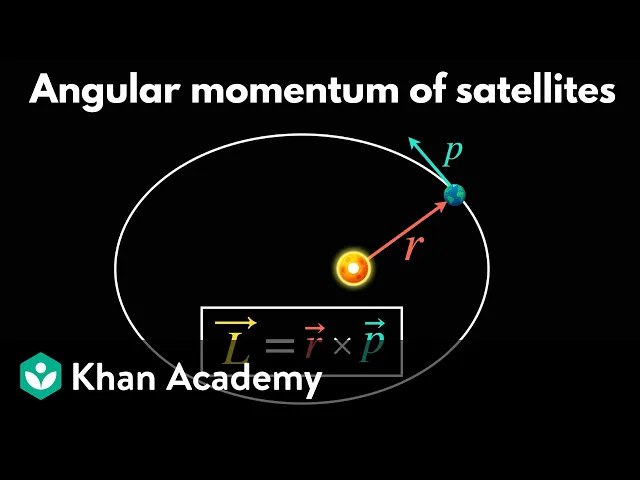
Angular momentum of satellites | AP Physics | Khan Academy
Khan Academy
0:00 [Instructor] Let's talk about angular momentum of orbiting stuff,
0:02 like planets and satellites.
0:04 To do that, let's start with a simple-sounding question.
0:07 I have a stone of mass m moving with some velocity v in a straight line.
0:13 Does this stone have angular momentum?
0:16 Well, we know angular momentum of any rigid body is
0:19 given as the product of its rotational inertia times angular velocity.
0:22 So our instincts might be, "Hey, this stone is not rotating.
0:26 It's just moving in a straight line.
0:27 So angular momentum is zero.
0:29 It doesn't have any angular momentum." (laughing) But that would be wrong.
0:33 Why?
0:34 Well, think of it this way.
0:35 Imagine there was a thin light rod, which was fixed at one end over here,
0:41 so that, you know, it can freely rotate like this.
0:44 Now, what do you think would happen if this stone were to go and hit
0:47 this rod so that its velocity is perfectly
0:50 perpendicular to the rod and it sticks to it?
0:52 Well, you can imagine it's going to start spinning with some speed, right?
0:56 And to figure out that speed,
0:57 we would need to know the rotational inertia of this rod.
1:00 But if you assume that the rod's mass
1:03 is negligible compared to that of the stone,
1:05 and if you also assume ideal conditions like say no friction and no
1:10 air resistance and all of that, then once it's sticks to this rod,
1:14 it will start spinning with the stone having that same linear speed forever,
1:20 which means now the system has angular momentum.
1:24 The system of rod and the stone together, it has some angular momentum, right?
1:29 But think about where did that angular momentum come from?
1:32 Remember, angular momentum of system cannot change unless
1:36 there is an external torque acting on the system.
1:39 Now, if we consider the rod and the stone as part of our system,
1:43 then as the stone hits that rod and sticks to it,
1:47 the forces and the torques are all internal to our system.
1:50 There are no external torques,
1:52 which means the angular momentum couldn't have changed.
1:56 So if the system has angular momentum here,
1:58 the system must also have angular momentum here as well.
2:01 And all of that angular momentum must be part of this stone,
2:04 because remember, this rod is not moving.
2:07 I mean, we have assumed it's mass to be negligible,
2:09 but even if it did have mass,
2:11 if it's at rest, it wouldn't contribute to the angular momentum,
2:14 which means the initial angular momentum of the system,
2:17 all of it must be part of just that stone,
2:20 which means even though this stone is moving in a straight line,
2:23 it's not spinning at all, it still has angular momentum.
2:28 Okay, but how much is that angular momentum?
2:31 Well, the angular movement of the stone here should be
2:33 the same as the angular momentum of the stone over here.
2:37 Remember, we are assuming that the rod has negligible mass,
2:40 so it has negligible rotational inertia.
2:42 So all the angular momentum is due to the stone.
2:46 Okay, so what's the angular momentum of the stone?
2:48 Well, let's just stick to its magnitude.
2:50 We can say the angular momentum is the momentum
2:52 of inertia of the stone times its angular speed.
2:55 I'm using the word speed because we are sticking to magnitude.
2:57 We'll talk about its direction later.
2:59 Okay, how much is the rotational inertia of the stone?
3:02 Well, if the stone is pretty tiny,
3:04 then we can say all of that mass is concentrated
3:06 at say the distance r from the axis of rotation.
3:10 So then the rotational inertia of the stone would be mr squared.
3:14 But what's the angular speed of the stone?
3:16 Well, angular speed equals just the linear speed v divided by r.
3:21 So over here, omega is v divide by r.
3:25 And so one r cancels and we get mvr.
3:28 And mv represents the magnitude of the momentum of that stone, right?
3:32 And so now we can write the angular momentum magnitude as just r times p.
3:37 And since the angular momentum is conserved because
3:40 there are no external torques acting on our system,
3:42 the magnitude of the stone's angular momentum even here must be r times p.
3:46 But here's a question.
3:48 Remember this thin rod that we imagined?
3:50 Well, that's just an imagination, that's not real, right?
3:54 So then what exactly is this r?
3:56 What does r truly represent in our angular momentum formula?
4:01 Well, think about r as the radius of the would-be circle
4:06 that the stone would be moving in if it was rotating.
4:10 The whole point is that, even though it's not rotating right now,
4:13 it has the ability to rotate sometime in the future.
4:16 That's why we say it has angular momentum
4:19 because it can rotate sometime in the future.
4:22 That's the whole idea.
4:23 So it can rotate about this point,
4:25 and that's why we say it has angular momentum about this point.
4:30 Okay, but saying that r is the radius of the would-be
4:34 circle along which that stone would rotate in the future,
4:38 (laughing) that's not very technical, right?
4:41 So how can we put it in more technical terms?
4:43 Well, we can say that this distance r represents the perpendicular distance
4:48 from this point on to the direction in which that stone is moving, look.
4:53 And so we can call this the r perpendicular times p.
4:59 Makes sense, right?
5:00 But remember, angular momentum is a vector quantity.
5:03 This is just its magnitude.
5:05 It also has direction.
5:06 How do we think about the direction
5:07 of the angular momentum of this stone right now?
5:10 Well, we can use our right-hand thumb rule.
5:12 You take your right hand and you curl
5:14 your four fingers along the direction of the rotation.
5:18 Then the thumb points in the direction of the angular momentum.
5:22 So if you curl your fingers over here
5:23 this way in the direction of rotation, look, the thumb points out of the screen,
5:27 so the angular momentum here is out of the screen.
5:30 But this means, and this is a very important thing about angular momentum,
5:34 that this angular momentum depends on our reference point.
5:38 Because remember, the value of our perpendicular depends on our reference point.
5:43 If I choose a different reference point,
5:45 the angular momentum of the stone would be different.
5:48 For example, consider the angular momentum
5:51 of the same stone with respect to this point.
5:55 Notice now the r perpendicular is much bigger.
5:59 So now the angular momentum magnitude is higher,
6:04 even though nothing has physically changed, it's the same stone,
6:07 it's the same situation, but if I consider it's angular momentum
6:09 with respect to this point, it's much higher.
6:12 Okay, what about angular momentum of that same stone with respect to this point?
6:16 Why don't you pause the video and think about its magnitude?
6:19 Would it be bigger, smaller?
6:21 And think about the direction as well.
6:23 Okay, so you can now see our perpendicular is much smaller.
6:27 So the angular momentum magnitude would be smaller.
6:29 But think about the direction of the rotation.
6:31 Now, if it were to rotate about this point, it would rotate this way, right?
6:36 Which means the angular momentum is not only smaller,
6:38 but it changes its direction.
6:40 So both its magnitude and direction depends on the point of reference.
6:44 Okay, finally, what do you think is
6:46 the angular momentum of this stone about this point?
6:49 Well, now our perpendicular is zero
6:51 because that point lies along this direction,
6:54 which means the angular momentum is zero.
6:57 Does that make sense?
6:58 Well, yeah, it's kind of like stone going
7:00 and hitting a hinge of a door, for example.
7:03 You can't make it rotate, right?
7:05 So now the angular momentum is zero, which means any point mass moving with some
7:11 velocity will have angular momentum given by this expression.
7:14 And that angular momentum depends on the choice of your reference point,
7:18 or you can think of that as your origin.
7:20 And now, since angular momentum depends on this reference point,
7:23 which we can think of it as origin,
7:25 it would make a lot of sense to define it in terms of a position
7:30 vector that we draw from that reference point
7:33 or from that origin to our point mass.
7:36 That way, we don't have to think about angular
7:38 momentum in terms of radius of some future imaginary circle.
7:41 Instead, we can talk about it in terms of its current position.
7:46 So our next question would be,
7:49 can we find an expression for r perpendicular in terms of its current position?
7:55 So we have a right-angle triangle.
7:57 So if I call this angle as theta, then I can write this r perpendicular in terms
8:02 of r and theta using some trigonometric ratio, right?
8:06 So which trigonometric ratio would we use?
8:08 Well, we can say sine theta is r
8:11 perpendicular divided by the hypotenuse, which is r.
8:14 And so from here, r perpendicular is just r times sine theta.
8:18 So I can say angular momentum equals r times sine theta times the momentum p.
8:25 And finally, we can now write this in its full glory,
8:30 the angular momentum as the vector product or the cross product of r and p.
8:37 Let's think about why do we write it this way.
8:39 First of all, whenever you take cross product of two vectors,
8:43 the magnitude of that cross product will be the magnitude of the first vector
8:48 times the magnitude of the second vector times sine of the angle between them.
8:52 And look, that's exactly what we have,
8:53 magnitude of r times magnitude of p times sine of the angle between them.
8:57 And so it makes sense to write this as a cross product.
9:00 And one question I used to usually have when I think about this angle is, "Wait,
9:03 is the angle this angle between these two vectors
9:06 or should we consider this angle between the two vectors?" Well,
9:10 technically it should be this angle because when we say,
9:13 "Angle between vectors," we have to consider them tail to tail.
9:17 However, here, it doesn't matter because
9:19 this angle is just 180 degrees minus theta,
9:22 and sine of 180 degrees minus theta is just sine theta.
9:27 So when you're dealing with cross products,
9:29 because you're dealing with sine theta,
9:31 either of them gives you the same result.
9:33 So for our purposes, we can just take this smaller angle.
9:36 But writing it this way also encodes the direction.
9:39 How do you think about the direction of the vector product?
9:42 Well, again, you use the right-hand rule.
9:44 Here, you start with your right hand,
9:46 and the four fingers should be in the direction of the first vector.
9:49 So your four fingers will be in the direction of the r vector,
9:53 and then you cross it from there to the second vector.
9:58 So we cross it from there to our p vector,
10:00 which is the same direction as v vector.
10:02 And when you do that, the thumb represents the direction of the cross product.
10:06 And notice that is in the same direction as the angular momentum.
10:10 And so look, this also gives us the right direction,
10:13 and that's why we write the angular momentum as a cross product.
10:17 It's basically writing the same way in a much more compact form.
10:20 It encodes both the magnitude and the direction in it.
10:23 And one final thing about the cross product is r
10:26 cross p is not the same as p cross r.
10:29 I mean, the magnitudes would be the same, but if you were to do p cross r,
10:33 then you would start with your forefingers along this vector,
10:36 the p vector, and then you would cross it towards the r vector.
10:39 So now your thumb would point inwards.
10:42 So r cross p is actually equal to the negative of p cross r,
10:45 so it's not commutative, okay?
10:47 So we need to be careful.
10:48 So angular momentum is not p cross r, it has to be r cross p.
10:53 Okay, now let's apply this to orbiting satellites and planets.
10:56 Let's consider the simple case of Earth going around the Sun,
10:58 and let's assume the orbit to be perfectly circular.
11:01 So the Earth has some mass m, it has some velocity v.
11:05 The question is, what happens to the angular momentum
11:08 of the Earth as it moves around the orbit?
11:11 The moment you hear the question, the first thing you should say is,
11:13 "About which point?" Because remember,
11:15 angular momentum depends on the reference point.
11:17 So let's consider the Sun's center to be the reference point.
11:21 What happens to the angular momentum of the Earth
11:23 about this point as it goes around the orbit?
11:26 Does it change?
11:26 Does it stay the same?
11:28 That's the question.
11:29 Well, one way to answer that question is,
11:30 we know the angular momentum of a system can only
11:32 change if there's an external torque acting on the system.
11:36 And how do we calculate torque?
11:37 In a similar way, we calculate torque as the cross product of the r vector,
11:42 the position vector, and the force.
11:45 So over here, our position vector from the origin
11:47 to the planet would look like this.
11:49 And is there a force acting on our planet?
11:51 Yes, force of gravity, right?
11:53 But does that force produce a torque?
11:55 That's the question.
11:56 Because if it does, then the angular momentum would change.
11:59 Well, what is the angle between r and f?
12:02 It's 180 degrees.
12:04 Sine of 180 degrees is zero, so the torque is zero about this point,
12:10 the force will be in the opposite direction of the position vector,
12:13 which means throughout the orbit,
12:14 the torque produced by the force of gravity about this point is always zero.
12:19 So its angular momentum stays conserved.
12:23 But at this point, you might say, "Well, isn't it obvious?
12:26 Like at every point the value of r, m, v, and theta, everywhere is the same,
12:31 so obviously the angular momentum must stay the same." Well,
12:35 in circular orbits, it is quite obvious.
12:37 But what about elliptical orbits?
12:40 Would the angular momentum stay the same?
12:42 Well, now look, the value of r changes,
12:45 and even the magnitude of velocity changes at every point.
12:48 The angle between r and v, the theta, that also changes.
12:52 So all of these are changing.
12:54 Now, it's not so straightforward.
12:56 Now, we can't tell just by looking at this whether the angular momentum,
13:00 you know, of this planet changes.
13:02 But if you think in terms of torque,
13:04 we can see it because, remember, the torque is still zero,
13:08 right, because the force of gravity is always
13:11 at the opposite direction of the position vector.
13:13 And therefore, we can immediately say, if the torque is zero everywhere,
13:17 then the angular momentum of the planet should stay conserved.
13:21 and this is a beautiful result.
13:23 We can use this to predict properties.
13:26 For example, if I knew the velocity of Earth at this point,
13:28 I can use that to predict what the velocity would be at this point.
13:31 It's a powerful principle.
13:33 And what's more important is that this is not just true for Earth and Sun,
13:37 this is true for any orbiting object,
13:40 whether you're a planet orbiting a star or a satellite orbiting a planet,
13:45 the force of gravity, because it is acting towards the center,
13:48 we call that as a central force, it cannot produce torque about the center.
13:53 And so the angular momentum of the orbiting planet
13:57 or satellite about the center of the parent star will always,
14:01 always stay conserved.
14:02 That's a powerful principle.
14:05 Now, having said that, remember, in our solar system,
14:06 there are other planets that are pulling on Earth as well,
14:09 and therefore they will produce a toque on Earth with respect to this point.
14:14 And so the Earth's angular momentum does change because of the other planets.
14:18 But if you consider all the planets as part of our system, then again,
14:23 the angular momentum of that new system would
14:26 stay conserved because gravity is a central force.
14:30 But of course, now if an interstellar asteroid came in, again,
14:33 that would change the angular momentum of our system.
14:36 And another thing is that remember that our planets are not just revolving,
14:40 they're also spinning about their own axis.
14:42 So that also adds to the angular momentum.
14:45 But of course, at this scale, the size of the planet is so minuscule,
14:49 we can just assume it to be a point object,
14:51 and we can consider its spin around its axis negligible at this scale.
14:54 So long story short, any mass having some velocity v will
14:58 have angular momentum given by this expression.
15:01 And that angular momentum depends on your point of reference.
15:06 And the cool thing is that the angular momentum of any
15:09 orbiting planet or a satellite about the center of the parent body,
15:15 that's important, will always be conserved, because gravity is a central force,
15:22 it cannot produce a torque about this point.