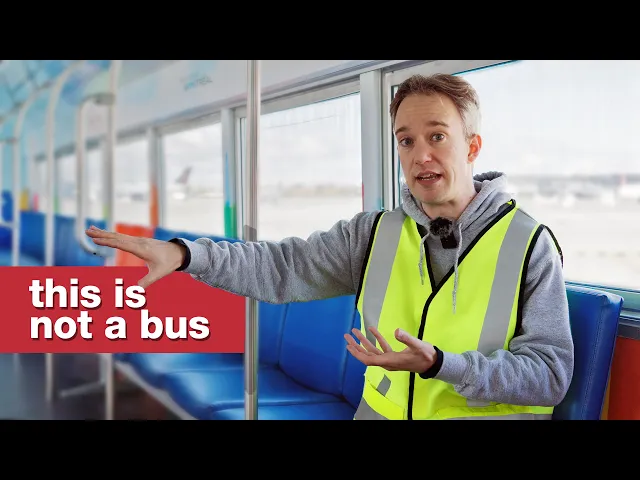
Boarding planes could have been very different
Tom Scott
0:00 If you're boarding a big aircraft,
0:01 the kind of large Boeing or Airbus that goes across the Atlantic,
0:04 you'll probably get on and off the plane using a jetbridge.
0:07 That's the movable, extendable corridor that connects the terminal to the plane.
0:11 But sometimes, the plane will have to park at what's called a "remote stand",
0:15 just a spot that's assigned in the middle of the tarmac.
0:18 And so, as the rain piles down,
0:20 some cold and tired airport staff will roll a set of stairs up,
0:23 and you end up riding a slow and crowded airport bus instead.
0:27 I guess you do get to skip the long walk through the terminal,
0:29 and it's great if you're the sort of aviation
0:31 geek who likes looking behind the scenes at an airport...
0:33 but it's not ideal if you have a connection to make.
0:36 It could have been very different.
0:39 The last time I flew into Montreal, here in Canada,
0:42 the aircraft door opened and on the other side
0:44 was what looked like a strange bus on stilts.
0:47 There were three of them.
0:48 Passenger transport vehicles, PTVs, one connected to each door of the plane.
0:53 And I figured I had a new video idea.
0:57 We have eight PTVs that are in use right now at Montreal Trudeau Airport.
1:02 Of course, we always strive to do gating directly,
1:06 but during summer season or some peak season during winter time,
1:10 we have no choice but to use remote parking.
1:12 During our peak season on a regular day,
1:15 we receive a bit more than 500 flights here at Montreal Trudeau.
1:19 And of those 500 flights,
1:21 about 10 to 15 of them will be remotely gated with a PTV.
1:25 The idea came from legendary architect Eero Saarinen,
1:28 as part of his plan for Washington Dulles Airport, which still also uses them.
1:32 The original name was "mobile lounge".
1:34 They were promoted in a short film produced by his friends,
1:37 equally legendary designers Charles and Ray Eames.
1:40 And that film shows exactly the sort of late-50s
1:44 luxury techno-optimism that wouldn't survive the next few decades.
1:47 Saarinen's original plan was that airport terminals
1:49 would work much like they do now,
1:51 but smaller, with boarding doors close together.
1:55 When it was time to board, a mobile lounge would dock to the terminal,
1:58 everyone would get on board,
1:59 and they'd be taken out to the remote stand in comfort.
2:02 Less space needed, less walking,
2:04 less noise near the terminal, easier for everyone.
2:08 And it worked.
2:09 There are photos of mobile lounges lined up outside
2:12 brand new shiny terminals that were designed for them.
2:15 When passengers see them arriving,
2:16 they know that they're not going to have to go
2:19 outside in the rain and the snow with their luggage.
2:21 For people with reduced mobility, it's more efficient.
2:24 For parents, and all the stuff
2:26 that goes with traveling with children, it's easier.
2:28 A PTV can welcome between 100 and 120 passengers per trip,
2:33 while a regular bus is more in the mid 70s, 75 passengers.
2:40 Montreal's PTVs here are a more modern variant called the Plane-Mate.
2:43 The original lounges were smaller than
2:45 this, and instead of lifting up on stilts,
2:47 they extended a boarding ramp that went out at an incline,
2:50 because the planes they were connecting to were smaller too.
2:53 Back then, a fully loaded jet might have 100 passengers.
2:56 The largest modern planes have four or five times that.
2:59 Airport terminals were getting bigger not just to accommodate planes,
3:03 but also sheer numbers of people.
3:05 Now, these newer versions are bigger, and to dock with the plane,
3:08 they lift themselves up with a "screw drive".
3:11 Those big lumps on the top?
3:12 They're to cover up the poles that the entire cabin is lifting itself along.
3:17 We do the maintenance and operations of the PTVs.
3:21 We acquired the manufacturing rights in the year 2000,
3:25 so we have all the engineering drawings and everything.
3:27 I would say now, we got it down to probably less than 20% that is custom.
3:33 The rest is off the shelf parts that we can get.
3:36 We have built new ones,
3:38 and right now we are looking at retrofitting them to electrical.
3:42 Our mechanics every day do a walk-around.
3:46 We guarantee 99.8% efficiency to the airport.
3:51 So why didn't these end up being used around the world?
3:54 Eero Saarinen blamed the cost, and that was certainly a factor.
3:58 Planes getting bigger was another.
3:59 And the former head of the Washington Airports Authority
4:03 said that passengers don't like them because we want autonomy.
4:06 We want to get off the damn plane and walk for a bit under our own power.
4:11 But if you ask me, I think the main reason is that in 1958,
4:15 the same year that animated film was made,
4:17 the first modern jet bridge was also installed.
4:20 There was one victory for that luxury techno-optimism, though.
4:23 The end of that film shows mobile lounges at a surely-soon-to-arrive spaceport.
4:28 And while, sadly, no one's boarding a Pan Am flight to the Moon any time soon,
4:31 NASA did buy a couple of Plane-Mates for astronaut transport.
4:36 There's nothing wrong with mobile lounges.
4:38 They still work well here in Montreal.
4:40 But when airports were expanding and had to choose,
4:43 most of them decided that jetbridges were just a little bit easier and cheaper.
4:50 I'm not allowed to drive this, by the way.
4:51 Like, thank you to everyone from Montreal Airport for letting me sit here,
4:54 and for all the access they've given me, but...
4:57 I'm not allowed to drive this.