Putting science into practice | Nobel Week Dialogue 2025 | Health For All
Nobel Prize
0:00 little bit about Médecins Sans Frontières.
0:02 So, just for for the audience a little bit in numbers.
0:05 So, you employ 67,000 people worldwide, and most of those people are locally
0:12 local people employed for Médecins Sans Frontières.
0:17 You have 7 million donors worldwide,
0:20 and 98% of your money comes from private donations.
0:26 So, so me, this is this is what a common humanity looks like.
0:29 I think this is incredible.
0:31 So, you became president then this this year, just in September.
0:36 So, but as Adam indicated, you know,
0:41 in 2024, you were medical team leader in Gaza.
0:48 So, let's start off talking about this.
0:53 So, so your experience there.
0:56 So, what is a medical team leader?
0:59 What is what is your role in in that in that position?
1:01 Yes, a medical team Firstly, thank you for having me.
1:04 It's a real pleasure to be here, and it's been fascinating all day.
1:08 A medical team leader is a little bit what it says on the on the tin.
1:11 So, at project level down, you know, by the patients,
1:14 you're the team lead for all the medical operations.
1:17 And what's not medical is the logistics, the administration,
1:20 finance, and HR, and of course the operations.
1:23 And the operations really looks at security and representation.
1:26 So, you're the team leader,
1:28 and depending on what the project is, you'll have the medical managers,
1:32 and and and and be bringing them
1:34 together to deliver the objectives of the project.
1:36 So, for example, in Gaza, [snorts] I was over three projects.
1:40 One was a trauma, so orthopedic trauma and burns unit
1:45 inside the Ministry of Health hospital called Nasser in Khan Yunis.
1:49 But also, we had two primary health care centers, and also water distribution.
1:55 So, in that sense, I had a water water manager,
2:00 surgeons, medics, nurses, physiotherapists,
2:03 occupational therapists, mental health activity managers,
2:08 and and I would be their team lead just to make
2:10 sure that we can do what we need to do.
2:12 And but in this doing what you need to do in such an extreme environment,
2:21 I mean, particularly the medical community were under attack.
2:26 How how how did you manage to work?
2:29 How did you cope in this?
2:30 Yes, I mean, you know, Gaza we characterize Gaza as a genocide, right?
2:35 And it's it's contextualized within the wider occupied occupy occupation,
2:39 sorry, of Palestine.
2:42 One feature of that genocide for us is is
2:45 the systematic dismantling of the health care system there.
2:48 And and that [snorts] was characterized in several different ways.
2:51 And and what we saw were not only
2:53 the direct attacks on hospitals and even medical convoys,
2:58 but also closures of hospitals.
3:00 So, when there is a a displacement order,
3:04 an order to leave an area, the hospital has to close.
3:07 The whole population goes.
3:08 So, so just in the in in the time in the 2 years that we've been there,
3:13 there have been 24 medical facilities that we've had to leave.
3:17 So, that's sort of the the the infrastructure closure.
3:20 But then, what's a feature that I hadn't seen previously quite so
3:23 much is this sort of very intentional attack on health care workers.
3:28 So, there have been over 1,700 health care workers
3:31 killed in Gaza since the beginning, since October 7th.
3:35 And we've had 15 colleagues, MSF colleagues, some killed at work,
3:40 and others killed just because of the sheer level of violence.
3:45 But [snorts] the feature here that's that's quite so
3:47 worrying is the sort of the very deliberate targeting,
3:52 and even torturing of health care workers simply for doing what they do.
3:56 So, my colleagues said at checkpoints,
3:59 whenever they were moved from the north to the south,
4:02 if there was any sign that you were a medic,
4:04 they'd been pulled out and then detained, questioned, some for many months.
4:09 Many many were beaten.
4:11 The orthopedic surgeon that I was working with still had a limp
4:14 from his detention when he had been detained at Shifa Hospital.
4:17 And so, how is Médecins Sans Frontières dealing with this, you know,
4:22 as an organization, this unimaginable situation?
4:29 I mean, for us, you know,
4:30 we we concentrate on bringing about care in in in in the best way that you can.
4:37 Right now, coming into winter with the ceasefire that's very fragile,
4:41 with ongoing violence, our main concern is that we haven't seen a huge
4:45 amount of increase in aid that we were expecting.
4:49 So, food, water, shelter is still a big need.
4:52 And you know, my colleagues are living through this.
4:55 I have the enormous privilege of going
4:56 in for 2 months and knowing that I would leave.
5:00 But but but my colleagues are still there.
5:02 They're living through this, and of course
5:04 the the threats of violence and disease is all around.
5:06 So, in that sense, I think what I always
5:09 do and with my teams is just really focus, you know, what can we do more?
5:13 What can we do better?
5:15 Think about those little moments of care
5:17 that you bring and healing to each patient, and try and facilitate it for them.
5:22 But that can be hard in a situation of a supply
5:24 blockade where you're reaching for your second or third line drug,
5:29 or you didn't have crutches or wheelchairs, and you've got so many amputees.
5:33 Or [snorts] it's it's impossible.
5:35 And it is impossible.
5:37 It It's It's even hard to imagine.
5:39 Yet, after Gaza, up until February this year year, you were in Sudan,
5:45 and which the UN says is the biggest humanitarian crisis on the on the planet.
5:50 It's bigger than Gaza.
5:51 There's more deaths than Gaza, twice as many,
5:54 I think, 150,000 people killed, many million displaced.
5:59 And what what is how is again, what is this experience like,
6:04 and how is Médecins Sans Frontières coping with dealing with this?
6:08 Sudan presents really profound difficulties, not not only in the sheer scale.
6:15 So, it really it is the biggest humanitarian
6:19 disaster in in terms of numbers of displaced,
6:21 numbers of killed, numbers at risk of of people.
6:24 You're in the tens of millions here.
6:26 What what happened in Sudan, and I'm half Sudanese,
6:29 is was it was a total implosion of the state overnight,
6:32 and and and and and and general warfare.
6:36 One characteristic of this war is is attacks on civilians,
6:39 attacks on civilian infrastructure, attacks on health care.
6:42 And it and [snorts] it's very difficult to work on both sides of the lines.
6:46 You've got two warring parties controlling their own territories,
6:51 and and they see and they they create blockades and make
6:55 it very hard for us to move supplies, to move staff.
6:58 You need a permit for everything.
7:00 And in that way, it creates a control, a a control that shouldn't be there.
7:05 Humanitarian aid, whether it's Gaza or Sudan,
7:08 shouldn't be conditioned on anything.
7:10 It's something that needs to get to the population.
7:12 It's independent.
7:13 It's neutral.
7:14 It mustn't be treated as a as a bargaining chip.
7:17 And you're doing this in the context of huge amounts of funding
7:22 being pulled at the US and other countries reducing aid funding,
7:29 development funding.
7:30 The Lancet There was a Lancet report a few few weeks ago, a few months ago now,
7:35 estimating about 14 million people by 2030 could be
7:40 could die because of this pull pull back from funding.
7:44 Many uncertainties in those numbers.
7:45 It's But you know, how how how
7:48 is Médecins Sans Frontières coping with that then?
7:51 Are you You can't We can't fill the gaps.
7:55 We can't fill the gaps.
7:56 We're not directly impacted by that.
7:58 So, we're independent, as you mentioned earlier,
8:00 with all our donors in terms of our funding.
8:02 But when you work in a healthy ecosystem,
8:05 and and actors around you are are falling away, then it has a profound impact.
8:10 So, on one side, it's costing us more to do the same,
8:13 and on the other side, we have to do more.
8:15 And an example there I can give is while I was in Sudan,
8:18 the cuts that had been announced meant
8:20 that And I was working in Omdurman in Khartoum,
8:22 and we were doing trauma inside an emergency room,
8:25 but also pediatrics and and cholera and vaccination.
8:29 But overnight, three different organizations came to me saying,
8:33 "Can you help?" And one of them was an emergency room giving food,
8:37 an emergency response room, the ERR's of Sudan.
8:40 Was actually giving food in the hospital.
8:41 They'd lost their funding.
8:43 Another was a Sudanese network that had had funding
8:46 from a US agency to do community sexual reproductive health.
8:50 So, a community network of midwives just fell away.
8:54 And in the context where there is sexual violence
8:56 as a as a as a weapon of war, that's an issue.
9:00 And so, there's a there really is a maternal
9:02 and child health sort of emergency in Sudan.
9:05 So, when sexual reproductive health fell away
9:07 overnight in the city, that was a problem.
9:09 And we, you know, we can flex, but we you know,
9:12 to fundamentally change our program overnight was not something I could do.
9:16 So, I could support as much as possible.
9:18 But other examples are that, for example, with malnutrition, you know,
9:21 even now this year in Yemen and Niger, for example,
9:27 we've had to put in unplanned provision for malnutrition,
9:33 something that hadn't been provisioned or or planned
9:35 in the beginning of the year, but we pivoted and do that.
9:38 So, then we're doing more than we expected.
9:41 That's okay.
9:41 We always keep buffers of funding in our unplanned pot.
9:45 You never know when an emergency is going to start.
9:47 But there's we have to be clear.
9:49 There's no way that one organization, MSF,
9:52 can fill the gap left behind
9:54 by so many countries abandoning their international donations
9:59 and and and their sort of commitments
10:01 for global health and and humanitarian action.
10:04 Now, now we're going to invite some more panelists and then
10:09 and and discuss this this this this idea of bench
10:14 to bedside because with MSF as as sort of the the extreme
10:20 in some ways extreme environments for providing health care.
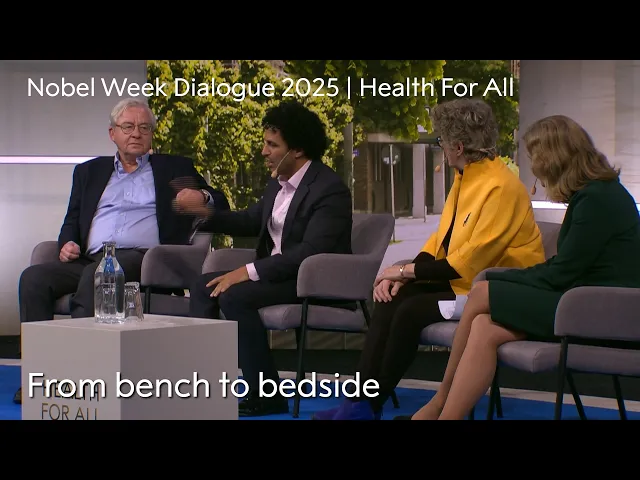
10:24 So I'd like to invite on stage Jan
10:26 Nielsen and Maya Fiennes start and Sally Davis.
10:34 [applause] Next to chair.
10:41 Oh right, so I should stay on this one then.
10:43 Oh there we go.
10:45 [laughter]
10:45 There's an order.
10:46 Musical chairs.
10:47 There we go.
10:48 Good.
10:48 Get there in the end.
10:50 All right, so it's a gender division.
10:54 [laughter] Interesting.
10:53 Well, there is a And color also, yes.
10:57 Um so just but maybe just
10:59 to to to to bridge this as well then this conversation.
11:03 So on that bedside on treatment Yavid you you do a lot of innovation within MSF.
11:11 You have like mechanisms internally to sort of create new innovations
11:16 and speed up that process between you know research and and and treatment.
11:23 Absolutely, yes.
11:24 I mean we have internally what's called the access fund and and that's precisely
11:28 actually based on some of the things we've been talking about in earlier panels.
11:32 So so looking at drug development, drug pricing,
11:35 access to medicines was the fuller name and it's to assure that lower income
11:40 countries and neglected populations can have access
11:42 to medicines that the the richer nations do.
11:46 And actually interestingly our peace prize fund from in 1999.
11:52 I mean that's the reason MSF is here.
11:54 We're sort of Nobel laureates in that sense.
11:56 We we gave committed some of that money to starting an organization
12:01 called the drugs for neglected diseases
12:03 initiative DNDI and it does exactly that.
12:07 It develops for in a non-profit model
12:10 medicines for neglected diseases and I remember
12:13 visiting in in the DRC in Congo a clinical research trial that was literally
12:18 a you know a short flight over the jungle a half a half
12:23 a day's drive to the town and then you take a motorcycle at 5:00 a.m.
12:28 couple of hours through the jungle again and then
12:31 onto a canoe and that was about 3 hours down
12:34 to the community and there you're doing lumbar punctures to to check
12:37 on these people to see if they have sleeping sickness.
12:39 And if they did, you have to bring them all the way back to the hospital
12:44 and that's not for a 3-week inpatient treatment
12:46 that killed one in five and it was arsenic based.
12:49 So that's not that's not a viable treatment for a disease
12:52 and DNDI MSF did this clinical research and have been able
12:55 to bring forward an oral treatment for sleeping sickness and it's
12:59 just revolutionized that and it's affordable and and and easy to store,
13:04 easy to deliver and so that's an example that it can be done.
13:07 Mhm.
13:08 Good and then maybe and then this is good to bring you in Jan because
13:12 you know are we doing enough to do
13:14 that translational work in least developed economies,
13:20 at least developed countries.
13:21 I mean so much of the work is happening
13:24 in the developed world and emerging economies could be losing out.
13:30 Yes, no we're not doing that at all.
13:33 It really struck me last year we had Nobel Symposium cardiovascular disease
13:39 in South Africa and we had the leading scientists there and we were discussing
13:44 the latest diagnostics and molecular diagnostics and new treatments based on RNA
13:50 and then we had one day you have focused on cardiovascular disease in Africa.
13:55 And it was only with African scientists that they said it
13:59 was all very interesting but it doesn't really help us anything.
14:03 You know, we have public health problem in Soweto 50% of the women are obese.
14:09 They all are developing hypertension
14:12 and they're suffering from diabetes and stroke.
14:15 And if we try to convince about public health, they don't listen to us.
14:22 They listen to the to the village witch doctor.
14:27 And our governments are so busy with corruption,
14:31 war and so that they're not really paying attention to the public issues.
14:35 So we would like you and our sector
14:38 we really say we have to solve these problems.
14:41 It's not something that you would do but it's something completely
14:44 different from what we're doing in science in the developed countries.
14:49 Mhm.
14:50 And Sally, do you have a thought on this as well
14:53 on this translational to emerging economies and developed developing countries?
14:59 So I think it is very difficult to take
15:01 high-tech and dump it in a low a low-income country.
15:07 Can they afford it?
15:08 Can they run it?
15:09 Do they want it?
15:10 Was it a priority?
15:12 I set up in 2020 an NGO called the Trinity
15:16 Challenge and we've gone about it by mission driven.
15:20 Here's a problem.
15:22 Bid in if you want the prize for how you would solve it using local tech.
15:29 85% of the solutions have AI and machine learning
15:32 but it's locally that they've worked out what to do, how to do it better.
15:37 The winner the first time was a tie winner who's turned farmers.
15:42 This one was about AMR.
15:43 If if I'm involved that's often there.
15:47 But it turned farmers into disease detectives using their mobile phones
15:52 and a central vet and it's really helped their local economies.
15:57 So doing things locally and letting them solve
16:02 their own problems which I think is part of yours.
16:04 But you can extend that into the high-income countries.
16:08 So what I used to be famous for was
16:12 that I persuaded our government in 2006 to let
16:16 me launch the National Institute of Health Research NIHR
16:21 which was there to fund clinical applied and policy research.
16:26 And the whole concept behind it was that no one was funding that properly.
16:31 We had to keep the basic and experimental but we needed this.
16:36 And that if people got their hands dirty and joined in the clinical studies then
16:41 once they got the results they were much more likely to put them into practice.
16:45 So it was a way of getting more research done but it was also a way
16:50 of improving the standards of care so that they
16:54 were modern in our NHS hospitals and primary care.
16:57 And it's huge success.
16:58 We would say over 1.2 billion funding each each year now.
17:03 And can you give some examples of the the kind of things
17:07 that have have come from it that wouldn't have come without?
17:12 A study that showed that you only needed as a woman
17:16 with a certain time of breast cancer
17:18 three visits for radiotherapy instead of 12.
17:22 In COVID all the recovery trials, one of the parts of NIHR that I set up was I
17:30 I took away all the research funding that was in the NHS,
17:33 put it together and instead of having clinical
17:37 trials networks that were based on just friends meeting,
17:40 we developed managed clinical trials networks where the nurses,
17:45 the data collectors, everyone was trained in what their role was, how to do it.
17:51 We would only put into our managed clinical network
17:54 that was in 99% of hospitals trials and studies that had
17:59 gone through ethics committee and were properly powered and properly
18:03 constructed and then we could run them really effectively.
18:07 And during COVID that's why we were able
18:09 to prove very quickly that high-dose steroids had
18:12 an impact that many of the things
18:15 that Trump thought up caused harm and didn't work.
18:19 And then to try out the actual drugs.
18:21 We've got a vaccine part of it that did
18:23 a lot of the challenge studies and everything.
18:26 So we've got lots of good examples.
18:29 Good and then so on COVID then Maya I'm going to turn to you.
18:33 I mean you you were Secretary of State
18:36 for Health during the COVID crisis here in Sweden.
18:40 Had to remind me about that, did you?
18:43 [laughter] And you've written a book about it at the center of the crisis
18:47 and it was an absolute unique moment and it it changed a lot of things.
18:54 When we talk about from bench to bedside,
18:57 all along the chain it revolutionized many
19:00 many things and and accelerated many things.
19:03 But can you talk through that that period of decision making and stress that it
19:10 must have been to to change a whole system to respond to this this pandemic?
19:17 Don't bring it back.
19:18 But I think when we're speaking about from from bench to bedside,
19:22 I would say that that COVID was really a a triumph
19:26 of the professions really because it did go quickly from bench to bedside.
19:30 I mean we did implement new protocols for treatment.
19:34 I mean of course the vaccines is one
19:36 part of it but but treatments were changed quickly.
19:39 We phased out chloroquine and quickly when we realized
19:41 that that was not a a good way of treating patients.
19:45 And and when I speak to to professions that that worked during COVID,
19:48 they often feel that that they were allowed to to make decisions that you know,
19:52 should be the the of the professions during this time.
19:56 But on the other hand,
19:57 they often described that nobody listened to their experiences afterwards.
20:02 And and that's something we also work at on at Karolinska
20:06 Institute to actually I mean we put so much resources into COVID.
20:10 We could put resources into collecting lessons learned, right?
20:13 And and so many people working in health care did incredible things
20:17 during during very chaotic circumstances and we need to collect their lessons.
20:22 But I think on your other question on on sort of [snorts]
20:25 the the science to policy during COVID,
20:27 I think that was something I struggled with.
20:28 And and some people asked me, "Well, oh, you have a PhD,
20:31 it must have been much easier for you." Well,
20:32 my PhD is not in, you know, infection medicine, so that didn't help so much.
20:37 I think the only thing that that helped was that to have
20:39 a PhD made me a little bit less respectful towards researchers.
20:43 I mean, I don't hesitate to call a researcher if
20:45 I need an answer or something and that's sometimes great.
20:47 Sometimes you end up with the wrong researcher
20:49 and then you have to ask someone else.
20:51 But but I think that's been something I've
20:53 been reflecting a lot about after the pandemic.
20:55 How can we actually put in place that a good system
20:58 for for science to policy or evidence-based
21:00 policy because I did struggle with that.
21:03 And and and maybe say a little bit more on the struggling because it's you know,
21:07 it's making decisions under extreme uncertainty and that you know,
21:12 constantly changing and having to make some judgments about how
21:16 the public are going to respond to those decisions etc.
21:19 So how how did how did how did that go when Sweden
21:23 took a very different route in some ways than than other countries?
21:30 Can can you say a little on that?
21:32 Well, we did.
21:32 We there was I would describe it as a political
21:35 decision but also as a natural consequence of our you know,
21:39 public administration and and about our contagious matter
21:43 law that we wanted to to listen very
21:45 closely to the Public Health Agency and to listen
21:48 to the experts and that made us difficult.
21:51 I mean, there were other countries where the politicians made one decision
21:54 and the Public Health Agency did one
21:55 but we didn't really have that opportunity luckily,
21:59 I think personally because I think it was important to stay close to the agency.
22:03 But there's of course a discussion that I think is
22:05 interesting if if politicians use experts to sort of delegate responsibility.
22:11 I mean, the democratic responsibility must always be with the politicians.
22:14 You can never say that oh, but the agency said that I mean that that has
22:18 to be a a decision taken within a democratic
22:21 system because the responsibility must also be be possible
22:25 to to demand within the political or democratic system.
22:29 Mhm.
22:29 And uh I I wanted to come in because I was
22:34 when I was setting up the National Institute for Health Research,
22:37 I was the chief scientific advisor at the Department of Health.
22:40 Then I became the chief medical officer
22:43 and I stopped talking about evidence-based policy.
22:46 What I aimed for was evidence-informed policy because I recognized
22:51 the democratic right of the ministers to take a decision.
22:55 My job was to try and make sure they knew all the bits.
22:58 I would often if asked tell them what I would do if I was them
23:02 but I wasn't them and they brought other
23:04 things to the table to make those decisions.
23:07 Mhm.
23:07 [clears throat] And and Jan, I mean,
23:10 you you you you think there were some amazing innovations you know,
23:14 from bench to bedside in during COVID but we
23:18 we're at risk of ignoring them or forgetting about them.
23:22 I I think it was an interesting experience because as Myra said,
23:27 the decision-making went down to the professionals.
23:30 And it turned out to be effective
23:34 and the working environment was much more stimulating.
23:38 So people really liked working even though it was tough work,
23:40 they really liked it.
23:41 And the interesting thing that's the way it used to be.
23:44 If you go back to the 70s and 80s, the professionals were running the thing.
23:48 Unfortunately, they didn't care about the budget that much.
23:51 So something had to be done and then came I'm
23:55 sure you heard of new public management all of you.
23:57 So there were managers taking care of health care
24:00 and these focused more or less entirely on health care.
24:04 Of course and the universities increasing competitiveness,
24:08 you wanted to go for the big funds which was more on the molecular side.
24:12 So the clinical research just disappeared.
24:16 And that's so dangerous because if the if the really
24:21 new discoveries is going to come to benefit of the patients,
24:25 we need a translation of course and that's clinical research
24:29 and we have to find a way back again where we can
24:31 work together health care and university and I think you did
24:34 a fantastic initiative in forming the National Institute of Health Research.
24:39 And we have to find similar ways.
24:42 We can't do the same way because you know,
24:44 we have counties taking care of health care and and government taking care.
24:48 But I think you the way you did it is a great inspirer to others.
24:52 Thank you.
24:53 And Javed, with MSF, how how was COVID dealt with in those sort of humanitarian
25:01 crises in that sort of area and sort of retraining,
25:04 rethinking and just managing the sort of bedside
25:07 treatment in the in in that kind of environment?
25:10 What were the learnings?
25:11 It was a it was a profound shock obviously to everyone.
25:14 I mean, I was working in the UK health
25:16 service through through COVID because I was stuck, right?
25:19 There were no flights out and and we have teams that turn over.
25:22 We have supply lines that not quite just in time but you know,
25:27 they they are quarterly and so when
25:31 you have a two-year blockage of supply lines,
25:33 that creates a a real problem and and so for us
25:37 the issues were were really structural in in just carrying on.
25:41 We took the outlook very early that this is bigger than us.
25:46 We're not going to be able to respond
25:49 to a pandemic in every region and in every country.
25:53 So our outlook was preserve the life-saving
25:57 we're doing already which is critical
25:59 in many of the places that we work and that was very hard.
26:03 So we had staff who if they were on six-month rotations,
26:07 the international staff that come in and go out
26:10 stayed in projects for a very very long time.
26:13 Um supplies and of course then there were there were issues around yes,
26:19 then in places where we were expecting a high burden of disease,
26:23 what operational response can we and should we make?
26:26 And we did do that and actually it ended up being
26:28 in Europe in in in in sort of vulnerable or marginalized populations.
26:33 So we ended up doing COVID care for homeless people
26:37 in the UK or for the elderly in in Belgium in care homes
26:41 in France and that was also new for us because we're quite
26:45 used to the field being over there and it being in Europe.
26:50 Um again was a little bit sort of oh, we haven't you know,
26:53 we haven't done this before this sort of medical operations.
26:56 So yeah, in in many different ways it provided us with um yeah,
27:02 difficulties and challenges that we hadn't met before not least
27:05 that three our three main we do all our logistics in house.
27:09 Everything that we move goods, supplies is is done we do it by ourselves
27:15 but our three main logistics centers were in Europe.
27:18 Uh and so when Europe was shut down, that created its own issue.
27:22 So even on that basic level,
27:24 a learning has been to diversify our supply chains and lines and even look
27:29 for local procurement in ways that we would
27:32 not because of you've mentioned earlier today Sally, the assurance of drugs.
27:36 I mean, if you're buying antibiotics locally, you don't know where that's from.
27:40 We had very strict rules to not do
27:42 that but in a situation where we couldn't move supplies out,
27:46 we had to make trade-offs.
27:48 Yeah.
27:49 Okay, so well, looking forward Sally, what what do you think are the sort
27:54 of cultural and structural changes needed, you know,
27:58 learnings from from the the institute in the UK and beyond to to really embed
28:05 to sort of accelerate this this gap
28:08 or this from from from the research to to treatment?
28:16 Well, I think what doctors at least in Britain and I
28:19 think generally are very bad at is taking things from outside.
28:25 A supermarket, you do something that way, it works.
28:29 You scale it.
28:30 So I think we need to start much younger with our medical staff
28:34 and our nursing staff and pharmacists saying
28:37 join in research so that you understand it,
28:40 you get a feel for it and you want to put it into practice.
28:43 But then look at what's going on elsewhere and pull it in.
28:49 You know, be absorptive.
28:52 We don't all have to do the research.
28:54 Let's change to a behavior that's absorptive
28:58 and ever improving and as frugal as possible.
29:01 And what do you mean by absorptive is it Well,
29:03 um it's it's a business term, isn't it?
29:06 That you you don't just go on doing what you always did.
29:10 You see that someone else is doing
29:12 it differently and you evaluate or think about
29:16 anyway is it better and then you start doing it if you think it is.
29:21 Right.
29:21 [laughter] And innovation absorbing from elsewhere their learnings
29:24 so that you you really keep up to date.
29:28 And you really need a culture of innovation organization to be able to do that.
29:31 much better way of saying it.
29:33 Thank you.
29:33 [laughter] But it's like how do you create
29:35 that kind of culture of innovation I suppose.
29:38 Um And you have to make it fun and you have
29:40 to give people enough money and you have to trust them.
29:44 Mhm.
29:44 And I think Jan and I probably agree
29:47 that the present health systems don't really trust the doctors enough.
29:52 So how my any thoughts how do we how how can we create these governance
29:57 systems for for innovation do you think
30:00 in the medical systems all the way through?
30:03 That's tricky question.
30:05 I'm I'm also reflecting actually on on I
30:08 mean the implementation side that we're all discussing here.
30:10 I think that sometimes suffers actually from a a bit of paternalism and I mean
30:16 we were discussing this earlier during the day
30:18 that why do people go to McDonald's?
30:20 We told them that it's not healthy.
30:21 They keep doing it.
30:23 And why do people not take vaccines?
30:26 We told them it's good for them and I think that there's
30:29 actually there's a amount of danger actually to to to have this attitude
30:33 from both you know political side and the medical side because sometimes we
30:38 we don't realize that you know it's
30:40 not a conflict between enlightenment and stupidity.
30:43 It's it's a social conflict.
30:44 It's the the reason that people don't take vaccines is that they don't trust
30:48 government and sometimes it's actually rational not
30:50 to trust government if we look at history.
30:53 So so I think that we need a little bit of be a little
30:56 bit humble also when we approach the implementation
30:59 of both medical inventions and other inventions.
31:02 Well I think that is a a good a good moment to end on.
31:06 So humbleness of the the research community in this.
31:09 So I'd just like to thank our panelists so much for joining us today.
31:14 A big round of applause.
31:17 [applause]