Our First Contact with Aliens Will Be Their Last Words
Cool Worlds
0:02 If alien civilizations are out there,
0:05 what will humanity's [music] first contact with them most plausibly look like?
0:10 What kind of civilizations are we most [music] likely to detect?
0:15 What signature will betray their presence to us?
0:20 I've [music] spent many years pondering this question
0:23 and today I present to you a new theory,
0:27 one which [music] you will not find in any Hollywood movie or TV show.
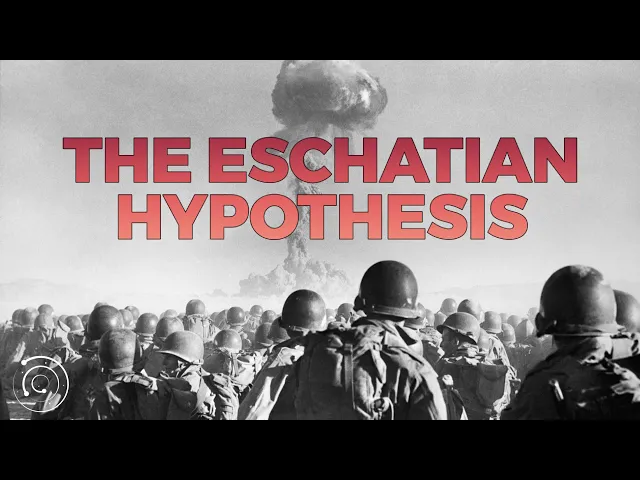
0:31 An idea which I [music] call the Escation hypothesis.
0:36 The secret source to this idea comes
0:38 from thinking about the history of observational astronomy.
0:42 The most prestigious groundbreaking astronomical detections are
0:46 those that detect entirely new [music] types of astrophysical phenomena.
0:50 A good example and subject to my own research is exoplanets.
0:55 Even before their discovery,
0:56 it was widely recognized what a big deal their discovery
1:00 would be and multiple teams were trying to pull this off.
1:03 Many looked at the solar system as a kind of template as to what to expect.
1:08 And thus they built instruments designed to detect
1:11 Jupiter-like planets on wide distant orbits around their star.
1:16 But some radical [clears throat] thinkers looked in the most unexpected places.
1:21 It was Alexander Walshan and his team who
1:23 started finding the first confirmed exoplanets in 1990.
1:28 But these were bizarre worlds, planets orbiting pulsars.
1:33 A few years later, the first exoplanets around normal stars were found.
1:37 But again, they shocked the scientific community
1:39 with a discovery of so-called hot Jupiters.
1:43 You see, for decades,
1:44 it was assumed that gas giants like Jupiter would form [music] in the outer
1:48 regions of solar systems where it was cool enough for ices to remain stable.
1:53 But in the late '9s,
1:54 astronomers kept finding Jupiterized [music] planets 10 times closer
1:58 to their star than Mercury's orbit around the sun.
2:01 Planets with temperatures of thousands of Kelvin.
2:04 Looking back, with the benefit of hindsight,
2:06 we now understand that both hot Jupiters and pulsar
2:09 planets are in fact very unusual rare types of planets.
2:15 For example, although most stars indeed have planets of one kind or another,
2:19 less than 1% of them have hot Jupiter type planets.
2:23 Now, you might be wondering, if they are so rare,
2:25 then how come they dominated this early
2:28 phase of exoplanet detection back in the '90s?
2:30 Well, the reason is simple.
2:33 Can you guess it?
2:34 It's because of detection bias.
2:37 The reason why we found so many of them
2:39 is just because they're so damn obvious and loud.
2:41 You can hardly miss them in spite of their intrinsic rarity.
2:46 Perhaps the most poignant example of detection bias in astronomy
2:50 is just to look up at the night sky.
2:53 On a clear night, you can see a couple thousand stars above you.
2:57 And remarkably, about a third of those are giant stars, essentially dying stars.
3:03 The sun, too, will one day enter this stage.
3:06 in roughly 5 billion years from now,
3:09 ballooning so large it will likely engulf the Earth.
3:12 But this is a transitory phase lasting for less than 10% of its total lifetime.
3:18 Indeed, only about 1% of all stars in the universe are in this giant phase.
3:24 And yet, despite representing just 1% of the population,
3:28 they make up about a third of the stars that you can
3:31 see with a naked eye when you look up at the sky.
3:34 And of course the reason for that is again detection
3:37 bias or technically in astronomy we call it mommquist bias.
3:41 [music] Stars become so brilliant as giants that we
3:44 can see them from far far further away.
3:47 For example, Danb [music] in the constellation Signis is easily
3:50 visible by eye despite being roughly 2,000 lighty years away.
3:55 But the nearest star Proxima Centuri just four
3:58 light years away isn't visible by eye at all.
4:02 And to cap this argument off,
4:04 my favorite example of a detection bias would have to be supernovi.
4:09 The most common type of supernova is a core collapse event.
4:13 Very massive stars, those greater than 8 times the sun's mass,
4:17 have different fates to most stars, much more violent destiny.
4:22 Stars are in essence a balancing act
4:25 of outward radiation pressure and inward gravitational pull.
4:29 When the fuel starts to run dry, gravity wins out and the star implodes.
4:35 The outer layers collapse inwards and bounce off
4:38 the inner dense core leading to a spectacular supernova explosion.
4:44 Now, these events are so energetic that [music] for a few days,
4:48 this one single star can outshine the other stars in its galaxy combined.
4:54 But like hot Jupiters, these are very rare events though.
4:58 A Milky Waysized galaxy gets just one supernova every half century or so.
5:03 But despite their staggering rarity,
5:06 astronomers routinely detect thousands of these things every year.
5:12 Why?
5:13 Because they are so damn bright that we can
5:16 see them from essentially the other side of the universe.
5:19 So the history of astronomy teaches us that often the easiest
5:24 examples of astronomical phenomena to detect are in fact highly atypical.
5:29 Pulsar planets, hot Jupiters, giant stars,
5:32 and supernovi are all freaks, extreme examples of their broader class.
5:38 They are the loud, obnoxious twits at the cocktail
5:41 party that suck up all the oxygen.
5:44 Most people don't act that way,
5:46 but you can bet the rare few who do get noticed by everyone.
5:51 So, by extension, we should expect the first detection
5:55 of an alien civilization to be someone who was being unusually loud.
6:00 Their behavior will probably be quite atypical,
6:03 but their enormous volume makes them
6:06 the most likely candidate for first discovery,
6:08 as the history of astronomy has taught us time and time again.
6:13 Now, the idea sounds simple, but there is a lot to unpack here.
6:17 Before we discuss that, I just want to say
6:19 a big thanks to Novian for sponsoring today's episode,
6:22 who make what could be arguably called the coolest pens on the market.
6:28 These gravitydeying creations are laced with magnets to keep them hovering
6:32 on your desk like something out of a science fiction movie.
6:36 This right here is the hover pen future model which [music]
6:40 you can spin or nudge and it just elegantly holds in place.
6:44 These are beautiful to write with, but also just to admire on your desk.
6:49 If there's someone in your life who you struggle to think of a [music]
6:53 good Christmas present for, then this is what you've been looking for.
6:57 Classy but unique, a way for them to think of you each day.
7:02 Another beauty is the hover pen interstellar with an 18
7:07 karat goldplated [music] ring and an embedded meteorite.
7:12 Trust me, this pen is a real conversation started to have on your desk.
7:16 [music] So, just in time for Christmas,
7:18 head to noviumesign.shop/coolworlds and use my discount codeworlds for 15%
7:26 off their entire lineup for the next 72 [music] hours.
7:29 You can use the QR code or links are down below in the description.
7:32 Once again, that's noviesign.shop/coolworlds and use
7:37 the code coolworlds for 15% off.
7:40 Now, back to the video.
7:43 Recall our analogy of a supernova.
7:46 But that raises the question,
7:47 what is the civilization equivalent of a supernova?
7:51 Well, consider that a supernova is really just a phase of disequilibrium.
7:55 For eons, the star was perfectly stable and quite unremarkable.
8:00 Gravity and radiation pressure in harmony with one another.
8:03 The whole reason why this star became so
8:06 detectable was because of this terminal phase of disequilibrium.
8:10 So we might imagine that a civilization
8:13 in disequilibrium with its environment would
8:16 represent one [music] of the easier types of signals for us to detect.
8:19 This instability is really any phase
8:21 where a civilization's energy [music] throughput, environmental forcing,
8:24 or technological interventions depart sharply from long-term equilibrium,
8:29 generating disproportionate waste heat, radiative leakage,
8:33 surface modification, or high energy transients.
8:36 As an example, one proposed method that an alien
8:39 could potentially detect us is anthropogenic climate change,
8:42 [music] unnaturally rapid changes in appliance temperature, weather,
8:46 and atmospheric chemistry, [music] which is obviously not sustainable.
8:50 Perhaps the most extreme dicular room we can think of is nuclear war.
8:54 Detonate all the nukes on Earth and we'd light up
8:57 like a Christmas tree for the whole galaxy to [music] see.
9:00 Indeed, astronomer James Elliot explicitly suggested
9:04 doing this in space as a way
9:05 of saying hello and also getting rid of all of the nukes back in 1971.
9:10 Such an act maximizes our volume,
9:13 our detectability, albeit only for a brief period.
9:17 This is perhaps the closest analogy of a supernova
9:20 that I think we're [music] capable of.
9:22 This is all particularly potent because
9:24 detectability scales with luminosity to roughly [music]
9:27 the three halves power because the observable volume grows as the radius cubed.
9:32 [music] Explanation is on screen for that.
9:34 But most critically, what this really means is that a civilization that is
9:38 100 times louder becomes roughly a thousand times more detectable.
9:42 [music] And this causes these brief supernovi phases
9:45 to be vastly over represented in our detections.
9:48 The exact method of disequilibrium isn't [music] important.
9:52 What really matters is the principle.
9:54 The greater the imbalance, the louder they become.
9:58 And [music] this idea gels neatly with a previously
10:01 published idea in astronomy known as the sustainability solution.
10:05 To [music] see this, consider the thermal image of a housing complex.
10:09 All those red areas are waste heat inefficiencies.
10:13 So developers tried to improve the designs to minimize such wastage.
10:17 [music] And of course, the ultimate goal will be a building
10:19 that was completely indistinguishable from its environment.
10:22 And so, the more sustainable we become,
10:25 the less detectable [music] we are to other alien species.
10:28 As a twist on Arthur C.
10:30 Clark's famous words, science fiction author Carl Schroeder once wrote,
10:34 "Any sufficiently advanced civilization is
10:37 indistinguishable from nature." So advanced,
10:41 mature alien civilizations could be out there,
10:44 but we would never know about them because they become so
10:48 sustainable that there's no signature left us to grab onto anymore.
10:52 The Escation hypothesis leans into this idea and suggests
10:57 that the most detectable alien civilizations will be the unstable ones.
11:01 The ethmology comes from the Greek escatos which translates as the last the end
11:07 of all things because baked into this is
11:11 the recognition that [music] instability is inherently unsustainable.
11:15 One way or the other this signal
11:17 and plausibly the entire civilization will soon end.
11:21 Like a supernova, this tumultuous [music] period simply cannot last.
11:27 The open question with this hypothesis and one which I gladly
11:31 concede is whether [music] these periods
11:34 of disequilibrium are sufficiently common,
11:37 loud and prolonged to make them more detectable than the other
11:42 population of quiet and presumably more
11:45 numerous quasi sustainable civilizations out there.
11:48 Broadly speaking, their detection probability will
11:51 be a product of those three factors.
11:53 the fraction of civilizations which are loud,
11:56 just how detectable they become during that period,
12:00 and how long this phase actually lasts for.
12:03 That combination competes with the detectability of quiet civilizations.
12:07 [music] The Escation hypothesis thus suggests
12:11 that the former will beat out the latter.
12:14 And to be clear, I'm not claiming that this is definitively true,
12:18 merely that we should take this idea seriously,
12:22 especially given the context of historical astronomical detections
12:25 that we have seen [music] in this field.
12:27 There is an undeniable tragedy to [music] this notion.
12:32 Hollywood has preconditioned us to expect one of two types of alien contact.
12:36 Either a hostile invasion force
12:39 or a benevolent species bestowing wisdom to humanity.
12:43 But the Escatian hypothesis is neither.
12:46 Here, first contact is with a civilization in its death throws,
12:50 one violently flailing before the end.
12:53 As an extension to this idea,
12:56 such a species may even recognize his imminent demise and decide to consciously
13:00 [music] send out messages into the void as a kind of lastditch resort.
13:04 The late Steven Hawking often warned against sending
13:07 [music] messages into space for fear of destruction,
13:11 a concept foundational to the dark
13:13 forest theory in Lucia Shin's threebody problem.
13:16 But in this case, any fears
13:18 of external threat dissolve when facing internal annihilation.
13:22 There's nothing to lose and everything to gain.
13:25 So whereas thus far in this video I
13:28 have presented the Escatian hypothesis as a kind
13:30 of generic disequilibrium signature in this modification
13:34 it takes the form of a deliberate transmission.
13:37 Perhaps a radio signal for instance.
13:40 Who knows?
13:40 Perhaps the infamous wow signal was indeed such a last cry for help.
13:46 See our previous video for more [music] on that.
13:48 But it has to be said that the picture I've painted for you
13:51 fully undermines the classic [music] Hollywood portrayal
13:54 that we've become all so used to.
13:56 In this contact scenario, we [music] are not the vulnerable party,
14:00 but rather we are the ones who serenely bear
14:03 witness [music] to a train wreck of a civilization,
14:06 one who is desperately screaming out into [music] the night.
14:10 In the same way that we can gaze through
14:12 our telescopes at older sunlike stars turning into giants,
14:16 [music] a preview of our own solar systems fate,
14:19 these civilizations could be a premonition
14:21 of what lies ahead [music] for humanity.
14:24 I personally have three solutions right now in my head
14:27 for the Fermy paradox and the [music] Ecatian hypothesis is one of those.
14:32 I don't know if I'd call it my favorite,
14:34 but I do believe it is a plausible solution.
14:37 And the ramifications are important [music] because
14:39 it would actually influence our search strategy.
14:42 If true, we should search continuously broad and deep
14:46 for short transient events as generically [music] as possible.
14:50 That's a tall order, but it exemplifies the direction of many
14:54 modern astronomical surveys [music] like the Reuben telescope
14:57 that aims to capture a video
14:58 of the sky in multiple wavelength bands every night.
15:02 Perhaps this is our best [music] bet just
15:04 to keep our eyes peeled for the anomalies,
15:07 the weirdos, the loud shouts in the night.
15:10 Indeed, a [music] recipe that astronomers
15:12 have followed for centuries with great success.
15:15 So, please let me know what you think about this idea.
15:18 And as [music] always, stay thoughtful and stay curious.
15:32 Happy holidays everybody.
15:34 If you liked this video, please do give it a thumbs up
15:36 and consider [music] subscribing if you haven't already.
15:39 And if you really want to help us out,
15:41 you can become a supporter to my research team,
15:43 the Cool Wards Lab, just like our latest supporters,
15:45 that is Philillip Johnston [music] and Matthew Faraby.
15:49 Thank you so much for your support, guys.
15:52 Use links up above and down below if you too want to join us.
15:55 See you around the galaxy.